


Xbox Live Creators Program makes Windows features available on Xbox One
Why it matters to you
The lines between console and gaming PC are becoming increasingly blurred, as this update could allow developers to implement keyboard and mouse support on the Xbox One.

At GDC 2017, Microsoft announced the Xbox Live Creators Program, an initiative designed to make it easier for developers to release games with Xbox Live functionality across Windows 10 and the Xbox One. At Build 2017, the company offered up some more details regarding what kind of Windows features can be enabled on the Xbox One as a result of the program.
Andrew Parsons, Microsoft’s senior program manager for game developers, took to the stage on day one of the Build conference for a session titled “State of play: Modern game development.” He noted that the Xbox Live Creators Program will give developers the ability to enable all Windows features on the Xbox One, including full keyboard support.
Parsons noted that “at least two” developers had asked him about the possibility of implementing keyboard support via the program in the past week, which is why he made sure to include this information in his presentation. This functionality could offer huge benefits to certain sectors of the development community, especially studios that specialize in genres that tend to rely on keyboard control schemes, like real-time strategy games.
The debate as to whether keyboard and mouse or a dedicated controller provides a better gaming experience has raged on among players for decades. Historically, it hasn’t been easy to give console gamers a method of opting for keyboard and mouse control schemes, so the Xbox Live Creators Program could prove to be an effective and efficient method of giving gamers and developers alike the best of both worlds.
However, there is one major obstacle that could complicate the process of offering keyboard and mouse support on the Xbox One. Microsoft engineer James Yarrow, who also took part in yesterday’s session, noted that support for mice “probably won’t work.”
Digital Trends clarified this comment with Parsons following the presentation, and he stated that initially, most models of mice won’t be compatible. However, a handful of mice will be, and Microsoft hopes to add support for all mice over time.
Logitech packs Romer G switches in its new mechanical keyboard
Why it matters to you
If you ever wanted to convince your boss to buy you a decent mechanical keyboard for work, the K840 could be your best bet for that.
Logitech is continuing to tout its own brand of mechanical switches, the Romer G, in its new K840 keyboard. While that’s hardly surprising, what is a bit of a surprise is the understated look of the board, giving it a much more professional look than the gamer styling which is so common in contemporary mechanical keyboards.
Eschewing those gamer looks and marketing, the K840 is said to offer an “elevated typing experience,” making it a perfect fit for a “productive environment at home or in the office.” To that end, the board sports the highly efficient and tactile Romer G switches with their slated 70 million-plus keystroke lifespan, alongside an aluminium frame which looks clean and durable.
Some features that do transfer over from more gaming-orientated keyboards, though, are media controls and a few remappable keys. The F1-F4 keys can all be reprogrammed using Logitech’s Options software, which acts as a catchall toolkit for its more enterprise-focused peripherals.
The board also supports 26-key rollover, so you can press up to 26 different keys at once without them interrupting one another. It seems unlikely that any command would ever require so many keypresses, but at least you know you can do some two-player hotseat gaming while the boss isn’t looking.
As the final selling point for this board, Logitech touts the 1.8m cable and the fact that it has a strain-relief plug at its base. That should prevent the cable from shearing off over time. There’s no pass-thru USB port, so it ends in a single connector.
Without RGB backlighting, dedicated macro switches and other features that are more commonplace on mechanical gaming keyboards, Logitech has been able to keep the price of this board relatively low. It can be pre-ordered now directly from Logitech for $80. Orders should start shipping out shortly.
Google’s new mobile app feature will help you find something fun to do
Why it matters to you
If you’re constantly stuck at home wondering what to do with your free time, Google can now help you find ways to keep busy.
Stop staring listlessly into space when someone asks you if you have any weekend plans. Instead, just stare at Google. On Wednesday, the search giant unveiled something new for you to search: Your plans.
Google’s newest feature on both the Google app and mobile web in the United States allows you to see a “clear summary of activities from sites from across the web like Eventbrite, Meetup, and more, that might be just what you’re looking for.” So when you search for a comedy show in New York, you’ll be able not only to see what venues you might want to check out, but also discover upcoming shows and even buy tickets immediately through the Google app.
Cutting out all the intermediary steps that might otherwise accompany searching for your Friday night plans, Google instead allows you to check out details about various activities with a single tap of the search button. You can see an event’s title, date and time, and location, or check out “more events” to see similar options. If you find something that tickles your fancy, just tap on it to purchase tickets.
Moreover, you can search for events happening in a specific time frame, so if you know that you’re taking a trip to Austin next week, you can filter your results to see what your best options may be. Or if you’re staying more local but need some inspiration for how to spend your time, just type “events near me” to see what’s happening in your neighborhood.
Google is also opening up this new feature to event creators, who are invited to explore the company’s developer guidelines to see how you to boost their listings, ensuring that eager event seekers will find their offerings. “We hope this update helps you make FOMO a thing of the past,” Google concluded, “You’ve got plans to make!”
Best app deals of the day! 6 paid iPhone apps for free for a limited time
Everyone likes apps, but sometimes the best ones are a bit expensive. Now and then, developers make paid apps free for a limited time, but you have to snatch them up while you have the chance. Here are the latest and greatest apps on sale in the iOS App Store.
These apps normally cost money, and this sale lasts for a limited time only. If you go to the App Store and it says the app costs money, that means the deal has expired and you will be charged.
More: 200 Awesome iPhone Apps | The best Android apps for almost any occasion
Alarm Clock

Alarm Clock turns your iPhone into a beautiful nightstand clock. Don’t fiddle around with the default alarm app — use this elegant version instead.
Available on:
iOS
Smile More

Feeling down and a bit lost? Sometimes all we need is a little reminder that there are things to smile about. Whether it’s the thought that everything will get better, or to be reminded that you are both lovely and loved, Smile More is here to help brighten your day.
Available on:
iOS
Recapify

Recapify is a mobile collaboration app that allows users to elegantly recap, communicate, organize, save, and measure high value meeting results, all in two minutes or less.
Available on:
iOS
Adrian James Bootcamp

Adrian James Bootcamp has been named the toughest 15-minute bootcamp on the planet. Download the chart-topping app to increase strength, burn fat and boost your energy levels.
Available on:
iOS
Blend

Blend is a simple, global, interactive group messaging app for groups of friends that share common interests. Get the latest updates on Beyonce, The Warriors, NYT, and many other topics, all through Genies.
Available on:
iOS
Write for iPhone

This app features automatic Dropbox syncing so you can jot down whatever is on your mind, and rest assured it’ll be safely stored for later use.
Available on:
iOS
Apple iPad 2017: News and rumors
Why it matters to you
Apple may still be planning a new iPad range, which could include a brand-new screen size, in 2017.
You’re forgiven if the Apple iPad has slipped your mind. Apple hasn’t treated its tablet line with the same excitement as the iPhone for a while, and those who already own an iPad are usually pretty happy to continue using the one they have, without upgrading it regularly.
Rumors Apple would release new iPad models in 2017 have spread for a while, and although one arrived in March, it didn’t get its own event celebrating it. Does that mean Apple’s finished with the iPad for 2017? Not necessarily. There’s still talk of one with a new screen size coming, and a new Apple Pencil stylus.
Here’s everything we think we know about Apple’s 2017 iPad range so far:
Apple iPad Pro 2 10.5-inch
Now the 9.7-inch iPad has become the entry point into the iPad range, there’s speculation Apple may replace the 9.7-inch iPad Pro with a new 10.5-inch iPad Pro. Although it would have a larger screen, the device may have a bezel-less design, and therefore, a very similar body size to the 9.7-inch Pro. The screen size isn’t fixed in stone, and rumors state it may be as small as 10.1-inches, or as large as 10.9-inches, with the 10.5-inch size being most often discussed.
Despite initially being rumored for a March 2017 launch and never appearing, there’s still talk of the tablet coming soon. The latest rumored release date is June, following an update to an Apple Authorized Retailer’s stock system, obtained by 9to5Mac. The site lists an Urban Armor Gear Metropolis Folio Case for a 10.5-inch iPad. Crucially, it only mentions iPad — no “Pro.” However, the 12.9-inch Metropolis case supports Apple’s Smart Keyboard and Pencil, so it’s reasonable to assume this one would as well.
Still, accessory companies have a habit of planning products based on new devices that haven’t been announced yet, and it’s very possible that’s what we could be looking at here.
Back in March, an IHS Markit analyst told Forbes the 10.5-inch tablet would arrive in April, and that production was slated to begin soon. She also mentioned initial supply would be limited, and reiterated the screen would have a thin bezel to reduce the overall size of the device.
The existence of a 10.5-inch iPad Pro has been discussed plenty of times. In a tweet, a case manufacturer leaked documents showing one of its early designs for the tablet. While strong evidence, it’s not quite confirmation of the new iPad, as the company could simply be working on the product to ensure it can be produced in a timely fashion should the device become a reality.
Although a 10.5-inch screen size is mentioned most, we have heard other rumors. One published by MacOtakara initially went with 10.9-inches, adding the body will measure 7.5mm, but the screen won’t have a bezel, and a home button won’t be on the front. A bezel at the top of the tablet will remain to house a front facing camera and other sensors. Touch ID and the speaker may be built into the space behind the screen.
The same site published another rumor in late February, stating a 10.5-inch iPad would be the featured product during a March launch event. It referred to the tablet as the 10.5-inch iPad Pro 2. It also mentioned a 9.7-inch iPad Pro in the lineup, going against rumors the 10.5-inch model would replace it.
The sometimes unreliable Digitimes publication says Apple’s new 10.5-inch iPad will use the new A10X processor and will take over from the 9.7-inch iPad Pro in the range. Analysts from Barclays also agree Apple is planning to launch a mid-size iPad and reiterated the bezel-free screen rumor, though they also expected it to launch alongside Apple’s new 9.7-inch iPad back in March.
Apple iPad Pro 2 9.7-inch
There’s some debate as to the fate of the 9.7-inch iPad Pro, and while some rumors suggest that it will be replaced with a slightly larger device, fresh ones indicate that’s not the case. These new rumors suggest that the device will be updated when Apple refreshes the iPad range, however the update will be minor. The report comes from Mac Otakara, and says that the new device will get an A10X chip with boosted graphics and CPU performance.
Apple iPad Pro 2 12.9-inch

The iPad Pro 12.9-inch tablet may receive an update in 2017, if rumors are correct. The screen size is expected to stay the same, but the True Tone technology used on the smaller iPad models — where contrast and color are automatically adjusted depending on what’s being shown on screen — may be added to it.
Like rumors surrounding the 10.5-inch iPad Pro, the 12.9-inch version may get a new Apple A10X processor, and also a camera upgrade to bring it in line with other iPad models. The body may get 3mm added to its thickness, making it almost 10mm thick, but that would be an odd move unless the device has an even bigger battery inside.
A report from MacOtakara published in February 2017 said the new 12.9-inch iPad Pro 2 would launch at an event in March, but this didn’t come true.
Apple Pencil 2
Malarie Gokey/Digital Trends
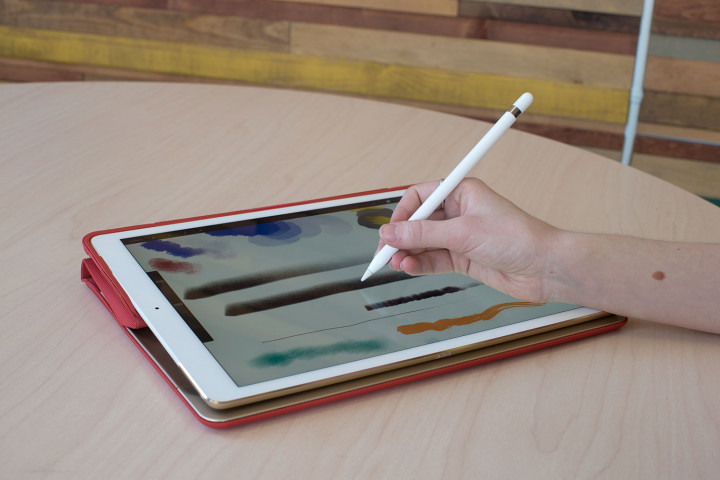
Rumors say a new Pencil stylus will accompany the new iPad Pro models upon announcement in 2017. Reports dating back to mid-2016 talk about a Pencil 2, with new annotation features that work across more iOS apps, including Mail, Messages, and Safari.
No other rumors regarding features are circulating, but several patents filed by Apple over the past year hint it may bring interchangeable virtual nibs to the Pencil 2, an eraser function on the opposite end of the stylus, and possibly Touch ID support. However, patents don’t always turn into real products or features, so don’t treat this as confirmation.
A rumor originating from the supply chain in China stated the Pencil 2 would be announced in March 2017, at the same event where the new iPad Pro models will be revealed. This failed to come true. It’s possible, if talk of a thicker iPad Pro 2 12.9-inch are correct, Apple will build a Pencil storage system into the new version of the tablet.
Apple iPad Mini 5/iPad Pro Mini
The iPad Mini 4 was revealed in September 2015, and like the iPad Air 2, it’s ready for an update. However, if an iPad Mini 5 is coming, very little is being said. There has been talk of a Pro version refresh, but it’s questionable whether there is any value in making such a device. For now, the silence may mean Apple will only refresh its larger iPad tablets in 2017, and let the Mini 4 live on for another year.
However, a February report from MacOtakara mentions a 7.9-inch iPad Pro, indicating Apple may update the tablet to fit in with an expanded Pro model lineup. The specifications, or what will define it as a Pro model, aren’t discussed.
Release date
Apple announced the new 9.7-inch iPad on March 21 2017, and confirmed the new low-cost model would replace the iPad Air 2. The tablet was revealed in a press release without a full-scale launch event. Rumors had all concentrated on a launch event happening in March or early April for the new iPad range, but such a gathering never occurred.
The only rumors outside of these concentrated on shipping dates for new iPad tablets, including the rumored 10.5-inch model. For example, a report from Digitimes indicates that the new 10.5-inch and the 12.9-inch iPads would ship in May or June. It also speculates Apple will hold an event at its newly built Apple Campus in April, where the tablet may be launched.
That’s all the news and rumors regarding the 2017 Apple iPad range so far, but we’ll be updating regularly, so check back often.
Article originally published on 01-19-2017. Updated on 05-11-2017 by Adam Ismail: Added Apple Authorized Reseller stock leak about UAG’s 10.5-inch iPad Pro case.
Artifice mimics nature as expert rock-climbing route re-created via 3D modeling
Why it matters to you
By replicating sites in detail, this technique could help make exclusive experiences more accessible for the masses.
An expert rock-climbing wall has been re-created within a gym thanks to a team of computer scientists and engineers. The gym wall isn’t exactly the same as the one found in nature but instead focuses on the rock’s key climbing features that a skilled climber would use.
“We were excited by the idea of essentially being able to transport famous routes from around the world into our own local climbing gyms,” Emily Whiting, lead author of the study and rock climbing enthusiast, told Digital Trends.
The team reconstructed the most difficult sections (“cruxes”) of two popular climbing sites: “Things As They Are Now” (TATAN) in New Hampshire and “Pilgrimage” in Utah.

Emily Whiting, et al.
The team began by taking photos of the wall to generate a 3D digital reconstruction. They then watched sample video of a climber making his ascent. By analyzing how he positioned his body, the team was able to pinpoint where the climber placed his hands and feet, while estimating the direction of his hold to determine contact regions.
By comparing the digital reconstruction with where the climber grabbed, the team was able to develop 3D models that accurately resemble the most important holds.
“The key idea is that we only replicate critical portions of the rock face that are needed for grasping or as foot holds by the climber,” Whiting explained. “We call this ‘strategic fabrication,’ as it takes advantage of the way climbers interact with the rock.”
Rock climbing is fun of course, but the technology that made the project possible may find more serious applications as well. For example, it may be used to reconstruct difficult or dangerous areas to bring archaeological sites to life. “Our system could be applied to sites that are difficult or dangerous to access, but it’s important to experience the space,” Whiting said.
The researchers are also keen to move into virtual reality to match the visual aspect to these tactile experiences.
Huawei Nova 2 could arrive later in May
New mid-ranger tipped for May 26 unveiling in China.
The Huawei Nova series landed in late 2016, bringing metal-clad designs, long battery life and dependable cameras to a price point below the premium Huawei P series. And although the Nova and Nova Plus haven’t yet reached their first birthday, it appears successors may already be on their way.

GizChina highlights a teaser for the new Nova 2 phones, with the slogan “That’s one small step for self-shooter, one giant leap for the value of the device” and a May 26 launch date. The poster also references the Nova 2 “series,” so we should be in for a one-two punch of Nova 2 and Nova 2 Plus devices, like last year.
The Nova 2 appears to have already passed through China’s TENAA, where images from the certification body reveal a metal design based on the Huawei P10, complete with dual camera setup — a first for the Nova series.
Hardware specs remain a bit of a mystery, though it’s been suggested the Nova 2 could be one of the first phones to debut Qualcomm’s new mid-range champion, the Snapdragon 660. The original Nova phones were among the first to use the Snapdragon 625, another important mid-range milestone in terms of performance and battery life.

Pair that with Huawei’s new, more palatable EMUI 5.1 interface, and you’ve got an intriguing little handset.
A Western launch for the Nova 2 series could also come earlier than expected. Huawei has scheduled a press conference for May 23 in Berlin for the launch of new “flagship” products, and given the close timing between that presser and the Chinese launch, we wouldn’t bet against seeing the Nova 2 announced for Europe.
Blue Satellite review: Wireless headphones with real power

A great addition to the Bluetooth headphone canon from a company with the color in its name.
If you’re a podcaster, Blue Microphones is a company you know, or need to know. If you’re a headphone fan, not so much. But the company has been making inroads into the lucrative over-the-ear headphone business since it launched the powered Mo-Fis back in 2014.
Now the company is moving into the wireless headphone space with its Bluetooth-powered Satellite cans, and is bringing a lot of what it learned with it along the way. Active noise cancellation? Check. A powered headphone amplifier built in? Check. Apt-X codec support? Yep. 24-hour battery life? Oh, yeah. Amazing sound quality? Yes, yes, yes.
The phones, which are available May 12 for $399 from a number of retailers, including Amazon, Best Buy, Newegg, Fry’s, Dell, and Microcenter stores, were unveiled at CES but remained elusive to the public. Blue said it was tweaking the hardware and ensuring the ANC was up to par, and I’m glad it put in the extra time because these things sound great — with a couple small caveats.

Let’s start with the basics: these are big, over-the-ear headphones built mainly from rigid plastic, with small amounts of aluminum peppered throughout. The mesh headband and leather cups provide adequate comfort for long periods of listening — much more so than previous Blue headphones I’ve used — and despite their size, the Satellites don’t feel heavy or burdensome.
Because they are wireless, the Satellites have all of the important toggles on the outside of the phones themselves: on the left bottom is a small power toggle and Micro-USB charging port; on the left cup are toggles for Bluetooth pairing, Active Noise Cancellation and the powered amplifier; and on the right are the play/pause and volume up and down buttons. These are sensibly located, and after a few days with the Satellites I was able to “touch” activate the various modes, though if you’re not wearing them you can see a helpful white LED pulse flashing momentarily after pressing a button, which is a nice touch.

You’ll be pressing those buttons a fair amount, too, if you’re a traveler or an audiophile — or both. First, let’s talk about the included amplifier; this is one of Blue’s signatures, and it essentially bypasses the source’s built-in amplifier, be it a phone or laptop or dedicated music player, for something that is likely more powerful. I say likely more, because while the 280mW amp is likely more powerful than your phone’s powering these headphones, some audiophile devices, like the LG V20 or HTC 10, may sound fuller without the additional power. And the amplifier cuts down the battery by two-thirds, so it’s better if you leave it off.
These are some of the warmest, most inviting wireless headphones I’ve used to date.
The Active Noise Cancelling is slightly more forgiving on the battery, but you’ll likely only need it in bursts. The headphones themselves sound incredibly full and lush, thanks to the two 44mm drivers inside the cans, but Blue attempts to justify the headphones’ $400 price by utilizing separate 30mm drivers for the ANC, which is, to my knowledge, unprecedented in this category. That accomplishes two things: it doesn’t “paste over” the existing audio feed by using the same drivers; and it allows the ANC to operate independently, which improves the overall effectiveness. In practice, I didn’t find the noise cancellation to be that much better than my current go-to ANC headphones, the Phiaton BT220 NC, but I have also yet to take them on a noisy airplane, and will update this review when I do.

Now let’s get to the most important part, the sound. Though when connected to Bluetooth (the Satellites support the Apt-X codec, if you’re interested) there is a slightly audible noise floor, once the music begins these are some of the warmest, most inviting wireless headphones I’ve used to date.
They’re more accurate than the Bose QC35s, though not quite as boomy, and don’t sound as accurate as the Sennheiser Momentum 2s, but they’re certainly up there with some of the top choices in their class, especially with the amplifier turned on.
I do have a few gripes about the Satellites: they have no auto-off function, so for the many times when you take them off your head and inevitably forget to hold down the power button for three seconds to turn them off, you’re going to come back to a pair of dead cans the next day. No big deal, but just something to keep in mind. As is the fact that the Satellites charge via Micro-USB, which isn’t ideal in an office where I am trying to go all-in on USB-C.
Despite their size, the Satellites don’t feel heavy or burdensome.
Finally — and this is my biggest issue — the Satellites will automatically connect to the last source it paired with, and will not allow another source to take it over. There is no grace period when turning them on either, like on most other Bluetooth headphones I’ve used, which means you actually have to disconnect them, or turn off the previous source, before pairing with a new one. Because I often go between my phone and my laptop, having to explicitly disconnect the one before engaging the other has proven immensely frustrating.
Foldable and easily stowed, the Satellites are Blue’s best headphones to date, and aside from the small gripes, my favorite portable Bluetooth experience, too. At $399.99, they’re on the same level as flagship headphones from Bose, Sony and Sennheiser, but I think they stand their ground.
See at Amazon
Xiaomi kicks off retail push in India with its first Mi Home store
You no longer need to wait for flash sales to buy Xiaomi phones.
After selling its phones online for three years, Xiaomi has set up its first Mi Home in India. With the brand gaining momentum in the country, launching an offline store gives it a new platform to sell its devices.

The manufacturer has ambitious plans for its retail push into the country. Over the next two years, Xiaomi intends to launch over 100 Mi Home stores across India. The move certainly makes sense. Even though online retail has grown by a significant amount in recent years, the offline market still accounts for a bulk of the sales.
By going offline, Xiaomi will be able to market its wares more effectively, and to a wider audience. Xiaomi isn’t gunning after the likes of Samsung or Vivo in this segment. Although the Chinese manufacturer is one of the largest when it comes to online retail, it doesn’t have the resources to go head-to-head in the retail space.
Instead, it will focus its energies on what it does best: carve out a niche for itself and build a loyal customer base. This is what made the brand so alluring to millions of users in the country back when it made its debut in 2014, and the same strategy is being used for its offline stores. The fact that its handsets offer great value for money doesn’t hurt either.

Xiaomi will be selling accessories, its VR headset, power banks, fitness bands, air purifiers, and phones — the Redmi Note 4, Redmi 4A, Mi 5, and Mi Max — at the store. The main allure with the Mi Home is that there’s no waiting involved — customers will be able to walk into the store and get their hands on a device. There’s also the option of pre-booking a phone online and picking it up from the Mi Home.
The Mi Home in Bangalore is located in Phoenix Marketcity, a high-end mall located on the outskirts of the city. The store will be open to customers starting May 20 at 9 a.m.
There isn’t a timeline for when Xiaomi will launch stores in other cities, but the next four Mi Home stores will be coming to Delhi, Mumbai, Hyderabad, and Chennai.
LG to make Google Pixel 3 is ‘pure speculation’ at present
Even though the 2017 versions of Google Pixel phones are yet to be revealed, even confirmed, there has been plenty of speculation flying around that the company has chosen LG to make their 2018 replacements.
The Google Pixel 3, it is said, will be made by LG.
However, LG itself as dismissed those reports as poppycock, saying that any such idea is “pure speculation”.
The current Google Pixel and Google Pixel XL were released at the end of 2016 and are still widely regarded as amongst the best Android phones out there. They are manufactured by HTC, which is also tipped as making the next generation models – Google Pixel 2, for want of a better name.
- Google Pixel and Pixel XL tips and tricks: Getting to grips with Google’s phone
LG was cited by a Korean news source Chosun Biz as getting the contract next though. It does have some element of believability considering LG has made Nexus handsets in the past – namely, the Nexus 4, Nexus 5 and Nexus 5X. But it’s far too early for this kind of rumour to be popping up.
Even if LG and Google have entered into an agreement, it will be a considerable while before either is willing to talk about it.
Instead, let’s look forward to the Google Pixel 2. It’s not likely to be ready for public consumption until the second half of 2017 but we do have a wish list of what we’d like to see from it. You can check that out here: Google Pixel 2: What do we want to see?
 AIVAnet