


May security patch rolls out to the Galaxy S8 and S8+ in India
May 2017 security patch is now live for the Galaxy S8 in India.
Samsung has started rolling out the May 1, 2017 security patch to the Galaxy S8 and S8+ in India. The update comes in at 613.25MB, and aside from the May security patch, there doesn’t seem to be anything else that’s new (at least from a user-facing standpoint).

The changelog details the usual stability fixes, “enhanced features”, and performance improvements. The build increments the version number to G950FXXU1AQE5 on the Galaxy S8 and G955FXXU1AQE5 on the S8+.
If you’re using either phone in India and don’t see the OTA update yet, head to Settings > Software update >Download updates manually to initiate the download. As the update is over 600MB in size, make sure you’re on a Wi-Fi network before starting the download.
Notice anything new? Let us know in the comments.
Samsung Galaxy S8 and S8+
- Galaxy S8 and S8+ review!
- Galaxy S8 and S8+ specs
- Everything you need to know about the Galaxy S8’s cameras
- Get to know Samsung Bixby
- Join our Galaxy S8 forums
Verizon
AT&T
T-Mobile
Sprint
Automatic screenshots are the latest Nintendo Switch problem. Do you have it?
The Nintendo Switch is without doubt a fantastic console and has helped to revive Nintendo after the failings of the Wii U. But, like other games consoles, it’s not without its faults and the most recent one that some users have encountered, is the Switch taking several screenshots automatically.
- Nintendo Switch: Price, specs and everything you need to know
It’s not a major problem by any stretch, but it’s something that shouldn’t be happening. The console will take screenshots every second or so, without users pressing the screenshot button. Some have even noticed the console will wake itself up to take some, too.
The majority of users that have come across the issue have also installed Minecraft: Nintendo Switch Edition, so the thinking is the game is causing the problem. However the game hasn’t been running in some cases and screenshots are still being taken. In this video livestream of the game, you can see “Capture taken” appearing in the top left of the screen.
Nintendo has yet to comment on the issue or release an official update to fix the issue, although software version 2.30 has just been released and includes “general system stability improvements to enhance the user’s experience”.
- Got the Nintendo Switch dead pixel issue? Here are your consumer rights
It’s the same line the games company uses for a lot of its software updates, so it’s not clear if this will solve the problem, as it may just be coincidental timing. It’s not the first time the Switch has encountered problems, as some users reported dead pixels on the screen.
Philips Hue expands White Ambience range with three new smart lamps
Philips has expanded its Hue range of smart lighting with three new smart lighting fixtures: two table lamps and a ceiling light fixture.
- What Philips Hue smart bulbs are there and which should you buy?
The three new lamps: Wellner and Wellness table lamps, and the Being Flushmount, are part of the White Ambience range. This means you have 50,000 different levels of white light to choose from. Rather than just being a dimmable lamp, Philips says you can change the temperature of the white light to suit different moods. It could be you want bright, intense light in the morning to help wake you up, and relaxing, cool lighting in the evenings when you’re winding down from a day at work.
Philips
You can already buy White Ambience bulbs to fit your existing light fittings, as well as some ceiling-mounted pendants, spotlights and table lamps, but the new smart laps usher in new designs that will ultimately add more style to your room.
The Wellner and Wellness table lamps work with the White Ambience A19 bulb which uses an E27 screw fitting, while the Being Flushmount has an integrated LED strip that can output up to 2,400 lumens.
- Hive takes on Philips Hue with colour changing light bulbs
You can buy the Philips Hue Wellness table lamp from Amazon for £99.99, or the Being Flushmount for £119.99. The Wellner tablet lamp is available from John Lewis for £120.
The Morning After: Tuesday, May 16th 2017
Hey, good morning! You look fabulous.
Squeezable smartphones, perhaps our first look at the glass-backed, iPhone 8 (don’t worry, unrelated), and the death of the graphing calculator? All this, and we’re only on Tuesday morning. Oh, and Toyota is musing on flying cars.
But can it play Drug Wars?Desmos app could kill off the graphing calculator

Overpaying for graphing calculators has been a rite of passage for as long as any millennials can remember, but the reign of the TI-84 may be coming to an end. That’s because of a new online calculator called Desmos that can run on any connected device and provide similar features. There are other internet-based calculators, but this one is embedded in the test itself and has backing from SAT administrator The College Board.
Squeezy phone.HTC’s squeezable U11 is its true 2017 flagship phone

After releasing the U Ultra, HTC is again attempting a top of the line smartphone with the U11. The specs behind its 5.5-inch curved Gorilla Glass display are just on par with other flagship devices, but the standout gimmick here is Edge Sense. Side-mounted pressure sensors can detect varying levels of grip and respond with associated shortcuts or app actions. Also, it can run up to three virtual assistants at once, with support for Google Assistant, Alexa and HTC’s own Sense Assistant. Finally, it loses the headphone jack but includes USB-C connected headphones that handle customized audio, as well as noise-canceling that runs off of the phone’s battery.
It’s the Shazam of foodThe ridiculous Not Hotdog app from ‘Silicon Valley’ is real

These days it’s even more difficult to tell parody apps from the real ones.
Android in autoVolvo and Audi are building Android into their new cars

Ahead of the Google I/O event later this week, Volvo and Audi have announced plans to base their next-generation infotainment systems on Android. There aren’t a lot of details yet, but the partnership promises support for Google Assistant, Google Maps and Android apps like Spotify running directly on the car’s hardware without requiring an Android Auto hand-holding from your phone.
ExclusiveiPhone 8 renders point to glass back and wireless charging

A reliable source in the accessory industry has told us that these renders represent Apple’s iPhone 8. If they hold up, they point to a new vertical orientation for the dual-camera setup, with the microphone and flash integrated into the camera hump. They also suggest that the dual-camera and wireless charging will be a standard feature, but we’ll have to wait until this fall to find out for sure — and to see the rumored tenth anniversary iPhone.
Meet the ‘Skydrive’Toyota wants flying cars in time for the 2020 Olympics

Larry Page isn’t the only one with a thing for flying cars — Toyota is backing a small startup working on a drone-like vehicle. The Skydrive from Cartivator would lift about 33 feet off of the ground and scoot along at up to 62mph. The plan is to have commercial versions ready ahead of the 2020 Olympic Games in Tokyo. That seems optimistic, but it could provide one more reason to snag a ticket now instead of waiting.
But wait, there’s more…
- Implanted pancreatic cells could cure diabetes
- Plenty of blame to go around: The ‘WannaCry’ ransomware is a stark reminder of a broken system
- What’s on TV this week: ‘Phantom Dust’ remastered, ‘Twin Peaks,’ ‘Kimmy Schmidt’ and ‘Injustice 2’
- United flight crew inadvertently shares cockpit door codes online
- Engadget Podcast Ep 39: Rip Off
- Motorola’s leaked 2017 phone lineup points to the return of the Moto X
The Morning After is a new daily newsletter from Engadget designed to help you fight off FOMO. Who knows what you’ll miss if you don’t subscribe.
NHS gave DeepMind patient records on an ‘inappropriate legal basis’
A data-sharing deal between DeepMind and London’s Royal Free Hospital Trust was struck on an “inappropriate legal basis,” a top UK government advisor has said. In April 2016, NewScientist revealed that the company had received 1.6 million patient records to develop an app called “Streams.” While there are strict rules regarding patient data and confidentiality, common law states that consent is “implied” if the information is being used for “direct care.” Google’s AI division used this line of thinking to justify the deal, however Dame Fiona Caldicott, the UK’s National Data Guardian, disagrees because the app was still in testing at the time.
If the app was in development, that means it wasn’t yet ready for medical use. Testing, Caldicott argues, is different from “direct care,” and nullifies the argument that the company had “implied consent” from patients. In a letter to Professor Stephen Powis, medical director at the Royal Free Hospital, Caldicott said: “Given that Streams was going through testing and therefore could not be relied upon for patient care, any role the application might have played in supporting the provision of direct care would have been limited and secondary to the purpose of the data transfer.”
Full copies of National Data Guardian’s letter sent to @SkyNews warning of legal basis re: @DeepMindAI + 1.6 million NHS patients’ data. pic.twitter.com/QjLRDGs1xr
— Alexander J. Martin (@lexanderjmartin) May 15, 2017
The letter, obtained by Sky News, was sent by Caldicott in February. She passed the same conclusions along to the Information Commissioner’s Office (ICO), who is currently investigating the deal. In March, the data protection watchdog said it was “close” to publishing its findings, which could dramatically affect how the UK’s National Health Service (NHS) works with technology companies like DeepMind in the future. As Bloomberg reports, the ICO has the power to fine the hospital and impose other sanctions should it believe the original data transfer was illegal.
Streams is an “instant alert app” that quickly reviews test results and looks for serious problems, such as acute kidney injury. If anything is found, doctors are alerted immediately so that further diagnosis and, potentially, life-saving treatment can be carried out efficiently. Caldicott does not dispute the app’s effectiveness or the use of technology to improve healthcare. The legal basis for mining patient data, however, needs to be done in a “transparent and secure manner,” she says, otherwise public trust and the opportunities for discussion and further development will vanish.
NewScientist’s original article, sourced from a Freedom of Information (FOI) request, triggered some public outcry from the academic community. One study concluded that DeepMind and the NHS had made “inexcusable” mistakes, and that the ICO’s case should be treated as a “cautionary tale” for future technology and healthcare partnerships. The backlash caused the AI company to temporarily suspend Streams’ use in hospitals. A new data-sharing agreement was drawn up last November, alongside confirmation that the app had been registered as a medical device with the Medicines and Healthcare Products Regulatory Agency (MHRA). It’s now been rolled out widely across Royal Free’s hospitals in London.
DeepMind has so far defended its actions. A spokesperson told The Register: “Nurses and doctors have told us that Streams is already speeding up urgent care at the Royal Free and saving hours every day. The data used to provide the app has always been strictly controlled by the Royal Free and has never been used for commercial purposes or combined with Google products, services or ads – and never will be. Clinicians at the Royal Free put patient safety first by testing Streams with the full set of data before using it to treat patients. Safety testing is essential across the NHS, and no hospital would turn a new service live without testing it first.”
Health data privacy group medConfidential takes a different view, however: “This response by Google shows that DeepMind has learnt nothing. There may well be lawful reasons for third party IT providers to process data for direct care for 1.6 million patients – unfortunately for Google’s AI division, developing an app is not one of them.”
Source: Sky News
Third-Party Apps Will Need App-Specific Passwords for iCloud Access From June 15
App-specific passwords are set to become a mandatory requirement for third-party apps that access iCloud user data, according to an Apple Support email sent out today.
Currently, app-specific passwords are used to allow non-native apps like email clients to sign in to iCloud accounts that are protected by two-factor authentication. The security measure ensures that users can still link up their iCloud account to apps and services not provided by Apple, while also avoiding the need to disclose their Apple ID password to third parties.
However, app-specific passwords will become a basic requirement from June 15, according to Apple. The policy change basically means that users who want to continue using third-party apps with their iCloud account will have to enable two-factor authentication and generate individual passwords for each app.
Beginning on 15 June, app-specific passwords will be required to access your iCloud data using third-party apps such as Microsoft Outlook, Mozilla Thunderbird, or other mail, contacts and calendar services not provided by Apple.
If you are already signed in to a third-party app using your primary Apple ID password, you will be signed out automatically when this change takes effect. You will need to generate an app-specific password and sign in again.
Two-factor authentication ensures that you’re the only person who can access your Apple account, even if someone knows your password. To turn it on from any iOS device running iOS 10.3 or later, open the Settings app, tap your name at the top, and then tap Password & Security.
If you’re using iOS 10.2 or earlier, you can enable it from Settings -> iCloud -> Apple ID -> Password & Security. If you’re on a Mac, go to System Preferences -> iCloud -> Account Details, click Security, and enable two-factor authentication from there.
To generate an app-specific password, sign into your Apple ID account page (https://appleid.apple.com), go to App-Specific Passwords under Security, and click Generate Password.
Tags: iCloud, Apple security
Discuss this article in our forums
HTC U 11 hands-on: HTC’s true 2017 flaghsip
As we near the halfway point of the year, we’re about to enter that lull period in the mobile industry where flagship announcements are few and far between. In previous years, Taiwan-based HTC has been consistent about introducing its flagship phone earlier in the year, usually during Mobile World Congress, but this year they’ve opted to do something different – by announcing a pair of phones shortly after CES, with neither of them being considered as flagships by the company.
See also:
HTC 10 revisited: one year later
6 days ago
The HTC U Ultra and U Play introduced a totally new design language and user experience to consumers, a radical departure from HTC’s track record in years past. While that history proved popular with reviewers and tech aficionados, it didn’t exactly translate into mass market appeal. Hence the changes HTC introduced this year.
While the U Ultra and U Play don’t yet seem to have made a huge difference to HTC’s mainstream popularity, the question remained: could HTC’s true 2017 flagship turn things around? Now that they’ve seen what the competition has done, HTC is the last of the bunch to take the wraps off its latest hero device, the HTC U 11, which as its model number indicates, is the 11th flagship in HTC’s history, but one that contains much of the new U series’ DNA as well.

Expectations are undeniably riding high with this one, especially given what we’ve seen thus far. Can the HTC U 11 remain relevant against the best of 2017’s flagship devices? Does it have the necessary wow factor it will need to stand out against the best from Samsung and LG?
Expectations are undeniably riding high with this one, but can the HTC U 11 remain relevant?
Looking at the HTC U 11, there’s no denying the new direction HTC has planned for its devices, opting to once again leverage the same all-glass construction and unibody aluminum band introduced by the HTC U Ultra and Play. Available in four colors – ice white, amazing silver, brilliant black, and sapphire blue (with a special fire engine red version in select markets) – the HTC U 11’s mirror-esque finish adds a nice luster to the phone, but just as before, the glass finish becomes a real magnet for fingerprints.

This “liquid surface” design language replaces the storied tradition of HTC utilizing primarily metal bodies for its flagships. Some might not be pleased about this direction, but it’s nonetheless something new and different to help establish HTC’s new identity. The HTC U 11 has symmetrical 3D glass on front and back and if you liked the look of the U Ultra or U Play, you’ll love the U 11.
The HTC U 11 has an IP67 rating, something that the previous U devices lacked.
If you were a little anxious about just how big this phone would be, you’ll be pleased to know the HTC U 11 almost matches the HTC U Play’s overall size, making it far more manageable to hold in one hand than the U Ultra.
In addition to that, the HTC U 11’s construction has an IP67 rating, something that the previous “U” devices lacked, so to that degree, it at least matches some of its main flagship rivals for dust and water resistance.

And after so much flak about all the dead space in the HTC U Ultra, the HTC U 11 also forgoes the 3.5mm headphone jack – choosing instead to rely on the USB Type-C connection and the new HTC USonic earbuds that’ll come bundled with the phone. Sure, it’s a small consolation, but this new version features active noise cancellation courtesy of the HTC U 11’s audio processing and an additional mic in the ear buds. There’s also one touch calibration for fine-tuning your audio profile.
The HTC U 11 also forgoes the 3.5mm headphone jack…
Other audio-centric features of the HTC U 11 include 3D audio recording with its four “omni-directional, high sensitivity” microphones. The U 11 comes with HTC BoomSound Hi-Fi edition speakers, which leverage both the speaker on the bottom edge of the phone as well as the earpiece.

The U 11’s speakers channel audio through the whole phone, turning the entire thing into a speaker. Impressively enough, you can cover either speaker without the typical drop in volume. There’s also a USB-Type C to 3.5 mm headphone adapter in the box and a “performance grade” DAC to keep audiophiles happy.
When it comes to all-glass constructions, this “liquid” glass design language is still a step up over the LG G6, even more so thanks to the way its curved edges and tapers make it more comfortable to grasp. But we wouldn’t go so far as to proclaim that the HTC U 11 is better looking than the Galaxy S8.
Some changes are positive – the camera lens is now more flush to the surface and the HTC U 11 certainly has the kind of looks that attract curious eyes – but the question remains of how much substance lies beneath the surface. For example, the Galaxy S8 looks just as good, if not better than the U 11, and arguably offers a lot more.

Let’s get back to the hardware for a minute. Part of the reason for the HTC U 11’s more manageable size is because of its screen: an “in-betweener” 5.5-inch Quad HD (2,560 x 1,440) Super LCD 5 display with Gorilla Glass 5. We can’t complain about the resolution and size, given then it’s more than ample for VR purposes with a pixel density count of 539 ppi.
Saturation and contrast look good, but we’ll have to put the screen through our display testing in the full review before we make any definitive judgments. Super LCD technology has always been superior with outdoor visibility under direct sunlight though, so it’s reassuring that the same is found here with the HTC U 11.

Slapped with the flagship moniker, the HTC U 11 is powered by a Qualcomm Snapdragon 835 SoC, the latest and greatest from the chip maker. That’s certainly a sigh of relief and effectively ensures its flagship status, but the US variant of the phone will only be available with 4 GB of RAM and 64 GB of internal storage with microSD expansion.
The Qualcomm Snapdragon 835 SoC ensures the U 11’s flagship status, but the US will only get 4 GB of RAM.
What’s interesting, though, is that an additional version for the international market will offer 6 GB of RAM and 128 GB of storage. We didn’t see any hiccups with the 4 GB model in our short time checking it out, but again, we’ll need to put it through its paces in the full review to see how it stacks up against the best devices of 2017.

Of course, the headline feature for the HTC U 11 is what the company is calling Edge Sense. Expanding upon its new HTC Sense Companion experience and HTC Sense on top of Android 7.1 Nougat, HTC Edge Sense offers quick access to certain functions….by merely squeezing on the sides of the phone with your hand.
The headline feature for the HTC U 11 is what the company is calling Edge Sense, or squeezable shortcuts.
Yes, you read that correctly! Essentially, the HTC U 11 is capable of analyzing two kinds of squeezes, short and long, which are fully programmable and allow for things such as turning on the flash, launching the camera, taking a selfie, and much more.

It’s ultimately just a new form of shortcutting, which is something we’ve seen countless times before (think BlackBerry’s convenience key, Android Nougat’s launcher shortcuts or double pressing the power button to launch the camera). But Edge Sense is a familiar idea implemented in a very novel way.
While it’s easy to pass off as a gimmick, there’s still some practicality in it. Take the example of trying to take a photo underwater: touch screens don’t work underwater, but on the HTC U 11 you can launch the camera with a single squeeze and then shoot a photo with a long squeeze. Or perhaps you want to turn on the flashlight in the frigid winter when it’s too cold to pull your gloves off.
See also:
HTC U Ultra review
March 24, 2017
The best part is that it’s fully customizable and entirely optional, so you can tweak it exactly the way you like or completely ignore it, the choice is yours. Sense Companion, Google Assistant (and eventually Amazon Alexa) are programmable and you can add two shortcuts to any app: this is definitely cool. We were even told additional functionality might be added at a later date. There are definitely some solid use cases for Edge Sense, but we wouldn’t say it’s a game changer in any capacity.

Moving onto the cameras, there’s a 12 MP “UltraPixel” camera in the rear, which features 1.4μm pixels, “UltraSpeed” auto focus, OIS, dual-LED flash, and an f/1.7 aperture lens. Even though it’s difficult to gauge its performance and quality right now, HTC assures us that it’s going to be near or at the top of many benchmark tests. Complementing that is a beefy 16 MP front-facing camera with a BSI sensor, f/2.0 aperture and HDR Boost mode (which is essentially always-on instant HDR with no lag).
Knowing what HTC has brought to the table, is it enough to compete against the current lineup of flagships? Being the last to announce its first-half flagship, HTC had ample time to organize and develop its flagship phone to make it a formidable one. At the current moment, it’s honestly going to hinge on one key factor; pricing.

At launch, it looks like Sprint will be the only US carrier to sell the HTC U 11, which has a price of roughly $700 attached to it. That’s right there with the rest of the pack, but HTC is sweetening the deal by giving away two Amazon Echo Dots if you pre order right now from Sprint. Unlocked versions of the phone will be available through HTC and Amazon’s web sites.

The pricing is more justified than the HTC U Ultra, but it still has some stiff competition. If it proves to be superior in key areas like battery life, performance, and camera, it can absolutely bring HTC back into the spotlight.
Read next: HTC U11 specs, features, and availability details
HTC U11 Our First Take
The HTC U11 is mesmerizing to look at, but lacks a true standout feature.
HTC, once a king in the smartphone market, kicked off 2017 with an all new design with the U series in hopes to rejuvenate interest in its smartphones. Gone are the all-metal design and chamfered edges; glass is the new sexy.
The U Ultra and the U Play didn’t take off earlier this year, though their mixed-to-poor reviews didn’t help. Thankfully, neither of those phones are the true flagships of the U series. That’s where the U11 comes in. It’s the successor to the well-reviewed HTC 10, and it has a lot riding on its shoulders.
We’ve spent some brief time with the new phone, which was just announced at an HTC event in Taipei, Taiwan. The U11 checks off all the boxes, but even with its gorgeous design, it doesn’t feel as exciting as some of its competitors.
Let’s take a look at how it stacks up against competition like the Samsung Galaxy S8 and LG’s G6.
Stunning glass design
We can’t complain too much about HTC’s new liquid glass design strategy. It’s unique, and makes the U11 stand out, partly because it’s so shiny. The U11 is the most beautiful smartphone we’ve seen.
The color shimmers under a coating of Gorilla Glass, and changes as you tilt it, thanks to the mirrored coating on the back — a process HTC calls “optical spectrum hybrid deposition.” Naturally, with such a smooth, shiny back, the phone does attract a lot of fingerprints — keep a microfiber cloth handy. This is the same problem other glass devices like the Galaxy S8 have.
It’s the most beautiful smartphone we’ve seen.
The HTC U11 feels incredibly smooth in the hand, like a pebble — similar to how we felt holding the Galaxy S8. All the edges on the rear have smooth curves, and the transition from glass to metal is seamless.
But what about the front of the phone? Sadly, HTC hasn’t followed Samsung and LG’s suit in minimizing edges. There is a lot of space (bezels) around the screen on the top and bottom of the display, similar to the Google Pixel. It looks dated, and we wish HTC had made the front look more interesting. The company told us it’s happy with the 5.5-inch frame and wanted to keep the 16:9 aspect ratio, as opposed to the 18:9 aspect ratio on the G6 and the S8.
So what use do those large front edges serve? Like an iPhone, the bottom of the phone has a fingerprint sensor that doubles as a home button. Unlike the iPhone, it’s flanked on both sides by capacitive (touch) Android navigation buttons. On the top, you’ll find a selfie camera.
The 5.5-inch LCD screen — protected by Gorilla Glass 5 — packs a resolution of 2,560 x 1,440 pixels, which is fantastic, and standard for a high-end phone. It’s bright and colorful, and we’ll have to do more testing to see how it measures up against the competition. Sadly, it doesn’t look like Google’s Daydream virtual reality platform will be supported, because the screen doesn’t utilize AMOLED technology. Very few phones do.
 Jeffrey Van Camp/Digital Trends
 Jeffrey Van Camp/Digital Trends
 Jeffrey Van Camp/Digital Trends
 Jeffrey Van Camp/Digital Trends
The volume rocker sits above the power button on the right, and a USB Type-C charging port is on the bottom edge of the U11. Next to it is a single speaker port — the other is at the top earpiece to provide hi-res stereo sound.
The U11 is available in blue, black, white, and silver, though the white color is not coming to the United States. Our favorite: blue. It really shows off what’s possible in smartphone design; we had a tough time not staring at it for awkwardly long periods of time. The HTC U11’s coloring and reflectiveness is mezmerizing.
High-end specs
The HTC U11 has all the processing power you expect to see in an expensive smartphone. It’s powered by Qualcomm’s fancy new Snapdragon 835 processor, like the Galaxy S8.
It has 4GB of RAM, which should be plenty for anything you need to do, and comes with 64GB of internal storage. There’s a 6GB RAM and 128GB storage variant, though it looks like it will only be available in select countries. The U11 also has a MicroSD card slot, in case you needed to upgrade your storage.
The HTC U11 has all the processing power you expect in a flagship smartphone.
Performance seemed great in our limited testing — we didn’t notice any lag, stuttering, or hiccups. We’ll do more in-depth testing when we receive a review unit.
There’s no Bluetooth 5, which is sad since it offers much improved range and faster data speeds. Currently, the only major flagship with Bluetooth 5 is the Galaxy S8. It does have Bluetooth 4.2, which was the previous standard.
The rear 12-megapixel camera supports Optical Image Stabilization, and it has 1.4 micrometer pixels, which allows for better low-light performance. The selfie camera is packed with 16-megapixels, though more megapixels doesn’t mean it’s better. We’ll report back after testing it.
The HTC U11 is IP67-rated, like the iPhone 7, meaning you can submerge it in 1 meter of water for 30 minutes.
The U11 has a 3,000mAh battery, which HTC said should last a day. We’re expecting it to last a little less than that, considering it’s powering a high-resolution display, but we’ll have to wait and see.
Clean user interface, neat features like Edge Sense
The U11 runs Google’s Android 7.1.1 operating system, with the company’s Sense user interface. It’s not too far from standard Android, with a few HTC-specific features like BlinkFeed — a feed built into the home screen that provides personalized news, and the Sense Companion that debuted on the U Ultra that gives recommendations on nearby restaurants, and does a few other small things.
Sense Companion is HTC’s artificial intelligence assistant, and it’s meant to offer pop-up notifications based on where you are and the time of day. Sadly, not much has improved since its debut. It’s still lacking integrations with a lot of third-party services.
But the star of the show is Edge Sense. Around the aluminum unibody construction on the frame, HTC has added mechanical sensors that can sense pressure. This lets you squeeze the phone to trigger specific actions. It’s more or less the same as Convenience Key on the BlackBerry KeyOne, except the goal here is to experiment with a buttonless design.
Nigel Newby-House, associate vice president of Portfolio Planning, told Digital Trends that Edge Sense brings us closer to buttonless phones. If people can get used to the simple short- and long-press features of the U11, the feature could then greatly expand to future devices.

Jeffrey Van Camp/Digital Trends
“The future could see this extended to other places on the phone,” he said.
Edge Sense is genuinely useful. There’s a wide variety of actions you can trigger, such as turning off Wi-Fi, launching an app, or turning on the camera. In specific apps like the camera, you can squeeze the phone to capture a photo, eliminating the need to press any buttons. In the HTC messaging app, you can squeeze the phone to trigger voice input, in case you don’t want to type.
It’s not a gimmicky feature, and Edge Sense is a good stepping stone for a future device devoid of buttons. We’ll have to see if we accidentally trigger actions by handling the phone, but we do know that you can choose the level of sensitivity.
The U11 also has four microphones, like the U Ultra. One is always-on, and it determines which microphones to turn on or off, depending on where you are situated. HTC said this is great for voice interactions, like with Google Assistant. Amazon’s Alexa is also available, though only in the U.S., U.K., and Germany.
Availability and pricing
HTC has yet to announce price and availability, but we expect the U11 to match the $650 price tag of most flagships.
The HTC U11 offers great performance, a potentially solid camera, and neat software features like Edge Sense. It’s also waterproof and looks great. It’s missing a truly exciting new feature, though. That may mean it’s a good upgrade if you need a device, but not worth the upgrade if your phone works fine. We’ll have to test it more to see how our final thoughts line up.
Highs
- Gorgeous rear design
- Powerful processor
- Edge Sense seems useful
- Waterproof
- Alexa and Google Assistant support
Lows
- Thick edges around the front screen
- Fingerprint magnet
- Brittle, glass design
Why Motorola bringing Lenovo’s laptop strategy to smartphones is not the right move
New models in the C, E, G, X, and Z series will confound potential customers.
Motorola has a clearly-defined strategy for its smartphones: the Moto E series is aimed at the entry-level segment, the Moto G lineup is catered to the budget category, and the Moto X and Z phones traditionally serve the mid-range and high-end segments. However, a recent leak suggests that the company is getting ready to significantly expand its smartphone lineup in 2017.
The list includes the mid-range Moto Z2 Play and high-end Z2 Force with Moto Mods support, a mid-range Moto X with a Full HD display and so-called SmartCam, new entrants in the Moto E series, and the introduction of an “Ultimate Essentials” Moto C series that starts at €89.
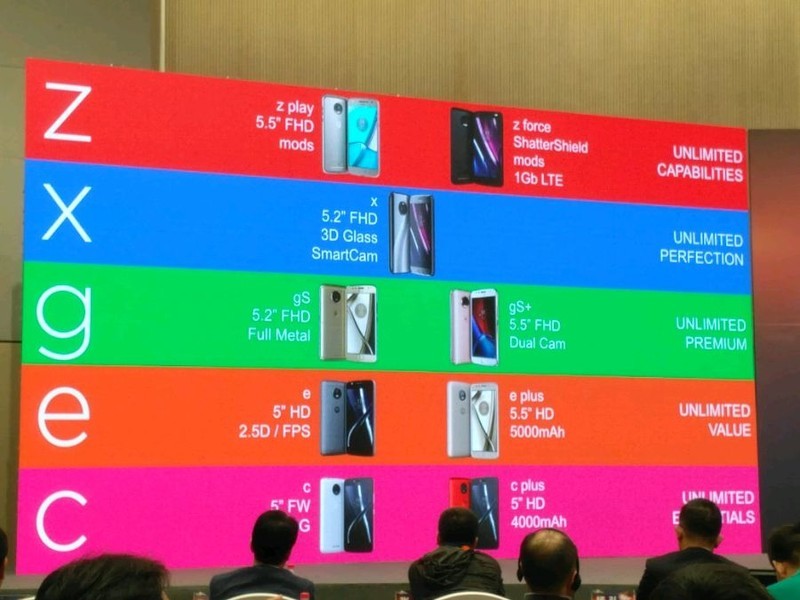
Inexplicably, it looks like Motorola is getting ready to launch a refreshed variant of the Moto G5 with dual rear cameras. The Moto G5 Plus made its debut back in March, with the 12MP imaging sensor being one of its main highlights. The leak suggests Motorola is increasing the screen sizes — the Moto GS will come with a 5.2-inch panel (up from a 5-inch panel on the Moto G5), and the GS+ will allegedly feature a 5.5-inch screen (up from 5.2 inches).
According to the leak, Motorola will release no fewer than nine phones later this year, which will lead to a crowded lineup. We’ve already seen that to a certain extent last year in Asian markets with the Moto M and Moto G, which were positioned in the same segment. The only differentiator with the Moto M was the metal chassis, and although a successor to the Moto M wasn’t detailed in the leak above, it is possible we’ll hear more about the device at a later date. It’s also odd that there doesn’t appear to be a regular Moto Z in the lineup — the Moto Mods functionality will be limited to the Moto Z2 Play (which may be a downgrade over the first) and the more expensive Moto Z2 Force.
With nine new models on the horizon, Motorola will face a tough time of rolling out quick updates.
Lenovo has a habit of rolling out devices aimed at a particular niche — we’ve seen that over the last two years with the Vibe C, the Vibe X, Vibe S, and the Vibe P. Motorola is now following in its parent company’s footsteps, and the reasoning for that may come down to Lenovo’s newfound strategy for the smartphone segment. It’s possible the company will find cost savings by sharing components and designs throughout its varied product range, though, but to most consumers this will be confusing.
After toying with the “Moto by Lenovo” branding last year, Lenovo is now leveraging the Motorola brand more effectively in global markets. The manufacturer revealed earlier this year that although it would continue a dual-brand strategy, Motorola’s brand name would take precedence in markets like India, where the manufacturer sells phones under both labels.
The move makes sense from Lenovo’s standpoint — with the company scaling back its own offerings, the onus is now on Motorola to roll out new phones to fill that void. Judging by the positioning of the new Moto E and Moto C series, that’s exactly what Motorola is doing.
The Moto C is now official, offering a 5-inch FWVGA display, quad-core CPU, 1GB of RAM, 8GB storage, 5MP camera, 2MP front shooter, 3G, and 2350mAh battery for €89. There’s a Moto C Plus with a larger screen and 4000mAh battery along with 1GB of RAM and 16GB storage that will retail for €119. The Moto E refresh for 2017 is likely to retail for $150, adding a fingerprint sensor and beefier specs.
By introducing several new models at once, Motorola is making it harder for itself when it comes to rolling out updates. The company isn’t as quick as it used to be at delivering software updates, and in the case of a few phones like the Moto G 2015 and Moto E3 Power, the company decided not to offer an update at all. By introducing at least nine new models this year, Motorola will be significantly taxing its engineering resources as it tries to keep its portfolio of devices up to date.
What’s your take on Motorola’s revised smartphone strategy? Let us know in the comments below.
HTC U11 is official: Snapdragon 835, UltraPixel 3 camera, Edge Sense squeeze input!

HTC’s 2017 flagship will be available unlocked in the U.S., and sold exclusively via launch carrier partner Sprint in the U.S.
HTC has hosted a special event in Taipei, Taiwan to officially unveil the new flagship phone for its 20th anniversary year: the HTC U11. The U11 follows in the footsteps of the U Ultra and U Play, released earlier in the year, with a refined version of that phone’s “liquid glass” design — while introducing a pressure-sensitive, squeezable metal trim as part of the new Edge Sense feature.
It also boasts suitably high-end specs — the U11 is a 5.5-incher with a Quad HD SuperLCD 5 display, and it’s powered by Qualcomm’s latest Snapdragon 835 chip, with 4GB of RAM and 64GB of storage in the U.S. and UK (some other regions will also carry a 6GB/128GB model). As is becoming increasingly standard for flagship phones, the HTC U11 is water and dust resistant, rated IP67. And the company has upgraded its 12-megapixel shooter — now dubbed an “UltraPixel 3” camera — with faster autofocus and an f/1.7 lens, and enhanced HDR capabilities thanks to the always-on HDR Boost feature.
See at Amazon
More: HTC U11 specs
Squeeze to start the camera, take a photo, open Assistant or launch your favorite app.
Edge Sense is the big new hardware feature HTC is focusing on with this phone, turning the entire outer frame itself into a programmable shortcut area. Squeezing the phone — either with a short or long grip — can launch the camera, Google Assistant, the camera, or any app. Many of HTC’s own apps have Edge Sense capabilities built in, and an add-on app launching shortly after the U11 goes on sale will allow you to map certain features of third-party apps to a short or long squeeze too, without the developer needing to update it.
Speaking of Assistants, the U11 will launch with Google Assistant, and Amazon’s Alexa will be made available via a Play Store software update in the weeks following release. HTC says it’s working to bring more AI assistants to the phone, and that they’ll be treated as equals, with the same access to wake-up voice commands and Edge Sense’s capabilities. In China, Baidu’s DuerOS will provide Assistant functionality relevant to that market on the HTC U11.
Like the HTC Bolt and U Ultra, the U11 also abandons the 3.5mm headphone jack, and instead comes bundled with a pair of HTC USonic USB-C earphones, which have now been upgraded to include active noise cancellation. And elsewhere, HTC’s BoomSound Hi-Fi system has been enhanced to bring volume in line with the company’s older front-facing BoomSound speakers, thanks to the entire body of the phone acting as a resonant chamber.
More: HTC U11 hands-on preview
The HTC U11 will go on sale later in May, starting in select markets next week. The unlocked HTC U11 will sell for $649 in the U.S., and it’ll also be available on Sprint, the exclusive carrier launch partner. In the UK, it’s £649 SIM-free from Amazon, Very.co.uk, Argos, and will also be available at Carphone Warehouse, EE and O2. More regional carrier announcements should start popping up in the days ahead.
For more on HTC’s latest creation, you’ll want to check out our hands-on preview!
HTC U11
- HTC U11 preview
- HTC U11 specs
- Manufacturing the U11: Behind the scenes
- Where to buy in the U.S.
- Join our U11 forums
- HTC U11 vs Galaxy S8
- HTC U11 vs LG G6
Press release:
HTC Unveils New Flagship Smartphone Made for the Brilliant U: Meet the HTC U11
HTC U11 combines revolutionary new squeeze interaction with stunning liquid surface design, intelligent personal audio, amazing cameras, and multiple AI assistants for a smarter smartphone
TAIPEI – May 16, 2017 – You affectionately squeeze the hand of the one you love. A baby intuitively squeezes her mother’s finger. A child squeezes his teddy bear to feel safe at night. Nothing feels as close, connected and personal as the sensation of touch or the warmth of an embrace. And no device is as personal in our lives as our smartphone. Inspired by the power of touch and the Brilliant U, HTC today unveiled HTC U11, the world’s first smartphone with revolutionary new squeeze interaction. Made for “U” with design, materials, and experiences that reflect your inner drive, passion, creativity, and individuality, HTC U11 offers the most advanced features ever in a smartphone, including:
- HTC Edge Sense, the next dimension in touch interaction with your phone.
- Liquid Surface, a stunning, unique design that reflects you.
- HTC USonic, our most advanced headset ever built for personal audio, now including Active Noise Cancellation.
- Amazing cameras with the highest independent rating ever awarded to a smartphone camera1.
- HTC Sense Companion, Google Assistant, and Amazon Alexa for a smarter, more helpful smartphone2.
All together, HTC U11 sets a new standard of what you can expect from a smartphone.
U touch
- Few things are as natural and intuitive as the sense of touch. HTC Edge Sense transforms this fundamental sense into a completely new and revolutionary interaction with your phone. With a simple squeeze, HTC Edge Sense lets you easily engage with your phone in an unprecedented yet intuitive way, helping you more naturally enjoy the things you love like taking photos, opening Facebook, or launching any of your favorite apps.
- For example, with HTC Edge Sense, launching your camera has never been easier. No more fumbling for buttons or awkward hand positions. No more worrying about dropping your phone while you pose. Just lift, squeeze, smile, and snap.
- You can also send texts faster and easier than before. Texting can be impossible when you are on the move, but using HTC Edge Sense for Voice to Text, you can speak your text messages without having to slow down. Lightly squeeze, speak your message and send your texts on the go.
- You can even customize the squeeze gesture: open email with just a squeeze. Or launch your favorite game (or any other app). Or pick any one of a host of options. Want even more touch control? HTC Edge Sense gives you the ability to activate advanced touch and use a “short squeeze” as well as a “squeeze and hold” for even more functionality at your fingertips.
- And because Edge Sense is based on actual pressure applied to the side of the device, it can be used in nearly any condition – including while wearing gloves or in weather such as snow or rain that would normally be a challenge with capacitive buttons.
Reflects U
- HTC U11’s liquid glass surface is crafted to impress using Optical Spectrum Hybrid Deposition. By layering highly-refractive precious minerals across the phone’s back cover, we’ve created vivid new colors that transforms light with every movement you make.
- The new seamless, curved look of HTC U11 is achieved with 3D glass on both front and back. Heating and then bending the glass using extreme pressure results in unique, 3-axis symmetry for a phone that is slim no matter which way you hold it.
- HTC U11 has a 5.5″ Quad HD 3D glass screen designed for vivid, crisp images and text in any light – even direct sunlight. With our best display and true-to-life color reproduction, we provide you a purer full-framed viewing experience. Our display avoids the cropped pictures or distorted colors at the edge that are the results you can expect from a curved screen.
- Plus, HTC U11 is water-resistant3, so no need to worry about splashes, spills, or dunks.
Tuned to U
- HTC U11 introduces the latest version of HTC USonic, which now combines Active Noise Cancellation with the ability to tune audio to your unique hearing. By leveraging built-in microphones on the headset and USB-C data connectivity, USonic earbuds map your inner ear with an advanced sonar-like technology and then adapt the sound profile to your unique biology. This creates an incredibly personal and optimized listening experience with vibrant audio shaped specifically for you.
- USonic now incorporates Active Noise Cancellation, which reduces disruptions and distractions around you, so you can stay focused on your music. Active Noise Cancellation continuously monitors environmental sound levels, and quickly adjusts to any new noises or disturbances. You’re free to stay focused on your music, videos, or games
- HTC BoomSound Hi-Fi Edition speakers got an upgrade, too. We’ve improved the speaker design to deliver more loudness and better Dynamic Range Audio. On top, the tweeter now offers an acoustic chamber that allows the highs and mids to sound richer. While below, the woofer sports a new speaker and improved magnetic circuit design for louder, clearer and deeper bass tones. You really have to hear it to believe the power of BoomSound.
- We didn’t forget to upgrade the microphones, either, using four optimally positioned omnidirectional microphones together with our new Acoustic Focus technology, HTC brings you our best 3D audio recording quality yet. HTC U11’s microphones work together to record audio from all directions, and when shooting video with Acoustic Focus, you can visually zoom in to target your subject and amplify their specific sounds.
- Out of the box, we will also ship an HTC USB-C to 3.5mm adapter with a built-in DAC that offers great audio performance and wide compatibility with all other devices and earphones.
Pictures that move U
- HTC U11 has achieved the highest ever rating for a smartphone camera for both photo and video by independent metric DxOMark4. Our multi-axis optical stabilization system and super-fast autofocus in all lighting conditions make the camera quick, your pictures sharp, and videos smooth. We improved our camera and video for a more dynamic exposure range with HDR Boost without the lag, new white balance enhancement, a major reduction in noise, and excellent detail preservation.
- HTC U11 introduces Auto HDR Boost to give you all the benefits of HDR without the lag. HDR Boost offers clearer, more balanced pictures by taking multiple shots that measure the darkest shadows and brightest highlights without any slowdown. HTC U11 enhances textures and colors, increases visible detail and brings out the best in every shot. When shooting video, Temporal Noise Reduction automatically uses information from the previous and next frames to remove unwanted noise and deliver the clearest video.
- Great news for serious photographers: HTC U11 incorporates the new UltraSpeed AutoFocus with same full sensor auto-focus technology that’s found in top DSLR cameras, so you can enjoy significantly faster focus speeds, with snappy and delightful performance. In addition, HTC U11’s exceptional optical and electronic stabilization system will keep your photos and video steady and crisp even when your hand is shaking.
- The new front camera now combines high-resolution 16MP detail and our UltraPixel light sensitivity for brilliant selfies day or night. It also utilizes the same powerful HDR Boost and noise reduction as the main camera.
The smarter digital companion for U
- Three brains are better than one, so inside HTC U11 you can find three intelligent companions devoted to you: HTC Sense Companion, Google Assistant, and Amazon Alexa2. In mainland China, HTC U11 also offers Baidu DuerOS.
- We’ve made HTC Sense Companion smarter than ever: it will get to know you and your daily patterns over time in order to offer you more convenience every day. For example, HTC Sense Companion is smart enough to notice if you have any late appointments that day and will remind you to recharge while you have time or bring a power bank. It will make sure your phone is running at its optimum speed by suggesting to clear junk files and unused apps for more free space. It will let you know if you need to dress for inclement weather conditions, track your fitness progress relative to your goals, recommend great nearby restaurants at mealtime, and much more5.
- HTC U11 runs the latest version of Android, so it also includes Google Assistant, the helpful personal assistant powered by Google se arch and services for finding directions, getting answers, managing your tasks, planning your day, and entertainment.
- HTC U11 is also the first smartphone on the market to feature hands-free wake word access to Amazon Alexa. By simply asking questions such as “Alexa, what’s the weather today?” or saying things like, “Alexa, turn on my living room lights,” Alexa will respond to your needs anywhere you go, making it easy to control smart home products, ask for news, weather, music, and the 12,000-plus skills in the Alexa skills store. The Alexa voice service is currently available to customers in the United States, U.K., and Germany.
- And in mainland China, HTC and Baidu DuerOS have built a strategic partnership to create a voice-based virtual assistant with speech recognition and voice interaction to satisfy Chinese users’ needs, which can better understand Chinese people and help them find what they want.
Powerful U
- HTC U11 is the first smartphone to be commercially released worldwide that is exclusively powered by the Qualcomm® Snapdragon™ 835 Mobile Platform. So no matter what region of the world you live in, you get an octa-core processor with breakthrough speeds, jaw-dropping graphics, impressively smooth performance and outstanding battery life. Every HTC U11 also includes UFS 2.1 for an extremely fast processor paired with the fastest memory performance. Experience Gigabit Class LTE (up to 1Gbps) with the integrated Snapdragon X16 LTE modem, which is designed to deliver fiber optic speeds on the go for lightning-fast music and video downloads and to get almost instant access to the web, social media sites or your content in the cloud. You get 25% faster graphics than the HTC 10, with 35% or 3 hours more video playback, 30% or 8 hours more music playback and 43% or 3.5 hours longer web browsing time via a LTE network6.
- A blazing fast processor with amazing camera and incredible HTC USonic sound means you’ll want a lot of storage for apps, games, photos, music, and entertainment: HTC U11 offers 4GB RAM/64GB storage and 6GB RAM/128GB storage options, so fun on your phone is always available.
- HTC U11 also offers a fingerprint reader for enhanced privacy and security. Requiring just a few minutes to set up, the fingerprint reader will unlock your phone with the press of your finger – making it faster and easier to jot the note, capture the photo, or do anything you want with your phone on a moment’s notice.
The HTC U11, available in Amazing Silver, Sapphire Blue, Brilliant Black, Ice White, and Solar Red, and will be available worldwide from May 2017 onward. Please see htc.com for detailed specifications and more information.
 AIVAnet