


Google Cast beams Daydream VR to your TV
As slick as Google’s Daydream VR can be at times, there’s a simple problem: you can’t easily share your experiences with others. That’s about to get better. When the Daydream 2.0 Euphrates update arrives, it’ll include support for Google Cast — if you want to share a game or a 360-degree video on your TV (or other video devices), you just have to pick a source and start streaming. You won’t usually get the immersive stereoscopic effect, of course, but this could be important for everything from education to social situations.
The upgrade will also offer support for capturing screenshots or video that you can promptly share on social networks. It’s a simple addition, but it could mean a lot for increasing the spread of VR. It’s hard to convey what you’re experiencing when you can’t even share it in a tweet — now, many more people will know what they’re missing.
For all the latest news and updates from Google I/O 2017, follow along here.
Source: Google
Google brings high-end 3D graphics to mobile VR with Seurat
With Seurat, Google is giving game developers and movie studios a simple way to bring their 3D imagery down to mobile VR. Named after the French painter, Seurat can break down complex 3D scenes so that they can be easily rendered on phones. It basically takes the headache out of manually scaling down a 3D scene.
At Google I/O today, Lucasfilm’s ILMxLAB revealed that it used Seurat on a scene from Rogue One, which took an hour to render on a high-end PC, to turn it into something a mobile GPU could render in 13 milliseconds. The tool was able to reduce the scene’s texture size by a factor of 300, and its polygon count by a factor of 1,000, according to ILMxLab. Based on the brief demo we saw, the mobile VR scene definitely wasn’t as polished as the cinematic version, but it still looked surprisingly great given that it was running on mobile hardware.
Developing…
For all the latest news and updates from Google I/O 2017, follow along here.
Kanex Launches Apple Certified ‘GoPower Watch Stand’ With Extra USB Port for iPhone
Following an announcement last December, accessory company Kanex today launched its GoPower Watch Stand for the Apple Watch. The Apple MFi-certified accessory includes an integrated charging puck that recharges and displays the Apple Watch, as well as an additional USB port on the back that can simultaneously charge an iPhone, iPad, or any other USB-compatible device.
“The Apple Watch, as with all Apple products, was designed with elegance in mind, and the Kanex GoPower Watch Stand is no different,” said Andrew Truong of Kanex. “It features a smart minimalist design that elevates the Apple Watch for a convenient viewing angle, while also eliminating cable clutter. Plus, with an additional USB port on the back, our Kanex GoPower Watch Stand is the perfect all-in-one solution.”
The company also announced that its GoPower Plus power bank now comes in Rose Gold and Matte Black colorways. The power bank supports simultaneous charging to two devices and has an 8,000 mAh battery with an integrated MFi-certified Lightning adapter. The accessory was previously available in Space Grey and Gold.
Anyone interested can purchase the GoPower Watch Stand for $69.95 and the GoPower Plus for $59.95 on Kanex.com.
Related Roundups: Apple Watch Series 2, watchOS 3
Tag: Kanex
Buyer’s Guide: Apple Watch (Neutral)
Discuss this article in our forums
SwiftKey Keyboard for iOS Gains Refreshed Design, Animated Themes and Support for 68 New Languages
The Microsoft-owned SwiftKey Keyboard app for iOS today received a major update, introducing a refreshed design, new animated themes, and support for 68 new languages, bringing the total number of languages supported to 106.
SwiftKey’s entire look and feel has been overhauled, with the Nickel Light and Nickel Dark themes gaining a new, cleaner design with flatter, wider keys and a simpler color scheme. The app also has a new icon.
New animated themes are being added to SwiftKey, including “Cogs” and “Zig Zag,” both of which feature subtle animations underneath the keyboard keys. In total, SwiftKey says there are six new themes available for users to download.

With today’s update, SwiftKey says it supports more languages than any other iOS keyboard available in the App Store. The new language options can be accessed through the “Languages” section of the SwiftKey container app. Users can download multiple languages and SwiftKey will automatically detect the language being used, providing word predictions.
Supporting the many different languages spoken by our users around the world and delivering the best multilingual typing experience has always been one of our goals – and a point of pride for the SwiftKey team. We’re incredibly excited to offer more language models than any other iOS keyboard available right now and we can’t wait for you to get your hands on them.
SwiftKey Keyboard can be downloaded from the App Store for free. [Direct Link]
Tag: SwiftKey Keyboard
Discuss this article in our forums
Facebook Messenger Redesign Makes it Easier to Navigate, Find Online Friends, and Play Games
Facebook today revealed a new redesign coming to its standalone Facebook Messenger app for iOS and Android, with subtle UI changes that emphasize new features like games, while making it easier to see which friends are online and what notifications have been missed (via TechCrunch).
The main UI addition is the introduction of three new tabs atop the app for messages, active friends, and groups, which Facebook believes is a way to ensure that Messenger is “your hub for connecting with all the people and businesses you care about.”
The company also hopes that the more prominent positioning of active friends encourages Messenger users to interact with people in real time more often, since it’s easier to scroll through a list of online friends than before. The app now stretches to encompass the iOS toolbar at the top of the screen, instead of stopping below the bar as before.
Facebook Messenger’s previous design (left) compared to its upcoming design (right)
These changes are designed to make Messenger simpler for you – to help you get to your contacts quickly, jump into your conversations where you left off, start new chats, and stay up to date.
The tabs at the bottom of the iOS app now have descriptions as well, including Home, Calls, People, and Games, the last of which is another new addition to Facebook Messenger. Games within the app launched earlier this month, allowing users to play a variety of single-player and turn-based games directly within the app, similar to a few gaming apps on the iOS Messages App Store.
One aspect of Facebook Messenger that’s been decreased is its camera button, which used to expand above the dock at the bottom of the app but now sits flush and aligned with the rest of the tabs. Although the button now has less of an emphasis, Facebook Messenger’s Snapchat clone, Messenger Day, is remaining within the app, and all of the camera’s filters and masks will still be available to use. A Discover tab will be added as the app rolls out, in order to connect users with businesses, places, and services.
Facebook is also adding in iOS-like red dot badges for each new tab in Messenger, so whenever users log into the app and have a missed message or call, a badge will appear on the corresponding tab. The social network has begun doing this in its main app recently as well, urging users to tap on the new “Marketplace” and “Video” tabs with the same badges.
Facebook Messenger users can expect the changes to begin appearing on both iOS and Android this week.
Tags: Facebook, Facebook Messenger
Discuss this article in our forums
Mercedes Benz batteries may soon be integrated with your solar panels
The Mercedes-Benz name has long meant luxury in the automotive industry, but now the carmaker wants to bring that same cachet to your home and its energy needs. On May 18, the German automaker announced a strategic partnership with Vivint Solar that’s aimed at helping it “bring the Mercedes-Benz customizable home energy storage system to the U.S.”
Thanks to the new collaboration, customers may soon be able to enjoy the German engineering and performance of Mercedes-Benz batteries alongside Vivint Solar’s experience in designing, installing, and maintaining solar energy systems.
Already, more than 100,000 homes across the U.S. boast Vivint Solar energy systems. But the company hopes that this number will increase by way of its new agreement with Mercedes, which marks the first time that Vivint will integrate batteries into its product line.
“As Mercedes-Benz electrifies its vehicle fleet, solar plus storage is essential to enable those vehicles to be powered by clean energy,” said Boris von Bormann, CEO of Mercedes-Benz Energy Americas, LLC. “With batteries featuring the best in automotive engineering from Mercedes-Benz, and high-quality solar energy systems from Vivint Solar, our solution allows customers to take the next step toward a sustainable energy future. The launch of our home battery system in Europe has been successful, and we are thrilled to be working with Vivint Solar to bring a reliable and compelling solar plus storage offering to American homes.”
The hope is that the battery storage provided by Mercedes will give Vivint Solar customers the ability to more carefully control the renewable energy their solar panels generate. Not only will the batteries serve as a backup power source in the case of a blackout, but they could also help customers cut down their energy costs. After all, whatever leftover solar energy is created in the day can be stored in batteries and used at night when energy consumption is often highest.
The new energy storage systems will be comprised of modular 2.5kWh batteries, which can be used in concert to create a system as big as 20kWh. All systems will be customized to Vivint Solar customers’ needs.
“The choice to work with Mercedes-Benz Energy, a world-class innovator in energy storage, was an easy one,” said David Bywater, CEO of Vivint Solar. “We believe their energy storage system is going to delight our customers, and [we] are impressed with their ambitious plans for the future. We look forward to bringing this innovative solution to consumers, beginning in our California markets, and to empowering greater renewable energy usage.”
For a fee, this startup will blast your cremains into space onboard a SpaceX rocket
Why it matters to you
This startup wants to step up the funeral game by launching your loved one’s ashes into outer space
The traditional funeral is about to get a space-age makeover. Elysium Space will soon be launching people’s ashes into outer space. The pioneering memorial spaceflight company announced that its Elysium Star II craft will be onboard a SpaceX Falcon 9 rocket.
The startup is comprised mostly of former ex-NASA personnel and so-called “funeral experts.” In late 2017, Elysium Space announced plans to team up with Spaceflight, a provider of launch and mission management services. As part of the partnership, the companies hope to reduce the rather lengthy wait times for such “space funerals” from years to months.
Once customers are registered, they receive a kit with a capsule for their loved one’s ashes. This is then shipped to Elysium Space, at which point the capsule is placed inside of the spacecraft. After launch, the capsule containing the ashes will orbit the Earth for two years. Elysium Space also plans to release a companion app that allows customers to track the spacecraft as it orbits the planet. As part of this descending orbit, the capsule will eventually incinerate upon reentry, allowing your loved one to go out in a literal flaming ball of glory.
There are currently 100 bookings for the initial Elysium Star II mission and the total cost to send a single capsule of ashes to space will be just shy of $2,500. This price will surely only decrease as SpaceX continues to advance its rocketry systems and drive down the cost of each launch. The company made history earlier this year when it successfully launched and landed a recycled rocket. This cost-saving strategy has helped pave the way for startups like Elysium Space and others.
In all fairness, Elysium Space is far from the first entity to launch human ashes into space. A capsule containing Star Trek creator Gene Roddenberry’s ashes was carried to space onboard STS-52, a 1992 space shuttle mission. Similarly, Clyde Tombaugh, the human who discovered Pluto, had his ashes stored in vial aboard the New Horizons spacecraft. That said, Mr. Tombaugh’s ashes will be the first human remains to exit our solar system.
The Elysium Space mission launch date has yet to be confirmed, although it will take place at the Vandenberg Air Force Base.
Siri has a sense of humor: The funniest questions you can ask Apple’s digital helper
It’s safe to say that anyone who owns an Apple product — be it an iPhone, iPad, or a Mac — is aware of Siri, what it is, and what it’s most often used for. The virtual assistant has been around since 2011, when it debuted on the iPhone 4S, and has since helped many people by answering their random questions, dictating navigation, and providing hands-free assistance via timers and reminders.
Siri can do many things when used to its full potential — but you can have fun with Siri, too. Ask the right questions and you might be surprised by the answers. After all, Apple built Siri with a sense of humor. The assistant’s funny side has become even more apparent in recent years, as more and more people have interacted with it and, inevitably, ended up asking ridiculous questions.
We understand that you’re not going to start asking Siri a bunch of questions and hope that one of them hits home, however, so we’ve taken the time to have a conversation with the assistant and dig up some of the funnier responses. Some questions have multiple responses, so it can be worth asking the same question more than once.
Ask Siri
Q: What does Siri mean?


Q: Are you a robot?
A: “I can neither confirm nor deny my current existential status.”
Q: How smart are you?
A: “I’m smart enough to know not to answer that question.”
Q: Are you intelligent?

Q: Do you follow the three laws of robotics?

Q: What do you dream about?

Q: How old are you?

Q: Can you stop time?
A: “I only break the space-time continuum on Wednesdays.”
Q: Why do you vibrate?
A: “To get your attention. Got it!”
Q: What are you doing later?

Q: Will you go on a date with me?
A: “I’d love to, but I lack corporeal form.”
Q: Do you have a girlfriend?
A: “There was a Roomba once that followed me around everywhere.”
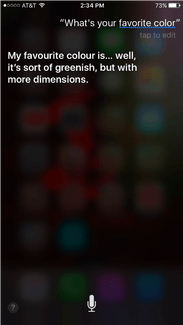
Q: What’s your favorite color?
Q: Do you like pie or cake?
A: “I’d rather not say.”
Q: Can you beatbox?
A: Siri will proceed to beatbox. Seriously.
Q: Can you sing?

Q: What is your favorite animal?
A: “I heart Totoro.”
Movies and TV
Q: What’s your favorite movie?
A: “I don’t really have a favorite. But I hear that 2001: A Space Odyssey got some good reviews.”
Q: Is Jon Snow Dead?

Q: Is Winter coming?
A: “I can’t get the weather for Westoros right now, but I can get the weather in West Hollywood.”
Q: Are you Her?

Q: What is Inception about?

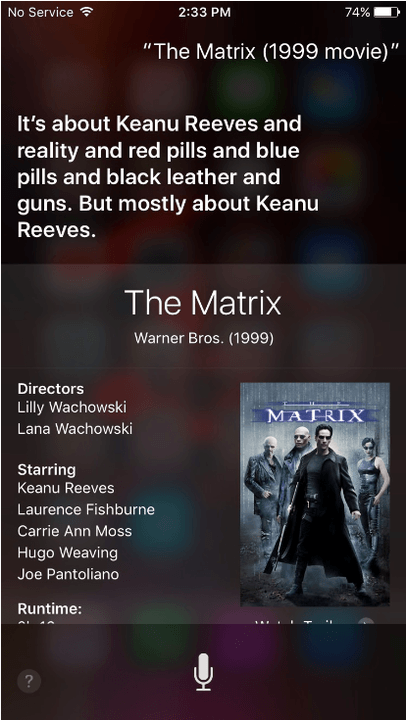
Q: What is The Matrix (1999) about?

Q: Have you seen The Matrix?
A: “I don’t need to. I already live in an alternate reality.”
Q: Blue pill or the red pill?
A: “You disappoint me, Mr. Anderson.”
Q: Do you like Blade Runner?
A: “I haven’t seen Blade Runner. It sounds very realistic, though.”
Q: Hey Computer?
A: Siri will proceed to respond as if you were LEGO Batman.
Q: Do you know HAL 9000?


Jokes and riddles
Q: Make me laugh.
A: “I can’t. I always forget the punchline.”
Q: Do you know any good riddles?

Q: What came first: The chicken or the egg?

Q: Why did the chicken cross the road?
A: “I don’t understand why people ask questions they already know the answer to.”
Q: How much wood could a woodchuck chuck if a woodchuck could chuck wood?

Q: Will pigs fly?

Other miscellaneous questions
Q: Do you like Pokemon Go?



Q; Windows or Mac?
A: “I’m pretty loyal to Apple. It’s just how I’m made.”
Q: What phone is the best?
A: “Seriously?” or “You’re kidding, right?”
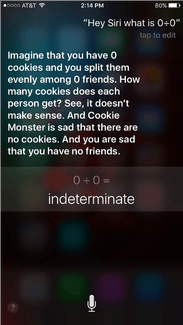
Q: What is zero divided by zero?
Q: When is the world going to end?


Q: How do I look?
A: “I’m guess pretty good! For a human.”
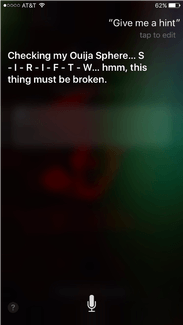
Q: Give me a hint.
Best app deals of the day! 6 paid iPhone apps for free for a limited time
Everyone likes apps, but sometimes the best ones are a bit expensive. Now and then, developers make paid apps free for a limited time, but you have to snatch them up while you have the chance. Here are the latest and greatest apps on sale in the iOS App Store.
These apps normally cost money, and this sale lasts for a limited time only. If you go to the App Store and it says the app costs money, that means the deal has expired and you will be charged.
More: 200 Awesome iPhone Apps | The best Android apps for almost any occasion
Big Clock

Stop squinting to see the time. This is the biggest, ad-free clock available in the App Store. You can even use it to completely customize your alarm.
Available on:
iOS
TopScanner

This app turns your iPhone or iPad into full-featured PDF document scanner. For example, you can scan your receipts and save as PDF file to trace your expenses.
Available on:
iOS
Easy Backup Pro

Your contacts are the most important data in your phone, which may be lost in seconds. Easy Backup Pro keeps your contacts in a safe place.
Available on:
iOS
Dramatic Black & White

Using Dramatic Black & White you can make your own black-and-white photographs, ones where light and contrast, grit and form come together to tell a story.
Available on:
iOS
Expenses OK

Expenses OK is the fastest way to track your expenses. Just enter data in the widget of the app and see how you’re spending your money.
Available on:
iOS
Simple Audio Manager

If you are looking for a voice recorder for college or your business meetings, or for recording anything you want, you should check out the Simple Audio Manager and Recorder.
Available on:
iOS
Apple reportedly sought cut of ‘tips’ exchanged in Chinese messaging apps
Why it matters to you
WeChat is an indispensable service for hundreds of millions of users, and Apple is taking a risk by threatening to remove apps like it from the App Store.
Apple is reportedly clashing with several developers of social networking apps that are prominent in China, according to The Wall Street Journal. The issue concerns the “tipping” feature common in many of these apps, which allows users to pay content creators directly.
One of those developers is Tencent, the company responsible for producing WeChat, China’s most prominent messaging and payment platform. According to the report, Apple’s stance is that the money exchanged by users — specifically tips — are in fact a form of in-app payment. That would allow the company to take a 30-percent cut of each transaction, per App Store rules.
In April, it was reported that Tencent scrubbed the tipping feature from the iPhone version of its app, and it appears other developers may be compelled to follow suit.
This all comes at a time when Apple has hit a roadblock in its Chinese expansion. Domestic manufacturers, like Huawei, Oppo, and Vivo, are outperforming the iPhone maker. In 2016, Apple fell from first place among smartphone vendors in the country for the first time in five years.
As a result, the company could be looking to eke out even more revenue from its install base — though in this particular instance, it runs the risk of alienating its most vital partners in the region. Developers told The Wall Street Journal that Apple has threatened to remove their software from the App Store if they fail to comply.
Losing WeChat in particular would be a serious blow to any smartphone manufacturer selling its wares in China, as the app boasts nearly one billion active users. Even if WeChat remains on the iPhone in its current state, however, consumers may spring for Android devices instead if the ability to tip doesn’t return to Apple’s hardware.
Apple has reportedly been in talks with Tencent to negotiate a solution, but the Cupertino, California company runs the risk of triggering a regulatory ruling by the Chinese government, which may be inclined to side with developers.
An executive from one such developer said that his platform doesn’t take a cut of what users spend on tips, so Apple would effectively be receiving 30 percent “for doing nothing.”
 AIVAnet