


Google I/O is the Greatest Show on Earth
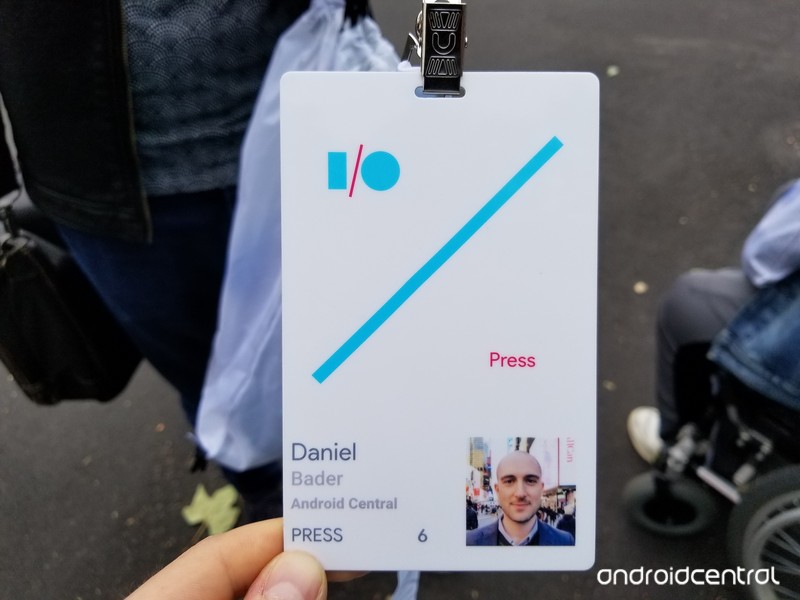
Google I/O is for everyone, and that’s amazing.
Google I/O has only been around for a decade, but to many developers, tech fans and lucky writers, it’s The Greatest Show on Earth.
Though it’s shared a venue with both Apple’s and Microsoft’s developer conferences at one point or another, Google has managed to put its own colorful and at-times weird spin on the very dry notion of a developer conference. From a live Google Glass demo in 2012 involving skydivers to an infamously long and rambling question and answer period by then-CEO Larry Page, Google I/O has always been, through the thoroughly rehearsed keynote scripts and predictably healthy lunch fare, a bit haphazard and unpredictable.
This year’s conference was a bit more sedate than previous years, but no less weird or charming.
When the conference outgrew Moscone and San Francisco and shifted to Shoreline Amphitheater in 2016 — a concert venue made legend by being inspired by, and hosting 39 times, The Grateful Dead — its haphazardness took on a whole new meaning, as organizers were completely unprepared for the relentless sun and torrent of people desperate to learn about a half dozen new products that would, in retrospect, take months to materialize.
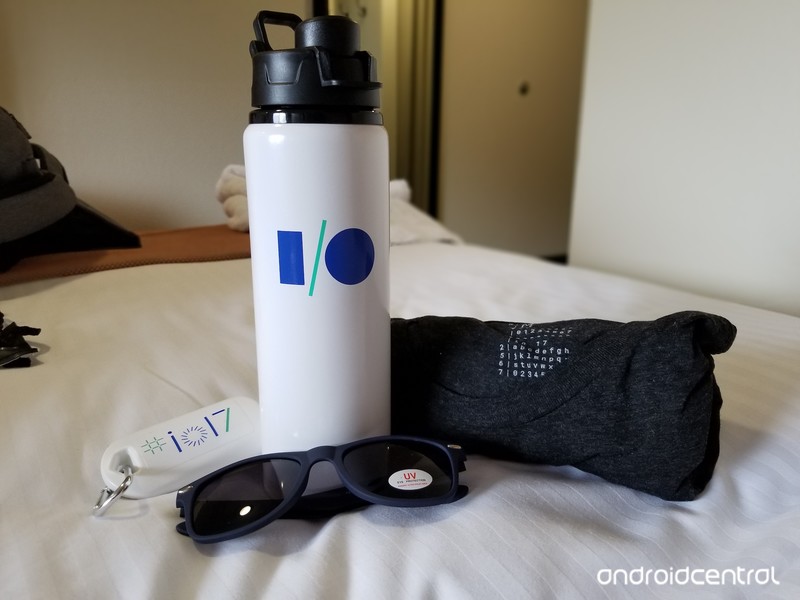
This year’s conference was a bit more sedate, but no less weird or charming. The weather, while no less relentlessly sunny, was more tolerable, and coupled with an ample number of (likely very expensive) air-conditioned tents and plenty of free water and sunscreen (the loadout for each attendee was a light cotton t-shirt, a pair of sunglasses, a metal water bottle, and a small clip-on tube of coconut sunscreen, all Google-branded), there was far less cause for complaint.
Similarly, despite the lack of major product announcements, I got the impression that developer attendees felt like this year’s show was more substantial, as most of the improvements, from Kotlin being adopted as an official Android programming language to a bolstering of existing platforms like Assistant and TensorFlow, were ready to be played with.

And then there was the annual concert, headlined by one of my favorite bands — and one that I never thought I’d get to see live — LCD Soundsystem. It was one of the nicest Google I/O surprises I can remember, surpassing watching Tycho in the spitting rain back in 2015. Google I/O is always a spectacle, but there’s something about watching thousands of increasingly drunk, swaying developers singing along to one of the most critically acclaimed and fun bands of the 2000s that makes me really happy.
Google I/O is also one of the few chances I get to convene most of the Android Central team in one place for an extended period, and there was a lot of blabbering, from the excellent podcast to the late-night pizza and beer as we scrambled to get everything finished. Working remotely is great and all, but it’s nice to recall just how awesome everyone is in person, too.
“Everyone is welcome here.”
The circus is now over and everyone has left the tent. But like the real Greatest Show on Earth, Google I/O will be remembered year after year as much for its follies as its charms. It’s a sprawling mess of an act that somehow manages to attract a growing number of fans (maybe that’s where the circus metaphor should end, though, since the Ringling Bros was an animal rights nightmare and may not survive scrutiny in a few decades) every year. And I think I know why.
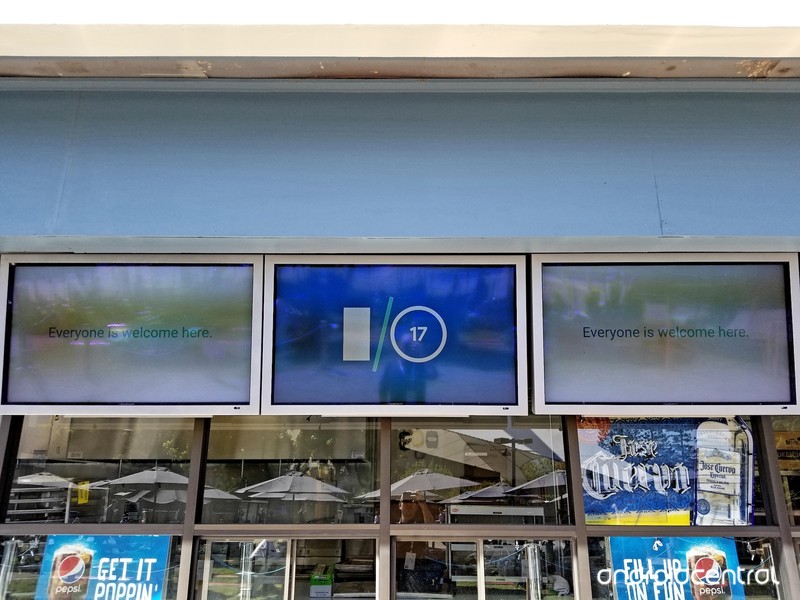
It struck me when I was sitting on a picnic table drinking an afternoon coffee, lazily looking around at the passersby. A TV screen in the distance flipped between the Google I/O logo and a message: “Everyone is welcome here.” It’s a simple thing, to say that. You can even dismiss it as a platitude. But when looking around at the sheer variety of people, of backgrounds, of experience, I can confirm that to be true.
To some extent, Google I/O is a summer camp for nerds, a place where all are welcome and no one is discriminated against. In an ugly world, here’s a guarantee of three days without intolerance or disrespect, of being both an individual who matters and a part of something significant. Yes, Google I/O is just a developer conference, but there’s a good reason why I hear, time and time again, that it’s the best one there is, and the greatest show on earth.
A few more thoughts from the week that past:
- The HTC U11 is such a bizarre thing. I like what I’ve seen, but there is zero chance it’s going to make a dent in the market, especially when the least popular major U.S. carrier was the only one to deem it worthy of supporting.
- Yes, that’s how carrier exclusives work: the provider agrees to put significant amounts of marketing support behind a product in exchange for its silo. I’ve spoken to many handset sales reps who say they never go out seeking an exclusive. It’s the worst of all scenarios.
- Nope. Just nope. But I ❤️ Russell for writing this.
- I’ve had a surprising amount of fun with Alexa Calling this past week, though it’s mostly been to troll Modern Dad. I’m not quite as bullish as he is on its disruptive potential, but I do like the notion of a voicemail box for the 21st century.
- I also got a Google Home and so far, so meh. It doesn’t sound nearly as good as the Echo (which doesn’t sound nearly as good as my Sonos Play:1), but I also haven’t delved into Actions just yet. We’ll see — I’ll write something on it soon.
- On the other hand, I am so in love with the fact that I can now type to Google Assistant.
- I can’t wait until Google Lens is a thing. I can see that being used for so many useful things.
- Off topic, but the second season of Aziz Ansari’s Master of None is probably the single best season of TV I’ve watched all year, and I watch a fair amount of good television. Watch it.
Nokia 9 leak shows off dual cameras, 5.3-inch QHD display, Snapdragon 835
An early look at the Nokia 9 shows off a device with a lot of potential.
Nokia’s foray into the world of Android started off with three entry-level offerings — the Nokia 3, Nokia 5, and Nokia 6 — with the company stating that it would launch high-end phones at a later date. The Nokia 9 is likely to be the first of the premium phones, and a recent leak out of FrAndroid gives us a first look at the design and possible specs.

The phone in question is a prototype of the Nokia 9, and as such is covered in a bulky case that hides its overall design. However, it has cut-outs for the various connectors, confirming USB-C charging and the presence of a 3.5mm jack. The Nokia 9 will have a 5.27-inch QHD display with an Always On mode, two 13MP cameras at the back oriented vertically, 4GB of RAM, 64GB storage, and Quick Charge 3.0. There’s also a physical home button up front that houses a fingerprint scanner.
On the software front, it looks like the Nokia 9 will come with Android 7.1.1 Nougat out of the box, and the interface itself doesn’t appear to deviate much from vanilla Android. The publication notes that the camera isn’t quite up to scratch, but given that it is a prototype model, we should see a lot of improvements in that area before the phone makes its debut.
There’s no word on when the Nokia 9 will be made official, but we’ll let you know once we hear more.
Samsung Galaxy Note 8 dummy shows vertical dual-lens camera
Pictures and video have appeared online that purportedly show a dummy version of the Samsung Galaxy Note 8.
The phone itself isn’t expected to be officially launched until September, but details have been hitting the internet over the last few weeks. Now this dummy handset has been posted. It is said to be a model that could have been shipped to a case manufacturer for size and design purposes.
From the photos and clip, you can see that the design is similar to the current Galaxy S8 and S8+ devices. It is even pictured alongside the Galaxy S7, showing that it’s not a million miles away from that phone too.
It will have an Infinity Display, like the latest Samsung flagships, it is said. But its screen will be 6.3-inches – just a fraction larger than the S8+.
- Samsung Galaxy Note 8: What’s the story so far?
- Samsung Galaxy Note 8 said to have 6.3-inch 18.5:9 screen
- This amazing picture leak could show us the Samsung Galaxy Note 8
Where it will differ, it seems, will be with a vertical dual-lens camera on the rear and S Pen stylus.
The rear camera has been talked about before, with rumours suggesting that it will be made up of 12-megapixel and 13-megapixel sensors. This is the first time we’ve seen it ranged vertically however. And there’s no sign of a fingerprint sensor either, hinting that speculation about an in-screen biometric sensor could be true.
Of course, this is just a dummy handset with no confirmation whatsoever that it originates from Samsung, so take everything with a healthy pinch of Himalayan mountain salt.
Shell Eco-marathon: Driving the future through super efficiency
“That green button under your foot is the kill switch,” we’re told as we strap into the five-point racing harness. “Lift your foot off it and the engine will stop.”
The engine in question reverberates through the carbon fibre cabin of Shell’s UrbanConcept vehicle, a super-efficient car that we’re now driving slowly round a closed track in London’s Olympic Park. The looming shell of the Velo Park dominates the horizon, its celebration of speed a stark juxtaposition to today’s challenge.
Shell
“The course is not about speed, it’s about efficiency.” Those words circulate as the concept car rolls smoothly across the Tarmac and the first corner looms. Lose too much momentum and you’ll waste fuel picking up speed again; accelerate too hard and the single-rear wheel drive will twist the vehicle needing a costly correction.
The engine is from a scooter and the cabin is sparse. It’s an empty shell designed to be as light as possible. It’s not lost on us that the weakest link in this chain is the weight of the driver, and the relative lack of skill.
Shell
That’s a challenge that’s faced by Eco-marathon participants, who build cars of this type in the UrbanConcept or Prototype classes for Shell’s competition. The UrbanConcept is a more practical design, something you might actually be driving in the future, with a seat, doors, there’s even a sliding window you’re unlikely to use. Shell even has a road legal version, adding luxuries like mirrors and indicators.
The Prototype by contrast is about pure efficiency, like piloting a sarcophagus, with the driver lying prone inside, with a small window to view the road ahead.
While most of the talk about Shell Eco-marathon is about engineering – its participants are engineering students from around the world – once behind the wheel, it’s about the skill of the driver. Just like Formula 1 at the other end of the spectrum, all the research and engineering is just to put that driver on the course and let them perform.
Pocket-lint
As we pull to a halt, the team is already opening up the engine bay and examining the fuel level. A serious shake of the head confirms what we already know: “not so good.” We blame the weight of the driver, and seek consolation in a post-race doughnut.
Don’t blame the driver: An autonomous future
The UrbanConcept vehicle is easy to relate to and Shell is also going to be opening this up to autonomous vehicles in the near future. Sure, autonomous vehicles aren’t that rare these days. Everyone seems to have one in development, with autonomous of self-driving features now available on a wide range of production cars.
Oxford Robotic’s approach is different, because it doesn’t reply on GPS. It uses a laser system for location identification, scanning and recognising the world around it so it can take control of the vehicle and drive it for you. The idea is to create a system that isn’t dependent on other technologies like GPS, letting you put vehicles into locations that can’t use satellite systems.
Pocket-lint
This could be underground, warehouses, urban environments or in parts of the world that aren’t covered by GPS, and give you a vehicle that can still perform autonomously. In the case of the Oxford Robotics concept, it knows the route it has to drive by recognising where it is, and drives us smoothly with no problems.
That’s really what Eco-marathon is about. It’s about approaching the problem in different ways and seeking answers by doing things differently. The focus of the student’s course has an impact. Some may be working on ultra-low friction bearings, some might be looking at lightweight materials, some might be looking telematics, figuring out how to gather data in real time and pass that back to the driver.
As long as you stick to Shell’s rules, then creativity flows and the variety of designs and solutions you’ll see taking part is striking.
Shell Eco-marathon: Getting involved
For the last 30 years or so, Shell has been running the Eco-marathon. It’s a challenge to develop the most efficient vehicle possible, looking to push boundaries, but also the minds and skills of those who participate.
The concept for the Eco-marathon dates back a lot further – to the 1930s – when a challenge between staff at Shell in the US lead to a competition to see who could get the furthest distance on a set amount of fuel.
Pocket-lint
The participants present a wide range of variety in design, budget, focus and even fuels. You’ll find electric, hydrogen, bio-diesel and petrol. We stop by to see the contrast between Colchester Institute’s Prototype design – including pieces salvaged from a washing machine, and handstitched plastic panels – and that of University College London, with a full carbon monocoque.
While the designs are radically different that aims are the same: to seek out efficiencies, to improve the performance and take bold steps into how we engineer the future and how we think about our vehicles in the future. That and have a lot of fun, of course.
The competition returns to London for the second year in a row in 2017, being held at the Queen Elizabeth Olympic Park in east London. Between 25-28 May, Shell will throw open the doors on the Make the Future Live festival, with free tickets for those interested in attending and taking in some of the marvels on show. You can find more information on the Make the Future website.
Amazing Nokia 9 hands-on pics appear online, along with photo samples
A phone very much thought to be the Nokia 9 has already appeared in a leaked video this month, but this latest unveiling of the handset is by far and away the most revealing yet.
French website Frandroid claims to have spent some time with the forthcoming handset, even being allowed to take photos using the prototype device in order to test its camera. It then posted the results along with shots of the phone the site used.
You might think it looks a bit odd in the hands-on images, but it’s actually hidden behind a fake casing in order to obscure the final design. The screen, camera and other ports were exposed though, suggesting that the device is the same as previous leaked pictures have shown.
- Nokia 9 to feature QHD OLED display, iris scanner and OZO Audio
- Nokia 9 flagship to launch in Q3 for €749
One of the posted shots includes a list of specifications, which reveal the Nokia 9 to have a 5.3-inch QHD (2560 x 1440) screen – it says 5.27-inches technically, but that’s generally rounded up.
It also suggests that the device will run on a Qualcomm Snapdragon 835 chipset, have 4GB of RAM and come with 64GB of storage built-in.
There will be a mini-jack headphone socket, which will come as some relief for those annoyed at some manufacturers ditching theirs.
However, it’s not all great news as Frandroid reports that the camera results were less impressive than many other flagship devices currently available, such as the Samsung Galaxy S8 and iPhone 7.
In test shots, the images displayed a lack of some detail and light performance was average.
Frandroid
It must be remembered that this is said to be a prototype Nokia 9 rather than the final phone, so things could get better by the time it is fully consumer-ready. And Frandroid was impressed by one camera feature – the ability to take simultaneous, square shots using the rear and front-facing cameras.
No announcement date has been revealed so far, but previous rumours point at a third quarter launch and a price of around €750 (£650).
The Morning After: Monday, May 22nd 2017
Hey, good morning! Over the weekend, you might have missed the (legal) consequences of emoji, Microsoft’s holographic display that could squeeze inside your glasses, and how drones and AI are battling poachers.
A smiley isn’t just a smile for everyone.
Israeli court says emoji can signal your intent

Emoji are always open to interpretation, and when the person reading them is a judge, there could be tangible consequences. A court in Israel has ordered a couple to pay $2,200 for using emojis that “convey great optimism” in a text they sent to a landlord when looking for an apartment. After a few back and forths, the couple stopped responding, with their last text promising to send him the changes they wanted to his apartment contract. While the landlord eventually found another renter, he took the other couple to small claims court for misleading him with their emoji use.
A single revolution of their blades can reportedly power one house for 29 hours.
UK switches on the world’s largest wind turbines

The largest wind turbines in the world have started producing energy for the UK. Dong Energy, the Danish company behind the project, has recently switched on the 32 gigantic structures in Liverpool Bay. At 640 feet, the turbines are taller than some skyscrapers, and have 262-foot-long blades that can generate 8 megawatts of power.
You don’t need an elaborate headset to experience augmented reality.
Microsoft’s true holographic display fits in your glasses

A lot of the technology billed as holographic, well, isn’t. Real holography requires a laser-generated 3D image, and it’s no mean feat to stuff that into something you can comfortably wear. Microsoft researchers have developed a true, near-eye holographic whose optics can fit inside a regular pair of glasses. The mirrors and the liquid crystal on silicon needed to achieve the effect sit inside the frame — it’s only the electronics that have to stay outside. Tiny-sized projectors normally result in an unusable picture, but the researchers’ adjustments have made it easy to read details down to individual pixels.
Still need to make less CO2.Sorry, you can’t plant enough trees to offset fossil fuels

Ever planted a tree to feel better about your environmental footprint? It might not be the solution to climate change you hoped it would be. A simulation-based study has determined that it would be utterly unrealistic to plant enough trees to offset humanity’s CO2 emissions as they are — the plantations would need to be so big that they’d “eliminate most natural ecosystems” or cut into food production.
But wait, there’s more…
- The world’s largest tech fund is run by SoftBank and Saudi Arabia
- After Math: Get free
- Drones and AI help stop poaching in Africa
- Switzerland votes for an end to nuclear power
Amazon’s checkout-less Go stores could be coming to the UK
Amazon’s checkout-free grocery stores could be coming to the UK and Europe, if its recent intellectual property filings are anything to go by. Bloomberg reports that the retailer has successfully registered trademarks for slogans “No Lines. No Checkout. (No, Seriously.)” and “No Queue. No Checkout. (No, Seriously.)” with the UK Intellectual Property Office, hinting that it’s already planning to its high-tech Amazon Go stores outside of the US.
The registered strap lines were first used in a promotional video (shown below) for Amazon Go when the company first unveiled the concept in December 2016. In it, shoppers are shown signing in on the Amazon Go app, filling their bags and then leaving the store without stopping to check out. Sensors can detect the products and automatically bill the customer. Amazon calls it the “Just Walk Out Shopping” experience and has already opened its first store for employees in Seattle.
While Amazon has yet to confirm its expansion plans (the company also has registrations pending with the European Commission), major UK supermarkets will be keeping a keen eye on things. In a bid to mirror Amazon, Tesco recently confirmed it’s trialling a new one-hour delivery service, but is currently only offering the option to select customers and staff in London zones 1 and 2.
Via: Bloomberg
Source: Intellectual Property Office
Stem cell therapy makes sterile mice fertile again
Researchers at Shanghai’s Jiao Tong University have conducted an experiment involving stem cells and sterile mice. Germline stem cells — the building blocks of an egg — were taken from a young mouse and implanted into the ovary of a mouse that had been sterilized. Five to eight weeks later, and this implanted mouse was mated with a healthy to see if pregnancy would occur. The experiment, which tested eight such mice, found that six of the group managed to fall pregnant and deliver healthy offspring.
The thinking, as outlined by Science News, is that such a technique could eventually be used to help sterile women conceive. That’s probably a few decades away, but the fact that germline stem cells have been proven to work in this context marks a big step forward. Other projects, too, are seeing similar positive results. It was less than a week ago that news broke about a 3D-printed ovary that carried a mouse pup to term. In addition, researchers at Children’s Hospital, Philadelphia, developed an artificial womb that was used to help save the lives of premature infants.
Via: Science News
Source: Cell
Most U.K. Apple Pay Terminals Now Support Transactions Above £30
Most shop tills in the U.K. that take Apple Pay now accept mobile payments above £30, The Telegraph reported on Sunday. Jennifer Bailey, head of Apple’s payment arm, said over half of contactless payment terminals in the country are now able to take Apple Pay transactions of any value.
Previously, most contactless card readers have adhered to the £30 upper limit, which is meant to prevent fraud when a pin isn’t used. However, Apple’s Touch ID approval system on iPhones and iPads provides the extra security to enable payments of any value.
The upgrades, which Ms Bailey said applied to hundreds of thousands of terminals, means shoppers in many places can make payments of any value without taking their wallet with them.
Apple Pay’s ability to approve high-value payments could turn out to be a significant advantage over contactless cards, following some reports that mobile payments have struggled to gain traction among consumers. The mobile wallet also has to compete against rivals Android Pay and Samsung Pay.
However, Apple says Apple Pay transactions in the U.K. have grown by 300 percent in the last year, with 23 banks now supporting the service. “Our momentum has been fantastic. We’re really excited about the progress,” Bailey told the Telegraph.
Retailers in the U.K. now accepting the higher-value payments include supermarkets such as Waitrose and Sainsbury’s, and restaurants including Pizza Express and Nando’s.
Related Roundup: Apple Pay
Tag: United Kingdom
Discuss this article in our forums
Alleged Molds Purport to Show Relative Sizes of Apple’s 2017 iPhones
A series of photos claiming to show molds of Apple’s upcoming 2017 iPhone range appeared online over the weekend, providing a potential look at the relative sizes of the rumored new devices. Apple is expected to announce three new iPhone models this year: two LCD-based “S” cycle upgrades to the iPhone 7 and 7 Plus, alongside a radically redesigned tenth-anniversary “iPhone 8” with an edge-to-edge OLED display.
It’s worth bearing in mind that the molds shown in the images could simply be made for use in the production of third-party iPhone cases rather than actual handsets. Either way, they do appear to line up with unconfirmed details we’ve been hearing over recent months, particularly with regard to the dimensions of the devices.
The mold of the so-called “iPhone 8” is pictured between the two iterative models, which shows the redesigned handset isn’t much bigger than the 4.7-inch iPhone 7S chassis on the right hand side. Despite the similarity, reports suggest the redesigned phone could pack a 5.8-inch display that’s closer in size to the screen on the 5.5-inch iPhone 7 Plus. A lack of bezels at the top and bottom of the device are said to enable the larger OLED area.
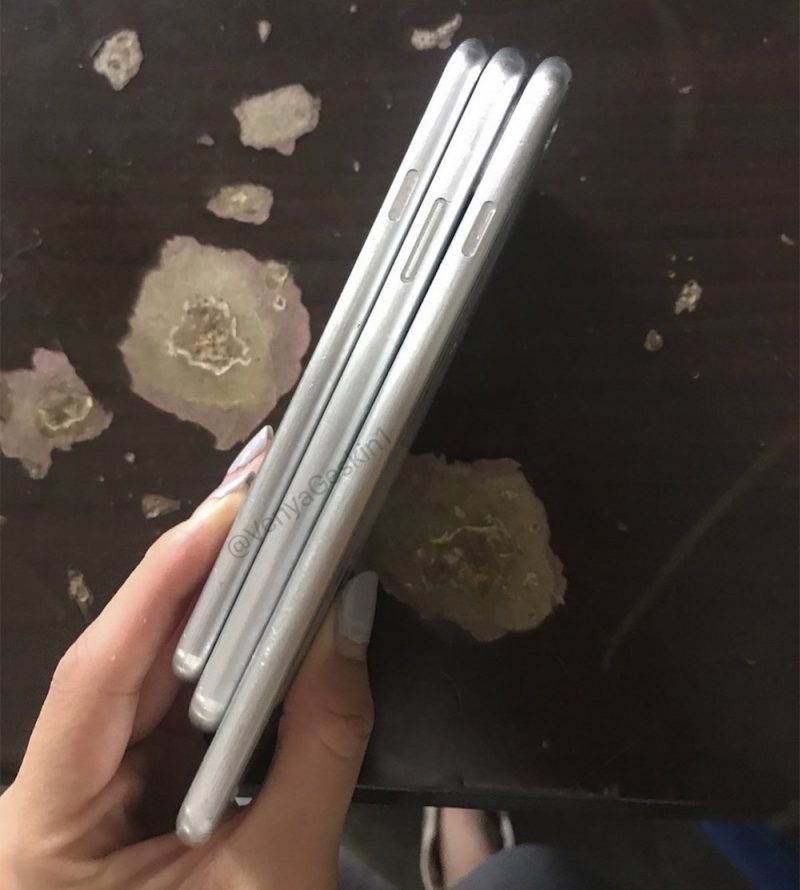
The side-on view offers another take on the relative dimensions, and also reveals a longer power button on the OLED iPhone in the middle. The appearance of the longer button in previous dummy images has led to speculation that it could act as a fingerprint recognition surface if Apple can’t implement Touch ID into the OLED display. Rumors say Apple has struggled to overcome the challenges involved in such a feat, but details are still sketchy.
Some sources suggest the company could resort to placing the sensor on the back of the handset, like on the Samsung Galaxy S8, but most agree this would be an inferior implementation compared to Touch ID’s current front-facing location on the home button.
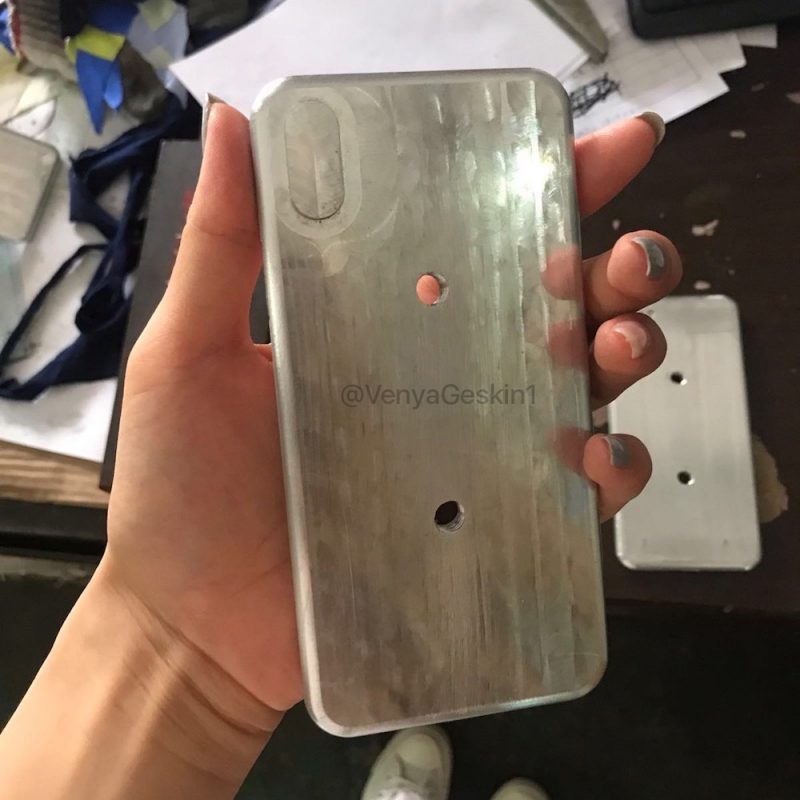
Cutouts for the rear camera in the middle mold line up with previous rumors that Apple will go with a vertical dual-lens orientation in the “iPhone 8”, in contrast to the horizontal layout on the iPhone 7 Plus, which is expected to remain on the 7S Plus.
The OLED iPhone is expected to be unveiled at a September event alongside the “S” cycle phones, and could feature new 3D-sensing technology in the front-facing camera, as well as a faster A11 chip, face and iris recognition, better waterproofing, some form of wireless charging, and a glass body.
Related Roundup: iPhone 8 (2017)
Discuss this article in our forums
 AIVAnet