


Apple Music trial is no longer free in some countries
Apple Music has adjusted its free trial in some countries, and we don’t quite know why. In order to land your three-month trial in Australia, Spain and Switzerland, you’ll be charged around 99 cents. We’re looking into how widespread the new charges are, but for now, the trials remain free in most countries, including the UK, Canada and the US.
Apple has continued to adjust its Music strategy since launch. It had planned to avoid royalty payments to artists during its free trials, — something it reversed after Taylor Swift took umbrage with it. Is the company looking to recoup these payments now? Is it possible to game the trial system with new accounts, extending your Music access beyond that three month period?
Apple’s push into video centers on its Music service, with a handful of musician-centric documentaries (and Carpool Karaoke) coming soon to paying users… and those trial takers. We reached out to Apple for comment, who said that “prices and promotions vary from country to country”. For example, Hong Kong users have only ever got a one-month trial of Apple Music.
It might be that the company is merely testing different methods to ensure only interested parties (those willing to have money in their iTunes account) are trialling the service. Despite the charge, the new three-month trial price in affected countries is relatively small, costing one tenth of a full-paying month of Apple Music. We thought the fight for streaming music dominance had died down, but it looks like it hasn’t.
Source: AppleInsider
HP debuts a tablet for artists at Cannes for some reason
HP chose the Cannes festival as a way to draw attention to its latest creativity-oriented high-end laptops and hybrid tablets. The most interesting device is the Spectre x2, a Surface Pro-like tablet with a detachable keyboard and stainless steel kickstand. HP is targeting Windows Ink users and other graphics pros with the 2.5-pound tablet, which has been significantly updated from the last model with an Ink-certified, pressure sensitive stylus, 3,000 x 2,000 pixel 12.3-inch touchscreen and detachable, full-size keyboard.
It should be no slouch in the performance department, with a 7th-gen (Kaby Lake) Core i7 processor, 360GB M.2 SSD and Intel Iris Plus 650 graphics that can support two 4K external monitors. The battery will run up to 8 hours, or a bit less if used for video playback. Other features include HP fast charge, Bluetooth 4.2 and 802.11ac 2×2 WiFi, and dual speakers “custom-tuned” by Bang & Olufsen. The Spectre X2 will arrive in June in the US and most of Europe starting at $1,599 (€1,599).
Another model that might make your back-to-school wish-list is the Envy 13. Intel is pitching it as a sort of Macbook Air replacement, as it features similar specs like a Full HD display, 128GB SSD, Core-i5 Kaby Lake Intel CPU, and Intel Iris graphics, all in a 2.7-pound package. That laptop is also coming to the US and Europe in June for €899 ($899).
If you’re looking for a bit more power and a bigger screen, the Envy 17 might be worth the price. It’s got 16GB of RAM, a Kaby Lake Core i7-7500U processor, a 17.3-inch, 1,920 x 1,080 pen-enabled touch display and NVIDIA discreet graphics — albeit a lowly 940MX chip (why HP?). Other specs include a 1TB 7,200 RPM HDD (again, why?), Bang & Olufsen-tuned dual speakers, a Windows Hello-supported IR camera, all in a hefty 6.73 pound package. That model, also set to arrive in the US and Europe next month, starts at $1,099 (€1,099).
Finally, HP outed a new Envy x 360 15.6-inch convertible with a fully rotatable scren in both Intel and AMD flavors. Highlights of that model including powerful processor options (Kaby Lake Core i7 or i5 CPUs, or AMD A9 and A12 models), a 1,920 x 1,080 toushcreen that’s Windows Ink compatible, Intel HD or Radeon R7 graphics, a Hello Windows Full HD IR webcam with integrated dual array digital microphones, and 1TB of (spinning) ATA HDD storage.
The battery is good for 8 hours and 45 minutes on the Intel model and a bit less on the AMD for video playback, which is enhanced by the Bang & Olufsen speakers. While it can be converted into a tablet by flipping the screen around, your arms would get pretty tired considering the 4.76 pound heft. Both models are coming next month starting at $749 with an AMD CPU and $899 if you go Intel.
‘Today at Apple’ Launch Celebrated With Images Taken From Music, Drawing, and Photography Sessions
Apple this weekend celebrated the launch of its new in-store programming, “Today at Apple,” at all of its 495 retail locations. The world-wide expansion of the educational program was announced in April, and this weekend marked the official debut of Today at Apple at every Apple store around the globe.
“Today at Apple” kicked off this weekend with new in-store programming around the world, including Photo Walks and Kids Hour at all 495 Apple stores. From Getting Started with Coding to How To: Sketch, Draw and Paint with iPad, stores collectively hosted 4,000 sessions a day, including some with very special guests.
Users interested in the program can choose from 60 different hands-on sessions in creative skills, and in some of the new images shared by Apple its visitors are shown learning how to illustrate with an iPad Pro and Apple Pencil. Artist Todd Selby and French illustrator mcbess lead the art-focused sessions at Apple Union Square and Apple Regent Street, respectively.

Apple also had a few singers perform for the grand opening of Today at Apple, including Charlie Puth and Leon Bridges at Apple Union Square, Dua Lipa at Apple Regent Street, and Sigrid at Apple Marché Saint-Germain. At Apple Williamsburg, Grammy-nominated musician Steve Lacy held a Music Lab to teach visitors how to create and record music on iOS and macOS devices.

Other Today at Apple events included:
– Movement artist and star of Apple’s AirPods commercial, Lil Buck, shows off his moves in the Forum at Apple Union Square.
– iPhone photographers cover two miles in 90 minutes as they seek out fashion-forward portraits with photographer Shingi Rice.
– iPhone photographers hit the streets of Brooklyn for a portrait-themed Photo Walk with Timothy Mulcare.
– Aspiring coders of all ages can learn how to code in Swift, Apple’s programming language for iOS and Mac apps.
Apple launched a new website for Today at Apple, which allows those interested to check for sessions in their area and sign up for the classes in advance. During the launch, Apple noted that stores collectively hosted more than 4,000 educational sessions each day under the Today at Apple initiative.
Tag: Today at Apple
Discuss this article in our forums
Apple Sees Notebook Shipments Increase Year on Year in Q1 2017
Apple’s notebook shipments totaled an estimated 3.4 million units in the first quarter of the 2017 calendar year, compared to an estimated 2.9 million in the previous quarter, according to new data published by market research firm TrendForce.
The figure represents a 15.8 percent decline against the last quarter of 2016, reflecting a somewhat similar decline for the overall notebook market over the same period, however the company’s Q1 2017 numbers also indicate a year-on-year increase in overall MacBook shipments.
Apple shipped 3.4 million units of MacBook devices this first quarter and claimed fifth place in the ranking. The latest generation of MacBook Pro with Touch Bar, which was released in last year’s fourth quarter, was well-received by consumers and contributed significantly to the overall MacBook shipments. As a result, first-quarter MacBook shipments, while representing a 15.8% decline versus the prior quarter, also showed a year-on-year increase of 15.4%.
HP, Lenovo, Dell, and Asus all suffered marginal market share declines compared to Q4 2016, but Apple’s share stayed level over the last two quarters, enabling it to maintain fifth place in the shipment rankings. However sixth-placed Acer gained 0.8 percent ground on Apple over the same period, which TrendForce put down to expanded stocking of notebooks by channel distributors in anticipation of increased device production costs.

TrendForce estimates that MacBook shipments for the second quarter of 2017 will grow by more than 10 percent compared with the first quarter. The firm attributes this projection to suggestions that Apple will update its 12-inch MacBook with a new processor and the possibility of promotional pricing for some older models.
Recent rumors suggest Apple could be planning to announce refreshes for both the MacBook and MacBook Pro at June’s Worldwide Developers Conference. The notebooks are expected to be updated with faster Kaby Lake processors, an update from the Skylake processors in the current machines. Apple is also said to be considering updating the MacBook Air with new internals, as sales of Apple’s most affordable notebook have remained surprisingly strong.
Related Roundups: MacBook Pro, MacBook
Tag: TrendForce
Buyer’s Guide: MacBook Pro (Neutral), MacBook (Don’t Buy)
Discuss this article in our forums
Cases for Upcoming 10.5-Inch and 12.9-Inch iPad Pro Reveal Stereo Speakers, Centered Rear Microphone
A collection of new images today claim to show cases for Apple’s upcoming 10.5-inch and 12.9-inch iPad Pro devices. The 10.5-inch iPad Pro is believed to be an update similar in vein to the iPhone 8, with a size that remains close to that of the 9.7-inch iPad Pro, but includes a larger 10.5-inch display thanks to shrinking bezels.
2017 iPad Pro 10.5′ & iPad Pro 12.9′ cases.
(No new iPad mini this year) pic.twitter.com/Ft3FH48Yzy
— Benjamin Geskin (@VenyaGeskin1) May 22, 2017
Benjamin Geskin has shared the iPad Pro accessory images on Twitter today, showing off cutouts for the Lightning port, speaker grilles, microphone, and vertically-aligned camera. The microphone cutout is placed on the top rear of both new iPads, similar to its location on the newest 9.7-inch iPad. For the current 12.9-inch models, however, the microphone cutout sits on the right side of the iPad, above the volume buttons.
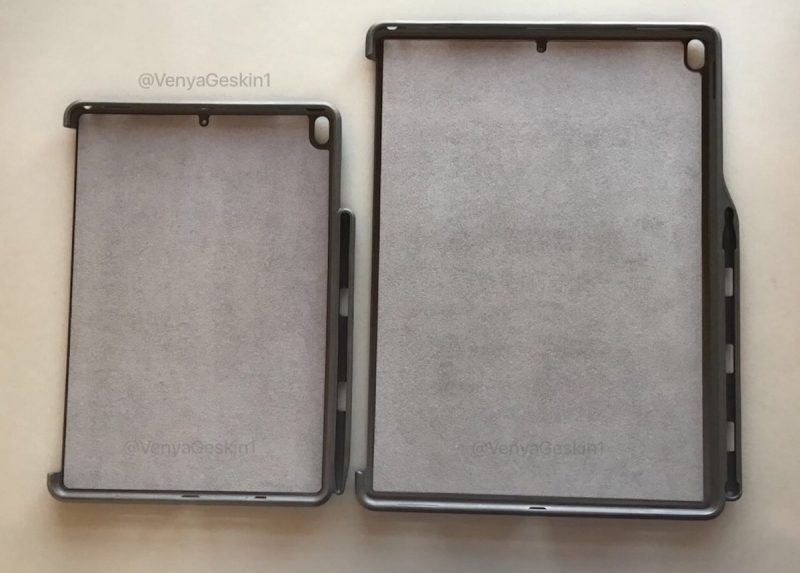
The cases include multiple large cutouts for what appears to be four speakers, with two on top of the case and two on the bottom surrounding the Lightning port. This suggests that the 10.5-inch iPad is likely to continue supporting the stereo audio system of the iPhone 7 and 9.7-inch iPad Pro update. The wood cases also include side inserts for Apple Pencil storage.

Also on top of the case is the expected cutout for the lock button, and the 3.5mm headphone jack will still be included on the 10.5-inch and 12.9-inch iPad Pros launching this year, according to the new cases. Volume rockers remain on the traditional right side of the iPad cases, as well.

With production on the 10.5-inch iPad reportedly ramping up, the device could debut as early as WWDC, which takes place two weeks from today. For the smaller-screened iPad mini, recent rumors have suggested that Apple might discontinue the devices due to likely cannibalization from the 5.5-inch iPhone Plus devices. According to Geskin, the iPad mini will remain off of Apple’s update list — for 2017 at least — with his Tweet stating, “No new iPad mini this year.”
Related Roundup: iPad Pro
Buyer’s Guide: 9.7″ iPad Pro (Don’t Buy), 12.9″ iPad Pro (Don’t Buy)
Discuss this article in our forums
Apple insists Beats headphones explosion wasn’t its fault
Why it matters to you
While the maker of the battery isn’t named, the story is a useful reminder to always purchase such items from reputable firms.
An Australian woman whose Beats headphones exploded on her head as she dozed on a long-haul flight in February, 2017, has been refused compensation by Apple.
The tech giant, which acquired Beats in 2014, blamed a faulty AAA battery for the incident, which left the woman with some nasty-looking burns to her face and hands.
“Our investigation indicated the issue was caused by a third-party battery,” an Apple representative said in a statement issued by lawyers for the unnamed woman, according to Adelaide Now. The name of the battery maker hasn’t been disclosed.
Some older versions of Beats headphones — such as the set used by the woman — require a pair of AAA batteries that fit into one of the cans.
The incident occurred about two hours into a flight from Beijing to Melbourne as the woman napped with her headphones on.
She described what happened in a statement to the Australian Transport Safety Bureau (ATSB): “As I went to turn around I felt burning on my face. I just grabbed my face which caused the headphones to go around my neck.
“I continued to feel burning so I grabbed them off and threw them on the floor. They were sparking and had small amounts of fire.”
A flight attendant alerted by the commotion used water to put out the fire, thereby preventing what could have become an even more serious incident.
The ATSB said at the time that both the battery and its cover melted and stuck to the floor of the aircraft, adding that for the rest of the flight the passengers “endured the smell of melted plastic, burned electronics, and burned hair,” while the owner of the wrecked Beats headphones said people were “coughing and choking the entire way home.”
In response to Apple’s claim that the fire was caused by a faulty AAA battery, the woman said via her lawyers: “The headphones don’t work without batteries, yet nowhere on the headphones — or their packaging — did it specify which brand of batteries should be used.”
It’s not clear if the woman is intending to continue her action against Apple, but the tech company, for one, is adamant that the Beats device itself was not the cause of this highly unfortunate incident.
Meizu’s next device is specially designed for international fans, and it launches on May 23
Why it matters to you
Meizu’s bold plan to launch a phone designed for international audiences may be the nudge you need to try out the company’s hardware.
Chinese smartphone manufacturer Meizu will launch a new device on May 23, and it’s one that’s very special to the company, Meizu’s head of global marketing, Ard Boudeling, told Digital Trends. Why? It’s the first which has been expressly designed for its international fans. While Meizu has produced devices only for China in the past, this new model has been specially developed for use outside China. Meizu sells its smartphones online in parts of Europe, Asia and South America.
Exactly what this will mean will come with the announcement, and Meizu isn’t teasing anything beyond a single image with a multi-colored letter C in the centre at the time of writing. What will make it suitable for international audiences? Only Meizu knows at the moment, but we wonder if it means a change to Meizu’s Flyme user interface, which is placed over the Android operating system on most other Meizu phones. However, this is speculation on our part for now.
To coincide with this push into dedicated international devices, Digital Trends spoke to Boudeling ahead of the launch, to understand more about a company which may be unfamiliar to many. What became clear is its dedication to hardware research and development, which has resulted in Meizu pioneering some more widely used technologies today.
Research and development

“We started as a hardware company 14 years ago,” Boudeling told us, “and hardware is still at our core today. When we started doing hardware in 2003, we didn’t use a fixed research and development budget. Rather, every idea or project was reviewed individually and received resources if it seemed worthwhile. At the time it was basically innovate or die, and we found this method most effective since no good project would get dismissed due to budget restraints. The market has now matured, yet we maintain our attitude to let R&D work free from budget restrictions.”
Engineers in Meizu’s R&D department obviously like the relative freedom, and many have worked for the company for more than a decade. What has this open approach to innovation resulted in? Boudeling gave us a few examples. In 2014, the MX4 Pro became the first Android phone with a fingerprint sensor that needs a finger pressed down on it to activate, rather than being slid down the sensor like other examples at the time. This is now standard on all high-end Android smartphones. The examples continue, with Meizu’s way of disguising antenna bands on its metal smartphones commonly adopted elsewhere, and Huawei taking inspiration from Meizu’s multi-functional fingerprint sensor in its own user interface recently.
“In 2017, we will continue to demonstrate that we are among the companies bringing innovation to this industry,” Boudeling confidently stated. He noted the debut of Super mCharge, a fast-charging technology demonstrated earlier this year, which took a battery to 100 percent charge in 20 minutes — way faster than all other fast-charging technologies available at the moment, including Meizu’s own existing mCharge. It’s not certain the Super mCharge system will be available this year though. Meizu is also invested in making its cameras the best they can be, with a dedicated camera R&D department working on the feature. The MX6’s camera was the fastest in the world upon release, taking pictures at a mere 319ms.
No U.S. launch plans
Meizu is one of the top smartphone manufacturers in the world, with shipments reaching 22 million units last year. What does all this mean for its next device? It’s not giving anything away until the grand reveal, but it’s definitely keen to continue making an impact internationally. Last year, it shipped 22 million units — breaking previous company records — and two million of those were sent outside China.
While the arrival of a true international phone from Meizu is great for those where the company’s phones are readily available, it’s not so good or U.S. fans, as the company doesn’t have any plans to launch in the United States, leaving many to rely on importers if they want to own a Meizu phone.
The mystery Meizu phone will be announced on May 23, and rumors are currently swirling around the impending arrival of a phone referred to as the Meizu M5c.
DJI Inspire 2 review

Research Center:
DJI Inspire 2
When DJI released the original Inspire drone, it was an instant hit with filmmakers. Up until that point, if you wanted a drone that could carry a decent camera, you had to build it yourself — but then DJI came along, and suddenly anyone with $3,000 could get their hands on a pro-level 4K camera copter that was ready to fly straight out of the box.
Thing is, that was nearly three years ago. Drone technology has progressed in leaps and bounds since then, and nowadays you can get a 4K camera drone for under $500. But DJI isn’t one to be left behind. In late 2016, the company unveiled the second generation — and now that it’s out in the wild, we got our hands on one for an extended review.
Features and specs
A number of features make the Inspire 2 stand out from the rest of the pack, but generally speaking, it just has more stuff under the hood. We like to think that DJI calls it the Inspire 2 because it has two (or more) of everything.
Arguably the biggest inclusion is a dual battery setup, which gives the Inspire 2 a number of key benefits. Not only does it give the bird more flight time — it also protects it from battery malfunctions, and, more importantly, provides ample power for ancillary systems like cameras, stabilizers, sensors, and processors.
We like to think that DJI calls it the Inspire 2 because it has two (or more) of everything.
Speaking of cameras, not only does this drone rock a detachable and easily upgradable Zenmuse cam (ours came with the new X5S), it also sports a forward-facing FPV camera, which allows the pilot to keep an eye on what’s ahead of the drone while simultaneously watching/controlling the Zenmuse camera.
It’s also equipped with dual inertial motion sensors, dual barometers, and dedicated processors for various subsystems — including the newly-added obstacle avoidance sensors. Hell, you can even fly it with two controllers. Together, these new additions serve to make the Inspire 2 far more reliable, stable, and safe to fly than any previous iteration.
Build quality and design
In terms of form, the Inspire 2 isn’t really a huge departure from the original model. It sports the same prop configuration, the same retractable landing gear system, and more or less the same body style. There are, however, a few small design upgrades that make the Inspire 2 more versatile and capable than its predecessors — despite the fact that it doesn’t look much different.
The most notable and noticeable design change is undoubtedly the Inspire’s new forward-facing FPV camera and obstacle-avoidance system. Both systems live in a nose-mounted sensor bar, which contains a small optical lens and two laser rangefinders. Aesthetically, it’s a fairly minor change — but in terms of functionality, these systems provide a huge benefit. Obstacle avoidance gives the drone the ability to autonomously prevent crashes, while the FPV camera allows the pilot (or pilots) to keep track of the Inspire’s heading, regardless of where the Zenmuse X5S might be facing.
 Bill Roberson/Digital Trends
 Bill Roberson/Digital Trends
 Bill Roberson/Digital Trends
 Bill Roberson/Digital Trends
Build quality is, as we’ve come to expect from DJI, off the charts. Even for a DJI drone, the Inspire 2 is ridiculously well built. The props feature a new locking system that ensures they’ll never come loose during flight, while the prop arms are made of the same super-strong carbon-fiber tubing that previous generations have. If this drone crashes (which is unlikely), the only components that’d likely suffer serious damage are the props and the camera. This thing is basically a flying tank.
Overall, the design is a victory. Instead of a massive overhaul, DJI took a winning formula and made a few small improvements — which we appreciate. It’s like trading in your car for a new model year: same look and feel, but with a few extra bells and whistles that make the driving experience completely different.
Battery life and recharge time
Battery life is hugely improved in the new Inspire. Whereas the original and Pro versions averaged about 15 minutes per charge, the Inspire 2 is rated for 27 minutes of flight time. In a simple hover test, we got just over 25 minutes of flight time before the drone went into emergency landing mode — but of course, that’s not really a good reflection of real-world use. During our normal flight tests, where we flew around and made use of the drone’s many subsystems, we averaged about 23 minutes of flight time. Like any other drone, if you use features that require more processing power (obstacle avoidance, Active Track, etc.), then you can expect to see a corresponding drop in flight longevity.

Bill Roberson/Digital Trends
As for recharge time, you can expect about an hour on the charger before your battery reaches capacity. After our hover test (which ran the battery down to 10 percent and prompted DJI’s automated emergency landing sequence), the battery took about an hour and 20 minutes to charge up to 100 percent — but in most cases, you won’t be draining the batteries that much. If you do what most people do and land shortly after the first “low power warning” pops up, you’ll end up with roughly an hour on the power dock to recharge.
Hour-long recharge times aren’t particularly special — but one thing we do appreciate is DJI’s new charger dock. It’s designed to accommodate up to four batteries at once — and charge them all simultaneously. If your batteries are not paired, the hub will intelligently charge the cells according to power levels from high to low. If your batteries are paired, the pair with more stored power will charge first — which means you’ll get back into the air faster and spend less time waiting for your batteries to juice up.
Flight performance and autonomy
In the air, the Inspire 2 is a beast. It’s big, burly, outrageously stable, and more reliable than any drone we’ve ever flown. Despite the fact that it’s quite a bit heavier than its smaller brethren, the Phantom and Mavic Pro, it’s every bit as quick and nimble. Acceleration is a bit slower due to the bird’s extra weight and inertia — but once it gets up to speed, it leaves everything else in the proverbial dust.
The Inspire 2 far more reliable, stable, and safe to fly than any previous iteration.
DJI rates the Inspire 2 with a top speed of 58 miles per hour, but with a good tailwind you can easily get it up to 60 or higher. This is especially useful when you’re filming something that moves quickly — like a car, for example. We took it along for one of our car review video shoots (check out the video up top), and the drone didn’t have any trouble keeping pace as we zipped around corners and blasted down straightaways. That being said, if you need to use the Inspire’s obstacle avoidance abilities, you’ll be limited to a top speed of 45 miles per hour. Still, that’s pretty quick for sensor-aided flight.
Speaking of which, the Inspire boasts a slew of smart piloting features. In addition to DJI’s standard suite of Intelligent Flight modes (TapFly, Waypoint, Point of Interest, Active Track, etc), the Inspire 2 is also equipped with DJI’s new Spotlight Pro mode — which is immensely useful for filming moving objects.
Spotlight Pro uses DJI’s visual tracking algorithms to lock onto a subject during flight, regardless of the direction that the Inspire 2 flies — thereby enabling a single pilot to capture shots that would otherwise require a dedicated camera operator. If the gimbal comes close to reaching its rotation limits, the Inspire 2 itself will rotate in the same direction without affecting flight control –or the shot being captured– to free up gimbal movement. In other words, you can literally fly circles around a moving subject and the camera will stay trained on it regardless of how the drone rotates.

Bill Roberson/Digital Trends
And that’s really just the beginning. Thanks to all the sensors and processing power packed into the Inspire 2, the drone can basically fly itself. That’s not just a figure of speech, either — it legitimately happened during our testing process.
During my first car-filming excursion, something went horribly wrong. Toward the end of the flight (which ultimately carried me about two miles away from the takeoff point), the Inspire’s battery levels hit 30 percent. Because the drone was still on its factory default settings, this caused the Inspire to initiate its “automatic return to home” function.
The drone can basically fly itself. That’s not just a figure of speech, either.
Normally, this wouldn’t be a problem – you can halt it with the flick of a switch in the app. But unfortunately I didn’t get that opportunity. At almost the exact moment that the Inspire stopped and turned to head back, my phone rang. The “you’re getting a call” screen popped up over the DJI Go app (Android | iOS), I panicked, and by the time I was done fumbling with my phone, the drone had already flown out of range — straight into a thicket of trees and wetland swamps.
For the first minute, I was in a state of sheer panic. I thought I had just lost a $5,000 drone, and was already dreading the call I’d have to make to DJI. But then I remembered that the Inspire 2 isn’t your average drone. It has advanced GPS, obstacle avoidance, and a slew of environmental sensors that all work in concert to make sure the drone doesn’t crash. So I crossed my fingers, hopped in the car, and headed back to the takeoff point.
Sure enough, the Inspire 2 was there. Somehow, it had managed to fly through a dense thicket of trees and foliage –completely unassisted, mind you– and navigate back to the exact point which it had taken off from. If that doesn’t inspire confidence in the drone’s autonomous flight capabilities, then I don’t know what will.
DJI Inspire 2 Compared To

Parrot Bebop 2 FPV

Hover Camera Passport

DJI Mavic Pro

3DR Solo Drone

DJI Phantom 4 Pro

Yuneec Breeze

Parrot DISCO FPV

eHang Ghostdrone 2.0

HEXO+

Horizon Hobby Chroma

Yuneec Typhoon H drone

Yuneec Typhoon Q500 4K

Parrot BeBop Drone

dji Phantom 2 Vision+
Camera and accessories
A stock Inspire 2 doesn’t actually come with a camera attached, but it’s designed to work with a handful of cameras in DJI’s Zenmuse line. Our review unit shipped with a top-of-the-line Zenmuse X5S: a Micro Four Thirds camera designed from the ground up to work with the Inspire 2.
In terms of capabilities, the X5S is big step up from its predecessors, the Zenmuse X4S and X5R. Most notably, it boasts a bigger sensor. With a pixel size of 3.4 microns, the 20.8 megapixel sensor can capture more detail than earlier generations, and also has better color sensitivity and a higher signal-to-noise ratio. As for resolution, it’s capable of shooting in 5.2K at 30 frames per second, 4K at 60 frames per second, and goes down as low as 720p.

Bill Roberson/Digital Trends
You can also swap between one of 8 different lenses, ranging anywhere from 18mm to 90mm. This gives you more creative freedom and allows you to pick the lens that works best for the shot you’re trying to capture. Of course, you’ll have to pay extra for these lenses, since they aren’t included in the stock X5S package — but it’s still nice to have options.
Speaking of options, DJI also offers a range of awesome accessories for the camera system — such as a dedicated 480GB solid state drive designed specifically for storing the X5S’s footage, and a long-range focus control remote that gives you faster, more tactile control over the camera’s focus settings. So between the lenses, storage options, and specialized controllers; the Inspire 2 gives you a high degree of flexibility in how you film. Whether you’re an amateur or a pro, this platform has the gear you need to get the job done.
Our Take
The Inspire 2 is, without a doubt, one of the best drones we’ve ever had the pleasure of flying. The specs and features are top-tier — but what really makes this drone special is how reliable it is. Usually, flying a $3,000 drone with a $3,000 camera attached to it would be a nerve-wracking experience. That’s a lot of money hanging precariously in the air. But DJI has gone the extra mile with the Inspire 2 to ensure that it’s basically infallible — and that’s a big deal. It’s one thing to build a drone that can carry a nice camera, but it’s entirely another to build one that’s safe and stable enough that you can fly without getting sweaty palms. If you buy this drone, you aren’t just getting a high-end cinema quad; you’re also getting the peace of mind that comes from knowing your drone is safeguarded against malfunctions.
Are there better options available?
Despite being a great drone, the Inspire 2 occupies a weird middle ground between high-end consumer drones and ultra-expensive elite cinematography drones — so it’s not for everybody.
If you’re just an average Joe looking to capture some good-looking 4K video you can share on your YouTube channel, you probably don’t need an Inspire 2. DJI’s Phantom 4 Pro boasts all the same flying modes, has a camera with a slightly smaller image sensor in its camera, and costs less than a quarter (just $1,500) of what a fully-loaded Inspire 2 does. It’s definitely not as robust in its video capture abilities, but for the average user, the P4 Pro is simply a better value.
If you’re a pro filmmaker and want something even more powerful, you’d be wise to explore DJI’s Matrice 600 platform. It’s even beefier than the Inspire 2, and can carry state-of-the-art digital cinema cameras like the Red Epic and Hasselblad A5D. But of course, it’s also more expensive. The drone itself costs $5,000, and that’s not even counting the gimbal or the camera. A fully-loaded rig can cost upwards of $30,000.
If what you’re looking for is a “prosumer” drone like the Inspire 2, but with a lower price tag, you should check out the Tornado H920 from Yuneec. It’s a hexacopter, and boasts a similar suite of features and functionality, but only costs $4,000 with camera included. The drone’s specs aren’t quite as robust as DJI’s inspire, and Yuneec’s CGO4 camera is a bit of a step down from the Zenmuse X5S — but Yuneec’s package does offer more bang for your buck.
How long will it last?
Thanks to DJI’s upgradable design and high-end specs, the Inspire 2 will likely remain at the top of its class for years to come. Of course, it’ll eventually be dethroned by competitors and new DJI releases, but given the Inspire line’s slow release cycle and future-focused design, we’d bet that the Inspire 2 won’t become obsolete for at least another four or five years.
Should you buy it?
Yes. If you have $6,000 to spare and you’re after a professional aerial cinematography rig that’s ready-to-fly straight out of the box, the Inspire 2 and Zenmuse X5S should definitely be on your radar.
Samsung Galaxy S8 Active: News and rumors
Why it matters to you
If you haven’t bought a Galaxy S8 because it’s too fragile, a rugged Active model may be on its way, ready to nestle in your slippery hands.
Samsung’s Galaxy S smartphone range has traditionally included a rough, tough version known as the “Active,” and if rumors are accurate, the Galaxy S8 model line-up will be no different. While many aspects will likely remain consistent between the regular S8 and the Active versions, there will be some key changes, aside from the inevitable rugged body. Here’s what we think we know about it so far.
Design
 The Galaxy S8 won’t survive many drops –unless you put it inside a good case — due to its all-glass construction, and the curved edge screen. How will a Galaxy S8 Active improve the situation? A leaked image published on the Wireless Power Consortium’s website shows what’s believed to be the device, and it won’t have the curved Infinity display that’s the defining feature of the regular Galaxy S8.
This gives Samsung more opportunity to encase the device in a harder wearing, tougher body shell. The leaked image doesn’t show the back of the phone, or the sides in any detail; but we can see a definite protective structure around the device. It almost looks like a separate case, but The Wireless Power Consortium — the group behind the Qi wireless charging system — lists the device as the Galaxy S8 Active, making it less likely we’re looking at a faked image.
With its flat screen, the S8 Active may end up resembling the LG G6, which shares an 18:9 aspect ratio.
Specs
Samsung stuffed the Galaxy S8 full of the latest tech, and we’d expect the S8 Active to be equally as impressive; but nothing has been revealed about the phone yet. However, like previous S Active phones, the body will probably meet military protection standards, and will have an IP68 water and dust resistance rating, matching the standard model.
The other major change is likely to be in battery capacity. The Galaxy S7 Active has a 4,000mAh cell, compared to the Galaxy S7’s 3,000mAh battery. The Galaxy S8 also has a 3,000mAh battery. Due to the leak on the Wireless Power Consortium’s website, wireless charging using the Qi system is highly likely.
The Galaxy S8 has a Snapdragon 835 processor, a 12-megapixel rear camera, and a 5.8-inch screen. If the S8 Active also has a 5.8-inch screen, it will be the largest on an Active model yet.
Release and price
The Galaxy S8 Active is apparently codename Cruiser, and has the model number SM-G892A, according to a leak from SamMobile. In early May, the same model number showed up on Netflix’s website activity data, indicating the phone is being tested.
Samsung hasn’t officially announced plans for a Galaxy S8 Active, so the release date isn’t known, but the Galaxy S7 Active was announced in June 2016. If Samsung is aiming for an annual refresh, we may see the S8 Active very soon.
Upon release, the Galaxy S7 Active was an AT&T exclusive in the U.S., where it cost $800 without a contract. We’ll keep you updated with Galaxy S8 news and rumors right here.
Lenovo rep confirms 3000mAh battery for the Moto Z2 Play
Lenovo is trading battery life for a sleeker phone.
It’s looking more and more likely that the Moto Z2 Play will feature a smaller battery than its predecessor. A leak from earlier this month revealed that the phone will come with a 3000mAh battery, and a recent tweet by a Lenovo representative confirms the change:
@AnbhuleAnant Hi Anant. Moto Z2 Play has Non-removable Li-Ion 3000 mAh battery. Auxen_Lenovo
— Lenovo (@lenovo) May 20, 2017
The Z2 Play passed through TENAA (China’s equivalent to the FCC) at the end of last week, giving us another look at the specs. The phone is likely to feature a 5.5-inch Full HD AMOLED display, Snapdragon 626, 4GB of RAM, 64GB storage, and a 12MP camera with an f/1.7 lens.
According to the original leak, Lenovo is prioritizing a thinner frame over a larger battery, with the Moto Z2 Play expected to come in at a thickness of 5.9mm, a full millimeter thinner than its predecessor. Motorola is likely to unveil the phone on June 8, so stay tuned for more on the company’s mid-range offering in the Moto Z series.
 AIVAnet