


Best apps for college graduates

Your future has arrived, and these apps will help you make the most of it.
You did it: you earned your college degree and graduated with a diploma in-hand. Which of course begs the question, what comes next? After you’ve graduated, and you’re ready to join the real world, it can be a bit overwhelming to figure out what precisely you are supposed to do next. There are resumes to be sent out, housing to acquire, and for many students, a leaning tower of School Loans that will need to be repaid over the next several years.
Have no fear though, these apps can help to ensure you hit the ground running!
Indeed

Once you’ve graduated and are figuring out what comes next, the first step ought to be starting to look for a position in your field. There are hundreds of different job search sites that you can post a resume to, but Indeed delivers a straightforward experience whether you are on a phone or computer.
Using Indeed you can upload your profile information, which is how prospective employers will find you. Once you’ve done that we suggest starting to look for the position that is right for you from the thousands of openings listed on Indeed. Since it automatically pulls from career boards, newspaper listings, and company career pages, you can even set up email alerts to notify you when a sweet new opening becomes available.
Download Indeed (free)
Hotpads

Along with finding gainful employment, you need to find a place to live. With dozens of different sites, there are plenty of ways to search for accommodation, but Hotpads makes it a better, easier experience to search for rental properties.
You can search a specific area, or look for your new home with specific parameters in mind. Once you’ve entered the criteria you are looking for, you will then be able to see properties in the area that fit your needs. You can also just click through properties, and get plenty of information on each one.
Download Hotpads (free)
Move Advisor

If you’re planning to move away after graduation, Move Advisor is an absolutely free app that will help you to make sure that you are prepared for the big move.
Move Advisor acts as an in-pocket emissary to make sure your moves goes as smoothly as possible. To this end you can build a week-by-week moving schedule so that everything is packed and ready to go on the big day, as well as giving you a full inventory so that nothing gets accidentally left behind. It even helps to connect you to local moving services if you wind up needing a bit of extra muscle to get everything where it needs to go.
See on Google Play
Mint

One of the biggest challenges to leaving school entirely behind is learning to stand on your own two feet without (much) help or assistance. While you might still call your mom about how to make her prized meatloaf, or ring up your dad to ask the best way to clean out your gutters, your budget will be entirely in your own hands. Thankfully there are apps out there that exist to help you balance your checkbook before it goes diving into the red.
Mint is owned by Intuit, the same folks that run TurboTax, and they connect to help you file, too. With the app you can get bill pay reminders, build a budget, keep an eye on your credit score, and even keep track of your finances all in one place. If you’re serious about building a budget and sticking to it, this is the best app you can find on Android.
Download Mint (free)
.cta .large
Living Social

Whether you’re back in your hometown after graduation or you’ve picked up and moved halfway across the country, you’re going to need to occupy yourself with more than just your career. Finding fun, and affordable, ways to relax when you aren’t really familiar with an area can be difficult at first.
That’s where Living Social comes in. The app delivers tons of great deals on local food, entertainment, hotels, and more, all with some serious discounted rates. This means that by scanning the deals each day you might be able to snag a spa day, even when you are counting pennies on a budget. For anyone who likes to enjoy themselves without spending all of their extra income, this is a great one to check out.
Download Living Social (free)
Flipp

You may be broke, but you still need to eat. Flipp is a coupon app for the phone addict, parsing thousands of great grocery deals in one place. Not only does it save you money through virtual coupon clipping, but it does its own price-matching magic to ensure you get the lowest prices on the staples you buy every day.
Download Flipp (free)
What are your suggestions?
There are plenty of great apps out there that can turn your phone into a serious powerhouse for getting your life settled the way you want it. Whether you’re trying to build a budget for the first time, looking for the perfect apartment to rent near your new office, or just trying to ensure that you can have a night out without feeling the hurt in the bank account the next day, there is most definitely an app for that.
Do you have a favorite set of apps that got you on track after graduation? Did we miss an excellent app for new graduates? Be sure to leave us a comment below and let us know about it!
Chromebook Keyboard Buyer’s Guide

The best keyboard you can buy for your Chromebook or Chromebox.
Like most any other laptop, your Chromebook works great with an external keyboard. It’s incredibly easy to use an external display, mouse, and keyboard if you work or play from a desk and Chrome does a great job mirroring to a monitor or having one as an extended display. All you need is the right parts!
Chrome OS supports any USB (wired or wireless) or Bluetooth keyboard. There are differences in the default keyboard layout across the function keys and the addition of a dedicated search key (the Windows key on a standard 104-key keyboard will act as a search key) but you won’t have any trouble typing out a web search or a term paper. We’ve looked at a lot of keyboards for your Chromebook and Chromebox, and here’s what we think are the best ones to use.
- Logitech K380 Multi-Device Bluetooth Keyboard
- ASUS Chromebox Wireless Keyboard & Mouse Set
- Logitech MK270 Wireless Keyboard and Mouse Combo
Best overall
Logitech K380 Multi-Device Bluetooth Keyboard

The Logitech K380 is not a dedicated Chrome OS keyboard, but even with that in mind, we think this is the best overall purchase for a Chromebook or Chromebox user because it works with everything and switching between up to three devices is as easy as pressing a button.
This compact keyboard has roomy keys with great feedback for typing and it automatically adapts so that the keys support the operating system of whatever it’s paired with. All of your keyboard shortcuts work exactly as you would expect, even if what’s printed on the key itself isn’t what you would see on your Chromebook.
Pair it with up to three devices at once; Chrome OS, Windows, Mac OS, Linux, Android, iOS, Android TV, Apple TV and Steam OS are all supported. You’ll never need another keyboard for any of your devices.
See at Amazon
Best for Chrome OS
ASUS Chromebox Wireless Keyboard & Mouse Set

Built specifically for ASUS’ Chromeboxes, this set (there’s a Bluetooth mouse included) has the right keycaps for your Chromebook.
The keys are roomy and the battery life is great. It’s also easy to connect to your Chromebook or Chromebox with a wireless USB receiver that supports both the keyboard and mouse. If you want a dedicated Chrome keyboard with the keycaps labeled so you won’t ever have to look up a keyboard shortcut, this is the one to buy.
See at ASUS
Best value
Logitech MK270 Wireless Keyboard and Mouse Combo

We mentioned that any USB or Bluetooth keyboard works fine with your Chromebook, and that means Logitech’s excellently priced (around $20 US) combo will work out of the box.
A single 2.4GHz nano receiver (this is not the Logitech Unifying Receiver found on more expensive products) gives a 10-foot connection range and there are no drivers or additional software to fool with. Plug the receiver in and power on the keyboard, then you’re good to go. Besides the great price tag, the MK270 has excellent battery life. A pair of AAA batteries provide about 6,000,000 keystrokes and the mouse battery (one AA) last up to 24 months.
This is a basic keyboard and mouse that will definitely get the job done, and it’s our best pick for people in search of value.
See at Amazon
More: Best wireless mice for Chromebooks
Welcome to Tomorrow, the home of stuff that hasn’t happened yet
It was just about a month ago that Christopher Trout put up a post on Engadget introducing himself as our new editor-in-chief. Since then, we’ve been busy drilling down into the areas we cover best: consumer electronics (“gear”), gaming and entertainment, with the odd story on politics, culture or science, when it makes sense. Today, we’re tying it all together with the launch of a new section on our site, about the future of, well, everything.
So often, consumer tech is about the near future: iterative updates and products you can buy now or very soon. With Tomorrow, we turn our attention to the unknown. Tomorrow shines a light on the products, technologies ideas and people that will drastically change the way we live. Think: lab-grown organs, commercial space flight, robot companions, flying cars — all of it years or even decades away. These stories will fall into our gear, gaming and entertainment buckets (or sometimes a different category entirely), but they will all have this in common: They will help bring the future into focus.
This isn’t our first time reporting on the future — see our coverage of next-level VR storytelling or that time we traveled to Hawaii to tell you how Tesla plans to alter the future of the electric grid. In addition to reported stories, we’ve also dipped our toes into longer-form video, including this feature on an AI poker champion and a documentary about cyborg athletes, which went on to be nominated for a Webby Award.
Starting today, we’re also investing in in-depth storytelling, with guidance from features editor extraordinaire Aaron Souppouris and our newly hired associate features editor, Chris Ip. Together, with help from our roster of writers, Aaron and Chris will produce stories and videos whose formats run the gamut from explainers to narrative storytelling to investigative reports. By the by, if you’re a freelancer with a flair for long-form and a strong understanding of the tech world, Aaron is now accepting pitches. Hit him up at aaron@engadget.com.
To mark the occasion of both our Tomorrow launch and our new-and-improved features program, we have a dozen stories about the future going up on Engadget this week, with topics including sex, warfare, video games, big data, solar energy, space, robotics, fashion, media and transportation. Some of them are in-depth, including Jessica Conditt’s feature on the future of nuclear weapons, and an essay from Daniel Cooper on how sexual-assault laws must evolve to keep pace with a rapidly evolving tech landscape. And we’ll be following up with a few features every month after, while our Tomorrow section will be updated daily.
Enjoy! And stay tuned for more from the distant future.
Welcome to Tomorrow, Engadget’s new home for stuff that hasn’t happened yet. You can read more about the future of, well, everything, at Tomorrow’s permanent home and check out all of our launch week stories here.
Uber is further improving ridesharing by making you walk more
In the wake of its terrible, horrible, no good, very bad 2017 (yup, and it’s only just May), Uber has been doing a lot of work to improve its service. As an extension of the “smart pickup points” trial from London and other cities last year, the ride-hailing company is augmenting the Uber Pool service in Manhattan, enhancing the option’s awareness of more direct routes and bus lanes. “After realizing that a short walk could save people both time and money, we knew we were onto something,” the outfit writes in a blog post. “Our data was starting to show that we could pick more people up and get riders to their destinations faster.”
The idea is to make the pre-existing Smart Routes as direct as possible. That means setting pickup points past a busy traffic light on the righthand side of the road to make things less stressful for drivers, avoiding bus lanes and less zig-zagging along the way. More than that, the app will analyze the route along the way (every few seconds, apparently) and recalculate the drop-off point to maximize efficiency versus setting a static destination when you get in the car.
Uber says that all of this has resulted in routes that have 20 percent fewer turns, and, as a result, are faster, saving you time and money. This makes a lot of sense for a place like Manhattan, and maybe we could see some of these additions trickle down to smaller cities as well.
Is it as convenient as getting picked up at your front door and being delivered in front of your destination? No, but unless you’re extremely lucky, subways and bus stops don’t really work that way either. And hey, it’s not like walking is unhealthy or anything.
Via: The Verge
Source: Uber
Google and the UN answer Syria queries with a poignant website
Most Syrian refugees are just families with children thrown into turmoil by an unwanted war, so it’s a cruel twist that the US and other nations have slammed the door on them. To help folks better understand their plight, Google has teamed with the UN Refugee Agency (UNHCR) on a new website that answers the five most common search queries from around the world. The website will appear today on Google’s home page in select countries or directly at http://www.searchingforsyria.org.
“‘Searching for Syria’ aims to dispel myths and misconceptions about Syria and refugees and provide an entirely fresh look at the biggest humanitarian tragedy of today,” says UN High Commissioner Filippo Grandi.
According to Google, searches about Syria have shifted from questions along the lines of “where are Syrian refugees going?” to a quest for a deeper understanding, like “what was Syria like before the war?” The four other most common search terms are “what is happening in Syria?”, “who is a refugee?”, “where are Syrian refugees going?” and “how can I help Syrian refugees?”
One of the goals is raise funding for the UN’s humanitarian efforts, but another is simply to “rally much needed support,” Grandi says. “The scale of the Syrian refugee crisis is difficult for most of us to fathom, but the questions on Searching for Syria are a reflection of many people’s desire to understand,” adds Google VP Jacquelline Fuller.
Google and the UN go behind the scenes to provide in-depth answers to those questions, via short editorials, refugee profiles, photographs and videos like the one above. For “what was Syria like before the war?”, for instance, the UNHCR points out that the most popular pastimes in the country included music, fashion and sport. In 2010, a year before war broke out, the top searches were “Arab Idol,” “bodybuilding,” “summer fashion” and “Miley Cyrus.”
Damascas was honored as the Arab Culture Capital in 2008 (Google offers a 360 degree view of the city). In 2010, Gorillaz became the largest western band to play in Syria, and the nation drew more tourists than Australia, with six UNESCO heritage sites that helped draw them.
However, one of those (Palmyra) was partly destroyed by ISIS extremists during the war, according to the “What is going in Syria?” section, and the country suffered numerous other tragedies. Two million Syrians have been killed or injured, including 24,000 children. One in four schools were damaged, destroyed or converted to shelters, resulting in 24.5 million years of education lost. Half the nations hospitals are no longer functioning, and millions of acres of farmland were destroyed.
Taken as a whole, the site is poignant and heartbreaking at the same time. Google and the UNHCR believe, however, that it will help people “better understand one of the most terrible events of the last six years.” At the end, they want folks to realize that Syrian refugees, many of whom are highly educated, just want to be free from violence and productive. “The contribution of refugees to their new homes worldwide has been overwhelmingly positive,” says Grandi.
Source: UNHCR, Google
Nuclear warfare and the technology of peace
The atom captivated the world in 1939.
Since the discovery of the neutron in the early 1930s, the international scientific community had been racing to unlock new elements and further understand the immense power trapped inside the smallest, most basic building blocks of life. Enrico Fermi, the man who would eventually create the nuclear reactor, toiled away in Italy; Irène Joliot-Curie, the accomplished daughter of Marie and Pierre Curie, experimented on the neutron in France; and Ernest Rutherford, the father of nuclear physics, worked with students to split an atom’s nucleus. Hungarian physicist Leó Szilárd worked out the concept of a nuclear chain reaction, a self-propagating process that promised to expel millions of times more energy than a traditional chemical reaction.
At the same time, Szilárd, physicist Lise Meitner and others were forced to flee Germany as Adolf Hitler took power and dismissed all Jewish scientists from their posts. In 1938, Meitner, chemist Otto Hahn and other eminent researchers gathered in Copenhagen and laid the groundwork for the discovery of nuclear fission — the firing mechanism for Szilárd’s earth-shattering chain reactions.
Finally, scientists had the promise of clean, infinite energy at their fingertips.
They also had the power to destroy the world.
When Meitner’s team published its findings in 1939, as the drums of World War II began to beat, the global scientific community realized the potential for a new and catastrophic breed of warfare. Szilárd teamed up with Albert Einstein to write a letter to President Franklin D. Roosevelt, warning him of the encroaching nuclear danger. The letter reads as follows:
“This new phenomenon would also lead to the construction of bombs, and it is conceivable — though much less certain — that extremely powerful bombs of this type may thus be constructed. A single bomb of this type, carried by boat and exploded in a port, might very well destroy the whole port together with some of the surrounding territory. However, such bombs might very well prove too heavy for transportation by air.”
Szilárd and Einstein proposed a partnership between scientists and the US government: Researchers would receive funding to experiment with nuclear technology, and the nation would have the chance to build the most powerful weapon in the world — before Germany did.
Roosevelt was moved by the proposal and he took fast action, establishing the Advisory Committee on Uranium. By 1942, this committee was known as the Manhattan Project, and its primary focus was the construction of a nuclear bomb.
Oak Ridge, Tennessee
Einstein never directly participated in the Manhattan Project. In 1947, the famed theoretical physicist told Newsweek he regretted even sending the letter that enabled the creation of the first nuclear weapons.
“Had I known that the Germans would not succeed in developing an atomic bomb, I would have done nothing,” he said.
If Einstein had done nothing, a young chemical engineer named Milton Levenson probably would have ended up fighting German soldiers on Europe’s Western Front. Instead, just before Levenson was to be shipped out of Louisiana in 1944, his commanding officer pulled him aside and handed him a stack of envelopes with large black seals. On the top one was scrawled a date, time and train number; Levenson boarded that train without knowing its destination. Only when he stopped did he open the second envelope, which held information on whom to call and what to do.
He ended up in Oak Ridge, Tennessee, one of the sites of the Manhattan Project. He was 21 years old.
“It was an interesting experience,” Levenson recalls. “The amount of information available was highly variable depending on where you were in the Manhattan project and what could be done. Normally, the objective of a specific small task was clearly defined even if you didn’t know how it fit the overall picture.”

A newspaper from August 6th, 1945.
This story comes up time and time again in first-hand accounts from Oak Ridge and the nuclear plant in Los Alamos, New Mexico: Throughout the early 1940s, young Americans were drafted into the Manhattan Project without any idea of its primary purpose. Most draftees, at least at first, didn’t realize they were helping to build a nuclear bomb.
“For instance, the women that ran the calutrons knew nothing about the science,” Levenson says. “They were just told that if you turn this knob, it speeded things up; if you turned it the other way, it slowed it down; you should adjust the knob so the speed is always so much.”
Levenson had more insight than most. He had just graduated from the University of Minnesota with a degree in chemical engineering when he took a government job in Decatur, Illinois, in 1944. As it turned out, he had signed up for the Manhattan Project. At the Houdaille-Hershey Plant, he worked to develop a barrier material that could be used in the gaseous enrichment of uranium, a process that enables nuclear chain reactions.
Levenson knew he was working on atomic technology, but he still had to put the pieces together himself. On his first three-day break from Decatur, he traveled to the John Crerar Library in Chicago and spent half a day researching nuclear theory as it applied to the plant’s activities. He concluded he was building an atomic bomb.
“Most of the people among the thousands did not know there were two separate projects; one was to enrich uranium, the other was to make plutonium,” Levenson says. “Those two projects were upgraded quite differently. … But by and large, very few people knew the overall picture.”
Enrichment transforms common uranium into a fissile isotope, uranium-235, though the element can also be used to create plutonium-239 or plutonium-241. These isotopes are rare or nonexistent in nature, and they are each capable of sustaining a chain reaction, the heart of a nuclear explosion. However, plutonium has a smaller critical mass, meaning it takes less material to make a bomb.
Aged 22, Levenson was in charge of a uranium-enrichment facility
When he ended up at Oak Ridge later that year, Levenson was an anomaly. Most of the recruits didn’t even have college degrees, and they were put to work doing leak detection and other menial yet crucial tasks. Levenson was an experienced, signed-and-sealed chemical engineer — just as young as the others, but more knowledgeable. By the time he was 22, Levenson was in charge of the X-10 plant, a major uranium-enrichment facility at Oak Ridge.
Scientists at the University of California at Berkeley discovered plutonium in December 1940, though because of the war, they didn’t announce their findings until 1948. During that gap, Levenson’s X-10 plant in Oak Ridge was the first production reactor to make plutonium-239.

National Archives
Initial nuclear bomb designs used a gun-type method, slamming together two pieces of subcritical U-235 to create an explosion, though these were relatively unsafe and prone to accidental detonation. Implosion-type bombs came next, featuring a fissile core surrounded by an explosive lens that, when ignited, squeezed the core material into a supercritical mass. Implosion-type bombs gave scientists more control over detonation and allowed them to use plutonium as the fissile material.
The US detonated the first nuclear weapon, an implosion-type plutonium bomb, at 5:29 AM on July 16th, 1945. It exploded with the energy of 20,000 tons of TNT, and the blast immediately transformed the desert sand into radioactive green glass.
Enrico Fermi witnessed the detonation.
“I had the impression that suddenly the countryside became brighter than in full daylight,” he wrote. “I subsequently looked in the direction of the explosion through the dark glass and could see something that looked like a conglomeration of flames that promptly started rising. After a few seconds, the rising flames lost their brightness and appeared as a huge pillar of smoke with an expanded head like a gigantic mushroom that rose rapidly beyond the clouds, probably to a height of 30,000 feet. After reaching its full height, the smoke stayed stationary for a while before the wind started dissipating it.”
Six days later, President Harry S. Truman wrote the following entry in his diary:
“We have discovered the most terrible bomb in the history of the world. It may be the fire destruction prophesied in the Euphrates Valley Era, after Noah and his fabulous Ark. … This weapon is to be used against Japan between now and August 10th. I have told the Sec. of War, Mr. Stimson, to use it so that military objectives and soldiers and sailors are the target and not women and children.”
On August 6, 1945, the US dropped a uranium gun-type bomb called Little Boy on Hiroshima, Japan. Truman gave the order.
The next day, he received the casualty reports: 80,000 people were killed and 70,000 injured, most of them civilian men, women and children. The US had deleted Hiroshima from the face of the Earth.
Journalist John Hersey traveled to the region one year later to gather first-hand accounts of the blast and aftermath. His resulting book, Hiroshima, describes the scene as follows:
“The night was hot, and it seemed even hotter because of the fires against the sky, but the younger of the two girls Mr. Tanimoto and the priests had rescued complained to Father Kleinsorge that she was cold. He covered her with his jacket. She and her older sister had been in the salt water of the river for a couple of hours before being rescued. The younger one had huge, raw flash burns on her body; the salt water must have been excruciatingly painful to her. She began to shiver heavily, and again said it was cold. Father Kleinsorge borrowed a blanket from someone nearby and wrapped her up, but she shook more and more, and said again, ‘I am so cold,’ and then she suddenly stopped shivering and was dead.
Mr. Tanimoto found about twenty men and women on the sandspit. He drove the boat on to the bank and urged them to get aboard. They did not move and he realized that they were too weak to lift themselves. He reached down and took a woman by the hands, but her skin slipped off in huge, glove-like pieces.”
Three days later, the US dropped a second nuclear bomb on Nagasaki, Japan. This one was designed to be even more powerful than the first — it was an implosion-type plutonium bomb. The region’s rolling hills helped contain the explosion, but it still killed at least 40,000 people and injured 60,000 more. Just 150 of those killed were military personnel.
It’s unclear whether Truman actually ordered the second bombing.
The day after the US attacked Nagasaki, the president received a memo from Maj. Gen. Leslie Groves outlining a third nuclear attack in Japan. It was scheduled for August 17 or 18, just a week away.
This bombing never happened.
Truman’s Army chief of staff, George Marshall, hand-wrote a response to Groves directly on that memo, reading, “It is not to be released over Japan without express authority from the President.”
This is how the US nuclear hierarchy was established. Truman and the military wrestled over control of the nation’s nuclear stockpile, as did presidents after him. However, after Truman’s message to Groves, the ultimate power to launch a nuclear weapon never left the Oval Office.
Proliferation
For years after World War II, the US was secure in its position as the only nuclear power in the world. And then, in 1949, the Soviet Union detonated its own nuclear bomb, a copy of the implosion-type plutonium warhead dropped on Nagasaki. The new atomic arms race was on. Today, there are more than 15,000 nuclear warheads hidden around the world. The United States has 6,800, while Russia, our foil in the Cold War, has an estimated 7,000. The remaining few hundred warheads are distributed among France, China, the UK, Pakistan, India, Israel and North Korea.
Of these nine nuclear powers, the US is the only country without a system of checks and balances at the top of its launch process. The president of the United States is the only person in the world with the sole authority to launch a nuclear strike.
“We’re the only country that has this bizarre arrangement where anybody in the White House who’s officially our president can do the launch,” says Richard Rhodes, historian and author of The Making of the Atomic Bomb. “It’s really quite terrifying. I’ve noticed that there’s recently been sudden movement in Congress to move that power back where the Constitution puts it, which is in Congress. It was moved to the president because they were concerned about not having any time to deliberate.”
Time is a major factor in the nuclear-launch process. In the event of a pre-emptive strike on the US, the president may have only seconds to authorize a response, and the military can have nuclear warheads in the sky within minutes.
In 1973, Harold Hering was training to be a minuteman, one of the people who would turn the key and actually launch a nuclear warhead if the order came down. He was nearly done with a months-long training program when he asked the following question of his superior officers: “How can I know that an order I receive to launch my missiles came from a sane president?”
Hering was discharged from the Air Force that same year. He never got an answer.
As it turns out, the US’s nuclear-launch systems take Hering’s hesitation into account.
In five minutes
How the US would go about launching a nuclear strike, as former minuteman Bruce Blair explains to Bloomberg:
- The president considers a strike.
- He meets with top military and civilian advisers, either in the Situation Room at the White House or on a secure phone line. This meeting is as long — or as brief — as the president wants; it may last for just 30 seconds.
- The president decides to strike. At this point, advisers can resign in protest or otherwise attempt to sway him against a nuclear attack, but the Pentagon will carry out the command without question.
- The Pentagon confirms the order by reading a “challenge code,” two letters with a matching pair only the president should know. The president reads the matching pair off of the “biscuit,” a laminated card he or an aide carries at all times.
- The Pentagon sends the order to every worldwide command center and launch crew. It’s an encrypted message roughly the length of a tweet.
- Launch crews open locked safes containing sealed authentication-system codes and compare them with the order.
- A military submarine or land-based launch crew authenticates the order. It takes 15 minutes to launch a nuclear warhead from a submarine, authenticated by the captain, executive officer and two other crew members. The land-based method is slightly more complicated: Five underground launch teams, spread miles apart, authenticate the order and re-target their missiles. They unlock the payloads. At the predetermined time, all five crews turn their keys simultaneously, sending five “votes” to the launch system. It takes just two “votes” to actually launch a nuclear warhead.
This entire process can take as few as five minutes.
Actually launching a nuclear strike is not something most people take lightly, no matter their training or patriotism, and the potential for mutiny is built directly into the US’s systems. Advisers can resign in protest and three entire launch crews can decide not to turn their keys, but the bombs will still be deployed. “It’s hard to imagine getting back to world-scale war unless the two main superpowers do something so incredibly stupid that they’ve managed not to do in the last 70, 75 years — which brings us to Donald Trump,” Rhodes says.
Trump is a wild card when it comes to military force and nuclear authority. He’s ordered non-nuclear bombings based on fickle gut reactions, he discusses national security threats in public, and he’s displayed a cavalier attitude toward nuclear weaponry in general. During the 2016 presidential campaign, Trump suggested more countries should have nuclear weapons, and in February, he dismissed a critical disarmament treaty between the US and Russia as a “one-sided deal.”
Plus, Trump has shaken up the US chain of command, giving his daughter and son-in-law top security clearance and a range of responsibilities. It’s unclear who has Trump’s ear at any given time, or whom he would invite into the Situation Room for advice on a nuclear strike.
Rhodes says it’s no wonder countries like North Korea are wary.
“These guys are really, really jumpy about being attacked, and I can understand why they are with someone like Trump in the presidency,” he says.
Of course, Trump isn’t the first wild card the nuclear world has seen. Hell, he’s not even the only one alive today: Kim Jong-Un is wildly unpredictable and increasingly desperate, and Vladimir Putin is trying his damnedest to prove Russia’s might on a global scale. There have been numerous close calls throughout the years when Russia or the US nearly pushed that big red button, but most of these were avoided thanks to the supreme caution of commanding officers.
“During the end of the Nixon regime, the Secretary of State and the Secretary of Defense had concurred that if Nixon ordered a nuclear attack on somebody, it would not happen,” Levenson says. “They were prepared to not do what he ordered. Today, anybody who thinks they can predict what our current government is going to do is kidding themselves.”
The Russian military even conducted a social experiment on its own officers during the Cold War, when top brass wanted to see how prepared their intercontinental ballistic missiles were for an actual strike.
Your browser does not support the audio element
Milton Levenson on Russia’s wartime experiment.
Soviet authorities planted stories in the press saying disarmament negotiations with the US were not going well, and they warned launch crews to refuel their rockets in preparation for an attack. A week later, after manufacturing all of this tension in its missile silos, officials sent out an urgent message ordering crews to roll back their shielding doors and get ready to launch.
“Not a single commander of a single Russian base did that,” Levenson says. “Every one of them got on the phone to try to find some senior person to find out if this was for real. That really shook up, as you can imagine, the Kremlin because if it had been a real event they would not have been able to respond.”
“It was one of the sausage-grinding operations where it never stopped. They built an enormous number of weapons that no one in his right mind, or even wrong mind, would ever think of using.”
The US and Russia own 90 percent of the world’s nuclear warheads, and the size of their arsenals means they dominate the international conversation. During the Cold War, Rhodes says the USSR built roughly 95,000 nuclear weapons and the US built around 45,000.
“The Soviets had a system that they’d always had since Communism took over, that everybody was supposed to crank out 110 percent every year, every factory, and so forth,” he says, noting supply concerns also helped ramp up Soviet production. “It was one of the sausage-grinding operations where it never stopped. They built an enormous number of weapons that no one in his right mind, or even wrong mind, would ever think of using.”
These stockpiles have shrunk significantly, but the US and Russia still have thousands of warheads apiece. The weapons themselves have evolved as scientists continue to experiment with fissile materials and the enormous amounts of energy of contained in a nuclear blast.
Boosted fission bombs, for example, can more than double the energy released by a traditional implosion-type weapon. But that’s nothing: The most powerful nuclear bomb ever tested, Russia’s Tsar Bomba, was a three-stage thermonuclear device that exploded with the energy of 57 megatons of TNT when it was detonated in 1961. Staged thermonuclear weapons can, in theory, stack multiple radiation implosions, each one significantly increasing the power of the blast without changing the size of the warhead much. This is one way to build a bomb capable of literally destroying the world.
During the Cold War, President Ronald Reagan greenlit Project Excalibur, a program spearheaded by notorious nuclear physicist Edward Teller. The plan was to build an in-orbit X-ray laser powered by a nuclear bomb and capable of destroying any Soviet missile that might be fired. The project became known as “Star Wars” and it was, in fact, more fiction than science.
“The only little problem, of course, was that if you explode a nuclear weapon in near-orbit, you’d get what’s called an electromagnetic pulse that would burn out the electronics on every computer on that side of the Earth, and every automobile ignition, and every circuit on a power plant,” Rhodes says. “You would basically take out the electrical system for the entire hemisphere.”

…If you explode a nuclear weapon in near-orbit, you’d get what’s called an electromagnetic pulse that would burn out the electronics on every computer on that side of the Earth.
Richard Rhodes
Ominous optimism
Nowadays, US scientists are particularly interested in shrinking the size of nuclear weapons and improving their accuracy.
“The most recent that I’ve seen — and it strikes me as just bizarre — is that they’ve started strapping GPS guidance systems onto nuclear bombs so that it can be guided the same way our cruise missiles and so forth are,” Rhodes says. “Instead of being, let’s say, accurate within 30 feet of a target, it would be accurate within 3 feet of a target.”
Nuclear bombs of the future are safer, smaller and more accurate — though the phrase “small nuclear bomb” is oxymoronic. That’s one reason future nuclear weapons might even use some type of directed-energy mechanism, a lot like Teller’s Star Wars laser (but actually practical). Directed-energy nuclear devices, which explode in a specific direction, have always been high on the US’s R&D list.
“In the US, a hundred different nuclear weapons have been designed,” Levenson says. “Every branch of the military wanted their own weapons. The Navy wanted depth charges, the artillery wanted nuclear weapons for canons, the Air Force wanted … missiles and bombs for planes. Now, I think there’s only six or eight types of weapons left in the US arsenal. The rest have all been demilitarized or dismantled or something. But the weapons we have today are incredibly more complex and much, much safer than the weapons we had 20 or 30 years ago.”
For instance, a US nuclear warhead can’t simply be stolen out of its silo and launched by a rogue nation.
“We have a technology that is highly classified, that makes it more complicated,” Levenson says. “If somebody steals the bomb, they can’t just make it go bang. We offered the Russians that technology and that they declined because they were afraid it might contain a Trojan horse and in case of war, we would turn off their bombs.”
Former President Barack Obama and Trump have both discussed the need to modernize the US’s nuclear systems. Obama proposed a $1 trillion program meant to upgrade outdated nuclear technology and aging warheads, citing “Russia’s aggressive policies” as a reason to take action. Trump has echoed this need.
On April 4th, head of US Strategic Command John Hyten told the Senate Committee on Armed Forces that the country’s nuclear infrastructure was operating past its sell-by date: “At a time when Russia and other countries continue to modernize and upgrade nuclear capabilities, nearly all elements of the US nuclear-weapon stockpile, delivery systems, and other infrastructure are operating beyond their designed service life.”
“What president would be so derelict as to allow his nuclear arsenal to decay and fall apart? That’s crazy. We’ve always maintained our nuclear arsenals.”
The Arms Control Association calls bullshit on this rationale, and Rhodes agrees. He sees the sudden rush to modernize — especially coming from Obama, who advocated for nuclear disarmament early in his presidency — as a direct response to Vladimir Putin’s renewed focus on his own atomic arsenal.
“The response coming through Republicans in Congress and through President Obama was to announce that we were going to modernize our nuclear arsenal, that it was old and those poor old weapons were falling apart, the plastic was rotting and so forth, which is baloney,” Rhodes says. “What president would be so derelict as to allow his nuclear arsenal to decay and fall apart? That’s crazy. We’ve always maintained our nuclear arsenals. We’ve constantly been renewing them.”
This is how nuclear deterrence works in the modern world: One nation tests an atomic warhead or teases nuclear capabilities, and the world sits up straight. Other nations test their own bombs and talk about all the money they’re going to pour into their nuclear arsenals. The first country responds in kind, and the cycle continues. It’s a call-and-response system.
It’s communication.
“I don’t know if you’ve ever seen the visual animated graph that you can find online that shows nuclear-weapons tests beginning in 1945 and running up to today,” Rhodes begins. “It does it with little pings on a map and the appearance of a little miniature burst of an explosion on a world map. …There it is, countries talking to each other. Countries saying, ‘Don’t do that, or I’ll do this. I’m gonna do this. Uh-oh, you’re gonna do that.’ Back and forth, modulated by, I’m sure one could lay in a background graph showing treaties and negotiations and threats of various kinds.”
New nuclear powers like North Korea may not have particularly sophisticated warheads or an atomic arsenal of thousands, but it takes just one rudimentary bomb to kill millions of people. On May 14th, North Korea tested what appears to be the first stage of an intercontinental ballistic missile — a weapon that could reach the US.
North Korea is screaming for attention, and the world is listening.
Korea was caught in the middle of the Cold War. The country had been under Japanese rule until the end of World War II, at which point the USSR declared war on Japan and liberated Korea north of the 38th parallel. This arbitrary line tore apart communities and families, and each region shakily established its own government. The US sided with the South, while the Soviet Union and China backed the North.
The US did not use nuclear weapons on the North during the Korean War, but it still decimated the region in a devastating bombing campaign. By 1952, the US had killed more than 1 million people in North Korea, and its major cities were 75 percent to 95 percent destroyed. The remaining population fled underground, building schools, factories, houses and military bases beneath the earth.
“We had reached the point where we had run out of targets, at which point we decided we would try to starve the North Korean people, so we bombed the big dams and river valleys that were flood-controlled for their rice production,” Rhodes says. “In one case, there was a dam that flooded an entire valley, scoured it out 27 miles down-river from the dam, with all the people and villages and rice paddies, cattle and so forth that you would expect to find in a productive river valley.”
Most of North Korea relied on hydropower, systems that were also destroyed in the bombing of the dams. Since the end of the Korean War in 1953, North Korea has been struggling to rebuild its power grid as well as its cities.
Which brings us to May 14th. North Korea has been scrambling to build up its energy infrastructure for decades. That’s one reason the country is now going public with its nuclear capabilities — Kim Jong-Un wants a seat at the table. He needs help, and he wants his energy and security demands to be taken seriously.
Even the US acknowledges this aspect of North Korea’s strategy.On May 11th, Director of National Intelligence Daniel R. Coats presented his Worldwide Threat Assessment to the Senate Committee on Intelligence. In it, he says, “We have long assessed that Pyongyang’s nuclear capabilities are intended for deterrence, international prestige, and coercive diplomacy.” Not, it should be noted, nuclear war.
“We have long assessed that Pyongyang’s nuclear capabilities are intended for deterrence, international prestige, and coercive diplomacy.”
This is what peace looks like in an atomic world: stability balanced on the back of a constant threat. While terrifying in its own way, the idea of mutually assured destruction has effectively halted all world war.
“Nothing has changed in terms of the way wars get started,” Rhodes says. “It’s just that these weapons are sitting in the background. … We’ve put an end to world-scale war partly by giving everybody an explosive belt, if you will. It’s too risky for countries to go directly at each other with their full arsenal of weapons of mass destruction, and so we fight these little wars around the edges of things.”
Global battles have transformed into chaotic skirmishes fought on fractured lands; the future of nuclear warfare may not be a battle between monstrous superpowers after all. Terrorist organizations lack the capacity to build a nuclear weapon themselves, so their best bet would be to steal enriched uranium or an actual bomb from a nuclear nation. Considering the tight security around every country’s stockpiles — even the US and Russia have worked together to help secure each other’s warheads — Rhodes says it’s highly unlikely a terrorist group will actually get its hands on a nuclear weapon in the near future.
“I wondered for years afterward why George W. Bush didn’t use a nuclear weapon against the people who attacked on 9/11,” Rhodes says. “I realized the reason was that they didn’t have a country. There would be no point in dropping a few nukes on the mountains where they were holed up in caves. We didn’t have a target, much as we didn’t have a target in Korea during the Korean War.”
Instead of North Korea, Russia or terrorist groups, Rhodes and other experts say the most alarming threat in the world lies between two new nuclear powers: India and Pakistan.
“The people I’ve talked to who are in the nuclear business all say that that’s the most frightening situation in the world today, just because there’s such an intense animosity between the two countries and constant probes back and forth by government-supported terrorist groups on both sides. It’s just extremely volatile,” he says.
The tension between India and Pakistan could feasibly lead to a “nuclear autumn,” as Rhodes puts it, in which the countries use atomic weapons to burn down each other’s cities. “That could easily drop the world’s average annual temperature by two or three degrees and kill several billion people from starvation because of crop failure,” Rhodes says. “That’s where we are.”
Luckily, neither nation has nuclear weapons ready to launch at a moment’s notice. Their bombs are disassembled and the parts stored in safes around the countries. And in Pakistan, a large commission of government and military leaders would have to agree on a nuclear strike before launch.

President Eisenhower delivers his “Atoms for Peace” speech to the UN General Assembly in New York City on December 8th, 1953.
IAEA
Even with all of these moving pieces, the nuclear world today is shockingly stable. The entire Southern Hemisphere is free of nuclear weapons, thanks to the Latin America Nuclear Weapons Free Zone Treaty and others, and 190 nations have signed the Nuclear Nonproliferation Treaty, pledging to reduce the spread of nuclear weapons worldwide. The US and Russia signed the New Strategic Arms Reduction Treaty in 2010, with the goal of reducing the number of nuclear weapons in each country by 2018. There are a dozen other agreements on the books. The world is working to reduce its nuclear-weapons capabilities and these treaties are helping.
“In the course of building a detection system to police the [NPT], there’s a system now in place that can detect the explosion of 50 pounds of TNT halfway around the world underwater, as well as seismic tests of all kinds and the ability to sniff out any radiation products that escape into the atmosphere, and so on and so on,” Rhodes says. “Even those small dud tests that the North Koreans conducted at the very beginning of their program, when they were getting maybe 5 tons of TNT equivalent from a nuclear weapon that didn’t work right, we were able to detect those, and quickly run in with our planes that sniff out the radiation products and confirm that they happened.”
Of course, paperwork doesn’t ensure peace, and nations consistently break their promises. Russia recently violated the 1987 Intermediate-Range Nuclear Forces Treaty, which bars the country and the US from building or storing any land-based nuclear missiles capable of hitting targets within 3,400 miles. As it turns out, Moscow has an operational intermediate-range missile. And, in response, the US is making a lot of noise about modernizing its nuclear-weapons program.
In a world of nuclear deterrence, so it goes.
“I’ve come to the conclusion that the reason the United States is probably going to be the last or maybe the next-to-the-last nuclear power to disarm its nuclear arsenal is because of domestic politics,” Rhodes says. “It is so easy for one party to accuse the other of being weak on defense, and the simplest way to counter that charge is to build a few more nukes, or scrape off the rust on a few old nukes, or whatever we need to do for the president to look tough. That’s what got Clinton almost into a war with North Korea in ’94.”
Your browser does not support the audio element
Richard Rhodes on the politics of nuclear arsenals.
As long as we have presidents, we’ll have nuclear bombs; and as long as we have nuclear bombs, we’ll have deterrence.
“As far as nuclear weapons go, and I’d be thrilled to be able to say I think there will not be any in the future,” Levenson says. “I think that from a practical standpoint, there’s very, very few things that can get uninvented. …I don’t have a lot of faith that the average person is good and human and the rest of it; I think that we’re likely to have nuclear weapons for a long, long time.”
Image credits: Matthew Lyons (lead illustration); Atomic Heritage Foundation (The Villager newspaper clipping); National Archives (Hiroshima photo, modified); Forces armées françaises / Pierre J (Licorne nuclear test); International Atomic Energy Agency (Eisenhower speech).
Welcome to Tomorrow, Engadget’s new home for stuff that hasn’t happened yet. You can read more about the future of, well, everything, at Tomorrow’s permanent home and check out all of our launch week stories here.
Interior of ‘Apple Orchard Road’ in Singapore Unveiled Ahead of Grand Opening
Apple last night removed the blockades previously obscuring the inside of its new retail location in Singapore, which will officially be called Apple Orchard Road when it opens this Saturday, May 27 (via The Straits Times).
After the “Apple Loves Singapore” artwork was removed from the location, people passing by have gotten the chance to take a glimpse inside the two levels of the store. The bottom level is said to be the place where customers will browse and purchase iPhones, iPads, Apple Watches, Apple TVs, Macs, and various accessories, while the top floor will be home to “Today at Apple” classes.
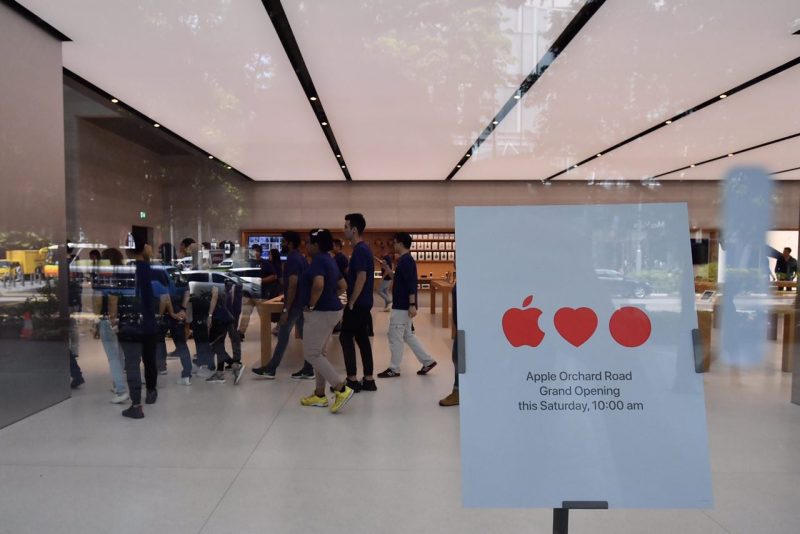
Work on opening the first official Apple retail location in Singapore has been ongoing for well over a year, with Apple confirming the store’s existence in November 2015, the same month it began hiring for the new location. Once it opens on May 27, the store will be open daily from 10 a.m. to 10 p.m. local time.

Apple Orchard Road’s grand opening coincides with the beginning of the company’s new Today at Apple initiative, which kicked off this past weekend. Apple recently celebrated the launch of the educational classes by sharing a collection of photos that show its visitors learning to code, taking pictures, creating illustrations, and producing music all on iOS and macOS devices.
Tags: Singapore, Apple retail
Discuss this article in our forums
Emerson Announces HomeKit-Compatible Sensi Thermostat With Touchscreen
Home thermostat maker Emerson today announced two new smart thermostats, one of which includes a color touchscreen display. The Sensi Touch Wi-Fi Thermostat — along with an updated version of Sensi’s existing Wi-Fi Thermostat — is now compatible with Apple’s smart home management platform HomeKit, for controlling the device using the Apple Home app on iPhone, iPad or Apple Watch, or voice using Siri.
Apart from showing current system temperature and swipe-to-set features, the touchscreen display on the Sensi Touch Wi-Fi changes color to indicate whether the system is heating or cooling, while live humidity tracking keeps users informed about their home’s atmosphere. Meanwhile, smart alerts serve to notify homeowners of extreme temperature changes when detected.
Additional menu options enable users to customize the information on the home screen display and to choose a continuous back glow for soft lighting in dark hallways or rooms. In addition to the touchscreen controls, the thermostat also has illuminated terminals for increased visibility while wiring and easy-click terminals that eliminate the need for a screwdriver.
“As we’ve continued to learn from our customers, homeowners are gravitating toward simple smarthome solutions that make life easier,” said Robert T Sharp, executive president of Emerson Commercial. “Our latest Sensi thermostats combine enhanced capabilities, including support for Apple HomeKit with simple and secure controls, and a sleek new interface with a proven home comfort experience that puts users firmly in control of their environment, anytime and from anywhere.”
The thermostat display functions are mirrored in the accompanying Sensi app, which includes instructional steps for easy do-it-yourself installation, no experience required. Elsewhere, the system supports flexible scheduling for each day of the week, while a geofencing feature allows users to change temperature settings when they leave and before they return to their home.
In addition to the Apple HomeKit integration, the Sensi thermostats are compatible with smart home platforms Amazon Alexa and Wink. The Sensi Wi-Fi Thermostat costs $129.99, while the Sensi Touch Wi-Fi Thermostat costs $199.99 and will be available in the U.S. starting June.
Tag: HomeKit
Discuss this article in our forums
Apple and Visa Sued Over Digital Payment and User Authentication Technology Used in Apple Pay
Apple and Visa have been sued by a small company based in Boston this weekend, which claims that Apple Pay violates 13 patents that it holds related to digital payment systems and user authentication technology. The company behind the lawsuit, Universal Secure Registry, filed the complaint in a Federal District Court in Delaware on Sunday (via The New York Times).
According to the filing, USR chief executive Kenneth Weiss “was the first in the space, and the secure payment technology that he developed goes right to the core of Apple Pay.” Specifically, Weiss’ company is claiming that the 13 patents include details on authentication systems embedded in smartphones, biometric ID confirmation through fingerprint scanning, and the generation of secure, one-time-use tokens in financial transactions.
According to Weiss, he had “extensive meetings” with Visa in 2010 that centered around working together to introduce a mobile payments system into smartphones, which allegedly lead to Visa signing a 10-year nondisclosure agreement with Weiss and his company to be able to use the technology. Weiss said that Visa eventually “dropped further communication without securing a license,” and that any inquiries he wrote to Apple in asking the Cupertino company to license his technology were never answered.
Then, Visa began working with Apple on a partnership that eventually lead to the debut of Apple Pay in 2014, which the lawsuit claims to have been built with the “willful infringement” of USR’s patents. Weiss is now seeking damages in relation to Apple Pay and Visa’s alleged patent infringement, represented by Quinn Emanuel Urquhart & Sullivan, which advised Weiss to file a suit before seeking a license agreement or royalties from Apple or Visa.
This suit seeks unspecified damages, but details the scope of the infringement, claiming, “since 2014 Apple’s backend servers and Visa’s payment processing network VisaNet, including Visa Token Service, have supported and processed transactions made using Apple Pay, including billions of Apple Pay transactions made in the United States.”
“It is not uncommon for large companies to be unresponsive to outside suggestions for innovation or improvements to their product or technology,” said Weiss. “Occasionally, these companies infringe patents and force a patent owner to file a lawsuit as the only way to financially benefit from the technology he invented.”
Weiss founded Security Dynamics and invented the RSA SecurID token system, which is used to secure and authenticate important data sent by major companies, banks, and multiple branches of the United States government. USR is said to hold a portfolio of Weiss’ patents related to the new lawsuit, and also including a few pending applications and foreign patents he has filed dating back to 2000.
Related Roundup: Apple Pay
Tags: lawsuit, Visa
Discuss this article in our forums
HP Envy x360 loses some weight while boosting the specs
Along with updating and refreshing the Spectre x2 2-in-1, HP has given a similar treatment to the Envy x360 convertible, with a fully rotating hinge that lets you choose various positions to place it in.
One of our biggest gripes with the previous version of the x360 was that it was rather large, and we didn’t feel it was the ideal companion for taking on-the-go. While HP may have kept the same 15.6-inch screen, it has managed to take a sizeable chunk off of the bezels to make it much more manageable.
Side bezels have been reduced by 55 per cent, to 6.65mm, while the top bezel is down 25 per cent to 13.9mm. Not only will this bezel trimming make the Envy x360 easier to carry around with you, it also gives the screen more of an edge-to-edge aesthetic.
The keyboard is also edge-to-edge, is fully backlit, has full-size keys with 1.5mm travel and there’s even enough space for a full numeric keypad to the right.
Two versions of the Envy x360 will be available, a Dark Ash Silver model with an AMD A9 or A12 processor, or a Natural Silver model with Intel Core i5 or i7 processor, depending on your configuration. Both will have full HD screens, although Intel-version customers will be able to specify an Ultra HD screen.
Storage can be specified in one of three ways, either a standalone HDD up to 1TB, a standalone SSD up to 512GB, or you can select a dual storage option that combines the two. Every model gets 16GB of RAM.
As with other HP products, the audio on the Envy x360 has been tuned by Bang & Olufsen and connections include a single USB Type-C, two USB Type-A, an HDMI, SD card reader and 3.5mm headphone jack.
Battery life figures differ depending on your processor option, the AMD version will last up to 10.25 hours, while the Intel model extends it to 11.5 hours. However, both have fast charge technology to regain 90 per cent power in 90 minutes.
Pricing and availability for the HP Envy x360 has yet to be announced.
 AIVAnet