


Make your own desktop light show with Corsair’s new Commander Pro controller
Why it matters to you
Corsair’s new lighting system is impressive and heavily customizable, but you’ll have to pay quite a lot for it.
Corsair wants you to take your fancy lighting beyond the RGB keyboard and into your desktop PC. Along with a new range of HD140 RGB cooling fans, it’s also launching a new system of fan controllers headed by the Commander Pro, which lets you not only control your fans with ease but coordinate their lighting, too.
Although desktop interior lighting is hardly a new phenomenon, with the growth of RGB backlighting on keyboards and mice, for many companies, the focus over the past few years has been on peripherals. Corsair is looking to turn the RGB spotlight back on the interior of your system though, with its new range of products.
The Commander Pro is described as the ultimate controller for cooling and Corsair Link-enabled hardware. It’s a small black box that you can hide behind your motherboard tray and it connects up all of your cooling fans in one place. It has two RGB lighting channels, which can handle up to six fans or four LED strips a piece, and there are four thermistor inputs too, for temperature control and automated fan speed adjustment.

The system can control fans from 0 RPM, right through to their maximum, with fine-tuning controls and a number of baked-in lighting configurations. That keeps your system not only looking good, but running cool and most importantly quiet, as and when needed (thanks, Hexus).
You can even partner it up with Corsar Link-enabled hardware, like its all in one liquid cooling systems and power supplies.
If you want to expand the lighting options available to you and your RGB fans, Corsair is also offering a new Lighting Node Pro. It gives you access to some much more impressive lighting effects and custom color combinations for up to 12 fans and eight lighting strips. Four of those come with the Node Pro itself, so system builders and hardware enthusiasts can jump on the fancy lighting train in one bundled package.
The Corsair Commander Pro is available now, straight from Corsair, with a price tag of $70. The companion Lighting Node Pro system is a little cheaper, offering greater lighting options for $60. Each of the new Corsair HD140 RGB fans will set you back a further $35. It’s also available in a smaller, 120mm form factor, with a price tag of $30.
For those not looking for the full fan-controlling system, each fan comes with its own three-button controller, so you can manually adjust their lighting as and when you like.
Researchers uncover hack that can take over PCs via video subtitle files
Why it matters to you
If you’re using an outdated media player and you download a dodgy set of subtitles, your computer could potentially be taken over by a malicious hacker.
Researchers at Check Point Security Labs have uncovered a nasty new hacking technique that takes advantage security deficiencies in several popular media players. The exploit uses phony subtitle files to breach a user’s defenses, at which point it’s possible to gain complete control over the system.
Hackers can apparently create malicious subtitle files that run code when they’re loaded into a media player, according to the report published by Check Point. The company estimates that hundreds of millions of users running software like VLC, Kodi, Popcorn Time, and Stremio could be at risk.
Subtitle files are generally perceived as being harmless, and as such they’re rarely vetted too stringently by media players or antivirus software. The situation is made worse by the fact that there’s little standardization, with over 25 different formats with different features and capabilities currently in use.
Check Point has also determined that subtitle repositories are being manipulated to help distribute the malicious files to users. Subtitles submitted by attackers are having are being boosted in the rankings, making it more likely that they’ll be downloaded by users, and selected by media players that can download such files automatically.
Having discovered these vulnerabilities, Check Point disclosed the problem to the developers responsible for the media players that were tested. Some had already taken steps to address the issues, while others are still looking into the situation. As of the time of writing, VLC and Stremio have been officially updated with a fix, while a fixed version of Popcorn Time is available here, and a fixed source code release of Kodi is available here. There are still concerns that other media players might also be affected.
The key here is that subtitle files are being exploited because they’re widely considered to be innocuous. As soon as users and developers drop their guard, malicious hackers see their window of opportunity — and that’s why the work done by organizations like Check Point is so important.
Macphun to bring award-winning photo-editing apps to Windows
Why it matters to you
Macphun’s photo editing apps have won numerous awards in the Mac App store, and for the first time, the company is bringing them to Windows.
Macphun, the developer of MacOS photo-editing apps, is heading to Windows. The company announced that it is bringing its most popular applications, Luminar and Aurora HDR, to Windows for the first time, with a public beta arriving in July.
The move to Windows was a long time coming, according to Macphun Vice President Kevin La Rue. “A PC roadmap has been in our strategy for a long time,” he confirmed with Digital Trends. “Our goal is to offer as many creatives as possible a simple, powerful, and fun way of photo-editing, no matter what platform they use.”
This is good news for Windows users who shoot high dynamic range (HDR) photos or who have been searching for a simpler, less expensive alternative to Adobe Photoshop for image retouching. Aurora HDR was developed with input from renowned landscape photographer Trey Ratcliff, with the intent of making HDR processing easy and flexible. Digital Trends had the opportunity to test out the program in December 2016 and found it to be both approachable and powerful.
We also spent some time with a beta version of Luminar in November 2016, which we called a “breath of fresh air” in the world of photo editing. That application has also received significant updates since our hands-on test.
Windows users may not have heard of Macphun yet, but the company’s apps have won numerous awards, including Apple’s “Editor’s Choice” recognition in the Mac App store for five years running. Luminar also took home the coveted 2017 Technical Image Press Association (TIPA) award for Best Imaging Software.
While those eager to test drive Luminar and Aurora HDR on Windows will get their chance with the beta in July, the full versions won’t be released until this fall, alongside new versions of the MacOS counterparts. Going forward, both versions will be developed simultaneously. We have new versions of these products already in the pipeline for the Fall of 2017 that will launch simultaneously on Mac and Windows, La Rue said.
“Our plan is to be a cross-platform software company going forward and we are starting with Luminar and Aurora HDR,” La Rue said. For now, the back catalog of Macphun’s other apps will remain MacOS-only.
Google’s latest tool will track offline purchases tied to online ad campaigns
Why it matters to you
Next time you buy something in a brick-and-mortar store, Google might know all about it.
The next time you pick up a discounted undershirt at American Eagle, Google might know. This at the Mountain View, California-based search giant’s annual advertiser conference, it announced a new tool that will allow it to track how much money people spend — and on which products they spend it — in brick-and-mortar stores.
It will tie into Google’s digital advertising business. When the integration launches in earnest this year, the ad clicks of Google Account users will be matched to data about their brick-and-mortar purchases. The company won’t be able to examine specific items purchased or how much a specific person spent, but it will use the collated data to track the effectiveness of online ad campaigns. And eventually, it will give retailers a detailed sales report.
Google’s using login information such as email addresses to identify the people clicking on ads. It matches that data with information from merchants and credit card issuers to determine if digital ads motivated an offline purchase.
It won’t work for all payments. Retail customers who pay with cash or use one of the 30 percent of U.S. debit and credit cards that Google can’t access won’t be tracked. And it only tracks customers who login to Google’s services. But it’s an improvement over the current system, which susses out users’ interests mainly from web searches and the content they consume across the company’s services — including Gmail, YouTube, and Android.
And it’s a veritable firehouse of purchases. Google said it has access to roughly 70 percent of U.S. credit and debit card sales through partnerships with companies that track them.
Google’s insists that it’s taken steps to protect users’ privacy. Sridhar Ramaswamy, Google’s senior vice president of ads and commerce, told the Associated Press that “incredibly smart people” designed the new tool to be “secure and […] safe.” Data’s collected in a double-blind way, he said, meaning that data Google’s collected can’t be viewed by merchants or credit partners.
Google’s hoping the new system will convince merchants to boost advertising budgets. The company, which runs an ad network valued at $80 billion, faces increasing competition from social media juggernaut Facebook. Together, the two companies are projected make up 74 percent of digital ad growth in 2017.
Two months ago, major YouTube advertisers including Coca-Cola, Amazon.com, Walmart, Starbucks, and Microsoft pulled campaigns from YouTube, citing faulty filters that prevented ads from appearing next to homophobic, anti-Semitic, and racist content. In response, Google made changes to YouTube’s advertising terms of service and said it would improve its blend of user flagging, human moderation, and algorithmic detection.
But it’s not all doom and gloom. In the first fiscal quarter of 2017, Google reported growth in ad sales of 19 percent to $21.4 billion.
PlayOn, the DVR for streaming video, now also available as an Android app
Why it matters to you
Not satisfied with the limited number of titles you can download for offline viewing from Netflix? Just check out PlayOn Cloud instead, now available on Android.
It’s been six months since we were first introduced to PlayOn Cloud, a service that allows you to record video from Netflix, HBO Now, and other streaming service providers for viewing offline, and now the service is spreading its wings. After a successful debut on iOS last November, the app is coming to Android, which means that your “DVR for streaming video” can now be accessed regardless of what kind of smartphone you may have. And with 12 popular streaming services to record from, you can rest assured that you’ll never want for content ever again, even if you’re in a Wi-Fi dead zone.
Not only is PlayOn Cloud now available for Android, but it’s also introducing a pretty decent price reduction. Crediting technological advances, PlayOn says that it’s been able to cut the cost of a Cloud recording from 99 cents down to just 40 cents, a drop of 60 percent. You can buy recordings of your favorite movies or programs in packs of 5, 10, and 20 as in-app purchases.
“By offering PlayOn Cloud for both Android and iOS devices and by significantly reducing the cost of recordings, we are affordably offering the ultimate streaming experience — the ability to watch any streaming movie or show anytime, on any device — without worrying about blowing up your data plan or missing a show because it has expired,” said Jeff Lawrence, president and CEO of PlayOn. “This is a game changer for commuters, travelers, users with mobile data caps, and those who don’t want to miss movies and TV shows when they expire from streaming services.”
Recordings you create in PlayOn are kept in your own personal cloud locker within the app for 30 days. From there, you can download recordings directly to your mobile device, PC, or Mac, and enjoy it whenever your heart desires. And thanks to PlayOn’s AdSkip technology, you can watch your recordings without commercials (or at least, skip over them as they come up).
Currently, the PlayOn Cloud Android app lets you record and download all content from Netflix, Amazon, Hulu, Yahoo View, HBO Now, YouTube, NBC, ABC, CBS, FOX, PBS, and The CW. The service promises that even more streaming channels will be added in the near future. Future updates will bring more streaming channels to the app.
Following Intel integration, USB Type-C could be the only port we need
Why it matters to you
In the future all of our gadgets could be powered by and use inputs via a USB Type-C port.
Intel is looking to integrate Thunderbolt 3 support into all of its processors moving forward, in a move which it hopes will bring a new era of USB Type-C standardization to an industry which has a multitude of connectors for different products. Better yet, it will open up the protocol specification under a royalty-free license to further encourage its uptake.
Although there are certainly some problems with trying to create a new standard technology, Intel does have a reasonably solid history of achieving it. It helped develop the original USB standard back in the ’90s, which revolutionized the connection of various peripheral devices to PCs. Thunderbolt 3 is its next attempt to do so, with a reversible, high-power, wide-bandwidth input and output standard.
The future Intel hopes to reach one day is one where everything is run through a singular port type. With that support built into the Intel CPU at the core of a laptop or desktop, the systems can be built leaner, thinner, and lighter. Any of the Thunderbolt ports could power the system, or deliver data to and from it.
While that by itself should aid adoption by third-party manufacturers, in 2018 Intel will open up the protocol specification to a much wider audience, by releasing it with a non-exclusive, royalty-free license. This will allow other chip manufacturers like Qualcomm or AMD to build Thunderbolt functionality into their processors too, further enhancing the uptake of the Type-C standard.
Over the past few years, Intel has worked closely with other companies to enhance Thunderbolt 3 as the worthy successor to traditional USB ports. It teamed up with Apple to co-develop the standard and recently enhanced its device plug-and-play support with Microsoft’s Creators Update for Windows 10.
Moving forward, Intel hopes to see as many as 150 different PC designs supporting Thunderbolt by the end of the year. In the years to come, however, it expects to see more single-cable docking systems for laptops and tablets, as well as faster external storage options, better support for external gaming graphics cards, and higher throughput for virtual reality headsets.
That is, if they don’t go wireless for the next generation.
DJI’s new Spark drone is even better than the rumors led us to believe
Why it matters to you
DJI’s new drone is not only its most user-friendly product yet — it’s also the most affordable.
Putting months of rumors and speculation to rest, DJI — the undisputed king of drone world — finally unveiled its much-anticipated Spark drone to the world today at a press event in New York City.
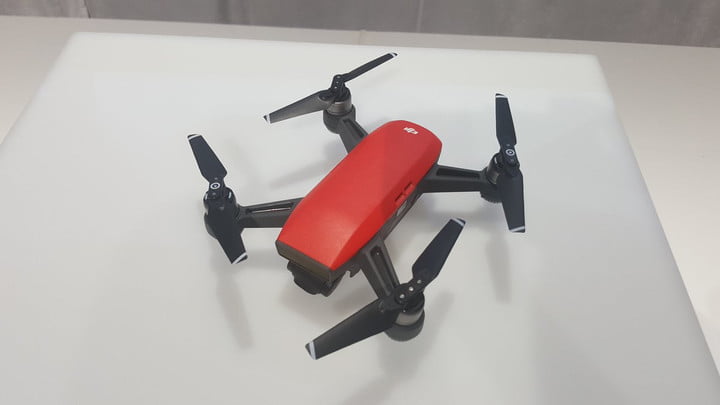
Weighing in at less than a pound and measuring just 5.6 inches wide and long, the Spark is easily the most compact and portable drone in DJI’s product lineup — but don’t let its diminutive size fool you. Despite the fact that it’s just slightly larger than a can of soda, the Spark has plenty of technological muscle under its hood.
In addition to a 16-megapixel camera that shoots video in 1080p at 30 frames per second, the drone also sports a two-axis gimbal. This enables the Spark to mechanically stabilize the camera and cancel out any jarring, shaky movements — ultimately resulting in smoother, better-looking footage. This also gives it a leg up on the competition, as most selfie drovnes only feature single-axis mechanical stabilization.
To complement the camera, the Spark also comes with a wide array of intelligent flying modes. In addition to DJI’s standard offerings like TapFly and Active Track, the drone sports a handful of brand-new modes, such as Rocket (ascent with camera pointing down), Dronie (fly up and backward while locked on subject), Circle (orbit a fixed point), and Helix (orbit outward in a spiral pattern). It also recognizes gestures, and can be controlled via hand gestures — without a controller or smartphone.
As if that weren’t enough, DJI also equipped the drone with a slew of environmental sensors that allow it to sense and react to its surroundings autonomously. On top of the usual GPS and GLONASS positioning systems, the Spark has a forward-facing 3D vision system, which is used for both indoor positioning and obstacle avoidance.

Drew Prindle/Digital Trends
It’s pretty quick, too. According to DJI, Spark has a max speed of 31 miles per hour, and can stay airborne for about 16 minutes on a full charge. Range varies depending on your control style. Using gesture control only, the drone will stay within about 10-20 feet. Using your smartphone to fly gives you about 100 feet of range, and if you want even more distance, an accompanying controller stretches the maximum distance to over 100 yards.
Best of all is the price. You can pre-order the Spark today for just $499. That puts it squarely in competition with popular drones like the Yuneec Breeze and Hover Camera Passport — although on paper, DJI’s drone has significantly better specs. As for a release date, the company expects to begin shipping in June. Find out more here, and stay tuned for our hands-on review!
DJI’s new Spark drone is even better than the rumors led us to believe
Why it matters to you
DJI’s new drone is not only its most user-friendly product yet — it’s also the most affordable.
Putting months of rumors and speculation to rest, DJI — the undisputed king of drone world — finally unveiled its much-anticipated Spark drone to the world today at a press event in New York City.
Weighing in at less than a pound and measuring just 5.6 inches wide and long, the Spark is easily the most compact and portable drone in DJI’s product lineup — but don’t let its diminutive size fool you. Despite the fact that it’s just slightly larger than a can of soda, the Spark has plenty of technological muscle under its hood.
In addition to a 16-megapixel camera that shoots video in 1080p at 30 frames per second, the drone also sports a two-axis gimbal. This enables the Spark to mechanically stabilize the camera and cancel out any jarring, shaky movements — ultimately resulting in smoother, better-looking footage. This also gives it a leg up on the competition, as most selfie drovnes only feature single-axis mechanical stabilization.
To complement the camera, the Spark also comes with a wide array of intelligent flying modes. In addition to DJI’s standard offerings like TapFly and Active Track, the drone sports a handful of brand-new modes, such as Rocket (ascent with camera pointing down), Dronie (fly up and backward while locked on subject), Circle (orbit a fixed point), and Helix (orbit outward in a spiral pattern). It also recognizes gestures, and can be controlled via hand gestures — without a controller or smartphone.
As if that weren’t enough, DJI also equipped the drone with a slew of environmental sensors that allow it to sense and react to its surroundings autonomously. On top of the usual GPS and GLONASS positioning systems, the Spark has a forward-facing 3D vision system, which is used for both indoor positioning and obstacle avoidance.
Drew Prindle/Digital Trends
It’s pretty quick, too. According to DJI, Spark has a max speed of 31 miles per hour, and can stay airborne for about 16 minutes on a full charge. Range varies depending on your control style. Using gesture control only, the drone will stay within about 10-20 feet. Using your smartphone to fly gives you about 100 feet of range, and if you want even more distance, an accompanying controller stretches the maximum distance to over 100 yards.
Best of all is the price. You can pre-order the Spark today for just $499. That puts it squarely in competition with popular drones like the Yuneec Breeze and Hover Camera Passport — although on paper, DJI’s drone has significantly better specs. As for a release date, the company expects to begin shipping in June. Find out more here, and stay tuned for our hands-on review!
Xbox 360 architect is spearheading Microsoft’s quantum computing project
Why it matters to you
Microsoft is taking a unique approach to quantum computing in the hopes of outpacing its competition to become the first company to offer it to you.
After years and years of theoretical research, quantum computing is now well on its way to becoming a reality. In March, IBM unveiled its plans to offer the first commercially available quantum computer and it seems that Microsoft is betting big on its own aspirations for the technology.
Todd Holmdahl is Microsoft’s corporate vice president of next-gen devices. He is perhaps best known for his role in the hardware design of the Xbox and Xbox 360 video game consoles, but his current project puts him at the helm of the company’s burgeoning interest in quantum computing.
“We have line of sight to a commercial product,” Holmdahl told the MIT Technology Review. In some ways, Microsoft is facing an uphill struggle as it attempts to compete with rivals who have spent more time actively pursuing quantum computing. That said, the company is taking a different approach and there is a lot of optimism about the results it could yield.
Researchers have used various different methods in their attempts to create a large-scale universal quantum computer and two implementations — trapped ions and superconducting qubits — have emerged as the most promising options. However, even when the approach at the foundation of a project has been decided upon, there is plenty of work to be done in terms of scaling up.
For instance, the recent IBM Q announcement stated that the company expects to offer a 50-qubit system over the next couple of years and it is expected that quantum computers will need thousands of qubits or more to realize their potential. Even the most promising implementations are hindered by the delicate nature of quantum hardware.
However, Microsoft is carving its own path with an attempt to create the first device that is able to isolate and encode a single bit of data using a subatomic particle known as the Majorana fermion. The team hopes to use this research to create topological qubits, which would be much more resilient and stable than standard qubits.
If it is a success, it could help Microsoft outpace its competition once the necessary groundwork has been laid. Holmdahl is confident that the project will hit the mark, as the 52-year-old told the MIT Technology Review that he expects the company to construct its first topological qubit before he retires.
The race to secure the market for commercial quantum computers has been heating up for some time but with Microsoft doubling down on its efforts, things are about to get even more interesting. Holmdahl’s presence on the project indicates that the company is pursuing a commercial product, rather than just theoretical research and it seems clear that time is of the essence.
Honor adds a display and heart-rate monitor to its $30 fitness tracker
Why it matters to you
Fitness trackers are getting cheaper and while this one may not launch outside of China, we will likely see similar ones in the near future.
Honor is moving a little deeper into the fitness tracking landscape. The company, which is owned by Huawei, announced the new Honor Band A2 — which represents a pretty huge improvement over the original Honor Band.
The device now features a 0.96-inch OLED display, along with a built-in heart-rate sensor, and IP67 waterproof rating. When it comes to metrics, the device is able to track steps, sleep, and exercise — and it will even give you a notification if you have been sitting around for too long.
Of course, the screen is not just for fitness tracking — it will also deliver notifications such as text messages and phone calls. You can also manage those notifications — so you can dismiss or mute notifications quickly and easily. While the 95mAh battery seems small for somewhat used to the 2,000mAh+ batteries in phones, Honor says the battery will last up to nine days.
Perhaps the best thing about the fitness tracker, however, has nothing to do with its features — the band comes at only $30, which is an excellent price for what seems to be a capable device.
Unfortunately, however, the device is not going to be very widely available. It will only be available in China on June 9 and it comes in black, green, white, and red. The device is compatible with both Android 4.4 and above and iOS 8.0 and above — so the vast majority of people with a reasonably modern phone will be able to make use of the device.
The Honor Band A2 is a follow-up to the Honor Bad A1, which was a pretty good band in its own right. Still, it did not feature a display and as such could not really deliver things like notifications. It was also only available in China — so we do not really anticipate the Honor Band A2 ever expanding beyond Honor’s home country — despite the fact that we might not want to.
 AIVAnet