


Let Sony’s favorite developers help pick your next game (updated)
Four years on and the PlayStation 4’s digital storefront is pretty well stocked. But finding more obscure stuff to buy isn’t the easiest and the search function kind of sucks. As a way of addressing that on the store’s web version, Sony is introducing curated lists of games from “the industry’s most creative minds,” dubbed The Creators. PlayStation’s head of worldwide studios Shuhei Yoshida has his picks listed, as does Rocket League studio Psynonix, Street Fighter’s Yoshinori Ono and the Final Fantasy XV team among many, many others.
Like Kotaku notes, there are a lot of repeated games among the lists and self-love from studios here. Guerilla Games’ Herman Hulst is probably contractually obligated to have (the excellent) Horizon: Zero Dawn in his picks, for example, but he also lists the criminally underrated Until Dawn as well. Maybe he just likes games with “dawn” in their titles, who knows.
Where it gets interesting is seeing what indie developers chose. Tom Happ of Axiom Verge fame naturally pulled a few Metroidvania titles like Shadow Complex Remastered and Guacamelee! — the former being the modern game that kicked off the genre’s renaissance. Capy went all in on 2D games with its own Super Time Force Ultra in addition to picking Shovel Knight: Treasure Trove, Broforce and TowerFall Ascension.
It’d be great if this wasn’t just a one-off version of previous lists, and instead became more of a flavor of the week style curation that’d highlight the PS Store’s hidden gems — especially considering just how cluttered the marketplace is.
Will this come to the console version, you know, where people are more likely to peruse the store? That isn’t clear, but we’ve reached out to Sony for more information and will update this post should it arrive.
Update: A Sony spokesperson responded and said that this will indeed be an ongoing thing, but that there isn’t “a firmly established schedule” yet for when the list will refresh.
Via: Kotaku
Source: PlayStation Store
UC Berkeley researchers teach computers to be curious
When you played through Super Mario Bros. or Doom for the very first time, chances are you didn’t try to speedrun the entire game but instead started exploring — this despite not really knowing what to expect around the next corner. It’s that same sense of curiosity, the desire to screw around in a digital landscape just to see what happens, that a team of researchers at UC Berkeley have imparted into their computer algorithm. And it could drastically advance the field of artificial intelligence.

Google’s AlphaGo AI, the one that just repeatedly dominated the world’s top Go players, uses what’s called a Monte Carlo tree search function to decide its next move. Each “branch”, or decision, in that tree has a weighted value that’s determined from previous experiences and the relative rewards associated with them. This is known as “reinforcement learning” and is basically the same way you train a dog: rewarding effective behavior and discouraging the ineffective.
This obviously works well for dogs (all of whom are good) but it does present a significant shortcoming when training neural networks: the AI will only pursue high reward actions no matter what, even to the detriment of its overall efficiency. It will run into the same wall forever rather than take a moment and think to jump over it.
The UC Berkeley team’s AI, however, has been imbued with the ability to make decisions and take action even when there isn’t an immediate payoff. Though, technically, the researchers define curiosity as ” the error in an agent’s ability to predict the consequence of its own actions in a visual feature space learned by a self-supervised inverse dynamics model.”
To train the AI, the researchers taught it to play Super Mario Bros. and VizDoom. As you can see in the video below, rather than blindly repeat the same high value action over and over again, the system plays more like people do with the same basic understanding that there’s more to the game than the wall immediately in front of them.
“In many real-world scenarios, rewards extrinsic to the agent are extremely sparse, or absent altogether,” the study’s authors wrote. “In such cases, curiosity can serve as an intrinsic reward signal to enable the agent to explore its environment and learn skills that might be useful later in its life.”
The implications of this are immense. We’ve already got Google training neural networks to design and generate baby neural nets, researchers at Brigham Young University teaching them to cooperate, and now this advancement enabling AI to teach itself. The pace at which artificial intelligence is getting smarter and more human-like is accelerating. Best of all, it shows no signs of slowing down.
Source: MIT Technology Review
Boeing is building DARPA’s new hypersonic space plane
A few years ago, DARPA started work on a new experimental aircraft project called the XS-1, a vehicle designed to make launching satellites a faster, less expensive endeavor. Today, that project just took a huge leap forward: DARPA has announced that it’s partnering with Boeing to build its next generation hypersonic space plane. Specifically, the aircraft manufacturer has been tapped to complete advanced design work on the XS-1 project, following up on the concept Boeing pitched to the agency during the project’s early stages — which it will now help build and test over the next several years.
In practice, this means Boeing is now building a unmanned, reusable hypersonic jet with the goal of running ten test flights over ten consecutive days by the year 2020 — a program that’s designed to prove that the XS-1 will be able to launch satellites into low-earth orbit on short notice. “The XS-1 would be neither a traditional airplane nor a conventional launch vehicle but rather a combination of the two,” DARPA’s Jess Sponable explained in a press release. “With the goal of lowering launch costs by a factor of ten and replacing today’s frustratingly long wait time with launch on demand.”
The XS-1 will manage this feat by flying to suborbital heights without boosters before deploying a disposable, secondary rocket to push its payload into orbit. Better still, the spaceplane be able to take a second satellite up within hours of delivering the first. Well, that’s the plan anyway — the project is still years away from being finished, and the earliest on-ground engine tests won’t start until 2019 at the earliest. Until then, we’ll have to settle for DARPA’s concept video, which admittedly, is still pretty cool.
Via: Popular Mechanics
Source: DARPA
Ellen coyly hints at return to standup with Netflix special
It’s been over 15 years since Ellen DeGeneres took the stage for a proper stand-up special. With a smash hit daytime talk show, a record-setting Twitter account and bonafide American treasure status, DeGeneres doesn’t exactly need the exposure of another special, but Netflix has been on a hot streak recently, nabbing up standup specials from comedy heavyweights and up-and-coming talent alike. So, the streaming company reached out to DeGeneres on her platform of choice to see if she’d be game for another solo show. Her response? “OK I’m in.”
Looks like it’s been 15 years since you did a stand-up special, @TheEllenShow. How about one for Netflix?
— Netflix US (@netflix) May 24, 2017
Let me think about it. Ok I’m in. https://t.co/kUAdHyXAjS
— Ellen DeGeneres (@TheEllenShow) May 24, 2017
Since this was just a Twitter exchange, there are precious few details about the potential comeback special and no release date to speak of yet. Meanwhile, Netflix is reportedly dropping a lot of cash attracting comedy’s top talent. Deadline Hollywood reports that the company spent $40 million total on a two-part special from Chris Rock last year. The company also released three hours of standup from Dave Chapelle and signed Jerry Seinfeld up for two specials plus a new season of Comedians in Cars Getting Coffee that should drop later this year. DeGeneres, meanwhile, recently launched a digital content network of her own.
Source: Deadline Hollywood
Attackers can use video subtitles to hijack your devices
Be careful before you fire up media player software to play that foreign-language movie — it might be a way for intruders to compromise your system. Check Point researchers have discovered an exploit that uses maliciously crafted subtitles to take control of your device, whether it’s a PC, phone or smart TV. It’s not picky about the program, either — the researchers demonstrated the flaw in Kodi, PopcornTime, Stremio and VLC. The technique isn’t particularly complicated, and relies on a tendency by developers to assume that subtitles are little more than innocuous text files.
As many media player apps download subtitles from repositories they explicitly trust, all it takes is an attacker who sneaks a malicious file into the repository in such a way that you’re likely to download it. An intruder can manipulate a ratings-based subtitle system to push their file to the top, for instance. Combine that with the complexity of the subtitle world (there are over 25 formats, and each media player handles them differently) and you get a plethora of security holes.
The good news: in some cases, it’s fixed. PopcornTime, Stremio and VLC all have updated versions (you can find them in the source link below). However, it’s not guaranteed that your client of choice has a patch ready and waiting. Kodi only has a source code fix available as of this writing. If you’re using another media player with subtitle support, you may want to be careful about using it until you know that the programmers have addressed this exploit.
Via: 9to5Mac
Source: Check Point
Twitter’s live 360-degree videos arrive on Apple TV
Twitter launched its very first streaming app on Apple TV last year with the promise of Thursday Night Football and live sports. Now it’s expanding its television repertoire with even more live content: 360-degree videos. The social media company just announced that it’s adding a Periscope Global Map to its Apple TV app, from which you can then select all kinds of live 360 videos from around the world. After you select a video from the Periscope Global Map, you can then navigate the 360-degree video using the Siri remote.
According to Twitter, 77 million hours of live user-generated video was broadcasted on Periscope in the first quarter of 2017, so it seems you won’t be lacking for content. Also, seeing as Twitter also has live TV apps on Xbox and Amazon TV boxes, it won’t be surprising if live 360 videos appear on those platforms some time soon as well.

This also makes Twitter the very first Apple TV app to support live 360 video, effectively beating YouTube and Facebook to the punch. Yet, YouTube isn’t far behind, as it did announce last week at Google I/O that it was bringing its 360-degree videos to TVs soon. It’s not coming to the Apple TV as far as we know, but Google did announce that it’ll be available for Android TV, Playstation 4, Xbox One as well as 4K TVs from LG and Samsung. It’s not clear yet if Facebook will do the same with its own live videos, but seeing as both Twitter and YouTube already have, it would make sense for it to do it as well.
Source: Twitter
NASA probe on a fast track to reach metallic asteroid
While NASA’s plans to put humans on Mars have suffered recent setbacks, its unmanned robotic programs are achieving milestones on a daily basis. Earlier this year, NASA announced that it had approved a mission, Psyche, to the asteroid belt. Today, the organization announced a shift in Psyche’s launch schedule — with big ramifications.
Psyche 16 is a metal asteroid that may be the remnant of an early planet core. By studying the asteroid, scientists hope to learn more about Earth and the development of planets in our solar system. The mission was originally slated for liftoff in 2023, with arrival at the asteroid Psyche 6 in 2030. However, NASA directed the team to research whether an earlier mission would be feasible. After studying possible trajectories, they determined that launching one year early—in 2022—would shave four years off the spacecraft’s journey. It’s now expected to arrive at Psyche 6 in 2026.
Originally, Psyche was scheduled to have two gravity assists to help it along to the asteroid belt: an Earth flyby in 2024 and another from Mars in 2025. These assists help change the direction and speed of the spacecraft without using engine power. The adjusted trajectory that will occur with an earlier launch eliminates the need for an Earth gravity assist. However, the spacecraft will still require a Mars flyby.
Psyche was chosen as part of NASA’s Discovery program, which is a series of low-cost robotic space missions (capped at $450 million). The target is the asteroid 16 Psych, which measures 130 miles in diameter and is composed of iron and nickel. These are the same elements that comprise Earth’s core, which makes the asteroid of special interest to scientists.
Source: NASA
Apple Releases New Firmware Update for AirPods
Apple today released a new 3.7.2 firmware update for its AirPods, likely introducing bug fixes and performance improvements to the wireless earbuds.
AirPod firmware updates are installed automatically when the AirPods are connected to the iPhone, so AirPods users should begin seeing the new firmware soon as the update rolls out to everyone.
AirPods owners can check the version number in the Settings app by going to General –> About –> AirPods while the AirPods are connected to the iPhone.
Apple did not provide release notes with the firmware update, so it is not known what problems the new software might address.
Though AirPods were first released back in December of 2016, they continue to be in short supply. Shipping times for the AirPods are still at six weeks from the online Apple Store.
Tag: AirPods
Discuss this article in our forums
New iPhone 8 Dummy Video Surfaces as Third-Party Companies Start Developing Clones
Though we’re only four months away from the presumed launch of the “iPhone 8,” we haven’t seen any part leaks for the much-rumored OLED device nor have we seen parts for the two standard LCD iPhones that are said to accompany it.
With a lack of part leaks, we’re relying on dummy units, design drawings, and design renders to give us an idea of what to expect from the device, and there’s been no shortage of those leaks, many of which are somewhat confusing due to the fact that Apple tested several iPhone 8 prototypes.
This week, the first hands-on video featuring an alleged iPhone 8 dummy model surfaced. We already saw the dummy model in question in photographs back in April, but the video provides a better look at the device, and perhaps a better picture of what the iPhone 8 might look like if accurate.
This particular dummy device, said to be a CNC model, aligns with design drawings and rumors pointing towards an edge-to-edge display with a glass body encased in a shiny stainless steel frame. There is no Home button and no visible Touch ID sensor, suggesting it is built into the display, which would be in line with many rumors.
It features a dual-lens rear camera in a vertical orientation and it lacks an Apple logo, so it’s not entirely clear if this is representative of the final design Apple settled on, but it does match up with a lot of the rumors we’ve heard. Alleged iPhone 8 design drawings and schematics that resemble this dummy suggest the iPhone will be thicker than the current iPhone 7 and iPhone 7 Plus.
The dummy device in the video above represents one set of design drawings we’ve seen, but there’s also a second set of design images that have circulated featuring an iPhone with an aluminum body and a rear Touch ID button underneath the Apple logo. The device with a rear Touch ID button is said to be one of the prototypes Apple tested as a fallback should an under-display Touch ID solution not pan out.
Rumors and leaks seem to be coalescing around the first iPhone 8 design without a rear Touch ID sensor, suggesting the images with the back Touch ID button are based on an outdated design that was perhaps scrapped. That it appears unlikely this design will be used in the iPhone 8 hasn’t stopped one China-based company from creating an iPhone 8 clone based on the schematics and design drawings that have been circulating.
Leaker Benjamin Geskin this morning shared images of what he says is an iPhone 8 clone that was designed based on an early iPhone 8 prototype model. It features a front display with slim bezels, a vertical camera, an aluminum body in multiple colors, and a rear Touch ID sensor.
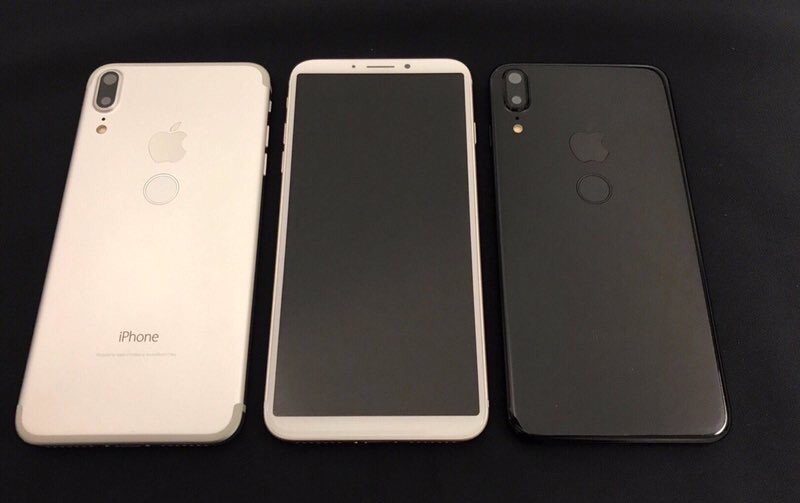
As a clone, this is not representative of what the real iPhone 8 will look like, but it provides an interesting glimpse at prototype design and what an iPhone with a rear Touch ID sensor might resemble.

With multiple prototypes in testing, the actual design of the iPhone 8 will remain unconfirmed and up in the air until we start to see legitimate part leaks. In past years, part leaks have started earlier than May, and their absence may suggest that Apple still has not settled on a finalized design.
For a complete overview of the iPhone 8 rumors and a better picture of what we expect to see included in the overhauled device, make sure to check out our iPhone 8 roundup. It goes into much greater detail on the different design prototypes and it includes information on all of the internal features we expect, like advanced biometrics (facial or iris recognition), an A11 processor, wireless charging, a new front-facing camera system, and more.
Related Roundup: iPhone 8 (2017)
Discuss this article in our forums
Paper Wings is high-flying fun!

Overview:
Paper Wings is a fast-paced arcade game about controlling a papercraft bird to collect coins in an endless run until you miss a coin or die to an obstacle. The difficulty ramps up quickly and the game is fun and has a nice conservationist message built in.
Developer: Fil Games
Cost: Free (with ads)
Impressions:
Paper Wings is a very simple concept on paper (pun intended), with only two buttons that turn your bird left and right to slide it about the screen. You need to rock up and down to facilitate speed and maintain altitude since the bird acts like a paper airplane. The difficulty comes mostly from the lack of control you have over your bird, with the only turning coming from looping around as you’re limited to moving in two directions. To further increase the difficulty, there are also hazards like tracking bombs that are fast and can almost be mistaken for coins.
1 of 8


You have the choice between a large number of real life birds from all over the world to play with, and each one has unique characteristics that change up the gameplay, such as magnets to pull coins or increased power-up times. The different birds all have little biographies about them and where they come from. The game also features a donate option to help support the American Bird Conservancy with donations, which is awesome in its own right.
Conclusion:
I really like Paper Wings, from its cute papercraft visuals to its simple yet challenging gameplay. Its one of the few games I will probably keep on my phone, as I usually delete most of the games I review after I am finished with them. It’s the right mix of short burst play, fun, and polish that makes a mobile game worth playing for me. It’s a
Download Paper Wings on the Google Play Store
 AIVAnet