


Apple Said to Aim for Trial Production of Micro-LED Displays by End of 2017
A new report posted by Digitimes today has taken a look into the micro-LED ambitions of multiple companies, including the timeline by which Apple might begin its trial production of micro-LED displays. Although it’s yet to be confirmed, Apple is likely to use such display technology on a version of the Apple Watch launched in 2018 or later.
The report, citing industry sources, states that Apple’s current aim is to manufacture a “small volume” of products with micro-LED displays towards the end of this year. Reports over the past few weeks have referenced similar timelines for Apple’s micro-LED plans, and today’s news also corroborates the location of Apple’s trial production run, expected to be housed in a plant in Taoyuan, Taiwan.
A few makers engaged in R&D for micro LED display products, despite many technological bottlenecks, are expected to take the initiative to begin trial production in the second half of 2017 at the earliest, according to industry sources.
Apple has been keen in the development of micro LED technology following its acquisition of LuxVue in 2014, and recent market speculations also indicate that Apple is likely to crank out a small volume of micro LED display products from its plant in Taoyuan, northern Taiwan at the end of the year.
Rumors of an Apple Watch with a micro-LED display began last summer, when it was suggested that such a device may launch in 2017, but with the current reports of late-in-the-year trial productions on micro-LED displays it’s likely that the 2017 “Apple Watch Series 3” will continue to use OLED technology. In regards to advantages, devices with micro-LED have the chance to be thinner, lighter, see an improved color gamut with increased brightness, and sport higher resolutions.
Apple’s production on micro-LED is said to be the final realization of its acquisition of low-power microLED-based display maker LuxVue in 2014. Similarly, Samsung has been rumored to acquire micro-LED company PlayNitride, which is expected to begin a trial production on the displays sometime in the second half of 2017. Foxconn has also announced plans to acquire display startup eLux, “for development of next-generation micro-LED display technology.”
Although no direct connection with Apple has been made by the manufacturers, their previous history as suppliers for the Cupertino company points toward either company, or both, as additional micro-LED suppliers for a future generation Apple Watch. According to industry sources speaking on Foxconn’s eLux purchase, “The acquisition could provide a fast track for Foxconn to commercialize micro-LED technology,” bringing it to a wider range of consumer products.
Related Roundups: Apple Watch Series 2, watchOS 3
Tags: digitimes.com, Micro-LED
Buyer’s Guide: Apple Watch (Neutral)
Discuss this article in our forums
Sphero Launches $300 iPhone-Controlled Lightning McQueen From Disney/Pixar’s Cars
Continuing its partnership with Disney, Sphero today revealed its newest iPhone-controlled toy, this time themed after the Disney/Pixar Cars character Lightning McQueen. Sphero calls him the “Ultimate Lightning McQueen,” letting users drive Lightning remotely via Bluetooth by using an iOS or Android application.
Lightning himself has authentic movement and animations which Sphero calls “emotive suspension,” which allows Lightning to perform movie-accurate animations beyond simply driving around. According to TechCrunch, which spoke to Sphero about the launch, “his left and right sides also twitch up and down with excitement, and he’ll speak and move in response to taps on his roof, hood and doors.”
There’s a full LCD display on Lightning’s windshield that animates the character’s eyes, and an animatronic mouth that moves as he talks. During playtime, users can drive Lightning away from them up to 100 feet, and one charge will last around 40 minutes.
Sphero worked closley with Pixar creative director Jay Ward and supervising animator Bobby Podesta, to ensure Lightning’s personality and look was as close as possible to his representation in the movies.
“As our partnership with Disney has evolved, we’ve been able to start to look at further properties within the Disney portfolio,” explained Product Manager Jenica Watts. “One of the teams had the opportunity to build an amazing, lifelike Lightning McQueen.”
This was all supervised by Pixar’s Jay Ward, who’s creative director for the Cars franchise, with advice from Bobby Podesta, supervising animator on Cars 3. The end result is that Ultimate Lightning McQueen has a real sense of personality — enough so that after we’d been charging him for a few minutes in the corner of the TechCrunch New York office, we had to put him to sleep because of his constant demands for attention.
In the iOS app, users will be able to drive Lightning around at speeds of up to 6 mph, with controls enabling reverse and drifting options. The app will allow users to directly interact with Lightning as well, with Sphero saying that there are “more than 150 animations for Lightning to perform.”

Users will be able to string together various animations and voice lines into scripts with an “acting studio,” creating their own miniature Cars storylines. He’ll even offer his own commentary when a Cars movie is playing, thanks to an included microphone that will pick up the film’s audio. The launch of Ultimate Lightning McQueen coincides with the upcoming release of Cars 3 in June.
Those interested can purchase their own Ultimate Lightning McQueen from Sphero’s website today for $299.99.
Tag: Sphero
Discuss this article in our forums
Comcast tries to shut down pro-net neutrality site
Internet advocacy group, Fight for the Future, says Comcast sent it a cease-and-desist order demanding the group take down Comcastroturf.com on the grounds that it violates the company’s “valuable intellectual property.” The site appeals for help identifying what it claims are fraudulent comments posted on the FCC’s own site, supporting FCC chairman Ajit Pai’s plans to rollback net neutrality rules. Many comments have already been flagged as spam, or posted under people’s names without their permission. (It’s not the first time something like this has happened.)
Evan Greer, Fight for the Future’s campaign director, said that the cease-and-desist order is indicative of why net neutrality is needed: “If Ajit Pai’s plan is enacted, there would be nothing preventing Comcast from simply blocking sites like Comcastroturf.com that are critical of their corporate policies.”
Fight for the Future is protesting the FCC’s moves to overturn the reclassification of broadband internet. The change, back in 2015, formed the rules for protecting net neutrality; that ISPs should treat all data served to customers at equal speeds and uncensored — rules that were sometimes dodged.
Comcast told the Daily Dot that it “supports strong, legally enforceable net neutrality rules and does not and will not block websites or content.” The cable and internet company says it’s an outside vendor that’s responsible for monitoring websites that uses its brands without authorization. This vendor then routinely sends out notices to suspicious sites. The statement added that the site in question raised other legal issues, as it asked for user details and that the site didn’t have a privacy policy.
The cease-and-desist order itself is innocuously worded, stating that Comcastroturf’s name is “confusingly similar” to Comcast. (There are more confusing similarities in tech.) The notice added that the company wants the site turned over to it, or it will proceed with legal action. Comcast said that it doesn’t currently plan to proceed with legal action.
Nintendo’s Switch has a retro gamepad option thanks to 8Bitdo
If you’ve got a Nintendo Switch and an 8Bitdo gamepad lying around, there’s good news: the two can now play together. 8Bitdo has released a firmware update that will let its entire controller family connect to Nintendo’s hot new console. That includes the NES30 Pro, FC30 Pro, NES30, Zero and N64 controller, all styled in homage to classic Nintendo models.
You don’t get vibration, rumble, NFC and motion control like you do with the included Joy-con or Switch Pro controllers. However, 8Bitdo models are well-regarded for their design and build quality and no one can deny the retro appeal. Prior to the firmware updates, all models were only compatible with Windows, Android, macOS and Steam.
Many gamers that bought an 8Bitdo pad probably did so because they’re Nintendo fans, so it’s pretty likely that they also have a Switch. With the new release, all they’ll need to do is download and install the free firmware, making the devices a lot more valuable — which is nice, since they’re not exactly cheap.

The 8Bitdo family are some of the very few third-party controllers available for the Switch. If you’re concerned about how well it plays with Nintendo’s hardware, one user on the /r/NintendoSwitch Reddit forum said “Switch support is a fucking dream,” and another added that it “works flawlessly.”
Via: Nintendo Life
Source: 8Bitdo
The new Nokia 3310 is too basic for 2017
Nostalgia’s a funny thing. It makes us leave the house in the dead of night to imprison a wild Clefairy and scramble over each other to buy an NES Classic Edition decades after we sold our original consoles for a pittance at yard sales. Companies are always finding new ways to push our sentimental buttons, and for HMD Global, that means launching a new Nokia 3310 more than 16 years after the original made its debut in 2000. But does anyone really have fond memories of a cellphone that was only good for calling your dad to come pick you up from school?
Aside from having a similar shape, the new Nokia 3310 is “streets ahead” of its namesake, with features my 15-year-old self could’ve only dreamed of. A 2.4-inch (240 x 320) color display, for instance, though it’s barely visible in direct sunlight. And how about that 2-megapixel camera with flash? It’s pretty bad, and you have to move snaps over to a PC to view them at an acceptable resolution, but it’s better than nothing, which is exactly what you got with the original 3310.
Then there’s the FM radio and MP3 player, MP3 ringtone support, voice note recorder, calendar and weather apps. The device has a video player, too, which doesn’t immediately make sense, besides playing back clips recorded through the 2MP camera. But there are websites that let you easily convert YouTube videos in 3GP format, which you can then bung onto a microSD card — yep, the new 3310 has a microSD slot — and watch through the player. Elaborate, I know, but it works.
Even some of the simplest features on the new 3310 would’ve looked alien on a phone at the turn of the millennium, like the loudspeaker and 3.5mm headphone jack, let alone Bluetooth support for pairing wireless headphones and speakers. Having had no experience with feature phones for as long as I can remember, I’m relatively impressed with everything the new 3310 is capable of.

You’ve got the basic Opera Mini WAP browser for web surfing, though most websites are a mess of unreadable text as they try to render on the tiny display. You can still check your Gmail at a push, and there are simple apps available for Twitter, Facebook and Facebook Messenger that scale appropriately to the conservative resolution. Doing anything online is long-winded and frustrating, however, because you’re forever waiting on the sluggish 2.5G connection (there’s no WiFi to speak of, unfortunately). It’s the worst, and a sobering reminder of everything we take for granted in the 4G smartphone era.
But it works both ways, because the new 3310 embodies some of the user-friendly things we’ve long forgotten about. Remember when your phone would last a whole week without needing to be recharged? Or when your phone wouldn’t shatter into uselessness at the mere suggestion of a 3-foot drop? How about the feeling of real feedback you only get with the glorious click of physical buttons? On a related note, predictive text is awfully accurate considering one key press can be any of three or four letters — not that I want to go back to the pre-full keyboard days.


In various ways, the new 3310 harks back to simpler times, but it also misremembers some important details. How dare HMD even call this a 3310 when you can’t replace the front and back shells? The scope for customization was one of the best things about the old model. Back then, a couple of bucks would buy you a shiny metallic peach number with spring-loaded keypad cover and, naturally, infinite cool points. Now you’ve only four colors to choose from: yellow, red, blue and gray. Boring …
Also, there’s some strange new abomination of Snake made by Gameloft that’s barely recognizable from the semi-infinite arcade game of old. It’s colorful and has levels, power-ups and a choice of control schemes (I don’t like change). Worse yet, there’s no ringtone creator, which was part musical instrument, part game, and the perfect way to wind down after an intense Snake session on the school bus.

All things considered, I really have no clue who HMD Global is making this phone for, and for what reason anyone would legitimately buy one. I almost understand why the new 3310 ended up being the biggest announcement at this year’s Mobile World Congress conference. There’s nothing like a retro product to whip the internet into a frenzy. All HMD had to do was recycle the 3310 name, and you’ve got people like me writing amusing headlines and people like you excitedly sharing memories from your old 3310 days in Facebook shares.
But having used the new 3310 as my primary phone for the best part of a week, I’m not all that interested in pseudo-reliving the Nokia heydays. It’s small and light, colorful and cute, but think about all the apps you use on a daily basis. There’s no loading up Google Maps to navigate an unfamiliar part of town, or checking train times. No WhatsApp or Instagram or Tinder or Spotify or YouTube. I quickly learned I couldn’t copy my Google contacts onto my SIM card so the 3310 could read them. IPhones simply don’t have that functionality these days. And the only SMS messages I receive are takeaway-restaurant spam, so prepare to be completely unaware of what’s going on in your group IM chats.

What’s more, the new 3310 is expensive for what it is. The phone launches in the UK today for £50, or roughly $65. You can buy smartphones for that kind of money — not attractive, powerful devices running the latest version of Android, but fully fledged smartphones from the likes of Alcatel, ZTE and Archos all the same. And if you really, really want a basic phone — a don’t-mind-losing “festival phone,” for example, though I’m sure this use case is just an urban myth — then grab a Nokia 216 from Carphone Warehouse for £29. It runs exactly the same Nokia Series 30+ software, so it does everything the new 3310 does plus you get a front-facing camera. In short, it’s both better and cheaper.
Now, it’s all well and good for me to throw shade at the new 3310 for its limited functionality, but I’m well aware that feature phones are still very much relevant in some parts of the world — HMD is planning to launch the phone worldwide, but whether the company will actually get around to releasing a model that supports North American 2G bands is still up in the air.

According to Strategy Analytics, almost 400 million feature phones were shipped last year, with over 35 million bearing the Nokia name. But if you look at a particularly popular market like India, where feature phone sales outpace those of smartphones, the new 3310 is still confusing. It recently launched there for 3,310 rupees (roughly $50/£40), but a quick look on Amazon India tells me you can get the better Nokia 216 for 2,494 rupees. It’s a no-brainer.
There are other forces at play here, though. Finnish firm HMD Global acquired the rights to use Nokia’s name only on certain products this time last year, so it’s still pretty fresh in the public consciousness — not ideal when you’re trying to drum up interest in a new range of Android smartphones bearing Nokia logos, especially after Microsoft’s failure to make a success of the Lumia brand. Whichever way you look at it, the new 3310 just isn’t applicable in 2017. But as a master class in brand-awareness marketing? Mission well and truly accomplished.
Samsung’s cheaper, cuter Gear 360 cam arrives May 25th
Samsung’s updated Gear 360 is almost here — you’ll only have to wait one more day to be able to get it in the US. The 360-degree camera will be available tomorrow, May 25th, in store and online from Best Buy and its website, Amazon, AT&T, Sprint, T-Mobile, Verizon, US Cellular, Samsung’s website and through the ShopSamsung app. In addition to being cuter than its predecessor, it can also capture real 4K videos and has the ability to livestream 360-degree footage at 2K resolution through a compatible phone, including newer iPhones. Even better, it’s also cheaper at $229 — the older Gear 360 was priced at $350 when it launched stateside, though you can get one from Amazon these days for around $160.
The updated camera isn’t without its faults, though. When we took it for a spin in March, we found its base less stable than the older one’s tripod legs. Also, it has a smaller battery than its older sibling, which translates to shorter battery life. If you still dig it despite those and you’re also looking to buy a Galaxy S8 or S8+, take note that you can get the new Gear 360 for only $49 if you also buy one of the Korean conglomerate’s latest flagship devices from May 25th to June 19th.
Garmin Announces ‘VIRB 360’ Camera With iPhone-Compatible Mobile Editing and AR/VR Support
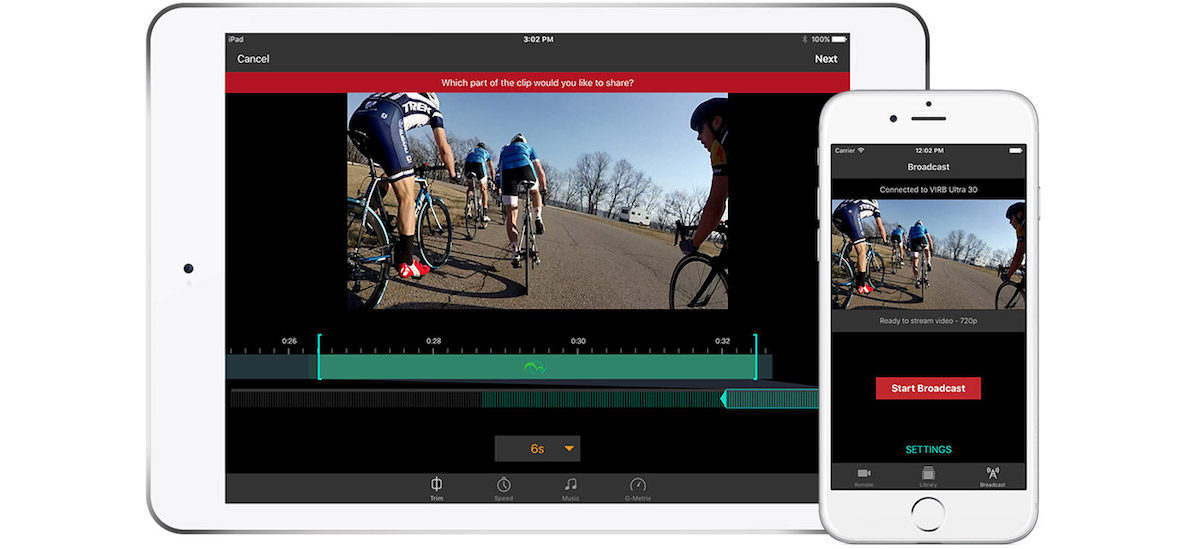
Garmin today announced a new 360-degree camera called the “VIRB 360,” which is compatible with a connected iOS app that allows users to edit, stabilize, share, live stream, and add data overlays to videos. The $799.99 compact camera itself captures video up to 5.7K at 30fps, and has a quad microphone set up so audio is captured from every direction as users record content.
The VIRB 360 is waterproof up to around 30 feet, and works with Garmin’s mounts as well as other standard camera mounts and attachments, and the company said it can shoot more than one hour on a single charge. The device’s screen was specifically designed to be read in the sun, so users can easily find the camera’s battery level, storage, mode, and connectivity indicators anywhere outdoors.
The device ensures that videos won’t be shaky as well, thanks to 4K spherical stabilization that automatically smooths out quick movements and vibrations so users don’t have to worry about keeping the VIRB 360 steady when recording. The in-camera stitching feature — which automatically combines video captured by the device’s dual lenses — captures video in a resolution of up to 4K/30fps.
“The VIRB 360 lets you relive personal experiences and share them with your friends – from a different point of view, every single time,” said Dan Bartel, Garmin vice president of global consumer sales. “VIRB 360 owners will no longer need to worry about trying to capture the perfect angle or setting up the perfect shot. The camera’s easy-to-use feature set will make even the most inexperienced users look like experts.”
In addition to videos, the camera can take auto-stitched, 360-degree, 15 megapixel spherical photos with modes including single capture, burst shot, and time lapse. All of the content that the VIRB 360 creates is compatible with most virtual reality headsets, so users can relive their own footage in VR. There’s also an augmented reality feature that includes various data overlays — barometer, elevation, GPS, etc. — placed on top of a video.
Users will be able to control the camera through voice commands that tell the device when to start or stop recording, switch capture modes, or even remember a specific moment in a video so it can be easily discovered later. The VIRB 360’s voice control system is awakened by the statement, “OK Garmin.”
The VIRB Mobile app [Direct Link], as well as the desktop-based VIRB Edit software, lets users edit, stabilize, share, and add data overlays into videos. Once an iOS or Android device is connected, it can be used as a remote control for the camera with live 360 degree video feeds appearing on the smartphone, or users can even instantly view the content live in VR with compatible headsets. Live streaming to YouTube and Facebook is available only on iOS devices.
Garmin hasn’t announced a specific launch date yet, but the company confirmed that the VIRB 360 camera will debut sometime in June, costing $799.99. More information about the camera can be discovered on Garmin’s website here.
Tag: Garmin
Discuss this article in our forums
Lightweight Smacircle ebike can be folded up and stored in your backpack
Why it matters to you
If you’re in the market for an ebike, then take a moment to check out the wacky-looking Smacircle.
Claiming to be the world’s most compact and lightweight ebike, the Smacircle sports one of the most striking designs we’ve ever seen for such a machine.
Looking from some angles like an elaborately designed pair of (very large) spectacles, the ebike’s strong carbon fiber frame tips the scales at just over 15 pounds (7 kg) and can handle anyone weighing up to 220 pounds (100 kg). Handily, the Smacircle folds up into such a tight package (and in just 10 seconds, apparently) that you can drop it in a backpack once you reach your destination, or carry it straight into your home or office.
Bikes like the Smacircle are often popular with folks with short commutes between a station and the workplace, with its top speed of 12.4 mph (20 kmh) likely to save you a decent amount of time than if you were to walk the route.
Of course, one of the burning questions for any potential ebike buyer is: “How long can I ride it for?” The Smacircle promises a one-hour ride at top speed, and twice that at 6 mph. The bike’s Samsung lithium-ion battery, tucked away in the seat, takes about 2.5 hours to fully recharge. Run out of juice mid-ride and you’ll have to carry it or shove it in your bag as there’s no manual ride option, though of course if you’re on a slope you’ll be able to coast down it.

An iOS and Android app lets you monitor battery usage and speed via your smartphone, which you can slot in the center of Smacircle’s handlebars. Speed is controlled via the app or handle, while other features include electronic brakes and built-in lights for night riders.
Shenzhen-based Smacircle recently smashed through its $30,000 funding goal on Indiegogo and is gearing up for an October release. Back the project to the tune of $649 and besides the ebike you’ll also receive a backpack to carry it in. The deal represents a 57 percent saving on the expected retail price.
As with any crowdfunding project, there are risks and challenges involved. Smacircle’s creator sounds confident it can make its bike a reality, although accepts that “unforeseen obstacles can arise during any manufacturing process.” It certainly looks promising, and it’s the kind of bike we’d definitely like to take for a ride to see if it really does deliver on all its promises.
Polar’s A370 fitness tracker monitors you whether it’s marathon day or bedtime
Why it matters to you
Whether you’re running a marathon or in a deep slumber, Polar’s A370 fitness tracker has you covered.
Leave it to Polar to announce a new fitness tracker that’s affordable yet comprehensive. On Wednesday, the 40-year-old fitness company took the wraps off the A370, a compact tracker with activity-recording features, a wrist-based heart rate monitor, sleep tracking, and much more.
The A370 boasts a color touchscreen display and vibrating notifications, but its heart-monitoring sensor is the real draw. It works in tandem with the A370’s “3D” accelerometer to detect pulse-pounding activities like walking and running. When you’re engaged in intense exercise, it captures heart rate at a higher resolution, and when you’re inactive, it ratchets down the heart-rate readings to save battery.
That heart data feeds the A370’s companion app, Polar Flow, which packs in Polar’s Smart Coaching, Activity Benefit, Smart Calories, and Training Benefit features.

Polar Sleep Plus, Polar’s sleep-tracking solution, uses a smart algorithm and data from the A370’s 3D accelerometer to record the timing, amount, and quality of sleep based on your position and wrist movements. Polar Sleep Plus uses those and other metrics — including the total duration of sleep, actual sleep time, when you fall asleep and wake up, and any interruptions that occur during sleep — to generate a “continuity” score that shows how long you slept uninterrupted.
“We spend a third of our life sleeping, so if you’re trying to gain holistic insight into your fitness, it’s equally as important to monitor and understand our bodies at rest as it is to understand them during physical activity,” Marco Suvilaakso, chief strategy officer at Polar, said in a statement. “With Polar Sleep Plus and [the A370], your data is analyzed to provide guidance that helps you better understand your sleep habits and the impact they have on your fitness, health and quality of life […] Polar A370’s continuous heart rate monitoring, coupled with Polar Sleep Plus insights, provides a 24/7 approach to fitness with actionable steps, whether you’re running, lifting weights, or home relaxing.”


The Polar A370 does more than track sleep and heart rate. Its 3D accelerometer can estimate running speed and distance when you’re on a treadmill or track. And it pairs with other compatible Bluetooth devices to track pace, distance, and route.
The Polar A370 begins shipping in early June for $180, and is available for pre-order starting today. Interchangeable bands in black, white, red, petrol, blue, and orange are $25 each.
Acer has a crazy large curved monitor for PC gamers for a crazy high price
Why it matters to you
Acer wants only the best for PC gamers, and has produced a huge curved desktop monitor that should give customers plenty of bang, but for plenty of bucks.
The latest entry from Acer in the PC gaming arena is the new Predator Z35P, a 35-inch curved desktop monitor packing a hefty 3,440 x 1,440 resolution. Available for pre-ordering now, the panel will cost a hefty $1,100 when it ships to retailers in the United States later this month. The panel originally launched in a few other countries overseas in early May.
Acer’s new desktop panel has an 1800R curvature, meaning that if the monitor created a complete visual circle, then the radius would measure 1,800 millimeters. This curvature appears to be the standard as of late, as panels with lower curvatures (like 3000R) are more expensive to make. Acer’s new panel is expensive as it is due to the screen size and 21:9 aspect ratio.
Here are the specs for Acer’s upcoming curved panel:
Screen size:
35 inches
Panel type:
Vertical Alignment
Backlight tech:
LED
Screen resolution:
3,440 x 1,440
Aspect ratio:
21:9
Pixel pitch:
0.34mm
Viewing angles:
178 degrees
Response time:
4ms
Max refresh rates:
100Hz (DisplayPort)
50Hz (HDMI)
Color support:
16.7 million colors
Color space support:
sRGB 100 percent
Contrast ratio:
2,500:1
Max brightness:
300 nits
Ports:
1x HDMI 1.4
1x DisplayPort 1.2
5x USB 3.1 Gen1 (1x Up, 4x Down)
Audio:
2x nine-watt speakers
True Harmony customized equalizer
Tilt angle:
-4 degrees to 35 degrees
Swivel angle:
20 degrees
Max adjustable height:
5.12 inches
For starters, Acer’s new desktop monitor relies on Vertical Alignment (VA) panel technology. This is essentially a compromise between two technologies: the older, generally used Twisted Nematic (TN) tech offering extremely high brightness levels and fast response times, and In-Plane Switching (IPS) tech providing rich colors and wide viewing angles. VA tech has better color and better viewing angles than TN panels, and better brightness levels than IPS panels.

Adding to the panel type is support for Nvidia’s G-Sync technology. When paired with a PC packing a supporting GeForce graphics chip/card, this technology will synchronize the output frame rate of the GeForce chip with the refresh rate of the monitor. This prevents the screen from tearing, stuttering, or exhibiting visual input lag produced when the two devices aren’t in sync. On top of that, Nvidia Ultra Low Motion Blur minimizes “ghosting” and motion blur during fast movements on-screen.
Of course, Acer’s new monitor includes proprietary technology to make the most out of the user’s visual experience. For instance, the Acer VisionCare suite reduces screen flicker, and reduces both the amount of brain-frying blue light and the amount of on-screen glare. There’s also a sensor that will adjust the brightness and contrast based on the ambient light conditions.
For gamers, Acer throws in its GameView technology. Accessible from the hotkeys on the monitor, GameView enables users to activate on-screen crosshairs when those available in-game just don’t cut it. Users can also adjust the darkness levels to better see in the shadows, and make precise color adjustments. Users can even save their customized settings in three profile slots.
To pre-purchase Acer’s new curved 35-inch Predator Z35P desktop monitor, head over to Amazon here.
 AIVAnet