


Mophie’s Juice Pack for the Pixel XL adds Qi wireless charging
Just because you chose Google’s Android over every other rendition doesn’t mean you should be left out of the wireless fun.
Mophie has concocted a clever solution for those of you who may adore your Pixel XL smartphones, but have been secretly ruing the day you abandoned your wireless charging privileges. The newly released Juice Pack case for the Pixel XL not only tacks on an additional 2950mAh battery, but it also adds Qi wireless charging capabilities.
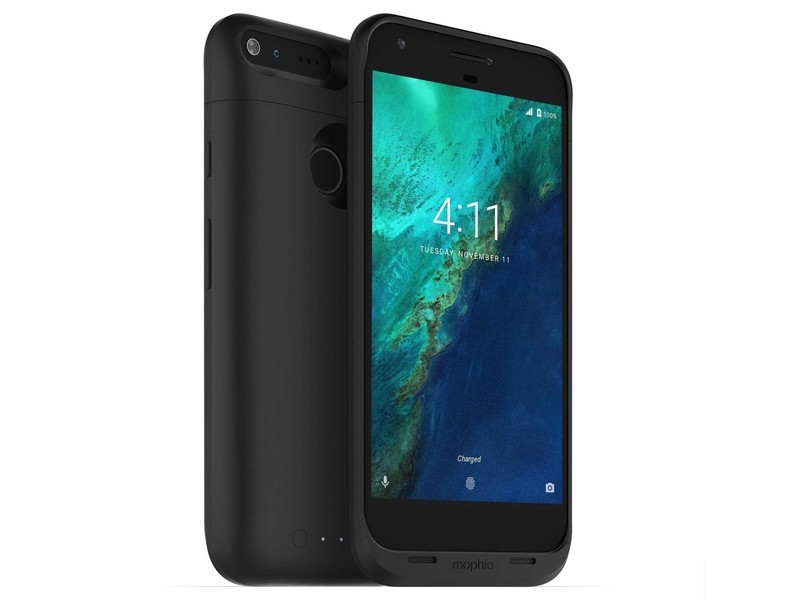
The Juice Pack offers protective covering and up to 50 hours of additional talk time, claims Mophie. You can charge both the battery pack and the Pixel XL’s internal battery via a Qi wireless charging pad, though Mophie also mentions compatibility with “other wireless systems.” If you need even faster charging, you can plug in a USB Type-C cable instead and Juice Pack will prioritize re-juicing the Pixel XL first.
Perhaps the only drawback of the Juice Pack is that it tacks on an additional 3.8 ounces to your current load, making the Pixel XL an even bigger device. But if you need the extra energy and like the idea of tapping to charge, the Mophie Juice Pack for the Pixel XL sells for nearly $100.
See at Mophie
Is Amazon’s checkout-less grocery store coming to the UK soon?
Remember Amazon Go? Well, Amazon might bring it to the UK.
The online retailer could soon export its experimental checkout-less grocery store to the UK, if a recent trademark registration of “No Queue. No Checkout. (No, Seriously.)” is to be taken seriously. The slogan mirrors ones used by Amazon when it introduced the first Go store last December. Amazon even has similar trademarks currently going through the European Union’s Intellectual Property Office.
Amazon began testing a grocery store with no checkouts and no cashiers in downtown Seattle last year. But the store is only open to Amazon staff. It allows customers to walk in, grab items from the shelves, and walk out – without having to stand in a checkout line or cash out at a register. Amazon has been using the tagline “No Line. No Checkout. (No, Seriously.)” when marketing Go stores in the US.
- Alexa is now available on Fire tablets in the UK
- Amazon Echo Show: Release date, price and everything you need to know
- Amazon now offers an even better Fire tablet for kids
There are rumours that Amazon hopes to one day open 2,000 grocery and convenience stores across the US. The Go-branded stores might even have multiple formats, allowing Amazon to better rival Target and Walmart. But, up until now, we’ve heard nothing but Amazon’s plans of expanding Go internationally. We’ve therefore contacted Amazon for a comment and will update you when we know more.
The Amazon Go experience is meant to make shopping less tedious and time-consuming. The system uses machine learning, sensors, and artificial intelligence to track items you pick up in the store and then it adds those items to a virtual cart in Amazon’s app. Once you have everything you want, you can just go, and Amazon will charge you accordingly. It calls this process “Just walk out technology”.
Keep in mind Amazon already offers online grocery ordering and delivery in select areas in the UK.
- Can I get Amazon Prime Now one-hour deliveries in my area?
Pittsburgh is falling out of love with Uber’s self-driving cars
Pittsburgh was the initial test city for Uber’s self-driving car initiative. While our experience in one of the autonomous vehicles was thankfully pretty safe, it wasn’t long before reports of accidents and wrong-way driving began to surface during the first month of the operation. Nine months later, the relationship continues to sour, according to a report in the New York Times. The things Uber promised in return for the city’s support — including free rides in driverless cars, backing the city’s $50 million federal transportation grant and jobs for a neighborhood nearby Uber’s testing track — have not materialized. The situation was an issue during the mayoral primary, too, with critics calling out incumbent Bill Peduto for not getting these agreements in writing from the ride-sharing company.
Uber responded to the criticism, telling the Times that it has created 675 jobs in the greater Pittsburgh area and has contributed to local organizations. However, one high-profile pastor near Uber’s test track said that he’d given Uber a list of potential candidates for jobs at the site, but was told to send them through the regular job portal. According to the Times, none of these individuals, including a mapping engineer and other technicians, have been hired. Uber told the Times that while it was open to a deal with the city, it was still waiting for a draft proposal from local officials.
Uber’s problems don’t stop at the Pittsburgh city line, of course. The company continues to fight a lawsuit around alleged stolen tech, its drivers are dissatisfied with new fee structures and even Elon Musk turned them down for a partnership in self-driving cars. The company also had to halt its autonomous program in Tempe, Arizona after a car crash. Ford has reportedly invested $1 billion in a Pittsburgh-based self-driving car startup, which could meet more of the city’s need for written agreements and data sharing. The current Uber initiative in Pittsburgh may have raised the profile of the city as a technology-friendly town, but this new falling out is yet another example of the turmoil surrouding the company.
Source: New York Times
Facebook is dealing with a massive revenge porn problem
If it wasn’t already apparent that Facebook faces a lot of challenges when grappling with sensitive material, it is now. As part of a slow but steady file leak, the Guardian has revealed that Facebook has faced at least one recent surge in revenge porn and sexual extortion cases — 54,000 potential cases just in January. The company ended up disabling over 14,000 accounts involved in these disputes, 33 of which involved children. It’s not clear how this compares to other periods (Facebook doesn’t divulge specific figures), but that’s no small amount.
The company’s Global Policy Management head, Monika Bickert, is quick to acknowledge that this isn’t an easy problem to solve. She notes that Facebook uses image screening to catch some of these instances and seeks to “constantly review and improve” its policies, but points out that these are “complex areas.” Facebook is “determined to get it right,” Bickert says. A Guardian source adds that Facebook’s moderators tend to “make [the] most mistakes” with sexual policy due to its “very complex” nature.
Some of Facebook’s steps to address its overall content monitoring are likely to help here. For example, it’s hiring 3,000 new moderators on top of its existing 4,500 — that could help staff devote more time to each case and reduce the chances that a violator will slip through the cracks.
The policy itself doesn’t make things easy, though. Like in other areas, Facebook is trying to straddle the line between freedom of expression and protecting users, and you might not always be happy with its approach. It’ll allow “moderate” portrayals of sexuality, including clothed simulated sex and pixelated acts, but not overt imagery or digitally created nude art. You can post generic expressions of sexual desire (including some raunchy language), but you cross the line when you target a specific person or go into detail. And you’re technically allowed to solicit sex, but only if you avoid clearly outlining the acts.
Confused yet? You can see the problem. While Facebook is undoubtedly aware that it risks being heavy-handed, there’s some wiggle room as to what constitutes an offense. You could rightly argue that revenge porn isn’t that ambiguous (is it a photo shared without consent for the purposes of titillation? Then it’s wrong), but it’s easy to envision situations where a post is technically allowed but might be offensive to most people, such as expressing some non-specific lust in the comments on a photo. Until Facebook has spent more time refining its methods, you could see some troublemakers go scot-free.
Source: The Guardian
Copyright troll lawyer is finally disbarred for fraud
While it is illegal to download copyrighted files from file-sharing sites, it is also against the law to extort downloaders. John L. Steele, a Chicago lawyer who pled guilty to perjury, fraud and money laundering resulting from alleged “honeypot” schemes, has just been disbarred by an Illinois court. Both Steele and his law partner, Paul Hasmeier, were indicted last March for uploading porn videos that they acquired through sham companies in the West Indies and then suing whomever downloaded them, resulting in a staggering $6 million in settlement fees. That’s quite a honeypot.
According to the Cook County Record, Steele’s law firm, Prenda, would use court subpoenas to find out who had downloaded the pornographic content — some of which they filmed themselves — and then allegedly pressure the downloaders for settlement money in exchange for dropping the suit. Profiting from such extortions without disclosure is what led to a US district judge sanctioning Steele and Hasmeier in 2013, as well as passing the case along to the FBI. Hasmeier’s case is still pending, though his law license was suspended in 2016.
Via: TorrentFreak
Source: Cook County Record
‘Far Cry’ is coming to America
Up until today, all of the Far Cry games have been set in far off locations. A tropical island, Africa, another tropical island, the Himalayas and prehistoric times have all played witness to the franchise’s often morally ambiguous open-world first-person shooter. But now, the franchise is heading stateside. Series overlord Ubisoft has started teasing the next game in the franchise with a live-action trailer, as one does, and while there isn’t a lick of CGI or gameplay, the 41-second clip does do a great job setting the game’s tone.
We see a flock of birds rustled from their perches as a man screams somewhere offscreen, an ambling river, another man running through a verdant field and then, we hear a church bell ringing. Except it isn’t a pastor clanging the bell, but someone knocking it about with another, possibly freshly deceased, person’s head. Yeah, Far Cry 5 will almost assuredly be rated M for Mature when it comes out.
If font of the “Welcome to Hope County, Montana” text didn’t clue you in to the modern setting, watching the clip a few more times might. There’s a propane tank sitting next to said chapel, power lines, grain silos and if you pause at the 27-second mark, you can see what looks like a high-powered rifle on the bell-ringer’s back. A few weeks ago, some theorized that due to filming the teaser in Montana, that the game would be set in the Old West as a way to compete against Rockstar’s forthcoming Red Dead Redemption sequel. Guess again.
So, what exactly makes Far Cry, well, Far Cry? Making wallets out of the animals you kill, an open world, moral quandaries and playing the errand boy for two rival factions, it’d seem. Perhaps we’ll find out more later this week when Ubisoft drops the announcement trailer on the 26th. Given the state of AAA video game PR plans and E3 being just around the corner, maybe don’t expect to see gameplay come Friday though.
Source: Ubisoft (YouTube)
YouTube TV now works on Apple TV over AirPlay
If you’re the rare YouTube TV subscriber who finds yourself stuck in an Apple household, there’s good news for you. The streaming TV service’s iOS app just got upgraded with AirPlay support, giving you a quick way to shoot whatever you’re watching over to an Apple TV. Sure, an actual Apple TV app (or really, any streaming box app) would be nice, but it’ll likely be awhile before Google gets those out. That’s a shame, since competing TV services from Sling, DirecTV and Hulu all have apps of their own. At least Youtube TV subscribers aren’t just stuck using Chromecasts to get their big screen fix.
Via: The Verge
Source: YouTube TV (iTunes)
Supreme Court shuts down location loophole for patent suits
Patent trolls have had it pretty easy lately, especially in East Texas. A 2016 ruling by the US Court of Appeals for the Federal Circuit allowed patent suits anywhere a defendant company’s products are sold. The Eastern District of Texas has become a favorite of high-tech patent lawsuits thanks to its rapid litigation timetable and plaintiff-friendly rulings. The US Supreme court today may have put an end to such free-range suit practices, however. The justices involved in the patent case between TC Heartland and Kraft Foods ruled unanimously that patent suits can only be filed in courts located where the target company is headquartered.
It’s not just friendly juries or quick turnarounds that made East Texas so attractive. Many in the district require defendants to seek permission before they can file motions to dismiss cases that are based on abstract concepts, like podcasting or computer-based stock trading systems. If the target company can’t show good cause for dismissal, the lawsuit will continue, usually with less-than-favorable results for the company being sued.
Technology companies like Apple and Google have been a particular favorite of patent litigators. The companies have even taken to the Supreme Court to recoup losses around frivolous suits as well as limiting where the suits can be filed. The current ruling could help stem the tide of patent litigation filed in East Texas, at least, making it a bit more difficult for trolls to find favorable rulings.
Source: Reuters
Nest’s next camera might be 4K, but not for streaming
It’s been almost a year since Nest has released a new product and rumors are starting to trickle out that the one-time connected home darling is on the verge of a new release. As Android Police claims, Nest is launching a new, higher-resolution WiFi security camera sometime later this month.
According to AP’s “trusted source,” the camera will have a 4K-capable sensor, but will only stream 1080p images. Although that may sound like a loss of quality, it actually gives the image more detail at 1080p and a wider viewing angle that doesn’t require a wide lens that can cause distortion. If the rest of the rumor holds up, the device will automatically zoom in on regions where it detects motion and stream that in 1080p. Effectively, you get a camera that can pan and tilt without moving parts. (It’s the same way that Mevo cameras can mimic a multi-camera setup with just one device.) You can also view the whole frame in down-scaled 1080p, but there’s currently no plan to stream or save at 4K resolution since that would likely strain most people’s home wireless.
Resolution aside, the camera apparently looks a little like the current Nest Outdoor camera and is said to be powered by USB-C with an LED recording ring. The 4K device will likely be rated only for indoor use and carry a steeper $300-plus price tag when it is announced later this month.
If the 4K camera becomes a reality, it could also be a key component in another rumored Nest product: a smart home security hub with alarm sensors, smartphone control and selective user access. Security products aside, the company is also said to be working on a low-cost, sub-$200 version of its popular learning thermostats.
‘Red Dead Redemption 2’ won’t come out in 2017 after all
Apparently, 2017 ain’t big enough for Red Dead Redemption 2. The sequel is now slated to hit PlayStation 4 and Xbox One in spring 2018, rather than its initial release window of fall 2017. Rockstar Games announced the delay in a blog post, alongside a handful of fresh apology screenshots.
“This outlaw epic set across the vast and unforgiving American heartland will be the first Rockstar game created from the ground up for the latest generation of console hardware, and some extra time is necessary to ensure that we can deliver the best experience possible for our fans,” Rockstar says. “We are very sorry for any disappointment this delay causes, but we are firm believers in delivering a game only when it is ready.”
Rockstar promises more details about Red Dead Redemption 2 in the summer (take note that E3 is coming up in June).
The new screenshots are just as vague as the announcement trailer: They feature pristine American landscapes and Old West settings, but offer few clues as to the sequel’s story or any updated mechanics. But in case anyone was worried, there are definitely guns in Red Dead Redemption 2. Whew.
Source: Rockstar Games
 AIVAnet