


Earth’s radio signals may be protecting it from space radiation
The Earth’s atmosphere bears precious little resemblance to what it looked like at the start of the Industrial Revolution. As radio technology has advanced and spread, the signals that transmitters produce — specifically the Very Low Frequency (VLF) variety — have changed the way that the upper atmosphere and the Van Allen Radiation Belts interact, according to a study recently published in the journal Space Science Reviews. In effect, these radio waves may be enveloping the globe like an electromagnetic comforter, protecting it from satellite-frying space radiation.
The Van Allen Belts are a pair of zones where high-energy particles blasted out by the Sun become entangled in the Earth’s magnetosphere, forming a pair of fluctuating bands that encircle the Earth. Should the belts fluctuate into the path of an orbiting satellite, their energetic particles can easily fry the satellite’s electronics — like a natural EMP.
“The conventional wisdom is that the inner edge of the outer belt kind of moves in and out as the atmosphere—especially ionosphere and plasmasphere—grows and shrinks,” says Phil Erickson, a space plasma physicist at MIT, told Popular Science. Well, recent observations from the Van Allen Probes, a pair of heavily shielded spacecraft that monitor the belts, suggest that these fluctuations are being diminished by what appears to be humanity’s use of VLF radio transmitters which are often employed in military communications and navigation.
Per the Space Science report, statistical data suggests that the Van Allen Belts have been getting pushed steadily back from the surface of the planet since the 1960’s, about when VLF radio technology was first introduced. More recently, even when a 2015 solar storm was strong enough to strip back the plasmasphere like a banana peel, the Van Allen belts stayed in place.

The Van Allen Probes – Image: NASA
This is likely because, the study argues, the radio signals are deflecting incoming solar radiation back into space before they can be captured by the Earth’s magnetic field. However, the VLF waves aren’t energetic enough to deflect heavier solar emissions, like protons, and can’t protect against the effects caused by significant solar storms.
Still, the effect is noticeable enough that the US Navy has made plans to launch the DSX satellite later this year, which will study whether an onboard VLF transmitter is sufficient to protect spacecraft from interstellar radiation. If it proves successful, the first crew to Mars may be able to leave their supply of Rad-X behind.
Via: Popular Science
Source: Space Science Reviews
‘Nex Machina’ brings co-op robot slaughter to the couch June 20th
Developer Housemarque’s ode to Robotron: 2048, Nex Machina, finally has a release date: June 20th on both PC and PlayStation 4. And if you were a fan of what you played in the beta but thought it was missing something, maybe that je ne sais quoi was couch-play with a buddy. “Local co-op will allow two players to play side by side, just like in the old school arcade halls, competing or helping each other out,” the developer writes on the PlayStation Blog. It’s something Housemarque has included in its previous games, sometimes as a post-launch add-on, but here it’ll be a part of the experience on day one. Want a preview of how the voxel-based madness will play out next month? Peep the trailer below.
Source: PlayStation Blog
Audeze makes $2,495 earbuds only an audiophile could love
Audeze built a reputation on really good (and more portable) planar magnetic headphones. Back in September the company debuted its first in-ear model: the iSine. Despite looking somewhat like a mini TIE fighter, those bulkier earbuds do a solid job of improving sound quality for people who prefer that fit to an on-ear or over-ear set of headphones. There’s even a separate model made specifically to pair with a VR headset. This week, Audeze took another huge step in its in-ear lineup by announcing the $2,495 LCDi4.
Nearly $2,500 for a set of earbuds? Yes, but these certainly won’t be for everyone. Audeze built a pair of in-ear headphones that feature similar technology to what is uses on the $4,000 LCD-4 over-ear model. The design of those massive audiophile-grade cans have been scaled down to a more portable package. In fact, the same ultra thin diaphragm from those pricier headphones is on display here.
Audeze says the LCDi4s feature overall distortion (THD) that’s less than 0.2 percent, even when you have music cranked all the way up. What’s more, each separate unit is matched within +/- 1dB of each other and there’s bass response that ranges flat from 900Hz down to 10Hz, helping make that overall soundstage as wide as possible. And yes, you should probably pair these with a capable headphone amp to maximize their potential.
If you’re already checking your savings account to see if you can afford a pair of the LCDi4s, they’re available for pre-order now. However, Audeze says they won’t ship until mid-June.
Source: Audeze
There’s an easy fix for WannaCry, if you haven’t rebooted yet
There’s a glimmer of hope for a specific subset of victims in the WannaCry hack. Security researchers have released a fix that gets rid of the ransomware and restores a device’s files, though it only works on Windows XP to Windows 7, and only on computers that have not been rebooted since the infection.
The fix is called wanakiwi and it comes from security researcher Benjamin Delpy. The program scours a computer’s memory for prime numbers, the foundation of encryption, and then uses those to generate unlock keys for the encrypted files. (Restarting the computer could erase these prime numbers.) This ingenious little tool is based on Adrien Guinet’s wannakey, which was designed to recover Windows XP keys.
WannaCry is the largest ransomware attack in history, and it isn’t over yet. It was unleashed on 300,000 computers in more than 150 countries on May 12th, briefly locking down the United Kingdom’s National Health Service and thousands of other major institutions around the globe. The ransomware demands $300 (in bitcoin) to restore the infected device’s files, and it gives victims one week to pay. Today, the first deadlines are up.
WannaCry infects computers running outdated versions of Windows — Microsoft released a patch for the exploit in March, but that doesn’t protect people or businesses who don’t automatically update, or anyone using pirated software.
Hackers lifted the program from the National Security Agency, which originally called the vulnerability “Eternalblue.” A group named The Shadow Brokers claims to have stolen hacking secrets from the NSA and has been publishing these tools online.
Copycat hacks have been popping up since WannaCry went live, and the program itself is evolving as security firms attempt to block it.
Via: CNET
Source: comae
MacRumors Giveaway: Win a Leather Desk Organizer Set from Pad & Quill
For this week’s giveaway, we’ve teamed up with Pad & Quill to offer MacRumors readers a chance to win a Leather Desk Organizer Set that includes a Large Leather Desk Pad, a Leather Mouse Pad, a Large Leather Desk Organizer Tray, a Small Leather Desk Organizer Tray, and a Wooden Apple Pencil Holder.
Like all of Pad & Quill’s leather goods, the components of the desk set, which are available in three colors, are made from premium American Full Grain Leather, complete with hand-pounded copper rivets and parachute grade stitching for durability. Each piece is artisan made and personally signed by the artisan who crafted it, guaranteeing that each item is well-crafted and unique.
The Large Leather Desk Pad is designed to be the centerpiece of the desk set, and it’s large enough to accommodate a MacBook Pro or a standard computer keyboard. It features two pen holders and a suede backing so it stays in place on the desk, plus there’s a layer of neoprene to make it an ideal writing surface.

A matching Leather Mouse Pad also features a built-in pen, and the accompanying Small Leather Desk Tray can hold an iPhone or other small accessories, while the Large Leather Desk Tray can hold a notebook or tablet. Both trays have a cord window for device charging.

For iPad Pro users, the desk set comes with a Wooden Apple Pencil Holder, made from walnut. It can be used with an Apple Pencil placed vertically or horizontally, and there’s also an Apple Pencil charging adapter holder built in.

The full desk set is normally priced at over $400, but it’s on sale for $365 as part of a limited time launch. We have one of the complete desk sets to give away to a MacRumors reader. To enter to win, use the Rafflecopter widget below and enter an email address. Email addresses will be used solely for contact purposes to reach the winner and send the prize. You can earn additional entries by subscribing to our weekly newsletter, subscribing to our YouTube channel, following us on Twitter, or visiting the MacRumors Facebook page.
Due to the complexities of international laws regarding giveaways, only U.S. residents who are 18 years of age or older are eligible to enter. To offer feedback or get more information on the giveaway restrictions, please refer to our Site Feedback section, as that is where discussion of the rules will be redirected.
a Rafflecopter giveawayThe contest will run from today (May 19) at 11:00 a.m. Pacific Time through 11:00 a.m. Pacific Time on May 26. The winner will be chosen randomly on May 26 and will be contacted by email. The winner will have 48 hours to respond and provide a shipping address before a new winner is chosen.
Tags: giveaway, Pad & Quill
Discuss this article in our forums
iOS 11 Concept Imagines Overhauled iPad Interface With Drag-and-Drop Functionality
Apple is planning to unveil its next-generation operating system for iOS devices, iOS 11, in less than a month. Despite the imminent debut date of the new OS, we’ve heard very little about what we should expect to see in the update.
Based on the fact that iOS 10 offered very few features for the iPad, Federico Vittici of MacStories, who uses an iPad for much of his daily work, has imagined an iOS 11 update wishlist that overhauls the iPad interface, introducing new iPad-only features that many pro users would undoubtedly love to see.
Vittici collaborated with designer Sam Beckett to bring his iOS 11 wishlist to life, providing concrete examples of ways Apple could redesign the iPad experience.
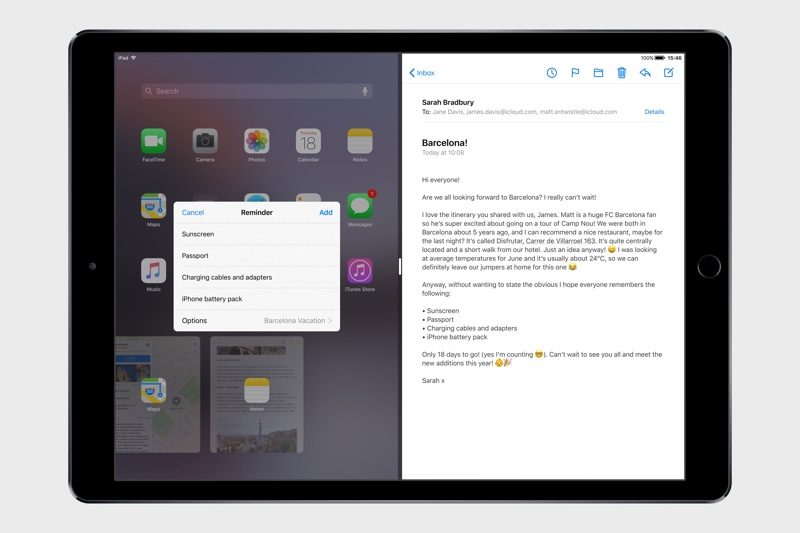
System-wide drag and drop functionality that would let users drag content between apps or from one iPad split screen window to another is at the top of Vittici’s list. Images, text, links, documents, and more could be dragged using intuitive long press gestures. In the example image below, text from an email is dragged into a list in Reminders.
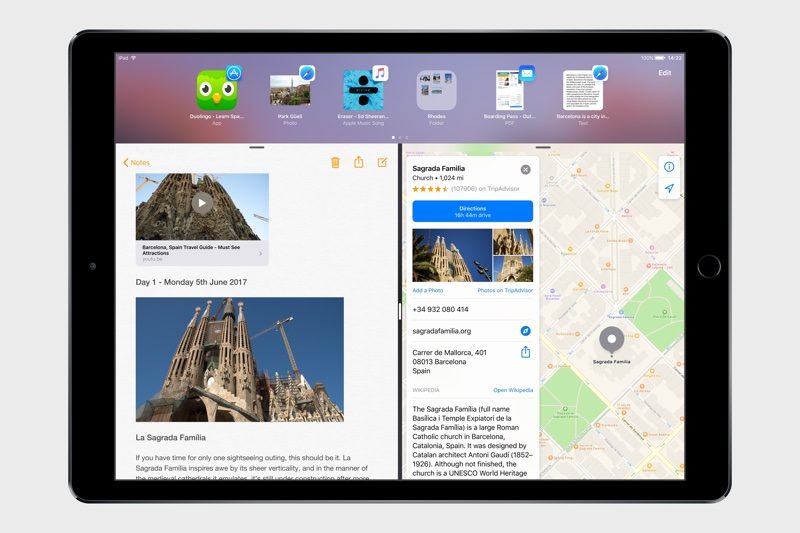
An imagined “Shelf” feature goes hand-in-hand with drag and drop, giving users a place to store anything on the iPad they want to reference at a later time. It’s similar to the desktop on a Mac, storing items for easy access.
Viticci’s other iOS 11 wishlist items include a new Split View app picker with a search feature and a better layout, a Mac-style Finder app that works with iCloud Drive for a more consistent document-finding interface, a denser home screen, multiple audio streams, and a refreshed design with bolder typography and more of a focus on visual feedback.
For additional images and a more detailed explanation of the items on Vittici’s iOS 11 wishlist, make sure to check out the full article over at MacStories.
Related Roundup: iOS 11
Tags: Concepts, macstories.net
Discuss this article in our forums
Watch iTunes content on your Android with TunesKit (Promoted Review)

As of only a few years ago Apple reported that there are currently 800 million iTunes accounts. If even half of those are active, that’s still a lot of people that are using iTunes for some reason or another. Considering that DVD and Blu-ray discs are becoming less popular and digital content is becoming more popular, iTunes remains as one of the premier content delivery systems for TV and movies. But what if you have an Android tablet, home set-top box, or smartphone and you want to still watch your purchased iTunes video? That’s where TunesKit DRM Media Converter for Mac/Windows comes in as a great solution.
Introduction
TunesKit DRM Media Converter for Mac/Windows is a standalone piece of software designed to work on Apple OS X (version 10.8 and above). Its primary goal is to allow iTunes users the ability to watch video content on other devices such as Android tablets or smartphones. TunesKit can convert any M4V file (iTunes default video format) to a DRM-free MP4, MOV, AVI, FLV, or other common video file type.
 TunesKit has a very basic look, but fortunately it’s incredibly easy to use
Nitty Gritty
TunesKit gives users a ton of options for video and audio formats making it incredibly handy for those that hope to transfer videos to various devices. I was able to successfully convert and transfer a movie from my iTunes library to my Galaxy S7 Edge within 45 minutes. TunesKit makes it simple for families that have a multitude of devices (iOS, Android, Windows) to share content across those devices.
 Converting Black Swan from M4V with DRM, to a MKV file in less than a half hour
Video quality of converted files varies slightly depending on the codec and file type used for conversion. I converted the same video a few different times to try to find the best format for the best quality. I quickly discovered that in general, the larger the resulting file was, the better the overall video quality became. Overall file size is important to note when determining on which device(s) you may be watching your movies or shows on in the future. Thankfully TunesKit offers a great amount of options in choosing video type and quality-size options.
TunesKit does a great job on the OS X platform but, it is also available for Windows users. Although this review focuses on the Mac version, it is known that the Windows version produces similar results. It is nice to know that TunesKit recognizes the diverse technical landscape we have today and looked to support multiple operating systems; from what I can tell, the workflows are also similar across both operating systems.
Currently the full version of TunesKit for Mac retails for $44.95 USD, and while the price is a little steep, I think the overall value is definitely there. For the cost of a few movies you can theoretically rent or purchase any iTunes movie and have it accessible across multiple devices at any time. Anybody that rents, buys or already owns movies through the iTunes store could aim to benefit from what TunesKit offers.
 TunesKit has all the common video and audio formats for conversion
Conclusion
TunesKit DRM Media Converter for Mac/Windows does an excellent job of stripping DRM protection from iTunes content. Because it works on rented content as well as licensed content, TunesKit definitely straddles a gray area as far as what some may consider legal territory. With that in mind, TunesKit does an excellent job of quickly and easily converting iTunes videos to essentially any common video format.
It’s easy to recommend TunesKit for Mac (or Windows) to anybody that has an established library within iTunes. For those that use Google Play or another competing service, TunesKit has less value and less to offer overall. If you love iTunes, TunesKit is a wonderful piece of software that can quickly and effectively convert your movies to a handful of varying file types.
Pick up TunesKit DRM Media Converter for your OS at the following links
TunesKit DRM Media Converter for Mac
TunesKit DRM Media Converter for Windows
AMD claims Vega gaming cards will be faster than Frontier Edition
Why it matters to you
AMD’s Vega cards, possibly the most powerful graphics cards ever made, could really shake up the Nvidia-dominated market.
AMD has teased more information about its upcoming Vega line of graphics cards and has fans salivating with the news that the gaming editions of its cards will be even faster than the Frontier Edition it showed off earlier this week. The only downside is that they won’t be launching until later this year.
With AMD’s Ryzen CPUs performing so well when they were released earlier in 2017, the hype for AMD’s next generation of Vega graphics cards grew in earnest. While it’s been a long time since AMD could legitimately contest Nvidia with high-end performance, Vega looks set to do so and if AMD can even go beyond its Frontier Edition, it could quite handily steal the performance crown.
The Frontier Edition of the first Vega card — aimed at professionals and enterprises — is expected to launch in June, with as much as 13 teraflops of raw power. That’s a full TFlop more than Nvidia’s ungodly expensive Titan Xp, and the gaming editions of the Vega card are said to be even more impressive.
That’s thanks to new features like the second generation of high-bandwidth memory (HBM2), a new memory cache controller, a new geometry pipeline, and more.
AMD’s Radeon VP, Raja Koduri said during his Reddit AMA (via Ars Technica), that production issues associated with HBM were solved with HBM2 and that what AMD had achieved, was to take high-end graphics card features and packed them into consumer hardware.
Koduri also suggested there may be a 16GB variant of an RX Vega card, which would back up the Compubench specifications for an unnamed AMD card with 16GB of memory we saw earlier this week.
Other Vega information includes the fact that gaming cards will feature 8+6pin power connectors, not the dual eight-pin connector of the Frontier Edition. He also confirmed that a water-cooled version will be available at some point, with a “slight difference in clock speed.” That may suggest that Vega overclocking isn’t particularly dependent on cooling, but that remains to be seen.
We also learned that the Frontier Edition card will be capable of playing games, though it won’t be designed with that in mind and would not be a cost-effective way of getting that kind of performance.
More news on the Vega range of AMD graphics cards will come out during Computex between May 30 and June 3, where AMD will unveil the consumer-focused Vega cards for the first time.
Watch a self-driving artificial intelligence try to drive around ‘GTA V’
Why it matters to you
Grand Theft Auto V is one of the best open-world games ever, but it could also play an important role in developing self-driving vehicles.
Grand Theft Auto V might be a fun anarchy simulator, but it’s proving to have some practical uses in the real world, too. Some AI developers are using it to prototype their self-driving car algorithms and now you can watch one of them learning as it goes, live on Twitch.
Last year, the Darmstadt University of Technology in Germany and Intel Labs collaborated on a method of pulling visual information from Grand Theft Auto V, according to a report from Bloomberg. The game has now been modified such that it can be used in research projects designed to perfect self-driving programs.
The AI currently trying its luck at driving around Los Santos is called Charles. It uses pixel-level-analysis of on-screen information to make decisions about how to drive around the fictional city. In essence, it uses the same visual data that a human driver would. For an idea of what Charles “sees,” the developer has put together a short image library to explain it.
Crafted in Python — hence the Stream name, “Python Plays” — Charles currently doesn’t have any short-term memory, so doesn’t have much of an ability to learn. That’s why its driving is so poor right now and doesn’t seem to get much better no matter how long you view the stream. It does occasionally make it a few blocks without hitting anything and long-term viewers claim it is getting better, but it is far from being a safe or capable self-driving system.
Despite its obvious problems though, for a homebrew project by a single developer, the fact that it’s able to get around without any specialized information is reasonably impressive. You can imagine with time and further development, how an AI could become more proficient at driving by using a virtual toolkit like GTA V.
This kind of testing will hopefully help teach automated driving systems how to respond to unexpected obstacles with the same alertness and awareness as a skilled human driver. Anything can happen when you’re on the road, and it’s essential that an AI is able to respond appropriately, no matter what the eventuality.
At some point, self-driving technology will be advanced enough to stand up to trials on the same roads as every other human motorist. However, until we reach a certain level of sophistication, it will be the pedestrians roaming the streets in Grand Theft Auto V who bear the brunt of any unexpected occurrences.
Updated on 05-19-2017 by Jon Martindale: Added Twitch stream and information on it.
Microsoft Surface sales slip — and May 23 looks like the date to do something about it
Microsoft’s Surface Pro 4 was introduced in 2015 as the company’s newest “tablet that can replace your notebook” style of 2-in-1. The Windows 10 machine offered a larger and higher-resolution display, as well as sixth-generation Intel Core processors, which is likely why it sold far better than Microsoft expected it to.
More: Surface Pro 5 could launch alongside the Windows 10 Creators Update in early ’17
Given the machine’s resounding success, it only makes sense that Microsoft will produce a Surface Pro 5 at some point, a fact that seems to have been confirmed by a recent job posting listed on LinkedIn. The company has otherwise been surprisingly good at keeping new Surface machines a secret, however, and so almost all we currently have to go on is speculation. Here’s everything we know so far.
The delays keep on coming – is May 23 the charm?
Many people expected Microsoft to introduce the Surface Pro 5 successor in October 2016. That would have followed Microsoft’s recent pattern of introducing new and enhanced Surface products at its annual hardware event. However, that didn’t happen. Instead, the company introduced the futuristic Surface Studio, along with a minor but welcome update to its notebook-centric 2-in-1, the Surface Book with Performance Base.
More: 2-in-1 PC aren’t dead, and Microsoft’s class-redefining Surface Pro 4 is proof
Next, speculation shifted to an early-2017 launch of the Surface Pro 5 to coincide with the release of the Windows 10 Creators Update. A recent report allegedly identified Taiwanese company Pegatron Technology as one of the manufacturers of the Surface Pro 5, with a first quarter release estimate. The idea that Pegatron might produce the next Surface Pro isn’t that far-fetched, especially because the company currently produces the Surface Studio for Microsoft.

Surface Studio
Microsoft
Given the Creators Update’s due date of April 2017, some sources were speculating that Microsoft could announce the Surface Pro 5 at Mobile World Conference (MWC), which ran from February 27 through March 2. However, MWC 2017 came and went with no word on new Surface machines, and Creators Update is due next week and there’s still nothing from Microsoft.
Furthermore, long-time Microsoft watcher Mary Jo Foley was told by sources at the end of March 2017 that while Microsoft is likely to hold a Spring 2017 event of some kind, there may or may not be an announcement of a Surface Pro 5. Soon after, Microsoft announced an event for May 2, 2017, which is said to focus on the education market. Microsoft’s Build conference is about a week later, starting on May 10, 2017. However, Build usually isn’t used as a venue for new physical product announcements.
Finally, the May 2 educational event came and went, with a Surface Laptop introduction but no Surface Pro 5, and then Built 2017 was a bust as well — at least as far as new Surface hardware goes. That left yet another Microsoft hardware event that is scheduled for May 23, 2017 in Shanghai, China.
If technology reporter and leaker Evan Blass is correct — and he often is — then it is at next week’s event that Microsoft will be releasing what is looking more like a refresh of the Surface Pro 4 than a significant new generation. And if Blass is correct, then the machine will be called simply the Surface Pro, joining Apple’s MacBook Pro in letting people figure out the generation for themselves.
This is the Microsoft Surface Pro 4 refresh https://t.co/H0RVtwRqFO [click through for more pics] pic.twitter.com/TUogevpDvm
— Evan Blass (@evleaks) May 19, 2017
Additional leaked images were published by Blass at VentureBeat, and they show off a machine that appears to follow the Surface Laptop motif in having multiple coordinated color schemes.
Given the timing of the upcoming event and the fact that this rumor is coming from @Evleaks, it appears that that May 23 will indeed be the date.
4K display, Kaby Lake, and more – or almost nothing at all
The Surface Pro 4 uses sixth-generation Intel Core processors and offers an excellent 12.3-inch display with a 3:2 aspect ratio, 2,736 x 1,824-pixel resolution, and 267 PPI. Anticipated — and logical — Surface Pro 5 updates, therefore, include a move to seventh-generation Intel Kaby Lake processors and a 4K display option. Also expected, and equally logical, is the inclusion of more expansion ports and a move to USB Type-C, which would also allow the new machine to be even thinner than the Surface Pro 4. The Surface Pro 4 has a single USB 3.0 port, a DisplayPort, and an SD card reader.
Other rumored possibilities:
- The Surface Pro 5 could offer an option with an ARM processor, given Microsoft recently announced that Windows 10 will support ARM at some point. That would make an LTE variant an obvious update as well. However, because ARM support isn’t likely to arrive in the Creators Update and perhaps not even with the Redstone 3 update that’s expected toward the end of 2017, it seems unlikely that Microsoft would announce an ARM variant so soon.
- Microsoft has patented an active pen with wireless charging, which would make some sense for the Surface Pro 5 given that the Surface Pen already magnetically attaches to the side of the Surface Pro 4.
- A larger capacity battery is also possible, which would please anyone who’s suffered through the relatively poor battery life afforded by the Surface Pro 4. Moving to seventh-generation Intel processors would help, given they’re more efficient.
More recently, Microsoft pundit Paul Thurrott tweeted an interesting and potentially disappointing tidbit:
Surface Pro 5 will not change the Surface Connect power connector, I was just told. Kaby Lake, nothing dramatic.
— Paul Thurrott (@thurrott) April 6, 2017
If this information is valid, then it’s entirely possible that Microsoft will only give the existing Surface Pro 4 a slight refresh. While switching from sixth-generation Intel Skylake processors to seventh-generation Kaby Lake would provide a small boost in performance and more significant power savings, that certainly wouldn’t represent the kind of major update that many Surface Pro fans have been anticipating.
According to Blass’s leaked information, we are definitely looking at a refresh — at least judging by the Surface Pro’s minor external changes. USB Type-C is nowhere to be found, following Microsoft’s decision of leaving that port off of its devices for now. The good news is that the inclusion of the usual Surface Connect port promises compatibility with existing Surface accessories, something that Microsoft has said it wants to maintain. And a move to Intel’s Kaby Lake processor for bettery performance, battery life, and 4K video decoding seems to make a good deal of sense.
 AIVAnet