


Samsung Galaxy S7 Edge – One Year Later (review)
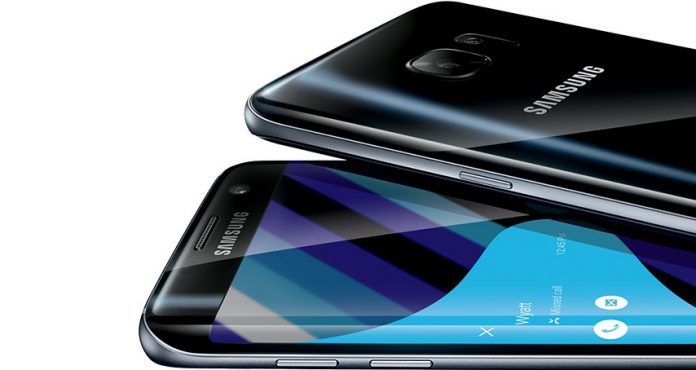
The Samsung Galaxy S7 Edge originally released on March 12, 2016. Now that users have had a full year to use and explore the device in the wild, we decided to look back on the S7 Edge and how it’s fared over the past 12+ months. Samsung is slightly notorious for having devices that find ways to slow down over the years in one way or another. Whether this is a flaw in design or just an inevitability of all electronics, it’s still disheartening considering the cost of these devices.
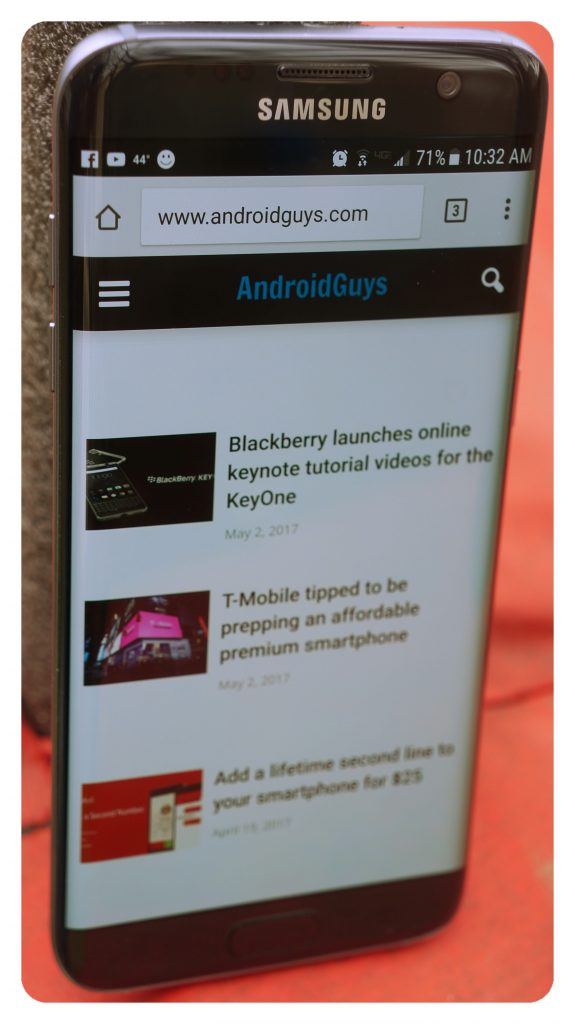 The Galaxy S7/Edge easily renders the best websites, videos, games and applications with ease
Even though the S7 Edge has been out a full year, the specs of the device still impress. Let’s refresh our memories with a lovely list of numbers and details pertaining to the S7 Edge.
Specs
- Screen: Curved 5.5″ 2560 x 1440p S-AMOLED display
- Processor: Snapdragon 820 (US and China), Exynos 8890 Octa (International)
- Storage: 32 GB/64 GB (expandable up to 200 GB through micro-SD)
- RAM: 4 GB
- Primary Camera: 12 MP, f/1.7, 26mm
- Secondary Camera: 5 MP, f/1.7, 22mm
- Battery: 3600 mAh
- Dimensions: 5.94 x 2.86 x 0.30 in
- Weight: 5.54 oz
- IP68 certified – dust proof and water resistant at 1.5m for 30 minutes
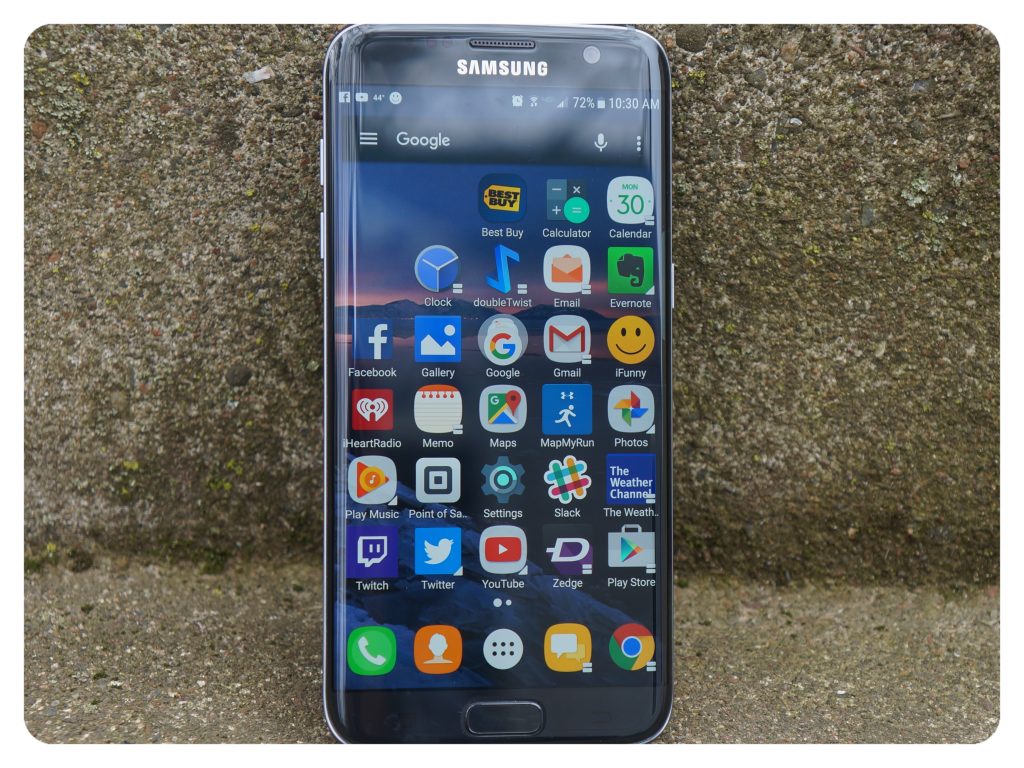 The bright AMOLED display on the S7/Edge works great outdoors
Accolades
The Samsung Galaxy S7 Edge has a huge upside. As indicated in our original review, the S7 Edge is a powerhouse that was top of the line at its original release time. Still, to this day, it’s a top overall performer that can ease through the paces with multitasking and rendering performance that is only now being out-classed by brand new devices. Samsung is known to include top of the line chips and features in their premium devices such as the S7 Edge.
Processing
I have played some of the newest and most demanding 3D games and VR experiences on my Galaxy S7 Edge and I have found that performance has remained between good to great. The Galaxy VR applications have been the most strenuous for my S7 Edge and I have actually found that my phone becomes quite warm after extensive play sessions. I was hoping that this issue could be patched over time to better utilize the power of my phone and decrease the over-heating issues I originally experienced, but so far have seen no improvement.
Camera
Samsung is always at the top of the heap when it comes to the ability to take good-looking photos. The biggest knock against the Galaxy phone cameras is the over-processing of most photos as pictures oftentimes become quite saturated and less natural looking. While some users appreciate the “Hollywood” effect of their photos, it has left pro-users somewhat disappointed in the unnatural look of photos on the S7 Edge. I would love to see more options in taking photos on future Galaxy devices. While this issue affects different users in different ways, it’s indisputable that the camera’s low-light and overall pixel density is second to none. I’ve taken thousands of photos with the Galaxy S7 Edge and have been very pleased with the look of most pictures.
Security
The S7 Edge shipped with a fairly competent fingerprint reader that works well under most conditions. Over time, I discovered that wet or dirty fingers give the sensor some issues on detecting fingerprints accordingly. This is somewhat of an issue considering that the S7 Edge is designed to be a device that is water and dust resistant but does not have the ability to read fingers when they are wet.
Fortunately, the screen is sensitive enough that you can resort to using a simple swipe or grid-based security function when fingers are wet. Samsung includes ‘Samsung Pass’ on the S7 Edge which allows for an extra layer of security that uses biometric data to help secure certain information on your phone. I didn’t use this feature extensively over the past year but was pleased to see it available.
Edge
The Edge feature of the Galaxy S7 Edge smartphone is unique, but not always beneficial. The stylistic advantages of the S7 Edge are imminently apparent and sure to draw in onlookers that are just passing by.
What I discovered in my first year is that the Edge feature offers a little in usability but a more in the overall look of the device. I rarely used the Edge panels and found that it was much easier to access things such as APPS EDGE by just navigating to the appropriate application instead. Considering I rarely create tasks, I also found that the TASKS EDGE feature was also virtually useless. The best use of the Edge feature that I used on almost a daily basis was having additional information such as the time or notifications show up on the device when the screen was off.
Battery: The battery in the Galaxy S7 Edge seems perfectly appropriate for the device. Most users expect at least a day’s use out of their respective smartphone. I found that in most general use settings the S7 Edge was capable of delivering on this expectation. The 3600 mAh battery provides enough juice to allow most users a full day’s use.
Only a few times in the past year did I overuse the device to the point where I was recharging in the late afternoon hours. One feature I found considerably useful, was the Performance Mode allowed in Android 7.0+ on the S7 Edge. This allows a user to optimize use for games, entertainment, high performance or extended battery life. The optimized setting will lower the overall resolution in general use as well as turn off the ‘always-on’ display to extend battery life well beyond what is normally expected.
 The all-glass backing looks great, but I still recommend using a case to protect it
Quirks
After using my Samsung Galaxy S7 edge over the past 12 months a few things stand out as negatives. Most of these are minor complaints, but things I believe Samsung could work towards fixing in upcoming iterations.
Software
Although Samsung’s Touchwiz software skin has become more efficient and less intrusive over time, it’s still a few steps back from a pure Android interface. Samsung is notorious for having its own version of almost everything Android-related, between Touchwiz to the offshoot Tizen to its own version of an app store. On the S7 Edge, Touchwiz does a decent job of performing like stock-Android, but the look is unique enough to leave a few of us wanting something different. Fortunately, it’s easy enough to change the look of Android with a new launcher or icon packs, even if it’s on a Samsung device.
Performance
Whether it’s a Samsung device or a phone from another manufacturer, you may experience a slowdown on almost any device over time. Samsung is one of the top sellers of Android-based mobile devices and because of this, it is often reported that Samsung devices, such as the S7 Edge, slow down incrementally over time.
While using my S7 Edge over the past 12 months, I have experienced this issue. As I filled up my device with videos, apps, music and a plethora of downloaded files and add-ons, I began to notice some slowdown that became quite annoying. Usually, the best fix for these types of issues is a complete refresh of the device. This can be quite the feat for basic users but more often than not will return you to the “out-of-the-box” performance that you started with. It’s never fun to watch your phone become slower in its age and I’d love to see Samsung include an option to tune performance over time instead of sending users to technical support for help.
It’s never fun to watch your phone become slower in its age and I’d love to see Samsung include an option to tune performance over time instead of sending users to technical support for help.
Hardware/Durability
Because the Galaxy S7 Edge is an all-glass device, it’s important for most users to have proper protection for this phone. I personally purchased a screen protector and case on day one and have used them both ever since. One thing I discovered early on, is that it’s much more difficult to use a phone with a curved glass edge if there is not a case on the device.
Without a case, I found that the edges of my hand would register as “screen-touches” and would effectively render the phone useless, or at the minimum very difficult to use. With a case on, the edges of the screen were protected and I was able to navigate as intended through menus, scrolling, and normal applications use. I believe that some smart software could eliminate this issue altogether and expect Samsung to employ some type of fix for future iterations of Galaxy devices that have the curved edge.
 The S7 Edge has a great screen and although somewhat large, still fits nicely in most hands
Conclusion
Now that it has been a full year, it’s much easier to look at the S7 Edge in its entirety. Good and bad experiences can be summed up to an overall impression quite easily. I have strangers ask me about my phone all the time, which means it’s a unique and intriguing device, at the least. I always reply by telling people that I really love the S7 Edge but do not love the cost of the device.
Fortunately, I’ve had no major issues with the S7 Edge and my overall experience has been quite positive, but with the cost of the phone, I have actually considered looking for something different for my next upgrade.
With the S7 Edge, I’ve been quite content on the capabilities, look, and overall functionality of my phone. Being a fan of the Galaxy Note series, I considered a Note7, but in hindsight am very happy that I chose the S7 Edge. The extra real estate, the superb camera, and high-resolution AMOLED screen have made me feel as if I’m in some elite club–and paying for it along the way. If technology advancements continue to drive prices down on high-end smartphones, I believe that the Galaxy S series will remain a top choice for mobile users well into the future.
Samsung really has achieved what it wanted to do with this device: a great screen, a solid camera, respectable software and support, a sleek and smart design with features that will keep customers coming back for more. I can still recommend the S7 Edge as a premium device but suspect those that are looking for a new phone will gravitate to the brand new Samsung Galaxy S8 or S8+. As for me, I’ll be keeping my eye out for the possibility of a new iteration in the Note series.
Trump’s cybersecurity order delivers nothing but more surveillance
Remember that cybersecurity Executive Order we anticipated from the Trump administration, which seemed to quietly disappear in January?
The already-delayed deadline for Trump’s EO on “the cyber” and his promise to create a Cyber Review Team passed last month. Many were wondering if it would fade off into oblivion like a tyrant’s hairline — or show up suddenly to drop cyber-bombs on someone’s vacant cyber-tarmac.
After a suspenseful delay and one leaked draft, the Trump administration’s cybersecurity EO “Strengthening the Cybersecurity of Federal Networks and Critical Infrastructure” finally saw the light of day. Between the WannaCry ransomware news, and nonstop pandemonium issuing from the Mad King’s court, it was easy to miss.
The good news, is that Trump didn’t appoint Julian Assange or Rudy Giuliani to be the nation’s Cybersecurity Commandant. No, he bestowed that honor on a man whose primary qualifications include being a real estate heir and the president’s son-in-law: Jared Kushner.
Since corrupt appointments have made the past few months a sort of Groundhog Day in hell, it’s no surprise really. I mean, it was only one month before the election that Trump finally put a cybersecurity policy on his website. And it was cribbed from a speech he rattled off saying that he intended to hand most of the work off to others.
As we’ve come to expect from this administration, the page with Trump’s cybersecurity policies is now a 404.
The original text had Trump saying that when he was sworn in, he’d order “an immediate review of all US cyber defenses and vulnerabilities, including critical infrastructure, by a Cyber Review Team of individuals from the military, law enforcement, and the private sector.”
Fast forward to April: We finally got an idea of what the hell was going on. Whispers around government press campfires said the Trump regime was “close” to revealing its cybersecurity EO and that the president’s son-in-law was working on the Order with White House tech policy aides in Kushner’s new Office of American Innovation.
Trump also recently signed an executive order creating the American Technology Council, with Kushner as director. Combined with the new EO on cyber, it means that Kushner is in charge of implementing the order. So he will be managing the hiring and awarding contracts.
But how did it turn out? Well, some people really love it. That’s probably because they haven’t thought through what it means that Kushner is running the biz-dev end of the show. Also because the whole order reads like Jared copied Obama’s homework.
Specifically, Jared and company copied the Obama White House “Presidential Policy Directive 21 of February 12, 2013” and the “Commission on Enhancing National Cybersecurity” report released in December 2016.

U.S. President Barack Obama meets with members of the Commission on Enhancing National Cybersecurity at the White House in Washington February 17, 2016.
As you can see, Obama’s 2016 report has been removed by the Trump administration. Take my word for what was in it.
Unfortunately, Trump and Kushner didn’t copy most of the parts that matter.
The new cybersecurity order has three sections. The first part (“Cybersecurity of Federal Networks”) says they’ll create reports geared toward modernizing federal IT, guided by the National Institute of Standards and Technology’s (NIST) Framework for Improving Critical Infrastructure Cybersecurity. Framework that came from from President Obama’s order in 2013.
The second section “Cybersecurity of Critical Infrastructure” tells agency leaders to figure out how they can support the cybersecurity of “section 9 entities” at risk of attack and affecting public health, safety, and national security. This is yet another part cribbed from Obama’s 2013 order.
This middle bit includes only a quick mention of botnets and IoT. And even this tiny section seems suspect in its vague wording. Like the rest of the order, there is nothing telling us how they plan to tackle the problem, and concludes by saying a report is due in a year.
The entire order is a list of reports with loopholes, and for copied homework it sure left out crucial national security hot points. It’s a shame threats like Mirai — star of the 2016 cybersecurity threat show in the 2016 order — have to be inferred in the Trump-Kushner order.
Researcher Jake Williams from Rendition Infosec saw bright, flashing hazard signs when looking at the Internet of Things section. This section puts decision making around securing IoT devices and consumers under the jurisdiction of the FCC and FTC, among others.
Williams told Engadget in a Thursday call, “I think it’s a power grab for new capabilities by law enforcement.”
Williams explained, ” If it’s true that Trump brought in industry leaders, then any one of them knows you can’t stop botnets without lots of network monitoring. Given some of the things I’ve seen, I suspect they’ll use the report to say, ‘look at the problems; let’s give law enforcement more monitoring capabilities.’”
Drawing a clear line between intentions of the EO’s decision makers on IoT and potential harm to consumers, Mr. Williams added, that “the idea that they want the FCC involved in botnet monitoring would be to justify the commercial losses, and making that a national security issue.”
Of course, reducing consumer cybersecurity protections is right in line with the new FCC’s statements. It’s also in lockstep with Trump’s outspoken enthusiasm for government surveillance. In his words, the NSA “should be given as much leeway as possible.”

Donald Trump meeting with cyber security experts in the White House, January 31, 2017.
That might also please the original team that backed the Obama report — it also had serious flaws when it came to protecting citizens from government overreach. Lest we forget, the commission behind it included corporate interests like the president and CEO of MasterCard, the corporate VP from Microsoft Research, the chief security officer of Uber (Joe Sullivan, formerly Facebook counsel) and former NSA head Gen. Keith Alexander. Some of you may remember Alexander as the guy forced to admit that the number of terrorist plots foiled by blanket surveillance were wildly overstated.
The final section, “Cybersecurity for the Nation” begins with vague wording about protecting the internet and fostering a cybersecurity workforce… but goes right into a 90-day deadline for a plan on “the Nation’s strategic options for deterring adversaries and better protecting the American people from cyber threats.” Sounds like cyberwar to me.
Next, within 45 days Trump wants the FBI, the Secretaries of Defense and Homeland Security (among others) to give him everything they have on “their international cybersecurity priorities, including those concerning investigation, attribution, cyber threat information sharing, response, capacity building, and cooperation.”
Talk about missing the point of copying someone’s work; the order is short, opportunistic, and wholly lacking specifics. No action items, direction to create initiatives, there’s a little nod telling Jared Kushner to carve out budgets (but no details), and nothing about collaboration with the public sector.
And while Obama’s 2016 report included a generous amount of attention to consumer rights, even suggesting a security “nutritional label” for products, we come up empty with Trump and Kushner’s order.
I think you can see why it’s more than annoying that some of my colleagues saw the EO and thought it was a good thing. It’s not. It’s about five hundred steps backward from where we were last year, with a layer of malfeasant opportunism on top.
And we weren’t exactly in a great place last year with our government coming to grips with our nation’s cybersecurity, either.
Super agile, ball-fetching drone could make your human friends obsolete
Why it matters to you
Drones equipped with smart planning algorithms have the potential to be even more useful.
Kids develop the skills to catch a ball that is thrown to them around the age of three or four, leading us to believe it’s not a particularly challenging skill.
However, as AI researcher Hans Moravec’s “Moravec’s paradox” states, when it comes to robotics and artificial intelligence, the human skills we think are going to be difficult for a machine to replicate often turn out to be easy, while the skills we think will be easy turn out to be difficult.
In a new piece of research, investigators from Switzerland’s ETH Zurich trained a drone equipped with a net to be able to catch a ball when it is thrown. The drone in question is something called an “omnicopter,” described by the researchers in a previous paper. It boasts eight motors oriented in different directions, giving it an enormous amount of range of movement — thereby allowing it to play fetch in a way that most drones would be unable to.
“We use an external camera system to detect both the position of the ball and the omnicopter,” researcher Dario Brescianini told Digital Trends. “As soon as the ball is thrown into the air, we calculate its flight path and plan a trajectory to catch it. The key element behind making a successful catch is the computationally efficient generation of trajectories. This enables the generation of thousands of different trajectories in real time that achieve the same high level goal of catching the ball. The algorithm then selects the best trajectory and the vehicle executes 20ms of this trajectory, before the entire process is repeated.”
However, as much fun as we could imagine a ball-catching drone would be around the office, Brescianini says the work has other, broader applications. Specifically, the vehicle and trajectory generation algorithm presented could be used in any scenario that requires flying to any desired attitude and position with a high degree of exactness and timing.
The 2017 version of Acer’s Iconia One 10 tablet was just leaked online
Why it matters to you
The 2017 Acer Iconia One 10 is shaping up to be quite a device, and now we’ve got our first look at the tablet.
It looks like Acer is planning a follow-up to last year’s Acer Iconia One 10 — with a new tablet of the same name. Now, we have our first look at what the new tablet might look like thanks to a leak from Slashleaks.
The leak doesn’t just offer a look at the tablet’s design — it also shows off some of the specs we can expect from the phone. For example, the device will reportedly come with a quad-core MediaTek MT8167 processor, along with 2GB of RAM, which should help make it relatively powerful for most consumer uses. Sure, those in need of a ton of power for multitasking and high-performance apps might need something a little more intense — but the tablet should be fine for things like web-browsing and social media.
Apart from the processor and RAM, according to the leak the tablet offers a 5-megapixel rear-facing camera, coupled with a 2-megapixel front-facing camera. It’ll also boast 16GB or 32GB of RAM, along with a pretty hefty 6,100mAh battery, which should keep the tablet going for a solid day or two of use.
The display on the tablet sits in at 10.1-inches with a Full HD resolution, so the tablet will be a great choice for things like watching movies and videos. The specs represent a very minor change over last year’s Acer Iconia One 10 tablet, with the only real change being the display. While the new device has a Full HD, or 1920 x 1080, display, last year’s offered a 1280 x 800-resolution tablet.
We also have a leaked image of the tablet, and while it’s not an overly stunning device, it’s not bad-looking either. The leak shows a black tablet, but we assume that — like last year — the tablet will also be available in white, if you so choose.
We’ll update this article as we hear more about the 2017 Acer Iconia One 10.
The 2017 version of Acer’s Iconia One 10 tablet was just leaked online
Why it matters to you
The 2017 Acer Iconia One 10 is shaping up to be quite a device, and now we’ve got our first look at the tablet.
It looks like Acer is planning a follow-up to last year’s Acer Iconia One 10 — with a new tablet of the same name. Now, we have our first look at what the new tablet might look like thanks to a leak from Slashleaks.
The leak doesn’t just offer a look at the tablet’s design — it also shows off some of the specs we can expect from the phone. For example, the device will reportedly come with a quad-core MediaTek MT8167 processor, along with 2GB of RAM, which should help make it relatively powerful for most consumer uses. Sure, those in need of a ton of power for multitasking and high-performance apps might need something a little more intense — but the tablet should be fine for things like web-browsing and social media.
Apart from the processor and RAM, according to the leak the tablet offers a 5-megapixel rear-facing camera, coupled with a 2-megapixel front-facing camera. It’ll also boast 16GB or 32GB of RAM, along with a pretty hefty 6,100mAh battery, which should keep the tablet going for a solid day or two of use.
The display on the tablet sits in at 10.1-inches with a Full HD resolution, so the tablet will be a great choice for things like watching movies and videos. The specs represent a very minor change over last year’s Acer Iconia One 10 tablet, with the only real change being the display. While the new device has a Full HD, or 1920 x 1080, display, last year’s offered a 1280 x 800-resolution tablet.
We also have a leaked image of the tablet, and while it’s not an overly stunning device, it’s not bad-looking either. The leak shows a black tablet, but we assume that — like last year — the tablet will also be available in white, if you so choose.
We’ll update this article as we hear more about the 2017 Acer Iconia One 10.
Ultra-strong artificial spider silk could be used for future medical implants
Why it matters to you
This artificial spider silk could one day be used to create safe, durable building blocks for artificial ligaments.
Ever dreamed of being a real-life Spider-Man? Researchers at Stockholm’s KTH Royal Institute of Technology are keen to help — courtesy of their invention of the strongest artificial silk fibers yet created. Made using a combination of spider silk proteins and nanocellulose from wood, the new process is also impressively low-cost and scalable in a way not seen before.
“We have developed a high-performance hybrid material where we are able to combine the stiffness of cellulose with the toughness and functionality of recombinant silk,” researcher Daniel Söderberg told Digital Trends. “Furthermore, we show that by fabricating filaments using a microfluidic process we are able to get never-seen-before properties.”
A description of the work is published in the journal ACS Nano, in a paper titled “Ultrastrong and Bioactive Nanostructured Bio-Based Composites.”
The partially wood-based artificial spider web won’t just be used for ridding New York of evildoers, however. (In fact, for some reason the researchers haven’t singled this out as a possible use, at all.) Instead, they are interested in the possible medicinal properties of spider webs — which reportedly date back as far as ancient Rome, when webs were used to dress soldiers’ battle wounds.
“The unique combination of strength, flexibility, and bioactivity in a biocompatible material is very attractive for both implants and tissue engineering applications where load-bearing constructs are needed, such as hip prosthesis, bone, ligaments, and tendons,” co-author My Hedhammar told us.
The notion of combining the artificial webbing’s biodegradable, virtually non-toxic properties with its mechanical strength opens up a range of exciting possibilities — such as using it as a possible filament material building block for artificial ligaments.
“There are several interesting routes forward,” Hedhammer said. “For example, we want to look into how this method can be used for large-scale production. We are also eager to create more advanced 3D structures.”
Android O should make it easier to monitor your phone’s battery life
Why it matters to you
With Android O, you will be able to better understand how certain apps and processes are affecting your phone’s battery life.

Over the years, Google has introduced a range of features intended to limit battery consumption by apps in Android. One of the more major features released in the last several years was Doze, introduced in version 6.0 Marshmallow, which allowed the system to override background processes in apps that were draining power too frequently.
In spite of these enhancements, however, the battery settings menu has remained mostly unchanged, delivering the same basic information it always has. Fortunately, with Android O, Google is looking to change this.


Battery options have been overhauled in the upcoming version of Android, based on a preliminary look into the beta released this week. The result is more actionable data that should keep you better informed about how your device operates whether the screen is on or off.
In the past, the menu simply displayed percentages of battery consumption broken down by app, with some more detailed information like total running time if you dug into it — though Android previously did not differentiate between foreground and background usage.
With Android O, that is changing. Tapping on an app in the list will call up precisely how much time it has been operating in active use, versus in the background. And it is often background usage which takes a serious toll on our smartphones’ batteries — all those push notifications and discreet updates come at a price, and add up over time.
The new menu will even communicate battery usage by an app in milliamps, if you are so inclined. In addition to all these noteworthy little tips, the same tried-and-true functions still remain, like the ability to toggle battery optimization off for apps you simply cannot afford to miss an update from, or the option to shut down all background processes and notifications for those overactive types.
Longtime Android users will also note that the graph that shows your device’s battery status over time is still present if you check advanced usage. And many display related settings, like adaptive brightness and sleep intervals, are present in battery options as well for easy access.
For an in-depth look at all the new features debuting in Android O, check out our first take.
Weekly Rewind: ‘Roseanne’ returns, Apple’s pizza boxes, golden egg saunas

A lot can happen in a week when it comes to tech. The constant onslaught of news makes it nigh impossible for mere mortals with real lives to keep track of everything. That’s why we’ve compiled a quick and dirty list of this week’s top 10 tech stories, from Google I/O 2017 to how to buy the best laptop — it’s all here.
Here’s everything we expect to see at Google I/O 2017, and how you can watch it

Google has numerous events throughout the year, but I/O is by far the biggest. It’s a three-day affair of keynote presentations, developer workshops, and product announcements, and it’s where Google has unveiled a range of innovations, including Project Jacquard, Google Home, and Daydream.
The festivities at the Shoreline Amphitheater in Mountain View, California don’t began May 17 at 10 a.m. PT — the scheduled time of the conference’s first keynote address. Here’s how to watch the conference.
Read the full story here.
Charge as you drive on Electroad, coming soon to 11 miles of asphalt in Israel

While plenty of attention is focused on the growing popularity of electric cars, far too little is paid to the roads that the cars themselves are using. Sure, we get to cover an innovative new surface material every now and then but for the most part, roads have not changed a whole lot in the past few decades.
A new collaboration between the Israeli government and a local company is aiming to change that, however. Working to address the electric car challenge of too few charging stations, the country is beginning work on a pilot scheme to install technology that will allow electric buses to charge while driving, by way of smart technology embedded in the road.
Read the full story here.
10 common laptop-buying mistakes you can easily avoid

You’ve probably owned a few notebooks, and you know what features you like, experiencing the good and the bad that come along with choosing a machine. For instance, there’s the inconvenient hassle of toting around a 17-inch behemoth, or the inevitable letdown that goes along with streaming Netflix movies to an 11-inch screen. Fortunately, there is a bevy of suitable options for every lifestyle or purpose, so long as you know what you’re doing. And remember, there are exceptions to every rule.
Here’s our list of the most common laptop buying mistakes, so you can leave all potential regrets at the door. If you want to build your own computer, check out our PC parts buying guide.
Read the full story here.
‘Roseanne’ reboot on ABC will revive a classic slice of Americana

The Connors are returning to a TV near you soon. The revival of the 1990s classic TV comedy Roseanne is officially returning to its original home: ABC.
During a call with reporters, ABC Entertainment president Channing Dungey proclaimed “we’re rebooting Roseanne.” The new season will be eight episodes and is slated to return in the middle of the ABC TV season. There is no word yet on what time slot the reboot will fill.
If you spent hours invested in the Connors’ family drama, then rest assured that most of the most popular characters will be returning. Besides Roseanne Barr reprising her leading role, John Goodman, Big Bang Theory‘s Michael Fishman, Sarah Gilbert, and Laurie Metcalf are all set to return. So that means Dan, Darlene, Jackie, D.J., and Becky will supposedly be returning for your viewing pleasure.
Read the full story here.
Meet Lhakpa Sherpa, the woman who has climbed Everest 8 times

A 44-year old Nepali woman by the name of Lhakpa Sherpa has broken her own record for the most summits of Mt. Everest by a female climber. This past weekend, Lhakpa was part of a team of mountaineers that successful scaled the peak from its North Side in Tibet, giving her the eighth successful expedition of her illustrious career. And while that number is indeed impressive, it is only a part of her amazing story.
Like most Sherpas, Lhakpa was born and raised in Nepal. One of 11 children, she grew up in the shadow of Makalu, the fifth highest mountain on the planet at 27,825 feet. But, as a young girl coming of age in the Himalaya during the 1970’s, it was believed that women could not climb the very big peaks that lured foreign mountaineers to her homeland. It wasn’t until she joined an all-women expedition in 2000 that she was finally given the chance to actually set foot on Everest. That year, she would reach the summit for the first time, without any formal mountaineering training or experience whatsoever.
Read the full story here.
Forget the iPhone — Apple’s most defining patent might just be this pizza box

By now, you’ve surely heard lots of stories about Apple’s brand-new Cupertino headquarters.
And that every single element of the design – from the massive curved sheets of glass to the polished concrete ceiling tiles, to the ventilation system and even the door handles — was crafted with an obsessive level of detail echoing the company’s products.
And you’ve probably heard that its construction, which was not completed on schedule and, according to multiple sources, cost about $5 billion and drove contractors and local officials mad.
Read the full story here.
A worry-no-more wearable tracks your feverish child’s temperature

Two caring parents have used their engineering expertise to develop a smart thermometer that continuously monitors a child’s temperature. Called simply Degree, the wearable thermometer fits snugly into the child’s ear and relays information about the progress of his or her condition during a fever.
The unique device was inspired by an unfortunate event, when the daughter of Greta and Johannes Kreuzer suffered a febrile seizure, with a severe fever and sudden changes in body temperature. “You just can’t see it coming without monitoring the body temperature continuously,” Greta told Digital Trends. “We thought, it can’t be that we have the measuring technology for adults but aren’t able to monitor our children to help them when they are sick.”
Read the full story here.
Apple iPad 2017: News and rumors

Now that the 9.7-inch iPad is the entry point into the iPad range, there’s speculation Apple may replace the 9.7-inch iPad Pro with a new 10.5-inch iPad Pro. Although it would have a larger screen, the device may have a bezel-less design, and therefore, a very similar body size to the 9.7-inch Pro. The screen size isn’t fixed in stone, and rumors state it may be as small as 10.1-inches, or as large as 10.9-inches, with the 10.5-inch size being most often discussed.
Despite initially being rumored for a March 2017 launch and never appearing, there’s still talk of the tablet coming soon. It may make its first official showing during Apple’s Worldwide Developer Conference at the beginning of June, says analyst Ming-Chi Kuo of KGI Securities, who says there’s a 70 percent chance the new tablet will be just one of the new products revealed during the keynote.
Read the full story here.
Swedes sweat out public discord in the unique Golden Egg sauna

Here’s a unique way to settle public unrest or discord: discuss it in a sauna. No sauna? No problem, build a really cool one and people will come. That’s what happened in the far northern Swedish town of Kiruna, when looming damage from iron ore mining meant the whole town had to relocate a few miles away, according to Dezeen.
Iron ore is a major income source for Sweden, and is Kiruna’s economic lifeblood. A rich seam of ore runs downward diagonally through the town, and the only way to continue mining is to move the whole town and its 18,000-plus residents. Therefore, the town is moving east, and a new masterplan created by architectural firm White Arkitetker is being developed.
Read the full story here.
Weekly Rewind: ‘Roseanne’ returns, Apple’s pizza boxes, golden egg saunas

A lot can happen in a week when it comes to tech. The constant onslaught of news makes it nigh impossible for mere mortals with real lives to keep track of everything. That’s why we’ve compiled a quick and dirty list of this week’s top 10 tech stories, from Google I/O 2017 to how to buy the best laptop — it’s all here.
Here’s everything we expect to see at Google I/O 2017, and how you can watch it

Google has numerous events throughout the year, but I/O is by far the biggest. It’s a three-day affair of keynote presentations, developer workshops, and product announcements, and it’s where Google has unveiled a range of innovations, including Project Jacquard, Google Home, and Daydream.
The festivities at the Shoreline Amphitheater in Mountain View, California don’t began May 17 at 10 a.m. PT — the scheduled time of the conference’s first keynote address. Here’s how to watch the conference.
Read the full story here.
Charge as you drive on Electroad, coming soon to 11 miles of asphalt in Israel

While plenty of attention is focused on the growing popularity of electric cars, far too little is paid to the roads that the cars themselves are using. Sure, we get to cover an innovative new surface material every now and then but for the most part, roads have not changed a whole lot in the past few decades.
A new collaboration between the Israeli government and a local company is aiming to change that, however. Working to address the electric car challenge of too few charging stations, the country is beginning work on a pilot scheme to install technology that will allow electric buses to charge while driving, by way of smart technology embedded in the road.
Read the full story here.
10 common laptop-buying mistakes you can easily avoid

You’ve probably owned a few notebooks, and you know what features you like, experiencing the good and the bad that come along with choosing a machine. For instance, there’s the inconvenient hassle of toting around a 17-inch behemoth, or the inevitable letdown that goes along with streaming Netflix movies to an 11-inch screen. Fortunately, there is a bevy of suitable options for every lifestyle or purpose, so long as you know what you’re doing. And remember, there are exceptions to every rule.
Here’s our list of the most common laptop buying mistakes, so you can leave all potential regrets at the door. If you want to build your own computer, check out our PC parts buying guide.
Read the full story here.
‘Roseanne’ reboot on ABC will revive a classic slice of Americana

The Connors are returning to a TV near you soon. The revival of the 1990s classic TV comedy Roseanne is officially returning to its original home: ABC.
During a call with reporters, ABC Entertainment president Channing Dungey proclaimed “we’re rebooting Roseanne.” The new season will be eight episodes and is slated to return in the middle of the ABC TV season. There is no word yet on what time slot the reboot will fill.
If you spent hours invested in the Connors’ family drama, then rest assured that most of the most popular characters will be returning. Besides Roseanne Barr reprising her leading role, John Goodman, Big Bang Theory‘s Michael Fishman, Sarah Gilbert, and Laurie Metcalf are all set to return. So that means Dan, Darlene, Jackie, D.J., and Becky will supposedly be returning for your viewing pleasure.
Read the full story here.
Meet Lhakpa Sherpa, the woman who has climbed Everest 8 times

A 44-year old Nepali woman by the name of Lhakpa Sherpa has broken her own record for the most summits of Mt. Everest by a female climber. This past weekend, Lhakpa was part of a team of mountaineers that successful scaled the peak from its North Side in Tibet, giving her the eighth successful expedition of her illustrious career. And while that number is indeed impressive, it is only a part of her amazing story.
Like most Sherpas, Lhakpa was born and raised in Nepal. One of 11 children, she grew up in the shadow of Makalu, the fifth highest mountain on the planet at 27,825 feet. But, as a young girl coming of age in the Himalaya during the 1970’s, it was believed that women could not climb the very big peaks that lured foreign mountaineers to her homeland. It wasn’t until she joined an all-women expedition in 2000 that she was finally given the chance to actually set foot on Everest. That year, she would reach the summit for the first time, without any formal mountaineering training or experience whatsoever.
Read the full story here.
Forget the iPhone — Apple’s most defining patent might just be this pizza box

By now, you’ve surely heard lots of stories about Apple’s brand-new Cupertino headquarters.
And that every single element of the design – from the massive curved sheets of glass to the polished concrete ceiling tiles, to the ventilation system and even the door handles — was crafted with an obsessive level of detail echoing the company’s products.
And you’ve probably heard that its construction, which was not completed on schedule and, according to multiple sources, cost about $5 billion and drove contractors and local officials mad.
Read the full story here.
A worry-no-more wearable tracks your feverish child’s temperature

Two caring parents have used their engineering expertise to develop a smart thermometer that continuously monitors a child’s temperature. Called simply Degree, the wearable thermometer fits snugly into the child’s ear and relays information about the progress of his or her condition during a fever.
The unique device was inspired by an unfortunate event, when the daughter of Greta and Johannes Kreuzer suffered a febrile seizure, with a severe fever and sudden changes in body temperature. “You just can’t see it coming without monitoring the body temperature continuously,” Greta told Digital Trends. “We thought, it can’t be that we have the measuring technology for adults but aren’t able to monitor our children to help them when they are sick.”
Read the full story here.
Apple iPad 2017: News and rumors

Now that the 9.7-inch iPad is the entry point into the iPad range, there’s speculation Apple may replace the 9.7-inch iPad Pro with a new 10.5-inch iPad Pro. Although it would have a larger screen, the device may have a bezel-less design, and therefore, a very similar body size to the 9.7-inch Pro. The screen size isn’t fixed in stone, and rumors state it may be as small as 10.1-inches, or as large as 10.9-inches, with the 10.5-inch size being most often discussed.
Despite initially being rumored for a March 2017 launch and never appearing, there’s still talk of the tablet coming soon. It may make its first official showing during Apple’s Worldwide Developer Conference at the beginning of June, says analyst Ming-Chi Kuo of KGI Securities, who says there’s a 70 percent chance the new tablet will be just one of the new products revealed during the keynote.
Read the full story here.
Swedes sweat out public discord in the unique Golden Egg sauna

Here’s a unique way to settle public unrest or discord: discuss it in a sauna. No sauna? No problem, build a really cool one and people will come. That’s what happened in the far northern Swedish town of Kiruna, when looming damage from iron ore mining meant the whole town had to relocate a few miles away, according to Dezeen.
Iron ore is a major income source for Sweden, and is Kiruna’s economic lifeblood. A rich seam of ore runs downward diagonally through the town, and the only way to continue mining is to move the whole town and its 18,000-plus residents. Therefore, the town is moving east, and a new masterplan created by architectural firm White Arkitetker is being developed.
Read the full story here.
Weekly Rewind: ‘Roseanne’ returns, Apple’s pizza boxes, golden egg saunas

A lot can happen in a week when it comes to tech. The constant onslaught of news makes it nigh impossible for mere mortals with real lives to keep track of everything. That’s why we’ve compiled a quick and dirty list of this week’s top 10 tech stories, from Google I/O 2017 to how to buy the best laptop — it’s all here.
Here’s everything we expect to see at Google I/O 2017, and how you can watch it

Google has numerous events throughout the year, but I/O is by far the biggest. It’s a three-day affair of keynote presentations, developer workshops, and product announcements, and it’s where Google has unveiled a range of innovations, including Project Jacquard, Google Home, and Daydream.
The festivities at the Shoreline Amphitheater in Mountain View, California don’t began May 17 at 10 a.m. PT — the scheduled time of the conference’s first keynote address. Here’s how to watch the conference.
Read the full story here.
Charge as you drive on Electroad, coming soon to 11 miles of asphalt in Israel

While plenty of attention is focused on the growing popularity of electric cars, far too little is paid to the roads that the cars themselves are using. Sure, we get to cover an innovative new surface material every now and then but for the most part, roads have not changed a whole lot in the past few decades.
A new collaboration between the Israeli government and a local company is aiming to change that, however. Working to address the electric car challenge of too few charging stations, the country is beginning work on a pilot scheme to install technology that will allow electric buses to charge while driving, by way of smart technology embedded in the road.
Read the full story here.
10 common laptop-buying mistakes you can easily avoid

You’ve probably owned a few notebooks, and you know what features you like, experiencing the good and the bad that come along with choosing a machine. For instance, there’s the inconvenient hassle of toting around a 17-inch behemoth, or the inevitable letdown that goes along with streaming Netflix movies to an 11-inch screen. Fortunately, there is a bevy of suitable options for every lifestyle or purpose, so long as you know what you’re doing. And remember, there are exceptions to every rule.
Here’s our list of the most common laptop buying mistakes, so you can leave all potential regrets at the door. If you want to build your own computer, check out our PC parts buying guide.
Read the full story here.
‘Roseanne’ reboot on ABC will revive a classic slice of Americana

The Connors are returning to a TV near you soon. The revival of the 1990s classic TV comedy Roseanne is officially returning to its original home: ABC.
During a call with reporters, ABC Entertainment president Channing Dungey proclaimed “we’re rebooting Roseanne.” The new season will be eight episodes and is slated to return in the middle of the ABC TV season. There is no word yet on what time slot the reboot will fill.
If you spent hours invested in the Connors’ family drama, then rest assured that most of the most popular characters will be returning. Besides Roseanne Barr reprising her leading role, John Goodman, Big Bang Theory‘s Michael Fishman, Sarah Gilbert, and Laurie Metcalf are all set to return. So that means Dan, Darlene, Jackie, D.J., and Becky will supposedly be returning for your viewing pleasure.
Read the full story here.
Meet Lhakpa Sherpa, the woman who has climbed Everest 8 times

A 44-year old Nepali woman by the name of Lhakpa Sherpa has broken her own record for the most summits of Mt. Everest by a female climber. This past weekend, Lhakpa was part of a team of mountaineers that successful scaled the peak from its North Side in Tibet, giving her the eighth successful expedition of her illustrious career. And while that number is indeed impressive, it is only a part of her amazing story.
Like most Sherpas, Lhakpa was born and raised in Nepal. One of 11 children, she grew up in the shadow of Makalu, the fifth highest mountain on the planet at 27,825 feet. But, as a young girl coming of age in the Himalaya during the 1970’s, it was believed that women could not climb the very big peaks that lured foreign mountaineers to her homeland. It wasn’t until she joined an all-women expedition in 2000 that she was finally given the chance to actually set foot on Everest. That year, she would reach the summit for the first time, without any formal mountaineering training or experience whatsoever.
Read the full story here.
Forget the iPhone — Apple’s most defining patent might just be this pizza box

By now, you’ve surely heard lots of stories about Apple’s brand-new Cupertino headquarters.
And that every single element of the design – from the massive curved sheets of glass to the polished concrete ceiling tiles, to the ventilation system and even the door handles — was crafted with an obsessive level of detail echoing the company’s products.
And you’ve probably heard that its construction, which was not completed on schedule and, according to multiple sources, cost about $5 billion and drove contractors and local officials mad.
Read the full story here.
A worry-no-more wearable tracks your feverish child’s temperature

Two caring parents have used their engineering expertise to develop a smart thermometer that continuously monitors a child’s temperature. Called simply Degree, the wearable thermometer fits snugly into the child’s ear and relays information about the progress of his or her condition during a fever.
The unique device was inspired by an unfortunate event, when the daughter of Greta and Johannes Kreuzer suffered a febrile seizure, with a severe fever and sudden changes in body temperature. “You just can’t see it coming without monitoring the body temperature continuously,” Greta told Digital Trends. “We thought, it can’t be that we have the measuring technology for adults but aren’t able to monitor our children to help them when they are sick.”
Read the full story here.
Apple iPad 2017: News and rumors

Now that the 9.7-inch iPad is the entry point into the iPad range, there’s speculation Apple may replace the 9.7-inch iPad Pro with a new 10.5-inch iPad Pro. Although it would have a larger screen, the device may have a bezel-less design, and therefore, a very similar body size to the 9.7-inch Pro. The screen size isn’t fixed in stone, and rumors state it may be as small as 10.1-inches, or as large as 10.9-inches, with the 10.5-inch size being most often discussed.
Despite initially being rumored for a March 2017 launch and never appearing, there’s still talk of the tablet coming soon. It may make its first official showing during Apple’s Worldwide Developer Conference at the beginning of June, says analyst Ming-Chi Kuo of KGI Securities, who says there’s a 70 percent chance the new tablet will be just one of the new products revealed during the keynote.
Read the full story here.
Swedes sweat out public discord in the unique Golden Egg sauna

Here’s a unique way to settle public unrest or discord: discuss it in a sauna. No sauna? No problem, build a really cool one and people will come. That’s what happened in the far northern Swedish town of Kiruna, when looming damage from iron ore mining meant the whole town had to relocate a few miles away, according to Dezeen.
Iron ore is a major income source for Sweden, and is Kiruna’s economic lifeblood. A rich seam of ore runs downward diagonally through the town, and the only way to continue mining is to move the whole town and its 18,000-plus residents. Therefore, the town is moving east, and a new masterplan created by architectural firm White Arkitetker is being developed.
Read the full story here.
 AIVAnet