


HTC U 11 hands-on: HTC’s true 2017 flaghsip
As we near the halfway point of the year, we’re about to enter that lull period in the mobile industry where flagship announcements are few and far between. In previous years, Taiwan-based HTC has been consistent about introducing its flagship phone earlier in the year, usually during Mobile World Congress, but this year they’ve opted to do something different – by announcing a pair of phones shortly after CES, with neither of them being considered as flagships by the company.
See also:
HTC 10 revisited: one year later
6 days ago
The HTC U Ultra and U Play introduced a totally new design language and user experience to consumers, a radical departure from HTC’s track record in years past. While that history proved popular with reviewers and tech aficionados, it didn’t exactly translate into mass market appeal. Hence the changes HTC introduced this year.
While the U Ultra and U Play don’t yet seem to have made a huge difference to HTC’s mainstream popularity, the question remained: could HTC’s true 2017 flagship turn things around? Now that they’ve seen what the competition has done, HTC is the last of the bunch to take the wraps off its latest hero device, the HTC U 11, which as its model number indicates, is the 11th flagship in HTC’s history, but one that contains much of the new U series’ DNA as well.

Expectations are undeniably riding high with this one, especially given what we’ve seen thus far. Can the HTC U 11 remain relevant against the best of 2017’s flagship devices? Does it have the necessary wow factor it will need to stand out against the best from Samsung and LG?
Expectations are undeniably riding high with this one, but can the HTC U 11 remain relevant?
Looking at the HTC U 11, there’s no denying the new direction HTC has planned for its devices, opting to once again leverage the same all-glass construction and unibody aluminum band introduced by the HTC U Ultra and Play. Available in four colors – ice white, amazing silver, brilliant black, and sapphire blue (with a special fire engine red version in select markets) – the HTC U 11’s mirror-esque finish adds a nice luster to the phone, but just as before, the glass finish becomes a real magnet for fingerprints.

This “liquid surface” design language replaces the storied tradition of HTC utilizing primarily metal bodies for its flagships. Some might not be pleased about this direction, but it’s nonetheless something new and different to help establish HTC’s new identity. The HTC U 11 has symmetrical 3D glass on front and back and if you liked the look of the U Ultra or U Play, you’ll love the U 11.
The HTC U 11 has an IP67 rating, something that the previous U devices lacked.
If you were a little anxious about just how big this phone would be, you’ll be pleased to know the HTC U 11 almost matches the HTC U Play’s overall size, making it far more manageable to hold in one hand than the U Ultra.
In addition to that, the HTC U 11’s construction has an IP67 rating, something that the previous “U” devices lacked, so to that degree, it at least matches some of its main flagship rivals for dust and water resistance.

And after so much flak about all the dead space in the HTC U Ultra, the HTC U 11 also forgoes the 3.5mm headphone jack – choosing instead to rely on the USB Type-C connection and the new HTC USonic earbuds that’ll come bundled with the phone. Sure, it’s a small consolation, but this new version features active noise cancellation courtesy of the HTC U 11’s audio processing and an additional mic in the ear buds. There’s also one touch calibration for fine-tuning your audio profile.
The HTC U 11 also forgoes the 3.5mm headphone jack…
Other audio-centric features of the HTC U 11 include 3D audio recording with its four “omni-directional, high sensitivity” microphones. The U 11 comes with HTC BoomSound Hi-Fi edition speakers, which leverage both the speaker on the bottom edge of the phone as well as the earpiece.

The U 11’s speakers channel audio through the whole phone, turning the entire thing into a speaker. Impressively enough, you can cover either speaker without the typical drop in volume. There’s also a USB-Type C to 3.5 mm headphone adapter in the box and a “performance grade” DAC to keep audiophiles happy.
When it comes to all-glass constructions, this “liquid” glass design language is still a step up over the LG G6, even more so thanks to the way its curved edges and tapers make it more comfortable to grasp. But we wouldn’t go so far as to proclaim that the HTC U 11 is better looking than the Galaxy S8.
Some changes are positive – the camera lens is now more flush to the surface and the HTC U 11 certainly has the kind of looks that attract curious eyes – but the question remains of how much substance lies beneath the surface. For example, the Galaxy S8 looks just as good, if not better than the U 11, and arguably offers a lot more.

Let’s get back to the hardware for a minute. Part of the reason for the HTC U 11’s more manageable size is because of its screen: an “in-betweener” 5.5-inch Quad HD (2,560 x 1,440) Super LCD 5 display with Gorilla Glass 5. We can’t complain about the resolution and size, given then it’s more than ample for VR purposes with a pixel density count of 539 ppi.
Saturation and contrast look good, but we’ll have to put the screen through our display testing in the full review before we make any definitive judgments. Super LCD technology has always been superior with outdoor visibility under direct sunlight though, so it’s reassuring that the same is found here with the HTC U 11.

Slapped with the flagship moniker, the HTC U 11 is powered by a Qualcomm Snapdragon 835 SoC, the latest and greatest from the chip maker. That’s certainly a sigh of relief and effectively ensures its flagship status, but the US variant of the phone will only be available with 4 GB of RAM and 64 GB of internal storage with microSD expansion.
The Qualcomm Snapdragon 835 SoC ensures the U 11’s flagship status, but the US will only get 4 GB of RAM.
What’s interesting, though, is that an additional version for the international market will offer 6 GB of RAM and 128 GB of storage. We didn’t see any hiccups with the 4 GB model in our short time checking it out, but again, we’ll need to put it through its paces in the full review to see how it stacks up against the best devices of 2017.

Of course, the headline feature for the HTC U 11 is what the company is calling Edge Sense. Expanding upon its new HTC Sense Companion experience and HTC Sense on top of Android 7.1 Nougat, HTC Edge Sense offers quick access to certain functions….by merely squeezing on the sides of the phone with your hand.
The headline feature for the HTC U 11 is what the company is calling Edge Sense, or squeezable shortcuts.
Yes, you read that correctly! Essentially, the HTC U 11 is capable of analyzing two kinds of squeezes, short and long, which are fully programmable and allow for things such as turning on the flash, launching the camera, taking a selfie, and much more.

It’s ultimately just a new form of shortcutting, which is something we’ve seen countless times before (think BlackBerry’s convenience key, Android Nougat’s launcher shortcuts or double pressing the power button to launch the camera). But Edge Sense is a familiar idea implemented in a very novel way.
While it’s easy to pass off as a gimmick, there’s still some practicality in it. Take the example of trying to take a photo underwater: touch screens don’t work underwater, but on the HTC U 11 you can launch the camera with a single squeeze and then shoot a photo with a long squeeze. Or perhaps you want to turn on the flashlight in the frigid winter when it’s too cold to pull your gloves off.
See also:
HTC U Ultra review
March 24, 2017
The best part is that it’s fully customizable and entirely optional, so you can tweak it exactly the way you like or completely ignore it, the choice is yours. Sense Companion, Google Assistant (and eventually Amazon Alexa) are programmable and you can add two shortcuts to any app: this is definitely cool. We were even told additional functionality might be added at a later date. There are definitely some solid use cases for Edge Sense, but we wouldn’t say it’s a game changer in any capacity.

Moving onto the cameras, there’s a 12 MP “UltraPixel” camera in the rear, which features 1.4μm pixels, “UltraSpeed” auto focus, OIS, dual-LED flash, and an f/1.7 aperture lens. Even though it’s difficult to gauge its performance and quality right now, HTC assures us that it’s going to be near or at the top of many benchmark tests. Complementing that is a beefy 16 MP front-facing camera with a BSI sensor, f/2.0 aperture and HDR Boost mode (which is essentially always-on instant HDR with no lag).
Knowing what HTC has brought to the table, is it enough to compete against the current lineup of flagships? Being the last to announce its first-half flagship, HTC had ample time to organize and develop its flagship phone to make it a formidable one. At the current moment, it’s honestly going to hinge on one key factor; pricing.

At launch, it looks like Sprint will be the only US carrier to sell the HTC U 11, which has a price of roughly $700 attached to it. That’s right there with the rest of the pack, but HTC is sweetening the deal by giving away two Amazon Echo Dots if you pre order right now from Sprint. Unlocked versions of the phone will be available through HTC and Amazon’s web sites.

The pricing is more justified than the HTC U Ultra, but it still has some stiff competition. If it proves to be superior in key areas like battery life, performance, and camera, it can absolutely bring HTC back into the spotlight.
Read next: HTC U11 specs, features, and availability details
HTC U11 Our First Take
The HTC U11 is mesmerizing to look at, but lacks a true standout feature.
HTC, once a king in the smartphone market, kicked off 2017 with an all new design with the U series in hopes to rejuvenate interest in its smartphones. Gone are the all-metal design and chamfered edges; glass is the new sexy.
The U Ultra and the U Play didn’t take off earlier this year, though their mixed-to-poor reviews didn’t help. Thankfully, neither of those phones are the true flagships of the U series. That’s where the U11 comes in. It’s the successor to the well-reviewed HTC 10, and it has a lot riding on its shoulders.
We’ve spent some brief time with the new phone, which was just announced at an HTC event in Taipei, Taiwan. The U11 checks off all the boxes, but even with its gorgeous design, it doesn’t feel as exciting as some of its competitors.
Let’s take a look at how it stacks up against competition like the Samsung Galaxy S8 and LG’s G6.
Stunning glass design
We can’t complain too much about HTC’s new liquid glass design strategy. It’s unique, and makes the U11 stand out, partly because it’s so shiny. The U11 is the most beautiful smartphone we’ve seen.
The color shimmers under a coating of Gorilla Glass, and changes as you tilt it, thanks to the mirrored coating on the back — a process HTC calls “optical spectrum hybrid deposition.” Naturally, with such a smooth, shiny back, the phone does attract a lot of fingerprints — keep a microfiber cloth handy. This is the same problem other glass devices like the Galaxy S8 have.
It’s the most beautiful smartphone we’ve seen.
The HTC U11 feels incredibly smooth in the hand, like a pebble — similar to how we felt holding the Galaxy S8. All the edges on the rear have smooth curves, and the transition from glass to metal is seamless.
But what about the front of the phone? Sadly, HTC hasn’t followed Samsung and LG’s suit in minimizing edges. There is a lot of space (bezels) around the screen on the top and bottom of the display, similar to the Google Pixel. It looks dated, and we wish HTC had made the front look more interesting. The company told us it’s happy with the 5.5-inch frame and wanted to keep the 16:9 aspect ratio, as opposed to the 18:9 aspect ratio on the G6 and the S8.
So what use do those large front edges serve? Like an iPhone, the bottom of the phone has a fingerprint sensor that doubles as a home button. Unlike the iPhone, it’s flanked on both sides by capacitive (touch) Android navigation buttons. On the top, you’ll find a selfie camera.
The 5.5-inch LCD screen — protected by Gorilla Glass 5 — packs a resolution of 2,560 x 1,440 pixels, which is fantastic, and standard for a high-end phone. It’s bright and colorful, and we’ll have to do more testing to see how it measures up against the competition. Sadly, it doesn’t look like Google’s Daydream virtual reality platform will be supported, because the screen doesn’t utilize AMOLED technology. Very few phones do.
 Jeffrey Van Camp/Digital Trends
 Jeffrey Van Camp/Digital Trends
 Jeffrey Van Camp/Digital Trends
 Jeffrey Van Camp/Digital Trends
The volume rocker sits above the power button on the right, and a USB Type-C charging port is on the bottom edge of the U11. Next to it is a single speaker port — the other is at the top earpiece to provide hi-res stereo sound.
The U11 is available in blue, black, white, and silver, though the white color is not coming to the United States. Our favorite: blue. It really shows off what’s possible in smartphone design; we had a tough time not staring at it for awkwardly long periods of time. The HTC U11’s coloring and reflectiveness is mezmerizing.
High-end specs
The HTC U11 has all the processing power you expect to see in an expensive smartphone. It’s powered by Qualcomm’s fancy new Snapdragon 835 processor, like the Galaxy S8.
It has 4GB of RAM, which should be plenty for anything you need to do, and comes with 64GB of internal storage. There’s a 6GB RAM and 128GB storage variant, though it looks like it will only be available in select countries. The U11 also has a MicroSD card slot, in case you needed to upgrade your storage.
The HTC U11 has all the processing power you expect in a flagship smartphone.
Performance seemed great in our limited testing — we didn’t notice any lag, stuttering, or hiccups. We’ll do more in-depth testing when we receive a review unit.
There’s no Bluetooth 5, which is sad since it offers much improved range and faster data speeds. Currently, the only major flagship with Bluetooth 5 is the Galaxy S8. It does have Bluetooth 4.2, which was the previous standard.
The rear 12-megapixel camera supports Optical Image Stabilization, and it has 1.4 micrometer pixels, which allows for better low-light performance. The selfie camera is packed with 16-megapixels, though more megapixels doesn’t mean it’s better. We’ll report back after testing it.
The HTC U11 is IP67-rated, like the iPhone 7, meaning you can submerge it in 1 meter of water for 30 minutes.
The U11 has a 3,000mAh battery, which HTC said should last a day. We’re expecting it to last a little less than that, considering it’s powering a high-resolution display, but we’ll have to wait and see.
Clean user interface, neat features like Edge Sense
The U11 runs Google’s Android 7.1.1 operating system, with the company’s Sense user interface. It’s not too far from standard Android, with a few HTC-specific features like BlinkFeed — a feed built into the home screen that provides personalized news, and the Sense Companion that debuted on the U Ultra that gives recommendations on nearby restaurants, and does a few other small things.
Sense Companion is HTC’s artificial intelligence assistant, and it’s meant to offer pop-up notifications based on where you are and the time of day. Sadly, not much has improved since its debut. It’s still lacking integrations with a lot of third-party services.
But the star of the show is Edge Sense. Around the aluminum unibody construction on the frame, HTC has added mechanical sensors that can sense pressure. This lets you squeeze the phone to trigger specific actions. It’s more or less the same as Convenience Key on the BlackBerry KeyOne, except the goal here is to experiment with a buttonless design.
Nigel Newby-House, associate vice president of Portfolio Planning, told Digital Trends that Edge Sense brings us closer to buttonless phones. If people can get used to the simple short- and long-press features of the U11, the feature could then greatly expand to future devices.

Jeffrey Van Camp/Digital Trends
“The future could see this extended to other places on the phone,” he said.
Edge Sense is genuinely useful. There’s a wide variety of actions you can trigger, such as turning off Wi-Fi, launching an app, or turning on the camera. In specific apps like the camera, you can squeeze the phone to capture a photo, eliminating the need to press any buttons. In the HTC messaging app, you can squeeze the phone to trigger voice input, in case you don’t want to type.
It’s not a gimmicky feature, and Edge Sense is a good stepping stone for a future device devoid of buttons. We’ll have to see if we accidentally trigger actions by handling the phone, but we do know that you can choose the level of sensitivity.
The U11 also has four microphones, like the U Ultra. One is always-on, and it determines which microphones to turn on or off, depending on where you are situated. HTC said this is great for voice interactions, like with Google Assistant. Amazon’s Alexa is also available, though only in the U.S., U.K., and Germany.
Availability and pricing
HTC has yet to announce price and availability, but we expect the U11 to match the $650 price tag of most flagships.
The HTC U11 offers great performance, a potentially solid camera, and neat software features like Edge Sense. It’s also waterproof and looks great. It’s missing a truly exciting new feature, though. That may mean it’s a good upgrade if you need a device, but not worth the upgrade if your phone works fine. We’ll have to test it more to see how our final thoughts line up.
Highs
- Gorgeous rear design
- Powerful processor
- Edge Sense seems useful
- Waterproof
- Alexa and Google Assistant support
Lows
- Thick edges around the front screen
- Fingerprint magnet
- Brittle, glass design
Why Motorola bringing Lenovo’s laptop strategy to smartphones is not the right move
New models in the C, E, G, X, and Z series will confound potential customers.
Motorola has a clearly-defined strategy for its smartphones: the Moto E series is aimed at the entry-level segment, the Moto G lineup is catered to the budget category, and the Moto X and Z phones traditionally serve the mid-range and high-end segments. However, a recent leak suggests that the company is getting ready to significantly expand its smartphone lineup in 2017.
The list includes the mid-range Moto Z2 Play and high-end Z2 Force with Moto Mods support, a mid-range Moto X with a Full HD display and so-called SmartCam, new entrants in the Moto E series, and the introduction of an “Ultimate Essentials” Moto C series that starts at €89.
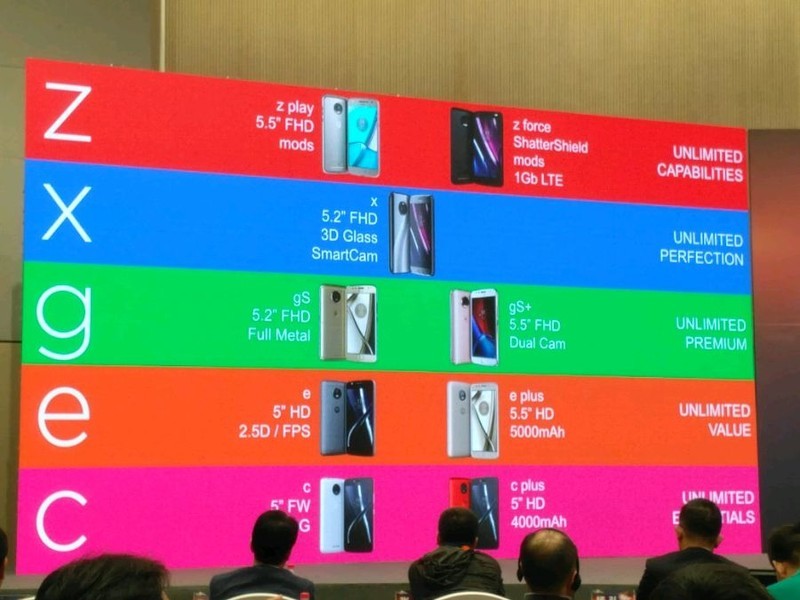
Inexplicably, it looks like Motorola is getting ready to launch a refreshed variant of the Moto G5 with dual rear cameras. The Moto G5 Plus made its debut back in March, with the 12MP imaging sensor being one of its main highlights. The leak suggests Motorola is increasing the screen sizes — the Moto GS will come with a 5.2-inch panel (up from a 5-inch panel on the Moto G5), and the GS+ will allegedly feature a 5.5-inch screen (up from 5.2 inches).
According to the leak, Motorola will release no fewer than nine phones later this year, which will lead to a crowded lineup. We’ve already seen that to a certain extent last year in Asian markets with the Moto M and Moto G, which were positioned in the same segment. The only differentiator with the Moto M was the metal chassis, and although a successor to the Moto M wasn’t detailed in the leak above, it is possible we’ll hear more about the device at a later date. It’s also odd that there doesn’t appear to be a regular Moto Z in the lineup — the Moto Mods functionality will be limited to the Moto Z2 Play (which may be a downgrade over the first) and the more expensive Moto Z2 Force.
With nine new models on the horizon, Motorola will face a tough time of rolling out quick updates.
Lenovo has a habit of rolling out devices aimed at a particular niche — we’ve seen that over the last two years with the Vibe C, the Vibe X, Vibe S, and the Vibe P. Motorola is now following in its parent company’s footsteps, and the reasoning for that may come down to Lenovo’s newfound strategy for the smartphone segment. It’s possible the company will find cost savings by sharing components and designs throughout its varied product range, though, but to most consumers this will be confusing.
After toying with the “Moto by Lenovo” branding last year, Lenovo is now leveraging the Motorola brand more effectively in global markets. The manufacturer revealed earlier this year that although it would continue a dual-brand strategy, Motorola’s brand name would take precedence in markets like India, where the manufacturer sells phones under both labels.
The move makes sense from Lenovo’s standpoint — with the company scaling back its own offerings, the onus is now on Motorola to roll out new phones to fill that void. Judging by the positioning of the new Moto E and Moto C series, that’s exactly what Motorola is doing.
The Moto C is now official, offering a 5-inch FWVGA display, quad-core CPU, 1GB of RAM, 8GB storage, 5MP camera, 2MP front shooter, 3G, and 2350mAh battery for €89. There’s a Moto C Plus with a larger screen and 4000mAh battery along with 1GB of RAM and 16GB storage that will retail for €119. The Moto E refresh for 2017 is likely to retail for $150, adding a fingerprint sensor and beefier specs.
By introducing several new models at once, Motorola is making it harder for itself when it comes to rolling out updates. The company isn’t as quick as it used to be at delivering software updates, and in the case of a few phones like the Moto G 2015 and Moto E3 Power, the company decided not to offer an update at all. By introducing at least nine new models this year, Motorola will be significantly taxing its engineering resources as it tries to keep its portfolio of devices up to date.
What’s your take on Motorola’s revised smartphone strategy? Let us know in the comments below.
HTC U11 is official: Snapdragon 835, UltraPixel 3 camera, Edge Sense squeeze input!

HTC’s 2017 flagship will be available unlocked in the U.S., and sold exclusively via launch carrier partner Sprint in the U.S.
HTC has hosted a special event in Taipei, Taiwan to officially unveil the new flagship phone for its 20th anniversary year: the HTC U11. The U11 follows in the footsteps of the U Ultra and U Play, released earlier in the year, with a refined version of that phone’s “liquid glass” design — while introducing a pressure-sensitive, squeezable metal trim as part of the new Edge Sense feature.
It also boasts suitably high-end specs — the U11 is a 5.5-incher with a Quad HD SuperLCD 5 display, and it’s powered by Qualcomm’s latest Snapdragon 835 chip, with 4GB of RAM and 64GB of storage in the U.S. and UK (some other regions will also carry a 6GB/128GB model). As is becoming increasingly standard for flagship phones, the HTC U11 is water and dust resistant, rated IP67. And the company has upgraded its 12-megapixel shooter — now dubbed an “UltraPixel 3” camera — with faster autofocus and an f/1.7 lens, and enhanced HDR capabilities thanks to the always-on HDR Boost feature.
See at Amazon
More: HTC U11 specs
Squeeze to start the camera, take a photo, open Assistant or launch your favorite app.
Edge Sense is the big new hardware feature HTC is focusing on with this phone, turning the entire outer frame itself into a programmable shortcut area. Squeezing the phone — either with a short or long grip — can launch the camera, Google Assistant, the camera, or any app. Many of HTC’s own apps have Edge Sense capabilities built in, and an add-on app launching shortly after the U11 goes on sale will allow you to map certain features of third-party apps to a short or long squeeze too, without the developer needing to update it.
Speaking of Assistants, the U11 will launch with Google Assistant, and Amazon’s Alexa will be made available via a Play Store software update in the weeks following release. HTC says it’s working to bring more AI assistants to the phone, and that they’ll be treated as equals, with the same access to wake-up voice commands and Edge Sense’s capabilities. In China, Baidu’s DuerOS will provide Assistant functionality relevant to that market on the HTC U11.
Like the HTC Bolt and U Ultra, the U11 also abandons the 3.5mm headphone jack, and instead comes bundled with a pair of HTC USonic USB-C earphones, which have now been upgraded to include active noise cancellation. And elsewhere, HTC’s BoomSound Hi-Fi system has been enhanced to bring volume in line with the company’s older front-facing BoomSound speakers, thanks to the entire body of the phone acting as a resonant chamber.
More: HTC U11 hands-on preview
The HTC U11 will go on sale later in May, starting in select markets next week. The unlocked HTC U11 will sell for $649 in the U.S., and it’ll also be available on Sprint, the exclusive carrier launch partner. In the UK, it’s £649 SIM-free from Amazon, Very.co.uk, Argos, and will also be available at Carphone Warehouse, EE and O2. More regional carrier announcements should start popping up in the days ahead.
For more on HTC’s latest creation, you’ll want to check out our hands-on preview!
HTC U11
- HTC U11 preview
- HTC U11 specs
- Manufacturing the U11: Behind the scenes
- Where to buy in the U.S.
- Join our U11 forums
- HTC U11 vs Galaxy S8
- HTC U11 vs LG G6
Press release:
HTC Unveils New Flagship Smartphone Made for the Brilliant U: Meet the HTC U11
HTC U11 combines revolutionary new squeeze interaction with stunning liquid surface design, intelligent personal audio, amazing cameras, and multiple AI assistants for a smarter smartphone
TAIPEI – May 16, 2017 – You affectionately squeeze the hand of the one you love. A baby intuitively squeezes her mother’s finger. A child squeezes his teddy bear to feel safe at night. Nothing feels as close, connected and personal as the sensation of touch or the warmth of an embrace. And no device is as personal in our lives as our smartphone. Inspired by the power of touch and the Brilliant U, HTC today unveiled HTC U11, the world’s first smartphone with revolutionary new squeeze interaction. Made for “U” with design, materials, and experiences that reflect your inner drive, passion, creativity, and individuality, HTC U11 offers the most advanced features ever in a smartphone, including:
- HTC Edge Sense, the next dimension in touch interaction with your phone.
- Liquid Surface, a stunning, unique design that reflects you.
- HTC USonic, our most advanced headset ever built for personal audio, now including Active Noise Cancellation.
- Amazing cameras with the highest independent rating ever awarded to a smartphone camera1.
- HTC Sense Companion, Google Assistant, and Amazon Alexa for a smarter, more helpful smartphone2.
All together, HTC U11 sets a new standard of what you can expect from a smartphone.
U touch
- Few things are as natural and intuitive as the sense of touch. HTC Edge Sense transforms this fundamental sense into a completely new and revolutionary interaction with your phone. With a simple squeeze, HTC Edge Sense lets you easily engage with your phone in an unprecedented yet intuitive way, helping you more naturally enjoy the things you love like taking photos, opening Facebook, or launching any of your favorite apps.
- For example, with HTC Edge Sense, launching your camera has never been easier. No more fumbling for buttons or awkward hand positions. No more worrying about dropping your phone while you pose. Just lift, squeeze, smile, and snap.
- You can also send texts faster and easier than before. Texting can be impossible when you are on the move, but using HTC Edge Sense for Voice to Text, you can speak your text messages without having to slow down. Lightly squeeze, speak your message and send your texts on the go.
- You can even customize the squeeze gesture: open email with just a squeeze. Or launch your favorite game (or any other app). Or pick any one of a host of options. Want even more touch control? HTC Edge Sense gives you the ability to activate advanced touch and use a “short squeeze” as well as a “squeeze and hold” for even more functionality at your fingertips.
- And because Edge Sense is based on actual pressure applied to the side of the device, it can be used in nearly any condition – including while wearing gloves or in weather such as snow or rain that would normally be a challenge with capacitive buttons.
Reflects U
- HTC U11’s liquid glass surface is crafted to impress using Optical Spectrum Hybrid Deposition. By layering highly-refractive precious minerals across the phone’s back cover, we’ve created vivid new colors that transforms light with every movement you make.
- The new seamless, curved look of HTC U11 is achieved with 3D glass on both front and back. Heating and then bending the glass using extreme pressure results in unique, 3-axis symmetry for a phone that is slim no matter which way you hold it.
- HTC U11 has a 5.5″ Quad HD 3D glass screen designed for vivid, crisp images and text in any light – even direct sunlight. With our best display and true-to-life color reproduction, we provide you a purer full-framed viewing experience. Our display avoids the cropped pictures or distorted colors at the edge that are the results you can expect from a curved screen.
- Plus, HTC U11 is water-resistant3, so no need to worry about splashes, spills, or dunks.
Tuned to U
- HTC U11 introduces the latest version of HTC USonic, which now combines Active Noise Cancellation with the ability to tune audio to your unique hearing. By leveraging built-in microphones on the headset and USB-C data connectivity, USonic earbuds map your inner ear with an advanced sonar-like technology and then adapt the sound profile to your unique biology. This creates an incredibly personal and optimized listening experience with vibrant audio shaped specifically for you.
- USonic now incorporates Active Noise Cancellation, which reduces disruptions and distractions around you, so you can stay focused on your music. Active Noise Cancellation continuously monitors environmental sound levels, and quickly adjusts to any new noises or disturbances. You’re free to stay focused on your music, videos, or games
- HTC BoomSound Hi-Fi Edition speakers got an upgrade, too. We’ve improved the speaker design to deliver more loudness and better Dynamic Range Audio. On top, the tweeter now offers an acoustic chamber that allows the highs and mids to sound richer. While below, the woofer sports a new speaker and improved magnetic circuit design for louder, clearer and deeper bass tones. You really have to hear it to believe the power of BoomSound.
- We didn’t forget to upgrade the microphones, either, using four optimally positioned omnidirectional microphones together with our new Acoustic Focus technology, HTC brings you our best 3D audio recording quality yet. HTC U11’s microphones work together to record audio from all directions, and when shooting video with Acoustic Focus, you can visually zoom in to target your subject and amplify their specific sounds.
- Out of the box, we will also ship an HTC USB-C to 3.5mm adapter with a built-in DAC that offers great audio performance and wide compatibility with all other devices and earphones.
Pictures that move U
- HTC U11 has achieved the highest ever rating for a smartphone camera for both photo and video by independent metric DxOMark4. Our multi-axis optical stabilization system and super-fast autofocus in all lighting conditions make the camera quick, your pictures sharp, and videos smooth. We improved our camera and video for a more dynamic exposure range with HDR Boost without the lag, new white balance enhancement, a major reduction in noise, and excellent detail preservation.
- HTC U11 introduces Auto HDR Boost to give you all the benefits of HDR without the lag. HDR Boost offers clearer, more balanced pictures by taking multiple shots that measure the darkest shadows and brightest highlights without any slowdown. HTC U11 enhances textures and colors, increases visible detail and brings out the best in every shot. When shooting video, Temporal Noise Reduction automatically uses information from the previous and next frames to remove unwanted noise and deliver the clearest video.
- Great news for serious photographers: HTC U11 incorporates the new UltraSpeed AutoFocus with same full sensor auto-focus technology that’s found in top DSLR cameras, so you can enjoy significantly faster focus speeds, with snappy and delightful performance. In addition, HTC U11’s exceptional optical and electronic stabilization system will keep your photos and video steady and crisp even when your hand is shaking.
- The new front camera now combines high-resolution 16MP detail and our UltraPixel light sensitivity for brilliant selfies day or night. It also utilizes the same powerful HDR Boost and noise reduction as the main camera.
The smarter digital companion for U
- Three brains are better than one, so inside HTC U11 you can find three intelligent companions devoted to you: HTC Sense Companion, Google Assistant, and Amazon Alexa2. In mainland China, HTC U11 also offers Baidu DuerOS.
- We’ve made HTC Sense Companion smarter than ever: it will get to know you and your daily patterns over time in order to offer you more convenience every day. For example, HTC Sense Companion is smart enough to notice if you have any late appointments that day and will remind you to recharge while you have time or bring a power bank. It will make sure your phone is running at its optimum speed by suggesting to clear junk files and unused apps for more free space. It will let you know if you need to dress for inclement weather conditions, track your fitness progress relative to your goals, recommend great nearby restaurants at mealtime, and much more5.
- HTC U11 runs the latest version of Android, so it also includes Google Assistant, the helpful personal assistant powered by Google se arch and services for finding directions, getting answers, managing your tasks, planning your day, and entertainment.
- HTC U11 is also the first smartphone on the market to feature hands-free wake word access to Amazon Alexa. By simply asking questions such as “Alexa, what’s the weather today?” or saying things like, “Alexa, turn on my living room lights,” Alexa will respond to your needs anywhere you go, making it easy to control smart home products, ask for news, weather, music, and the 12,000-plus skills in the Alexa skills store. The Alexa voice service is currently available to customers in the United States, U.K., and Germany.
- And in mainland China, HTC and Baidu DuerOS have built a strategic partnership to create a voice-based virtual assistant with speech recognition and voice interaction to satisfy Chinese users’ needs, which can better understand Chinese people and help them find what they want.
Powerful U
- HTC U11 is the first smartphone to be commercially released worldwide that is exclusively powered by the Qualcomm® Snapdragon™ 835 Mobile Platform. So no matter what region of the world you live in, you get an octa-core processor with breakthrough speeds, jaw-dropping graphics, impressively smooth performance and outstanding battery life. Every HTC U11 also includes UFS 2.1 for an extremely fast processor paired with the fastest memory performance. Experience Gigabit Class LTE (up to 1Gbps) with the integrated Snapdragon X16 LTE modem, which is designed to deliver fiber optic speeds on the go for lightning-fast music and video downloads and to get almost instant access to the web, social media sites or your content in the cloud. You get 25% faster graphics than the HTC 10, with 35% or 3 hours more video playback, 30% or 8 hours more music playback and 43% or 3.5 hours longer web browsing time via a LTE network6.
- A blazing fast processor with amazing camera and incredible HTC USonic sound means you’ll want a lot of storage for apps, games, photos, music, and entertainment: HTC U11 offers 4GB RAM/64GB storage and 6GB RAM/128GB storage options, so fun on your phone is always available.
- HTC U11 also offers a fingerprint reader for enhanced privacy and security. Requiring just a few minutes to set up, the fingerprint reader will unlock your phone with the press of your finger – making it faster and easier to jot the note, capture the photo, or do anything you want with your phone on a moment’s notice.
The HTC U11, available in Amazing Silver, Sapphire Blue, Brilliant Black, Ice White, and Solar Red, and will be available worldwide from May 2017 onward. Please see htc.com for detailed specifications and more information.
HTC U11 vs. Samsung Galaxy S8 first comparison: Market share matters

It’s tough to stand out in a market dominated by Samsung’s latest flagship.
HTC’s proper 2017 flagship, the U11, has arrived, and it hits the market just a few weeks after Samsung released its Galaxy S8. Though HTC is miles away from Samsung in terms of market share, it’s attempting to make a flagship on the same level when it comes to specs, hardware, and experience.
In terms of overall dimensions, the HTC U11 lands in between the Galaxy S8 and S8+ but is a closer comparison to the smaller GS8 when it comes to screen area. We spent some quality time with both phones together to see how they stack up.
There are plenty of internal similarities between these phones, but the companies have taken distinctly different approaches to hardware. Samsung made big strides this year in shrinking bezels and moving to an extra-tall 18.5:9 display, but HTC is sticking with the old model of a 16:9 aspect ratio and rather large bezels all around. Even further, HTC’s traditional capacitive keys and front-mounted fingerprint sensor are in stark contrast to Samsung’s switch in 2017.
HTC’s hardware execution is excellent, but the Galaxy S8 just feels futuristic.
HTC’s design decisions feel a little antiquated in general, but doubly so when sat next to the sleek and futuristic Galaxy S8. On the other hand, there are clear advantages to having a fingerprint sensor that’s right where you expect and a flat display with bezels that reduce accidental touches. The U11’s 5.5-inch display is smaller diagonally than the Galaxy S8’s, but because of its wider aspect ratio there’s actually more display here — but combined with the larger bezels, the entire phone is larger to boot. That doesn’t necessarily have large implications for actual use of the phone, but when you set the two together you do notice how dramatically narrower and easier to grip the Galaxy S8 is.
Size aside, the HTC U11’s hardware is equally impressive as the Galaxy S8’s. HTC’s manufacturing quality continues to be excellent, and the back glass panel curves and flows more effortlessly than Samsung’s with colors that catch your eye differently from all angles. You don’t get the dramatic edge screen effect or the big sweeping metal curves of the GS8, but the U11 just feels so … solid when you pick it up. There’s some value in that.
In waiting to release the U11 well after the original U Ultra and U Play, it let HTC make some key component upgrades that help it be a proper competitor to the Galaxy S8. The Snapdragon 835 processor is of course one major improvement, but we’re also looking at a different 12MP rear camera from the U Ultra that incorporates new phase detection auto focus and a fast f/1.7 lens. The rest of the specs line up identically to the Galaxy S8: 4GB of RAM, 64GB of storage, a 3000mAh battery and a QHD display resolution.
More: HTC U11 complete specs
HTC offers cleaner software … but also, no headphone jack.
The one place Samsung is distinctly different here is with its inclusion of the 3.5 mm headset jack, which HTC has moved beyond. HTC includes some great USB-C headphones with the U11 that include active noise cancellation, as well as a USB-C to 3.5 mm adapter, but at this point this choice may still rub some people the wrong way. At the same time, HTC does offer a superior dual speaker setup on the U11 that can offer better sound at higher volumes than the Galaxy S8’s single speaker.
HTC’s software hasn’t changed much in the past year (or two, if I think about it). On the upside, that means you’re getting an extremely fast, smooth and generally bloat-free experience, with some light visual touches that nicely integrate into Google’s Nougat software. But that also means some of HTC’s apps are going to feel stale as you notice they’re near identical to what you would’ve experienced on the last couple phones. The interface still feels consistent and everything looks fine, but it doesn’t quite feel as modern as what other companies have on their latest phones.
Meanwhile Samsung has definitely pushed its interface into modern design expectations, and still offers a dramatically higher volume of apps and features so there’s something here for everyone — even though that means it can be frustrating or overwhelming for those who want a simple and clean experience.
Fighting an uphill battle
In a high-end market so heavily dominated by Samsung, it’s really tough for any phone to break out and take away sales. Despite the HTC U11 offering brilliant hardware and matching its internal specs, it’s tough to pull ahead of the Galaxy S8. Phone buyers will have to be drawn to a few of the finer points in the U11’s experience in order to choose it over Samsung — its brilliant colors, “traditional” dimensions and simpler software are its only real standout strengths compared to the Galaxy S8, while the lack of a headphone jack, wireless charging and strong brand recognition are hurting it.
It’s not that the U11 is doing anything particularly wrong — and the phone overall seems to have what it takes to garner sales — but it doesn’t necessarily have the standout features to grab the attention of average buyers who so often start with Samsung’s latest phone as the default choice and work from there.
HTC U11
- HTC U11 preview
- HTC U11 specs
- Manufacturing the U11: Behind the scenes
- Where to buy in the U.S.
- Join our U11 forums
- HTC U11 vs Galaxy S8
- HTC U11 vs LG G6
Samsung Galaxy S8 and S8+
- Galaxy S8 and S8+ review!
- Galaxy S8 and S8+ specs
- Everything you need to know about the Galaxy S8’s cameras
- Get to know Samsung Bixby
- Join our Galaxy S8 forums
Verizon
AT&T
T-Mobile
Sprint
HTC U11 preview: Shiny and squeezy

HTC’s latest phone will try to convince you that squeezing is the next big thing in mobile. But beyond the quirky Edge Sense feature, the U11 dazzles with a shimmering metallic exterior and packs in all the power enthusiasts crave.
Unless you’ve already clawed your way to the top of the pile, standing out in the high-end smartphone market of 2017 is tough. These devices are commodities now, and making a phone — especially a high-end, high-priced phone — that’s really different and better is more difficult than ever.
For an underdog like HTC, it’s especially challenging. Last year the HTC 10 was praised for being a great all-rounder, but it didn’t offer much besides the core formula of metal body + latest specs. Once upon a time, HTC had a near monopoly on high performance and great build quality in the Android space. The 10 served as a reminder of the extent to which the competition had caught up to, and in many cases, surpassed HTC.
There wasn’t a great deal about the way the HTC 10 looked or what it did that was truly unique anymore. It did the same smartphone things as every other Android device, and it did them well, and that was about it. The foundations were solid, but relatively bare.
Forget the U Ultra and U Play — the is where the ‘HTC U’ brand story should have begun.
In its 20th anniversary year, HTC’s new flagship is the U11, the name being a collision of old and new branding. Technically, it’s the third member of the HTC U family, after the U Ultra and U Play — but honestly, forget those phones. The U11 is where the “U” brand story should have begun.
It’s a phone with beautiful glass construction bathed in vibrant, shimmering colors — a leap beyond the relatively dull metal unibody of the HTC 10. On the inside, it has all the top-end specs and features you’d expect from a 2017 flagship, along with important improvements in HTC’s own camera and audio tech.
See at Amazon
That’s only part of it, though. What makes the U11 truly unique is Edge Sense, a feature built into the metal rim, which responds to a squeeze and which HTC is pushing hard with this phone’s launch. And in a world where AI assistants increasingly compete for the same attention, HTC wants the U11 to serve as a hub, hosting Google Assistant, Amazon’s Alexa, and more — in addition to its own Sense Companion app.
It’s HTC’s boldest flagship in years. Given that it’s competing for shelf space and sales against the almighty Galaxy S8, it needed to be.
This past week we’ve spent a short time getting to know the HTC U11, and while it’s made a good first impression, the jury’s still out on a few of its core features.
As much as HTC is advancing its design language with color and curved glass this year, it’s also eschewing one of the major trends of smartphones of 2017. The U11 is a traditionally shaped 16:9 slab with a definite forehead and chin to it. From the front, it’s markedly less futuristic than Samsung and LG’s latest efforts. And if you could only see the front face, it’d be easy to confuse it for an HTC 10 or Bolt or U Play.
The U11 is a traditional 16:9 slab with a chin and a forehead, but that has its advantages.
Such a form factor definitely has its advantages, though. I can reach to the notification shade with ease, every time on the U11. And the fingerprint scanner is right there on the front, where I can reliably touch it without fumbling around.
It’s also nowhere near as bulbous as the needlessly oversized U Ultra. With a 5.5-inch screen and minimal side bezels, it’s a comfortable in-hand fit. This is a display size once reserved for enormous “phablet” devices, but now it’s more of a “Goldilocks” screen diagonal. To me, it feels just right.

The U11’s Quad HD SuperLCD5 panel looks bright and vivid indoors and also has good viewing angles. I’m also not noticing the obnoxious over-sharpening I saw on the U Ultra’s panel. But that’s about all we can say for now — I haven’t yet had the chance to use the U11 outdoors, so we’ll have to wait to see how it measures up on daylight visibility.
The front of the phone is a dead ringer for other modern HTC models, with capacitive keys down below and a fingerprint scanner which, if the U Ultra is any indicator, should be both quick and reliable.
There are plenty of small advancements over those older “U” phones, though, which make the U11 feel like a more premium piece of kit. HTC’s BoomSound Hi-Fi setup has been upgraded in the new phone. In a meeting ahead of the May 16 launch, HTC’s head of global product marketing, Darren Sng, told me that the entire body of the phone now acts as a resonant chamber, to boost volume to the level of HTC’s older, front-facing BoomSound speakers. (In my brief time with the phone, I can confirm that it is indeed loud!)
HTC’s USonic earbuds return too, this time with active noise cancellation — in addition to personalized audio profiles, generated through software by mapping your inner ear with sound.
The molded plastic between the display and metal trim is no more; instead, the “3D” glass of the front panel tapers directly into the metal, just like the curvaceous back panel. The symmetry isn’t quite as overt as the Galaxy S8’s, but still, the U11 has a much more organic feel to it than previous models.
The gorgeous ‘solar red’ HTC U11 flickers between gold and blood red.

That’s thanks in part to the phone’s shimmering, colored glass back panel. It’s not unlike what we’ve seen before in the U Play and U Ultra, but it feels like the tolerances have been tightened up a little, and so the U11 sports a more refined version of this “liquid surface design”.
There are five color options — the blue, black, and ice white we’ve previously seen from the U Ultra — in addition to two jaw-droppingly beautiful new hues. “Amazing silver” shifts between a sky blue and silvery gray color as you tilt it through the light.
And “solar red,” my personal favorite, flickers from a fiery blood red to a brilliant gold. (It’s unfortunate that the red won’t be available at launch but instead will come in a later production run — it really is a sight to behold.)
The U.S. will get silver, black, and blue U11s at launch.

Whereas the Galaxy S8 is most striking when viewed from the front, it’s the rear of the U11 that makes it stand out from the crowd. There are many glass-backed smartphones, but none quite match up to the impact of a back panel like the silver or red U11, which literally change color depending on the angle at which they’re held.
These are all the same phone — the ‘solar red’ HTC U11.
It remains to be seen whether this dazzling design will be enough to maintain interest in the U11 through what’s sure to be a highly competitive year. But it’s a strong start.
HTC also hits all the necessary spec points for a modern high-end handset: Snapdragon 835, and models with 4GB RAM + 64GB storage, or 6GB + 128GB, plus microSD. (In the U.S., it’s 4 + 64.) That’s paired with a 3,000mAh battery, Quick Charge 3.0, and IP67 water and dust resistance. Like the U Ultra, there’s no headphone jack, but HTC will at least package a USB-C to 3.5mm dongle in the box this time. (The dongle itself contains a high-end DAC, I’m told.)
More: HTC U11 specs
Squeeze is intimate. We don’t need to teach someone how to do it.
These are all expected incremental upgrades, and there’s nothing at all wrong with that.
But let’s talk about something you won’t find on most spec sheets: Edge Sense. This is the big marketing shtick for the phone — its ability to sense squeezes on its metal trim and do… stuff… accordingly.
“Squeeze is intimate. Squeeze is a form of touch, but it conveys this whole sense of warmness,” Darren Sng told me, “We don’t need to teach someone how to do it.”

Squeeze is also simple, and so there’s not a whole lot to explain about how Edge Sense actually works. You squeeze the sides of the phone, and it responds with a short buzz and then stuff happens. Many of HTC’s own apps have Edge Sense options built in — in the camera app, for instance, it’ll take a photo with a short squeeze (like a shutter button, kinda) or flip between the front and rear cameras with a longer squeeze. Or in the stock keyboard, squeeze to change to voice input.
Edge Sense will eventually learn to work with all your Android apps.
The rest of the time, you can set up default actions for a short or long squeeze. The early U11 units I played with were set up to launch the camera with a short squeeze or open Google Assistant with a longer squeeze.
In the weeks following launch, HTC will release an Edge Sense add-on app, which will allow U11 owners to extend their squeezy antics to any third-party apps by programming them to perform certain actions with a squeeze. (Long-squeezing in Instagram, for instance, might load the app’s camera panel.) This sounds like a great option given that, let’s be honest, third-party devs aren’t going to be in a hurry to support a feature that’s only available on one handset. However, HTC didn’t show this add-on app to us as part of its presentation, so that’s all we know for now.

As part of the phone’s setup process, you’ll calibrate your squeeze sensitivity, which should hopefully help you avoid false positives. In my brief time with the phone, I didn’t find it registering any accidental squeezes, but the distinction between a long squeeze and a short squeeze did take a little getting used to.
Is this really any better than a button? Edge Sense does work anywhere on the edge, I guess. And squeeze input has the advantage of working reliably where touch might not, such as under heavy rain or when you’re wearing gloves.
And hey, if it bothers you that much, you can disable it entirely.


Google Assistant and Alexa will coexist as equals on the U11.
It’s easy to jump to conclusions on a new and very different feature like this. It’s tempting to dismiss it as a gimmick. But the daily convenience angle is going to take time to judge. While I wasn’t blown away by Edge Sense’s utility, I’m not willing to dismiss it just yet. We’ll have a more considered opinion in our full review in the near future.
I mentioned one AI already — Google Assistant — but HTC is getting ready to make the U11 a hub for personal assistants. Amazon’s Alexa will be coming to the U11 in July via a Play Store update in U.S. English, UK English, and German, and there’ll be an option to enable Alexa via a squeeze in Edge Sense. Both will be “first class citizens” on the U11, Darren Sng says.
HTC’s also working with Baidu in China to bring the firm’s DuerOS assistant platform to the U11.
And that’s in addition to HTC’s own Sense Companion, which received a lukewarm reception when it debuted on the U Ultra.
We had a misfire when we started with Sense Companion.
“We had a misfire when we started [with Sense Companion],” Sng told me, “We didn’t realize the scope of how people wanted the AI companion to be much more active. We adopted a reactive approach.”
So in an update to the U11 shortly after launch, Sense Companion will start taking the initiative a little more. Smart alarms will allow Sense Companion to suggest tweaks to your alarm schedule for public holidays, or scheduled meetings. For instance, you might want to switch off your normal workday alarm on a vacation day, or set it a little earlier if you’ve got a meeting first thing.
But HTC’s own AI will remain focused on on-device intelligence like this. And right now it’s still a touch-based interface, with no voice component.
The rest of the U11 software experience is basically unchanged from our last experience of HTC Sense on the U Ultra, the biggest difference being that it’s now based upon the newer Android 7.1.1. The same old HTC apps — still a little tired looking — sit atop a relatively barebones Android UI. In fact, most of the changes from the HTC 10 stem from the upgrade to Nougat, as opposed to any HTC software changes.
That’s all well and good if you like the stock Android aesthetic, but it’s left looking a little bland next to Samsung’s space-age UI.

UltraPixel 3 brings some Pixel-like image processing tricks to the mix.
On the imaging side, the incremental upgrades continue, with HTC’s UltraPixel brand reaching its third generation. It’s still a 12-megapixel sensor with OIS (optical image stabilization), and EIS (electronic image stabilization) for video. The pixel size takes a knock down to 1.4 microns, while the lens itself has a brighter f/1.7 aperture. On paper, then, it matches up to the Samsung Galaxy S8’s main camera.
That’s backed up by “HDR Boost” on the software side — an always-on HDR mode that sounds a lot like Google’s HDR+. The idea is that the U11 is always ready to take HDR photos with zero lag and that this superior processing produces brighter pics with less noise. I didn’t have nearly enough time to come to any real conclusions on the camera, but in moderate indoor lighting it produced clear pics. And the focus on software processing and HDR lines up with where we’re seeing some of the greatest advances in smartphone camera tech.
HTC is also keen to highlight its “Ultraspeed AF,” — which stands for autofous, and nothing else — and which is able to focus in as little as 0.3 seconds even without a laser autofocus unit.
So in short, this could be another HTC camera worth getting excited about. (Expect another big DXOMark record announcement at the Taiwanese launch event.)
Around the front, the 16MP f/2.0 selfie camera from the U Ultra returns, complete with UltraPixel low-light mode to produce lower-resolution, but clearer night shots. And that’s likely to be augmented by the Snapdragon 835’s superior ISP (image signal processor), too.
HTC needs eye-catching, unique stuff to drum up some excitement around its brand and its phone biz, both of which have been flagging for the past few release cycles. Last year it didn’t really have any single standout feature to own with the HTC 10.
HTC needs new and exciting things to make buyers care about its phones again. And in the U11 it has two eye-catching innovations.
This year it has something shiny — that dazzling liquid metal back — and something squeezy — Edge Sense. That’s an improvement, for sure. It gives HTC’s marketers something to work with, and it gives potential customers a reason to pause before automatically buying a Samsung Galaxy S8. Even if Edge Sense really is 90% gimmick — as, let’s be honest, is Samsung’s Edge Screen — maybe it’s just the hook needed to turn buyers’ attention towards a well-built, good-looking smartphone with excellent performance.
But is it enough to compete against a dominant Samsung, a rising Huawei (in Europe, at least) and the influence of disruptive players like OnePlus? That’s a question for another day.
The HTC U11 begins shipping first in select countries from the week after announcement, with general availability coming in June. The unlocked HTC U11 will sell for $649 in the U.S., and it’ll also be available on Sprint, the exclusive carrier launch partner. In the UK, it’s £649 SIM-free from Amazon, Very.co.uk, Argos, and will also be available at Carphone Warehouse, EE and O2.
HTC U11
- HTC U11 preview
- HTC U11 specs
- Manufacturing the U11: Behind the scenes
- Where to buy in the U.S.
- Join our U11 forums
- HTC U11 vs Galaxy S8
- HTC U11 vs LG G6
HTC U11 coming to Sprint in U.S., also unlocked from Amazon and HTC
HTC U11 in the U.S.: where, when and for how much.
HTC’s relationships with the U.S. carriers have weakened, and with the launch of its 2017 flagship the U11 it has just one carrier on board. The HTC U11 is exclusive to Sprint at launch, going up for pre-order immediately online with a proper release on June 9. The pricing from Sprint is set at $0 down and $29 per month for two years, or a total price of $696. Sprint will be offering the U11 in black and blue colors, at least at launch.
Thankfully, you are only stuck going to Sprint if you want to buy the phone directly from your operator. HTC will also be selling the U11 unlocked on Amazon and HTC.com, continuing an excellent trend of selling directly to consumers who want to bypass the carriers. It’s available immediately for pre-order from both storefronts for $649, with an additional color choice of silver alongside black and blue. Unlocked models don’t have a specific shipping date, but we know they will ship in June.
See at Amazon

More: HTC U11 specs
The unlocked model won’t necessarily support all of the niche carrier-specific network enhancements, but it is designed to be used on all four major U.S. carriers — just pop in your SIM and go. The U.S. unlocked model also has the advantage of not being loaded with any carrier-imposed software, and will theoretically be in a better position to receive software updates as a result.
Strongly consider just buying unlocked this time around.
No matter where you buy it, the U11 in the U.S. is the model with 4GB of RAM and 64GB of storage — we won’t have access to the relatively rare 6GB RAM / 128GB storage version. Details on the stunning red and white color models are a bit foggier: we know those colors won’t be available in the U.S. at launch, but no information is available on whether they’ll come stateside in the future or not.
If you do choose to go with Sprint, you’ll get a nice little incentive when pre-ordering before June 8. Early pre-orders will receive two Amazon Echo Dots for free, presumably to promote the fact that the U11 will soon have Amazon Alexa built in as an assistant option. That’s a nice $99 value for those who are already planning to stick with Sprint as their carrier.
HTC U11
- HTC U11 preview
- HTC U11 specs
- Manufacturing the U11: Behind the scenes
- Where to buy in the U.S.
- Join our U11 forums
- HTC U11 vs Galaxy S8
- HTC U11 vs LG G6
HTC U11 vs. LG G6 first comparison: Making up ground

It takes serious work to get back into the flagship game in a meaningful way.
HTC has even less of a foothold in the flagship space than LG does, and the launch of the U11 is hoping to help propel HTC in similar ways to what the G6 has done for LG — picking up sales and improving after a lackluster 2016. For both phones, the way to get back on track is through doing all of the basics right, nailing the hardware and experience instead of reaching for gimmicks that end up hurting the message.
While their relative positions put them below the big leader Samsung in sales and mind share, the HTC U11 and LG G6 are actually quite comparable products. Here’s how they line up.
Both phones focus on strength and heft rather than delicate design features.
Unlike the stark contrast in designs seen between the HTC U11 and Galaxy S8, the LG G6 feels more like a direct match for HTC’s latest phone. The LG G6 of course has a distinct look with its relatively small bezels and 18:9 display, but the overall build feels of the same generation as the HTC U11. Both phones are unapologetically thick and robust, with metal frames that each feel strong rather than just looking svelte. The phones have a satisfying heft in the hand as a result, which plays into the feeling that both HTC and LG are focusing on strength and simplicity rather than design flair just for the sake of looking nice.
HTC’s glass back is a cut above LG’s typical color-coated glass. Not only does it offer a unique feeling of depth to the colors that help it stand out, but the way it wraps around the edges of the phone and meets the metal is exquisite. Flipping around to the front, though, HTC’s larger bezels and capacitive navigation buttons feel set in the past compared to the LG G6. The displays themselves feel comparable in terms of quality, so it’s really a personal preference on how you feel about the “standard” versus “tall” aspect ratio.
HTC takes the lead with a newer processor, but LG has a couple trump cards.
Launching a couple months later, HTC was able to get a newer Snapdragon 835 processor into the U11 compared to the last-gen 821 in the G6. Aside from that, the specs line up similarly — with LG taking the small advantage with a larger battery and of course retaining a headphone jack. Despite HTC doing very interesting things with its USB-C headphones and solid speakers, some people just won’t get over the headphone jack omission. The cameras, too, line up similarly. The U11’s 12MP with an f/1.7 lens matches up to the G6’s 13MP and f/1.7 — there are slight differences in pixel size, but LG has proven to be getting really great quality out of its smaller pixels. Of course the G6 has the trump card of its wide-angle rear camera as well, which continues to go unmatched in the market.
The software styling differentiates these phones further, though again not as much as setting the U11 beside the Galaxy S8. LG has made a move toward simplicity and lowering the number of duplicate apps and services in the G6, and that’s the track HTC has been on for a couple of years now. You can easily see that LG’s overall interface design is a bit more heavy handed than HTC’s, but neither phone hits you over the head with piles of excess features or software cruft. You could say HTC is living a bit in the past with its interface that hasn’t changed substantially since 2015, but at the same time say that for all of LG’s progress it has yet to catch up with modern software expectations. Pick your poison.
Moving on up
HTC and LG are both fighting similar battles trying to make up ground in the high-end space in 2017, and both the U11 and G6 are great devices to help them do just that. They each focus on having a solid phone with all of the proper internal specs, and just a couple of feature hooks to get people interested. LG has its dual cameras and small bezels, while the U11 offers better speakers, cleaner software and its unique “squeeze” functionality.
Both phones have considerable work to do to try and bring their respective companies back up to a high level in the flagship space, but the U11 and G6 each offer a compelling experience that make them worth considering in 2017.
HTC U11
- HTC U11 preview
- HTC U11 specs
- Manufacturing the U11: Behind the scenes
- Where to buy in the U.S.
- Join our U11 forums
- HTC U11 vs Galaxy S8
- HTC U11 vs LG G6
LG G6
- LG G6 review!
- LG G6 specs
- LG G6 vs. Google Pixel: The two best cameras right now
- Everything you need to know about the G6’s cameras
- LG forums
Verizon
Sprint
T-Mobile
AT&T
B&H
Made in Taiwan: How HTC designs, manufactures and tests its new U11 flagship

A glimpse at all of the behind-the-scenes work that goes into every single phone we use.
Leading up to the launch of the HTC U11, the company opened up its doors to show the amazing process that goes into making each flagship. I was lucky enough to be one of the journalists invited to see how it all comes together in Taipei, Taiwan. Through several buildings, offices, labs and production lines, I saw how HTC took the U11 from the early stages of design all the way to testing of individual components and finally assembly of individual phones that will soon be on store shelves.
From start to finish, it was an incredibly insightful experience.
Peering inside the design headquarters
HTC’s Taipei headquarters serve as the principle area for research and design, and is responsible for so much of the iconic HTC hardware over the past decade. It is here where I was able to get a glimpse at the design labs that took the U11 from drawing to prototype and finally into production. The massive building is filled with sharp right angles, copious amounts of smooth white walls, and glass that lets the light flow in from the open atrium that runs the entire height of the building.
More: Read our HTC U11 preview
For all of its excellent design nuances, the U11 still feels connected to the HTC phones of old.
The design team works away in an open office environment, in which I had the opportunity to be enamored with tables full of exploded component views of the new U11 and unreleased HTC design prototypes. (A fun one, in particular, was a prototype from ~2009 with a slide-out game pad that looked similar to an HTC Legend.) All three phones in the U series have a distinct glass back that is a culmination of years of working with glass in this building — and that work shows with the entirely unique colors and feeling of depth you don’t find in any other glass phone.
HTC is understandably proud of its hardware design (its design awards are prominently on display), which helps you understand a bit why it hasn’t taken more wild risks in recent years. The HTC U11, for all of its excellent design nuances, still feels very connected to the HTC phones of the last five years. Even if you feel HTC’s look as gotten stale, you can appreciate that continuity.
The testing that goes into individual components
Down the street from the headquarters, HTC has another building dedicated to finely tuning some of the individual components of the phones such as the speakers and cameras. Full departments for testing and developing audio equipment are here, including massive specialty anechoic chambers. The work here ranges from development of individual speaker hardware to tuning the experience of phone calls and headphones in a variety of simulated audio environments.
Testing individual components isn’t glamorous, but it’s immensely important.
Down the hall you’ll find the camera lab, which beyond feeling extremely odd thanks to its black floor, black walls and blackout curtains (to mitigate glare) is an extremely important area to the fine tuning of the camera processing. Purpose-built machines test how the camera firmware interprets different lighting conditions, colors and real-world scenes, giving feedback on how engineers can tweak individual parts. HTC’s camera engineers say their goal is to start with the base line of making the cameras reflect the real world as accurately as possible, then make slight adjustments sot he images continue to be appealing to the human eye.
More: HTC U11 specs
Apparently the work has paid off: HTC is touting that the U11’s rear camera has the best-ever mobile DxOMark Mobile score of 90, one point higher than the Google Pixel. We’ll have to see how it translates into the real world.
From components to completed phone in one building
About 45 minutes outside of Taipei, in Taoyuan City, HTC’s manufacturing facility stands tall in dark glass and concrete surrounded by otherwise typical low-rise city buildings. Inside, I watched U11s being built — moving from sheets of individual components all the way to complete assembly and testing.
The primary components of the phones are assembled in one long line, primarily by automated machines controlled by just a handful of people. Sheets of processors, connectors, memory units and other tiny pieces are placed on main boards, which are originally attached in sets of four. After some careful placement, they’re fed into a huge nitrogen reflow oven to effectively bake the components together so they’re all soldered in place.
A series of custom-built robotic arms scour through the incoming flow of main boards, separating them and performing various tasks before handing the boards off to the next position. At the end of the line, taking just a handful of minutes per board, a near-complete internal assembly comes out.
Test, test and test again — the production line strives for perfection.
One floor up, the assembled internal components move to a distinctly more human-run line for final assembly. The production line is marked “OCN,” coinciding with the “Ocean” codename for the U11. A couple dozen workers per line methodically piece together their selected components, while visually inspecting and scanning each one before placing it in the U11’s frame. Several steps down the line, with the phones sealed, a “pre-test” section of the line tumble-tests every phone — placing the phone in a rubber protective case, it’s tumbled in a machine 30 times over to test that internal components are securely attached. After completing the tumble test, their water resistance is tested with fine air jets. It is only after passing this pre-testing process that the phones go through a rigorous automated machine testing of the screen, ports, radios and cameras. The phones have the appropriate software flashed, and they’re packaged.
One in 10 phones are selected for a completely new round of extra testing, in which a worker actually boots up the device, performing dozens of additional tests simulating real-world use. If a single flaw is found, the entire batch of phones surrounding it is removed from the line.

And then the HTC U11 is ready for you
A one-day tour of HTC’s facilities is incredibly insightful, although it still dramatically sells short the amount of time and energy that has gone into the production of the U11. Production cycles for these phones typically last at least a year, meaning as the U11 is released to the world its successor is already under development.
But by seeing all of the individual pieces (figuratively and literally) coming together, you can appreciate the amazing amount of work that goes into making a modern smartphone that fulfills all of our needs and desires.
Ed. note: Due to tight restrictions on photography inside its production facilities, photos used in this article are all pre-approved by HTC for publication.
Our HTC U11 preview
Now that you’ve seen how the HTC U11 was made, you’ll want to know how it all comes together. Be sure to read our full HTC U11 hands-on preview to see everything HTC’s 2017 flagship has to offer.
Read our complete HTC U11 hands-on preview!
HTC U11 specs: Snapdragon 835, 5.5-inch QHD display, 12MP f/1.7 camera

HTC’s 2017 flagship boasts top-tier internals.
With the arrival of the HTC U11, the Taiwanese company kicks its new “U” brand into high gear, with a true 2017 flagship featuring suitably advanced internals. The short story: Snapdragon 835 — the first phone to use this chip across all regions — 4 or 6GB of RAM, 64 or 128GB of storage, 3,000mAh battery, new 12-megapixel UltraPixel 3 camera with upgraded HDR, and of course HTC’s squeezy Edge Sense feature. Check out the longer version down below.
Behold, the HTC U11 spec sheet!
| Operating System | Android 7.1.1, HTC Sense |
| Platform | Qualcomm Snapdragon 835 |
| Network | 4G LTE Cat. 16 |
| RAM | 4 / 6GB |
| Storage | 64 / 128GB UFS + microSD |
| Dual SIM | Some regions. Hybrid SIM2/SD slot |
| Display | 5.5-inch Quad HD SuperLCD 5Corning Gorilla Glass 5 |
| Back Panel | Corning Gorilla Glass 5 |
| Main Camera | 12MP, 1.4μm pixels, f/1.7 lens, OIS, EISUltraPixel 3, UltraSpeed AF, HDR Boost |
| Front Camera | 16MP, f/2.0 with UltraPixel mode |
| Water/Dust Resistance | IP67 |
| Battery | 3,000mAh, Qualcomm QuickCharge 3.0 |
| Audio | HTC BoomSound Hi-FiHTC USonicUSB-C + noise cancelling headphones |
| Colors | Ice white, brilliant black, sapphire blue, solar red, amazing silver |
HTC U11
- HTC U11 preview
- HTC U11 specs
- Manufacturing the U11: Behind the scenes
- Where to buy in the U.S.
- Join our U11 forums
- HTC U11 vs Galaxy S8
- HTC U11 vs LG G6
 AIVAnet