


Bloomberg: Sprint and T-Mobile are talking about a merger again
Sprint and T-Mobile are reportedly trying to pick up where they left off a few years ago. According to Bloomberg, the mobile carriers and their parent companies, Softbank (Sprint) and Deutsche Telekom AG (T-Mobile), have been unofficially talking about the possibility of a merger again. Back in 2014, Softbank CEO Masayoshi Son aggressively pursued T-Mobile’s purchase in a bid to deploy speedy mobile broadband. However, after a series of meetings with government officials who were concerned that the merger would seriously affect competition in the industry, the two companies decided to terminate their negotiation.
The FCC banned telecom and cable companies from discussing mergers for almost year while it was auctioning off wireless spectrum. T-Mobile even spent $8 million on the auction to be able to offer services across the US and Puerto Rico. After the ban was lifted in late April, reporters asked Deutsche Telekom chief Tim Hoettges whether he would consider a merger, and he said T-Mobile is willing to look at deals and partnership offers from interested companies.
The carriers might have a better chance of joining forces under the new administration, seeing as FCC head Ajit Pai is largely seen as pro-business. Their situations are much different this time around, though. T-Mobile flourished under the leadership of John Legere (pictured above), overtaking Sprint as the third largest mobile carrier in the country. Since it’s now worth $23 billion more than The Now Network, Sprint says it’s willing to let T-Mobile steer the ship in case they reach an agreement.
It’s unclear how interested T-Mobile is in pursuing the merger — and they’re not officially talking yet anyway — considering it’s in a much better place now. Hoettges is no longer trying to get rid of it, and some of its execs believe that buying a cable company is a better investment.
Source: Bloomberg
Microsoft patches Windows XP to fight ‘WannaCrypt’ attacks
Microsoft officially ended its support for most Windows XP computers back in 2014, but today it’s delivering one more public patch for the 16-year-old OS. As described in a post on its Windows Security blog, it’s taking this “highly unusual” step after customers worldwide including England’s National Health Service suffered a hit from “WannaCrypt” ransomware. Microsoft patched all of its currently supported systems to fix the flaw back in March, but now there’s an update available for unsupported systems too, including Windows XP, Windows 8 and Windows Server 2003 (but not Vista), which you can grab here.
Of course, for home users, if you’re still running one of those old operating systems then yes, you should patch immediately — and follow up with an upgrade to something current. If you’re running a vulnerable system and can’t install the patch for some reason, Microsoft has two pieces of advice:
- Disable SMBv1 with the steps documented at Microsoft Knowledge Base Article 2696547 and as recommended previously.
- Consider adding a rule on your router or firewall to block incoming SMB traffic on port 445
An additional blog post explains Microsoft’s analysis of how the malware spreads. On newer versions like Windows 7, 8.1 and 10, the March update tagged MS17-010 addresses the vulnerability it’s exploiting (that was revealed earlier this year by “The Shadow Brokers” when they leaked a stolen cache of NSA tools). While it’s not confirmed how the initial infections occurred, it’s believed the trojan horse was spread by email phishing links that drop the “EternalBlue” exploit released by The Shadow Brokers, as well as the WannaCrypt malware variant. Interestingly, it doesn’t even try to attack Windows 10, focusing solely on Windows 7/8 and earlier operating systems that are still vulnerable to the attack.

Once it’s on a computer, it goes on locking up the user’s files and arranging the ransom message. The spread of the initial release has actually stopped (after infecting more than 123,000 computers) because security researchers registered a domain that the malware checks before the infection starts. As long as the software finds it, a sort of killswitch engages and no encryption occurs. However, as @MalwareTechBlog notes, anyone could modify the attack to remove the killswitch and begin attacking computers again.
That’s because even without phishing links, another part of the exploit the searches out a vulnerable server component (SMBv1) on unpatched Windows machines and can infect them remotely. This probably won’t work across the internet for PCs behind a firewall or router, but if a server is connected directly to the internet, or a PC is on the same network as an infected computer, it can spread quickly — which is exactly what happened yesterday.
Developing..
Source: Microsoft Security Update for Windows XP, 8 and Server 2003, Windows Security Blog
Intel and Samsung back FTC lawsuit against Qualcomm
The Federal Trade Commission kicked off 2017 by targeting Qualcomm over allegedly anti-competitive behavior, and unsurprisingly, companies the chipmaker competes with agree. Intel and Samsung filed briefs supporting the FTC lawsuit, claiming that Qualcomm uses its dominant position in the mobile processor industry to squeeze others out.
In a post on its website, Intel said: “Qualcomm has maintained an interlocking web of abusive patent and commercial practices that subverts competition on the merits.” For its part, Samsung claimed that the reason you don’t see its Exynos chips used by non-Samsung companies is because Qualcomm has refused to license the necessary technology.
Oh, and let’s not forget, that all of this is happening while Qualcomm trades lawsuits with its biggest customer Apple in a squabble over licensing fees. That’s all part of a tough 2017 for the usually high-flying company, but we’ll learn more about how things will proceed when the FTC trial’s hearing happens June 15th.
Source: Bloomberg, Intel
Massive worldwide ransomware attack hits more than 75,000 victims, and climbing
Why it matters to you
Make sure your Windows PCs are up to date on the latest security patches, because this latest ransomware attack is serious.
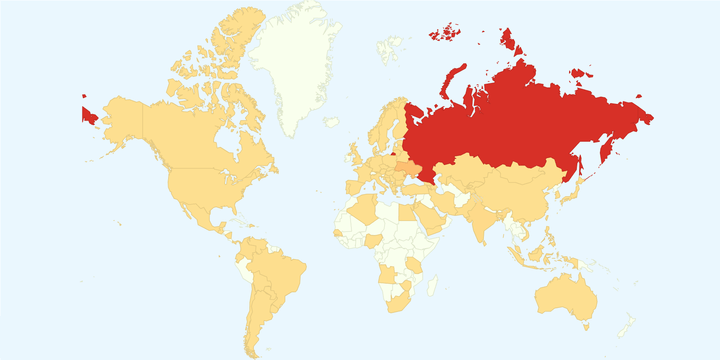
Today, cybersecurity firm Avast reported on a massive ransomware attack that has hit more than 75,000 victims in 99 countries. While most of the targets were located in Russia, Ukraine, and Taiwan, other victims have been identified in Europe.
Most notably, Spanish telecommunications company Telefonia was a victim, as were hospitals across the United Kingdom. According to The Guardian, the U.K. attacks hit at least 16 National Health System (NHS) facilities and directly compromised the information technology (IT) systems that are used to ensure patient safety.
Avast
The WanaCryptOR, or WCry, ransomware is based on a vulnerability that was identified in the Windows Server Message Block protocol and was patched in Microsoft’s March 2017 Patch Tuesday security updates, reports Kaspersky Labs. The first version of WCry was identified in February and has since been translated to 28 different languages.
Avast further speculates that the underlying exploit seems to have been stolen from the Equation Group, which has been suspected of being tied to the NSA, by a hacker group calling themselves ShadowBrokers. The exploit is known as ETERNALBLUE and named MS17-010 by Microsoft.
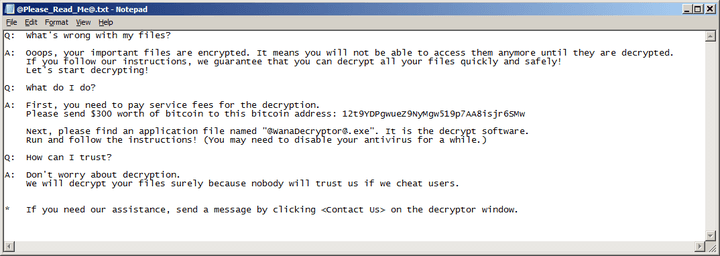
When the malware strikes, it changes the name of affected files to include a “.WNCRY” extension and adds a “WANACRY!” marker at the beginning of each file. It also places its ransom note into a text file on the victim’s machine:
Avast
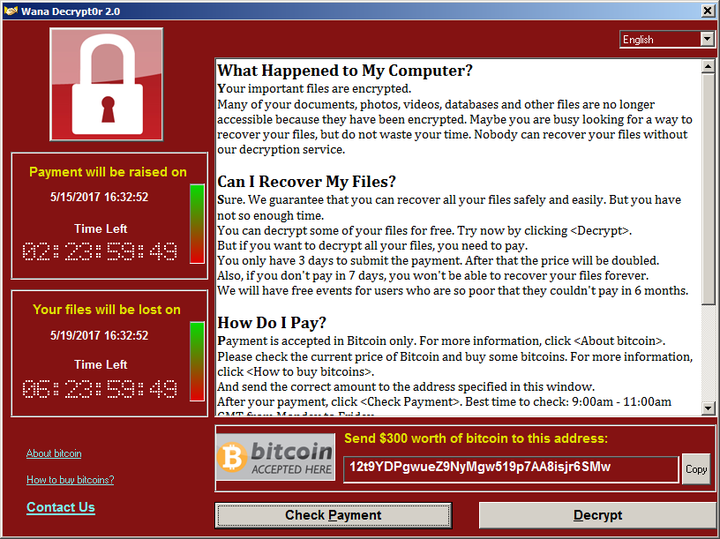
Then, the ransomware displays its ransom message that demands between $300 and $600 in bitcoin currency, and provides instructions on how to pay and then recover the encrypted files. The language in the ransom instructions is curiously casual and seems similar to what one might read in an offer to purchase a product online. In fact, users have three days to pay before the ransom is doubled and seven days to pay before the files will no longer be recoverable.
Avast
Ransomware is one of the worst kinds of malware, in that it attacks our information and locks it away behind strong encryption unless we pay money to the attacker in return for a key to unlock it. There’s something personal about ransomware that makes it different from random malware attacks that turn our PCs into faceless bots.
The single best way to protect against WCry is to make sure that your Windows PC is fully patched with the latest updates. If you have been following Microsoft’s Patch Tuesday schedule, then your machines should already be protected. It is the thousands of machine that have not yet been patched that are suffering from this particular widespread attack.
You can now buy an unlocked LG G6 in the U.S., but should you?
An unlocked model of the LG G6 is now on sale in the U.S. But should you buy one?
I have to admit something: even though I’ve had a Galaxy S8 in my pocket for a couple weeks now, I keep thinking of going back to the LG G6. It’s not just that the fingerprint sensor is in a better position, or that it’s a little easier to use with one hand, but because the dual camera setup is just so enticing, especially as I’m about to leave for Google I/O and its sweeping Northern California vistas.

Well, if you’re looking to pick up an LG G6 but don’t want a carrier variant (and all the bloatware it entails), you can now buy an unlocked version from Amazon, B&H or Best Buy.
The phone, model number US997, is compatible with all four major U.S. carriers, and comes with no pre-loaded carrier software. And while it may not be specifically optimized for one particular network — you’ll lose some T-Mobile or Verizon-specific enhancements — in exchange you get one of the leanest ways to run an LG phone.
It’s also considerably cheaper, at $599, than the equivalent unlocked Galaxy S8, which begins at $725, though for that you get an extra 32GB of storage and a faster processor, but who’s counting? The LG G6 stands up in many ways to the Galaxy S8 where it counts: overall user experience.
If you’re interested in the unlocked LG G6, let us know in the comments below!
Where to buy the LG G6 in the U.S.
LG G6
- LG G6 review!
- LG G6 specs
- LG G6 vs. Google Pixel: The two best cameras right now
- Everything you need to know about the G6’s cameras
- LG forums
Verizon
Sprint
T-Mobile
AT&T
B&H
Mother’s Day 2017 (US): 14 best tech gifts for mom
You only have a couple more days to pick out a gift for mom.
Mother’s Day is 14 May in the US this year, which is Sunday, but it’s not too late to figure out and buy the perfect gift for her. To help you quickly find something she’ll absolutely love, we’ve rounded up 14 tech-themed presents to consider. But let’s get one thing clear before we dive into this list: technology isn’t exclusive to one sex or the other. Moms like smartphones and gadgets just as much as dads do.
And they don’t need their technology to be pink-coloured or bedazzled or feminised in anyway. So, for the record, much of the stuff on this list will work not only for moms, but also for dads, non-binary parents, or anyone. And we’ve included gadgets at a range of price points.
Mother’s Day 2017: Best tech gifts for mom
Amazon
Amazon Echo Show
- Amazon Echo Show: Everything you need to know
Amazon has a new Echo device called Echo Show. It’s the perfect Echo for a mom because it can be used to display everything from family photos to recipe instructions. Parents can also use it to video or audio call their kids who also own an Echo device but don’t live at home. Unfortunately, the Echo Show doesn’t start shipping until this summer, but you can pre-order it now and tell mom it’s coming.
Buy Amazon Echo Show (US)
Tile
Tile Slim
- 5 things you didn’t know you could do with a Tile
Tile is a Bluetooth tracker with a built-in speaker. Moms can use the Tile – in conjunction with an app – to find lost items. People use Tile to track all sorts of objects, such as stuffed animals, keys, wallets, cars, laptops, and even smartphones. There are different versions of the Tile. The Tile Slim is as thin as two credit cards and costs only $30, though for Mother’s Day you can find it for just $24 on Amazon.
Buy Tile Slim (US)
Pocket-lint
Amazon’s 7-inch Fire
- Amazon Fire tips and tricks
Amazon’s 7-inch Fire tablet starts at $49.99 for the 8GB version. It offers access to the Alexa assistant, so she can use its Alexa Calling feature to phone her new Echo Show at home (if you got her that too). Moms can also use it to enjoy movies, TV shows, songs, Kindle ebooks, apps, and games. It’s available in four colours and has a plastic body, too, so it’s more durable than pricier tablets.
Buy Amazon Fire (US)
Amazon
Kindle Paperwhite
- Which Amazon Kindle is best for you?
If your mom loves to read but doesn’t necessarily desire a full-fledged tablet experience, consider the Kindle Paperwhite e-reader. It’s the perfect companion with thousands of titles available for download, and it’s easy to read in every type of condition. Its lighting shines across the display so she can read in low light or the dark. It’s on sale right now for $99 through Amazon.
Buy Kindle Paperwhite (US)
Pocket-lint
Fitbit Charge 2
- Fitbit Charge 2 review: Taking charge
Amazon has discounted several Fitbit activity trackers for Mother’s Day. The Fitbit Charge 2 is available for $130, down from its regular retail price of $150. The Fitbit Blaze is also going for $150, a $50 savings. But the Fitbit Charge 2 offers more advanced activity tracking again, thanks to the continuous heart rate monitoring, along with VO2 Max, Guided Breathing, and Connected GPS.
Buy Fitbit Charge 2 (US)
Pocket-lint
Apple Watch Series 2
- Apple Watch Series 2 review: Fitness first
If our mom is active but would love a full smartwatch, then look no further than Apple Watch Series 2. It features a different spec list to the Series 1 in that it has a different processor with built-in GPS, as well as a waterproof body. The aluminium models start at $269 for the 38mm size. And like any Apple Watch, you can customize it for mom, with different cases and band styles.
Buy Apple Watch Series 2 (US)
Roomba
Roomba 900 Series vacuum
- Amazon Echo: First 7 things you should do to get Alexa
Most moms don’t want a vacuum, but this is different. It’s pricey, sure, but all she has to do is yell at her Roomba while watching TV from the couch. iRobot supports the Alexa skill, so she can say “Alexa, ask Roomba to begin cleaning” to get the vacuum robot going. She will be able to use simple voice commands to start, stop, and pause cleaning jobs, all without the minimal amounts of effort.
Buy Roomba 900 (US)
Thrive
Thrive Market subscription
- Don’t fancy cooking? Here are five takeaway apps
Get your mom a subscription to the Thrive Market. It’s an online organic marketplace. If she loves Costco and Whole Foods, she’ll love this gift. For just $60 a year she can order organic food, baby supplies, home goods, cleaning products, bath products, and more – all without having to leave the house. Most moms love to shop, but if yours is also a homebody, we’re sure she’ll appreciate this.
Buy Thrive Market subscription (US)
Miniespresso
Minispresso
- Five of the best coffee machines
If your mom needs to have several cups of Starbucks coffee coursing through her veins, get her the $59 Minispresso, a to-go expresso maker from Hong Kong-based startup Wacaco. It weighs less than a single pound, fits in the palm of a hand, and makes it easy to brew fresh, quality expresso whenever, wherever. She can prepare amazing shots, with a quality close to a traditional machine.
Buy Minispresso (US)
Pocket-lint
Dyson Supersonic hair dryer
- Dyson Supersonic hair dryer review: Is it all just hot air?
A hair dryer is just a hairdryer, right? Not when it’s a $500 Dyson Supersonic hair dryer. Unlike any dryer you’ve seen before, Dyson has ditched traditional design and created a dryer that works in a similar way to the company’s bladeless fans. The motor runs at speeds up to 110,000rpm. It will dry your hair in double-quick time, and it has the design ethos of a Mercedes and BMW combined.
Buy Dyson Supersonic (US)
Pocket-lint
Bose QuietComfort 35
- Bose QuietComfort 35 review: The perfect travel companion
Every mom appreciates a little quiet time. And the QuietComfort 35 headphones are an entirely different kettle of halibut. While they look similar to former models, even feel the same on the old noggin when worn, they take Bose’s leading ANC tech and put it in a wire-free Bluetooth environment with, finally, a built-in rechargeable battery. A plane journey will never feel quite the same without them.
Buy Bose QuietComfort 35 (US)
Roku
Roku Premiere+
- Which Roku media streamer is best for you?
The $80 Roku Premiere+ supports 4K streaming at 60fps. It also has the added benefit of HDR functionality, so if your mom subscribes to the services that support it, i.e. Netflix and Amazon Video, she’ll reap the full rewards. It also offers a night listening mode, which compresses the dynamic range of sound to the same level, so loud explosions for example are kept at the same volume as everything else.
Buy Roku Premiere+ (US)
Pocket-lint
Netflix subscription
- Netflix tips and tricks
It’s Netflix. And only $7.99 a month. ‘Nuff said.
Buy Netflix (US)
Google Family Link
- What is Google Family Link?
If you can’t spend a single thing, then get Google Family Link. We think it’s the best parental device control service yet. It’s currently invitation-only, so get on that waiting list, but it will give your mom all the tools she needs to manage her younger kids’ screen usage. The service is free but you need to make sure the kids’ devices are compatible. We guarantee this will give her peace of mind.
Request Google Family Link (US)
Jason Bateman is signed up for ‘Arrested Development’ season five
Ready for more Arrested Development? People behind the series have teased more episodes ever since season four arrived on Netflix in 2013, but a tweet from Jason Bateman reveals we’re closer than ever. Bateman revealed he’s signed on for season five and plans to put more miles on the stair car this summer. There’s no word on when Netflix will start streaming any new episodes — thankfully it’s not this weekend while we’re pushing through season two of Aziz Ansari’s Master of None — but Entertainment Weekly confirmed that the hope is to start shooting more episodes this summer.
Look very probable I’m going to put some miles on the Stair Car this summer. Just officially signed on to more ARRESTED DEVELOPMENT today.
— Jason Bateman (@batemanjason) May 12, 2017
Source: Jason Bateman (Twitter)
Germany legalizes self-driving car tests
German automakers won’t have to bring their experimental autonomous cars to California for testing anymore. The country has just approved a law allowing companies to test their self-driving cars on its roads, so long as they follow a set of conditions. Perhaps the most important requirement is that drivers must be sitting behind the wheel all the time. They can take their eyes off the road to, say, use their phone and browse the internet, but they need to be able to take over if the vehicle’s AI needs them to.
In addition, the vehicles need to have a black box to record the journey and log whether it’s the AI or the driver that’s in charge. The box’s logs will determine who’s to blame in case of accidents: if it’s a human in charge, then the government will hold the driver responsible. But if it’s the AI, then the manufacturer is to blame.
Germany’s new law will make it a lot easier for its local automakers — some of the biggest in the world — to test their new technologies. Volkswagen, Mercedes Benz and BMW might not immediately stop their tests in California, though, not when the state might start allowing truly driverless vehicles on its roads until later this year. Germany might eventually follow suit and ditch the human driver requirement. However, that probably won’t be a possibility until 2019, when it’s time to revise the law to take new technologies into account.
Source: Reuters
Watch the world’s first skydive from a drone
Unlike typical consumer-aimed quadcopter drones, Latvian company Aerones specializes in big UAVs that can carry hefty loads. Last year, they showed off one of their big lifter’s prowess by towing YouTuber Kaspars Balamovskis on a snowboarding run. Today, they released another stunt video spotlighting one of their heavy lifters hauling a man a thousand feet in the air — before he let go to skydive back down to earth.
Aerones’ 28-rotor drone picked up skydiver Ingus Augustkalns from a tower before climbing to 330 meters, at which point he lets go to parachute to the ground. The not-so-typical video is one of several on Aerones’ site that flex its drones’ capabilities to pull off extreme stunts. But others show off the more benevolent applications of their 100 kg (220-pound) lifting capacity, like using them for human rescue operations or firefighting. And you thought drones were only good for half-time shows and delivering Domino’s.
Via: The Verge
Source: YouTube
Check out the lifelike robotic falcon scaring birds off an airport runway
Why it matters to you
Birds flying or nesting near airport runways can be extremely dangerous, but this fleet of robotic falcons could keep them at bay.
If you think that baggage-checking X-ray machines are as exciting as airport technology gets, prepare to have your mind blown!
At Canada’s Edmonton International Airport, the powers-that-be have launched a new program involving a fleet of robotic birds of prey (yes, really!), tasked with stopping real birds from dangerously flying or nesting near flight paths. It claims to be the first airport in the world to embrace such technology.
Called Robirds, the drones mimic the flight of falcons in a way that is lifelike enough to trick smaller birds into thinking their natural predator is in the area.
“The Robirds are robotic birds of prey that fly just like a real bird, through flapping wing motion,” Wessel Straatman, an R&D engineer at Clear Flight Solutions, the company which built the robo-falcons, told Digital Trends. “By mimicking their natural counterparts through silhouette and behavior, they are indistinguishable from real-life birds of prey to other birds. Birds instinctively react to the presence of birds of prey, making it less attractive for them to come to that area.”
Realizing the potential perils that birds can cause to planes (and vice versa), airports have long tried to scare them off in a variety of ways. Methods including kites or bird-scaring acoustics can work, but tend to be short-term solutions, as over time the birds see through the tactics. But according to Straatman, no such thing is likely to happen with the Robirds.
“Birds will never habituate to the presence of a bird of prey in an area, and since the birds cannot distinguish between real-life birds of prey and our Robirds, habituation does not occur with the Robirds,” he said. “This makes sure that we can focus on the long term, and truly offer bird control.”
It’s a clever solution both conceptually and, as the video at the top of this page makes clear, technologically, too. Provided it works as well as hoped, let’s keep our fingers crossed that similar tech rolls out around the world.
Suddenly the prospect of being stuck at the airport because of a delayed flight doesn’t seem so bad!
 AIVAnet