


YouTube has a minimalist new design that looks a lot like Android
Why it matters to you
Do you think the YouTube website is getting a little stale? Then you’re in luck, thanks to a redesign aimed at enhancing the viewing experience.
Hot on the heels of YouTube’s launch of its very own live-TV streaming service, YouTube TV, the king of the video streaming world has unveiled a new design for its website.
YouTube will now be much more minimalistic visually, as it puts even more of the focus on the videos by streamlining the site’s look using a web design style developed by Google known as Material Design. The new design will be consistent across all Google platforms, so YouTube will look the same regardless of whether you’re watching on desktop, a smartphone, tablet, or TV app.
The revamped design will be accompanied by a handful of new features. As the name implies, Dark Theme will apply a dark background to the website and be present throughout your browsing and video-watching experience. According to YouTube, the goal of Dark Theme is to “cut down on glare and let you take in the true colors of the videos you watch.”
Dark Theme is the first of many features being built on a new, faster framework called Polymer, which will enable hastened feature implementation in the future and, hopefully, an even better viewing experience for the site’s ever-expanding video catalog.
If you’re curious about the new design and want to check it out for yourself, just opt in to test out a preview of the new site. Should you give the new site a whirl and decide you’d rather stick with the current look for now, clicking on “Restore classic YouTube” in your YouTube Account menu will do the trick. As this is an early preview of the site’s new design, YouTube is asking for users to provide their feedback about what they like and don’t like, which can also be done through the Account menu.
You can check out the new design by going to https://www.youtube.com/new.
AMD confirms Vega and Naples will come to market this quarter
Why it matters to you
AMD may well make a real resurgence in 2017, if it can achieve similar success to its Ryzen CPUs with its new Naples and Vega chips.
AMD has made it clear that we can still expect its Naples server CPUs and Vega graphics processors (GPU) to release this quarter. The confirmation came during a recent earnings call, where AMD also reported strong revenue for the first quarter of 2017, though it wasn’t enough to turn a profit.
AMD has been struggling to compete in the high-end desktop CPU market for many years, and partly as a result, it has been a while since AMD was profitable. While it didn’t manage to turn a profit in the first quarter of this year, it still saw revenue rise by 18 percent over the same period in 2016. As Ars points out, too, that’s doubly impressive considering the first quarter is rarely a strong retail period for tech companies, even if they do launch their new products then. And of course, AMD did just that, with its Zen processors doing rather well.
Following on from that strong showing, AMD has only gotten fans more excited for Vega, AMD’s next-generation graphics architecture which could well challenge some of Nvidia’s top-tier offerings.
AMD said during the call that Vega was on track for release this quarter, which means we’ll see it, at the latest, by the end of June. That’s not long to wait and it could well be why Nvidia has been so keen to show off its dominance at the top end in the past few months with cards like the 1080 Ti and the Titan Xp.
Joining Vega in releasing this quarter is Naples, AMD’s new server CPU line based on the Zen architecture. As well know as the Ryzen line of Zen processors is to consumers, it’s arguable that Naples could have a bigger impact by virtue of it being designed for data centers. If a large percentage of the global market adopted AMD’s new CPUs over Intel, that could turn AMD’s fortune around.
And if the specifications are anything to go by, that may well happen, as the new Naples architecture looks strong when pitted against specification lists for comparable Intel Xeon chips.
Fly a real drone through a virtual obstacle course in DJI’s first AR game
Why it matters to you
Novice pilots can help build their flight skills without risking crashing into an object and damaging the drone.
Real life drone, meet your new virtual obstacle course. DJI pilots can now hone their flight skills while zooming through an obstacle course without actually coming close to physical objects, thanks to the new Edgybees’ Drone Prix AR, an augmented reality video game that uses actual drones.
Launched on Tuesday, the Drone Prix AR allows DJI pilots to fly through obstacle courses, avoiding objects and collecting points — much like a typical racing video game, except for flying the actual drone instead of a virtual race car. Users can race to beat their own best time or compete with other users around the world. The game is the first AR app for DJI drones, the company says.
Compatible with DJI’s Phantom 3, Phantom 4, and Mavic Pro series drones, the game includes more than 30 courses for beginner pilots to seasoned pros. The game is downloaded to an iOS or Android smartphone and works via a wireless connection to the drone and controller. Pilots can also link their Facebook accounts to share their scores.
DJI says the course allows new pilots to practice maneuvering through the skies — without actually coming close to physical objects — while teaching flight skills in a fun, safe manner. The game was developed through Edgybees, an AR company, as a third-party app.
“When we first came up with the idea for this app, we wanted to create a new experience for pilots combining the joys of flying with the thrills of gamification,” Edgybees’ chief technical officer and co-founder Menashe Haskin said in a statement. “The Drone Prix AR app is really the first augmented reality social game designed specifically to do just that. In contrast with flight simulators, Drone Prix AR provides a much more immersive experience that combines virtual obstacles with real-life piloting skills. DJI’s Mobile SDK allowed us to bring our idea to life very quickly and we are really excited to see how this app will change the way people experience flying a drone.”
The app is available on both the App Store and Google Play Store as a free download.
Close to the Metal Ep. 41: Everything Microsoft, and our first reader poll
As Microsoft gears up for Build, it’s only natural the software producer-turned hardware maker would want to show off what its been working on. The press conference today marked the release of the Surface Laptop, a traditional notebook, and a Windows 10 S, a student edition with specific limits and quick pick-up time.
Software limitations set Windows 10 S apart from its full-featured sibling. Users can only run apps downloaded from the Windows Store, preventing any unwanted problematic installations or security issues. If need be, an administrator can install more typical x86 applications, but it wasn’t made clear exactly what that process would look like. In addition to client systems, Windows 10 S helps administrators configure other systems, with a simple wizard that creates USB drives to load that image onto new computers.
Speaking of new computers, Microsoft took the opportunity to roll out the Surface Laptop, starting at $999. While the Redmond team didn’t mention any specific configurations, the system will come with Seventh-Generation Intel Core i5 and i7 CPUs, and up to 1TB NVMe SSD options, with an estimated battery life of more than 14 hours.
Microsoft is certainly swinging for the fences, but is it risking its OEM partners by infringing on their territory? We’ll discuss all that and more on this week’s episode of Close to the Metal.
Close to the Metal is a podcast from Digital Trends that takes a deep dive into computing and PC gaming topics. Each show, we’ll focus in on one topic, and leave no stone unturned as we show off the latest in hardware and software. Whether it’s the latest GPU, supercomputers, or which 2-in-1 you should buy, we break down the complicated jargon and talk about how user experience is affected in the real world. Please subscribe, share, and send your questions to podcast@digitaltrends.com. We broadcast the show live on YouTube every Tuesday at 1pm EST/10am PST.
Got an extra $100,000? You could bid to win a lunch with Apple CEO Tim Cook
Why it matters to you
You’re probably not going to bid on this auction but it’s at least nice to see Tim Cook participating in charity-based events.
Tim Cook has been auctioning off lunches with him for a few years now in partnership with Charitybuzz, with proceeds going straight to charity. This year, however, the winner gets a little something extra — a ticket to Apple Park, Apple’s fancy new HQ that isn’t even finished yet.
Of course, such an outing won’t come cheap — the starting bid is $100,000, but the proceeds will go to the Robert F. Kennedy Human Rights group. Not only that but just because the starting bid is $100,000, that doesn’t mean that’s where the price will end up — previous lunches with Cook have gone for as much as $610,000.
“Tim was recently honored with the Newseum’s Free Speech award for creating technology that has changed the way people communicate and for using his position to take a public stand on issues like racial equality, privacy, the environment and LGBT rights,” says the Charitybuzz website. “He has also been named Person of the Year by the Financial Times and he was ranked No. 1 on Fortune magazine’s 2015 list of the World’s Greatest Leaders.”
It will certainly be interesting to be one of the first to see the new Apple Park in person. The campus has been in development since 2014 and the first 12,000 employees are preparing to move into their new office. The campus is perhaps better known by its nickname, the “spaceship,” which is largely owed to its futuristic look. The campus also runs on 100 percent renewable energy and contains a garden full of local plants.
It’s unknown exactly where winners of the competition will be able to go — Apple Park actually has a visitor center where anyone can go. Unsurprisingly, that visitor center includes an Apple Store, where you can buy all the latest Apple products, and a cafe.
Do you have an extra hundred thousand bucks lying around? You can bid for the lunch at this website.
Got an extra $100,000? You could bid to win a lunch with Apple CEO Tim Cook
Why it matters to you
You’re probably not going to bid on this auction but it’s at least nice to see Tim Cook participating in charity-based events.
Tim Cook has been auctioning off lunches with him for a few years now in partnership with Charitybuzz, with proceeds going straight to charity. This year, however, the winner gets a little something extra — a ticket to Apple Park, Apple’s fancy new HQ that isn’t even finished yet.
Of course, such an outing won’t come cheap — the starting bid is $100,000, but the proceeds will go to the Robert F. Kennedy Human Rights group. Not only that but just because the starting bid is $100,000, that doesn’t mean that’s where the price will end up — previous lunches with Cook have gone for as much as $610,000.
“Tim was recently honored with the Newseum’s Free Speech award for creating technology that has changed the way people communicate and for using his position to take a public stand on issues like racial equality, privacy, the environment and LGBT rights,” says the Charitybuzz website. “He has also been named Person of the Year by the Financial Times and he was ranked No. 1 on Fortune magazine’s 2015 list of the World’s Greatest Leaders.”
It will certainly be interesting to be one of the first to see the new Apple Park in person. The campus has been in development since 2014 and the first 12,000 employees are preparing to move into their new office. The campus is perhaps better known by its nickname, the “spaceship,” which is largely owed to its futuristic look. The campus also runs on 100 percent renewable energy and contains a garden full of local plants.
It’s unknown exactly where winners of the competition will be able to go — Apple Park actually has a visitor center where anyone can go. Unsurprisingly, that visitor center includes an Apple Store, where you can buy all the latest Apple products, and a cafe.
Do you have an extra hundred thousand bucks lying around? You can bid for the lunch at this website.
T-Mobile plans to roll out 5G network within next three years
Why it matters to you
T-Mobile just spent $8 billion on 600 Hz spectrum. Unsurprisingly, it’s going to use it for 5G.
Leave it to T-Mobile, the rebellious self-coined “Un-carrier,” to make waves in the 5G space. On Tuesday, the Deutsche Telekom-owned operator pledged to launch nationwide 5G network in three years, with the aim of completing a rollout by 2020.
T-Mobile said it will deploy high-brand, high-speed 5G in select areas, but that the low-frequency spectrum it recently acquired — 45 percent of 600 MHz in the U.S. and Puerto Rico, to the tune of $8 billion — would form the bulk of its 5G network. That’s in contrast to its competitors, which have experimented with high-frequency spectrum that can deliver speedy — but geographically constrained — 5G coverage.
“This positions T-Mobile to deliver a 5G network that offers both breadth and depth nationwide,” T-Mobile chief technology officer Neville Ray said in a blog post.
For the most part, Verizon, AT&T, and others have turned to “millimeter wave” technology, which transmits over airwaves with narrower-than-average wavelengths. They occupy frequencies in the 30 to 300 GHz range — high enough to avoid interference from surrounding signals, but too high to pass through solid barriers like walls, concrete, or even the leaves of trees.

Christian Delbert/Shutterstock
Those limitations have carriers like Verizon investing in “fixed” 5G — high-speed wireless meant to deliver broadband in the home, rather than to mobile phones.
T-Mobile’s 600 Hz spectrum won’t deliver the speeds the competition can achieve, but it will cover a broader swath of the country. And it will have access to the airwaves as soon as this year, which could give it a further advantage.
“We’re going to run at it and run hard,” Ray told USA Today in an interview. “We’re saying that you’re going to see it at T-Mobile first.”
T-Mobile is far from the only one chasing 5G. Verizon announced 5G trials in 11 U.S. markets this year, following a partnership with Samsung, Qualcomm, and others that saw 5G routers installed in homes.
And AT&T said it will begin streaming DirecTV over 5G to some residential customers, and recently announced “5G Evolution,” a series of high-speed connectivity trials in 20 major cities.
In its announcement on Tuesday, T-Mobile sought to emphasize 5G’s other benefits.
“We expect to see a whole class of new applications and solutions that will be built for nationwide 5G,” Ray said in a statement. 5G’s low latency could help self-driving cars exchange sensor data and Internet of Things (IoT) devices save battery. Virtual and augmented reality stand to benefit from its reliability. “[Today’s] applications will just work better and faster,” Ray added.
Acer’s first convertible TravelMate 2-in-1, the Spin B1, is focused on education
Why it matters to you
If you’re a student or teacher, you can now pick up the first convertible 2-in-1 device to leverage the strengths of Microsoft’s new Windows 10 S education OS.
Microsoft is leaving the low-end Windows 10 S education PC market to its original equipment manufacturer (OEM) partners, and will instead focus on positioning its Surface Laptop to compete against the Apple MacBook, which is popular among higher-education students. Acer is an important Microsoft OEM, and it’s acting fast to jump into the fray against Google’s Chromebook education initiative.
First out of the gate is the Acer TravelMate Spin B1, a convertible 2-in-1 device that ships with Windows 10 S education OS, Cortana, Continuum, and Ink, along with an active pen that works with the obligatory touchscreen display. This is the first convertible in the TravelMate line, and it features a 360-degree hinge that supports the four standard modes — stand, tent, tablet, and traditional notebook.
The TravelMate Spin B1 offers an 11.6-inch Full HD (1,920 x 1,080) display. Power comes by way of an Intel Celeron processor and integrated HD graphics, and it also boasts 4GB of RAM and 64GB of storage. Connectivity is provided by a USB 3.0 port, a USB 2.0 port, an HDMI connection, and a 3.5mm headset jack. Wireless connectivity includes 2×2 MIMO 801.22ac Wi-Fi and Bluetooth 4.0. Acer promises up to 13 hours of battery life.
Acer is touting the TravelMate Spin B1’s overall rugged design, which is aimed at maximizing uptime and minimizing maintenance requirements. The machine is built with a shock-absorbent middle rubber frame, offers a pressure-resistant screen that can withstand a front impact of up to 132 pounds, and features a spill-resistant keyboard that protects against up to 11 ounces of water.
The TravelMate Spin B1 runs Windows 10 S, and supports Acer TeachSmart software, which works with embedded LED lights on the notebook cover to enable students to easily and unobtrusively communicate with teachers, receive class materials, take quizzes, and more. Windows 10 Ink support makes it easy for students to take notes and create drawings.
Acer is releasing the TravelMate Spin B1 this month in North America. It will cost $300, and comes with an active pen and Windows 10 S.
Microsoft serves up the sleek Surface Laptop, its first traditional notebook
Why it matters to you
The Surface Laptop, the first standard clamshell device from Microsoft, is available for pre-order from $1,000.
In an unusual twist for Microsoft’s hardware reveals, its newest Surface product, the Surface Laptop, was leaked the night before the company’s May 2 education-focused event. While most of the surprise was therefore lost, Microsoft still managed to create a little excitement with its introduction of the new Surface Laptop.
As rumored, the new machine is the first in the Surface line to function as a simple clamshell notebook. Nevertheless, the Surface Laptop supports the Surface Pen and Surface Dial, and so can provide some of the extra convenience both afford, along with the ability to support Windows 10 Ink. As with the other members of the Surface line, the it offers a 3:2 ratio PixelSense display with a 13.5-inch Gorilla Glass 3 panel supporting 3.4 million pixels. Microsoft brags that the display is the thinnest LCD touchscreen available today on a notebook.

Microsoft focused on craftsmanship in designing and manufacturing the Surface Laptop:
Microsoft announced the Surface Laptop alongside the new Windows 10 S that’s aimed at the education market, but the hardware doesn’t quite follow the same low-cost mentality. The Surface Laptop will start out at $999 for an unspecified configuration — Microsoft is clearly leaving it to its manufacturing partners to produce low-cost Windows 10 S machines for the classroom. The Surface Laptop will ship with Windows 10 S, and Microsoft is offering a free upgrade to Windows 10 Pro for a limited time.
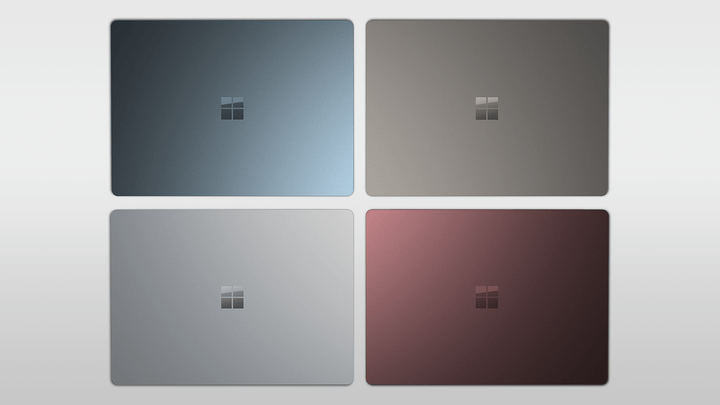
Microsoft is offering four colors for the Surface Laptop: Platinum, Graphite Gold, Cobalt Blue, and Burgundy. The color scheme will apply to the all-metal chassis as well as the cloth-covered keyboard deck.
In terms of specifications, the Surface Laptop will support seventh-generation Intel Core i5 and i7 processors, and up to 1TB SSD using NVMe technology. In spite of the high-end components, Microsoft estimates battery life at up to 14.5 hours. The company is aiming the Surface Laptop directly at the Apple MacBook line, perhaps the most popular of the extremely thin and light notebooks used in higher education today, and Microsoft highlighted the better performance and battery life of the Surface Laptop.
In terms of build, the Surface Laptop offers a tapered design, moving from 14.47mm at the rear to 9.9mm in the front. It weighs 2.76 pounds. The keyboard base uses the Alcantara material used in the company’s high-end Surface Pro 4 Type Cover, and the backlit keyboard offers 1.5mm key travel for a comfortable feel. The speakers are located underneath the keyboard at the front of the device, and utilize unique technology to radiate the sound through the cloth for an immersive experience. Connectivity is limited to a single USB Type-A port, a DisplayPort, and the standard Surface connection — surprisingly, there’s no USB Type-C port in sight.
More details will come at some point, but for now we know that Microsoft is taking pre-orders starting May 2 with delivery starting on June 15. At $999, the Surface Laptop offers a thin and light machine that’s optimized for Windows 10 and that competes directly with Apple’s MacBook while maintaining the Surface design aesthetic.
Updated on 05-02-2017 by Mark Coppock: Added additional details and updated images.
Microsoft enhances learning using Code Builder for ‘Minecraft’ and mixed reality
Why it matters to you
Microsoft is providing tools and experiences to enhance learning in the classroom, including the use of Minecraft: Education Edition.
During the #MicrosoftEDU press event in New York City, Microsoft introduced Code Builder for Minecraft: Education Edition. Available now as a beta, this tool enables students to build and create in Minecraft by using blocks of code or manually writing JavaScript. It supports ScratchX, Tynker, and a new open platform called Microsoft MakeCode.
With Code Builder, Minecraft players are joined by an “Agent” character that serves as a sidekick and carries out the coding commands. This sidekick can essentially build anything in the virtual Minecraft world, from 3D printed objects to huge, historic architectures like the Globe Theater in 16th-century London and the Parthenon.

For instance, when using ScratchX, players can grab a handful of single-line commands, place them in the ScratchX window, and lock them together. Thus, to have the Agent move forward three steps and till the soil for farming, the player would string together three “move forward” commands and one “till forward” command.
As a refresher, Tynker is a tool that teaches computer programming for students aged seven and older. Tynker includes visual code blocks for stacking code together, tools for creating Minecraft mods, programming drones, and creating multi-level arcade games. Meanwhile, ScratchX is a tool based on the visual programming language Scratch and is mostly used to test “experimental” Scratch-based features (aka Experimental Extensions). Microsoft introduced MakeCode in March, which interacts with physical computing devices like the micro:bit board.

In addition to introducing Code Builder for Minecraft: Education Edition, Microsoft’s Megan Saunders talked about bringing mixed reality into the hands of students. In one demo, Amy Henson demonstrated how to create the Earth and moon rotating around the sun in Paint 3D. The goal was to show how a solar eclipse works and she eventually dropped the scene into PowerPoint and generated transitions to animate the eclipse-creating scene.

In another demo, Henson pulled a virtual model of NASA’s Curiosity rover into the Microsoft Teams client. She then used a Surface tablet’s built-in camera to shoot live video of Saunders standing on stage and dropped the Curiosity model into the scene. Coming this fall on Windows 10 as Viewed Mixed Reality, the upcoming feature demonstrated how a virtual seven-foot Mars rover can scale appropriately next to a five-foot, eleven-inch human.

Next, Henson placed Acer’s upcoming mixed reality headset on her head to show how it can be used in the classroom. She took a trip into the future to view the solar system in the year 2492, a period when all eight major planets will be in their closest proximity to each other. That last time this planetary gathering took place was around 1,000 years ago.
Finally, Saunders said that Pearson Education is injecting 3D and mixed reality into its secondary and university-level curriculum. Pearson will offer courses in Commerce, History, Health, and STEM. Thus, in the 2018 school year, any student can take any course under the four groups using any Windows Mixed Reality device. The headsets will arrive during the 2017 holiday season for a starting price of $299.
 AIVAnet