


T-Mobile now offers free roadside assistance with its SyncUp connected car solution
Flat tire? Harrowing highway repair? T-Mobile has you covered.
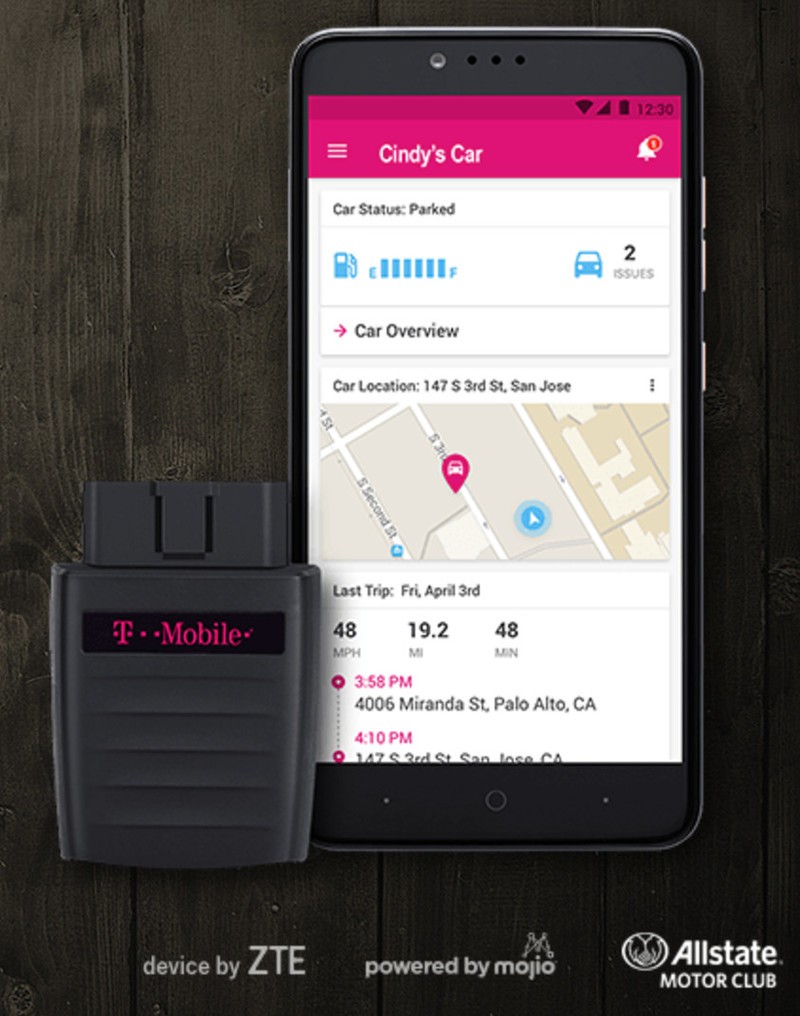
Last November, T-Mobile did what a lot of wireless carriers are doing: it got into the connected car game. But it did so cautiously, launching a small tool called SyncUp Drive in partnership with ZTE and Mojio that plugs into the OBD-II port of any car made after 1996.
The idea is to not only give its connected users a way to monitor their car’s health, but to provide a 4G LTE hotspot to passengers, along with other useful information. Multiple cars in a family can talk to one another to provide updates on whereabouts without having to text or make an unsafe call, while drivers also get a readout of potentially dangerous behavior and speeding alerts.
Now, T-Mobile says that after demand was double its initial forecasts, it is launching free roadside assistance with Allstate Motor Club. Anyone who buys a SyncUp Drive and at least 2GB of data per month on a 2-year plan gets the roadside assistance included. T-Mobile says that the addition was the biggest request from existing customers. The SyncUp Drive product itself is also down to $48 from $150.
To receive free roadside assistance, existing customers just need to update the SyncUp Drive app in the Play Store.
Do you use SyncUp Drive? If so, how do you like it? Let us know in the comments!
See at T-Mobile

Samsung Galaxy S8 ‘Microsoft Edition:’ Everything you need to know

What exactly is the “Microsoft Edition” of the Samsung Galaxy S8 (GS8)? How is it different than the regular version? And why would you want to buy an Android phone from Microsoft?
Last week, Microsoft quietly (and somewhat curiously) said that it will sell a version of Samsung’s new flagship smartphone in its U.S. retail stores. The phone, The GS8 “Microsoft Edition,” immediately grabbed online headlines, and in the process created some confusion.

Microsoft still hasn’t made an official announcement or issued a press release for the GS8 Microsoft Edition. So a number of questions still remain … or at least, they did. Read on for everything you need to know about the GS8 Microsoft Edition.
What Windows users need to know about the Samsung Galaxy S8
What the hell is the Samsung Galaxy S8 Microsoft Edition?
The GS8 Microsoft Edition is exactly the same as the regular GS8 you’d buy from a wireless carrier or other retail, with a few very minor differences. The Microsoft Edition is available directly (and only) at physical Microsoft Stores in the U.S. Also, Microsoft reps in stores selling the device will help new owners install a wider variety of Microsoft Android apps on the devices before they actually leave with their new phones.
Is there anything that’s different about the GS8 Microsoft Edition, other than apps?
Nope. It’s all about the apps and the in-store purchase experience.
From Microsoft:
Neither the hardware nor the software is different from other Samsung Galaxy S8 and S8+ devices.
Why buy a GS8 through Microsoft?
Why would you want to buy a Samsung phone from Microsoft, as opposed to, say, AT&T?
Um. Well … we’re not really sure. It’s not exactly hard to search Google Play for the word “Microsoft” and then install any and all apps of interest. And there aren’t any apps that are exclusive to the Microsoft Edition of the GS8, at least not according to a Microsoft employee named Ivan, who helped us pre-order a GS8 Microsoft Edition at the Microsoft Store in Boston.
Microsoft presumably gets a cut of the profits for each phone it sells or some sort of comparable compensation for its efforts. So you could buy the phone from Microsoft simply to support the company. If you live very close to a Microsoft Store, you could do it for convenience. Or, if for some reason you feel as though you’d have trouble finding all of the available Android apps from Microsoft, you could want a Store staffer to help you navigate Google Play. (But honestly, that would be kind of sad.)
Samsung DeX may beat Microsoft’s Continuum, but it’s still no slam dunk

Is the GS8 Microsoft Edition available for the ‘Big Four’ U.S. carriers?
No, it’s not.
The GS8 Microsoft Edition is only currently available for pre-order for AT&T customers. Ivan at the Microsoft Store Boston also told us that the plan is to offer Verizon Wireless versions of the GS8 Microsoft Edition, but the Boston store wasn’t offering Verizon preorders when we placed our AT&T order.
Ivan told us that Microsoft currently has no plans to offer Sprint or T-Mobile versions of the GS8 Microsoft Edition. (Microsoft didn’t confirm or deny this information.) So unless you’re an AT&T customer, the GS8 Microsoft Edition might not be for you, at least not for now. (You could unlock the phone and hope for the best on your carrier of choice, but that’s not ideal.)
From Microsoft:
Right now customers can pre-order devices with AT&T.
Does the GS8 Microsoft Edition come in both smaller and larger “+” sizes?
Yep. You can get the GS8 Microsoft Edition in both sizes. Again, it’s the same as the regular GS8 phones, except for all the Microsoft Android apps and the Microsoft Store availability.
Does it come in different colors?
No, it doesn’t. Right now the GS8 Microsoft Edition is only available in black, according to Microsoft.
Will it be available via online Microsoft Stores?
No. The whole idea is for customers to pick up the device physically, so the store reps can help them install the full array of Microsoft software.
From Microsoft:
Regarding online availability, Samsung Galaxy S8 and S8+ devices are currently only available for pre-order at U.S. physical Microsoft Store locations, as we want to ensure a best-in-class customer experience.
Is the GS8 Microsoft Edition cheaper or more expensive than the regular version?
The Microsoft version of the AT&T GS8 costs the same amount as the one you’d buy from AT&T: $749.99 for the 64GB GS8 Microsoft Edition and $849.99 for the 64GB GS8+ Microsoft Edition.
When will the GS8 Microsoft Edition be released?
Right now, Microsoft expects the phones to be available for pick up at its stores on the official GS8 launch day: April 21, 2017. The sooner you order yours, the more likely you’ll be able to get it that day. AT&T also says it will ship its GS8s so that they arrive “by April 21.”
From Microsoft:
Customers can pre-order Samsung Galaxy S8 and Galaxy S8+ devices in black now and purchase beginning April 21, at U.S. Microsoft Store locations …

Will Microsoft have GS8s on display in its retail stores?
Yes, at least according to Ivan from the Boston store. That’s notable because there is little or no Windows phone presence in Microsoft Stores today, and its endorsement of a Samsung Android phone could have significant implications on the future of Windows Mobile. (It’s also just weird, right?)
Do Microsoft Office apps come pre-installed on the GS8?
We’ve heard conflicting reports on this one, and though past versions of the Samsung Galaxy phones came with Office apps installed, the GS8 will apparently be different and will not ship with preloaded Microsoft apps, according to the company.
From Microsoft:
The applications do not come pre-loaded on the device. Microsoft Store associates will assist Samsung Galaxy S8 customers to set up their devices in the store to ensure every customer is ready to work, play and connect on their device when they leave.
Has Microsoft ever sold an Android phone in its stores before?
No way, no how. The GS8 Microsoft Edition is the first Android phone ever sold in a Microsoft Store.
From Microsoft:
This will be the first Android mobile phone sold at Microsoft Store, as we are always looking for new ways to provide value to customers and believe in offering an assortment of products to enable our customers to experience the best of Microsoft.
Hit Samsung’s website for details on the new phones.
And for more in-depth GS8 coverage and expert analysis, read:
Samsung Galaxy S8 and S8+: Everything you need to know
Samsung Galaxy S8 and S8+
- Galaxy S8 and S8+ hands-on preview!
- Galaxy S8 and S8+ specs
- Everything you need to know about the Galaxy S8’s cameras
- Get to know Samsung Bixby
- Join our Galaxy S8 forums
Verizon
AT&T
T-Mobile
Sprint
VR coasters are improving rapidly and discarding what doesn’t work
Rapid iteration and constant improvements are leading to and incredible future for VR in theme parks.

Alongside the launch of Galaxtic Attack, the new virtual and augmented reality layer to Mind Eraser at Six Flags America, Samsung and Six Flags have rolled out some significant improvements to the concept of VR coasters. The Samsung Galaxy S6 that sat in the heavily modified Gear VR for Superman: Ride of Steel has been upgraded to a Galaxy S7, and that’s far from the most interesting thing that has changed since last season.
Samsung and Six Flags have worked together to improve the fit of the headsets, dramatically increase the graphics in the headset, and make it much easier to bring users in and out of these experiences to help with potential ride delays. It’s a lot to have fixed over a relatively small period of time, and from our chat with Six Flags’ Sam Rhodes on what comes next it’s clear this pace for improvement isn’t going anywhere.
Read more at VR Heads!
Will you be using a Galaxy S8 screen protector?

It’s a new year with a new Samsung flagship — and another curved screen to try and protect.
As we patiently wait for the release of the Samsung Galaxy S8, we’ve already started thinking ahead to all the awesome accessories that will help keep your new phone protected and looking stylish.
One key accessory that some folks absolutely swear by is a tempered glass screen protector. If you’ve spent any time in the Galaxy S7 forums this past year, you’ll know that finding a quality screen protector for the curved screens of the Galaxy S7 and S7 edge has proved exceedingly difficult. Many suffered from the dreaded “halo effect”, which is especially prevalent with flat screen protectors on curved screens, while others had issues with adhesiveness or touch sensitivity. Eventually, we saw proper curved screen protectors emerge that offered true edge-to-edge protection, addressing the issues that plagued the early releases.
Now, any time we write about screen protectors, we always get a few contrarians in the comments who say screen protectors are a waste of money and they’ve never had so much as a scratch on their screens. And hey, that might actually be the case for some people. But why is a tempered glass screen protector so important? Because life happens — just ask Biggmac419 who shared the following story in the forums:
Biggmac419
02-13-2017 09:45 PM“
I’m a firm believe in tempered glass 2 years ago I was riding my motorcycle about to go for a jog and it flew out of my pocket and was ran over by what a bicyclist said 4 cars. He was a good guy and gave it back. This is how it was returned. The best 40$ I ever spent. And invisible shield replaced it for 6.95 shipping. AMAZING!!!
Reply
And the results:

It’s worth noting that you can see this particular screen protector from ZAGG didn’t need edge-to-edge protection to fully protect this Note 5 from sure destruction.
We won’t be able to figure out for sure which screen protectors will work best until the Galaxy S8 has been officially launched and we’ve all had some time to test and try out different screen protectors, but here’s hoping accessory manufacturers nail the design and functionality right out of the gate this time around.
If you’re still not convinced on the value of a screen protector for your phone, we’d suggest picking up a case that offers a lip around the edge of your phone so that your screen is protected properly if you place it screen-down on a table.
These are the best Galaxy S8 cases available so far
Here are some curved glass screen protectors that seem promising, to say the least:
Incipio Curved Glass Screen Protector
Incipio’s Plex Plus Shield Edge screen protectors for the Galaxy S8 aren’t available yet, but they sure look promising. They claim to be custom-crafted tempered glass sheets that will fit your phone like a glove and allow for perfect touch sensitivity.
See at Incipio
Otterbox Alpha Glass Screen Protector
If you trust in Otterbox to keep your phones safe, you’ll be happy to know it’s offering a curved glass screen protector for the Galaxy S8. No word yet on whether its screen protector is also compatible with its cases, but it looks like a promising option if you’re not scared off by the price. They’re expected to start shipping out by April 28.
See at Otterbox
SuperShieldz 3D curved glass
Supershieldz are experts in protecting smartphone screens. If you’re looking for tempered glass protection for your Galaxy S8 with curved edge-to-edge protection that won’t break the bank, you can order yours in advance from Amazon.
See at Amazon
Samsung Galaxy S8 and S8+
- Galaxy S8 and S8+ hands-on preview!
- Galaxy S8 and S8+ specs
- Everything you need to know about the Galaxy S8’s cameras
- Get to know Samsung Bixby
- Join our Galaxy S8 forums
Verizon
AT&T
T-Mobile
Sprint
Four decades of ‘Doctor Who’ arrive on the BBC’s BritBox
BritBox, the streaming service co-owned by British broadcasters BBC and ITV, has now become an essential purchase, at least for some people. The company is now the exclusive home to the entire library of classic Doctor Who episodes in the US. Subscribers will now be able to watch the surviving full serials from the 1963 – 1989 show, back when it was awesome.
The catalog mirrors that of the show’s DVD releases, including the recently-returned serials The Enemy of the World and The Web of Fear. Deeper cuts, like serials with missing episodes and the recently-reconstructed The Power of the Daleks aren’t included.
But, as a paean to hardcore fans, BritBox has pledged to add the audio versions of those wiped episodes in the near future. In addition, the catalog will also include short trips and side steps, such as K9 and Company, An Adventure in Space and Time and the first, non-broadcast “pilot” version of An Unearthly Child.

The BBC has always been protective over putting the classic show on streaming sites, since Doctor Who is still a big money maker. Hulu previously had a couple of serials from the classic show, as did Netflix, but both libraries were pulled when the license expired in February 2016. Ever since, Amazon Video has held some of the rights, but speculation was rife that the BBC was looking to offer one of its crown jewels exclusively on its own streaming platform.
The fact that the revenue from DVD sales must be drying up means that the BBC now feels comfortable releasing it onto BritBox. Considering that each DVD would set you back around $10, and there are around 130 DVDs to buy, the $6.99 per month rental charge is a bit of a bargain.
Graphene sieves are a cheaper way of making saltwater drinkable
A graphene-based sieve developed by a team of researchers from the University of Manchester could give millions of people access to clean water. See, it’s highly efficient in filtering the salt out of saltwater and could lead to a less energy-intensive desalination process. The team’s sieve is made of graphene oxide, an oxidized form of the material that could be easier and cheaper to produce in large quantities than the typical graphene.
According to project lead Dr. Rahul Nair, they can make graphene oxide sieves simply by pouring the solution onto a substrate or porous material. To make typical graphene permeable for desalination, you’d need to drill holes absolutely no larger than one nanometer into the membrane. “It is a really challenging job,” Nair said.
The team still had to find a way for graphene oxide membranes to filter out salts, though. In previous studies, scientists found that the membranes swell when immersed in water, enlarging their pores and allowing salts to pass through. To solve that problem, Nair and his team coated both sides of the membranes with epoxy resin.
The epoxy-coated membranes’ pores are too small for salt-and-water molecules to pass through. However, they allow pure water molecules to flow through really quickly since their one-nanometer pores are very close to the size of water molecules. Nair explained:
“When the capillary size is around one nanometer, which is very close to the size of the water molecule, those molecules form a nice interconnected arrangement like a train. That makes the movement of water faster: if you push harder on one side, the molecules all move on the other side because of the hydrogen bonds between them. You can only get that situation if the channel size is very small.”
Someday, these graphene-based sieves could change lives around the world. But before that happens, the team has to make sure they can withstand prolonged contact with seawater. They also need to test the material against current membranes desalination processes use. “The ultimate goal,” Nair said, “is to create a filtration device that will produce potable water from seawater or wastewater with minimal energy input.”
Source: BBC, Nature
Invasive, self-destructing iOS hack is even worse on Android
Security researchers from Google and Lookout are warning Android users about “one of the most sophisticated and targeted mobile attacks we’ve seen in the wild.” Called Chrysaor, it’s the sibling of Pegasus, a zero-day iOS exploit that was used to spy on a United Arab Emirates human rights activist. Once installed, attackers are able to spy on calls, texts, and emails, microphone, camera, keylogging, GPS and other user data.
In other words, this is not a hacking tool that was coded by “script kiddy” amateurs. Lookout believes it was developed for government surveillance use by NSO Group, a “cyber war” organization located in Israel that charges over $1 million to infect a phone with malware. (For more on what it can do, see Lookout’s paper here.)
There’s a big difference between the Android and iOS versions, too. The iOS malware was designed to jailbreak the target device using three known zero-day vulnerabilities and then install malicious software. If the root failed, the attack failed, and back in August, Apple patched those three holes, effectively rendering Pegasus useless.
On Android devices, however, if Chrysaor can’t root a device, it uses a failsafe to request permissions that still allow it to steal your data. “This means Pegasus for Android is easier to deploy on devices and has the ability to move laterally if the first attempt to hijack the device fails,” Lookout Security VP Mike Murray wrote.
The camera, microphone and nearly every other Android phone sensor is vulnerable to Chrysaor
Furthermore, the device is designed to uninstall itself if there’s any chance it will be spotted, presumably to let the malware purveyors use it with other clients. “Pegasus for Adroid will remove itself from the phone if the SIM MCC ID is invald, an ‘antidote’ file exists, it has not been able to check in with the servers after 60 days, or it receives a command from the server to remove itself,” Lookout says.
Lookout contacted the Android team after it spotted signs of the Android threat thanks to the work it did on Pegasus for iOS. In total, Google says that “a few dozen Android devices” may have been affected — mostly in hotspots or war zones like Israel, Georgia, Mexico, Turkey, UAE and Ukraine.
While Chrysaor is not widespread, it represents the bleeding edge of smartphone malware, and Android users are more vulnerable than folks on iOS. Google says its latest security releases should help stop it, and adds that “no Chrysaor apps were on Google Play.” As such, it advises Android users to avoid installing apps from sites they don’t know.
Source: Android Developers Blog, Lookout Blog
Spotify agrees to let artists keep new albums off its free tier
One of the biggest points of contention between music streaming giant Spotify and the record labels that provide it with songs is the service’s free tier. Regardless of whether you pay for a subscription or not, Spotify users have access to the same music catalog. That is finally changing though: as reported in Music Business Worldwide, a new deal between Spotify and Universal Music Group will make some albums premium-only for a limited time. It’s a reversal of a long-held position that Spotify wouldn’t segment its catalog in this way, but it was likely necessary to continue offering all the music it has access to.
Specifically, artists on Universal will have the option to make albums available for premium subscribers only for two weeks. “Starting today, Universal artists can choose to release new albums on premium only for two weeks,” Spotify CEO Daniel Eck said in a statement, “offering subscribers an earlier chance to explore the complete creative work, while the singles are available across Spotify for all our listeners to enjoy.”
This comes a few weeks after several reports indicated this long-standing conflict was close to being resolved. A two-week premium exclusive window straddles the line between giving artists a chance to capitalize on intense interest in new albums while not keeping those on the free tier shut out for very long, relatively speaking. And with Universal signing this deal, it wouldn’t be surprising to see the other two giant labels Sony and Warner sign similar contract soon.
Of course, the question on everyone’s mind is whether this will be enough for noted Spotify enemy Taylor Swift to bring her catalog back to the service. She pulled all her music from Spotify just ahead of the release of her 2014 album 1989 and hasn’t brought any of it back yet. She has specifically cited Spotify’s free tier as her issue with the service in the past. Other notable holdouts like Adele used a different strategy — she kept her recent album 25 off of all streaming services for a good six months or so but eventually put it out there, including on Spotify’s free tier.
Source: Music Business Worldwide
Apple is sorry about the Mac Pro, vows to relaunch it in 2018
The last new Mac Pro was announced back in 2013, and not much has changed much since. The iconic shiny objet proved a difficult fit for its pro users, and as a consequence Apple is apparently fundamentally rethinking its top-end computer series and everything that comes with it. According to a roundtable the company held with reporters earlier this week, Phil Schiller, Apple’s SVP of worldwide marketing added that since its new Pro will be a far more modular system, you can also expect a new Pro display to land alongside it. However, it told Buzzfeed that “You won’t see any of these products this year.” That’s because Apple’s engineering team is apparently still working to design a system that can easily and efficiently be upgraded — the biggest issue many had with the current Mac Pro.
We’ll note that the Pro devices are a smaller part of Apple’s computer pie: Schiller noted that desktop make up just 20 percent of the Macs it ships — and its Mac sales were up in 2016, compared to the still-shrinking Windows PC market. Apple said that its Mac Pro owners are a “single-digit percentage.”
Regarding the existing model, “We designed ourselves into a bit of a corner,” said Craig Federighi, Apple’s SVP of Software Engineering. The Pro had a triangular heat-sink system that didn’t lend itself well to pro-level upgrades. The company was also taking the chance to reiterate that its Mac series remains very important to it. Schiller, talking to Techcrunch: “The Mac has an important, long future at Apple… and if we’ve had a pause in upgrades and updates on that, we’re sorry for that — what happened with the Mac Pro, and we’re going to come out with something great to replace it.”
“We’ve asked the team to go and re-architect and design something great for the future that those Mac Pro customers who want more expandability, more upgradability in the future’, added Schiller, according to Daring Fireball.
The existing Mac Pro isn’t going anywhere just yet — Apple just announced a performance bump for it, one that will make the computers “faster and better for their dollar.” It’s shaved a thousand bucks off its 6-core Intel Xeon processor, dual AMD FirePro D500 GFX rig (now $2,999), while introducing a new $3,999 rig with an 8-core processor and dual FirePro D700 graphics. Anyone waiting for more than a bump is going to have to wait until 2018.
Source: Buzzfeed, Techcrunch, Daring Fireball
Apple is making an iMac with pros in mind
When you think “pro desktop,” you probably don’t think of the iMac. You can get one with a pro-quality display and a high-end (consumer) processor that will do the job for many tasks, but you likely wouldn’t buy one for massive 3D modeling or video projects. However, Apple might have you changing your mind before long. As part of a roundtable on the future of Mac desktops, the company’s Phil Schiller has promised that there will be iMac configurations made “specifically with the pro customer in mind” later in 2017. And before you ask: no, this doesn’t mean a touchscreen-centric design akin to Microsoft’s Surface Studio.
Schiller claims that touch input “doesn’t even register” on the concerns brought up by pros. They’re thinking “performance and storage and expandability,” he says. This probably doesn’t mean tearing open your iMac like you would a typical mid-tower desktop, but there are obvious candidates for improvements. You could see faster processors (such as Xeons or Core i7s with more than four cores), better graphics chipsets than the mobile parts you see now, higher-capacity storage options and, of course, Thunderbolt 3 ports.
There are limits to what you can stuff into an all-in-one chassis, and it’s reasonable to say that the iMac won’t scratch the itch for many pros — these are the people who frequently want 12-core chips, multiple graphics cards and as much memory as humanly possible. But between this and the planned 2018 Mac Pro redesign, it’s evident that Apple is acknowledging complaints that it isn’t taking desktops seriously.
Source: BuzzFeed News, TechCrunch

