


Uber has 10 days to pack up and get out of Italy, court ruling says
Why it matters to you
Uber is no stranger to battles with governments and their regulations, but now, the company is facing one of its tougher cases yet.
Uber is being unceremoniously thrown out of Italy. On Friday, a court in the European country decided to officially ban the ride-sharing app, noting that it results in unfair competition with traditional transportation offerings (like taxis). Although the ruling is subject to appeal, the immediate result for the time being is a 10-day timeframe for Uber to pack up and leave the country.
The decision upholds a complaint initially filed by taxi unions. As part of the decision, not only will Uber have to stop operating in Italy, but it’ll also have to stop advertising in the country. Should the company refuse to cooperate, it could be looking at a fine of 10,000 euros (which is to say, $10,600) for every day that it decides to stay active.
But unsurprisingly, Uber isn’t going away without a fight. In a statement, the company noted, “We are shocked by the Italian’s court decision and will appeal. Thousands of professional, licensed drivers use the Uber app to make money and provide reliable transportation at the push of a button for Italians.”
More: Uber puts the brakes on its self-driving fleet after Arizona car crash
This is not the first time Uber has been in trouble in Italy. Two years ago, a court in Milan decided to ban the UberPop application. At the time, it was determined that the app encouraged unlicensed drivers to offer taxi services. Despite an appeal, that decision was upheld at a later hearing in Turin.
Lawyers for Italy’s taxi unions are hopeful that the decision to ban Uber at large will also hold. “This is the fourth ruling by an Italian judge that ascertains Uber’s unfair competition, the latest battle in a legal war that began in 2015 to stop the most striking form of unfair competition ever registered on the Italian local public transportation market,” the lawyers told local newspaper Corriere della Sera. So if Uber wants to stay, it certainly looks to have its work cut out.
White House hires Lyft manager for a key transportation role
It’s tempting to oversimplify the ridesharing industry into an ideological battle: Lyft is the kinder, more generous outfit that donates to the ACLU, while Uber is a champion of hyper-capitalism that makes political compromises in the name of its bottom line. However, the truth is that both of these companies are complex beasts that reflect a wide range of views. Case in point: President Trump’s administration has unveiled plans to nominate Lyft’s General Manager for Southern California, Derek Kan, as the Under Secretary of Transportation for Policy. And it’s not as if he’s suddenly revealing his political stance, as this is really a logical next step given his career.
While Kan spent some time in the private sector before Lyft (he previously led strategy at the biotech startup GenapSys, for example), he was also a policy advisor to Senate Republican Leader Mitch McConnell, and the lead economist for the Senate Republicans’ Policy Committee. It would have been slightly surprising if he didn’t return to Republican politics at some point. His transportation background (he’s also on Amtrak’s board) just dictate the kind of position he takes, assuming he’s confirmed.
For its part, Lyft will only comment that it valued Kan and wishes him “luck in whatever path he chooses.” Like most companies, it’s not about to wade into the politics of its employees unless it becomes an issue for the larger organization (hi Facebook) — and that’s not happening here.
Via: LA Times
Source: White House
Gag ransomware forces you to play an anime shooter game
A typical ransomware takes your files hostage in exchange for money, but “Rensenware” asks for something else. It forces you to play an anime-type shooter game called Touhou Seirensen (Undefined Fantastic Object) and score 0.2 billion points in Lunatic mode. Based on what we’ve seen of the gameplay, some of you might wish your computers were infected with ransomware that ask for a reasonable amount of cash instead. Rensenware, which was first spotted by the Malware Hunter Team, was created as a joke.
It was made by Tvple Eraser on Twitter, who tweets primarily in Korean and had no intention of infecting other people’s PCs. Despite the lack of malice behind his actions, he still got a ton of flak since he released its source code on the internet — anybody can now use it to attack other people’s computers. To make up for it, Tvple Eraser replaced the gag malware’s code on GitHub with a tool that will let you bypass Rensenware’s encryption in case you get infected. While he said that working on the project was fun, he admitted that he made a mistake.
His apology on the GitHub page reads:
“I distributed source code except compiled binary on the web. However, at the point of the distribution, the tragedy was beginning.
Maybe It’s okay if I remove the encryption/decryption logic before I distribute the source code. then rensenWare can be treated kind of joke program. but I didn’t.
A number of people blamed me. It’s natural. because I made accident definitely wrong.
So I pulled down the source code of the rensenWare from the Github, and made this tool. I hope this tool can help the ones who are already affected by rensenWare.”
Since his apology doesn’t exactly erase Rensenware’s source code from the face of the internet, you may want to check out the tool he released. Make sure to watch Touhou’s gameplay, as well, so you at least have an idea what you’d be up against.
Found a surprising ransomware today: “rensenWare”.
Not asks for any money, but to play a game until you reach a score – and it’s not a joke. pic.twitter.com/Pu53WZFALA— MalwareHunterTeam (@malwrhunterteam) April 6, 2017
Via: Ars Technica
Source: Malware Hunter Team
These are our favorite wallpapers from the past year!

Wallpapers are underrated.
No matter how much theming and customization you do, you’ve got a wallpaper on your home screen. And a wallpaper is the easiest way to express your style, your passions, your substance on your phone. Which is why I implore you to please, PLEASE, ditch your dingy old wallpaper and get something new, something fun!
Over the past year of my weekly wallpaper articles, we’ve amassed quite a collection, and today, I’d like to share with you some of my favorites…

This is one of the first wallpapers I ever shared on this site, and it remains one of my favorites. Macchiato Mermaid is a theme I’ll find myself coming back to whenever I need to get another taste of Little Mermaid on my homescreen. It’s an easy theme, but I love the way the Trident pops on my dock. It’s sophistication that belies simplicity.
Macchiato Mermaid

Every twinkle! Every sparkle! It’s a sign of Christmas magic!
I’ve used this wallpaper two winters in a row, and I know I’ll be circling back to it again in a few months when the Christmas carols start playing again. I have the ever-charming Chateau de la Belle au Bois Dormant from Disneyland Paris shining in the distance, snow falling across the beautiful wintery scene, and a Santa boot left Cinderella-style on the steps (bet he’s missing that in this weather). This wallpaper is whimsical, yet refined, and the strong blue-white-red color scheme lends itself well to theming, with Glim red-variant icons for my dock and color-variable widgets when I get the whim.
Disneyland Paris Christmas

While our phones may be bringing the promise of the future to our homes, our pockets, and the rest of our lives, if you need a little more vintage futuristic-ness on your device, this wallpaper is here for you. This simple pattern is classic, elegant, and adds a subtle Disney flair to your home screen. Equally at home on a work phone or on your daily driver, this wallpaper plays well with most widgets, and the only icon pack that doesn’t go with it is Lines.
Spaceship Earth

Neuschwanstein Castle is one of the most picturesque castles in the world, nestled in the mountains of Germany. A poster of it hung above my bed in college, and probably hangs on a lot of walls because it is a beautiful castle — it was even the inspiration behind Sleeping Beauty’s castle at Disneyland. While most pictures show the castle draped in snow or summer splendor, this image of the castle surrounded by ruby red foliage is a certain kind of badass. Like a giant blood-red cape draped around the castles shoulders, that red hue also lends itself well to theming, with red search bars and red folder shortcuts.
Neuschwanstein Castle

Who hasn’t dreamed of soaring over the clouds? Of leaving the world and all its cares behind and seeing what the sky had to offer? Well, most of us wouldn’t fly off for too long (phone batteries are still only lasting a few days at most), but when we look at this wallpaper, we can daydream about it for a moment before going back to our Twitter feeds.
I’m also going to confess, this is a low-key Disney wallpaper for me because I turn it into a Soarin theme with red, yellow, and blue accents in addition to a Soarin logo app drawer icon.
Clouds Beyond Clouds II by FnKlinedinst

Looking up at the night sky for most of us treats us to a few brighter stars, maybe the moon, and a lot of darkness. But imagine if you looked at at night to a scene like this? Granted, some of the stars here are closer than any others will every be to Earth, but look at the color, the vibrancy, the activity. Look at all the stars, all the worlds there are out there! This wallpaper makes me wonder about the life, the wonder, the mysteries that are just waiting up in the sky, waiting to be found.
Stars

Some people say 3D animation isn’t as good as cel animation, and I’m here to jump up and down and scream ’til I’m in the Land of the Remembered that IT’S NOT TRUE! 3D animation can be vibrant, it can be beautiful, and it can be magical! The Book of Life is a 3D animation that used its digital medium with brilliance, giving otherworldly deities vibrance and mystical grace amongst the toy-like humans in our tale.
The museum guide tells us that La Muerte is made of sweet sugar candy, but she’s wrong: La Muerte is made out of goodness and sass. The dangerous gleam in her red-gold eyes when she discovers her husband’s treachery is raw, it is vivid, and it is real. She also delivers an undeniably strong message at the end of the film, one that we all need to be reminded of:
“Anyone can die. These kids, they will have the courage to live.”
La Muerte ba MooreD3

There’s a warmth to this place, and look at all the memos literally flying around! Who wouldn’t want to work there? Well, maybe not at the Department of Mysteries, but maybe we could find something with the Aurors, or maybe Mr. Scamander could use some aides after his shenanigans in New York… Oh, and this is a great wallpaper for theming, just add a golden search bar at the top and some green folder and app drawer accents. Sure, it’s a little on the Slytherin side of the color scheme, but damn it, it’s pretty!!
Ministry of Magic by Emmanuel-Oquendo
‘Ghost in the Shell’ is more cyberposeur than cyberpunk
Spoilers ahead for the Ghost in the Shell anime and US remake.
The original Ghost in the Shell anime feature is a cultural landmark. It was a neo-noir story set in a startlingly fresh vision of a connected world, and it was particularly timely in 1995 since the internet was just finding its legs in the real world. The film’s lead was a badass cyborg woman privy to bouts of existentialism. And, like the best cyberpunk science fiction, Ghost in the Shell (and its original manga) asked deep questions about our relationship with technology. There was little chance a Hollywood remake could successfully grasp what was special about its source material. And, unfortunately, the Scarlett Johansson vehicle is just as disappointing as we expected. It completely misses the point of cyberpunk.
If you’re not a sci-fi aficionado, it’s worth clarifying what cyberpunk actually is. In broad terms, it describes near-future stories that explore tech’s impact on society, and often with a cynical view about progress. They’re the modern equivalent of noir detective stories, with hard-boiled characters and all. The term was popularized during the 1980’s following works like William Gibson’s Neuromancer and Ridley Scott’s Blade Runner, but it could also be applied to science fiction from previous decades. Most notably, the term encompasses the work of Philip K. Dick, whose 1968 book Do Androids Dream of Electric Sheep? serves as the source material for Blade Runner. While most people would consider The Matrix the de facto 1990’s example of cyberpunk, it was also heavily inspired by Ghost in the Shell.
The exploration of identity is a common occurrence in cyberpunk, and indeed it’s core to the original Mamoru Oshii-directed film. If we can upgrade ourselves to be smarter and stronger, at what point do we become more machine than human? And with the rise of artificial intelligence, how do we even define life? Ghost in the Shell’s main character, Major Motoko Kusanagi, spends much of the film pondering who and what she is. She knows that she has a human brain encased in a cybernetic body (the film’s iconic opening sequence shows her “birth” and should be familiar to Westworld viewers). But does that make her a person, or just a unique machine?
“Everyone who’s entirely made of cybernetic parts like me wonders if I died a long time ago, and the current me is just a pseudo-person made of cyberbrain and body parts,” she says at one point. “Or maybe ‘I’ didn’t even exist in the first place.” And after her colleague Bato reminds her that she has a real brain, she counters with a bit of philosophical jiu-jitsu: “No one ever sees one’s own brain. We just determine from our surroundings that someone like us exists.”
In the Rupert Sanders-directed remake, Johansson’s character Major also wonders who she is, but she’s far less thoughtful about expressing it. And, typical of an American retelling of an Asian story, her ultimate answer is unsatisfyingly concrete. She eventually discovers that she was the victim of an evil corporate plan to kidnap people, steal their brains and plug them into cyborgs. But after successfully vanquishing the villains, she doesn’t question her fate — or anything, really. She just accepts her role as an intelligence agent. Simple. Existential dilemma solved!
There are, of course, deeper questions about identity where the American film completely fails. Cultural critics have been arguing for months that casting Johansson in the lead role was a form of whitewashing. Major Kusanagi, a Japanese character, was an ideal role for an Asian actress in Hollywood. Instead, she became just another action role for Johansson. Rather than figuring out a way to counteract the criticism, the film somehow manages to make it worse by revealing that Johansson’s character also has the brain of an actual Japanese girl. (There’s no shortage of think pieces online about why the casting was problematic.)

Paramount Pictures
Beyond the gunplay and set pieces, the Ghost in the Shell anime also set itself apart by throwing you into the deep end of a world where technology is completely integrated with humans. Most people have cyberbrains — metal cases for their organic brains that allow them to “jack in” to computers and networks. The film doesn’t slow down much to explain the concept of a cyberbrain to you, but you eventually grasp it by how characters use them. At one point, you see an official’s hands expand into a multitude of robotic digits, which is clearly a big help for typing faster. While the remake echoes this imagery, it doesn’t do anything thoughtful with it.
Take the character of Togusa, for example. In the anime, he’s established as the least augmented member of Section 9, the intelligence group led by Major Kusanagi. He uses a traditional revolver, and his lack of cybernetic implants seems like a detriment when he’s surrounded by literal supersoldiers. But as he starts to question why he’s even on the team, Kusanagi makes an intriguing point: A system with standardized components will inevitably fail. If every member of her team was cybernetically enhanced in the same way, that leaves them open to an attack that could take them all out.
Togusa’s mere presence is a check against that design flaw. The entire exchange is something we see often in cyberpunk: Technology doesn’t always mean progress. In the remake, they point out that Togusa uses an old gun and that’s it.
Perhaps the biggest failure of the American version of Ghost in the Shell is that it simply doesn’t do anything new. Whereas the original brought plenty of innovative ideas to the table — it was one of the few science fiction films to actually build on the Blade Runner aesthetic — the adaptation is perfectly content with copying surface-level style while dumbing down deeper concepts. While the film has been praised for its style, ultimately it’s basically just the original Ghost in the Shell aesthetic mashed together with Blade Runner and a boatload of CGI. The remake’s vision of New Port City is also oddly sterile. There’s none of the lived-in sense of grit you’d find in most cyberpunk stories.
Even the villain is far less interesting. In the remake, it ends up being yet another evil corporate plot. But in the anime, the “Puppet Master” is a completely synthetic life form “born out of the sea of information.” He’s not inherently evil, he’s just trying to figure out who he is.
“It can also be argued that DNA is nothing more than a program designed to preserve itself,” the Puppet Master says when someone claims he’s just a computer program. “Life has become more complex in the overwhelming sea of information. And life, when organized into species, relies upon genes to be its memory system. So, man is an individual only because of his intangible memory… and memory cannot be defined, but it defines mankind. The advent of computers, and the subsequent accumulation of incalculable data has given rise to a new system of memory and thought parallel to your own. Humanity has underestimated the consequences of computerization.”
Cyberpunk stories have rarely been about easy answers, and that’s yet another concept the Ghost in the Shell adaptation fails to grasp. Every conflict ends up having a distinct conclusion, be it the villain or Major’s place in the world. At the end of the anime however, Major Kusanagi doesn’t defeat the antagonist in the traditional sense. She joins with him to create an entirely new being — a union of a human soul and brain together with a purely cybernetic being.
After being transplanted into a new body, she looks out over the cityscape and simply asks: “And where do I go from here? The network is vast and infinite.”
Recommended Reading: iFixit wants to show you how to repair everything
Meet the $21 Million
Company That Thinks
a New iPhone Is a
Total Waste of Money
David Whitford,
Inc.
We’re no stranger to iFixit’s in-depth teardowns here at Engadget, but the company has a plan that’s much more than ripping apart the latest gadgets to see what’s inside. Inc. takes a look at how the the company is helping the masses repair everything from smartphones to kitchen appliances and why they offer guides for doing so free of charge.
|
When Shazam Scoops Your Album Announcement Well, this is awkward. |
Funny or Die at 10: An Oral History Funny or Die carved out a unique spot when it comes to online comedy. Wired takes a look at the site’s history that began with a two-minute Will Ferrell sketch. |
|
How Do You Beat the Smartphone Camera? One tactic is enlisting a well-known industrial designer with a proven track record to work on your 16-lens point-and-shoot camera. |
Peter Moore Talks Leaving Electronic Arts for Liverpool FC Glixel chats with the former head of EA’s esports division who left to take the CEO chair at Liverpool FC about stepping away from games after a 19-year career. |
SCOBY yourself: How to make kombucha from scratch
So you’ve ditched your home-brewed beer, are too impatient for homemade wine, and are justifiably wary of making bathtub gin. But you’re also tired of paying thirty bucks a case for kombucha, a drink that has been made by people from virtually nothing for centuries. Making kombucha from scratch has to be easier than some of these farm-to-table recipes, right? Not only is it a breeze, but it’s also a labor you’ll love.
More: Caffeine consumption: The difference between cold brew, espresso, and coffee
What is kombucha, anyway?
If you’re still reading, you’re probably either a fan of kombucha, or have at least sampled a commercially produced version. For the newbies, kombucha is a zesty, fermented, lightly effervescent drink made by adding bacteria and yeast to sugar and tea (black or green), and then letting the process of fermentation do its work. Science, yeah!
Make no mistake: Kombucha is a funky drink, and it’s often an acquired taste. It’s sometimes referred to as “mushroom tea,” because it has an earthy, savory aroma with hints of alcohol and vinegar. That’s why aficionados often add juice to the base brew to make the tea taste better.
The drink is fermented in three stages, which we’ll discuss below. Kombucha is high in acid and contains sugar, vinegar, B vitamins, antioxidants, trace amounts of alcohol due to the fermentation process, and a few other trace chemical compounds. An eight-ounce mug of kombucha contains about 60 calories. By comparison, an eight-ounce café latte from Starbucks contains about 100 calories.
Kombucha is produced by fermenting tea using a SCOBY (this one’s important, so remember it for the test, kids). The acronym stands for “symbiotic colony of bacteria and yeast,” and while it sounds like some kind of scary mutant, this chemical cocktail is a crucial tool in creating a truly unique drink.
Home-brewers either buy a “kombucha mother” starter, or use a starter sample from an existing culture to grow a new starter that ferments in a jar for a couple of weeks.

A Brief History of Kombucha
No one really knows where kombucha originated, but here’s what we think we know.
The common wisdom is that kombucha originated in what is now Manchuria around 220 BCE and was largely limited to that region for over a century. It is apocryphally reported that the drink and its recipe was imported to Japan in 404 CE by Kombu, a Korean physician called upon to treat the Japanese Emperor Ingyo using a special tea. The Chinese referred to kombucha as the Tea of Immortality and the Elixir of Life, so the drink’s unproven health benefits have a long history.
The first recorded mention of kombucha comes from Russia and the Ukraine late in the 19th century. Spread via Russian and German POWs after World War I, kombucha began to reach new countries quickly, according to The Atlantic. By the 1920s, the drink was brewed throughout Germany as a home and folk remedy. It was also sold in pharmacies under a variety of names.
The word itself has a murky history as well. Dictionaries suggest it probably originates with the Japanese word kombucha, meaning tea made from kombu, the Japanese word for kelp. Kombucha was sometimes confused with a kelp-based infusion due to the thick, gelatinous nature of the drink’s base culture.
Common problems with installing Windows 10 Creators Update – and how to fix them
The Windows 10 Creators Update is an impressive improvement over the Anniversary Update, chock-full of new features and user interface tweaks. Any time you upgrade your operating system, however, you risk something going wrong. Like any complex piece of software, Windows 10 and its installation process are vulnerable to mistakes, glitches, and hardware errors. That being the case, here are some of the most commonly-encountered problems that arise when installing or upgrading to the new version of Windows, and how to solve them.
More: Curious to see how the Creators Update stacks up to the Anniversary Update? Check our full review.
Low disk space

Windows 10 requires quite a bit of free disk space on your hard drive or solid state drive in order to install. The 32-bit version of the OS — used mostly on tablets and less expensive laptops at this point — needs 16GB of free space, the 64-bit version needs 20GB, and if you’re installing from a file stored on your computer itself with the Microsoft upgrade tool, you’ll need an additional 2 to 4GB just for the installation files.
If you have a full storage drive, or a small one to begin with, you’ll need to make some room. The quickest way to do this is to uninstall space-hogging programs. Robust 3D games and complex packages like Adobe Creative Suite take up gigabytes of space. Uninstall them and be sure to back up any save files or settings. Don’t worry, you can re-install them from the installation discs or with a download once Windows 10 is properly set up.
Should you still need, it’s recommended you remove files in the following order: video files, audio files, images of all kinds, then documents and other files. An external USB hard drive is the quickest and easiest way to accomplish this — simply save any files you can’t delete to the external media, and they’ll be easy to restore once you’ve installed Windows 10. Afterward, empty the Recycle Bin to clear the deleted files, or run a program like CCleaner to clear out your browser caches, logs, and other things that take up storage space.
To check your progress, click the Start button, type “This PC,” and click the result. The drive labeled “Windows” is what Windows 10 will install to — make sure you’ve got at least 20GB free, preferably a little more, just to be safe.
Master your Samsung Galaxy S8 with these tips and tricks

Samsung’s Galaxy S8 is finally here, and it’s a looker. The South Korean company’s phone packs a gorgeous edge-to-edge curved screen, a beefed-up front-facing camera, a top-of-the-line processor, and a new virtual assistant powered by artificial intelligence. But like many devices of the Galaxy S8’s caliber, not every feature is easy to use — or find.
Luckily, we’ve spent enough time with the Galaxy S8 to get a handle on a few of its most useful functions. Here’s what you need to know.
More: Show your Galaxy S8 you care with one of these great cases
S8 tips for Bixby, S-Health, and emojis
How to use Bixby

Bixby, Samsung’s new AI-powered assistant, is a tap away from every screen. The Galaxy S8 has a dedicated Bixby button that will eventually trigger actions like sending a photo to a friend and casting a video to a smart TV. For now, though, it pulls up Bixby Home, Samsung’s take on a Google Now-style anticipatory assistant.
Bixby Home consists of cards highlighting the weather forecast, breaking news, and more. But it’s more than just an organizer. Home learns your preferences and habits over time — if you typically call a loved one after work, for example, it’ll serve up contact info at the appropriate time each day.
There’s more to Bixby than Home. Saying “Hey Bixby” pulls up Bixby Voice, a Siri-like voice assistant that gives restaurant recommendations, dictates text messages, controls Samsung’s Connected line of smart home products, and more. Bixby Vision, yet another component of the overarching AI, recognizes objects and text in images and directs you to relevant shopping links.
How to schedule a doctor’s appointment with S Health
Whether you’re feeling under the weather or due for a physical, the Galaxy S8’s built-in S Health app has you covered. Thanks to deep integration with WebMD and Amwell, you can browse symptoms and drugs, find nearby pharmacies, schedule an online visit with a doctor, and reserve a video appointment with a certified physician.
The new S Health app is capable of more. It can store information regarding upcoming appointments like symptoms, photos, prescriptions, and insurance information, and it offers quick access to emergency services.
How to use the new emoji

The Galaxy S8 ships with a bundle of new emoji from Emoji 4.0, the newest collection of icons approved by the Unicode Consortium. They include a giraffe, broccoli, a pretzel, chopsticks, a scientist, judge, pilot, teacher, and a boy with bunny ears.
Using them is as easy as pulling up the Galaxy S8’s default keyboard and tapping the emoji button. Then, it’s just a matter of scrolling through the the list until you find the one you want.
Vertu Constellation Review: The Billionaire’s Phone

What do you get when you pay $6,000 for a phone?
Most of us live in a world where smartphones cost somewhere between $200 and $800. There’s a wide variety of phones in that range, from bargain ZTE and Motorola devices to top-end iPhones and Samsung Galaxy handsets. But there’s a whole world beyond that, the exclusive and expensive realm of the luxury smartphone. The latest phone to join those rarified ranks is the 2017 Vertu Constellation. This is both a pedestrian smartphone and one that’s sporting out-of-this-world services and construction. The Constellation is a measure in contradictions, as many things made for the billionaire class are.

Vertu has been at this for many years. They were founded as a division of Nokia and have traded hands since a few times; most recently the company was purchased by Turkish businessman Hakan Uzan for £50 million. So Vertu is a small, niche company that deals in small, niche electronics. Their latest release is the 2017 edition of the Constellation, which is what amounts to their mid-tier smartphone.
Mid-tier in Vertu Land means a starting price of $6,000.
Yeah, that’s a lot for a phone. Can it possibly be worth that much?
See at Vertu
About this review
We’re publishing this review after two weeks with the Vertu Constellation, running on the AT&T network in Cincinnati and New York City. Our review unit, loaned from Vertu, was running Android 6.0.1 with the 1 January 2017 security patch.
Vertu Constellation Video Review
Feels so good…
Vertu Constellation Hardware
The Vertu Constellation stands out in a sea of black slab phones. Where more and more phones are becoming more and more anonymous, Vertu has opted to adorn the front of their smartphone with, well, bling. There are at least seven different materials showing on just the front of the phone, yet somehow it’s an attractive device. There’s no denying that it’s ostentatious (the shiny chrome accents see to that), but I found myself liking it as soon as I pulled it out of the box, and it’s grown on me ever since.
There’s no denying that it’s ostentatious, but I found myself liking it right away.
Those materials are a mix of machined aluminum, calf leather, and sapphire. Owing to their relatively small production count, Vertu can get away with sourcing truly premium materials for their phones. Apple tried and failed hard to get a sapphire screen for the iPhone, and after using the Constellation I can understand why Apple spent hundreds of millions of dollars on that quest. The sapphire display cover here is smooth, crystal clear, and supremely hard — sapphire is one of the hardest materials out there, and is far more scratch resistant than even the latest iteration of Gorilla Glass. It’s also expensive, especially at the 140 carats needed for the Constellation.

That display is a sharp 5.5-inch QHD model with a 534ppi pixel density. It’s an AMOLED panel, but it’s been tuned without the excessive color saturation that’s a hallmark of AMOLED king Samsung. The panel wasn’t incredibly bright, though, and struggled with visibility in sunlight.
Right below the screen, wrapped in a silver accent, is a front-facing fingerprint sensor. This is a first for Vertu, and it’s spacious, accurate, and highly responsive. The set-up process is straight Nexus Imprint, with none of the customizations for customization’s sake that other manufacturers have seen fit to implement. The fingerprint sensor also doubles as a home button in conjunction with the on-screen key.
These are, hands-down, the best sounding and loudest speakers I’ve heard on any phone.
Flanking the screen at top and bottom you’ll find a pair of stereo speakers. These are, hands-down, the best sounding and loudest speakers I’ve heard on any phone — even the lauded HTC BoomSound speakers of years past. They’re offering Dolby tuning with on-the-fly EQ adjustments through a widget or the on-screen volume controls. The remarkable quality of these speakers helps make up for the regrettably large bezels on this phone — in an era where smartphones are moving more and more towards smaller and smaller bezels, Vertu has either bucked or lagged behind on that trend. The flip side is that there’s plenty of space for the large 13mm x 17mm drivers and the necessary acoustic chambers.
Wrapping around the sides of the Vertu Constellation is a hefty machined aluminum frame. Eschewing the smooth and rounded aesthetic of Apple and Samsung, the constellation’s metal has a sand-blasted finish, hard corners, and a concave character line that runs the entire height of the phone. It looks like it should be really uncomfortable, but it actually feels great, and helps this large phone grip with ease. That frame is host on the right side of the phone to a volume rocker and an unfortunately wiggly power button, while the left side is home to the dual SIM card/microSD card tray and a ruby button to launch the Vertu Concierge service (more on that later). Up top is a standard 3.5mm headphone jack, while on the bottom left corner is a USB-C port — it’s angled to match the slightly pointed base of the phone.
If you thought the front of the Constellation was busy, wait until you get a load of the back. We’re again looking at multiple materials, and without the requirement to work around the phone’s black rectangular screen, Vertu’s designers had a canvas to work with. Given what has come out of Vertu’s workshops in the past… I think they showed remarkable restraint. It’s a relatively simple layout — a band of brushed aluminum bordered by chrome strips stretches across the phone about 1/3 of the way from the top, with the camera and dual-LED flash housed dead center; the matte aluminum frame wraps around on either side, and the rest of the space is filled with a flat expanse of soft brown leather.

The end result is a phone that has some serious heft — at 241 grams it’s one of the heaviest phones we’ve seen in a long time, but then again, Vertu never made any claims otherwise. And there’s something that just seems right that a luxury smartphone should be a weighty one. It’s a tech reviewer cliché, but the Vertu Constellation truly does feel great in the hand, and in a completely different manner than a svelte, smooth, and featherweight phone like the new Galaxy S8.
So if this phone is so heavy and expensive, you’d hope for some high-end internals, right? Eh… you’re not getting a state-of-the-art smartphone here. The Vertu Constellation launched in early 2017, but it’s sporting the specifications of a phone from a year prior. Crack it open an inside you’d find a Qualcomm Snapdragon 820 processor, 4GB of RAM, and 128GB of internal storage augmented by a microSD card slot. Yep, that’s what you would find in a Samsung Galaxy S7 or LG G5 from a year ago — not even the later-in-2016 Snapdragon 821 made it into this phone. The reasoning is simple: Vertu doesn’t work in big numbers of anything, so their purchasing power is limited, their development team is small, and their engineering lead time is longer. Will the Snapdragon 821 and the brand-new 835 eventually make it into Vertu phones? Without a doubt, but you’ll be waiting for a while.
The Vertu Constellation launched in early 2017, but it’s sporting the specifications of a phone from early 2016.
That said, the Snapdragon 820 is still a mighty fine chip, even if it’s no longer the best in town. It carries the Vertu Constellation with aplomb, certainly far better than the Snapdragon 801 handled itself in the Vertu Signature Touch of 2014. It could simply be that with an 820 running things, the less-than-optimized Vertu software just can’t bog it down enough to matter.
Rounding things out on the hardware front, the Constellation sports dual-mode Qi + PMA wireless charging, Bluetooth 4.2, 21 LTE bands, dual-band 802.11ac Wi-Fi, and a 3220mAh battery. That’s far from the largest battery we’ve ever seen, and for the weight of this phone we’d have expected something more inside. But then again, Vertu doesn’t have the engineering bench to quickly bring the latest processors to market, let alone develop space-age battery tech.


You’ll find a 12MP camera on the back and a 4MP shooter on the front. Both are reasonably good in daylight, though they often struggled with focus and fell short when night fell. I’d have expected more, but as we saw for a long time with Android phone manufacturers: doing cameras right is hard and takes a lot of engineering talent. Vertu might have a great sensor behind that lens, but the pictures it puts out are merely adequate.

The numbers story
Vertu Constellation Specs
| Operating System | Android 6.0.1 |
| Display | 5.5-inch QHD AMOLED 140-carat sapphire cover |
| CPU | Qualcomm Snapdragon 820 |
| RAM | 4GB |
| Storage | 128GB + microSD (uses SIM slot 2) |
| Audio | Stereo Dolby front-facing speakers 3.5mm headphone jack |
| SIM | Dual Nano |
| Rear Camera | 12MP ƒ/2.0, 1.55 micron pixels phase detect autofocus, dual-tone LED flash |
| Front Camera | 4MP ƒ/2.0, 2 micro pixels |
| Battery | 3220mAh non-removable |
| Charging | USB-C |
| Dimensions | 162mm x 77mm x 10mm |
| Weight | 241g |
Marshmallugh.
Vertu Constellation Software
So if the Vertu Constellation’s design is aesthetically unique (and debatably attractive — I get it if you don’t like it, though I’ll admit that it looks a lot better in person), it’s certainly got to have some sort of software ace up its sleeve, right? Yes and no. When it comes to the Android OS, Vertu’s gone close to stock Android here, with only a custom launcher, old-school-style notification shade, and a few widgets on top of Android 6.0.1. There’s nothing terribly special about Vertu’s implementation of Android.

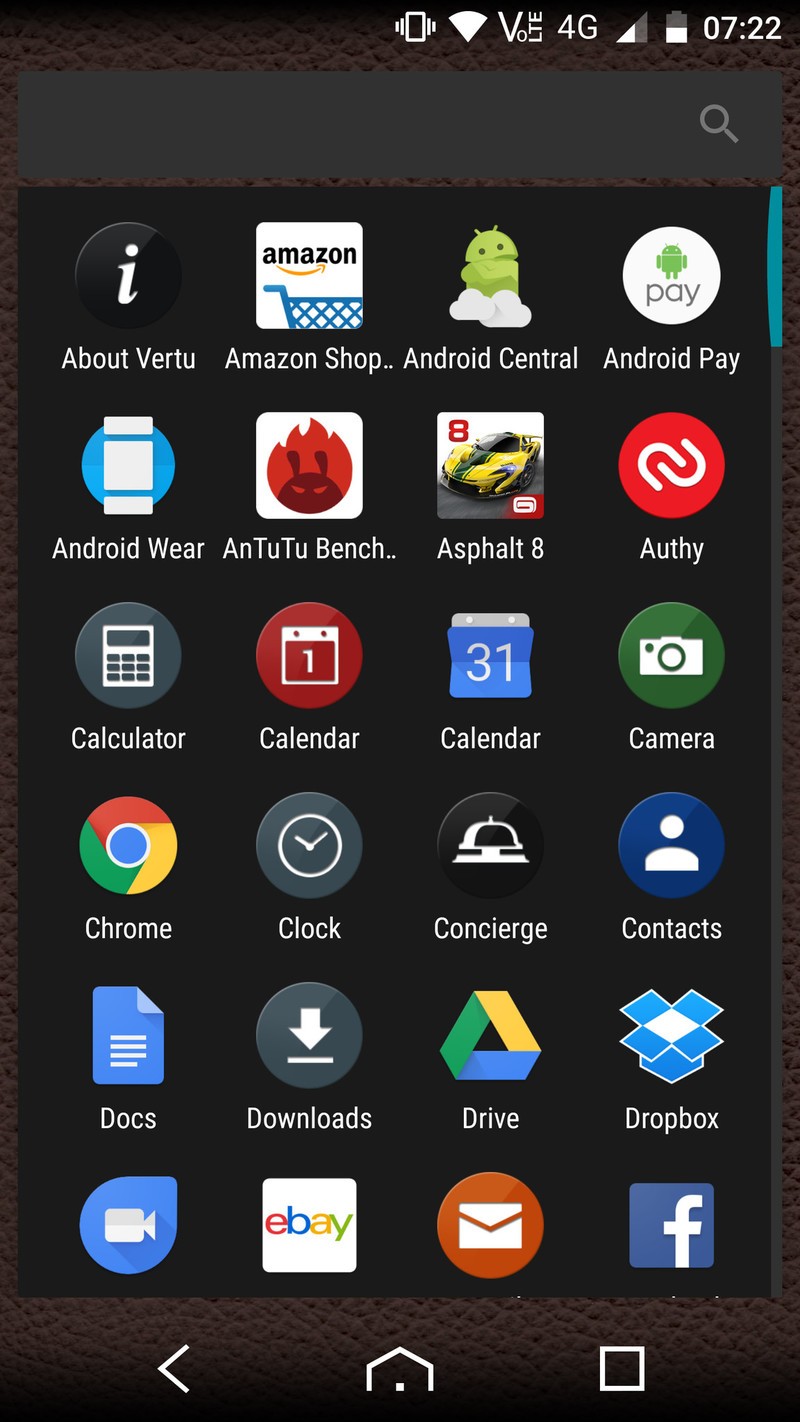


The custom analog clock widgets are nice, both in a functionality and a throwback sense. They show the time, and tapping in the center will take you to the clock app, as you’d expect. But along the outside you’ll find colored strips indicating your upcoming appointments — tapping there opens an agenda view that will take you to the Vertu Calendar app. And, of course, Vertu felt the need to build their own versions of apps like Calendar and Gallery, but they’re blessedly few and easy to ignore. Vertu’s software shines in the form of the services it ties into: Vertu Certainty, Vertu Life, and Vertu Concierge.

Certainty is a suite of apps — some third-party, others from Vertu, that aim to provide peace of mind for the Vertu owner. Some are security apps like Silent Circle for encrypted phone calls and messaging or Vertu’s own “anti-theft service” (it does not stop your phone from being stolen, only giving you the ability to remotely locate, lock, and wipe the phone through Vertu’s website). Others are about convenience, including sync to Apple’s iCloud calendar, contacts, and reminders and global Wi-Fi hotspot access through iPass.
Also rolled under the Certainty umbrella is remote assistant support where Vertu’s support staff can actually remotely take control of your phone to fix a setting for you or show you how something is done. That’s the sort of thing that Vertu can afford to do when they have a relatively small userbase and charge thousands of dollars for their phones.

Vertu Life is essentially what’d happen if the concierge had a bulletin board. Vertu’s agents have arranged for access to a wide range of events and venues, and they’re all available to you. From backstage passes for Coachella to 19th-century port wine to a luxury vacation to Antarctica (complete with emperor penguins and champagne) to priority reservations with perks at restaurants around the world, you’ll find a lot worth exploring in Vertu Life. It all comes at a cost, though. Vertu might have arranged for special discounts or bonuses with these packages, but none of them will be particularly cheap.
The crown jewel of the Vertu services is Concierge. If there’s any reason to buy a Vertu, this is it. Concierge isn’t some newfangled AI or virtual assistant — it’s real people making real judgment calls about what will best help you. Concierge is all about meeting your needs, be it something as basic as booking dinner reservations or things far more complicated. They offer communications in voice call, text chat, or via email — whatever suits your needs at the moment.
When the service is first set up for a new user, Vertu will call you (after making sure it’s a good time to call) to orient you with the service, what they can do (basically anything), and how it all works. I took the opportunity to ask my primary Concierge manager, Melanie, what the most unique request she’d fulfilled was: she booked a Hollywood A-list makeup artist to fly to Miami and spend five hours teaching a client how to do makeup like the stars.

I could have searched through thousands of restaurants in New York City, but I let the concierge make a reservation for me. The steak was phenomoenal.
I used Concierge for something a bit more pedestrian: dinner reservations in a city I don’t know that well. I was in New York City for the Samsung Galaxy S8 launch event, and for that evening I wanted to be able to take the team out for dinner (and to celebrate the simultaneous birthday of one MrMobile). I could have been a normal person and spent too much time researching restaurants on Google and Yelp (Did you know that there are a lot of places to eat in New York? Who knew!) and then finding an available reservation via OpenTable.
Instead, I hit the ruby button on the side of the phone, fired up the Concierge chat, and asked for a reservation for someplace nice but still somewhat casual. The concierge I was connected with confirmed the date and number of guests, and then went to work. An hour later, there was a reservation in my inbox for a steakhouse in downtown Manhattan. I probably wouldn’t have picked it myself, but that’s for the best, because it ended up being one of the best steaks I’ve ever had. Vertu even went so far as to arrange for complimentary appetizers (have you ever had a religious experience with bacon, because I did that night) and a round of Prosecco for the table at dessert.
You’re special
Vertu Constellation In Real Life
It’s kind of strange to think that something as simple as a phone could make you feel special, but Vertu phones do that to me. It might simply be because they’re absurdly expensive and it feels so weird to know that I’ve been walking around with one in my pocket. And it might be because of the human-driven power of Concierge and knowing that it’s just a ruby button away from fulfilling my every wish. Or it might be because I’m just kind of smitten with this phone, flaws and all, because it is so ridiculous and ostentatious.
 It’s a real ruby!
But there is no getting around that this is not a perfect phone, especially for what you might expect for a $6,000 price tag. You’re not getting top-end specs or the latest Android software (Nougat is several months away, if ever coming at all), and with heavy use you’ll still struggle to make it through the day, despite the heft of this phone making you think it must be full of lithium-ion battery.
For all those shortcomings, though, the Vertu Constellation is still the sort of phone I think would be fun to have weighing down my pocket. It’s certainly a conversation starter amongst my also-not-billionaires friends — I usually start with telling them which phone it is, walk them through the various features and materials, and then ask for a price. Everybody lowballs it because nobody can conceive of a phone costing this much.
Do you wear a crown? A real one?
Vertu Constellation: Is it worth it?
This isn’t an easy phone to review. In 2017 I feel as if I should be lighting on fire and throwing into a dumpster any phone that comes with these specs at anything approaching consumer flagship pricing, let alone blowing past it on its way to thousands of dollars as the Vertu Constellation does. But a Vertu phone is more than just the specs, more than just a dumb screen to run smart apps like every other Android phone.
It’s a status symbol; that you can afford to live the kind of lifestyle where a $6,000 phone is nothing and where you have the time and money to ask a Concierge to arrange for you to do things like party backstage at Coachella or reserve a dinner at the booked-for-the-next-year hot restaurant of the month.

You can see the target customer in setting up your Vertu Account. Where a typical phone might offer only a few options for title — Mister, Miss, Doctor — Vertu Accounts offer a laundry list of titles, ranging from King and Queen to Sheikh and Lord and His Excellency (my favorite). This is a phone for the super rich, for oil barons and oligarchs and literal royalty.
You’re not getting a technically superior product in the Vertu Constellation. You’re getting a luxury product, with all of the trappings that a luxury gadget should provide. No, a Vertu can’t make you coffee, but it can help you find the best coffee shop on the planet and book a private jet to get you there.
As the old saying about prices goes, “If you have to ask…”
See at Vertu
 AIVAnet