


SOBRO: The smart coffee table for cold beers and chill tunes
Coffee tables aren’t the most glamorous piece of furniture. If you’re anything like me, they inevitably become a repository for loose stuff like keys and remotes. Storebound’s SOBRO smart table aims to be a lot more useful. It’s not just nice to look at; it’s also well-equipped with a built-in fridge, speakers and even mood lighting, all of which can be controlled from your phone.
If your decor trends towards Queen Anne, or Victorian, or pretty much any sort of traditional style, the SOBRO probably won’t fit in very well. It’s all smooth white artificial surfaces with a black tempered glass top and variable LED lighting underneath. It looks like someone enlarged a portable outdoor speaker, down to the grill stretched across the front side.
The design is actually a bit misleading, as that part doesn’t emit any audio. The sound actually comes out smaller vents on the side, which are a lot louder than their size would indicate. Each end also houses a series of charging ports — both traditional AC outlets and USB ports for the wide variety of devices you may wish to plug in. It’s great for when guests need to charge their phone, but it could reduce the wire clutter in your living room in general — I certainly could use a better place to plug in my laptop, and it’ll also be handy for charging up game controllers.

Community
Of course, it isn’t a good party without something to drink. It’s always been annoying to get up for a cold one, and worse during a live event — I for one, missed the end of this year’s Super Bowl, walking back into the room with drinks like Troy with the pizzas in that episode of Community.
The SOBRO alleviates that problem by dedicating two-thirds of the under space to a refrigerator drawer, which chills drinks to as low as 34 degrees — not quite freezing, but cold enough for sodas and beers to be plenty refreshing. The drawer holds about 30 bottles or cans so it’s pretty spacious — Storebound gave me a diverse choice of soda, beer, energy drinks and bottled water, and under normal circumstances you shouldn’t have to worry about refilling it constantly. However, it won’t replace a traditional fridge: there’s no freezer and no compartments for separating out types of groceries.

Still, it’ll be nice to be able to just reach over for a new drink the next time you’re playing a particularly competitive round of Overwatch. If you can open the drawer quickly and easily, that is — the prototype’s fridge was a bit tricky to slide out if you pull anywhere other than the exact middle, and didn’t give me full access to everything in the compartment. Storebound assures me that the final version will feel a bit sturdier with full access to its contents. The temperature of the fridge can be controlled from your phone via a Bluetooth connection, but you probably won’t use that often — do you really care if your Coke is chilled at 43 degrees instead of 42? It just has to be cold.
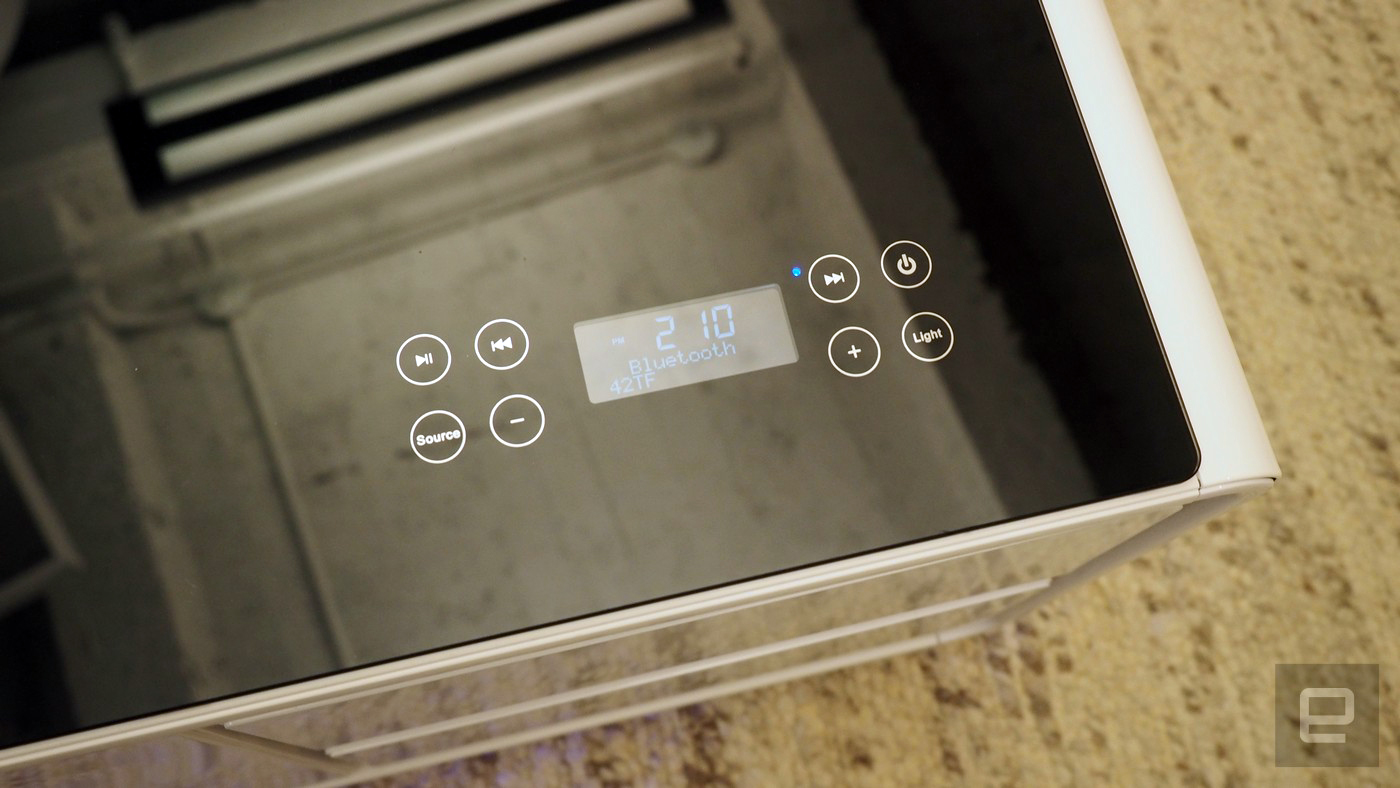
You’ll probably end up using the speaker controls a lot more, as you can stream music from your phone with all the usual commands like volume and track select. If you don’t have your device handy, or a guest wants to get involved with the action, there are also controls built into the corner of the tempered glass surface. The single-line LED display limits your options a bit, but it’s got the basics of volume and track skip covered. The buttons can be deactivated for when you’re not using them, so an errant beer can won’t accidentally pump up the volume to max.

Associate social media editor Michael Morris and social media manager Evan Rodgers, putting their dirty shoes all over that lovely glass surface.
Engadget
A Bluetooth dongle will even connect the table to your television, which might make your next home cinema experience a bit more immersive by bringing the audio closer to you. Just watch out for things like loud commercials, because it will play everything your TV emits whether you like it or not.
While the SOBRO seems like it would be ideal for your gaming room, it’s only for those willing to spend some serious money. The expected retail price of $1200 is a far cry from most of IKEA’s stock. But, it’s also higher on the quality scale — all ABS and steel with nary an ounce of particle board. And that quality can be yours for a hefty discount if you jump on the Indiegogo campaign now: Early birds can snag one for a relatively slim $649, with the table set to ship this September.
‘Danger Zone’ turns the best part of ‘Burnout’ into a full game
It’s been nine long years since we had a proper Burnout game. But when Paradise launched back in 2008 it didn’t come with the franchise’s trademark Crash Mode, the arcadey feature that tasked players with hurtling themselves through an intersection to cause as big of a car accident as possible. That debuted in 2002’s Point of Impact, returning in Takedown in 2004 and Revenge a year later before it was scrapped for an inferior clone in Paradise. Well, today there’s some good news: the latest project from former Burnout developers is Danger Zone, a game that sounds an awful lot like Crash Mode: The Game.
It also sounds a lot like studio Three Fields Entertainment’s last project, Dangerous Golf. But here you’re bouncing cars around a test facility and trying to cause as much destruction as possible, versus wreaking havoc on gas stations and kitchens with a chipping wedge and Golf’s firebomb golf balls.
“Players are challenged to drive into the junction and create the biggest First Impact that causes enough vehicles to crash to earn a ‘Smash Breaker,’ turning their car into a bomb that can explode on command,” the press release says. Like Crash Mode from days of yore, you score for how much you crash. The modern twist here, though, is that the online leaderboards should keep you chasing the internet’s high scores for quite awhile.
Best of all, we don’t have to wait long for this and it won’t cost all that much, either. The game arrives next month on Steam and PlayStation 4 for $12.99.
Spotify’s latest move shows it’s trying to get royalties right
Spotify has struggled with unpaid royalties recently, though it’s promised to fix things to help support frustrated artists. The company recently limited its free streaming option to build trust with music creators. In addition, Spotify just acquired New York startup Mediachain, which created a decentralized, bitcoin-style secure database that manages ownership information for creative media on the internet.
This is yet another initiative to make good on Spotify’s promises to pay artists fairly. The company has tried various measures, including predicting future earnings for artists and limiting access to music in its free tier for publishers both big and small.
It’s tough to know who exactly owns the rights to any given track, especially with smaller indie publishers. Mediachain helps solve this problem with a decentralized database that uses the same type of encryption as bitcoin, the blockchain. Typically, the information about who owns what percentage of a given track is scattered across “proprietary databases, spreadsheets, email inboxes and long-form contracts maintained by separate organizations,” according to a Medium post by Mediachain founder Jesse Walden. A music-focused blockchain, then, gives rights holders the power to publish ownership data without having to trust a third-party.
Spotify has been acquisition-happy lately with technology companies that include MightyTV for a better recommendation engine, Soundwave for social features and The Echo Nest for its internet radio expertise. Spotify’s purchase of Mediachain could serve it in good stead when trying to make sure artists and rights holders are paid fairly. Artists and publishing houses are more likely to trust a non-owned system like this instead of a single company.
Source: VentureBeat
Facebook’s live video problem is only getting worse
Facebook’s struggle with livestreams of terrible crimes is still very real, and appears to be worsening. Local media report that a young Thai man used Facebook Live to broadcast a murder-suicide where he hanged his baby daughter before taking his own life. The social network cooperated with police and took the two archived video clips down, but only after they were online for roughly a full day. Officials won’t be pressing charges against Facebook, which called the crime an “appalling incident” that had “absolutely no place” on its service.
As with earlier tragedies, the issue isn’t so much Facebook’s ability to intervene in mid-broadcast (that depends on concerned viewers, which is a problem in itself) as the delay in deleting the videos. It’s unclear when people first reported the terrifying clips to Facebook, but the lack of swift action meant that the videos spread widely across social networks and YouTube. One TV station even sparked further outrage by airing a barely-censored version of the footage. While it would be difficult to completely prevent someone livestreaming a murder in the first place, it’s evident that more could be done to limit the damage.
Researchers and insiders have already suggested a few options. Short delays would theoretically let Facebook cut off a livestream before people see a nightmarish act, for example. It could also place a higher priority on user reports for live videos than it does pre-recorded clips. No matter what, Facebook will likely want to do something — the immediacy and accessibility of its livestreaming is convenient, but it’s occasionally dangerous.
Via: Vice News
Source: Bangkok Post, Reuters
Samsung’s auto-reply app fights distracted driving
Let’s be honest: too many of us are using our phones while driving. It’s a problem and it’s dangerous, but we do it anyway. Samsung knows this and has come up with a new app cleverly named In-Traffic Reply to help. The app, currently in beta, aims to keep you safe while allowing you to answer messages you get while you’re behind the wheel.
In-Traffic Reply will use your smartphone’s sensors to detect when you’re in a car (or on a bike). It will then send an automatic response to calls and texts. You can choose the message sent out, too, from three options: the default “I’m driving, so I cannot answer at the moment,” a “fun, animated response,” or a custom reply of your own making.
If you’re looking to block texts in the car now, you can check out T-Mobile’s subscription-based DriveSmart Plus service and AT&T’s free DriveMode. Auto maker Mitsubishi and wireless provider Sprint (way back in 2011) have also explored solutions to the problem. Apple has provided custom replies for a while, but they still require you to look at your phone.
The final version of Samsung’s anti-distracted driving app should arrive mid-May in the Google Play Store. Here’s hoping it prevents more car crashes due to texting while driving.
Via: The Verge
Source: Samsung
Alleged iPhone 8 Schematic Depicts Dual-Lens Vertical Rear Camera, Hints at Wireless Charging
Another alleged iPhone 8 schematic is making the rounds today, shared on Twitter by several “leakers” who often share alleged leaked device images sourced from Weibo and unnamed tipsters. KK Leaks, OnLeaks, and Benjamin Geskin have all tweeted the image, which comes from an unknown source.
It is not clear if the schematic is legitimate, and we’re at the point in the rumor cycle where it’s difficult to separate what’s real from what’s fake, so it’s best to view all current leaks with some skepticism.
This is a tipped leak what means I can’t confirm if legit or not but there you have it… #iPhone8 pic.twitter.com/6OgASNUDNb
— OnLeaks (@OnLeaks) April 26, 2017
The schematic appears to depict the interior of the OLED iPhone 8, and it matches many previously-leaked design schematics and rumors. The device pictured features a vertical dual-lens rear camera with an LED flash in the middle, and it includes a large circular area, perhaps for some kind of wireless charging functionality. No rear Touch ID button is included in the schematic.
Over the course of the last few weeks, we’ve seen several alleged design schematics and renderings that are said to represent the iPhone 8, but because Apple is said to be testing multiple prototypes, we appear to be seeing two distinct devices, and it’s not clear which one represents Apple’s final 2017 iPhone.
One device, which seems to be similar to the device in the schematic above, features an edge-to-edge display with a small 4mm bezel, what appears to be a glass body (perhaps with a stainless steel frame), and a Touch ID Home button that appears to be embedded in the display, while the other features an edge-to-edge display with slightly wider top and bottom bezels, an aluminum body, and a Touch ID Home button located on the rear of the device.
Both are said to be representative of different designs Apple has pursued, and Apple is reportedly experimenting with a rear Touch ID button due to difficulties implementing it under the display. It’s not yet known if a Touch ID button under the display will pan out.
While we’re seeing different designs at the current time, there are several rumors that are consistent. The OLED iPhone is said to be similar in size to the 4.7-inch iPhone but with a display closer in size to that of the 5.5-inch iPhone, and almost all current rumors point towards a vertical dual-lens camera for improved images and perhaps some kind of augmented reality or 3D functionality.
Not much has been said about wireless charging recently, but Apple is supposedly implementing some kind of inductive charging solution, and we can count on an improved A11 processor in the device.
Apple plans to sell the OLED iPhone alongside two standard iPhones with LCD displays, which are said to be similar in size to the existing iPhone 7 and iPhone 7 Plus. With many of the rumors focusing on the flagship OLED iPhone, not much is known about the other two iPhones and their specific design also remains unclear.
Recent rumors are suggesting the OLED iPhone may be severely constrained when it launches in September, so it could be difficult to get for several months. That’s a common rumor that we hear every year ahead of the debut of a new iPhone, but the rumors, coming from trusted sources, are especially emphatic and dire this year, suggesting there’s some truth there.
Related Roundup: iPhone 8 (2017)
Discuss this article in our forums
Carezone will help keep your medical info on-track (review)

If you are a person who has multiple medications and/or supplements to deal with on a regular basis, you know that managing doses, refills, and prescription appointment cycles can be a real hassle. And sometimes you can get into a rut where you consistently miss on these, causing potentially real effects on your body.
Enter CareZone, a free app downloadable on the Google Play Store (link here). CareZone is a utility app designed to help you organize your medical life; everything from medication dosing, to appointments, to emergency contacts, and important documents.
The appeal of CareZone is the all-inclusiveness of the app. This isn’t just a medication reminder tool. CareZone has the ability to tie together all aspects of you medical life. Let’s take a quick tour to see everything it can do!
Setup
Now when I say “has the ability”, please read that there is some front-loaded effort required by you the user to get the app truly to the point where it can be of the most use.
The first step is simple enough: download the free app from the Play Store. Then the small amount of work begins. CareZone will ask you to fill out several pages of information; as stated earlier, the more info you put in the more useful the app becomes.
You are given the opportunity to fill out several areas of you medical life, including current medications and supplements (you can also scan photos of the bottles into the app), physician’s contact info, emergency contact info, and health documents (insurance card, driver’s license). You can also add your appointments into the built-in calendar, vitals metrics (such as blood glucose and blood pressure), and to-do lists.


Once you have all this info input, you can then also share you info with family members and close friends, so they can help as much as possible in the event you aren’t able to access it for any reason.
The medication scanning tool is particularly useful, as it asks that you take 4 consecutive photos of each medication vessel (1 per side, presumably). This ensures you have all the information needed by a doctor or pharmacist. I can see someone going to the Pharmacy, only to realize they didn’t have all the needed information to get their question answered. This could help avoid those embarrassing and time-consuming scenarios.
App Use
Using the app itself is very simple. Actually, one of the biggest draws I see to it is that in addition to tracking the medical info on yourself, you can also input and track the medical information of another person, presumably a family member or friend who may have difficulty in maintaining this themselves. This allows a several advantages:
All info is in one place; no more post-it notes strewn everywhere as new info is gleaned.
Their schedule can be in one place and maintained, but without cluttering up your personal or base schedule already on your phone/tablet.
The information is completely shareable with your loved one, so they don’t have to feel like they’ve lost control.
There is one area where the app can be a bit intrusive, and that is in the way of ads for you to use their medication ordering and delivery service. While it may be a darn good service, it does seem like you trip over these integral adds (not pop-ups or splash pages) more often than you’d like, if you’re not interested in this service.


Conclusion
That said, CareZone is a clean, well-designed application, that allows individuals and/or their loved ones to curate an essential medical file for use when dealing with care professionals or emergency staff. It will take a nominal amount of upkeep, but the benefits make CareZone a recommended app for those who can benefit from its mission.
For more information, visit the CareZone website.
Microsoft releases second April update for Surface Pro 4 and Surface Book
Why it matters to you
If your Surface Pro 4 or Surface Book is running Windows 10 Creators Update, there’s a driver update waiting for you.
Microsoft’s next event is scheduled for May 2, 2017, where the company is expected to cover Windows 10 Cloud Edition and focus on some kind of solution for the educational market. It’s speculated that the company might introduce the Surface Pro 5 successor to the highly successful Surface Pro 4 Windows 10 2-in-1.
In the meantime, the company continues to pay attention to its current Surface Pro 4 and Surface Book machines. Microsoft released the second set of driver updates this month for each machine, and the updates are aimed at further improving the stability and performance of devices upgraded to Windows 10 Creators Update, as Neowin reports.
The Surface Pro 4’s latest update focuses primarily on improving audio performance when playing video:
- Intel Corporation driver update for Intel Smart Sound Technology (Intel SST) Audio Controller (09.21.00.2102): Improve video playback on installed apps while online.
- Intel Corporation driver update for Intel Smart Sound Technology (Intel SST) OED (09.21.00.2102): Improve video playback on installed apps while offline.
The Surface Book drivers also improve audio performance while playing video, in addition to helping Cortana understand you when you are speaking to her:
- Realtek Semiconductor Corp. update for Realtek High Definition Audio (SST) (6.0.1.7895): Improves Cortana speech recognition.
- Intel Corporation driver update for Intel Smart Sound Technology (Intel SST) Audio Controller (09.21.00.2102): Improves video playback on installed apps while online.
- Intel Corporation driver update for Intel Smart Sound Technology (Intel SST) OED (09.21.00.2102): Improves video playback on installed apps while offline.
Neowin makes note of the fact that 24.1 percent of Surface Pro 4 users and 29.3 percent of Surface Book users are already running Windows 10 Creators Update. If you are an owner of either of these machines and you want to install the latest update, then you will need to make sure you’re running Creators Update as well.
AT&T lost nearly 200,000 subscribers in the first quarter of the year
Why it matters to you
When service providers compete, you win. And apparently, AT&T isn’t competing quite hard enough to retain its customers’ patronage.
It’s not just Verizon that is losing subscribers — AT&T is in the same boat. On Tuesday, the mobile service provider announced that it missed quarterly revenue estimates as a result of lower hardware sales, customers who kept their existing phones for longer, and rival companies who offered various deals on unlimited data plans. And while AT&T is still the number two American wireless carrier, it looks as though its position may be starting to feel a bit, well, precarious.
AT&T lost a total of 191,000 postpaid subscribers from January to March of 2017. Last Thursday, Verizon also reported a quarterly subscriber loss — its first ever, in fact.
Much of the floundering appears to be linked to customers’ demand for data. Both T-Mobile and Sprint have unveiled new unlimited deals, and while AT&T did reduce the price of its own plan, it apparently wasn’t enough to keep all its customers around.
“Obviously, this has made an already competitive market even more so, and our response to the unlimited data plans was probably a little slow,” Chief Executive Randall Stephenson said on the company’s post-earnings conference call. He also noted that AT&T lost market share in the first quarter of the year.
In total, AT&T’s operating revenue dropped three percent, and this was mostly attributed to low sales of phones — the lowest in the company’s history. And apparently, these less than ideal numbers may be a trend. The Dallas-based carrier said Tuesday that it would stop providing a full-year revenue forecast as wireless handset sales are so unpredictable.
Of course, all is not lost for the company. AT&T is currently engaged in an $85.4 billion acquisition deal with Time Warner that would allow it to control channels like HBO and CNN. The deal is expected to be signed, sealed, and delivered by the end of 2017. And AT&T also has grand plans to roll out 5G networks, hoping to win back customers with blazing fast speeds.
SFX professionals design 3D-printed head for ‘Nintendo neurosurgery’
Why it matters to you
This 3D model could help train neurosurgeons without the need for expensive, nonreusable cadavers.
A neurosurgeon, a special effects guy, and a computer engineer walk into a lab — out walks a lifelike 3D model of a 14-year-old-boy, designed to teach medical students how to perform minimally invasive brain surgery.
That’s our summary of recent work by a team of researchers from Johns Hopkins University School of Medicine. The model may be seem creepy, but it’s already offering trainees a realistic test subject.
“The model is highly accurate,” Alan Cohen, a professor of neurosurgery at Johns Hopkins who lead the project, told Digital Trends. “It is even more accurate than cadavers, because the model is based on MR (magnetic resonance) imaging from a real patient with the disorder being simulated, whereas cadavers do not usually have the pathologic disorders being taught.”

AANS
If available, minimally invasive neurosurgery is a procedure of choice for many surgeons because it doesn’t require a whole lot of poking and prodding. The operation is performed through tiny wholes using tiny instruments, with minimal brain trauma. However, tiny procedures don’t leave a whole lot of room for error and require some pretty sophisticated hand-eye coordination. As such, Cohen has dubbed the technique “Nintendo neurosurgery.”
“The procedure is done with miniaturized instruments inserted through working channels in an endoscope, a lighted tube similar to what the general surgeons used to take out the appendix or gall bladder in laparoscopic surgery,” he said. “The procedure is done with the surgical team guiding the instruments while watching a TV monitor.”
Though cadavers are the more conventional way to train medical students, they can be impractical. Each cadaver can only be used once, they’re relatively expensive, and hard to come by.
“Existing training methods are flawed,” Cohen said. “We sought to use 3D printing and a collaboration of neurosurgeons, neuroradiologists, simulation engineers, and a special effects team from Hollywood to create a novel training model for minimally invasive neurosurgery.”
The product of that collaboration — especially with special effects group FracturedFX — is a full-scale model that not only looks like a patient, but also has flowing cerebrospinal fluid and a realistically pulsating brain. In a study, neurosurgery fellows and medical residents performed surgery on the models and rated them highly for realism. Further tests will be needed to determine whether or not mock operations on the models improve operating room performance.
A paper detailing the study was published this week in the Journal of Neurosurgery.
 AIVAnet