


DJI Goggles let you control your drone and camera with a turn of the head
Why it matters to you
The DJI Goggles use a few unique features, like controlling the gimbal or even direction of the drone by turning your head.
DJI’s new first-person view (FPV) goggles are about more than just getting a bird’s-eye view of the flight — you can control the drone with them, too. On Monday, the company announced the full specs and features of the FPV headset, called simply DJI Goggles, after teasing about the release during the launch of the Mavic Pro late last year. The Goggles are the drone giant’s first FPV headset.
The Goggles put two 1,920 x 1,080 screens in front of each eye — the equivalent of looking at a 216-inch TV from less than 10 feet away, DJI says. With the Mavic Pro, the Goggles receive 1080p transmissions at 30 fps or 720p at 60 fps, though the FPV headset is also compatible with DJI’s Phantom 4 series and Inspire 2 series.
But DJI Goggles are about more than getting that first-person perspective — different control modes allow a turn of the head to adjust the direction of the drone, or the movement of the gimbal. The feature uses sensors inside the headset to control the yaw, or direction of the drone twisting on a vertical axis, or the tilt of the camera via the on-board gimbal. DJI explains that the control works much like a controller’s joysticks — straightening your head stops the turn just like returning the joystick back to the neutral position.
Along with the motion control, a touchpad on the side of the visor offers quick access to DJI’s intelligent flight modes, like ActiveTrack, TapFly and Terrain Follow, as well as the Goggles other settings via an internal menu.
Up to two DJI Goggles can be connected to the Mavic Pro drone wirelessly and users can also choose to bypass the controller for less lag time. The Goggles can also be used with the Phantom 4, Phantom 4 Advanced, Phantom 4 Pro and Inspire 2 but that is using a direct connection with the controller’s USB port. Once the flight is finished, the Goggles can also preview the footage using the microSD card slot or double as video game goggles using the HDMI port. The battery life is rated for up to six hours, DJI says.
With the control features, the Goggles can be used for piloting the drone, allowing a photographer and pilot to work together or giving a spectator a pretty nice view — though DJI suggests pilots using the Goggles have a spotter on hand to see what the pilot can’t from the drone camera. The Goggles are expected to start shipping on May 20 for pilots with an extra $449 lying around.
Kitty Hawk Flyer is an ultralight flying machine for you to ride at the beach
Why it matters to you
We’re not yet at the point of having genuine flying cars, but this awesome propeller-driven flying machine takes us a little bit closer.
The flying car’s future envisioned by The Jetsons may not be here yet, but it got one step closer on Monday when Google co-founder Larry Page shared a video of the Kitty Hawk Flyer: An ultralight electric flying machine that is set to debut sometime in 2017.
“Our mission is to make the dream of personal flight a reality,” the creators of the Kitty Hawk Flyer note on their website. “We believe when everyone has access to personal flight, a new, limitless world of opportunity will open up to them.”
The craft itself doesn’t look so much like a flying car as it does a majestic giant drone, upon which our Silicon Valley superiors can soar over our heads like modern-day knights on their geeky steeds. The good news is that you can get in on the act, too — although final pricing has yet to be announced. If you are tempted, though, you can pay $100 now to sign up to the Kitty Hawk membership club, which promises to save you $2,000 off the final cost of the ultralight vehicle. (Although it is worth noting that any time you can save a couple of thousand bucks off a price tag, it suggests the total price is not going to be cheap!)

The Kitty Hawk Flyer is legal to operate in the United States, so long as you fly it over water in uncongested areas. According to its creators, you can learn to control it in just a few minutes, and you don’t need a pilot’s license to do so.
“We’ve all had dreams of flying effortlessly,” Page said in a statement. “I’m excited that one day very soon I’ll be able to climb onto my Kitty Hawk Flyer for a quick and easy personal flight. Someday soon we hope you will be able to do just that, thanks to this team’s hard work.”
Forget working out and tanning, this is how we plan to impress folks at the beach this summer (or whenever it’s available to buy).
You can stream 4K from Google Play Movies on the Nvidia Shield TV
Why it matters to you
If you have a 4K TV, it is a bummer to not be able to enjoy that resolution from your streaming services, but the Nvidia Shield makes it possible.
4K streaming is the future of TV and a number of content providers have started to offer 4K content, allowing users to take advantage of their 4K TVs. There are, however, a number of other pieces to the puzzle — including streaming devices like the Nvidia Shield TV, and services like Google Play Movies and TV.
As of Monday, Google Play Movies and Google Play TV can stream 4K content straight through the Shield TV — so you will be able to enjoy all your favorite shows and TV in the stunning 4K resolution. Perhaps even more interesting is the fact that the Shield TV now supports Cast in 4K — so you will be able to Cast content from your phone, computer, and other devices in 4K.
Of course, just because the Shield TV supports Cast in 4K, that doesn’t necessarily mean that you automatically get 4K content. To stream that resolution, you need a pretty good Wi-Fi network set up. Still, it is nice that the feature is available and it means that as internet service providers offer faster networks, you will be able to take advantage of 4K streaming.
Nvidia is quick to point out that the Shield TV is one of the few streaming devices to support many 4K apps. In fact, only it and the Google Chromecast Ultra support 4K streaming from Google Play Movies and TV. Not only that, but only the Shield TV supports 4K streaming from Vimeo and Kodi.
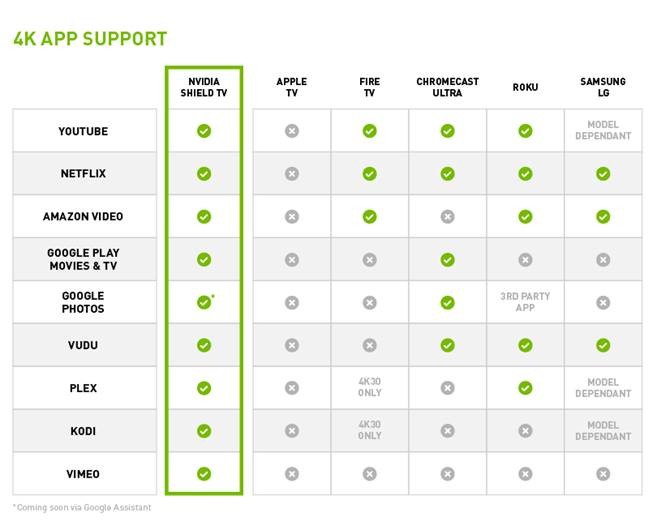
Plenty more devices with support for 4K streaming will be launched in the near future and with updates, it is likely that devices that already support 4K will begin supporting more apps. Still, if you really need access to a wide range of 4K apps and you need it quick, the Nvidia Shield TV may be the best bet for you. You can check out our review of the Nvidia Shield TV here.
Spotify wants to build a new device possibly like Snapchat Spectacles
Spotify isn’t trying to hide the fact that it’s getting into hardware.
As spotted by Zatz Not Funny, a job listing posted to the company’s website has revealed Spotify wants to build “a category defining product akin to Pebble Watch, Amazon Echo, and Snap Spectacles” that will “affect the way the world experiences music and talk content”. The listing also mentioned the device will be internet connected, and that it will come “directly from Spotify”.
- Snapchat Spectacles: What are they and how do they work?
More job descriptions suggest Spotify is dabbling in voice control and natural language, too, but it’s not clear if such technology would be integrated into hardware or Spotify’s apps. Beyond all these clues, there is little information available. All we know is that Spotify wants to create and launch its own Spotify-branded device that will presumably also offer its music-streaming service.
Let’s also keep in mind that connected speakers and voice assistants are everywhere right now, and as Spotify mentioned in its job listing, it’s certainly interested in exploring the idea of an Amazon Echo-like device of its own. We could definitely imagine Spotify going that route, but until we know more, we can only piece together all these job posts and details and try to guess.
- Amazon Echo: What can Alexa do and what services are compatible?
- Amazon Echo tips and tricks: Getting a grip on Alexa
We’ve contacted Spotify for a comment and will update if we hear back.
Apple’s OLED iPhone 8 might not be ready until November or later
Apple is rumoured to be working three new iPhones, but at least one of them might not be ready to ship in time.
Apple typically announces new iPhone models in September and ships them out by the end of the month, but according to reliable KGI analyst Ming-Chi Kuo (via 9to5Mac), who regularly reports on Apple’s plans, the OLED iPhone 8 won’t enter production until October or November.
The analyst pointed to the upcoming smartphone’s “significant hardware upgrades”, including the OLED screen and depth-sensing front camera and new 3D Touch module, as reasons for the delay.
- Apple iPhone 8 in pictures: Renders and leaked photos
- Which iPhone is best for you?
KGI is warning customers of severe supply shortages “for a while” after launch. That means you may have to wait months before you can get the OLED iPhone 8, which is rumoured to be the most exciting of the three new phones. The other two are thought to bring moderate upgrades to the iPhone 7. You can read all about the three different models and what they’re reported to feature from here.
We still think Apple will announce the OLED iPhone 8, which will be Apple’s 10th anniversary iPhone, alongside the other iPhones at the same event. You’ll probably even be able to pre-order at the same time, as Apple could just list a later shipping date for the OLED one.
- Schematic shows Apple’s next phone with an edge-to-edge display
- Apple might add its True Tone auto-adjusting display to iPhone 8 models
- Apple (Product)RED iPhone 7 is bold, brash and, well, very red
We’ll keep you posted as we learn more.
Channel 4 puts you into personalised Alien: Covenent trailer, Foster’s and Ronseal ads
Channel 4 has teamed with Foster’s, Ronseal and 20th Century Fox to launch an all-new form of TV advertising that speaks directly to you.
They will each screen ads on All 4 that include personalised messages to viewers.
For example, an Alien: Covenent trailer tells you to run, saying your name both in text and speech.
They draw your name from your All 4 log in data, so use the first name you entered when you signed up.
- Best movies to look forward to in 2017: Here are all the top film trailers
“We’re incredibly excited to offer the market something completely ground breaking,” said Channel 4’s digital and creative leader, David Amodio.
“The most attention grabbing word for anyone to hear is without doubt one’s own name, so to be able to offer advertisers the chance to speak directly to our millions of viewers is not just unique, but an immensely powerful marketing tool which adds even more value to All 4’s increasingly personalised experience.”
As well as the Alien: Covenent interactive teaser, Foster’s will be personalising its All 4 ad with your name followed by “…this one’s for you”, and Roseal will target viewers directly in order to motivate them into doing a spot of DIY.
All 4 has 15 million registered users and as long as you are one of them, you are bound to encounter one of the personalised adverts while watching content through the service.
Google teams up with Yi to launch new Jump VR camera rig for pros
Remember Google’s Jump VR platform? Well, it has a new camera rig.
When Google introduced Jump, which uses cloud-based software and algorithms to stitch together 360-degree videos, it announced a partnership with GoPro. The action-cam maker in partnership with Google made the Odyssey, a 16-camera rig and the first Jump camera. But now, Google is revealing the next-generation Jump camera, and it’s a $16,999 device made by Chinese company Yi Technology.
- Facebook’s new Surround 360 VR cameras will go on sale this year
- Nokia Ozo: Pro-spec VR capture doesn’t come cheap
- Samsung Gear 360 camera preview
The Xiaomi-backed Yi is announcing new cameras at the NAB conference in Las Vegas. The one that’s made in partnership with Google is for professionals. Called the Yi Halo, it’s 17-camera professional rig capable of shooting stereoscopic video in 8K resolution at 30 fps or 5.8K at 60 fps. Like the Odyssey, it has Jump software built right in, enabling filmmakers to easily create high-end VR content.
The Yi Halo also an extra camera over the Odyssey. It’s located on top of the rig and should allow filmmakers to capture 360-degree footage directly above the viewer’s head when viewed through a VR headset. The rig also has a smartphone app and touchscreen controls.
- Nikon KeyMission 360 is a 360-degree 4K actioncam
- Ricoh Theta hands-on
- LG 360 Cam: Capture your VR world
Yi is launching the Yi Halo now as part of a limited access program called Jump Start. Google explained it’ll accept Jump Start applications from filmmakers until 22 May, as it plans to give out 100 Yi Halos and provide access to its Jump Assembler cloud service.
DJI Goggles fully revealed, now available for preorder
DJI announced a pair of goggles last year, and now, it has finally shared full details on the device.
Called DJI Goggles, naturally, it is meant to work with the Mavic Pro, Phantom 4, and Inspire series drones. It looks a lot like a traditional VR headset in many ways and makes it seem like you’re sitting in a quadcopter. It provides a first-person, virtual reality-like experience of whatever the quadcopter can see, which takes your drone-piloting experience to a whole new, virtual level.
- Best drones to buy in 2017, whatever your budget
- DJI Osmo Mobile: Make buttery-smooth videos with your phone
DJI said users can fly the drone and control the camera gimbal using their head movements. The goggles feature two viewing modes (one in 720p resolution at 60fps; one in 1080p at 30fps; both with a 110ms latency), a 1920×1080 resolution per eye, a navigation touchpad, a headphone jack, various ports (such as micro SD card slot, micro USB, and HDMI inputs), and a six-hour battery life.
- DJI offers DJI Care so you can cover your drone with insurance
You won’t have full control over the drone’s path in the head-tracking flight mode; the drone will move forward at a set speed, and you can turn it left or right. But there is mode where someone else can control the gimbal while you fly the drone.
The $449 DJI Goggles are available for pre-order now in the US and will start shipping in late May. We will update this piece when we learn about UK pricing and availability information.
FCC may unveil softer net neutrality rules this week
Like it or not, the FCC may be close to divulging its plans for relaxing net neutrality rules. Recode contacts claim that Chairman Ajit Pai may talk about the softer regulation as soon as April 26th, when he speaks at a conservative group’s event. There’s no word on what the plan looks like now that Pai has talked to both internet companies and telecoms. However, the current belief is that Pai will only pay lip service to the net neutrality order he’s planning to replace.
Reportedly, Pai wants a system where internet providers merely promise that they won’t block or slow competing traffic, rather than subjecting them to strict regulation. Disputes would go to the FTC rather than the FCC, potentially because the FTC’s comparative lack of technical expertise would be more likely to favor telecoms over internet services and customers. Net neutrality wouldn’t completely disappear, but it would be easier for providers to engage in questionable practices (say, zero rating) without being punished.
Source: Recode, Reuters
Google Photos for iOS beams images to your TV with AirPlay
Google has been improving its Photos app for a while now, adding features like automatic white balance, compensation for wobbly video, social photo editing tools and even improving Apple’s own Live Photos. The one thing it’s been missing, however, is the ability to send your photos and videos to an Apple TV right from the app using AirPlay. That’s been remedied, though, with a new update that’s available to download right now from the App Store.
The Google Photos service and app came out in May 2015. Why it’s taken this long to be able to get those photos and videos to our big screen is beyond us. Sharing vacation videos and photos with a group of buddies is a ton of fun with AirPlay, and now you don’t have to leave the Google app to do so. If you’ve been waiting to go all-in with Google’s system for your visual media, it just might be time to do so.
Source: iTunes App Store
 AIVAnet