


Apple May Replace Your Broken Fourth-Gen iPad With an iPad Air 2 When Necessary
Apple Stores and Apple Authorized Service Providers now have the option of replacing a customer’s broken fourth-generation iPad with an iPad Air 2, according to an internal memo distributed by Apple last week.
An excerpt of the memo obtained by MacRumors:
Starting March 30, iPad 4th generation whole unit repairs may be substituted to iPad Air 2 models. Apple’s repair and order management tool will indicate for each repair if a substitution will take place. Please note the substitute part’s color and capacity to ensure the customer understands what their replacement iPad whole unit will be.
The fourth-generation iPad was released in November 2012, so when a customer needs a replacement model, it’s likely easier now for Apple to just give them a newer and more widely available iPad Air 2 in most cases.
Not every broken fourth-generation iPad will be replaced with an iPad Air 2. The decision will ultimately be decided on a case-by-case basis, likely depending upon availability of each tablet in the affected customer’s region.
Tag: AASP
Discuss this article in our forums
From corn to cattle, gene editing is about to supercharge agriculture

Agriculture has come a long way in the past century. We produce more food than ever before — but our current model is unsustainable, and as the world’s population rapidly approaches the 8 billion mark, modern food production methods will need a radical transformation if they’re going to keep up. But luckily, there’s a range of new technologies that might make it possible. In this series, we’ll explore some of the innovative new solutions that farmers, scientists, and entrepreneurs are working on to make sure that nobody goes hungry in our increasingly crowded world.
Corn isn’t the sexiest crop but it’s one of the most important. It’s the most abundant grain on Earth, used as food and biofuel around the globe. In ancient times, Mesoamericans thrived on it, waged wars over it. Their myths claimed corn was the matter from which gods created mankind itself.
But, just as corn helped create these civilizations, these civilizations helped create corn through meticulous selective breeding. Today’s grain hardly resembles its ancestors. Compared to the wild plant first cultivated by ancient Mexicans some ten thousand years ago, modern corn is a super mutant.
And yet, after all those thousands of years of cultivation, just two main genes are thought to be responsible for the evolution of the corn we eat today. Selective breeding is painstakingly slow and imprecise.
But that’s all about to change.
Selective breeding is painstakingly slow and imprecise. But that’s all about to change.
New gene editing tools like CRISPR/Cas9 now let scientists hack into genomes, make precise incisions, and insert desired traits into plants and animals. We’ll soon have corn with higher crop yields, mushrooms that don’t brown, pigs with more meat on the bone, and disease resistant cattle. Changes that took years, decades, or even centuries, can now be made in a matter of months. In the next five years you might eat tortilla chips made from edited corn. By 2020 you might drink milk from an edited cow.
Dubbed the “CRISPR Revolution” these scientific advances in gene editing have huge potential that many experts think could help fortify our food system and feed an increasing population of farmers who are threatened by food scarcity caused, in part, by climate change.
But not everyone is so certain. Beyond the contentious legal battles that have thus far complicated CRISPR science, calling into question who can and can’t use the technology, some consumer rights advocates think these tools will be used to maintain the status quo of an industry based primarily on corporate profit. Meanwhile, residual worry about genetically modified organisms (GMOs) may influence the public perception of gene-edited organisms, steering consumers towards the “organic” aisle despite scientific evidence.
What is gene editing?
Gene editing is, simply put, the act of making intentional changes to DNA in order to create an organism with a specific trait or traits. It’s like using a word processor to edit the words in a sentence. Geneticists insist we don’t confuse this with genetic modification (otherwise called genetic engineering), which introduces new genes from different species in order to achieve desired traits. The difference may sound trivial but experts say it could help calm the concerns associated with GMOs.
Consider this simplification. We have the sentence, “The cat has a hat,” but want to be more descriptive about the hat’s color. With modification, we would borrow the German word for black and write, “The cat has a schwarz hat.” The sentence makes sense (sort of) but it’s obvious that to some people it would be problematic and maybe even an improper use of language. With editing, we don’t have to borrow a word from another language. We instead just insert the English word and write, “The cat has a black hat.”
“In the older, more traditional system, scientists were taking a gene from one species and putting it into a plant to confer a particular trait on that plant,” Rachel Haurwitz, co-founder of Caribou Biosciences, told Digital Trends. “That’s not what we’re looking to do. We’re looking to use CRISPR gene editing to achieve the same outcome as we can get from traditional breeding, just faster.”
This ability to edit with such speed and precision is still relatively new, and due largely to CRISPR, which emerged straight from nature to become the most popular and powerful gene editing tool used today. Discovered in bacteria in the late eighties, it wasn’t until 2005 that researchers began to unravel its role. Scientists found that when certain bacteria come under attack from viruses, they use special enzymes to cut, copy, and save a bit of the viral DNA. Later, if the intruder returns, the bacteria can quickly recognize it and react to defend itself.
A few years later, researchers realized this system could be used to cut and edit the DNA of any organism, not just viruses’. In 2012, Jennifer Doudna and Emmanuelle Charpentier published the first paper demonstrating how CRISPR can be used to edit an organism’s genome.
“We’re looking to use CRISPR gene editing to achieve the same outcome as we can get from traditional breeding, just faster.”
Not only is this technique far cheaper, faster, and more precise than conventional genetic modification, it avoids many (if not all) of the issues raised by skeptics, whose main concerns point toward the creation of “transgenic” organisms.
But, whereas genetic modification entails combining DNA from multiple species, gene editing entails altering the DNA of one species with a trait that already exists naturally.
“Gene editing is not at all about taking DNA from a foreign species and integrating it into a plant,” Haurwitz said. “It’s really about working within the constraints of the plant’s own genome.”
Just over four years ago, Haurwitz founded Caribou as a spin off from Doudna’s lab at the University of California, Berkeley. Since then, her team has partnered with companies around the world, providing licensing rights to use the startup’s version of the gene editing tool. One of those partnerships may see the first CRISPR-edited organism come to market via DuPont Pioneer, one of the world’s biggest chemical companies.
Crops
The day before Halloween 2015, Yinong Yang submitted an “Am I Regulated” letter to the United States Department of Agriculture’s (USDA) Animal and Plant Health Inspection Service (APHIS). He and his colleagues at Penn State had used CRISPR to knock out a gene in white button mushrooms that makes them go brown over time. Without the browning gene, white buttons look better and last longer, and Yang wanted to know whether his mushrooms could legally go to market.
The following spring, the department’s response resonated throughout the scientific and agricultural community. “APHIS does not consider CRISPR/Cas9-edited white button mushrooms…to be regulated,” it wrote in an open letter.
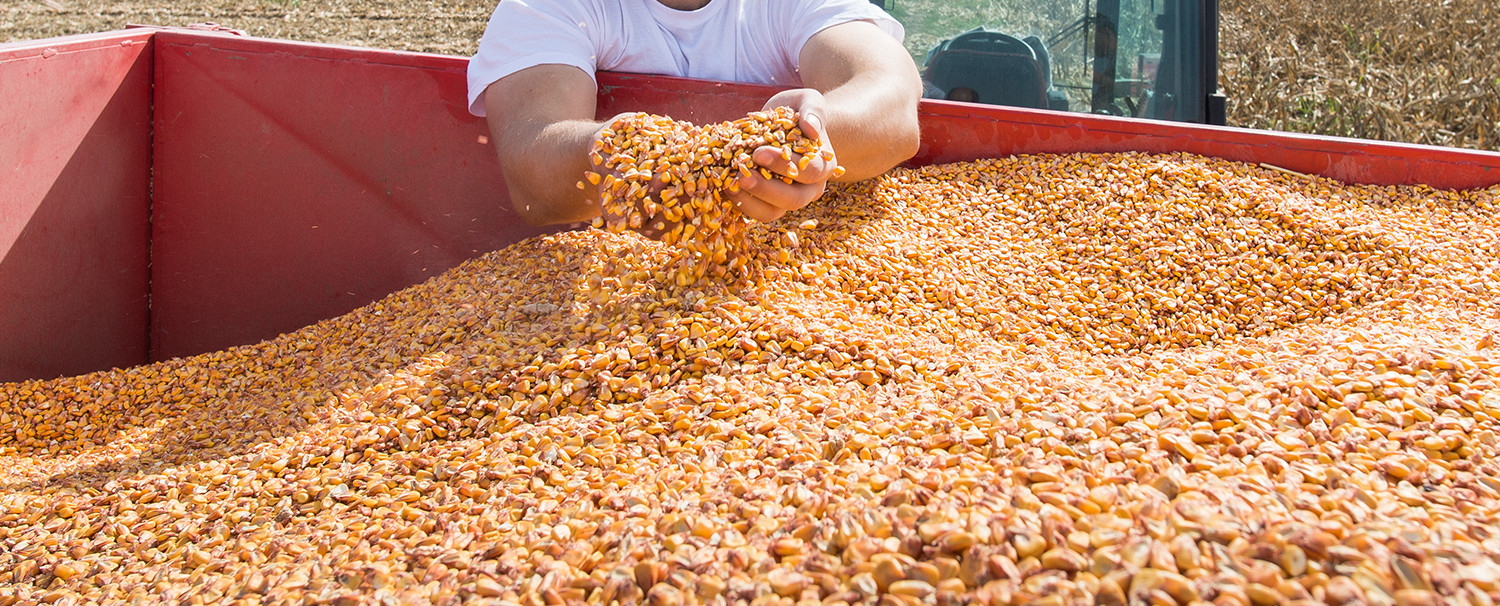 Last year, researchers at DuPont Pioneer, the agriculture branch of the multi-billion-dollar conglomerate DuPont, published a study about a strain of corn engineered with CRISPR to be more resistant to drought. It’s one of several CRISPR-modified crops that may soon be coming to market.
It was a landmark decision. Yang’s mushrooms were the first gene-edited crop cleared for commercial sale by the USDA, which made a clear distinction between genetic modification and gene editing, and set a precedent for those to come.
A few days later, DuPont — the fourth largest chemical corporation in the world — received a similar response from the USDA regarding its CRISPR-edited waxy corn that’s disease resistant and drought tolerant. DuPont wasted no time announcing plans to take its crop to market within the next five to ten years.
“The USDA has said these products do not fall into their remit, as their remit is really focused on, say, plant pathogens or noxious weeds,” said Haurwitz, whose company provides DuPont with its CRISPR technology. “At the same time we’re seeing the FDA put out a call for information as they’re looking at their own remit to oversee the entire food supply, not just products made with modern biotechnology. And I think they’re looking to members of the scientific and business communities to really weigh in over the next few months.”
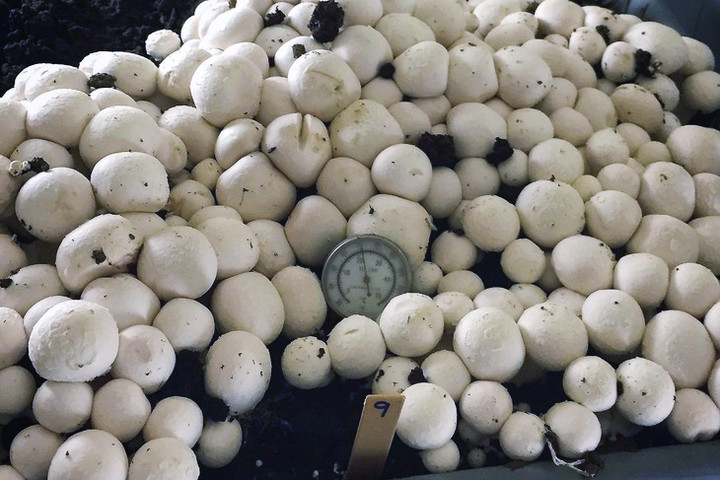
Unlike most Button mushrooms, these ones don’t brown or develop blemishes from being handled. This trait doesn’t occur naturally — it happens because the gene that makes the mushrooms turn brown was selectively removed from them via the CRISPR/Cas9 method. (Photo: Yang Lab)
For Yang’s part, he intends to improve his mushrooms before making them commercially available. Although not legally required, he plans to seek approval from the Food and Drug Administration (FDA) and Environmental Protection Agency (EPA).
Edited waxy corn may find its way into the food system much sooner than white button mushrooms, if not as human food than as fodder for the growing number of livestock around the world. Meanwhile, these livestock are also undergoing genetic edits as researchers use the same tools to make animals healthier, meatier, and more productive.
Livestock
Pigs harbor a lot of diseases and there are few as bad as porcine reproductive and respiratory syndrome (PRRS). It causes pregnant mothers to miscarry and makes it difficult for piglets to breathe. It’s a problem for the pig farmers as well. Every year, the PRRS virus costs the industry nearly $1.6 billion dollars in Europe and another $664 million in the US.
“The impacts of the disease for producers are often devastating,” said Jonathan Lightner, Chief Scientific Officer at biotech company Genus. “And the impacts on the animals themselves are terrible.”
“If we could integrate the polled phenotype into the dairy system, that would eliminate dehorning for at least seven or eight million animals a year.”
But Lightner and his team are working on a solution. In December 2015, scientists at Genus and the University of Edinburgh’s Roslin Institute demonstrated how CRISPR could remove the CD163 molecule, a pathway through which the PRRS virus infects pig. Just last month, the researchers refined their work to remove just the portion of the gene that directly interacts with the virus. Lab tests, as published in a paper in the journal PLOS Pathogens, have shown that DNA in cells removed from these pigs successfully resist the virus. Next steps in the study will test whether the pigs themselves are resistant to the virus.
Swine are also the subject of research at Seoul National University in South Korea, where scientists led by Jin-Soo Kin are using a different gene-editing tool called TALEN to create meatier, “double muscle” pigs by removing a gene that inhibits muscle growth. “We could do this through breeding,” Kin told Nature back in 2015, “but then it would take decades.”
In fact, farmers have developed similar traits through breeding Belgian Blues, a type super-sculpted beef cattle prized for its lean meat and beefy build. It took over a hundred years to establish those traits in the breed.
Researchers at University of California, Davis and a startup called Recombinetics are using the same TALEN gene editing technique to cut decades down to days, removing the horned gene from common dairy cows and inserting the one that makes Angus beef cattle naturally dehorned or “polled.” Polled cattle are desirable because they pose less threat to their handlers and to each other. But, as Tad Sonstegard, Chief Science Officer of Acceligen (a Recombinetics subsidiary) explained, polled cattle in certain breeds are simply less productive.
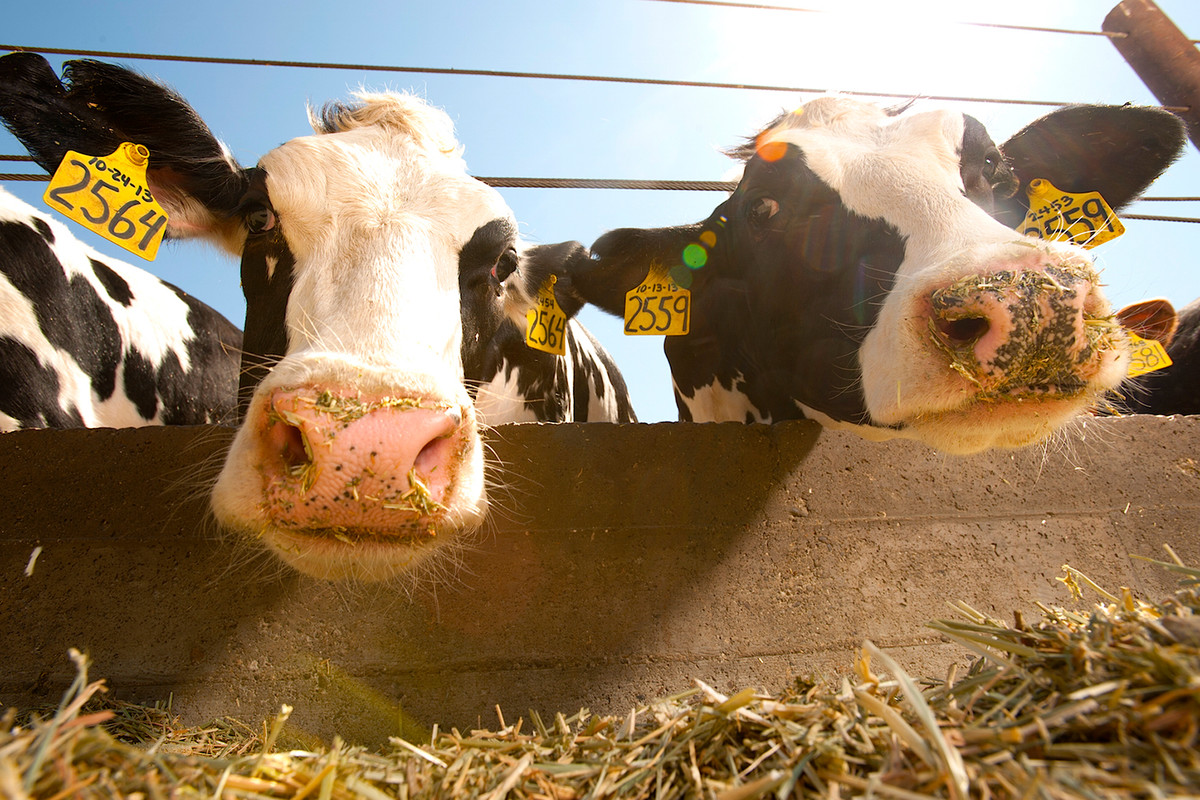
Gene editing ala CRISPR/Cas9 has allowed scientists to not only produce polled (hornless) cows, but also cows that are immune to common diseases, such as tuberculosis. (Photo: Gregory Urquiaga/UC Davis)
“The issue is that the top [dairy] bulls that everyone wants are horned,” Sonstegard said. “The animals that are polled that already exist have a difference of about $250 over their lifetime. If you’re running a thousand head dairy [operation], that’s a lot of money.”
What many ranchers do instead is dehorn their cattle, a stressful practice when anesthesia is used, a painful practice when it isn’t, and a significant expense for the ranchers either way.
“If we could integrate the polled phenotype into the dairy system, that would eliminate dehorning for at least seven or eight million animals a year,” Sonstegard said. “If you include beef, that’s up to fifteen million.”
Recombinetics has already bred a couple gene-edited calves, which are undergoing care and monitoring at UC Davis. But, before any gene-edited cows produce the milk in our grocery stores, Sonstegard said scientists would need to prove that milk from these cows is similar to horned and polled cows that haven’t been gene edited. “That would be simple though,” he said, “it would turn out the same.”
Saving species
As the global population grows, so does the demand for food. Meanwhile, farmers around the world face food scarcity generated in part by a changing climate that makes caring for plants and livestock an increasingly difficult task.
But CRISPR-like tools may be able to help.
“On the plant side we’re looking at ways to breed plants that are more drought tolerant or in other ways can better survive the stresses of climate change,” Haurwitz said. “I think that’s incredibly valuable and important as we look at the exploding global population.” Caribou has also partnered with Genus in its project to breed PRRS virus resistant pigs.
Beyond his work at Recombinetics, Sonstegard sits on the scientific advisory board of the Centre for Tropical Livestock Genetics and Health, a Gates Foundation-backed initiative to improve the genetics of native livestock in tropical regions. Most productive livestock breeds can’t survive the heat or diseases present in tropical environments, and breeds native to tropical environments haven’t had the same selective breeding programs that generate highly productive livestock.
“Will CRISPR be used primarily for patenting foods in ways that fit in existing corporate profit models?”
“Most of the indigenous animals have not been under strict artificial selection,” Sonstegard said. “It’s all been done anecdotally, since most farmers don’t have that many cows and their systems aren’t that big.” Meanwhile, most of the new DNA introduced to these herds is left over semen from bulls in developed countries, according to Sonstegard. “It’s cheap,” he said, “and no one in the developed country wants it anymore, so they ship it overseas.”
There are a couple possible approaches to strengthening these indigenous breeds. One way would be to edit the DNA of bulls from productive breeds so that they’re more temperature tolerant and disease resistant within tropical climates. Those bulls could then be introduced to the native herds to reproduce and spread their productive genes. Alternatively, the DNA of indigenous bulls could be edited with genes likely to improve productivity of the herd, including milk production and carcass yield.
“Right now the trend in those countries is that there’s a linear growth in livestock numbers,” Sonstegard said, “because they’re not improving production but demand is increasing, so they just make more animals.That’s not sustainable.”
Researchers are also using CRISPR to save dying and endangered species. This month some of Sonstegard’s colleagues published a paper showing they could develop surrogate hens that could help raise endangered species of birds. And in Florida, where an invasive disease known as citrus greening is decimating the state’s iconic orange industry, University of Florida scientists are using CRISPR to develop varieties of orange trees immune to the disease, according to the Tampa Bay Times.
But not everybody is so gung-ho.
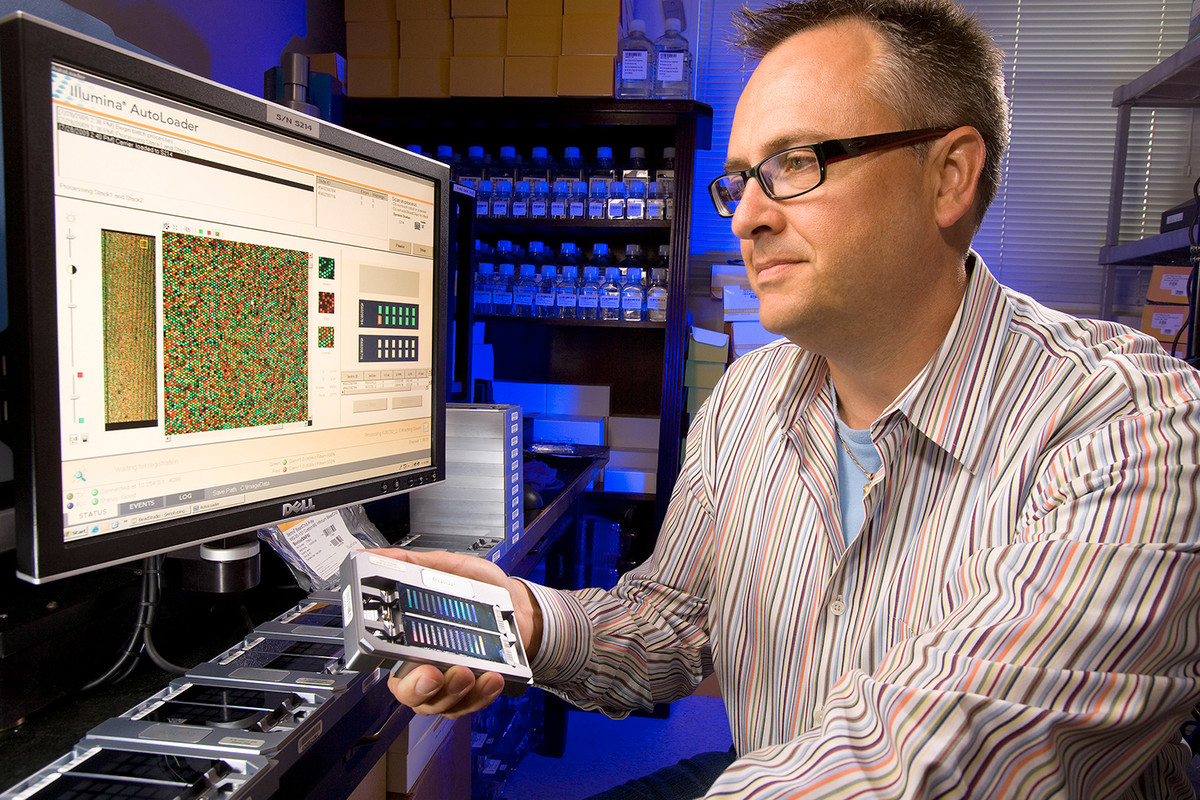
Geneticist Tad Sonstegard analyzes BovineSNP50 BeadChips for genotypic data that decodes each animal’s genome at more than 50,000 locations. This type of data is used in cattle research ranging from genome selection to mapping of congenital defects. (Photo: USDA/Peggy Greb)
UC Davis geneticist Alison Van Eenennaam, who collaborates with Recombinetics on gene-editing polled cows, is absolutely optimistic about the tool — “I think it can be used for very useful things,” she said. “Rather than ask ‘why’ we should use, let’s ask ‘how.’” — but she’s also careful not to overstate the potential of gene editing. When asked whether the technology could be used to address world hunger, she said, “I kind of think that idea is polyamorous. Show me anything that can magically solve world hunger. Let’s not oversell this technology. It’s useful but it’s useful for a fairly discreet purpose at this stage, which is making edits to a [gene] sequence that we know has a particular effect.”
And CRISPR, of course, has it’s skeptics. Stacy Malkan, Co-Director of U.S. Right to Know, a nonprofit that calls for transparency and accountability in the food system, is both concerned about the inherent risk involved in gene editing and suspects it could ultimately perpetuate an already imbalanced food system.
“There’s really no big difference between [gene editing] and conventional breeding.”
“Will CRISPR be used primarily for the purpose of patenting foods in ways that fit in existing corporate profit models,” she asked, “for example, to engineer commodity crops to withstand herbicides, or to engineer livestock to fit better in unhealthy confined feeding operations? Or will it be used to engineer foods that have consumer benefits? Will there be labeling, and safety assessments? There are many questions. Right now we hear a lot of marketing hype about possible benefits of CRISPR, but we heard the same promises about first-generation GMOs for decades and most of those benefits have not panned out.”
For scientists like Van Eenennaam, the GMO discussion is over. “”Frankly,” she said, “I’m over the debate. If someone isn’t convinced by the evidence that every single major scientific society in the world says it’s safe, than nothing I’m going to say is going to convince them any differently.” When it comes to gene-edited organisms, most scientists are even more insistent about its safety. “There’s really no big difference between [gene editing] and conventional breeding,” Van Eenennaam added.
But there isn’t complete consensus. Malkan points to an interview she recently had with Michael Hansen, senior scientist from Consumers Union, in which Hansen said of CRISPR-like gene editing tools, “These methods are more precise than the old methods, but there can still be off-target and unintended effects. When you alter the genetics of living things they don’t always behave as you expect. This is why it’s crucial to thoroughly study health and environmental impacts, but these studies aren’t required.”
From Sonstegard’s perspective, mutations and off-target effects occur naturally anyway, and gene editing simply offers a more precise approach than selective breeding.
Still, Malkan and others have their reservations, grounded in the idea that it’s too early to determine the side effects. “CRISPR is a powerful research tool for helping scientists understand genetics, how cells react, how entire plants and systems react,” she said. “In my view these experimental technologies should be kept in the lab, not unleashed in our food system, until those systems are better understood.”
Can tech help us feed a population of 9+ billion? Welcome to the Future of Food

Agriculture has come a long way in the past century. We produce more food than ever before — but our current model is unsustainable, and as the world’s population rapidly approaches the 8 billion mark, modern food production methods will need a radical transformation if they’re going to keep up. But luckily, there’s a range of new technologies that might make it possible. In this series, we’ll explore some of the innovative new solutions that farmers, scientists, and entrepreneurs are working on to make sure that nobody goes hungry in our increasingly crowded world.
Food is the ultimate technology.
It might not have circuits, touchscreens, or an app store, but of all the tech we’ve ever developed as humans, nothing else has had such a direct and significant impact on our progress as a species.
It was agriculture — the cultivation of edible things — that made it possible for humans to progress from nomadic hunter-gatherer tribes and develop settlements, cities, and civilization in general. Later, advances in agricultural technology — things like grain storage, steel plows, and mechanical threshers — allowed us to produce food surpluses, support larger populations, and colonize every corner of this rich, round planet. Food is undoubtedly one of our greatest technological achievements.
What changes will we need to make to ensure we don’t go hungry in the future?
It’s a double edged sword, though. Our agricultural success has brought humanity to a tipping point. The world’s population is expected to grow by over one third (roughly 2.3 billion people) between 2009 and 2050. To feed all those hungry mouths, global food production will need to scale up in a big way — and in a world where oceans are already overfished, arable land is increasingly scarce, and climate change makes crop yields unstable and unpredictable — doing so will almost certainly be an uphill battle.
How do we boost production to meet the planet’s rising demand for food without exacerbating the problems modern agriculture already faces? Can we continue on our current trajectory without destroying the ecosystems and depleting the resources that sustain us? What changes will we need to make to ensure we don’t go hungry in the future?
There’s no simple answer to these questions, but as always, recent technological innovations provide a grain of hope. Just as inventions like the tractor, the sprinkler, and chemical fertilizers helped farmers to meet rising demand in the past, new technologies might help us meet demand in the future. Right now, scientists all over the globe are leveraging a new generation of technological tools — things like gene editing, artificial intelligence, and flying robots — to ensure that our food future is secure.

Humans have been using genetic modification for centuries — but thanks to new tools like CRISPR, scientists now are pushing the practice into bold new territory. Get ready for drought tolerant, disease-proof, ultra high-yield crops.

Indoor farms can produce high volumes of fresh produce without relying on herbicides, pesticides, or the presence of the Sun. They could also cut down on carbon emissions by growing food directly inside urban areas, rather than producing it in rural areas and shipping it to city-dwelling consumers.

Animal agriculture is the number one cause of environmental destruction in the world — but nobody wants to stop eating meat. To remedy this problem, scientists are racing to develop lab-grown meat alternatives that taste identical to the real thing, but don’t require the cultivation/slaughter of livestock.

As part of their never ending pursuit of increased efficiency, many farmers are now turning to agricultural robots to cut down on operation costs, and accomplish more with smaller workforces
Many of the solutions we’re working on sound like they’re plucked straight from the pages of a sci-fi novel. Germany has developed a weed killing robot that intelligently plucks individual weeds to reduce reliance on herbicides. Tokyo has a vertical farm that uses LEDs and hydroponics to produce thousands of heads of lettuce each day. In the United States, there are at least half a dozen startups racing to create lab-grown meat.
Throughout the next two weeks, Digital Trends will take you on a tour of these new technologies, and offer an inside look at some of the most innovative ideas in agriculture right now. Starting today, we’ll publish one feature piece per day — each of which will highlight a different technology, trend, or idea that’s reshaping the Future of Food. This series will cover everything from shrimp farming to robotic bees, and everything in between — so you won’t want to miss it! Be sure to circle back to this page every so often, or sign up for our newsletter if you’d prefer to have articles delivered directly to your inbox. Enjoy!
Can Huawei’s 2017 flagships compete against the Galaxy S8 in the UK?

Huawei isn’t targeting the same super-high price tier as Samsung with its new flagships. Nevertheless, the P10 series has a formidable high street presence.
If you’re used to the Apple/Samsung duopoly as it exists in the U.S. right now — sure, with a bit of LG and Motorola thrown in — then it might be a surprise to learn that Huawei is a major force in the UK market. The Chinese manufacturer has slowly but surely been building its presence across the four major network operators, all of which carry its new P10 phone. (The larger P10 Plus has three of four onboard.)
That vital shelf space will play an important part in building not just sales, but brand awareness. While Huawei has used partnerships with big-name brands like Leica and Porsche Design to build a halo effect around its phones, the proportion of Brits who recognize (and can successfully pronounce) the name Huawei is nowhere near the likes of a Samsung or LG.
One Huawei representative remarked to me ahead of the P10 launch that the removal of front-facing branding from that phone was partly to counter customers pre-judging a product with an unfamiliar brand name. There’s still a Huawei logo around the back, but it’s not the very first thing you see. Instead, you see a premium handset, then associate it with the Huawei brand when you look a little closer. At least, that’s the idea.
Huawei expects to ship 10 million P10s in the short term. That’s not GS8 numbers, but it’s a start.
Despite its flat profits in 2016, the world’s number-three smartphone maker enjoyed strong sales in its P9 and Mate 9 series. It’s been reported that the short-term goal for the P10 is to sell 10 million units. That’s nowhere near the 40 million projected for the Galaxy S8, but then again we’re talking globally here, and Huawei remains basically a non-presence in the U.S. market.
In the UK, and Europe generally, competition between the two is a little closer. It’s way too early to judge the success of the P10 — or the GS8 for that matter — but Huawei’s phones are displayed prominently on the major operators websites, and in brick-and-mortar stores. The fact that Huawei is back for a second round of flagship devices across all the major networks suggests that UK P9 sales should have (at least) met expectations. This year, Huawei has the advantage of its software no longer being gross and broken — EMUI 5.1 is fast, stable and way less obtrusive than earlier versions.
Huawei hasn’t deployed the same massive marketing resources that Samsung has put behind the Galaxy S8 — but Samsung is pretty much unique in the amount of overt pomp, ceremony and advertising that accompanies its phone launches. And Huawei is targeting price tiers £100-200 below the Galaxy S8 and S8+, wit the smaller P10 selling for £550 unlocked, and its big brother going for £650. (With more RAM and internal storage, by the way.)
Priced as they are, the P10 phones aren’t really directly competing with the GS8.
Huawei’s pricing is competitive and realistic. Physically speaking, its phones are more in line with Apple’s 2016 iPhones than the bezel-less, futuristic creations we’ve seen from Samsung. And then there’s the whole brand value angle — Samsung has established itself as a brand worth of very expensive purchase in a way Huawei hasn’t quite managed yet.
Speaking in London ahead of the P10 launch, Bruce Lee, Huawei’s head of handset product line, told me that he expected slim bezels and taller aspect ratios to be one of the major trends of the year, but couldn’t comment on any plans Huawei might have for such a device. Reading between the lines, I wouldn’t be at all surprised if something was on the cards for later this year or early next year. (Lee also told me that he expects the Mate “Pro” series — a line kicked off with the Mate 9 Pro in 2016, with a curved screen and a smaller form factor to continue. A Mate 10 Pro would be a natural candidate for Huawei’s first foray into bezel-less phones.)
New Mate phones might stand a better chance of going head-to-head with Samsung in terms of pricing, form factor and feature set. As for the P10, all signs suggest it’ll be a solid seller for Huawei, undercutting its Korean rival on price while, on paper, beating it in key specs in the UK market. Here, Huawei’s more immediate competitors are LG and Sony — established names operating in the same price bracket.
Nevertheless, Huawei’s growth has outpaced just about all its Android rivals over the past couple of years, and the next 12 months are sure to bring some fascinating developments.
Samsung Galaxy S8 and S8+
- Galaxy S8 and S8+ hands-on preview!
- Galaxy S8 and S8+ specs
- Everything you need to know about the Galaxy S8’s cameras
- Get to know Samsung Bixby
- Join our Galaxy S8 forums
Verizon
AT&T
T-Mobile
Sprint
How to restore the app drawer button on the Galaxy S8 — or disable it altogether

It’s easy to bring back the ‘all apps’ button, or disable the app drawer altogether and see all your apps on your home screens.
Samsung’s new home screen launcher on the Galaxy S8 introduces many new features, but most notably it changes the way the app drawer works. Instead of having a button on the right of the favorites tray allowing you to view all your apps, you now access the app drawer by swiping up or down, similar to how the Google Pixel Launcher works.
It’s a new and simplified approach, and one that frees up some space in the favorites tray for an extra app. However, if you prefer to go back to the old way of doing things, a simple setting change will restore the “all apps” button. Alternatively, if you prefer no app drawer at all, like the iPhone’s home screen, that’s also possible on the GS8.
How to bring back the ‘all apps’ button
Long press on any empty area of your home screen
Tap the cog icon — Home screen settings
In the menu that appears, tap Apps button
From the next menu, select Show Apps button and then tap Apply

How to remove the app drawer altogether
Long press on any empty area of your home screen
Tap the cog icon — Home screen settings
In the menu that appears, tap Home screen layout
From the next menu, select Home screen only and then tap Apply

Note: It’s easy to restore either option to its previous setting through the home screen settings panel.
Samsung Galaxy S8 and S8+
- Galaxy S8 and S8+ hands-on preview!
- Galaxy S8 and S8+ specs
- Everything you need to know about the Galaxy S8’s cameras
- Get to know Samsung Bixby
- Join our Galaxy S8 forums
Verizon
AT&T
T-Mobile
Sprint
Xiaomi’s latest headphones are designed to be supremely comfortable
Xiaomi is bringing the Mi Headphones Comfort to India.
Xiaomi is adding to its arsenal of affordable audio products by launching the Mi Headphones Comfort in India. The 3.5mm closed-back on-ear headphones are set to go on sale in the country starting tomorrow, April 18, and will retail for ₹2,999 ($45). The headphones incorporate a lightweight construction and ear cups made out of breathable polyurethane foam that make them comfortable to wear throughout the day. The have a frequency range of 20Hz to 40,000Hz, and are Hi-Res certified.
Launching Mi Headphones Comfort: beautiful, great sound & super comfortable. Only ₹ 2,999 😀 Buy from https://t.co/lzFXOcGyGQ starting tomm. pic.twitter.com/K0iD203Nkj
— Manu Kumar Jain (@manukumarjain) April 17, 2017
The left ear cup also offers quick controls for music playback and receiving calls. The 1.4m cable is tangle-free, and Xiaomi says it conducts over 700 tests to make sure the headphones are durable. Like the more premium Mi Headphones, the Mi Headphones Comfort are designed by 1More. The headphones won’t be up for sale until tomorrow, but if you want to take a look at their product page and see what’s on offer, hit up the link below.
See at Xiaomi India
LG G6 finally goes up for pre-registration in India as Galaxy S8 launch nears
The LG G6 may launch in India before the end of April.
Samsung is getting ready to launch the Galaxy S8 and S8+ in India later this week, and it looks like the announcement made LG realize that it also has a flagship that’s yet to make its debut in the country. The South Korean company has finally started taking registrations for the LG G6 in India, which means that a launch isn’t too far away.

We don’t have any further details at this point, but it looks like the LG G6 will be priced at around the ₹49,990 mark. The G6 was unveiled a full month before the Galaxy S8, going up for sale in the U.S. two weeks ahead of Samsung’s flagship. The phone itself has a lot to offer, including a 5.7-inch QHD+ panel with an 18:9 ratio, Snapdragon 821, 4GB of RAM, dual 13MP cameras at the back, 5MP front shooter, and a 3300mAh battery.
The phone comes with 32GB internal storage in the U.S., but the Indian variatn will offer 64GB internal memory as standard. However, the Indian unit won’t have wireless charging. If you’re interested, you can register your interest in the LG G6 from the link below. The handset is likely to debut at the end of this month or during the first week of May, and we’ll let you know once we hear more.
Register your interest for the LG G6 in India
AC readers recall their first cell phones
What was your first phone? We asked, and here are some of your answers.
Can you believe what used to pass for a cell phone in the beginning? Or how much we used to spend just to make a phone call? And do you remember how excited we used to get over a carrier-provided app store on our phones, merely so that we could download color games?
Interestingly, roughly only 17 percent of you mentioned wielding a Nokia mobile device as your first. That’s still a fair number, but it’s far fewer than what we had initially imagined. In fact, about 25 percent of you actually started your mobile lives with a Motorola brick of sorts. (For those who are wondering, these numbers are based on a quick count of the comments at the original time of publishing, and some simple math.)

The Motorola DPC-550. (Via.)
TheNexxuvas:
Motorola Micro Tac Elite II analog with a whopping 10-speed dial memory and a lithium-ion slim line and regular size battery back when NiCad was the norm. The phone was touted as a business unit, and came with a dual slot desktop battery dock charger, too.
eahinrichsen:
My first cell phone was a Motorola StarTAC on Verizon. That thing was awesome. Remember charging your phone every third day?
ottchris:
The first cell phone I used at work was a Motorola DynaTAC. Hard to be inconspicuous using one of those!

The Motorola Bag Phone (Via.).
Quite a few of you had also started your mobile lives in a decidedly not-so-mobile manner. The Motorola Bag Phone was a thing in the early Nineties, and they were particularly popular with truckers, boaters, and people in rural areas. The actual Bag Phone handset wasn’t as high-tech as some of the other cell phones offered at the time, but they were considered reliable out in the field.
trekmario:
I had a Motorola bag phone. Man, I never lost a call on that one even in the woods lol.
NokiaBeast:
My first phone was a Motorola bag phone, too. It rode on the transmission hump of my truck. Man, it was huge.
zr2s10:
My first one, at 17, was a BAG PHONE that had to be plugged into the cigarette lighter (that thing you kids plug your USB chargers into) to run, because it had no battery. No presets, no voicemail, etc. Just enough display digits for 1-555-555-5555, and they were green. You know — like original Game Boy screens.

The QCP 860. (Via.)
There was also a surprising number of you who started out with a decidedly plain Qualcomm cell phone. Phones like the QCP 2700 still seem to be making the rounds on eBay, and some Amazon listings even list it as a co-production with Kyocera.
colorado_al:
1999 Qualcomm QCP-2760 on Sprint. It was awesome! SMS was 10 cents per message. It replaced my Motorola Gold pager. So nice to be able to call on the go!
aaronwe:
Qualcomm 860! Insanely thin at the time.
Some of you even took the opportunity reminisce about the pains of living life without cell phones back in the day, including lamenting about how frantic it felt to call into a radio station in hopes of winning concert tickets. Those were the days!
cwcheese:
Remember how hard it was to dial the local radio station to try and win the contests for albums and concert tickets? I can still feel the pain on the side of my index finger from dragging the dial around to get set for the next number. That must be why the radio stations always had so many 7, 8, 9, and 0 digits in their call-in line. 😉
It appears that while a majority of you are certainly enjoying the era of the smartphone we’re living through right now, you’re also definitely thankful for your humble beginnings. Thanks to everyone who took a second to reminisce with us about your first cell phone.
The Morning After: Monday, April 17th 2017
Hey, good morning!
While we consumed our body weight in chocolate, the US Navy banned vaping on its entire fleet and EA detailed the sequel to Battlefront. There’s also a drone that can spy on fish, some stealth iPad upgrades and a potentially life-saving AI.
The batteries kept on explodingUS Navy is banning e-cigarettes across its fleet

While they’re far from the most dangerous threat to those serving in the US Navy, it turns out e-cigarettes have been posing quite the problem in recent years. A Navy memorandum details 15 incidents of exploding batteries. Two occurred while e-cigarettes were in sailors’ mouths, two required fires to be extinguished and one even forced a naval aircraft to abandon its flight and return for landing. With this in mind, it’s perhaps no surprise that the US Navy decided to ban e-cigarettes across its entire fleet. Those on terra firma will still be able to vape to their hearts’ content, but the prohibition goes into effect next month.
Not quite a free iPad, thoughApple will replace your busted iPad 4 with an iPad Air 2

It’s an everyday occurrence for Apple to deem a faulty product a total loss, and replace it rather than repairing it. What’s not so common is swapping that product out for a different — and much improved — model. But that’s exactly what Apple has started doing with older iPads, according to a leaked memo. Essentially, Apple has run through its stock of the now-ancient iPad 4, and is instructing employees to replace tablets covered by AppleCare with the newer iPad Air 2. Of course, if you’re outside of that coverage, it probably makes a lot more sense to stump up the cash for an iPad or iPad Pro.
It even has a bait dispenserThe PowerRay drone helps you catch fish

Whether you’re a spy trying to foil an aquatic crime ring, or just want an upper hand when going fishing, Chinese companyPowerVision has just the drone for you. The PowerRay UUV is a miniature submersible equipped with a light to lure fish, a bait dispenser and even a 4K camera for salmon snooping. The one downside? Because wireless signals don’t play nicely with water, the PowerRay needs to be connected to its controller via a roughly 200-feet long cord. Well, that and the $1,500-$1,900 asking price.
You’ll play as an Empire soldier‘Star Wars Battlefront’ returns this November

Do you harbor fantasies of succumbing to the dark side? Someone at EA clearly does, as the sequel to 2015’s Battlefront will see you embodying a stormtrooper. Unlike the first game, Battlefront II will have an extensive single-player campaign that aims to fill in the 30-year gap between Return of the Jedi and The Force Awakens.
The debut trailer shows Iden Versio, the leader of a small team of Imperial soldiers, looking on in horror from Endor as the Death Star is destroyed. It’s not only Versio that you’ll embody, though, as EA says you’ll also control Alliance hero Luke Skywalker.
Computers could save livesAI can predict heart attacks more accurately than doctors
Enlisting AI to aid in diagnosis could reduce the number of deaths due to cardiovascular disease. A team of researchers from the University of Nottingham, England, developed a machine-learning algorithm that can best the American College of Cardiology/American Heart Association’s diagnosis guidelines by 7.6 percent. From a set of 83,000 test records, the AI system could have saved 355 extra lives. If you spin that number up to the estimated 20 million people who die each year because of cardiovascular disease, tens of thousands could be saved.
But wait, there’s more…
- Square may be planning a debit card
- David Bowie’s musical is making the leap to VR
- ‘Smart’ bandages have 5G data to track your health
UK forms ‘specialist squad’ to tackle prison drug drones
Training carrier pigeons to fly contraband beyond prison walls is undeniably canny, but these days all you need is an inexpensive drone to do the same job. While perhaps not as reliable, remote-controlled mules carrying drugs and phones into prisons are now a persistent problem for law enforcement. So much so that today the UK government has announced a new “specialist squad of prison and police officers” has been assembled to investigate the flying smugglers.
If you’re picturing a crack team of drone gun-wielding heavies with eagles perched on their shoulders, sorry to burst your bubble, but it’s more of an intel-sharing initiative. Police and prison officers will work with other agencies to examine drones recovered from unsuccessful runs to identify those involved in the smuggling operations, passing that info down to local-level officers to act on.
The first Brit to be jailed for flying contraband into prisons by drone received a 14-month sentence last July, but within today’s announcement, the government highlights other, more recent convictions. In October last year, a man was given three years and four months after he was caught outside a prison in Warrington with drugs and a drone in his bag. The heftier sentence of four years and eight months was handed down to another man in December, following his attempt to fly drugs and phones over the walls of HMP Manchester.
Via: BBC
Source: UK government
 AIVAnet