


Japan and the U.S. are having a giant robot duel, and we have the deets
Forget Samsung’s Galaxy S8 vs. the tenth-anniversary iPhone! Who cares about a nuanced discussion comparing the necessity for big data-driven surveillance and the importance of privacy and strong encryption? What kind of puny, pencil-necked geek spends time pondering the relative pros and cons of logic-based artificial intelligence and statistical AI?
If you’re a red-blooded, testosterone-pumping tech fan who likes your gear served up with a thick-crusted slice of pro wrestling pageantry, the only confrontation that matters this year is the one pitting Californian robotics company Megabots against Japanese robotics company Suidobashi in a totally awesome robot duel that’s been years in the making.
More: Method-1 mech is your sci-fi fantasy come to life
Set to finally take place this August (an announcement made this week), the date is the culmination of thousands of hours both companies have spent building giant human-driven mech robots — you know, like those things out of Mobile Suit Gundam Wing.
Now they’re going to do what any self-respecting big kid would do when playing with kickass action figures: bash them against each other until a clear victor has emerged. In short, Megabots and Suidobashi’s creators are here to kick ass, chew bubblegum, and do some wicked engineering. And they’re both all out of bubble gum.
“In 2015, we challenged Suidobashi Heavy Industries to a Giant Robot Duel between our existing Mark II robot and their KURATAS robot,” Gui Cavalcanti, CEO and co-founder of Megabots told Digital Trends. “They accepted the challenge, and upped the ante to include hand-to-hand combat. We tested the Mark II to see if it would survive in combat. The robot would but we, the pilots, wouldn’t.”
Megabots
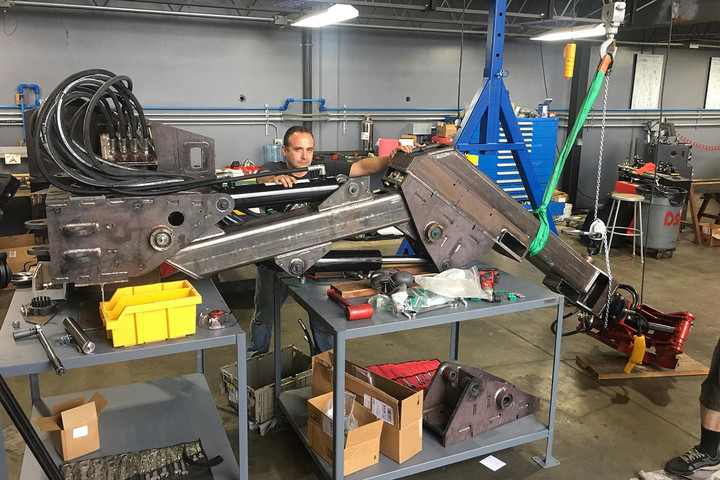
Like a Rocky training montage, Cavalcanti and his team went back to the drawing board for a rethink, and emerged with the Mark III robot.
This wasn’t always straightforward. As it turns out, bringing a giant mech to heaving, servo-assisted life isn’t as easy as you might imagine.
“Our biggest challenges have been suppliers, systems integration, and logistics,” Cavalcanti continued. “The Mk. III includes about $800,000 worth of off-the-shelf and custom parts, that we often order in gigantic bulk orders. Simply getting high-quality parts in the door reliably has been a huge issue for us. Integrating all those parts into a cohesive system has been really challenging. We have about 3,000 wires on the robot, around 300 hydraulic hoses, 26 of the fastest hydraulic valves in the world, and a 430 horsepower gas engine that wants to be in a car and not a robot. Getting all of those to play nice has been a long process.”
There was also that boring old stuff about logistics that turns out to be totally important, too. It’s a bit like those old road stories with professional wrestler Andre the Giant where body slamming fools wasn’t half as challenging as finding a hotel bathroom that could accommodate his 6’11, 500 pound frame.
We’ve had to change our designs in fundamental ways to allow them to be shipped nationally and internationally.
“Simply moving the robot around nationally and internationally has been a huge challenge,” Gui explained. “The robot has to break down into parts that fit inside a shipping container, for example, and be easy to re-assemble on-site. More than anything else, we’ve had to change our designs in fundamental ways to allow them to be shipped nationally and internationally.”
Still, the results have been worth it — since the team’s Mark III robot is a seismic upgrade over its predecessor. As far as tales of the tape go, it weighs 12 tons instead of six, and towers in at 16 feet instead of 15. In short, Cavalcanti said it was, “designed for hand-to-hand combat from the ground up.”
So onto the final question, then, which is why — with so many astonishing advances in robotics — should this all be settled in a duel?
“Because there’s a 50-year-long tradition in most world cultures of science fiction depicting giant robots fighting,” Cavalcanti said. “When we show our robot to people who haven’t heard of us, the reaction is always ‘Oh! I saw that in…’ and then they list any of 60 or 70 different video games, movies, [or] animated shows that feature giant robots fighting. We’re trying to bring the fantasies of sci-fi fans around the world to life.”
You can’t say fairer than that! We just hope Suidobashi is ready…
Galaxy S8’s Bixby features headed to Germany in Q4 2017

Bixby will be fully functional in Germany around the time we’re expecting the Galaxy Note 8.
The full feature set of Bixby, Samsung’s AI assistant feature for the Galaxy S8, will only be available in U.S. English and Korean at launch, with other regions having to wait it out. And now we have a rough idea of just how long that might take.
According to an entry on Samsung’s German support site, first spotted by GalaxyClub, Germans can expect a fully functional Bixby experience by… Q4 2017.
As in October, at the earliest.
Given the complexity of the features — and the fact that not even UK English will be supported at launch — it’s not entirely surprising that Bixby voice is going to take a while to port to additional languages. But still, six months from the launch of the GS8 is a considerable wait. And while not confirmed, it’s likely a similar lead time would also apply to other European languages.
By that time, we’ll be in the thick of the Galaxy Note 8 launch. Later in the year, a new multilingual Bixby might go up against an improved Google Assistant on this year’s Pixel phones, as well as a smarter Siri on the iPhone 8.
Bixby is clearly a long term play for Samsung. The feature is huge in scope, and won’t just be limited to phones — in time, expect to see it in smart appliances, TVs and wearables. But it’s also clear it’s going to take months, if not years for Bixby’s full potential to be realized.
Samsung Galaxy S8 and S8+
- Galaxy S8 and S8+ hands-on preview!
- Galaxy S8 and S8+ specs
- Everything you need to know about the Galaxy S8’s cameras
- Get to know Samsung Bixby
- Join our Galaxy S8 forums
Verizon
AT&T
T-Mobile
Sprint
Galaxy S8 enjoys record-breaking pre-orders in Korea

Pre-orders more than five times that of the Galaxy S7, according to local media.
The Samsung Galaxy S8 went up for pre-order in South Korea over the weekend, where it’s been met with a record-breaking reception. ZDNet reports that Koreans snapped up 550,000 Galaxy S8 and S8+ phones in the two-day period since pre-orders began, ahead of the phone’s April 21 street date.
To put that number in perspective, it’s 2.75 times that of the late Note 7 and 5.5 times that of the Galaxy S7 and S7 edge. The Galaxy S8+ model with 6GB of RAM and 128GB of storage — exclusive to Korea and China — was reportedly in highest demand.
Strong demand around Samsung’s new flagships in its home market follows a massive marketing campaign by the company. What’s more, the lack of a big-screened Samsung flagship last year following the Note 7 recall likely created pent-up demand for the larger of the two phones.
Korean pre-order customers will be among the first to get their hands on the GS8 and GS8+, with pre-orders arriving from April 17.
Samsung Galaxy S8 and S8+
- Galaxy S8 and S8+ hands-on preview!
- Galaxy S8 and S8+ specs
- Everything you need to know about the Galaxy S8’s cameras
- Get to know Samsung Bixby
- Join our Galaxy S8 forums
Verizon
AT&T
T-Mobile
Sprint
How to quickly launch the Galaxy S8 camera with the power button

The Galaxy S8’s camera shortcut has moved from the home button to the power button. Here’s how it works!
On the Galaxy S6 and S7, the camera app was easily accessible by double-pressing the physical home button from anywhere — screen on or off, and in any app. But the Galaxy S8 has no physical home button, which necessitated a change of strategy.
By default, the Galaxy S8 will launch the camera app if you double press the Power button. You can choose whether to Turn Off or Keep On the first time you use this shortcut.

But let’s say that, perhaps, you were too quick to dismiss the helpful shortcut feature at the beginning. The good news is that you can go into the phone’s settings panel to turn it back on.
How to enable Galaxy S8 camera quick launch
Open the Settings panel.
Tap on Advanced Features.
Tap the Quick launch Camera shortcut to enable it.

Now you’re back in business with the Galaxy S8’s quick launch camera shortcut.
Samsung Galaxy S8 and S8+
- Galaxy S8 and S8+ hands-on preview!
- Galaxy S8 and S8+ specs
- Everything you need to know about the Galaxy S8’s cameras
- Get to know Samsung Bixby
- Join our Galaxy S8 forums
Verizon
AT&T
T-Mobile
Sprint
Tag Heuer Connected Modular 45 review: The undisputed fashion smartwatch king
“It’s too expensive”. “It’s unnecessary”. “It’s too big”. “It doesn’t have all the features of a watch a quarter of the price”.
The arguments against the Tag Heuer Connected Modular 45 are many and varied. What we see, however, is a fashion-forward and quite excellent smartwatch with a genuine twist: modularity of body, lugs and strap choices. It’s desirable, a status symbol, and for many perhaps the only kind of decoration that will always be worn.
The Modular 45 is unashamedly plush, reflecting the luxury brand to which it belongs. That’s something that some people will never understand or accept, in the same way that some would argue buying an Audi isn’t worth the money over buying a Skoda. Brands have value and when the world of tech meets the world of fashion, it ruffles feathers – in both good and bad ways.
Sure, the Tag Heuer Connected Modular 45 is big, it’s expensive and, yes, there are cheaper smartwatches that do more. But this is hands down the most attractive Android Wear watch on the market right now.
Tag Heuer Connected Modular 45 review: Design brilliance
- Modular design: choose body, lugs and strap
- Premium metal body and metal backplate
- 45mm diameter, 13.5mm thick
- Waterproof to 50m
The second iteration of Tag Heuer’s Connected smartwatch brings with it a twist, but offers much the same visual appeal as the original model. We loved the chunky and sporty looks of the Connected and the Modular 45 repeats that Carrera-apeing design.
Pocket-lint
Unlike many of the other Android Wear watches, it’s in design that Tag really makes a statement. There isn’t a sense of “that’ll do” or compromise about it, it feels as though it has been designed and considered by a watch maker – which is perhaps no surprise, seeing as it has been. Everything from the bodywork to the strap is superior to those cheaper rivals. That’s the definition of luxury: being better is what it’s all about.
While the Modular 45 doesn’t have all the technical abilities that some other smartwatches offer, it’s the design that makes this watch. It wears well, it looks good and it feels good. It’s a watch you want to wear and a watch you want to be seen in. It doesn’t feel like an unnecessary gadget and there’s no qualm about the choice of materials.
Sure, some might baulk at the 45mm body, but that’s the same as the analogue Carrera that this watch is based on. It’s not a big smartwatch, it’s a big watch full stop.
Pocket-lint
Design improvements over the original Tag Heuer Connected (now called the Connected 46) include the metal backplate: this is even more substantial in the body than the slightly older model, but the big design twist is modularity, which takes this watch into a totally different league.
Tag Heuer Connected Modular 45 review: Modular marvel
- Huge number of colour combinations
- Choose your body, lugs and strap
- Easy switch modularity
If the Connected Modular 45 is a toy for kids who don’t want to grow up, then its modularity is only part of the appeal.
First of all, the 45 presents you with choices. You can choose the strap which is a fairly common option. Being able to choose the lugs is something else entirely. So is having the option to choose the body materials and bezel colour.
Pocket-lint
Sure, there are some limitations, but you’re not limited to silver or rose gold here: there’s titanium, aluminium or gold, there are even diamond bezels. There are matte black bodies with blue bezels, a rainbow of coloured aluminium bezels on a titanium body, or, as pictured here, black ceramic bezel on titanium body and many more. The price will vary depending on what you choose.
Being able to choose the lugs is a big point of differentiation too. This is the part that connects the strap to the watch and, with the press of a button, separates from the main body. There are matte black ceramic, diamond crusted, gold or the classic satin titanium lugs.
The important take-away point is that you can buy the watch you want. If you’re a gadget fan and you have plenty of cash, you can decide exactly what you want your Tag to look like. There’s even the option to buy an analogue watch module, so that you can leave the smartwatch at home, and walk out wearing a mechanical chronograph instead.
There’s also another consideration: this is Tag Heuer classic design and we suspect that in future there could be the option to buy a different smartwatch as technology evolves.
Pocket-lint
We’ve found it easy to break down our test watch into its main component pieces. Separating body, lugs and strap is simple, as is detaching the buckle from the strap. Important if you intend to have various options for different days, meetings, events, moods or whatever else suits you.
The one negative is that this modularity does present a natural failure point: there’s some movement between the lugs and the body and we have no idea how the mechanism will wear over time. For us using the watch over a short period of time there’s been no sign of it, but after a year, we simply can’t say.
We are also left wondering whether modularisation is a big sell: will people wanted to change parts of their watch repeatedly, or is this play for differentiation only going to be used to buy a unique watch and thereafter be ignored?
Tag Heuer Connected Modular 45 review: Hardware and specifications
- Intel Atom Z34XX, 512GB RAM, 4GB storage
- GPS, NFC, motion sensors
- Bluetooth and Wi-Fi
- Android Wear 2.0 operating system
Behind that premium design the technology doesn’t throw up too many surprises, except that this is an Intel powered watch when many are Qualcomm Snapdragon Wear 2100.
The Intel Atom Z34XX chipset sits at the heart of this watch as it did the previous model. There’s 512MB of RAM and 4GB of internal storage, which you can use to store music on your phone, connecting to Bluetooth headphones, so you can have music without the need for your phone.
Pocket-lint
Our experience is that this watch is every bit as fast and powerful as other Android Wear watches we’ve used. It’s perhaps more difficult to quantify that as we’re not roaming around playing games on the watch – but it reacts to the touch and does what we ask of it without any problems.
There’s Wi-Fi on board to let it connect independently to networks, something that’s more pertinent in Android Wear 2.0, which now runs much more independently than previous software versions.
The Modular 45 has GPS, NFC (for Android Pay) and motion sensors, as well as a microphone and ambient light sensors. The GPS means it’s a better device for tracking location independently, but it lacks the autonomy that comes from having its own 4G connection. There’s no such thing here, meaning it’s often dependent on your phone for more data, unlike something such as the LG Watch Sport.
Pocket-lint
There’s no heart-rate sensor, so this Tag isn’t an out-and-out sports watch. You can use a compatible Bluetooth heart-rate sensor, although we didn’t test this ourselves, so we can’t comment on performance or compatibility.
We don’t think that the lack of a heart-rate sensor is a huge deal here: although it offers 50m waterproofing, we can’t see that anyone is going to seriously choose it as a sports device. There are plenty of other options, like the Polar V800 or the Garmin Forerunner 920XT, that will happily give you a premium sports experience.
Tag Heuer Connected Modular 45 review: Display and watch faces
- 1.39-inch AMOLED display
- 400 x 400 pixels (287ppi)
- Sapphire glass
The Modular 45 hosts a 1.39-inch fully round display. There are no flat tyres here, like with the Moto legacy watches (which Fossil persists in running with). The Tag offers a 400 x 400 pixel resolution, resulting in 287ppi, which is typical of such a device. Just because it’s Tag doesn’t mean you’ll get more resolution. However, Tag has used an AMOLED panel for rich blacks and covered it with a 2.5mm thick sapphire crystal cover for protection.
Display-wise, we think the Apple Watch S2 looks better, with deeper blacks and more vibrancy. The Apple display also looks closer to the surface, whereas the Connected Modular 45’s deep glass – while great that it’s sapphire crystal – looks a little deeper set into the body than we’d like. While that means it maintains some of the character of a watch display, it doesn’t have that brilliance that some digital displays offer where they appear right on the surface.
Pocket-lint
There’s plenty of brightness, as well as an ambient light sensor, but this Tag isn’t strong in bright conditions, partly because the default watch faces are rather conservative and lack contrast. Metal-looking hands rotating over a metal-looking backgrounds don’t really standout when in direct sunlight. Still, you can still read the time which is the main point – so we can’t complain too much.
Watch faces have greater prominence in Android Wear 2.0 than they did in the earlier version, easily changed on the watch with a deliberate swipe across. To help you create your own design Tag gives you a few options with the Tag Heuer Studio or interactive themes.
Studio gives you a wide range of options and is best used in conjunction with the Connected app; the interactive themes version limits your options of colours, but will let you add your own complications, such as steps, appointments or battery life for example.
Interactive themes perhaps best showcases one of Android Wear’s new features, but it doesn’t feel fully embraced by Tag: we want a dazzling blue display with those complications, not just the choice of black or white.
Pocket-lint
Fiddle about and you can again come up with something unique and if you want more then you’ll have to reach to the Play Store for a little more.
Tag Heuer Connected Modular 45 review: Android Wear 2.0 software
- Google Assistant voice control
- NFC for Android Pay
The Tag Heuer Connected Modular 45 is one of the first devices to land with Google’s new take on watch software. It’s a refreshing change, adding a range of tweaks to make things more exciting throughout. AW2.0 is more mature, it looks better and it’s easier to get to the things that matter.
One of the exciting elements is that Android Wear is now better at working without a connected phone, or rather, that it’s less dependent on the phone it’s connected to. The Tag lacks its own 4G connection as we mentioned, but once connected to Wi-Fi, you can download apps directly to the watch, rather than via the phone. Greater independence should mean a better experience for iPhone users who want to pair Apple’s device with this watch.
- Android Wear 2.0: What’s new in the major software update for watches?
Adding payment support is a popular option as you will simply have to tap to pay in supported locations, while GPS means better tracking for your activities – be that walking or other sports. You’ll need to opt for an app that supports that, of course, and unlike many others, Tag isn’t pushing a bespoke workout app on you, so select Google Fit, Strava or download something else that suits.
Pocket-lint
Disappointingly there’s no support for one of Android Wear’s most interesting additions: rotational input. The Tag Heuer Connected Modular 45 only has one button, which is used for everything from opening the apps menu to triggering Google Assistant. We can’t help feeling that more buttons, giving you another plunger to set to, say, a favourite app would have been a nice touch.
Google Assistant, however, works with the microphone, letting you dictate various commands and requests. With Assistant getting more and more connected, you can use it to control your smart home devices, put in a navigation request or to reply to messages. It works well enough, although if there’s one software element that’s likely to fail, it seems to be Google Assistant, and we found it sometimes slow to get going.
There’s now also an on-screen keyboard so you can input text directly. It’s a little fiddly, but it works well enough if you have the patience and necessity to use it.
Pocket-lint
Then there’s the general crossover with things like Spotify or Netflix, giving you control on your wrist. Or navigation through Google Maps – so you can glance at your watch rather than needing to look at your phone – or through Citymapper, where you can plot the route and follow it on your wrist rather than needing your phone all the time.
Overall, it’s a much better experience than Android Wear was before, but with the Tag Heuer Connected 46 also updating to Android Wear 2.0, there are only going to be a few minor differences between these two watches. That said, there’s still room to make the software slicker, but that’s on Google, not Tag.
Tag Heuer Connected Modular 45 review: Battery life
- 410mAh battery
- 24 hour life at a push
- Magnetic charging plate
Battery life is the bane of many mobile devices, none more so than smartwatches. The Modular 45 has a 410mAh battery, charged via a magnetic contact plate that attaches to the rear (which, in turn, needs to connect to a Micro-USB power source).
The battery life isn’t substantial. It will make it through the day, but don’t be fooled into thinking you’ll get more life here than you do on other smartwatches. With minimal use you might get into a second day – but more often than not, you’ll need to charge this Tag every night.
Pocket-lint
We’ve managed, in average use, to end the day with 30 per cent battery, but you typically then lose 15 per cent overnight while you’re not wearing it.
Should you choose to use the Connected Modular 45 for a GPS event, too, or perhaps play some Bluetooth music, then you’ll find things deplete a lot faster. That’s pretty much par for course for smartwatches – so Tag Heuer is very much in the same position as everyone else.
Verdict
The Tag Heuer Connected Modular 45 is a lovely smartwatch – the best looking you can buy today.
Its focus is firmly seated in fashion, reflecting the brand’s Carrera watches with an added emphasis on personalisation. The Connected Modular 45, as its name suggests, not only offers watch face customisation, but physical customisation too – and there is a huge range of options so you can get exactly what you want… if you can afford it.
Armed with the credentials to be a wear anywhere premium smartwatch, the 45 also brings GPS and NFC to boost its digital skills, although it’s not as fully-loaded as some rival devices. That fits its lofty position, but this isn’t a smartwatch that sees a boost in battery or other technical skills: modularly and physical customisation is its forte, ticking every box on the spec sheet isn’t.
The Connected Modular 45 is an example of what Android Wear has enabled. While the new software is better, it’s still brand new and some of that is reflected in the experience of living with this watch, the most obvious being stuttery Google Assistant performance. That will get better as Google and app developers continue to refine things, so we’ll give Tag the benefit of the doubt there.
- Tag Heuer Connected Modular 45 vs Tag Heuer Connected: What’s the difference?
What’s most important is that this premium smartwatch feels like a premium smartwatch. While others will ape its style and design, there’s really nothing that matches its luxury position – and the modular approach is unique. With that said, there’s a closeness to the Connected 46 in terms of design and function. That older watch is now cheaper by some £300, and although it lacks some sensors, it might be all the Tag Heuer smartwatch you need.
The alternatives to consider…
Pocket-lint
Tag Heuer Connected 46
It might not be modular by design, but with Android Wear 2.0 incoming the differences between this and its follow-up aren’t really that significant.
Read the full review: Tag Heuer Connected review
New Apple iPad (2017) vs iPad Pro 9.7: What’s the difference?
Apple announced a new 9.7-inch iPad at its March 2017 event, replacing the iPad Air 2, but ditching the Air name. The Apple iPad (2017) is the cheapest way to get your hands on an Apple tablet, but how does it compare to the rest of the iPad family?
We’ve put it up against the iPad Air 2 in a separate feature, and you can also read our entire iPad round up if you want to see how it fits in on the whole. Here we are specifically comparing it to the iPad Pro 9.7.
- New Apple iPad (2017) review
- Apple iPad Pro 9.7 review
New Apple iPad 2017 vs iPad Pro 9.7: Design
- Similar designs, but iPad Pro is lighter and slimmer
- Smart Connector and raised rear camera lens on iPad Pro
- iPad Pro comes in additional rose gold colour option
The new Apple iPad 2017 and the iPad Pro 9.7 feature a very similar design with only a few slight differences on the surface. They are both distinctly iPad, offering slim, premium metal constructions with rounded edges and corners and the Touch ID home button on the front beneath the screen.
On the rear, the Apple logo is positioned in the middle, as usual, while the rear camera lens sits in the top left corner. The iPad Pro 9.7 has a raised rear camera lens and a flash module beneath it, while the new iPad has a flat rear camera lens and no flash. Both have a centralised Lightning port at the bottom in between grilles but the iPad Pro has Smart Connector ports on one of its sides, distinguishing it from the new model in terms of design.
These two slabs offer identical measurements in terms of width and height, at 240 x 169.5mm, but the iPad Pro 9.7 is slimmer at 6.1mm compared to 7.5mm. The Pro is also lighter at 437g or 444g compared to the new model’s 469g or 478g weight, depending on the whether you opt for Wi-Fi or Wi-Fi and Cellular.
The new Apple iPad 2017 and the iPad Pro 9.7 both come in silver, space grey and gold colour options, but the iPad Pro is also available in rose gold and it is the only iPad in the family that comes in this colour.
- New Apple iPad 9.7 vs iPad Air 2: What’s the difference?
New Apple iPad 2017 vs iPad Pro 9.7: Display
- Both 9.7-inch displays, 2048 x 1538 resolutions (264ppi)
- iPad Pro has fully laminated display with anti-reflective coating
- iPad Pro also has wider colour gamut and True Tone technology
The new Apple iPad 2017 and the iPad Pro 9.7 both offer 9.7-inch Retina displays, which means LED-backlit LCD screens with 2048 x 1536 resolutions for pixel densities of 264ppi. They also both have a fingerprint resistance oleophobic coating, but this is where their similarities conclude.
The iPad Pro 9.7 has a fully laminated display with an anti-reflective coating, while the new iPad doesn’t, meaning there is a small gap between the surface glass and the display panel of the new iPad and the reason for the increased thickness. In reality, it doesn’t actually make a great deal of difference other than content isn’t as close to the surface, but the colours of the new iPad are still vibrant and natural so the experience is still a great one.
The iPad Pro 9.7 also offers a P3 wide colour gamut and Apple’s True Tone technology, the latter of which adjusts the white balance based on ambient lighting conditions and is the most obvious difference between the screens of these two devices. The new iPad does have iOS Night Shift however, which like the iPhones, reduces the blue light emitted from the screen to help relax your eyes when you’re off to bed.
- What is Apple’s True Tone display?
New Apple iPad 2017 vs iPad Pro 9.7: Camera
- iPad Pro has 12MP rear, 5MP front cameras
- New iPad has 8MP rear, 1.2MP front cameras
- iPad Pro has rear True Tone Flash, front Retina Flash, 4K video recording and Live Photo feature
The new Apple iPad 2017 has an 8-megapixel rear camera with a f/2.4 aperture and 1080p video recording capabilities, while the front-facing camera resolution sits at 1.2-megapixels. There is no flash on either camera.
The iPad Pro 9.7 on the other hand, has a 12-megapixel rear camera with a f/2.2 aperture and 4K video recording, along with a 5-megapixel front-facing snapper. It also offers Live Photos, wide colour photo capture, a True Tone on its rear camera and a Retina Flash on its front snapper.
Other camera features are the same across both devices though, with both offering Auto HDR photos, exposure control, face detection, burst mode, timer mode and photo geotagging, all of which are also offered on the company’s iPhones.
- Which iPad is best for you?
New Apple iPad 2017 vs iPad Pro 9.7: Hardware
- iPad Pro has faster chip, but both have 10-hour battery life
- iPad Pro comes in 256GB storage option
- iPad Pro compatible with Smart Keyboard and Apple Pencil
The new Apple iPad 2017 comes with the A9 chip and embedded M9 coprocessor, which is said offer 1.6x faster CPU and 1.8x faster GPU compared to the A8 chip, used in the Apple iPad Air 2 and iPad mini 4. The iPad Pro 9.7 has a slightly more advanced A9X chip with embedded M9 coprocessor though, said to have a 1.85x faster CPU and 2.7x faster GPU to the A8.
The iPad Pro 9.7 also offers Apple Pencil and Smart Keyboard compatibility, which the new iPad doesn’t making it less of a working-on-the-go tablet compared to the Pro device. There is also four-speaker audio on the iPad Pro, compared to two-speaker audio on the new iPad, though pretty much everything else is the same in terms of hardware.
Both the iPad Pro 9.7 and the new iPad are said to offer up to 10 hours battery life, which in our experience is fairly accurate, and they both come in 32GB and 128GB storage options. The iPad Pro is also available in a 256GB option, which the new iPad is not.
New Apple iPad 2017 vs iPad Pro 9.7: Software
- Both run on iOS 10
Both the new Apple iPad 2017 and the iPad Pro 9.7 run on iOS 10, meaning you’ll get an almost identical experience across both devices, aside from a few extra features on the iPad Pro.
You will however get functions such as split-screen multi-tasking, the new Home app for any HomeKit-enabled devices you might have, iMessages and of course the richness of the App Store ecosystem.
- Apple iOS 10 tips and tricks
New Apple iPad 2017 vs iPad Pro 9.7: Price
- iPad (2017) starting price is £210 cheaper
The new Apple iPad 2017 starts at £339 for the 32GB Wi-Fi only option, stretching up to £559 for the 128GB Wi-Fi and Cellular model.
The Apple iPad Pro 9.7 starts at £549 for the 32GB Wi-Fi only option, while the 256GB Wi-Fi and Cellular option will cost you £849.
New Apple iPad 2017 vs iPad Pro 9.7: Which should you buy?
The decision between the new Apple iPad 2017 and the iPad Pro 9.7 will come down to what you want your new iPad for, as well as what you’re willing, or what you have, to spend on it.
The iPad Pro 9.7 offers a better screen, more advanced chipset, the option of more storage, better cameras and it is also compatible with the Smart Keyboard and Apple Pencil, both of which mean it is a great tablet for working-on-the-go, whether sketching or typing. The iPad Pro also offers better audio.
The new iPad 2017 is significantly cheaper though and although it doesn’t match the iPad Pro in terms of specs, it’s still a brilliant tablet that offers a solid, consistent performance. It will be more than enough for some, while others will want the extra functionality that comes with the iPad Pro. The question you really have to ask yourself is, are those extra functions worth £200 to you?
The Morning After: Monday, April 10th 2017
Still haven’t cut the cord from your cable TV package? YouTube might get you there. In more outlandish weekend news, international scientists plan to drill deep into the Earth, and are searching for the ideal chunk of oceanic crust to get things started. We also explain why Ghost In The Shell’s remake underwhelms and ransomware that demands a high score.
Live baseball games and unlimited DVR helped seal the deal.YouTube TV made this baseball fan finally cut the cord

Senior Editor Nicole Lee doesn’t watch a lot of TV. Instead of Game of Thrones and The Walking Dead, she watches YouTube videos and on-demand shows from Hulu or Netflix. She’s arguably the perfect candidate to cut the cord. But until recently, one thing held her back: baseball. With YouTube TV (and a few other services), she’s finally managed to cut her cable TV cord.
Journey to the not-quite center of the Earth.Scientists aim to reach the Earth’s mantle with an undersea drill

We’d know a lot more about what’s under the Earth’s crust if Jules Verne’s Icelandic volcano weren’t but a figment of his imagination. Japan’s Agency for Marine-Earth Science and Technology’s (JAMSTEC) largest drilling ship called “Chikyu” is very real, though, and a group of international researchers plan to use it to drill into the Earth’s mantle for the first time.
The JAMSTEC-led team will conduct a two-week preliminary study in the waters off Hawaii this September to determine if that’s where their Chikyu should drill. If the location doesn’t work, they’ll look at their other choices in the waters off Costa Rica and off Mexico.
Your files are locked until you’ve reached the high score demanded.
Gag ransomware forces you to play an anime shooter game.
A typical ransomware takes your files hostage in exchange for money, but “Rensenware” asks for something else. It forces you to play an anime-type shooter game called Touhou Seirensen (Undefined Fantastic Object) and score 0.2 billion points in Lunatic mode. Based on what we’ve seen of the gameplay, some of you might wish your computers were infected with ransomware that ask for a reasonable amount of cash instead. Rensenware, which was first spotted by the Malware Hunter Team, was created as a joke.
The opposite of ‘Rogue One’.Carrie Fisher will be in ‘Star Wars: Episode IX’ without using CG

Lucasfilm swore that it wouldn’t create a digital version of the late, great Carrie Fisher for future Star Wars movies, but that doesn’t mean she’ll be cut out entirely. Her brother Todd has revealed that Disney still wants to include Carrie in Episode IX, but that it plans to use recent footage of the actress instead of relying on a computer generated facsimile. Both Todd and Carrie’s daughter, Billie Lourd, have granted permission to use the shots.
But wait, there’s more…
- ‘Ghost in the Shell’ is more cyberposeur than cyberpunk
- Tesla sleek solar panel roof goes on top of your existing one
- Leaf veins may lead to longer battery life
Google’s AI will take on the world’s top Go player next month
It’s been a busy year for Google Deepmind. You might remember AlphaGo resoundingly beating Go grandmaster Lee Sedol by four games to one and secretly schooling some of the world’s best Go players online, but the team has also found time to help Britain’s national health service treat patients and arm its computer with new tricks to help it learn faster and “remember” previous knowledge.
AlphaGo can now justifiably be considered one of the world’s best Go players, but the Deepmind team can’t make a bonafide claim until its AI has beaten the world number one: 19-year-old Korean Ke Jie. Deepmind co-founder and CEO Demis Hassabis has now confirmed that after months of speculation, the match is on.
At the Future of Go Summit between May 23rd to May 27th, Google and the China Go Association (with help from the Chinese government) will bring together AlphaGo and some of the world’s best Go players and AI experts to “explore the mysteries” of the ancient board game.
There will be a variety of games on offer including Pair Go, where Chinese professionals will face off against each other but alternate moves with an AlphaGo teammate. The Team Go match, on the other hand, will see AlphaGo battle a five-player team of Chinese pros in a bid to test “creativity and adaptability.” Ke Jie vs AlphaGo will, of course, be the main focus. It’ll be a best of three match that Deepmind hopes will push AlphaGo to its absolute limit.
The event makes for an interesting spectacle, especially considering Ke once said he didn’t want to sit down with AlphaGo because it would learn his playing style. However, when Deepmind convincingly beat Lee Sedol, the 9th dan professional quickly changed his tune.
“Instead of diminishing the game, as some feared, artificial intelligence (A.I.) has actually made human players stronger and more creative,” said Hassabis. “It’s humbling to see how pros and amateurs alike, who have pored over every detail of AlphaGo’s innovative game play, have actually learned new knowledge and strategies about perhaps the most studied and contemplated game in history.”
Source: Deepmind
Nokia 9 flagship to launch in Q3 for €749
Nokia Power User has received more information relating to HMD’s Nokia 9 flagship, this time focusing on the release date and price. The information has come from the same source that recently reported the 9 would come with an iris scanner, QHD OLED display and OZO Audio.
- Nokia 8 flagship: Release date, rumours and specs
The source, which is still unnamed so can’t be fully authenticated, has once again used the Nokia 9 name, and claims it will launch in Q3 of 2017 with an asking price of €749/$699. It’s likely the €749 refers to the 64GB storage option, but there will reportedly be a 128GB storage option too, which will demand a higher premium.
The source says the phone will be unveiled in July or maybe even early August, and will then hit store shelves later in the year. It should therefore be released before the Apple iPhone 8, which according to latest rumours won’t be out until October or November due to issues with OLED panels.
As per the same source’s previous leak, the Nokia 9 will feature the Qualcomm Snapdragon 835 processor which has featured in some other 2017 flagships, and a Quad HD 2560 x 1440 OLED display. The processor will allegedly be backed up by 6GB of RAM, while the rear camera will be 22-megapixels and the front 12MP.
It’s also possible the Nokia 9 will be VR-enabled due to OZO Audio implementation. OZO is the name of Nokia’s VR headset, and OZO Audio has 3D audio recording and playback capabilities.
Homemade thrill ride speeds up if you’re not scared enough
Roller coasters don’t care how scared you are, they always follow their pre-programmed circuit to a “T.” That gave Dutch artist Daniel de Bruin an idea: What if a ride could measure your fear and amp up the thrills based on that? Since he’s also a designer, he decided to find out by building the Neurotransmitter 3000, a 7-meter (23 foot) high steampunk-looking ride that speeds up or slows down depending on your heart rate, body temperature and muscle tension.
To start the ride, de Bruin straps himself in the machine with three locking systems for safety (we’re not sure anyone else is allowed to risk it). Three sensors are then placed on his arm, wrist and ear that measure muscular tension, heart rate and temperature. He also also has control over the chair’s rotational speed with a handbrake.
The ride starts slowly but increases depending on de Bruin’s comfort level. It will stop altogether if your heart rate hits 130 beats per minute (bpm) or muscle tension reaches a certain threshold, but can go as fast as one rotation per second if you’re cool with it all.
In other words, it’s a continuous feedback loop — the ride will speed up if you’re not scared, but if the increased motion is too exciting, your vital signs will force the ride to slow down again. “The desire to be part of the things that I make has driven me to build the Neurotransmitter 3000,” de Bruin told Fontanel last year. “It will respond to my body and my body to it.”
de Bruin started the project as part of his graduate work at HKU University in Utrecht, Netherlands, and finished it in collaboration with the STRP.nl Biennial 2017, a week long exhibition of interactive installations. To see just how insane this thing is, check out the Fontanel post that features photos of it under construction.
Via: PSFK
Source: Daniel de Bruin
 AIVAnet