


MintSim: The new carrier in town (Review + Giveaway)

In case you haven’t been watching any commercials or paying attention to anything about mobile plans, there have been some major leaps for the consumer in the past 12 months as it pertains to mobile phone plans. First, almost every major plan now comes with unlimited talk and text. No more “rollover minutes” or worrying about if your kids are texting too much (I may be showing age here).
The latest development is that all of the major carriers have implemented an unlimited plan where you also get unlimited data (throttled after a certain data limit). With all of these benefits to the major companies, why would people choose the smaller people like Cricket Wireless or MintSim?
Price is generally one of the major differences as premium carriers demand premium prices. They also contract with hardware developers to get their customers a perceived value with flagship phones, but if you have read a good amount of our phone reviews you know that flagships and premium devices aren’t necessary.
We were lucky enough to get our hands on a MintSim sim card and play with the service for a little over a week now and, I have to say, it’s really something to consider. Let’s check it out.
MintSim
MintSim was developed by UltraMobile, a company that specializes in plans for international travel, and takes a different look at how we handle mobile data plans today. The way Mint is structuring its data plans is like a prepaid plan, on steroids. The premise is that you pay for your plan up front, and you get that service for the designated time frame. No overages, no hidden fees, no changes to the plan on a monthly basis. You just use your phone as you like, not worry about the bill.
Now, we will talk more about pricing in a little bit but, what do you get for your money. As I said before, you get unlimited talk and text in every single package. No need to worry about watching minutes or monitoring texts. Now the data. this is where I see this making a huge difference, MintSim is offering 2GB, 5GB, or 10GB of 4G LTE data on the T-Mobile network, so we know stability isn’t really an issue.

Showing Mint as carrier

Mint LTE data coverage

T-Mobile network backbone
Ok, that may not seem like much, but the game changer here is that every plan (yeah even that 2GB plan) comes with unlimited 3G data. if you run out of your paid 4G data for the month, you just roll down to the slower speed with no overages. Now there is an option of purchase more data for the month if you want to but, it is not required.
FAQ
There are always a few things to consider when switching carriers. Let’s break these things down in a simple, clean fashion.
- Can I use my current phone? Yes, as long as it is unlocked and works on GSM networks.
- Can I use my current number? Yes, provided you are in good standing with your current carrier. There is an online process to help make this process easier.
- Can I get a new phone number? Yes, there are numbers available in your area code.
- Where do I get signed up? MintSim is done all online. From signup to support to purchasing more LTE data, everything can be done from a browser.
You can find the answers to more common questions on the MintSim FAQ page.
Pricing
Yeah, I know, All that cool stuff above is pointless if it doesn’t fit into a budget, right? Well, MintSim has you covered. They offer 1, 3, 6, and 12-month plans. Remember when I said that you prepay for your plan? Well, you can pay for a year’s worth of data coverage up front. Never have to worry about overages, additional taxes, fees or any of the other crap the major carriers throw at you.
What does it cost? As you could imagine, there is a price break if you purchase additional months in advance, the 12-month plan being the most bang for your buck. That said, I think all of the plans are aggressive in their pricing and well worth your consideration if you are impressed thus far.
As you can see in the image above, there is a special right now. MintSim is essentially giving 2 months of service away for free to new customers. What better time to give it a shot if this is something you are interested in.
Final Impression
Carrier plans are not something I personally give a lot of thought to. My family has always been with one of the large carriers and my work gives me a discount on my plan so I’ve been a little complacent. The only thing that holds me back from switching over would be the lack of a “family style” plan. There is currently no price break for multiple lines. That being said, the prices, if we break them down to a monthly cost, are very aggressive and this only makes things better for us as consumers.
What’s in if for you?
We have partnered with MintSim to get our readers some extra savings. If you guys use the code ANDROIDGUY during checkout you will get yourself a 20% discount on any of the 6 or 12-month plans. If we do a little math, we are talking about $80 off of the most expensive plan, bringing the per month cost of the 10GB plan to just $26.67 per month for 12 months.
In addition, MintSim has provided us with 5 sim cards, each of which has 3 months of 2GB LTE coverage. you can port your old number or create a new one with these as well. To enter, click the link below and follow the instructions.
The giveaway starts right now and runs until 12 AM on Wednesday, April 12, 2017. At that time, we will select 5 winners. This giveaway is for the United States only.
a Rafflecopter giveaway
FX reel shows how ‘Ghost in the Shell’ developed its visual style
By most accounts, the movie adaptation of Ghost in the Shell didn’t live up to the visionary manga and anime it’s based on, but it did create some stunning visuals. The film’s holo-saturated neon cityscape was designed in major part by digital creative Ash Thorp, who recently put together a highlight reel of concepts and animations created for the film.
Part mood board and part tech demo, the short video blitzes through some of the most vibrant concepts that characterized the film’s world. True design nerds will want to dive into Thorp’s post on his personal blog, where he explains his philosophies behind the movie’s murky, neon-drenched cities and geometric-styled props:
“Pulling muse from the amazing original source material, I aimed to craft a look and style that would match [director Rupert Sander’s] vision, while still maintaining the essence of the original manga and anime. By merging physical buildings with the Solograms, old neon lights, and holograms, I aimed to paint a multi-layered facade over the city to bring it to life. I wanted it to feel as if the viewer was taking a psychedelic journey wavering between the realms of alternate reality and virtual reality.”
This isn’t Thorp’s first dip into bringing Ghost In The Shell to life. Three years ago, he directed Project 2501, an homage that recreated the anime’s title sequence in real-time with computer graphics. It’s little wonder Sanders brought him on to adapt the source material’s style to the film version — check out Thorp’s designs for his fan-film and compare them to the aesthetic that eventually ended up in the big-budget production.
Via: Prosthetic Knowledge
Source: Ash Thorp (personal site)
Zoe Quinn’s book about fighting online hate arrives Sept. 6th
Zoë Quinn, perhaps one of the most qualified people to talk about online harassment, has written a book on her fight against online hate. It’s called Crash Override, just like the volunteer group she founded to support harassment victims, and it’s now ready for pre-order. As GamerGate’s original target, the game developer had to endure having her accounts hacked, her sensitive photos stolen and her family and friends doxxed and harassed. She was also on the receiving end of numerous murder and rape threats. Quinn’s book talks about her GamerGate experience in its first few chapters, but it sounds like it has much more to offer.
“Crash Override”, its summary reads, “offers an up close look inside the controversy, threats, and social and cultural battles that started in the far corners of the internet and have since permeated our online lives.” The rest of the book focuses on Quinn’s work with the tech industry and the government to make the internet a safer place.
She discusses what she and her partners have done thus far to curb online harassment, which of their efforts worked and which didn’t. To make the book useful on a more personal level, she also included practical guides on what to do if you’re getting a lot of online hate. If these sound like something you’d love to read, you can pre-order Crash Override through Amazon or Barnes & Noble right now. It’ll start shipping when the book officially becomes available on September 6th.
GUESS WHAT NERDS my book is now available for preorder!!
🖤Out on 9.6.17🖤https://t.co/yfVgN64llvhttps://t.co/Z4QC6TChz5 pic.twitter.com/YTlm8s0Awk
— LaCroix b4 Boys (@UnburntWitch) April 4, 2017
Source: Zoe Quinn (Twitter), (Tumblr)
Valve only wants to sell you good games
As Steam continues to grow its expansive catalog, Valve is still figuring out how to separate the quality titles and undiscovered indie hits from the legions of mediocre games that are only designed to make a quick buck. The platform is already replacing its community-focused Greenlight program with the new Steam Direct service to help Valve clean up the sea of what it calls “fake games,” but it still doesn’t solve the problem of surfacing the really good stuff. To combat that problem, Valve is proposing a new system of “Steam Explorers” who will play their way through queues of undiscovered games and flag their favorites to give them a bump in the rankings.
The proposed system was described to two YouTubers and vocal critics of Steam during an in-person meeting at Valve Headquarters, which Kotaku has helpfully summarized here. But the meat of it is essentially a two-tiered revamp of the Curators Program that will happen around the same time as the launch of Steam Direct.
As Ars Technica reports, Curators will soon be able to build top ten lists, embed their own game videos and use some extra search functions to help them sift through the games catalog. Developers will also be able to contact Curators directly through the platform, which should curb some of the attempted fraud that has popped up in the past. Finally, Curators will get insights and analytics about how their links affect game sales and there’s a chance Valve may give kickbacks to the most active or influential users in the program. Sponsored Curators have been a problem for the platform in the past, but as Kotaku points out, this last feature has the potential to backfire if curators start to skew (consciously or not) their recommendations towards more popular games — defeating the purpose of curation in the first place.
The Explorers program, on the other hand, will be open for anyone to sign up and will come with its own set of forums for sharing favorite titles and setting up multiplayer matches. The combination of algorithmic discovery and Explorer approval is meant to help surface unknown titles, but as others have already pointed out, it could still be vulnerable to the same vote-hacking problems that plagued Greenlight.
None of these features are set in stone yet, so it should be noted that Valve could tweak any of them at any point. Most promising perhaps: Valve plans to start giving regular users more data about the games they’re seeing and why they are being given a particular recommendation. It’s not complete transparency, but will finally give users a better look inside Steam’s notorious black box.
Via: Ars Technica
Source: Kotaku
Amazon Prime will replace Twitter to stream Thursday NFL games
Last year Twitter made Thursday Night NFL games a centerpiece of its video streaming/group chat efforts. This year, the NFL is taking its 10-game simulcast package to Amazon Prime, according to reports by Recode, the Wall Street Journal and Variety. While Twitter made the games available for free (alongside the broadcasts on CBS or NFL Network), on Amazon they will be a part of its Prime subscription, just like two-day-shipping, movies, music and other things it offers.
Unnamed sources put the price tag for the package at $50 million, up from the $10 million Twitter paid. Of course, fans can also watch games via CBS, NBC, Verizon or just watching on cable TV. Amazon reportedly beat out Twitter, along with Facebook and YouTube, for the rights to stream the games.
While Amazon confirmed the deal is in place, Senior VP Jeff Blackburn told the WSJ that “We’re focused on bringing our customers what they want to watch, Prime members want the NFL.”
Source: Wall Street Journal, Recode, Variety, ESPN
Your kid’s ‘accidental’ Amazon app spending will be refunded soon
It’s finally time to put a bow on Amazon’s case with the Federal Trade Commission. In 2014, the online shopping juggernaut cam under fire for not fully warning parents that free apps could still contain in-app purchases. Last year a federal judge ruled that Amazon didn’t do enough to inform folks of such (or offer safeguards/speed bumps ahead of finalizing a purchase). That changes today as the FTC has ruled to end the lawsuit. This move means that the refund process for some $70 million in eligible purchases made between November 2011 and May 2016 can begin. Said refunds will be via method of purchase, not gift cards.
“This case demonstrates what should be a bedrock principal for all companies — you must get customers’ consent before you charge them,” the acting director of the FTC’s Bureau of Consumer Protection Thomas B. Pahl said in a statement. “Consumers affected by Amazon’s practices can now be compensated for charges they didn’t expect or authorize.”
The FTC says that details about the refund program (which Amazon will operate) will be revealed shortly. We’ve reached out to Amazon for more information about when exactly that will start and will update this post should it arrive.
Via: The Verge
Source: Federal Trade Commission
Researchers demonstrate that Google’s cloud video AI is easily duped
Why it matters to you
It’s not yet possible for an artificial intelligence to properly classify videos based only on their content, and so we need to keep using our own brains.
While artificial intelligence is an incredibly important field that’s growing by leaps and bounds, perhaps its most interesting lessons concerns just how incredible the human brain is at performing certain functions. While computers might be better at performing math and looking dozens of chess moves into the future, they can’t yet compete with the human brain at figuring out things like a video’s topic.
A recent research project demonstrated just that fact by feeding videos to Google’s Cloud Video Intelligence API and seeing if it could determine exactly what a given video was about. Apparently, this seemingly simple task is a challenge for Google’s AI and points out the difficulty of creating automatic systems to categorize video, as Motherboard reports.
More: Searching for objects and locations inside video footage is getting much easier
The research team in question works at the University of Washington, and the team used some trickery to see how smart the Google API really is. Currently in beta, the Google Cloud Video Intelligence API has one job, which was to “make video searchable” and to annotate video to make it easier for humans to search through them.
In their tests, the researchers injected extraneous, and subliminal, images of a pasta bowl into a video featuring primatologist Jane Goodall and gorillas. The result was that the Google AI concluded that the video was actually about spaghetti and not the apes. Another example involved placing a picture of an Audi into a video about tigers, which caused the AI to conclude that the video was about cars.

Although it might sound somewhat comical, these mistakes point out a serious issue with the AI. As the researchers noted in their conclusion:
“However, we showed that the API has certain security weaknesses. Specifically, an adversary can insert an image, periodically and at a very low rate, into the video in a way that all the generated shot labels are about the inserted image. Such vulnerability seriously undermines the applicability of the API in adversarial environments.”
Even worse, according to the researchers, “Furthermore, an adversary can bypass a video filtering system by inserting a benign image into a video with illegal contents.” The fact that the process of doing so requires no specialized knowledge about the AI’s machine learning algorithms or about video annotation in general was particularly disturbing.
Ultimately, what the research points out is that AI has a long way to go before it can match the human brain in determining things like a video’s topic. Inserting subliminal messages into video has been known for a long time to affect the human psyche, but at least a human wouldn’t think that a video about apes is actually about spaghetti — the human would probably just start craving pasta instead.
Ionic liquid melts old clothes so they can be spun into new ones
Why it matters to you
Plenty of old clothes end up in landfills. A new recycling technique which literally melts old clothes shows how we can change that.
It’s one thing if you haven’t changed up your wardrobe much in the past few decades, but if you’re one of those trendy folks who keep abreast of the latest fashions, chances are that the old clothes you throw out end up in a landfill somewhere.
That’s something that scientists from Aalto University in Finland want to change with an innovative technique for melting down old clothes to create new material.
“My work is part of an E.U. Horizon 2020 project called Trash-2-Cash that aims to reduce environmental pollution by trying to find adequate recycling strategies for cotton and polyester-based waste textiles,” Haslinger Simone, a doctoral candidate in Department of Bioproducts and Biosystems, told Digital Trends.
More: This machine pulverizes glass bottles, turns them into fine-grain sand in just 5 seconds
In a proof-of-concept demonstration, Simone and colleagues showed how an ionic liquid salt called 1,5-diazabicyclo[4.3.0]non-5-ene acetate (try saying that three times quickly!) could be used to dissolve the cotton in a fabric blended from cotton and polyester. Once the cotton was separated from the polyester, it could then be spun into fibers — thereby becoming the basis for new materials.
Simone said that other researchers have attempted similar things before, but often without following it through to its conclusion. “There is, for example, the lyocell process using NMMO as solvent,” Simone said. “Similar claims as our research have been made so far, but most of the time the proof of concept is missing. Moreover, ionic liquids are thought to be less hazardous and toxic due to their low vapor pressure.”
This week, the team is presenting their work in San Francisco, at the 253rd National Meeting & Exposition of the American Chemical Society. After that, there’s still more work to be done, however.
“Another project for the future is to retain dyes throughout the process, and improve the recycling process of the ionic liquid we use,” Simone concluded. “For commercialization we need to solve the recycling issue of the ionic liquid. We are planning to upscale but this is dependent on whether we manage to recycle the ionic liquid or not. Moreover, industry and policymakers need to make recycling more efficient by developing proper sorting systems for textile waste, and should start using materials that are easier to recycle than elastane, for example.”
Apple Music for Android gets a major upgrade to keep pace with iOS version
Why it matters to you
Version 2.0 of Apple Music for Android achieves parity with its iOS counterpart.
The new version of Apple Music for Android is here and it’s a doozy. Version 2.0 of the app for Google’s smartphone operating system includes a number of the features released on iOS 10 for the iPhone and iPad last September, most notably support for song lyrics and a streamlined music library.
A new design brings the app in line with its iOS counterpart. Apple Music has been simplified to four main categories — Library, For You, Browse, and Radio — denoted by large headers that bring “greater clarity.” The Now Playing screen takes a cue from the iOS version’s card-like interface and includes the ability to read song lyrics integration.
More: Apple Music now has 20 million paying subscribers, half that of Spotify
Apple Music’s other sections have been consolidated. Playlists now live in Library and New is located under the Browse tab. It is easier to see Downloaded Music stored for offline playback and there is less scrolling and fewer menus. Additionally, performance has improved.
But it is a little rough around the edges. As TechCrunch points out, a sign-in bug on select devices is preventing some subscribers from logging in. Affected Apple Music users are asked to enter an Apple ID verification code but there does not appear to be a place to enter the code provided.
Despite the occasional bug, though, Apple Music is on the upswing. Apple announced that the service reached 20 million paying customers in December and some analysts estimate that the total number of users sits somewhere north of 40 million.
More: Spotify vs. Apple Music: Which service is the streaming king
That is despite fierce competition from Spotify, which cleared 40 million paying users in September. Amazon recently launched Music Unlimited, and in December, Pandora rolled out Pandora Premium.
But Apple Music has the benefit of reach. It’s available in more than 100 countries, with more than half of its subscribers based outside of the U.S. in markets such as Japan, China, Russia, and Brazil.
Apple executive Eddy Cue told Billboard in December that 2016 had been “quite a year” for Apple Music. But Cue said the company had grander ambitions. “We can’t forget that, as an industry, we still have very few music subscribers,” he said. “There are billions of people listening to music and we haven’t even hit 100 million subscribers. There’s a lot of growth opportunity.”
More: Apple Music’s iOS 10 update includes new personalized playlists to compete with Spotify
To that end, rumor has it that Apple’s looking to spur Apple Music sign-ups by reducing the cost of its individual plan from $10 to $8 and its family plan from $15 to $13. The discounts, if true, could go a long way to heading off rivals.
Microsoft improves high-DPI display support in Windows 10 Creators Update
Why it matters to you
Your high-resolution display is going to work much better once you’ve upgraded your Windows 10 machine to Creators Update.
One of the significant and most legitimate complaints about Windows versus MacOS is that the latter does a much better job with high-resolution screens than the former. Windows 10 has alleviated some of that discrepancy but it is still not nearly as good as MacOS at properly scaling applications based on display resolution.
Microsoft worked hard on improving this so-called “high-dots-per-inch” performance in last year’s Anniversary Update, but it did not stop there. It put a bunch of work into improving high-DPI support in the upcoming Windows 10 Creators Update as well and it took to its blog on Tuesday to give an idea of what is coming.
More: Windows 10 users will reportedly receive the Creators Update on April 11
Simply put, Windows wasn’t designed in a time when we had access to high resolutions like 4K UHD (3,840 x 1,920) that pack a lot of pixels into the same physical square inch. And, unfortunately, Microsoft didn’t design into the operating system the ability to adjust how applications display text and user interface elements all the way up to the DPI.
In the past, Windows has required each developer to specifically adjust every application element for every possible DPI. For example, a developer would have to make icons that are nice and sharp for the Surface Pro 4’s 192DPI as well as ones for legacy displays running at 96DPI.
That is an expensive proposition given how many different Windows devices are available, and while Microsoft made some improvements in Anniversary Edition, there are still scenarios such as multiple monitor configurations that cause serious issues for how applications are displayed. The following image is an example of all of the things that can go wrong when screen elements are not adjusted for different DPI.
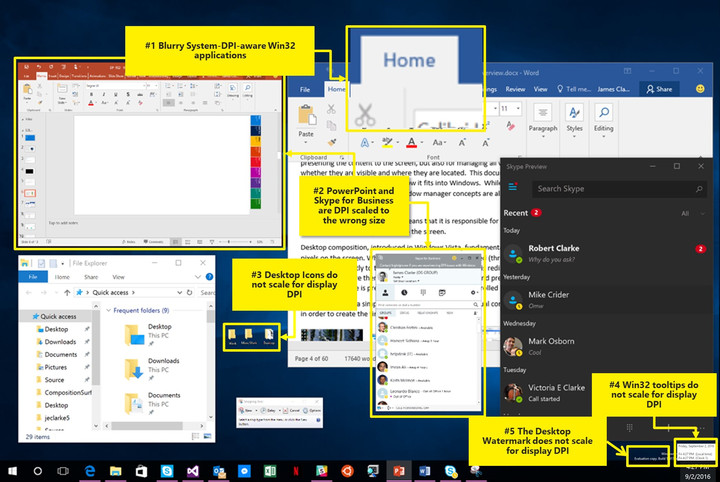
Creators Update should help with that, with improvements for two constituencies, developers and end users. For developers, Microsoft is implementing a number of changes, from continued improvement to how Windows 10 handles multiple monitors with different DPI and how it automatically scales DPI for dialogs.
End users should benefit from Microsoft’s work in Creators Update as well. First, they will be able to override default DPI scaling and select how scaling should be performed. Second, Microsoft is building in new enhanced system DPI scaling that should help with those applications that will likely never be updated to work with high-DPI displays. Finally, desktop icons are getting some work to make sure they scale correctly.
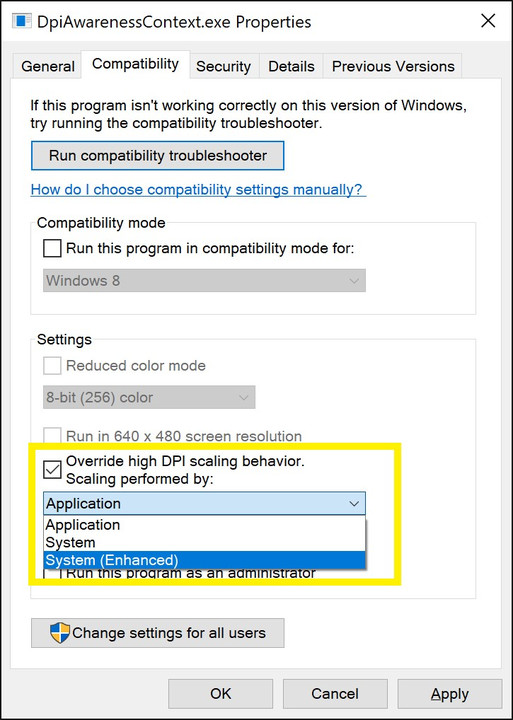
There is a host of new and highly technical details that are at the heart of how Microsoft is working to improve how Windows 10 handles high-DPI displays. There is also plenty of work remaining. If you are a developer or just technically inclined, then you will find some fascinating reading in Microsoft’s blog post. Otherwise, just rest easy knowing that your high-DPI machine will likely look better once you install Creators Update in a week or so.
 AIVAnet