


What’s on TV: ‘Rogue One,’ ‘Archer,’ Louis CK and ‘Chewing Gum’
While March Madness is finally coming to an end, it’s also time for some big spring premieres. Archer’s latest season, Dreamland is here, and it’s on FXX these days so check your cable lineup. Rogue One: A Star Wars Story makes its Blu-ray debut this week while the second season of Chewing Gum arrives on Netflix here in the US. Louis CK doubles up this week by appearing on Saturday Night Live and bringing a brand new comedy special to Netflix, while the biggest game releases are Persona 5 and PaRappa the Rapper Remastered. Oh, and Prison Break is back. Look after the break to check out each day’s highlights, including trailers and let us know what you think (or what we missed).
Blu-ray & Games & Streaming
- Office Christmas Party
- Rogue One: A Star Wars Story (3D)
- Ride the High Country
- Little Nikita
- Punchline
- Paterson
- Psycho Circus
- Blackwood Crossing (PS4, Xbox One PC)
- Persona 5 (PS4, PS3)
- Lego City: Undercover (Xbox One, PS4)
- Drawn to Death (PS4)
- PaRappa the Rapper Remastered (PS4)
- Talent Not Included (Xbox One)
- Dead Rising 4: Frank Rising DLC (Xbox One)
- Enter the Gungeon (Xbox One, PC)
- Bulletstorm: Full Clip Edition (Xbox One, PS4)
- Use Your Words (PS4, Xbox One)
- Virry VR (PS VR)
- Mortal Blitz (PS VR)
Monday
- NCAA Men’s Basketball Championship Game: Gonzaga vs. UNC, CBS, 9PM
- Abortion: Stories Women Tell, HBO, 8PM
- The Voice, NBC, 8PM
- 24: Legacy, Fox, 8PM
- Dancing With The Stars, ABC, 8PM
- WWE Raw, USA, 8PM
- Young & Hungry, Freeform, 8PM
- Baby Daddy, Freeform, 8:30PM
- APB, Fox, 9PM
- The Twins, Freeform, 9PM
- Rock and a Hard Place, HBO, 10PM
- Scorpion, CBS, 10PM
- The Breaks, VH1, 10PM
- Bates Motel, A&E, 10PM
- Taken, NBC, 10PM
- Quantico, ABC, 10PM
- Desus & Mero, Viceland, 11PM
Tuesday
- The Mindy Project, Hulu, 3AM
- Louis C.K., Netflix, 3AM
- Dimension 404 (series premiere), Hulu, 3AM
- Chewing Gum (S2), Netflix, 3AM
- Tumble Leaf Spring Special, Amazon Prime, 3AM
- The Voice, NBC, 8PM
- The Flash, CW, 8PM
- The Manns (series premiere), TV One, 8PM
- New Girl, Fox, 8PM
- WWE Smackdown, USA, 8PM
- The Fosters, Freeform, 8PM
- The Mick, Fox, 8:30PM
- iZombie (season premiere), CW, 9PM
- Prison Break (season premiere), Fox, 9PM
- Fresh off the Boat, BC, 9PM
- The Challenge, MTV, 9PM
- Switched at Birth, Freeform, 9PM
- Face Off, Syfy, 9PM
- Outsiders, WGN, 9PM
- Trial & Error, NBC, 9 & 9:30PM
- Imaginary Mary, ABC, 9:30PM
- The Americans, FX, 10PM
- The Partner, CNBC, 10PM
- Rebel, BET, 10PM
- The Detour, TBS, 10PM
- Cosplay Melee, Syfy, 10PM
- Stranded with a Million Dollars, MTV, 10PM
- Tosh.0, Comedy Central, 10PM
- Imposters, Bravo, 10PM
- Detroiters, Comedy Central, 10:30PM
- Desus & Mero, Viceland, 11PM
Wednesday
- The Path, Hulu, 3AM
- Harlots, Hulu, 3AM
- Shots Fired, Fox, 8PM
- Blindspot, NBC, 8PM
- Catfish, MTV, 8PM
- The Goldbergs, ABC, 8PM
- Arrow, CW, 8PM
- Survivor, CBS, 8PM
- Imaginary Mary, ABC, 8:30PM
- Are You the One: All Star Challenge, MTV, 9PM
- Empire, Fox, 9PM
- Criminal Minds, CBS, 9PM
- Law & Order, NBC, 9PM
- The 100, CW, 9PM
- The Magicians, Syfy, 9PM
- Major Crimes, TNT, 9PM
- Archer (season premiere), FXX, 10PM
- The Comedy Jam, Comedy Central, 10PM
- Designated Survivor, ABC, 10PM
- Chicago Justice, NBC, 10PM
- Criminal Minds: Beyond Borders, CBS, 10PM
- The Expanse, Syfy, 10PM
- Nobodies, TV Land, 10PM
- The Quad, BET, 10PM
- Suits, USA, 10PM
- Time: The Kalief Browder Story (season finale), Spike TV, 10PM
- Ripper Street, BBC America, 11PM
- Desus & Mero, Viceland, 11PM
Thursday
- Grey’s Anatomy, ABC, 8PM
- The Big Bang Theory, CBS, 8PM
- Supernatural, CW, 8PM
- Superstore, NBC, 8PM
- Powerless, NBC, 8:30PM
- The Great Indoors, CBS, 8:30PM
- Riverdale, CW, 9PM
- Mom, CBS, 9PM
- Chicago Med, NBC, 9PM
- Kicking & Screaming, Fox, 9PM
- Scandal, ABC, 9PM
- Life in Pieces, CBS, 9:30PM
- The Amazing Race, CBS, 10PM
- The Catch, ABC, 10PM
- The Blacklist: Redemption, NBC, 10PM
- Colony (season finale), USA, 10PM
- Dark Net (season premiere), Showtime, 10PM
- Desus & Mero, Viceland, 11PM
Friday
- American Playboy: The Hugh Hefner Story (S1), Netflix, 3AM
- The Get Down (E7 – 13 season finale), Netflix, 3AM
- El Faro de Las Orchas, Netflix, 3AM
- Win It All, Netflix, 3AM
- Dawn of the Croods (S3), 3AM
- Tangled: The Series, Disney, 7:30PM
- The Originals, CW, 8PM
- First Dates (series premiere), NBC, 8PM
- Beach Boys: Making Pet Sounds, Showtime, 8PM
- Toy Box (series premiere), ABC, 8PM
- You the Jury (series premiere), Fox, 9PM
- Disgraced, Showtime, 9PM
- Tattoo Age, Viceland, 9PM
- Vice, HBO, 11PM
- Animals., HBO, 11:30PM
Saturday
- Clippers/Spurs, ABC, 8:30PM
- Ransom, CBS, 8PM
- Training Day, CBS, 9PM
- The Son (series premiere), AMC, 9PM
- Saturday Night Live: Louis CK / The Chainsmokers, 11:30PM
Sunday
- The Good Fight, CBS All Access, 3AM
- The Circus: Inside the Greatest Political Show on Earth, Showtime, 8PM
- Top Gear, BBC America, 8PM
- Once Upon a Time, ABC, 8PM
- NCIS: LA, CBS, 8PM
- Sunday Night Baseball: Marlins/Yankees, ESPN, 8PM
- Making History, Fox, 8:30PM
- Home Fires, PBS, 9PM
- Family Guy, Fox, 9PM
- Time After Time, ABC 9PM
- Madam Secretary, CBS, 9PM
- Homeland (season finale), Showtime, 9PM
- The Last Man on Earth, Fox, 9:30PM
- Into the Badlands, AMC, 10PM
- American Crime, ABC, 10PM
- Feud: Bette and Joan , FX, 10PM
- Shades of Blue, NBC, 10PM
- Billions, Showtime, 10PM
- Trapped, Viceland, 10PM
- Girls, HBO, 10PM
- Crashing (season finale), HBO, 10:30PM
- Talking with Chris Hardwick, AMC, 11PM
- Last Week Tonight with John Oliver, HBO, 11PM
President Trump Signs Repeal of U.S. Broadband Privacy Rules
United States President Donald Trump today signed into law a bill that reverses Obama-era broadband privacy rules preventing Internet Service Providers from selling a subscriber’s web browsing history and other personal information without permission.
The now-reversed law would have limited what ISPs like Comcast, Verizon, and AT&T could do with sensitive customer data like location, browsing history, and other personal information like Social Security numbers. Under the law, which would have been enacted at the end of 2017, ISPs were also required to strengthen protections against hackers and security breaches.
Going forward, Internet Service Providers will not need to get permission from customers to sell customer data like web browsing history, but following customer outcry and confusion over the repeal of the law, many ISPs have said customer data won’t be sold.
Image via The Verge
Comcast, for example, says it has “no plans” to sell individual web browsing history, while Verizon says it “does not sell the personal web browsing history” of its customers.
Internet providers argued that the rules were confusing to customers and discriminatory and unfair because they didn’t apply to tech companies like Apple, Google, and Facebook.
Privacy advocates like the American Civil Liberties Union and the Electronic Frontier Foundation opposed the rollback of the law and have argued that privacy protections are desperately needed to keep consumers safe.
For end users, the repeal of the law effectively maintains the status quo because it was not enacted before being shuttered, but it’s worth noting that the resolution contains language preventing the FCC from enabling similar privacy rules in the future.
The repeal is the first step the Trump administration plans to take towards deregulating broadband internet service providers. According to White House Press Secretary Sean Spicer, President Trump has “pledged to reverse” net neutrality rules passed in 2015.
Note: Due to the political nature of the discussion regarding this topic, the discussion thread is located in our Politics, Religion, Social Issues forum. All forum members and site visitors are welcome to read and follow the thread, but posting is limited to forum members with at least 100 posts.
Tag: privacy
Discuss this article in our forums
This $250,000 flight suit will turn you into a real life Iron Man
Why it matters to you
Who hasn’t dreamed of taking to the skies like a real life superhero? The Daedalus flight suit lets you do just that… for the price of a small condo.
If you’ve ever dreamed of becoming a real-life Iron Man, and have enough Tony Stark-style cheddar that you can afford to drop $250,000 on an expensive toy, then 2017 may be the year for you!
That’s because the U.K.-based startup Gravity, which launched at the end of last week, is set to offer intrepid customers the chance to buy their own flight suit; giving wealthy owners the opportunity to joyfully soar over us lowly peasants as we trudge to work the boring, old-fashioned way.
More: The 2017 MIT admissions video features a high-tech Marvel superhero cameo
“It is a system that employs six micro-gas turbines to augment the human form, such that the pilot can then achieve vertical takeoff and full flight maneuverability,” inventor and co-founder Richard Browning told Digital Trends. “It’s augmenting the human mind and body with elegant engineering in the form of the six micro-gas turbines, and therefore is the rawest form of human flight achieved so far.”
In addition to micro-gas turbines, the suit features plenty of other Iron Man-esque touches, such as a heads-up display capable of relaying fuel levels using a WiFi connection. Apparently the suit can travel at multiple hundreds of miles per hour, although so far its creators haven’t been able to get hold of a big enough test flight area to truly put it through its paces.
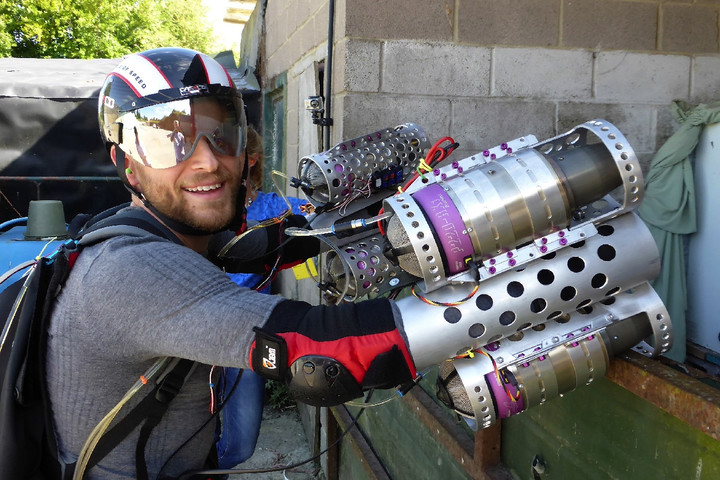
Given its hefty price tag, the Daedalus flight suit is unlikely to become a mass-market product any time soon, and Browning noted that it will appeal mainly to “high net worth individuals with the means to afford what’s likely to be a six-figure personalized suit.” There are other possibilities, however, such as using it at private demonstrations, educational events, or keynotes.
Put away your wallet, though, because the company’s not quite ready to start shipping.
“Our beta suit the Daedalus could go into mass production next week; however we are spending the next 3-6 months extensively improving and updating everything,” Browning said. “We see Q4 2017 as the point where we have a world class market leading technology, which has endless applications in commercial, military and entertainment market. It’s not just the suit in its current form that we will commercialize, but the technology behind it: brands who want to be part of the hundreds of millions of people who will want to see it in action and experience its development.”
Sony is developing a 150-megapixel sensor with some serious detail
Why it matters to you
Sony’s 150-megapixel backlit sensor likely won’t be in anything at a consumer price point, but the tech could power some serious medium-format cameras.
Sony’s backlit sensors could surpass three-digit megapixels as soon as 2018. A report recently released by the company’s imaging sensor division, Sony Semiconductor Solutions Corporation, includes a roadmap that has the company releasing 150-megapixel backlit sensors in 2018.
The report, part of an exhibit at the CeBIT 2017 conference in Germany in March, says the 100 million pixels will capture the detail on microscopic structures as well as allowing for a much bigger crop and zoom capabilities while maintaining detail. Those zoom capabilities are likely to make the sensor an option for aerial inspection drones and surveillance.
More: This 2-millimeter sensor could bring cameras to the smallest smartwatches
The sensor roadmap already includes a frontlit 100-megapixel sensor called the IMX211 already inside the Phase One XF. A monochrome version of that same sensor is due out this year.
Next year, that sensor will get an upgrade with backlighting, according to the company’s projected roadmap, with the IMX461. A backlit sensor moves the circuitry to the back of the sensor, resulting in better low-light performance. A150-megapixell sensor with a backlight design is also slated for launch in 2018 — the IMX411, which will come in both color and monochrome versions.
The report doesn’t hint at what cameras the sensor may be coming too but suggests the ultra high resolution could be used for aerial photography, surveillance, cultural heritage, and inspection. Sony also produces imaging sensors for other companies, including Nikon and Phase One. With the earliest version in the Phase One XP, it wouldn’t be much of a stretch to expect an updated medium format camera in addition to the drone photography and surveillance applications the report suggests.
The report also indicates that Sony is currently developing high-sensitivity sensors for nighttime use in security, as well as concentrating efforts on image sensors with a high framerate to increase the response time for applications such as industrial robots and self-driving cars.
Need a good home router? The TP-Link Archer C1200 is now on sale for $60
The TP-Link Archer series is one of the most popular lineups of modern 802.11ac Wi-Fi routers on the market. Some of the Archer models offer highly advanced features aimed at power users and come with big price tags to match, but most of us just need a solid, simple router that delivers good coverage and performance for our home or office networks. If this describes you, then consider the highly rated TP-Link Archer C1200 Wi-Fi router which is now on sale for just $60 from Amazon.
The TP-Link Archer C1200 utilizes dual-band AC1200 Wi-Fi for wireless throughput of up to 1,200Mbps. Dual bands increase your speed and network stability by providing two channels for data: A 2.4GHz band handles simple tasks like web browsing while the 5GHz band tackles heavier loads like HD streaming and online gaming. Dual-band Wi-Fi also helps to mitigate network congestion and prevent signal drops when multiple users are connected to the router.
More: The Emerson Sensi Wi-Fi Thermostat is now 18 percent off
 Three adjustable antennas expand the router’s range for blanket coverage of your home or office. Four high-speed Gigabit Ethernet ports located on the back of the router provide access points for wired connections to computers, smart TVs, and gaming consoles, while a USB 2.0 port lets you hook up peripherals such as printers and share files across your network from a connected device.
The companion Tether App, available for iOS and Android, makes it simple to set up and manage the C1200 from the convenience of your smartphone or tablet. The easy-to-use app also allows you to create a separate guest network for visitors and establish parental controls. The router supports modern WPA/WPA2 encryption standards as well.
A limited-time $35 discount brings the TP-Link Archer C1200 down to $60 on Amazon. If you need a quality router for basic home Wi-Fi needs, the C1200 is a solid and affordable choice.
$60 on Amazon
Which virtual assistant would you hire? Cortana vs. Siri vs. Google Now
Nearly every smartphone and computer on the market today has a smart assistant trapped inside, like a helpful ghost, but how do they stack up against one another? While it may seem like Siri, Cortana, and the nameless Google Now assistant are all just variations of the same thing — and well, they are to some extent — they each have their own quirks, flaws, and strengths. So which one’s best for you? Well, that’s not an easy question to answer, as they’re so similar it’s hard to compare them without digging deep into their capabilities. That said, let’s get started.
Cortana
On Windows Phone, you can use Cortana to make calls, send messages, set reminders, take notes, recognize music, find great restaurants, check your calendar, and more. The Windows 10 version of Cortana adds a few more features, like the ability to search files by context — i.e., “Hey Cortana, show me presentations I’ve worked on in the past week.” The Windows 10 Creators Update adds even more functionality, including the ability to lock, restart, or shut down your computer. All of this is done using natural language.

While you can store specific bits of information with Cortana, Microsoft’s virtual assistant is constantly analyzing your interactions to learn more about you. This info is stored in something Microsoft calls the “Notebook,” which includes the places you like to go, people you care about, your preferred quiet hours, and things you might be interested in, among other things. You can even edit it if you like.
Cortana can also read your emails, track your location, watch your browsing history, check your contact list, keep an eye on your calendar, and put all this data together to suggest useful info, if you allow it to. Cortana is designed to recognize context, so it should be able to understand follow-up requests, and you can phrase things in different ways and still expect a useful answer. You can also type your questions or requests, if you prefer to not speak out loud.
More: How to use and customize Cortana in Windows 10
Cortana is not limited Microsoft’s apps, either, as the it can access third-party content as well. For example, asking how many calories are in a banana would not only return the answer, but the option to add that food to your calorie tracker (if it supports Cortana). The assistant can also add something to your Hulu queue, or check out a friend’s Facebook feed. More and more third-party connectivity is being added all the time, and with the Creators Update, it’s easier than ever for third-party developers to include Cortana functionality. The latter update will open Cortana up to developers in a few important ways by allowing developers to add their own Cortana commands, which are tied directly to their respective applications.
Which virtual assistant would you hire? Cortana vs. Siri vs. Google Now
Nearly every smartphone and computer on the market today has a smart assistant trapped inside, like a helpful ghost, but how do they stack up against one another? While it may seem like Siri, Cortana, and the nameless Google Now assistant are all just variations of the same thing — and well, they are to some extent — they each have their own quirks, flaws, and strengths. So which one’s best for you? Well, that’s not an easy question to answer, as they’re so similar it’s hard to compare them without digging deep into their capabilities. That said, let’s get started.
Cortana
On Windows Phone, you can use Cortana to make calls, send messages, set reminders, take notes, recognize music, find great restaurants, check your calendar, and more. The Windows 10 version of Cortana adds a few more features, like the ability to search files by context — i.e., “Hey Cortana, show me presentations I’ve worked on in the past week.” The Windows 10 Creators Update adds even more functionality, including the ability to lock, restart, or shut down your computer. All of this is done using natural language.

While you can store specific bits of information with Cortana, Microsoft’s virtual assistant is constantly analyzing your interactions to learn more about you. This info is stored in something Microsoft calls the “Notebook,” which includes the places you like to go, people you care about, your preferred quiet hours, and things you might be interested in, among other things. You can even edit it if you like.
Cortana can also read your emails, track your location, watch your browsing history, check your contact list, keep an eye on your calendar, and put all this data together to suggest useful info, if you allow it to. Cortana is designed to recognize context, so it should be able to understand follow-up requests, and you can phrase things in different ways and still expect a useful answer. You can also type your questions or requests, if you prefer to not speak out loud.
More: How to use and customize Cortana in Windows 10
Cortana is not limited Microsoft’s apps, either, as the it can access third-party content as well. For example, asking how many calories are in a banana would not only return the answer, but the option to add that food to your calorie tracker (if it supports Cortana). The assistant can also add something to your Hulu queue, or check out a friend’s Facebook feed. More and more third-party connectivity is being added all the time, and with the Creators Update, it’s easier than ever for third-party developers to include Cortana functionality. The latter update will open Cortana up to developers in a few important ways by allowing developers to add their own Cortana commands, which are tied directly to their respective applications.
TPCast wireless adapter for HTC Vive scheduled to ship by end of April
Why it matters to you
If you ordered your TPCast wireless adapter for the HTC Vive headset from China, then you can expect it to ship this month.
HTC’s Vive virtual reality system has some of the best room-scale sensors around, letting VR users roam throughout a space and experience a more immersive experience. But that experience is hampered by the need to keep everything connected with cumbersome wiring.
That is about to change, as HTC announced a partnership with TPCast to create a wireless adapter that cuts the cord and lets users move around without tripping over wires. Now, it appears that TPCast is set to release its solution by the end of April after a bit of a delay, Road to VR reports.
More: The first wireless kit for HTC’s Vive gives new meaning to ‘hot pocket’
The story is a bit convoluted, as apparently the product was first up for pre-order in November via the online Vive store in China and expected to ship in the first quarter of 2017. It’s those pre-orders that are expected to ship by the end of April. The rest of the world was going to receive units sometime in the second quarter of 2017 and so it’s possible that those shipments might also be arriving a bit late.
In our first take on the TPCase wireless adapter, which connects to the Vive headset and removes the need to keep that component tethered to your PC, we found the solution promising but problematic in a few ways.
The adapter works as expected, allowing users to move freely within the Vive room-scale sensors without encumbrance. TPCast promises less than two milliseconds on latency and, by our testing, was able to keep up.
At the same time, we also found the wireless connection to be sensitive to movement and jostling of the adapter. While the connection was reestablished quickly, the disconnect detracted from the overall experience. TPCast indicated that final versions of the product would be less prone to the issue.
In addition, wireless adapters naturally require their own power. In our experience, the battery pack got rather warm. While it lasted up to five hours, it made for an uncomfortable experience that we hope will be also resolved with the final shipping product.
Now that the TPCast wireless adapter has a firmer shipping date, at least for Chinese pre-orders, we will be looking forward to moving around more freely within the HTC Vive’s VR landscape. If you have been waiting for your own TPCast, though it might yet be delayed, at least there is a light at the end of the virtual tunnel.
From the sky to your door, Amazon’s drones are coming – here’s what you should know
Amazon has done a lot recently to speed up its shipping services. It has algorithms that anticipate your orders, ultra-efficient robots that pick items from warehouses, and even a service (Prime Now) that delivers certain items to your doorstep just hours after you order them.
The only problem? Right now, this super-fast shipping service depends on delivery trucks, and only works if you live fairly close to one of Amazon’s warehouses. This puts limits on not only the number of people who can use the service, but also the selection of items available to prospective buyers.
More: The best drone you can buy
That’s where Amazon’s efforts to introduce drone delivery come in. The company first announced its project — appropriately dubbed Prime Air — in late-2013, to much skepticism. Since then, the project has overcome numerous hurdles, and while it’s not quite ready for primetime quite yet, every month it inches closer toward launch.
To help you keep track of the project’s development, we’ve put together this comprehensive timeline. It starts with Prime Air’s history and goes through every major development up to the present. Be sure to circle back from time to time, as this article is updated regularly to include the latest news and information. Enjoy!
A dose of reality
Getting Amazon drones off the ground (both literally and figuratively) will take a lot of work, in addition to persuading the FAA to agree to let drones in the air in the first place. One big hurdle is the issue of getting the packages to you. Although Amazon has established a commendable network of fulfillment centers throughout the country, there are only locations in 24 states, most of which are coastal.

To remedy this — and this is pretty out there — Amazon recently patented what it calls an “airborne fulfillment center.” This basically amounts to a warehouse that doubles as a drone airport, one that would hang suspended from a blimp. Another issue Amazon has to deal with is where to put these drones when they’re not in use. For this one, the company has suggested using street lights, cell towers, and other high-lofted objects as potential “docking stations.” And how about getting the package to you? Does the drone land on your front porch? Maybe not — it might deliver the package via parachute.
But in every case, these ideas are not yet realistic and show that it’s likely that it will be many more years before Prime Air takes off (no pun intended). As for a timeline, it looks like we will have to wait until as late as 2020, if not later, for large-scale availability.
Having trouble sideloading Android 7.1.2 on your Nexus or Pixel? You’re not alone
Sideload is broken with the latest version of ADB. Here’s what you need to do.
For the few keeners, like me, who are interested in quickly getting an update to Android 7.1.2, you may have run into a hitch while using ADB, the tool provided by Google for the purpose, to flash your phone.

Google reportedly broke the ADB sideload functionality for large files like the ones included with the new Pixel and Nexus in its latest platform tools that were distributed on March 16. Specifically, version rev.25.0.4 has been repurposed to save memory, but in doing so cannot deal with the size of the extracted OTA image files.
The fix is simple: if you’re using ADB, you should download the previous version, rev.25.0.3 released in December, which should fix the problem.
Download ADB rev.25.0.3 from Google
Android Nougat
- Android 7.0 Nougat: Everything you need to know
- Will my phone get Android Nougat?
- Google Pixel + Pixel XL review
- All Android Nougat news
- How to manually update your Nexus or Pixel
- Join the Discussion

