


Size matters not: KDE Slimbooks measure 0.70 inches with sixth-gen Intel CPUs
Why it matters to you
A new slim notebook based on the popular open-source Linux-based KDE community software that should interest customers looking for an alternative to Windows.
The international free software community KDE announced the launch of a KDE-branded laptop on Thursday called the KDE Slimbook. Built for KDE fans across the globe, the new Slimbook promises a highly stable computing experience given that KDE developers are using an identical hardware and software configuration when testing their apps. That means apps and hardware issues are resolved before a new version of KDE’s software is distributed to end users.
The new Slimbook is based on the KDE Neon platform and the Plasma Desktop interface. Neon is a software repository based on Ubuntu LTS (which is based on Linux) that provides rapid updates of Qt and KDE software while the rest of the Ubuntu-based components installed on the notebook are updated at a normal pace. KDE Plasma is the visual desktop environment built to enhance the Linux computing experience.
More: Lenovo issues a new Yoga 2-in-1 BIOS enabling Linux following conspiracy accusations
“Spanish laptop retailer Slimbook approached KDE with the idea to offer KDE-branded laptops that come pre-installed with Plasma and KDE Applications,” said KDE’s Thomas Pfeiffer in an update. “We were excited about the idea, and put our designers and developers to the task of creating a branding for such a device and making sure that KDE neon runs without any hardware-related issues on it.”
There are two versions of the KDE Slimbook: one with an Intel Core i5-6200U processor and one with an Intel Core i7-6500U, both of which are sixth-generation Skylake chips. Here is a brief rundown of each:
Core i5-6200U
Core i7-6500U
Release date:
Q3 of 2015
Q3 of 2015
Cores:
2
2
Threads:
4
4
Base speed:
2.30GHz
2.50GHz
Boost speed:
2.80GHz
3.10GHz
Cache:
3MB
4MB
Maximum power draw:
15 watts
15 watts
Graphics:
Intel HD Graphics 520
Intel HD Graphics 520
Graphics speed (base):
300MHz
300MHz
Graphics speed (max):
1,000MHz
1,050MHz
Outside the two processor differences, the KDE Slimbooks are identical in their hardware specifications and options. Here they are:
Screen size:
13.3 inches
Resolution:
1,920 x 1,080
System memory:
4GB DDR3 @ 1,600MHz
8GB DDR3 @ 1,600MHz
16GB DDR3 @ 1,600MHz
Storage (Samsung or Crucial):
120GB mSATA SSD
250GB mSATA SSD
500GB mSATA SSD
Connectivity:
Wireless N
Wireless AC
Bluetooth 4.0
Ports:
2x USB 3.0
1x Ethernet
1x Mini HDMI1x SD card reader
Keyboard:
LED-backlit
Webcam:
Yes
Battery:
6,800mAh
Size:
13 x 8.66 x 0.70 inches
Weight:
3 pounds
Outer material:
Aluminum
Color:
Silver
According to the specs, the operating system is marked as KDE Neon “for now.” Pfeiffer said that the KDE community is open other to distributions that can be pre-installed with Plasma, offering customers a choice of multiple operating systems. He also pointed out that the KDE Slimbook was created for those who love KDE software, and was not built primarily for those who are active contributors in the KDE community.
“We were not content with the quality of laptops available on the market,” explains KDE. “The majority shipped with proprietary and locked-in software solutions, filled with not-uninstallable bloat where the user was left at the mercy of whatever the company selling them a laptop saw fit for them to work with. As creators and makers we knew what it meant to be locked into a set of solutions defined by others.”
To purchase the KDE Slimbook, head here. The Intel Core i5 version has a starting price of $779 and the Core i7 model has a starting price of $908. Customers can only configure the amount of system memory, the amount of storage, the wireless connectivity component, and the keyboard layout.
LG’s next big phone will debut in Barcelona on February 26
Why it matters to you
Success is vital for LG’s next flagship phone — G6 — after the G5’s modular gamble didn’t pay off.
LG bet it all on mods with the G5, but its “Friends” ecosystem hasn’t been a winner, and the company has not released additional modules to help build the range and entice usage. Rumors that the modular system will be dropped are already spreading. As a result, LG will really have to blow the competition out of the water with its next flagship phone, which we expect will be called the G6.
Here’s everything we think we know about the LG G6.
Water resistance over modules and a removable battery?
LG’s Friends range of modules for the G5 didn’t catch on, despite being an unusual feature with plenty of potential. This lack of success may mean LG will drop the feature for the G6, and may add water resistance in its place. The latest rumors about the phone come from a CNET report, which cites a person familiar with the phone. According to the report, the LG G6 will indeed drop the removable battery in favor of water resistance — a controversial move, to be sure.
Not only that, but companies that supply waterproof adhesives are apparently bidding for the job of keeping the wet stuff out of the G6, according to ET News. Additionally, LG’s new teaser video which may refer to the G6 talks about water resistance as an often requested feature.
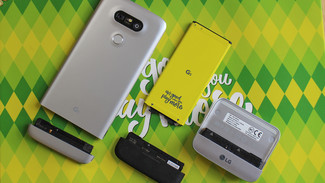 Sealing up the phone means not having removable sections for new modules or a replacement battery, another aspect that made the G5 standout from the competition. Previously, ET News reported that LG is not building modular components for the G6, and did not add them to the LG V20. The Japanese version of the V20, named the Isai Beat locally, included water resistance, but not the removable battery — two features that can’t work together.
In December, a tweet from David Ruddock of Android Police notes the G6 will not, in fact, have a removable battery. It will, however, feature an all-glass design, and will keep its headphone jack (unlike the iPhone and rumored Samsung S8).
Source: LG G6 will not have a removable battery, LG will move to an all-glass design language similar to Samsung. Headphone jack is a go.
— David Ruddock (@RDR0b11) December 7, 2016
It may not be the end for LG Friends, and LG has said it is not abandoning the modular ecosystem, according to CNET. Perhaps LG will return with a stronger range for the G7, or a spinoff range only for modules. It’s speculation for now, but should LG drop modules for the next major releases, it will be a blow to LG consumers that own the G5 as it would mean they spent money on supplementary products that aren’t reusable with future devices.
Design and display
The LG G6’s aesthetics are no longer a mystery. LG Display, the division in charge of mass-producing smartphone panels, TVs, and screens of every shape in-between, provided an image of the upcoming smartphone’s topmost bezel and sides to The Verge.
LG has confirmed that the G6 will have a 5.7-inch Quad HD+ display with a resolution of 2,880 x 1,440 pixels, but what’s unique is the 18:9 aspect ratio — meaning the device is likely more elongated than typical devices with that aspect ratio. And the company says the screen is impressively less than 1mm thick.
More: LG V20 review
One of 2017’s smartphone trends will be the gradual elimination of the bezel, and LG says it has reduced the bezel on the top of the G6 by 20 percent, as well as 10 percent on the sides. The overall screen-to-bezel ratio is said to be greater than 90 percent, with the bottom bezel measuring slightly taller than the top. The display, which is likely OLED, will be 10 percent more visible in daylight and will use up 30 percent less battery life.
A purported render of the G6, courtesy of @OnLeaks, shows a 360-degree video of what the phone will end up looking like. The render falls in line with other leaks we’ve seen, and has a similar design to the G5, although slightly more refined. It also appears as though LG will do away with modularity in the G6, and it looks like the 3.5mm headphone jack will stick around in LG’s flagship, at least for now. The leaks also show what appear to be glossy finishes, following the new design trend set by Apple with the jet black version of the iPhone 7.
Android Authority has also managed to get its hands on what appears to be very early renders, showing that the phone will have an almost identical design to its predecessor, the LG G5. For example, it will have the same dual-camera module placement, the same center-mounted fingerprint sensor, and the same button placement, on the right of the device. There will be a few differences, however — the G6 is expected to slim down a little to 72.43mm, which is slightly thinner than the G5’s 73.9mm, although barely enough to notice a difference.
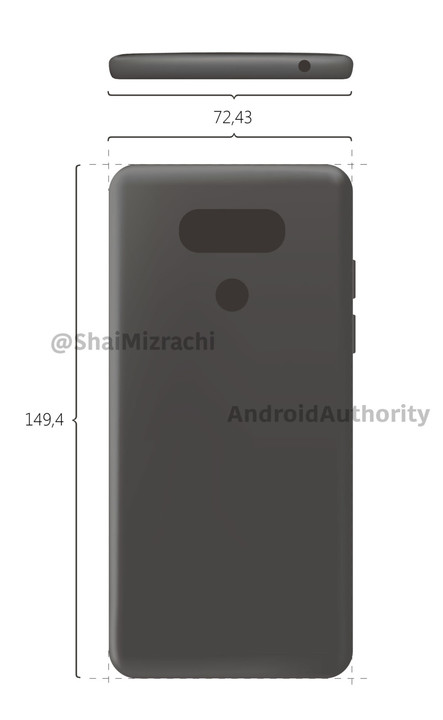
Android Authority has updated its post to say that the renders are an extremely early design, so it’s possible (and even likely) that the final design will change before the release of the G6.
An older processor
The LG G6 might not feature a top-of-the-line processor. According to Forbes, Samsung’s getting first dibs on the Qualcomm’s new Snapdragon 835, leaving competitors like LG with older chips. The G6 is said to feature the Snapdragon 821, the same processor as HTC’s U Ultra.
“The Snapdragon 835 won’t be available in large quantities until after the Galaxy S8 launches,” the Forbes source said.
It isn’t the first time LG’s opted to use an older processor in a flagship phone. Two years ago, it sourced the Snapdragon 808 instead of the 810 because of availability concerns. LG executives told Forbes that the company preferred, “proven [chip] that they can test thoroughly than the latest [and] fastest” — a factor that likely played a part in the decision.
Digital assistant(s)
Previous reports indicated that the LG G6 would include both Amazon Alexa and Google Assistant, however recent rumors suggest that instead the phone will only offer Google Assistant. The new report comes from CNET, which says that LG was planning on including Alexa in the phone, but shelved the plan because it didn’t feel ready to include the assistant just yet — and that we should expect the assistant to appear in LG phones later this year.
So far, the Google Pixel and Pixel XL are the only phones with Google Assistant, Google’s new digital assistant. According to a report from Business Korea, however, the LG G6 could have it too — making the G6 the first non-Google-branded phone to get the new assistant.
If LG did decide to include Alexa, it would be only the second smartphone, behind the Huawei Mate 9, to feature the assistant. LG has integrated Alexa into some of its other products, such as the InstaView refrigerator, so a continued partnership would make sense.
Release date
Looking forward to a new smartphone from LG? Good, because prepare to get excited. The company will hold a special event on February 26 in Barcelona, Spain, where it’s likely to show the G6 smartphone. The gathering takes place the day before Mobile World Congress opens its doors in the city. The invitation includes the tagline, “See more, play more,” which continues on from the “play more” theme introduced with the G5, and may play on the possible larger, higher resolution screen feature on the new phone.
It’s also spreading the word through LG social media accounts. On Twitter, LG posted a shorter version of the teaser video released earlier in January, where it asks members of the public to describe their ideal phone. The dream device is apparently water resistant, has a big screen, can be used with one hand, and has a great camera. LG closes the video telling us to imagine our wishes came true, then flashed a “February, 2017” date up on the screen.
The tweet, posted on January 18, says “Everything you want is on its way,” which indicates the above wishlist of features will be part of the G6.
The LG G series has traditionally been released at Mobile World Congress, so it’s not a surprise the G6 will also arrive at the show. What could change, however, is the availability date after the device is launched. The G5 was first unveiled at MWC in February 2016, but it wasn’t until April that consumers could actually buy it. According to the South Korea-based ETNews the G6 could be made available a full month earlier than its predecessor.
Why the change in availability? Well, 2016 wasn’t exactly LG’s best year. The G5 largely failed to capture the imaginations of consumers, and while the LG V20 was a great device, it also didn’t sell like LG might have hoped. In the new year, LG wants to shake things up a little — which means beating out the competition by releasing flagships a little early.
Iris scanner
Following reports of an LG Pay mobile payments system, LG may introduce heightened security on the G6, in the form of an iris scanner. LG Innotek, a division of LG that produces components and other technology, has shown a traditional double-camera iris scanner, and a new single module with an iris scanner and a selfie camera inside, at a recent technology show.
This has prompted rumors LG may take one of the modules and integrate it into the G6, although LG Innotek has issued a statement saying no deal exists. The company supplies components to many manufacturers.
MST payments
If there’s one feature Samsung has a leg up on compared to Google, LG, Apple, and other smartphone competitors, it’s Samsung Pay. Where other mobile payment solutions use NFC, or near field communication, to offer a tap-and-pay experience, Samsung uses Magnetic Secure Transmission (MST). This means it replicates a card swipe — so it works wherever you can use your credit card.
That’s far better than looking for NFC terminals. LG is now rumored to be adding MST technology into the G6 to offer a similar payment service to rival Samsung, according to ET News. The company was supposed to launch LG Pay at the start of the year, but the plans were scrapped. We may see it for the first time on the G6.
More: LG G5 review
We’ll continue to update this post as we learn more information about the rumored device.
Article originally published on 10-28-2016. Updated on 01-26-2017 by Christian de Looper: Added confirmation from CNET that LG would do away with removable battery in favor of water resistance.
The Rosetta Disk will last 1,000 years, contains mankind’s most important books
Why it matters to you
Crafted to last 1,000 years as an artifact for a future civilization, the Rosetta Wearable Disk contains thousands of pages of information in hundreds of languages.
Imagine what a wearable device containing the world’s most important information would look like.
Now try and imagine, were you designing such a thing, how you would ensure that it would still be as easily readable 50 or 100 years from now. In a world of ever-changing tech standards, it’s difficult to do that kind of thing for a decade ahead — let alone five or 10 of them.
The Rosetta Project has long been attempting to answer this second question. A global collaboration of language specialists, the Rosetta Project aims to create a modern version of the historic Rosetta Stone, the 196 B.C. artifact which provided modern mankind with our understanding of Egyptian hieroglyphs.
Starting out in 1998, the Rosetta Project used cutting-edge nickel micro-etching technology to bring to life a handful of Rosetta Disks, offering 13,500 individual pages of data in 1,500 languages; readable only using a 500x microscope.
More: Point your camera at text to get it translated with Google’s live camera translation
Jump forward to the present day, and the team has released a new Rosetta Disk — and one that also answers the first question we posed. Called the Rosetta Wearable Disk, it’s a Rosetta Disk about 2 centimeters in diameter and which can be easily worn on the human body.
The Rosetta Wearable Disk was produced using a laser which writes straightly onto a photosensitive material coated on a glass plate. These features are then developed to form the microscopic pages before the plate is electroformed to create a thin disk. As with the first-gen Rosetta Disk, information can be read using extreme magnification. (You can check it out for yourself, complete with high-res zooming, here.)
“This is the first process that’s come along that’s made me realize that we can reliably produce these disks in larger batches,” Dr. Laura Welcher, director of the Rosetta Project, told Digital Trends. “The cost went down, the scale went up, but it’s still a custom process. We definitely pushed the boundaries of what can be done in terms of storing text, particularly multilingual text. The ultimate goal was to create something much more affordable than the originals, which were available to people who made donations of $25,000 each.”
Because the Rosetta Wearable Disk is physically smaller than the original Rosetta Disks, there are fewer languages and pages per language, but it’s still an astonishing feat.
“The big question was always what books would you want in order to restart civilization?” Welcher said.
There are 100 numbered copies of the Rosetta Wearable Disk in all and these are available — while supplies last — to anyone who donates $1,000 or more to The Long Now Foundation — with proceeds going toward aiding language documentation and archiving. A thousand bucks may not be affordable to everyone, but given that the disk will reportedly last a millennium that is only $1 per year.
As to what’s next for the project, it seems that Welcher has been inspired by her dive into (semi) mass-market, affordable wearables.
“In the future, I think there could be a version of the disk that’s producible in much larger numbers,” she said. “There are some really interesting things we could explore with a wearable technology. We could look at other kinds of information that could go on these disks. I’m also interested in the materials we could make these from — possibly making a very, very hard transparent surface that would protect it so that we don’t have to cover it in glass as we are at the moment.”
Watch what happens when NFL quarterbacks are ‘replaced’ with drones
Why it matters to you
Those looking to gear up for the NFL Pro Bowl may enjoy watching the new drone drop competition that will take place on January 26.
Sure, the best NFL receivers can snatch a ball out of the air and make it look easy, but can they catch one dropped from 200 feet — by a drone? That’s exactly what the newest event at the Pro Bowl Skills Showdown is aiming to find out.
Airing tonight, January 26, at 7 p.m. ET on ESPN, and live-streaming to the ESPN website, ten players from the AFC will compete against the best of the NFC in a set of five different challenges, from dodgeball to the new wide receiver drone drop. The Skills Showdown is returning after a ten-year hiatus as a sort of precursor for Saturday’s AFC-NFC Pro Bowl in Orlando.
More: Fox, GoPro to give fans a ref’s-eye view of the field for Big Ten Championship
Of course, with the last Showdown held in 2006, there’s bound to be some new additions — so why not throw the popular drone into the mix? The quadcopters will be flying up to about 200 feet in the air and dropping footballs down to the wide receivers playing in the Pro Bowl.
Those wide receivers are set to include the Steelers’ Antonio Brown and the Raiders’ Amari Cooper for the AFC, with AJ Green (Bengals) and TY Hilton (Colts) in the reserves. On the NFC side, the list of receivers includes the Julio Jones of the Falcons, and Odell Beckham of the Giants, with Mike Evans (Buccaneers) and Larry Fitzgerald (Cardinals) in the reserves.
The cool #ProBowlSkills event I alluded to is a WR Drone Drop. Video here via @nfl from our test https://t.co/KHfHqAJGGz
— Brian McCarthy (@NFLprguy) January 25, 2017
The NFL shared its test of the Drone Drop competition as a sort of preview — the quadcopters grip a ball at the front, releasing while hovering at a steady altitude. Several sports commentators are suggesting that the Showdown, with the drone drop and dodgeball, could be more entertaining to watch then the actual Pro Bowl.
Brian McCarthy, a public relations representative for the NFL, confirmed that the organization had received FAA approval for the event — since it’s actually now illegal for commercial drone operators to fly over people.
The Skills Showdown kicks off on January 26 at 7 p.m. ET on ESPN — and will also be live-streamed on WatchESPN.
Cricket customers now get more data for the same low price
Why it matters to you
Extra data means customers will get to stream media, play games and surf the web even more while on the go — without spending an extra cent.
AT&T’s prepaid subsidiary, Cricket Wireless, has long been a solid option for those looking for maximum coverage at a relatively low price, who don’t mind slower data speeds. Starting January 27, the company will raise high-speed data allowances across several of its plans, according to a news release.
Under the new terms, customers at the $40/month Basic tier and the $60/month Pro tier will see allotments rise to 3GB and 12GB, up from 2.5GB and 10GB respectively. Additionally, Cricket is locking in an existing promotion that raised the data limit from 5GB to 8GB for its $50/month Smart customers. Going forward, 8GB will be standard at that price level, making it the best data-per-dollar value proposition of all of Cricket’s plans.
More: AT&T has officially shut down its 2G network, will pursue 4G LTE, other tech
Customers can save if they enroll in auto pay with the carrier, which credits them $5 a month at the end of each billing cycle. Cricket is also offering discounts on select phones, including the LG Stylo 2, for new customers who bring their numbers with them. The full list of sales is available here.
As always, all this cheap data comes at a price — and for Cricket, that means capped data speeds. “High-speed data,” which the company defines as LTE and HSPA+, is limited to 8Mbps and 4Mbps, respectively. After you run through your allotment, you’re stuck at 128Kbps for the rest of the month, unless you up your plan.
While that’s not a massive inconvenience compared to the 12Mbps AT&T’s post-paid customers reportedly average, the policy has stayed unchanged for years, even as Cricket continues to routinely increase data allowances. In fact, Cricket has been throttling high-speed data at 8Mbps since 2013, when AT&T founded the company as Aio. That was before it merged the brand with Cricket in 2014 after acquiring Leap Wireless. Back then, LTE wasn’t capable of quite the same kind of speeds we’re seeing today, nor was it as widely available.
As AT&T maintains the 8Mbps cap for Cricket customers — in all likelihood to nudge them toward its more expensive flagship service — a core part of its user base is getting increasingly left behind in the dust. This divide will only be exacerbated once carriers begin rolling out 5G networks, as they are expected to next year. Hopefully, AT&T has an upgrade waiting in the wings for its prepaid contingent.
Pearl RearVision Backup Camera review

Research Center:
Pearl RearVision Backup Camera
In April 2014, the federal government’s National Highway Traffic Safety Administration (NHTSA) put into effect a new regulation that requires all automobile manufacturers to add backup cameras to vehicles by May 2018. But until the mandated deadline, backup cameras are still offered as an option or exclusive feature, with some manufacturers charging upward of a thousand dollars to add the functionality as part of a more luxury trim package.
There are plenty of third-party backup cameras on the market that are more affordable, but a vast majority of cameras use wires for power and connectivity; wires that often require the need to drill through various parts of your vehicle. And the few wireless cameras that are on the market tend to be subpar in image quality and resolution.
To provide a best-in-class after-market solution, Pearl developed a completely wireless backup camera called RearVision. Pearl’s approach hits on all of the weak points of current backup cameras: RearVision is entirely wireless, dead simple to install, uses your smartphone as a high-resolution display, offers collision alerts, and relies on both Bluetooth and Wi-Fi connectivity to transfer live images on the fly.
Note: The RearVision will only work in 1996-model-year cars or newer that have a 12V OBD-II port. You should check your vehicle before purchasing.
Installation and setup
Despite our love for DIY projects and tinkering, the idea of drilling holes through a vehicle is far from appealing. So, RearVision’s no-drill setup is enticing.
Pearl says the RearVision takes ten minutes to set up. We managed to do so in about five – two of which was spent finding a screwdriver to remove the license plate – so installation took no effort, even for novices. The camera is out-of-the-box ready, with helpful illustrated instructions.

Once you’ve removed the license plate (and any cover it might have had), the process is as simple as attaching a metal frame around the license plate and securing it back in place. The main RearVision unit, which contains two cameras (one for day, and another to help it see at night; more on this later) is then attached to the frame with a single security torx screw. That’s it. Unfortunately, you will have to say good-bye to the old cover that proudly proclaims your alma mater, or that your other car is a Porsche.
The next step is to pair the RearVision to your smartphone, which requires downloading Pearl’s RearVision app (Android and iOS) and plugging in the RearVision adapter into your vehicle’s OBD II port, which is usually located below the steering column. All of the video processing and transmission of data is done by the OBD II port. Inside the small device is an eight-core processor and wireless connectivity to act as a middleman for video transmission, when you shift your car into reverse.
The kit also includes a phone mount that attaches to your car’s dash or vent, and your phone via a magnet.
After a brief onboarding process within the app, the RearVision backup camera is good to go.
Experience
Our expectations for the RearVision were incredibly high. After all, you’re paying $500 for a device that you’ll use every time you put your vehicle into reverse. Even though the RearVision is more affordable and less invasive than other after-market options, it’s far from cheap.
But even with the bar set high, RearVision managed to reach it. With its 175-degree field of view and onscreen lines for guiding, backing out a 2012 Buick Verano went from being a former pain-in-the-neck to not only convenient, but enjoyable. The wide field of view made it easy to see anything and everything behind the vehicle.
With its 175-degree field of view, backing out went from painful to convenient and enjoyable.
If an object or person gets too close for comfort, the RearVision will beep through its OBD II adapter and display a little water drop effect over the video – on top of where the obstacle is located. The sound is loud enough to get your attention – even with the radio on – and the ripple effect is a subtle visual cue that helps distinguish the obstacle from surrounding areas.
When your phone is positioned horizontally, the RearVision app shows you the full, wide-angle feed across the entire screen. When positioned vertically, the app shows two images: the entire 175-degree overview of what RearVision sees, and another above it that lets you choose from three separate locations of said video feed to zoom into for a closer look.
For us, the standout feature is the RearVision’s video quality. During daylight, the video is absolutely astounding, especially when paired with a larger phone, such as an iPhone 7 Plus or Google Pixel XL. There is obvious distortion around the edges of the video, but that’s to be expected with such a wide-angle lens in front of its small 1/3-inch CMOS sensor. Besides that, the picture is clear as can be and capable of picking up even the smallest obstacles – like your kitten that somehow snuck outside.
The camera also performs well at night. One of the two cameras housed inside the framing has an infrared sensor. When using RearVision at night, the system automatically switches to this camera and uses the rear-facing lights of your vehicle to illuminate the path behind it.
Please enable Javascript to watch this video
The image quality for both day and night is impeccable, as long as the connection is strong. It’s important to note how the RearVision operates in terms of transmitting the live video footage. The default method of video transmission is Wi-Fi. When Wi-Fi isn’t working for some reason or another, the system reverts to Bluetooth.
In the two months we’ve been using the device, we can only recall three times when it switched to Bluetooth (a notification pops up letting you know it’s using Bluetooth over Wi-Fi). And during these moments, we did notice a substantial decrease in video quality, but it was still good enough to see what was behind the vehicle.
If you’re wondering how the cameras are powered without wiring, it’s possible thanks to an internal battery that’s continually charged, via integrated solar panels beneath the frame. Even on the cloudy days, the RearVision worked without problem and never showed any signs of a low battery.
More: Yada Backup Camera with Dash Monitor review
The only issue we encountered with the RearVision was visibility in less than ideal situations. For example, when it was raining, the light used to illuminate the vehicle’s license plate caused the beads of water on the lenses to light up extremely bright, making the video feed all but unusable. It’s worth noting though that this wasn’t so much RearVision’s fault, as it was more the shape of the Verano’s rear end. For some reason, the rear bumper is angled in such a way that the lenses on the RearVision unit were more exposed, both to rain and the license plate light. On most other vehicles the unit wouldn’t be nearly as exposed, which should prevent this from happening.
Pearl says the RearVision takes ten minutes to set up. We managed to do so in about five.
To promote safe driving, and to adhere to specific laws, Pearl limits RearVision to operating only when you’re driving 10 miles per hour or less. When you aren’t backing up, the RearVision app switches to its dashboard interface, which offers customizable shortcuts to your most-used apps on your phone. Our setup, for example, includes Apple Music, Apple Maps, and Waze. It’s a clever app design that simplifies the process when you plan on using other apps for your drive.
On Android, you can set up RearVision to automatically open when you get in the car. On iOS you’re limited to a push notification when you get in your vehicle, but a simple swipe takes you directly into the app.
If you’re new to backup cameras in general, there will be a bit of a learning curve. Trusting the camera over your mirrors takes a little getting used to, but once you get the hang of it, it becomes second nature.
Warranty information
Pearl offers a three-year warranty, as well as a 30-day money-back guarantee. If your RearVision becomes defective during regular use, Pearl will either repair or replace the unit. This warranty is transferrable in the event a RearVision unit is sold as part of a used car, but the warranty date is still based on the original purchase date.
Our Take
The RearVision, price wise, sits somewhere in the middle: It isn’t the most affordable backup camera out there, but it’s also not out of reach. It’s without a doubt the least invasive and most impressive option across the board.
Is there a better alternative?
Compared to what we’ve seen in the market – in both specs and usability – there’s nothing like it. If cost is the biggest factor in your purchase, you’ll be able to find a more affordable option, but you’ll be sacrificing the simplicity of setup and the quality of video, which we think justify the cost.
How long will it last?
Theoretically, a RearVision unit will last as long as Pearl continues to support the specific model through its app. There aren’t a great deal of failure points on the unit, but depending on the region you’ll be driving, the elements might take their toll overtime. Pearl is a new startup, so we don’t have any historical data to reference, but the company was founded by three former Apple engineers, if that is any comfort.
Should you buy it?
Yes, if you’re in the market for a backup camera and don’t want to worry about drilling through your vehicle, the RearVision is a wonderful buy. It’s slightly expensive for a single-purpose gadget that you don’t use all the time, but unlike other backup cameras, there’s no hidden installation costs or cumbersome rigging to get it working, which alone makes it worth the price – even more so if it could save you from being in an accident.
Mozilla directs Firefox to disable Web of Trust add-on due to user data concerns
Why it matters to you
Mozilla is looking out for your safety by disabling the Web of Trust add-on that you might still have installed in your Firefox browser. It might be time to uninstall it.
The Web of Trust (WOT) service add-on aims to make browsing safer by monitoring the sites that users visit and warning when they run into a variety of danger such as scams, malware, and rogue web stores. WOT offers browser extensions and mobile apps that are intended to provide a “simple and safe browsing experience.”
However, Mozilla’s Firefox browser is apparently disabling the WOT add-on and marking it as suspicious based on concerns over the protection of user data. Apparently, WOT was previously identified as a problem add-on and removed from the list of available add-ons, and now those users who still have WOT installed in Firefox are no longer able to use it, as Graham Cluley Associates reports.
More: Web of Trust add-on pulled following report of privacy violations
WOT is a crowdsourced solution service that analyzes the ratings of over 140 million users to determine when a web page might include unsafe content or links. With WOT installed, a traffic light icon is used to indicate whether a current page is safe or unsafe, with a green light meaning that users have rated the site as safe, yellow if caution is advised, and red if potential threats have been identified.
According to reports in 2016, WOT gathers information on user browsing activities, including the date, time, location, and URL of pages visited. A user ID is associated with that data that WOT asserts is anonymous, but German broadcaster Norddeutscher Rundfunk (NDR) reporters were able to parse the data and pull out user-identifying information such as email addresses and names for at least 50 unique users.
On November 1, 2016, Mozilla was notified and, based on further research by Rob Wu, the WOT add-on was removed as a downloadable option. Users who still had the add-on installed and running were able to continue using it until January 25, 2017, when Mozilla apparently disabled WOT in Firefox.

Graham Cluley Associates
News of Mozilla’s actions first popped up on WOT’s support forums, with a number of users complaining that the add-on no longer functions. The user receives a notification on trying to run the WOT add-on stating that “Versions 20170120 and lower of the Web of Trust add-on send excessive user data to its service, which has been reportedly shared with third parties without sufficient sanitization. These versions are also affected by a vulnerability that could lead to unwanted remote code execution.”
WOT has confirmed that it’s working to patch a remote code execution bug that exists with the tool, but there’s no word yet on whether WOT will fix the “deanonymizing” problem that led to the add-on being removed. Anyone who has the add-on installed should likely consider uninstalling it and waiting to see if WOT addresses Mozilla’s concerns.
‘Scrabble’ with slang words is the best way to describe Ludacris’ new game
Why it matters to you
Ludacris says that the game can help players learn about each other’s unique forms of communication and find ways to use language to bridge generation gaps.
Rapper, actor, and now, app creator. Chris Bridges, better known as Ludacris, is a wearer of many hats, and his latest just might be his best yet. On Thursday, the Grammy-winning artist joined forces with Edwin Benton to release Slang N’ Friendz, a new mobile game that “gives players of all ages the chance to communicate using their favorite words by incorporating a dictionary database of slang words compiled from across the globe.”
While most word games insist on abiding by a rather strict lexicon, Slang N’ Friendz instead leverages more commonly used words to create more engaging gameplay. The free game hopes to encourage players to use “both traditional and alternate words,” remaining true to their own unique manners of speech. Really, there are next to no rules in this game, as it allows for customization features and even the ability to add new words to the game’s database.
“Our goal is to provide users with a fun, compelling and un-intimidating word game where they can be themselves, learn and represent where they come from. Our purpose is to connect people across the world and allow users to engage with someone they wouldn’t normally meet. Slang is universal and could be the driving factor that brings us together and one day, possibly change the world,” said Benton, the CEO and founder of Slang N’ Friendz.
More: 25 immersive apps and games that make Samsung’s Gear VR a must-have
To play, simply download the free app and get connected to an international community of users. You can select to play against a random user, a friend, or even on your own. Like Scrabble, Words with Friends, or other popular word games, you will be able to place your given letter tiles on a board to form a word. The difference, of course, is what qualifies as a word.
“In a time when so much of the world is divided, technology has the opportunity to bring us together. Slang N’ Friendz encourages users to connect, be friendly and identify what they have in common through language,” Ludacris said. “It’s also a chance for different generations to learn about each other’s unique forms of communication and find ways to use language to bridge generation gaps.”
Marvel announces multi-game partnership with Square Enix
Avengers! Reassemble?
We’re finally getting an Avengers game! OK, we’ve sort of had one before in the Ultimate Alliance franchise, but… meh?
IGN and Superherohype are spreading the word that Marvel has made a multi-year, multi-game agreement with Square Enix, bring together two entertainment powerhouses in (what will hopefully be) beautiful synergy.
Square Enix, well-known for the Final Fantasy franchise, is tapping Tomb Raider developer Crystal Dynamics, as well as Deus Ex developer Eidos Montréal for an Avengers game set to be released in 2018.
The Avengers Project is being designed for gamers worldwide and will be packed with all the characters, environments, and iconic moments that have thrilled longtime fans of the franchise. (Marvel)
We teamed up with @SquareEnix for a multi-year, multi-game partnership starting with The Avengers project! Details: https://t.co/Z9gqDlBVLJ pic.twitter.com/VyyAlxu2e1
— Marvel Entertainment (@Marvel) January 26, 2017
No platforms have been announced yet, but with Square Enix onboard, we can safely assume PS4 is in the mix.
No other games have been announced yet, nor has the plot for the Avengers game, known for now as “The Avengers Project”, been revealed. Our only clue is the cryptic appearance of the word “Reassemble” and the rather intriguing launch trailer below.
What do you think?
Are you psyched for an Avengers game? Or have you had it with the Avengers franchise? Sound off in the comments below!
Here’s our first live look at the Galaxy S8
This is the first live look at the Samsung Galaxy S8.
We now know what the Galaxy S8 will look like, if this live photo of the new device, or pair of devices, is real.
According to trustworthy leaker, Evan Blass of Venturebeat, the Galaxy S8 will resemble its predecessor in a number of ways, but will eschew the standard flat model for a duo of curved edge-to-edge variants in two sizes: 5.8 inches and 6.2 inches. Based on a previous leak, we know that the phone’s screen, which will reportedly have a non-standard 18.5:9 aspect ratio, will comprise 83% of the front, which approaches the definition of “bezel-less”. The odd aspect ratio will also allow Samsung to fit more vertically on the screen; the navigation keys won’t eat into any actual screen real estate like on other devices with typical 16:9 shapes.

The 5.8-inch version will reportedly have a 3,000mAh battery, while the larger 6.2-inch model will be boosted to 3,500mAh.
As you can see from the shot above, Samsung will be doing away with a physical home button and capacitive navigation keys on the phone’s front, moving to on-screen buttons while shifting the fingerprint sensor to the phone’s rear, to the right (or left, depending on how you’re holding the phone) of the 12MP rear camera. At the bottom, a USB-C port is centered next to a single speaker and, thankfully, a headphone jack.
Though we don’t know screen resolution as of yet, the 5.8-inch version will reportedly have a 3,000mAh battery, while the larger 6.2-inch model will be boosted to 3,500mAh. That is the same, and slightly smaller, than the Galaxy S7 and S7 edge, respectively.
Inside, a Snapdragon 835 will pair with 4GB of RAM, while a new 64GB base storage size will be augmentable with a microSD slot. As we reported earlier this week, the Galaxy S8 will be the first phone to ship with Qualcomm’s new ultra-fast Snapdragon 835, much to the chagrin of LG and others.
We can expect incremental upgrades in the imaging department, according to Venturebeat; a single 12MP rear sensor and f/1.7 lens sounds the same as the Galaxy S7’s on paper, but there will undoubtedly be improvements to the optics to talk about. On the software side, the camera will incorporate OCR abilities to parse images and text that the new AI assistant will be able to turn into documents for archiving.
The phone will be announced at an event in New York City on March 29.
Perhaps the most interesting and unusual feature will be a Microsoft Continuum-like desktop dock called DeX, which will allow Android to be used as a desktop operating system, with a little help from Samsung’s engineers. It’s unclear what version of Android the phone will run at launch, but we wouldn’t be surprised to see Android 7.1 Nougat when the Galaxy S8 debuts in April.
As for the announcement itself, VB is reporting that it will take place in New York City on March 29, a month after Mobile World Congress. In Europe, the phones will cost €799 and €899, respectively, €100 more than the Galaxy S7 and S7 edge.
More: Galaxy S8 rumor roundup
Samsung
Samsung is a massive South Korea-based multinational company that makes some of the best-selling phones, tablets and mobile accessories, but also spans industries such as televisions, appliances and semiconductors (like memory and processors). Samsung is the largest Android device manufacturer worldwide.
- Best Samsung phones
- Samsung Galaxy S7 edge review
- Best microSD card for Android
 AIVAnet