


New drone footage shows progress on Apple’s ‘Spaceship’ Campus 2
Why it matters to you
If you’ve bought Apple devices, then the firm’s new campus is something you’ve paid for — and it’s set to produce all the best new Apple products for years to come.
Another month, another video of the development of Apple’s spaceship campus captured by a drone. The latest footage of ‘Campus 2’ shows some pretty hefty advances to the building, including signs of new work on the canopies, plants around the building, and more.
The new video shows renewed progress — the previous update we got of the campus showed that progress had slowed thanks to bad weather, and excess water seemed to have affected the landscaping. Now, however, it seems as though the water has drained enough to continue work in most areas around the building.
More: Drone video provides updated aerial look at the new Apple spaceship campus
As can be seen in the video, the research and development facility now has pavement in front of it, and lighting poles have been placed around the building — helping illuminate walkways and the paved parking lot area. On top of that, the main transit tunnel is getting a walkway, around which trees have been planted. Trees have also been planted near Apple’s fitness center.
Outside of the main building, workers have been using cranes to install more canopies for the windows, and the finishing touches to other canopies that are already in place are being added, too. It’s also estimated that 70 percent of the solar panels have been installed. It also seems like the parking garages have been installed — and workers are using them to park their cars while they finish the building process.
Apple is hoping to completely finish the building this year, and a whopping 12,000 employees will move in to the 2.8-million-square-foot building. Of course, that doesn’t mean Apple won’t have other buildings in the area — but the new building will certainly serve as a kind of “Apple HQ.”
Check out the video for yourself below.
Update dazzles ‘Fallout 4’ with high-res textures on PC, enhanced PS4 Pro visuals
Why it matters to you
Gamers will see a prettier Fallout 4 for PC and PlayStation 4 Pro next week that take advantage of new hardware.
Bethesda announced on Monday that The Elder Scrolls V: Skyrim Special Edition and Fallout 4 will receive new updates on the Xbox One, PlayStation 4, and PC next week. However, Monday’s report focused only on the upcoming Fallout 4 content that will specifically target PC gamers and owners of the new PlayStation 4 Pro console. Details of the Skyrim Special Edition update will likely follow in another blog.
For starters, Bethesda is releasing Update 1.9 for Fallout 4 on the PlayStation 4, which will take advantage of the beefy hardware in the new PlayStation 4 Pro console. This patch will enhance the game’s graphic and lighting features, such as increasing the native resolution to 2,560 x 1,440 (or 1440p).
More: Nope, there won’t be any new Elder Scrolls special edition games, Bethesda says
According to Bethesda, the PlayStation 4 patch will also enhance god rays on the PlayStation 4 Pro, which is another word for light shafts that break through the clouds, trees, windows, and so on. The patch enhances the draw distance too, meaning NPCs, objects, grass, and trees do not just suddenly appear in the scene, but can be seen from far away.
On the PC gaming front, Bethesda is (finally) releasing a high-resolution texture pack for Fallout 4 sold on Steam. It’s a “love letter to our amazing PC fans” who have supported Bethesda Softworks through the decades. Outside the Elder Scrolls series, Bethesda is also known for its earlier work with the Terminator franchise and Wayne Gretzky Hockey.
While news of the new high-resolution texture pack is great for PC gamers, it comes with a hefty price: 58GB of free space just for the add-on alone. Bethesda also recommends 8GB or more of system memory, Intel’s Core i7-5820K processor or better, and Nvidia’s $700 GeForce GTX 1080 graphics card. For a comparison, here are the minimum and recommended requirements for Fallout 4 on PC:
Minimum
Recommended
Recommended With Texture Pack
OS:
Windows 7/8/10 64-bit
Windows 7/8/10 64-bit
Windows 7/8/10 64-bit
Processor:
Intel Core i5-2300
(2.8GHz)
AMD Phenom II X4 945
(3.0GHz)
Intel Core i7-4790
(3.6GHz)
AMD FX-9590
(4.7GHz)
Intel Core i7-5820K
or better
Memory:
8GB
8GB
8GB or more
Graphics:
Nvidia GTX 550 Ti (2GB)
AMD Radeon HD 7870 (2GB)
Nvidia GTX 780 (3GB)
AMD Radeon R9 290X (4GB)
Nvidia GTX 1080 (8GB)
or better
Storage:
30GB
30GB
88GB
“If your system can handle it, the Commonwealth will look better than ever,” the company said on Monday. “Give it a shot and if you need to return to the original textures, you can disable them within the game’s launcher menu.”
Fallout 4 arrived on the PlayStation 4, Xbox One, and Windows PC on November 10, 2015. That means for PC gamers, Bethesda took more than a year to release high-resolution textures for the game, which is a lot longer than the three months Bethesda took to support high resolutions in Skyrim. Bethesda’s fifth Elder Scrolls installment hit the PC gaming scene in late 2011.
Bethesda just released Skyrim Special Edition in October. This version includes remastered art, volumetric god rays, and more enhancements.
‘Resident Evil 7’ Denuvo protection defeated less than a week after launch
Why it matters to you
Piracy continues to be a major concern for PC games, and Denuvo’s defeat means that publishers will have to step up their copy protection efforts in the months ahead.
Once thought uncrackable by PC hacker groups, the Denuvo DRM protecting the PC version of Resident Evil 7 was easily bypassed this weekend, allowing Capcom’s game to be freely pirated less than a week after launch.
The short time frame for the crack is significant, as Denuvo’s DRM was previously considered to be so difficult to decipher that some cracking groups refused to wrestle with its many intricacies. This weekend’s revelation will likely lead to the quick cracking and distribution of future Denuvo-protected games.
More: ‘Resident Evil 7’ is now out, and its first DLC isn’t far behind
Released worldwide this week, Resident Evil 7 represents a dramatic transformation for Capcom’s long-running survival horror series. After two decades’ worth of action-oriented releases for the series, Resident Evil 7 shifts its gameplay to a first-person perspective, emphasizing its horror-themed narrative over all-out action.
The PC version of Resident Evil 7 was a particular point of pride for Capcom, as the publisher chose to employ Denuvo’s anti-tamper technology and digital rights management scheme in order to protect it from being pirated upon release. Previously featured in high-profile PC games like Rise of the Tomb Raider and Watch Dogs 2, Denuvo’s DRM requires hackers to sift through a game’s code in order to remove multiple trigger points before a cracked version can be created.
The location of specific trigger points within Denuvo’s DRM also varies from game to game, making it impossible to remove the protection using automated tools. Up until recently, cracking it required hours of intense, repetitive work on the part of hackers, reducing the likelihood of cracks being released for protected games at launch.
More: ‘For Honor’ loses offline play, single-player campaign requires online connection
This week’s fast hacking work on Resident Evil 7 makes it very likely that future Denuvo-protected games will be similarly cracked in the months ahead. Ubisoft’s Denuvo-protected For Honor will be a primary target for hackers upon its release next month, as the publisher previously announced that the game will require an always-online connection for paying customers, even in its single-player mode. Players who download a cracked version will not face any such restrictions.
Other Denuvo-protected games premiering in the months ahead include Tom Clancy’s Ghost Recon Wildlands and South Park: The Fractured But Whole. Currently, there’s no word as to whether Denuvo’s copy protection will be strengthened for future releases.
Apple ditches tool designed to deter iPhone and iPad theft, but why?
Why it matters to you
Apple has removed an online tool that made it easy for buyers to confirm that their secondhand devices had not been reported lost or stolen.
Apple’s Activation Status was a nifty tool that allowed users to check the ownership status of their iPhone, iPad, or iPod touch. Basically, it provided a safeguard against third parties who traffic in stolen devices. But it is no more. According to Mac Rumors, the Activation Status tool has been removed from the iCloud web page.
The company has not provided an explanation for the page’s removal.
Activation Lock, which was introduced alongside iOS 7 and which is enabled automatically when you turn on Find My iPhone, requires that you enter an Apple ID and password in order to bypass your device’s lock screen. It’s designed to prevent unscrupulous parties from using your iPad, iPod Touch, and iPhone if it’s lost or stolen — a device with Activation Lock requires the owner’s login information even if it’s erased or reactivated.
More: If iOS 9.3 bricked your iPhone or iPad, download this update from Apple
“[With] Activation Lock, if a thief tries to turn off Find My iPhone, or if they even wipe the device entirely, they will not be able to reactive it because they won’t know your iCloud username and password,” Apple’s Craig Federighi said at Apple’s Worldwide Developers Conference in 2013. “We think this is going to be a really powerful theft deterrent.”
Activation Lock works by cross-referencing the serial number of iPhones, iPads, and iPod touches with a database of devices reported stolen. Purchasers can request the device’s serial number and use the company’s tool to verify that Activation Lock has been turned off. If the device is still locked or if the seller refused to provide a serial number, chances are good that the device was lost or stolen.
Activation Lock’s impetus was pressure from lawmakers. In June 2013, New York State Attorney General Eric Schneiderman and San Francisco District Attorney George Gascon scheduled a face-to-face meeting with Apple, Google, Motorola, Samsung, and Microsoft to discuss the implementation of a “kill switch” that would render stolen devices inoperable.
More: Will iOS 7’s Activation Lock really deter iPhone theft?
The feature isn’t bulletproof, to be fair. Smartphone unlocking company ChronicUnlocks began offering the ability to remove Activation Lock from protected devices for a $150 fee. It noted, though, that the workaround wouldn’t wasn’t effective against devices in “Lost Mode,” a feature of the Find My iPhone app that Apple recommends enabling when a device is lost or stolen.
And Activation Lock isn’t as seamless as some users were led to believe. In October 2016, iPhone 7, 6, and 6s owners experienced an Activation Lock issue in which the device was linked to an Apple ID email address that didn’t belong to them. Users couldn’t sign in, and so couldn’t set up the iPhone. The company recommended that affected owners visit an Apple store, schedule a Genius Bar appointment, or call Apple’s support team at 1-800-MY-APPLE.
Alexa, my Americano! Starbucks unveils chatbot for iOS, Amazon devices
Why it matters to you
The app for iOS and Amazon’s Alexa makes it easier to order your go-to beverage and avoid the wait in line, most of the time.
When unlocking your smartphone, launching the Starbucks app, and placing an order’s a little too much to handle, there is an easier way to get your caffeine fix. On Monday, the company s rolled out what it calls “on-command ordering,” a feature that lets anyone with an Amazon Echo speaker or iPhone place an order by using a chatbot or voice
“The Starbucks experience is built on the personal connection between our barista and customers, so everything we do in our digital ecosystem must reflect that sensibility,” Gerri Martin-Flickinger, chief technology officer for Starbucks, said in a statement. “Our team is focused on making sure that Starbucks voice ordering within our app is truly personal and equally important was finding the right partner in Amazon to test and learn from this new capability.”
More: Starbucks has an emoji keyboard, so send a Frappuccino with that smiley face
The Alexa integration’s pretty straightforward. Once the skill (Amazon’s term for “app”) is enabled via Alexa’s dashboard and a Starbucks account linked, Echo users can say “Alexa, order my Starbucks” to queue up designated favorites from one of the last 10 stores they have ordered from. Asking “Alexa, tell Starbucks to check my balance,” meanwhile, supplies the primary Starbucks Card balance.
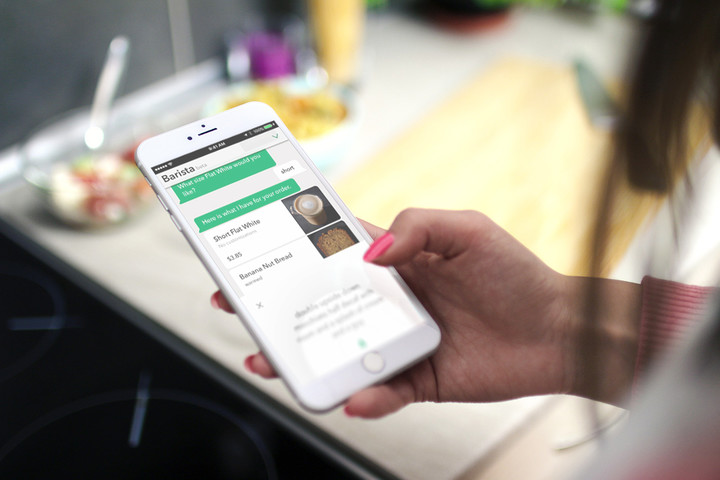
The updated iOS app features an AI assistant called “My Starbucks barista.” The digital chatbot, much like the chat apps that have become popular in Facebook Messenger, uses artificial intelligence by way of natural language processing to facilitate ordering. It provides up-to-date information about menu items, prices, and orders — users can ask which seasonal beverages are currently on tap or which baked goods are available in store. Once the customers have reached checkout phase, it will confirm a pick-up location, provide a list of available payment methods, and place the order.
More: Starbucks addicts can now order Frappuccinos with an app at 4,000 stores
The coffemaker says that the new assistant will only be available to 1,000 iOS users nationwide during a limited beta test. A phased rollout is planned through summer 2017, with an Android version to follow later in the year.
The mobile app’s recent popularity has caused a headache for some of the cafe’s busiest locations. According to Fortune, baristas have had difficulty keeping up with mobile orders, which has led to bottlenecks at delivery stations and caused some walk-in customers to leave. The company has since added one to two more baristas focused on mobile orders and payment at some “top volume” cafes.
More: Warning: Starbucks iOS app doesn’t keep your password safe
With the launch of voice ordering and an in-app chatbot, the coffee-making giant is targeting recent trends. In May, Google CEO Sundar Pichai said that 20 percent of queries in the Google mobile app on Android devices are voice searches. At a conference in June, Facebook’s David Marcus announced that more than 11,000 bots had been added to Messenger since the launch of the social network’s development platform in late 2015.
Three finally lets you make Wi-Fi calls and texts without a separate app
Why it matters to you
It’s been a long time coming, but the British mobile service provider now lets you natively make Wi-Fi calls and texts
We’ve some long-awaited good news for our friends in the U.K. After literally years of waiting, British mobile service provider Three has enabled native Wi-Fi calling for your iPhone. That means that if you have an Apple mobile device and are using Three as your carrier, you’ll be able to make and receive calls and texts anytime and anywhere you have Wi-Fi. Previously, in order to take advantage of this feature, users would have to use the separate InTouch app, which took up precious real estate on the iPhone’s home screen.
But happily, those times have passed. Now, if you have any iPhone that launched in 2014 or later (which includes the iPhone 5c, iPhone 5s, iPhone 6, iPhone 6s, iPhone SE, and iPhone 7, and all the associated Plus models), you’ll be able to make Wi-Fi calls natively.
More: Google’s simple and elegant Google Wifi makes home networking easy
In order to take advantage of this, you’ll need to make sure you’re running the latest software on your iPhone, which means upgrading to iOS 10.2 if you haven’t already. To do so, simply head over to Settings, then General, and click on Software Update. Download and install the most recent software update, then make sure that you also have the latest carrier software package installed on your iPhone. This is done by visiting Settings > General > About, whereupon you ought to see a “Carrier update available” message pop up.
From there, things get much simpler. Go to Settings > Phone, select “Wi-Fi Calling,” and switch the “Wi-Fi Calling on This iPhone” option to the on position. Confirm that you do indeed want to be able to make calls when you don’t have service but do have Wi-Fi, and get chatting.
It’s actually not just the iPhone that now has this feature. The LG G5, Samsung S6, and S6 edge also no longer require the separate Wi-Fi calling app, and Three says that more phones will soon be added.
Android Central Photo Contest: It’s Cold!

Share your photo in the forums and you could win a super cool prize package!
We’ve been listening to your requests, and we’re happy to announce that we’re bringing back the Android Central photo contests! We’ll be running each contest for two weeks so everyone has plenty of time to snap a great shot and get it posted in the forums for judging, so keep an eye out every second Monday for a new theme and new chance to win!
Now, let’s get to this contest’s prompt — “cold.” Now you don’t have to live in a cold climate to take a picture for this contest, but you may have to think outside the box to get something interesting. We can’t wait to see the chilly photos you take this week.

We’ll be picking two winners for this contest, with each taking home an Honor 6X phone and Doctor Strange prize pack!
Entering is easy. Just drop your entry in the forum post at the link below. Tell us which Android you used to get the picture, and any back story you want to add to it. We’ll pick a winner Sunday (February 12th) at 11:59 PM ET and announce them on the blog with the next contest.
Enter the latest Android Central Photo Contest
- Pictures must be taken with an Android device
- Pictures must be uploaded to the contest thread. I’m not running all over the internet to track them down.
- You have to tell us which device you used to take the picture and any special software you might have used. Editing your pictures is fine — this is art.
- Feel free to add a little back story — we want to know how the picture came to be.
- You must have used a valid email address to register here at AC, so I know how to contact the winner.
- Only one entry per contest per person.
Good luck, everyone!
Top photo credit to previous contest winner gk1984!
Max out the storage in your phone with this 256GB card for just $119
Right now you can pick up SanDisk’s 256GB microSD card for just $119, a savings of $60 from its regular price. If you are looking to max out the storage in your phone, this is the card you will want to grab. Currently, 256GB is the largest capacity card available, allowing you to store tons of videos, pictures, music, files, and much more on it. You won’t have to worry about deleting a picture to be able to take a new one with this card in your phone, nor will you miss the great video of your child’s first steps due to a lack of storage space.

To sweeten the deal, B&H Photo doesn’t collect tax on shipments outside of New York, and you can get free shipping as well. Don’t miss out as this offer is only good through January 31.
See at B&H Photo
New York City tech leaders object to Trump immigration ban
If it wasn’t already clear that the tech industry is opposed to President Trump’s immigration restrictions, it is now. Hundreds of New York City tech luminaries have signed a letter that urges Trump to change his mind on the policies, many of whom are from companies you’ll recognize — Airbnb, Blue Apron, Comcast Ventures, Foursquare, Indiegogo and Kickstarter are just a few examples. Many of them are CEOs or founders of influential firms, including Uber chief Travis Kalanick.
The collective argues that the ban, which covers both refugees as well as immigrants from several Muslim-majority countries, will both “undermine” New York City’s diverse tech community and “send a dangerous message” that immigrants aren’t welcome. The town is defined by its immigrant culture, the group contends, and many tech giants were founded at least in part by immigrants (think Intel, Google and Tesla, for starters). Americans should be doing “everything in our power” to attract these entrepreneurs, not giving them the boot.
We wouldn’t count on Trump taking the letter into account when he stood firm in the face of nationwide protests. However, this suggests that the tech industry is presenting a united front on the issue — the President won’t get much support from companies worried about losing potential talent and cultural diversity.
Source: Tech:NYC
Gap envisions a future with augmented reality ‘dressing rooms’
Fashion brands know that experimenting with tech is imperative, whether it be to enhance the retail experience or introduce fans to the concept of virtual reality. For Gap Inc., which, in addition to its eponymous label owns Banana Republic, Old Navy, Athleta and Intermix, technology has never played a major role in its business strategy. But, as the company struggles with declining sales, it’s trying to find new, creative ways to engage with customers. That’s where Gap’s “DressingRoom” app will come in when it launches in the coming days.
The application, built in collaboration with Google and San Francisco-based startup Avametric, uses augmented reality to let shoppers “try on” clothes without having to step into a store. After adding information such as your height and weight, DressingRoom places a virtual 3D model in front of you and lets you see how different items would fit. If you likane the way a garment looks on you, or at least the mannequin based on your measurements, you can purchase it directly from the app.

As compelling as the idea may be, it does have its limitations. For starters, it’s exclusive to Google Tango smartphones, and right now there are barely any of those available. So far, there’s only Lenovo’s Phab2 Pro, and ASUS isn’t expected to release its ZenFone AR until later this year. Gap says that at least for the time being, it’s only focused on making its application work on Google’s augmented reality platform. That’s great news for the search giant, which needs more willing partners like Gap in order for Tango to be a success.
The other issue is that some people, myself included, would prefer to physically try on the clothes before making a decision. I’m probably not the only person who feels this way, although as a techie I’m curious to give it a shot. Avametric, whose tech powers the app, says it’s already working with other brands and retailers on similar projects, but unfortunately the company couldn’t disclose much beyond that.
When asked why choose AR over VR to build DressingRoom, Avametric CEO Ari Bloom suggested that augmented reality has a gentler learning curve. He says that the hardware and software required for virtual reality has more “immediate barriers,” since you have to learn new behaviors to interact with things around you. Mixed reality, meanwhile, continues to be an appealing technology for many developers, with the success of Pokémon Go being perhaps the most prominent example.

Gap’s DressingRoom app will soon let you ‘try on’ clothes from home.
DressingRoom likely won’t solve all, if any, of Gap’s problems. The company has been struggling in recent years, having suffered seven consecutive quarters of declining sales, according to Investopedia. It did log strong holiday numbers this winter, but by that point Gap had already announced it was closing more than 175 of its namesake stores. Gil Krakowsky, VP of Strategy and Business Development for Gap, says DressingRoom is just one of various initiatives that his team is working on to lure shoppers back in — particularly those who don’t visit its brick-and-mortar locations.
Gap isn’t the only mainstream retailer in a slump either. Last month, Macy’s revealed it will cut 10,000 jobs after mediocre sales during the holidays. The company blamed some of its troubles on tech giant Amazon, which has won over customers with its own fashion section, low prices and expedited shipping for Prime members. As a result, Macy’s had to close 100 stores and said it would start focusing on its “digital business,” though it wasn’t clear exactly that means. Macy’s declined to comment for this story, but one could assume that this means placing more resources on its online site and apps.
As for Gap, Krakowsky says it’s too early to know if DressingRoom will have any positive financial impact. He says his team will see how customers respond to the app, which is set to launch on Google Play soon, and go from there. “The fashion industry,” he says, “has not traditionally been geared toward helping people understand how clothes will actually fit,” and he believes DressingRoom is an opportunity to change that. We’ll see how that turns out.
 AIVAnet