


Some of Earth’s oxygen escapes to the moon every month
The Earth and the moon share more than an orbit around the Sun. Turns out that bits of atmosphere manage to travel the 240,000 miles out to our nearest celestial neighbor, and have been for more than 2 billion years, according to data gathered by Japan’s moon-orbiting Kaguya spacecraft.

In a study published on Monday to the journal Nature Astronomy, planetary scientist Kentaro Terada of Osaka University observes that ionized oxygen particles escape from the upper atmosphere for five days every month to bombard the surface of the moon. Terada’s data suggests that oxygen atoms in the upper atmosphere are first ionized by ultraviolet light and then accelerated into the magnetosphere, the planet’s magnetic envelope. The magnetosphere extends more than 370,000 miles away from the Sun, fully enveloping the moon’s own orbit around the Earth.
For five days every month when the moon passes through the magnetosphere, it is blasted with these ionized particles. The Osaka University team estimates that every square centimeter of the moon’s exposed surface is struck by approximately 26,000 oxygen ions every second over the five day period. While this isn’t enough for the moon to develop a breathable atmosphere of its own, this discovery suggests that the moon’s surface could hold clues to Earth’s ancient atmosphere — much like ice cores being dug out of the Greenland and Antarctic permafrost.
Source: Science News
GM and Honda will mass-produce hydrogen fuel cells together
Just weeks after the car and energy industries began their big push on hydrogen, the first real action is being taken. General Motors and Honda have leapt into bed together to begin work on a new factory that’ll mass-produce hydrogen fuel cells for their vehicles. Fuel Cell System Manufacturing (FCSM) will be based at GM’s electric vehicle battery site in Brownstown, MI (pictured), and is expected to start work in 2020.
The partnership between GM and Honda has been in place for several years after the pair signed a development agreement back in 2013. Each one will kick in $85 million to equip the joint venture and hire around 100 engineers to run the plant when it begins operations. The pair hope that combining their efforts will result in cheaper fuel cells thanks to economies of scale that mass-producing these cells provide.
Both companies are pushing fuel cell technology as the futuristic alternative to gasoline, citing the lack of emissions, range and quick refueling times as the benefits. The release also repeats the wonky claim that “water vapor is the only emission from fuel cell vehicles.” Which, as we know, is only because the emissions take place where the hydrogen is sourced, rather than when it is consumed.
For instance, the cheapest way to procure commercial quantities of hydrogen is using natural gas to reform methane into hydrogen. But this process releases carbon monoxide into the atmosphere, which isn’t exactly the most healthy thing to do. Also, methane leakage from this process is similarly dangerous, since methane is a much nastier greenhouse gas than carbon dioxide.
Hydrogen’s dangers are well-known, but the energy industry will be much more in favor of it than EVs. After all, oil companies can bolt on hydrogen tanks onto existing gas stations in a way that they wouldn’t with EVs. Which, you know, don’t create emissions and don’t need expensive and cumbersome infrastructure. Just saying.
Car2Go adds luxury Mercedes models to its carsharing lineup
If you live in a big city, you’ve likely seen Car2Go’s white and blue two-seater Smart cars zipping about. Unlike other car sharing services, you can rent one of the company’s vehicles, take it for a spin, and then simply park it anywhere in its service area when you’re done. While it’s certainly convenient, it’s not very useful if you need to haul around friends or a trunk full of shopping bags. That’s changing today, as the company just announced that it’s bringing full-sized Mercedes CLA sedans and GLA crossovers to seven cities.
Both cars will offer plenty of tech-enabled features, including smartphone integration with CarPlay and Android Auto; adaptive braking; blind-spot assistance; a rear view camera; and Harman/Kardon sound systems. Thankfully, Car2Go is also taking a subtler approach to branding: They’ll be available in black, white and silver, with just a small sticker labeling them as Car2Go vehicles.
While the company will still keep its iconic Smart cars around (including the newer Smart ForTwo models), it appears to be gearing up to focus more on the luxury models. That makes sense, since its main competitor today is BMW’s ReachNow service, which also offers luxury cars. It’ll cost you $0.49 per minute, $19 per hour or $79 per day to rent the new Car2Go vehicles, which is a slight bump over its normal Smart car pricing.
Car2Go is launching its luxury models in Seattle (where ReachNow already has a big presence); Portland, Oregon; Austin, Texas; Washington, D.C.; Toronto; and Vancouver. The company also plans to expand the new lineup to more cities by the end of the year.
Via: Jalopnik
Source: Car2Go
The best cordless stick vacuum
By Liam McCabe
This post was done in partnership with The Sweethome, a buyer’s guide to the best homewares. When readers choose to buy The Sweethome’s independently chosen editorial picks, it may earn affiliate commissions that support its work. Read the full article here.
Power cords got you wound up? We’ve spent more than 100 hours over the past few years looking into 73 different cordless vacuums, and after testing more than a dozen of them, we’re sure the Dyson V6 is the best choice. No cordless vacuum from any other brand matches the cleaning performance of the V6; in our tests, it picked up more ground-in dust and hair from our carpets than any competitor and cleaned up bare floors in fewer passes.
Who should get this
The best cordless vacuums now have enough cleaning power to match good plug-in vacuums, and enough battery life to clean small to midsize homes (roughly 1,200 square feet) in a single pass. Obviously, the best part about owning a cordless vacuum is that you have no cable to unwrap and rewrap during every cleaning session or catch on corners and doorways. So if you have ever skipped vacuuming because you’re feeling too lazy to unwrap the cord (guilty as charged), or your cramped floor plan makes cord-wrangling feel like a major chore, a cordless vacuum can be a life-changer.
But cordless vacuums have some disadvantages. Cordless vacuums always cost much more than plug-ins with comparable cleaning performance and can’t consistently match the cleaning performance of the very best plug-ins on thicker carpets. They also have shorter warranty periods and limited run times. See our full guide for more on the pros and cons of cordless vacuums. And if you need more help choosing the right vacuum for your home, we have a quick guide for that.
How we picked and tested

The cordless vacuums we tested for this guide (left to right): Hoover Cruise, Hoover Air Cordless Lift, Dyson V8 Absolute, Anker HomeVac Duo, Dyson V6, Hoover Linx, Hoover Air Cordless 2-in-1, Black+Decker Smartech HSVJ520JMB. Photo: Liam McCabe
We started by making a list of all the cordless vacuums we could find. Since we started covering this category in 2014, we’ve tracked 73 models (though many are now discontinued).
For our main pick, we looked for a cordless vacuum that cleans as well as a good plug-in. That means it should suck up noticeable debris from bare floors and short- or medium-pile carpets in a couple of passes, as well as some of the less-noticeable fine dust and hair that accumulates deeper in carpets over time. We stuck to models that met the following criteria: an 18-volt battery or greater, a lithium or lithium-ion battery, at least 15 minutes of run time, strong customer ratings, and a two-in-one design or a hose with attachments.
After winnowing down the possibilities based on specs, we decided to call in four vacuums for testing, ranging in price from $180 to $300: the Dyson V6 (base model), the Hoover Air Cordless Lift, the Hoover Cruise and the Black+Decker Smartech HSVJ520JMB.
Some cheaper picks lack features but work fine to tidy up smaller spaces. So we called in a few budget-friendly models for testing as well: the Hoover Linx, the Hoover Air Cordless 2-in-1, and the Anker HomeVac Duo. We also called in the Dyson V8 Absolute, an upgrade vacuum with extra battery life.
We tested at home, using an evolving procedure to measure cleaning performance, handling, and ease of maintenance. Cleaning trials included cat litter, baby powder, cat hair, steel-cut oatmeal, and lentils, sucked up from wood floors, laminate floors, tile floors, low-pile area rugs, low-pile knit carpets, and medium-pile rugs. We tested open-floor pickup, as well as side suction from corners and baseboards. And we tried to measure the strength of a vacuum’s airflow by seeing how much debris it can clean up without actually driving over it. We also double-checked battery life and tested vacuums for maneuverability using a timed slalom course.
Our pick
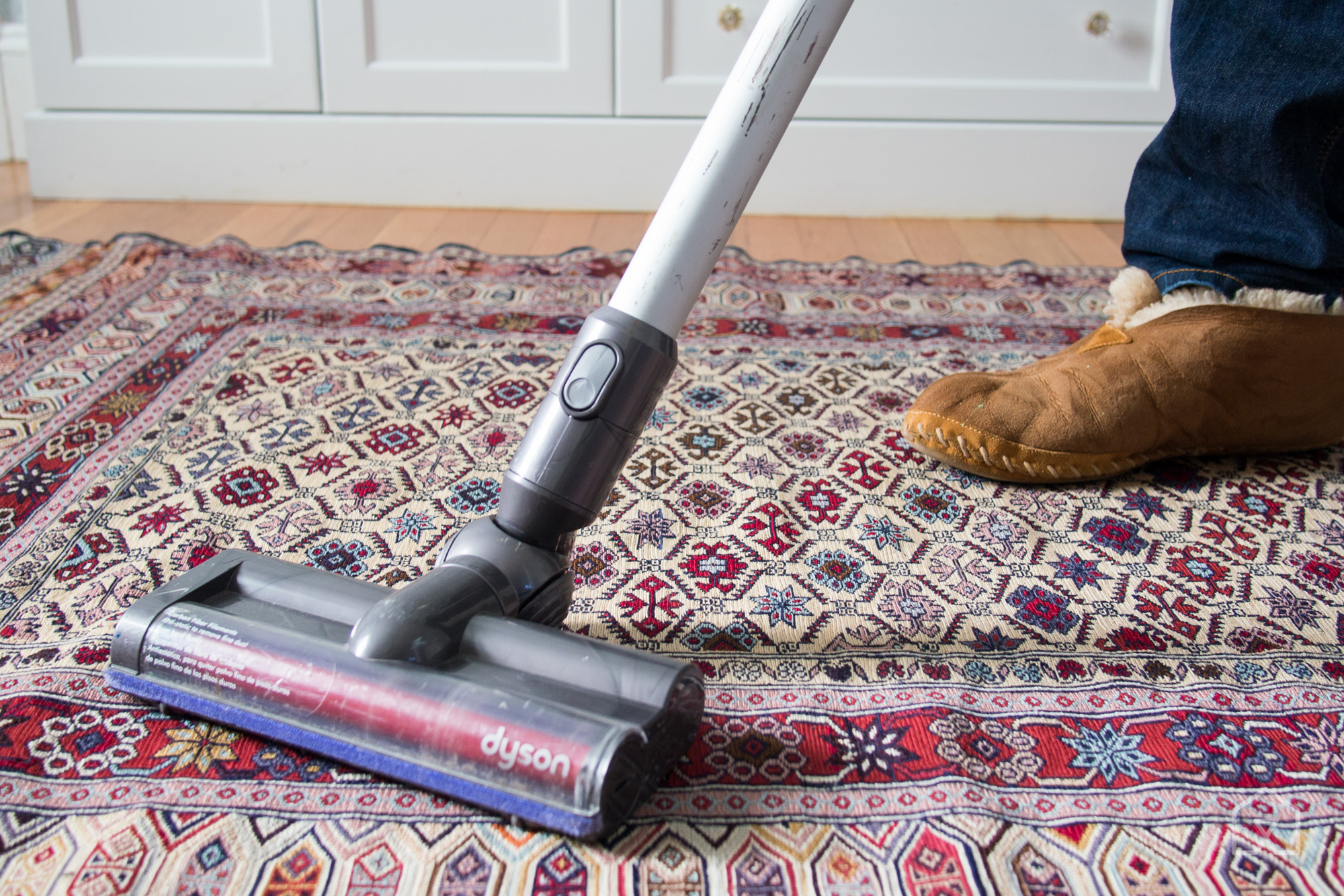
The Dyson V6 base model has a cleaning head that works well on both carpets and bare floors. Photo: Liam McCabe
The Dyson V6 base model is the best cordless vacuum for most people because it cleans as well as a good plug-in vacuum on most common types of flooring and costs less than other Dyson cordless models. In our tests no other brand’s cordless vacuums came anywhere close to matching the carpet-cleaning performance of the V6. The V6 is also great on bare floors, and it can convert into a handheld vacuum, too. It’s lightweight and very thin, and most people find it easy to handle and to stash away between uses. With a 17-minute battery life (about average for the category), it’s best suited for an apartment or a smaller townhouse, where it can usually clean the whole space on a single charge—our estimate is about 1,200 square feet.
Dyson makes a handful of V6 variants that some people might want to consider depending on their flooring, but after looking at all the configurations we think the base model is the right choice for most people because it works well on almost any surface and (most days) costs less than the others. For more on why we like the Dyson V6, see our full guide.
A tried-and-true choice for modest messes

Photo: Liam McCabe
A cheaper cordless vacuum can work for small jobs like picking up crumbs off the kitchen floor, or as a “good enough” cleaner for a home with mostly bare floors. If that’s what you’re after, we think the Hoover Linx (BH50010) is the best choice. For the price, it’s as durable and effective as a cordless vac can get.
The Linx is a competent floor cleaner, a little bit more capable than others at its price. It can pick up visible debris from bare floors and debris sitting on the top layer of short rugs and carpets. The side brushes flick particles away from baseboards pretty reliably. The Linx is not strong enough to suck up much of the fine dust in your carpets—nothing at this price is. But if you’re mostly cleaning bare floors and area rugs (which you can pick up and shake out by hand from time to time), using the Linx is a fine way to keep your floors tidy. If you’ve only ever used a cheap vacuum anyhow, the Linx will seem normal.
A budget model with a longer battery life

Photo: Liam McCabe
If you want a budget cordless vacuum with more battery life or the ability to pull double duty as a hand vacuum, check out the Anker HomeVac Duo (also known as the Eufy HomeVac Duo). Like the Hoover Linx, the Anker HomeVac Duo can’t compete with the Dyson V6 in cleaning power, but it’s useful for tidying up.
This guide may have been updated by The Sweethome. To see the current recommendation, please go here.
Note from The Sweethome: When readers choose to buy our independently chosen editorial picks, we may earn affiliate commissions that support our work.
Four hours with ‘Horizon Zero Dawn’
Personally, I don’t put much stock in video game previews. Pre-release gameplay events for major, AAA titles are generally controlled and precise experiences, with scenes hand-picked by developers to show only the best, most complete parts of a game. They’re representative of the studio’s goals, but not necessarily the final product.
However, most preview events aren’t four hours long. For Horizon Zero Dawn, Guerrilla Games and Sony opened up the robot-dinosaur-infested world and set me loose for nearly four hours. I played straight through the very beginning, skipped a section that apparently includes some spoilery story points, and then ran around the game’s massive world completing sidequests and following the main narrative. It was a sizable chunk of the game that actually felt representative of a complete experience.
I can’t say, definitively, whether Horizon is a good game just yet. But, after playing it for a few hours, I can say one thing wholeheartedly: I’m more excited than ever to play Horizon when it comes out on February 28th.
To begin with, Horizon is gorgeous. The game will be rendered in 2160p checkerboard (meaning, basically 4K) on the PlayStation 4 Pro, but its graphics shine even in 1080p on the standard PS4. This is the debut of Guerrilla Games’ Decima engine, a new foundation for rendering video games with built-in tools for artificial intelligence, physics, logic and world-building. This is also the engine powering Hideo Kojima’s mysterious Death Stranding, by the by.
Among the rolling vistas of lush wilderness, towering metallic beasts, day-night cycles and a dynamic weather system, one thing stands out as an accomplishment in Horizon: The characters’ mouth movements. No matter how advanced game technology may be nowadays, developers still find it difficult to accurately animate the act of speaking. Mouth movements don’t always line up with the spoken lines, or they’re simply too stiff or repetitive.
Horizon’s Decima engine doesn’t solve this problem entirely, but it’s the closest I’ve seen to realistic speaking motions in a video game. This one feature makes me happier than it should, and it’s representative of the level of polish I experienced throughout my time with the game.

The introduction stars Rost, a burly man in furs and a Viking-style braided beard, as he hauls his charge, the baby Aloy, across a gorgeous valley and up a mountain for a sacred blessing. Rost explains the situation to Aloy as he walks, reminding her that they’re both outcasts in the Nora tribe. He is not Aloy’s father and her mother’s identity is a complete mystery, but Rost raises Aloy like his own, with warmth and respect in his eyes. It’s a special, touching relationship right from the beginning.
The mystery of Aloy’s mother is what truly drives the story forward, though. Motherhood is a central theme in Horizon, from Aloy’s goal of discovering who her mother is and why her birth was seen as a curse, to the hierarchy of the Nora tribe itself.
This is a matriarchal society, where women are honored for their ability to grow and nurture life. Women hold positions of power in their communities, and across the surrounding land, the villages carry names like “Mother’s Heart” and “Mother’s Cradle.” The tribe’s omnipotent god is called the All-Mother.
Before Aloy embarks on a quest to learn about her own mother, she’s presented as a child desperate to be accepted by the Nora community. Members of the tribe are forbidden from speaking to her or Rost, a fate that makes her childhood lonely and frustrating. After an unfortunate encounter with some tribe members as a child, Aloy finds herself alone in a cave-like bunker filled with rats, corpses and the remnants of a long-dead, technologically reliant society.
She’s not scared. Instead, she’s curious — she pokes around the cave until she finds a triangle-shaped piece of technology on the ear of a corpse, and she puts it on her own head. The world comes alive behind a translucent purple dome and Aloy is able to investigate the various broken terminals scattered around the cave system. There are desks, bunk beds and many more corpses, some of which Aloy can tap into to hear their final voice messages.

This society might have been a cult; it might have been a group of people attempting to escape armageddon. The cave is familiar — these people carry names we would recognize and they clearly come from a timeline very much like our own, but with significantly more advanced technology. Members of the Nora tribe speak of a people who perished because they didn’t pay due respect to the All-Mother, and the cave is a testament to these tales.
As Aloy runs around the cave and the sprawling world above, the power of the Decima engine is on full display. Even just the way young Aloy runs, with a child’s bouncing, uncontrolled gait, is completely endearing.
And then, Aloy grows up.
From a young age, Aloy has a singular mission: Win the Proving, a test of hunting and warrior skill, and she’ll be granted any wish she wants by the leaders of the Nora tribe. She plans to ask for the identity of her mother, of course. She trains with Rost, providing players an opportunity to learn the game’s controls in an environment that feels like a natural progression of the story.
Aloy’s main weapon is a bow and a variety of arrows, including electric tripwires and fire bombs, which she crafts with resources found in the wild. The triangle communicator device remains attached to her head, allowing her to receive information about new threats and creatures. That’s right — here’s where those mechanical animals come into play.

Horizon’s world is overrun with beastly robots: Horse-like creatures crafted out of metal and wires graze the grasses; artificial velociraptors prowl the prairie waiting to pounce on intruders. Eventually, when Aloy leaves the valley to explore the outer lands, she encounters towering long-neck monsters roaming among the mountains. It’s unclear where these metal creatures come from, but the tribes live with them in a tense kind of harmony. Tribe members hunt the smaller robots for parts but otherwise try to stay as far away from them as possible.
Using the triangle communicator device, Aloy is able to see the paths that certain robots take, allowing her to sneak around them in ways that other tribe members can’t. Eventually, when Aloy leaves the confines of her valley, she learns how to tame the horse-like creatures and she’s able to ride one from mission to mission.
Riding a robot horse feels really cool, in case there was any doubt.
Horizon offers players a variety of gameplay options. Lay traps to capture and kill as many metal animals as you can, or use stealth tactics to take down only the prey you need to. Bow and arrow, slingshot bombs, electrified tripwires, a spear — the weapon choices and environments lend themselves to numerous different play styles.

I’m not patient enough for pure stealth, so I found myself leaping around the grasslands, diving away from attacks and laying into monstrous metal creatures with arrow after arrow. The tripwires are incredibly fun to use, but touchy — if you attach one end of the wire to a rock but miss connecting the other end to something solid, that wire disappears from your inventory. It’s safer to quietly lay down some traps and then initiate a fight with a metal beastie (not to mention, it’s incredibly fun).
Horizon is huge. Even after nearly four hours of playtime, I only just scratched the surface of the world map, and I ran into at least six separate sidequests. Horizon’s world feels real and grounded; it’s packed with intriguing characters from a range of backgrounds, all of which feel authentic to the game’s universe.
Of course, Aloy is the most interesting character in the game — which is certainly a good quality for a protagonist to have. She’s a powerful, skilled hunter on a grave and mysterious quest that will undoubtedly reveal more than just her own personal history. There are so many questions in Horizon (Who is her mother? Why is she cursed? Where did the robots come from? Why did the previous society die off?), and Aloy is the conduit for all of the answers.
I’ve been dreaming of Horizon’s world since finishing my playthrough, rolling these questions around and around in my head. But, the main question on my mind has nothing to do with the game’s lore. After playing the preview, I wonder: Will the full game be as gripping as the couple of hours I played?
Just like Aloy, I have hope.
Motherhood, nature and technology in ‘Horizon Zero Dawn’
Horizon Zero Dawn is Guerrilla Games’ first original creation since releasing the original Killzone in 2004. Not only is it Guerrilla’s first foray into a brand-new universe in 13 years, but it’s a completely new genre for the studio: an open-world, action RPG. These are generally massive games with intricate narratives and winding sidequests, as opposed to the constrained, linear nature of most first-person shooters.
In order to make sense of a story in Horizon’s vast open world, Guerrilla brought on Fallout: New Vegas lead writer John Gonzalez. Gonzalez helped create Aloy, Horizon’s protagonist, and the massive landscape that she inhabits — robot dinosaurs and all.
While giant mechanical beasts are cool, the heart of Horizon is Aloy’s quest to uncover her true identity. Aloy has no mother, which makes her an outcast in the Nora tribe, a matriarchal society that prays to an all-knowing goddess.
The identity of Aloy’s mom is the singular mystery driving Horizon’s story.
“As we were exploring this world, as we were imagining the societies that would come into existence, one of the social orders that we wanted to explore was the matriarchy of this tribe,” Gonzalez says. “This ended up being an inspiration for Aloy’s character. Because, if you have a tribe for whom parenting and in particular motherhood — bringing forth life and nurturing it — is the holiest act, the most sacred act that someone can perform, then it would be uniquely painful to not know who your mother was or where you came from.”
Along her journey, Aloy becomes a skilled hunter and warrior, and she is placed on a collision course with events much larger than herself.
“We wanted to combine the personal and the epic, and hopefully by doing that, not just satisfy the curiosity of the player, but also provide a really emotionally powerful experience as well,” Gonzalez says.

The team at Guerrilla Games studied various societies around the world and dove into anthropology textbooks to get a better sense of how a matriarchal tribe might operate. In particular, they drew inspiration from Jared Diamond’s book Guns, Germs and Steel: The Fates of Human Societies.
“It has this idea that one’s geography is destiny, in a way,” Gonzalez says. “The material conditions in which a group of people are living really determine the technologies that they’re going to develop. We tried to use some of that in imagining these groups.”
Aloy’s world is filled not only with sprawling valleys, flowing rivers and craggy mountains, but also with a wide variety of robot-like animals. Their place in the ecosystem is a mystery. Tribe members mention that they don’t know where the mechanical beasts came from or what their purpose is.
The Nora tribe and these robotic animals live in a tense balance. Many of the creatures are hostile, and the tribe members often hunt them down for parts. It’s a stark contrast: Aloy wearing furs, leather and feathers, hunting shiny mechanical animals that stalk her with glowing eyes.
This play between technology and nature isn’t on accident.
“If you look up the definition for nature, it is essentially whatever humans don’t do or make. Which falls apart on the face of it, because we are obviously part of the natural order,” Gonzalez says. “We arise from nature the same way as any other organism. In some ways, I think the concept calls into question whether or not those two forces have to be opposed to one another.”

Gonzalez and Guerrilla Games aren’t trying to force a didactic message about nature, technology or motherhood onto players. These ideas are simply the foundation for all of the game’s action, suspense and emotional depth.
To that end, one new element that Gonzalez helped implement in Horizon is the Flashpoint system. At certain points throughout the game, players can decide how Aloy will respond to a situation, whether with confrontation, compassion or an analytical kind of insight. These choices can end up affecting how the game eventually plays out.
For example, when Aloy is a child, she encounters a sneering young boy from the Nora tribe who throws a rock at her head. She picks up a rock herself and players decide whether she throws it at his head, at the rock in his hand, or if she drops it.
“There’s a moment later on in the game where you’re going to encounter that same kid, where he’s grown up, and what you chose to do is actually going to be reflected in the way that that interaction plays out,” Gonzalez says. “The way we looked at that was, it’s not so much choosing what you want to do, but actually a moment of pausing to empathize with Aloy. It’s like choosing how she’s going to express her personality.”

Guerrilla Games’ focus was always on crafting a compelling story, Gonzalez says. And from the very beginning, Horizon was going to star a young woman — early concept art features expansive landscapes and the tiny image of a girl sitting on a mountaintop or surveying the valley. For Gonzalez, it feels as if Aloy jumped out of the concept art and demanded to be the star of the game.
“It’s the kind of thing that Aloy would do,” he says.
Starbucks’ iPhone app lets you order by talking to it
Starbucks is continuing its efforts to stay on top of technological trends by adding new voice-ordering functions to its iOS app and Amazon’s Alexa digital assistant. Called “My Starbucks barista” on iOS, the service is being rolled out to select customers today as an extension of the company’s Mobile Order and Pay feature, which lets users send and pay for an order ahead of time. At the same time, the company is launching a Starbucks Reorder Skill to the Alexa platform.
My Starbucks barista was previously announced at the company’s Investor Day in December, and uses an AI-powered messaging interface like many existing chatbots. You’ll be able to speak your order, and customize your food and drink to your personal preferences, according to Starbucks. On Alexa, users will be able to re-order a standard, pre-defined order by saying, “Alexa, order my Starbucks.” They will be able to pick up their food and beverage at a pre-determined outlet.
The voice-based ordering service will be available to one thousand users at first, and the company intends to continue rolling out the feature in the US through summer this year. An Android version is also in the works, but if you don’t want to wait to use your voice to make an order, you can always dial the company’s toll-free phone number.
Via: TechCrunch
Source: Starbucks
‘Psychonauts in the Rhombus of Ruin’ will launch on February 21st
It’s been a long time since the first Psychonauts was released — more than 10 years, in fact. However, developer Double Fine announced in late 2015 that it was bringing the series back with a pair of game: Psychonauts 2, a proper sequel, and Psychonauts in the Rhombus of Ruin, a game for PlayStation VR meant to bridge the two titles. The latter title is just about ready to drop: Sony and Double Fine just announced that it’ll be released on February 21st.
If you know anything about the original Psychonauts, it sounds like you’ll be right at home here — Rhombus of Ruin picks up right where the original game left off. But rather than playing the latest title as a platformer, Rhombus of Ruin is a 3D, first person adventure in virtual reality. Fortunately for those of us who might not have played the original title, which came out way back in April of 2015, Sony says that the PS4 exclusive should be pretty accessible whether or not you’ve played the original.
And if you’re not feeling up for a VR experience, Psychonauts 2 sounds like it’ll retain the original third-person platformer feel that original used. But it’ll be a while before you get to check that one out — it still doesn’t have a release date as of now. But with Rhombus of Ruin just about ready to go, we imagine Double Fine will be working hard to get the next title in the series out the door before too long.
Source: PlayStation Blog
Dropbox SmartSync lets you collaborate across Mac and Windows PCs
Last year, Dropbox introduced an interesting new feature called Project Infinite, which promised to let you view and access all of your files, whether they’re on your hard drive or in the cloud. The idea here is that all your files will appear right there in your desktop, and you can view and make changes to them without having to launch Dropbox’s web interface. Several months later and Project Infinite has left its beta state. Now, it’s called SmartSync, and it’ll be available to all Dropbox Business users starting today.
A particularly useful highlight of SmartSync is that it’ll work on both Windows and Mac (backwards compatible with Windows 7 and up, or Mac OS X 10.9 and higher). Rob Baesman, Dropbox’s head of product, says that this cross-platform and backwards compatible system is an “industry first.” “You’re free to collaborate with whoever you want,” he said. “You don’t have to think about space the same way you did in the past.”

Another Dropbox product that’s finally making its public debut is Paper, which has been in beta for almost two years. A Google Docs replacement of sorts, Paper is touted as an online collaboration tool with several other office-centric features thrown in. You can create a to-do list and assign them to team members, set due dates, organize content by projects, and of course do all the usual writing and editing too. A few months ago, Dropbox released mobile app versions of Paper for Android and iOS, which lets you do all of this on-the-go.
As part of its general launch, Dropbox is introducing a few new features to Paper too. There’s Presentation Mode, a “Smart Meeting Notes” feature that sends everyone at a meeting the same document (provided you hooked Paper up to your Google Calendar), plus general usability improvements like improved search and better accessibility for screen readers. The company is also working on mobile offline capability in the coming months.
While SmartSync won’t be available to general users just yet, Paper is open to everyone with a Dropbox account starting today. It’ll be available in 21 different languages.
‘Fallout 4’ visual upgrade demands a monster PC
Fallout 4 is already a good-looking game (insofar as a nuclear wasteland can look good, anyway), but Bethesda is about to kick things up a notch. An update rolling out next week will add a High-Resolution Texture Pack that adds an absurd level of visual detail for PC players — check out the rust and scratches on the power armor above if you need evidence. To say that this will demand a beefy system is an understatement, though. The developer recommends at least a 2015-era desktop Core i7 chip, 8GB of RAM, and a monster graphics card — you should have either a GeForce GTX 1080 or (until Bethesda pulled mention of it) the as yet unreleased AMD Radeon RX 490. And did we mention that you need an extra 58GB of storage for all that new art?
Don’t fret if you prefer to play on a console, though, as there are also some perks coming to the PS4 Pro. Sony’s newer system will play Fallout 4 at 1440p resolution if you have a 4K set, and everyone should notice both a greater draw distance for objects and improved “godray” lighting effects. It’s not the native 4K upgrade you might’ve hoped for, but it could give you a good reason to revisit the game if you haven’t touched it in a while.
Via: Kotaku
Source: Bethesda
 AIVAnet