


I took a nap on Sleep Number’s auto-adjusting smart bed
I’ve never spent more than a couple of hundred bucks on a bed. After spending a few minutes with the 360 smart bed, however, I’m tempted to reconsider. Why? Because it adapts to my every move. As you toss and turn in the night, the bed will automatically recognise this movement and naturally contour to your body. It will also adjust the firmness of the mattress so if you need more support for your back, for instance, you’ll receive the necessary assistance without lifting a finger. These smarts are paired with an adjustable base that will tilt your head upwards if you start snoring in the middle of the night. (Not that I ever snore or anything…)
Intrigued? I sure am. Sleep Number had a demo unit at CES this year, so of course I jumped at the chance to lie down and take a load off. (It makes a nice change from running between convention halls, anyway.) Here’s what I know: It’s a super comfortable mattress, with just the right balance of squishiness and rigid support. Secondly, it’s positively monstrous, positioning your body high above the floor. As for the promised smarts, well, I have bad news. The version I saw was out of action (a problem with the Bluetooth connection, apparently) so I could only imagine how it would respond to my pretend nighttime fidgeting. Bummer.

Regardless, it’s an intriguing product. There’s a foot warmer at the bottom of the bed that will turn on before you clamber in at the end of a long day. Some lights underneath the frame will turn on automatically when you get up in the middle of the night. The bed’s underlying platform, SleepIQ, will even liaise with your favorite apps, such as Fitbit and Nest, to further learn and adapt to your body. Sleep Number isn’t the only company developing smart beds, however. There’s the Balluga, for instance, which promised a similar level of comfort on Kickstarter last year.
Sleep Number promises to ship the bed in the first half of 2017. Pricing is still a mystery — the company says it will be “similar” to the smart mattresses and frames it offers now — but I expect it to be on the high end. (The necessary sensors, motors and dual air chambers in the mattress probably don’t come cheap.) It’ll certainly be more expensive than the beds I normally buy — but in return, I would be getting a completely different level of nighttime comfort. Whether that’s worth it is a personal preference — some will argue that you can’t put a price on a good night’s sleep.
Click here to catch up on the latest news from CES 2017.
Find your keys like you find your Pokémon with Pixie
We’ve seen Bluetooth item trackers before, like Tile and Protag’s Duet, but they’re usually pretty dull. Pixie, on the other hand, will curb the anxiety of losing something by turning it into a game. Like other trackers, Pixie uses Bluetooth, but it also adds augmented reality into the mix, so your phone will actually show you where the general area where your device is. Once you get in real close, it’ll start pointing you left and right like a good old fashioned game of hot and cold. You could also use it to cheat at hide and seek with your kids.
Pixie has another trick up its sleeve. If you have multiple devices, they communicate with each other which helps the app know where they are with greater accuracy. The makers of Pixie claim it’s a similar principle to how GPS works, but be sure that there’s no GPS going on here, so you’ll still need to be within general Bluetooth distance from the item you’re trying to find (around 40 feet).
One thing I thought was a clever touch, was that Pixie has made an iPhone case that has one of the trackers baked right into it. The trackers — called “Pixie points” — look like a large, thick, guitar plectrum, and have approximately 12-month’s battery life. They’re also solid little critters, with IP67 dust-and waterproofing. Ideal for if you lose an item outside in the rain — your phone might not fare so well, but at least you’ll find it.
Pixie comes in packs of two (including a phone case) for $49, or packs of four (again, with a phone case) for $99, and will be available starting January 25th. Just don’t lose your wallet in the meantime.
Click here to catch up on the latest news from CES 2017.
Source: Pixie
LeEco’s Android-powered smart road bike is for hardcore cyclists
LeEco, the eccentric maker of TVs, phones, cars and bikes, has a new pair of high-end smart bikes to show off here at CES 2017. The company hasn’t even brought its original Super Bike to market yet, but it’s already refined the concept to make its new offerings more practical for serious cyclists. Gone are the heavy dynamos and size limitation; this year’s vehicles come in two flavors, and are more lightweight. The new, somewhat blandly named Smart Road Bike and Smart Mountain Bike pack a new version of LeEco’s Android-based Bike OS software that now supports a small selection of third-party sensors. I hopped on a prototype road bike the company was showing off for the first time here in Las Vegas, and so far I find the idea of a smart bike slightly questionable.
Like its predecessor, the smart road bike has laser-emitting lights on the ends of its handlebars that shoot out lasers to mark out lines three meters away from either side of you. This creates a sort of faux bike lane on the road so the drivers around you know not to get too close. This is a sound safety feature I can get behind.
What makes the road bike smart is its integrated Android system that tracks your speed, distance traveled, and route, among other metrics. Between the handlebars sits what is basically a four-inch tablet with a color touchscreen that is equipped with a Snapdragon 410 processor and 4G LTE radio. This performs functions that a normal cycling computer would, such as track your distance traveled, route and speed, as well as your pulse and power via third-party sensors.

Unlike a cycling computer, though, the system also offers a walkie-talkie feature that was also on the Super Bike. During my time on the smart road bike, the tablet was slower to respond to my taps and my swipes than I’m used to on today’s flagship phones. The delays got a little frustrating, and frankly very distracting, which is a significant problem when you’re biking. You don’t want to have your head down looking at the screen when the software is stalling while you’re riding at top speeds on the road.
Still, this is only a prototype, and it’s possible that the system could get much faster. You’ll appreciate that speed when you’re swiping through the new Bike OS 2.0, which is less stock Android than before, according to a LeEco representative. It has a custom settings menu that looks simplified, offering straightforward options such as Home, Music, Track and Settings. You can play online or local music, or tune in to FM radio stations during your ride via a headphone port.

The bike itself is made of high-end materials, said LeEco’s rep, including carbon fiber for the frame, handlebars, seat post and wheels, while other parts of it are made of SRAM. Serious cyclists will appreciate the new 1x drive train system for getting high speeds or power by piling more gears on the rear wheel instead of having them on both, which makes the bike lighter and simpler.
LeEco has no information yet to share about how much the bikes will cost, but says the vehicles will be released in the second quarter of the year. Until then, cycling aficionados have to make do with our plain old’ dumb bikes, or strap on a cycling computer to feel better.
Chris Velazco contributed to this report.
Click here to catch up on the latest news from CES 2017.
Moro is basically a four-foot Amazon Echo with arms
In-home assistants like Amazon Echo and Google Home are handy, but their functions are limited: They can tell you where to find a can of soda, but they can’t actually bring one to you. Enter Moro.
Robotics company Ewaybot created Moro as a rolling, humanoid assistant for research labs and universities, and it’s currently in a handful of schools across China. Moro is about four feet tall, weighs roughly 77 pounds, and its arms have six points of articulation; they each end in a three-pronged version of a hand that can grip everything from pens to heavy vials. The robot responds to voice communication as well (watch out, Alexa).
Moro uses Intel’s RealSense camera to avoid obstacles, plus ultrasound and infrared sensors. It costs $30,000, making it relatively affordable for universities and laboratories. However, that’s not where Moro’s story is going to end, if Ewaybot gets its way.
Eventually, the company wants to get Moro in households across the world. When it’s ready to roll out the in-home version of Moro, Ewaybot plans to sell it for significantly less than $30,000. The company wants it to be affordable and accessible.
Before that happens, Ewaybot has big plans for Moro. After its debut at CES in Las Vegas, the device is going on a tour of US universities. The company’s founders are alumni of Harvard and Carnegie Mellon University, so they have contacts in the academic world and they hope to see Moro in research labs across the nation soon.
Daniel Cooper contributed to this report.
Click here to catch up on the latest news from CES 2017.
Smart Cube turns any drawer into a Bluetooth-controlled lockbox
One of the latest devices to go from crowdfunding to CES is this Bluetooth-connected lock from Smart Armor. The Cube uses Bluetooth Low Energy (BLE) to pair with your phone, and can unlock whenever it’s in range (or from further away, if you have a Bluetooth router or other device to control it). Simply mount the device in a drawer or box that you’d prefer remain closed to prying eyes, fingers or other appendages, and it can tighten closed. Even if someone tries to tamper with the device, it will send out an alert. Mounted with double-sided tape, it can stand up to 100 pounds of force, or owners can mount it with the provided holes.
Smart Armor sees potential use cases in people who have young children, roommates or AirBNB guests. On Indiegogo, it met the $50,000 goal in just a few days and should go on sale at retail by March. The lock’s MSRP is $89, while a three-pack is available for pre-order at a price of $225.
Click here to catch up on the latest news from CES 2017.
Source: Smart Armor Tech
CES 2017: Nvidia’s ‘GeForce Now’ Cloud Service to Bring High-End PC Gaming to Mac
Tonight at its CES 2017 keynote event, Nvidia announced GeForce Now for Mac and PC, a cloud gaming service that allows low-end Mac and PC users to play high-end PC games. The service is similar to an identically-named service for Nvidia Shield users.
Nvidia says that there are an estimated 1 billion PC users who have integrated GPUs that can’t play games “to their full potential.” GeForce Now allows those users to access a Pascal-powered PC in the cloud to play games to their full potential.
In addition to letting users with low-end computers play high-end games, the service will become one of the few ways Mac users can play the latest AAA PC games. According to The Verge, Nvidia showed off the service by playing Rise of the Tomb Raider on an iMac. Rise of the Tomb Raider is not yet available for macOS.
GeForce Now doesn’t stream games from the cloud to a user’s computer, similar to how Netflix streams movies to various devices, reports Engadget. GeForce Now is more like a high-end PC in the cloud that runs a user’s games. Users will have to purchase their games from online distributors like Steam and Origin. Once they’re purchased, they can use the power of GeForce’s GRID servers to run them on their computers.
The service will cost $25 for every 20 hours of play. Nvidia says the service will start rolling out in March
Tags: Nvidia, CES 2017, geforce now
Discuss this article in our forums
Sony A1E series Release Date, Price and Specs – CNET
 Sony
Sony
OLED-based televisions are the cream of the high-end TV crop, and until now only LG has sold them in the United States.
In 2017, Sony enters the OLED fray. The new A1E series will ship later this year at an as-yet-undisclosed price, although a previous report says the 55-inch and 65-inch will ship during the second half of 2017, with prices of $2,000 and $3,000, respectively. It also said the panels used in the Sony TV will be originally manufactured by LG Display.
Sony’s announcement today mentions none of that, but does reveal some new details about the series. It will include a 77-inch size (likely $20K or more) and, more interesting, a new audio technology. The screen of the TV itself acts as a speaker to produce sound, so the audio emanates from the picture itself. It eliminates speakers around or behind the TV for what Sony is calling a stand-less form factor.
I got a quick demo of the technology from LG Display earlier and it worked well, but don’t expect stellar sound from a TV screen.
All the cool new gadgets at CES 2017
See full gallery


1 – 4 of 21
Next
Prev
OLED stands for Organic Light Emitting Diode, a display technology found in phone and laptop screens too, although only LG Display makes large screen sizes with that technology. LG’s OLED TVs deliver the best picture quality we’ve ever tested, beating LCD sets from Samsung, Sony and others in our tests over the last few years.
I expect similar stellar image quality from Sony’s OLED TV, and they could even beat LG (we’ll see). They’ll have 4K resolution and a flat form factor, just like LG’s, and new for 2017 they’ll work with both HDR10 and Dolby Vision HDR formats (just like Sony’s 2017 XBR-X930E/X940E LCD TVs). Sony also talks up its processing, which is generally very good. Game on!
The set will also work with Google Home, so that device can control the TV via voice, and like previous Sony sets it uses Android TV’s operating system.
Sony A1E specifications
- OLED display technology
- 55-, 65- and 77-inch sizes
- HDR compatible (Dolby Vision and HDR10)
- Acoustic Surface audio technology
- Works with Google Home
- Android TV operating system
JBL Flip 4 Release Date, Price and Specs – CNET

The JBL Flip 4 ships this spring in six different colors.
David Carnoy/CNET
JBL’s Flip 4 Bluetooth portable speaker looks virtually identical to the Flip 3, but it has some improvements on the inside, including new drivers and full waterproofing.
I got a quick chance to listen to it here at CES 2017 and it’s hard to tell how much better it sounds — JBL says 20 percent better — but it remains one of the top compact Bluetooth speakers for less than $100 (it lists for $99.95).
I’ll have a full review — and compare it to the Flip 3 — when it comes out in the US this spring. UK and Australian details weren’t announced, but $100 converts to about £80 or AU$140.
All the cool new gadgets at CES 2017
See full gallery


1 – 4 of 21
Next
Prev
JBL Flip 4 features
- Wireless Bluetooth streaming: Wirelessly connect up to two phones or tablets to the speaker and take turns playing music
- 12-hours of playtime: Built-in 3,000mAh rechargeable Li-ion battery supports up to 12 hours of playtime
- IPX7 waterproof (can be dunked in water)
- Connect more than 100 JBL Connect+ enabled speakers together to amplify the listening experience
- Speakerphone with noise- and echo-cancelling
- Voice assistant integration: Access Siri or Google Now from your JBL speaker with a button press
- New fabric covering and rugged rubber housing make the Flip 4 more durable than previous model
- JBL Bass Radiator: Dual external passive radiators help deliver more bass
- Available on JBL.com and select retailers for $100 starting in spring 2017
- Six color options: black, white, teal, gray, red and blue

The Flip 4 can be stood vertically or laid down horizontally.
David Carnoy/CNET
JBL Pulse 3 Release Date, Price and Specs – CNET

The Pulse 3 ships this spring for $200.
David Carnoy/CNET
JBL has taken its Pulse Bluetooth speaker and its built-in light show to the next level, making the speaker fully waterproof and improving the sound.
I got a chance play around with the upcoming Pulse 3 for a few minutes here at CES 2017 and while it’s hard to tell how much better it sounds, it does look a lot different from its predecessor (the Pulse 2), which I liked a lot. The mesh grill is gone and the speaker has a tough semi-transparent outer plastic shell. It looks even more like a digital lava lamp.
One of the key new features is that it’s fully waterproof, which means you can drop it in the shallow end of a pool at night and get some really cool effects for a short period of time (an IPX7 certification means that you can submerge it in up to 3 feet of water for 30 minutes). You won’t get any sound out of it if it’s underwater — Bluetooth doesn’t transmit through water — but you can’t have everything.
The Pulse 3 carries a list price of $200 (which roughly converts to £162 and AU$274) and hits stores this spring. We’ll have a full review as soon as we get our hands on a review sample.
All the cool new gadgets at CES 2017
See full gallery


1 – 4 of 21
Next
Prev
The JBL Pulse 3 Features
- Wirelessly connect up to two phones or tablets to the speaker and take turns playing music (the speaker now has full 360-degree stereo sound, according to JBL)
- Built-in rechargeable Li-ion battery provides up to 12 hours of music and light show playtime
- IPX7 waterproof design
- Build your own party by connecting more than 100 JBL Connect+ enabled speakers together to amplify the listening experience
- Customizable 360-degree light show sets the atmosphere, animating your favorite songs automatically by synchronizing its light show with your music
- Noise and echo-cancelling speakerphone lets you take calls from your speaker with stunning audio clarity
- Customize your light show experience and configure your JBL Connect+ settings with the JBL Connect+ App for iOS and Android
- Available on JBL.com and select retailers for $200 starting spring 2017 in white and black. For more information, visit JBL.com/CES
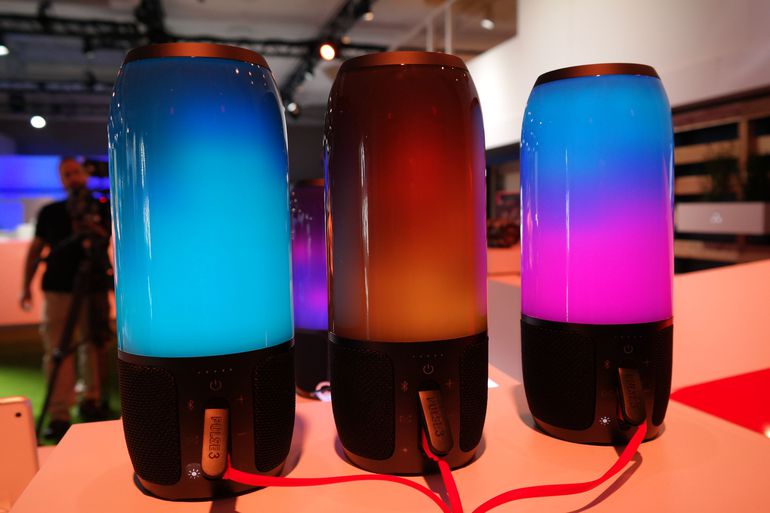
The Pulse 3 from behind charging via micro USB.
David Carnoy/CNET
Black & Decker Smartech Robotic Vacuum Release Date, Price and Specs – CNET
 Black & Decker
Despite robot vacuum competition heating up, we’re still waiting for a competent model at a reasonable price. Maybe Black & Decker’s first entry into the field — the Smartech Robotic Vacuum on display at CES — can fill that void.
Robot vacuums
- Neato Botvac Connected
- Roomba 980
- Dyson 360 Eye
Sure, we quite like models from iRobot and Neato, but expect to shell out $700 plus for a current gen model and upward of $500 even for an older Neato. Starting in March, you’ll be able to buy any one of four new Black & Decker bots priced between $300 and $400.
At the top of the range, the $400 Smartech bot has features competitive with iRobot and Neato. Like the recent Neato Botvac Connected and Roomba 980, you can steer the Smartech bot with an app on your phone and set a schedule for it.
Better yet, the $400 Smartech bot senses whether it’s vacuuming carpet or hardwood and switches modes automatically, something neither iRobot nor Neato can do. We saw Smartech debuted on stick vacuums at CES last year. The rest of its specs are competitive as well.
- 90 minutes of battery life
- 1-liter dust bin
- A HEPA filter
- Three cleaning modes: Auto, Quick and Spot Clean
- Anti-tangle bristles
- iOS and Android apps
Check out all the smart home products at…
See full gallery


1 – 4 of 33
Next
Prev
A couple of gimmicks — you can also change the color of an LED on top of the Smartech vac and name it in the app — round out the features.
Unfortunately, those two add-ons aren’t the first to go when you start cutting the price for the cheaper models. The $380, $350, and $300 models primarily cut the anti-tangle brush, battery life, and smarts respectively.
Regardless, if the Smartech line can navigate and clean as well as the high-priced competition, Black & Decker’s army of robo vacs will be well positioned to move in on iRobot and Neato’s turf.
 AIVAnet