


The consequences of the Trump presidency on cybersecurity
Hacking and cybersecurity played a huge role in the presidential election. So much so that Donald Trump, America’s new president-elect, was helped greatly by the acts of criminal hackers in his journey to the White House, and is now an outspoken WikiLeaks fan.
Though, unless he appoints Julian Assange as his Cybersecurity Czar, I doubt we’ll be seeing WikiLeaks coming to Trump’s rescue when he needs help with cyber-policy in the near future. But you never know.
And that’s where this insane ride, where any consideration of the human beings who will experience the consequences of their combined machinations is absent, is going: Mr. Trump is now going to be in control of America’s cybersecurity and cyber-warfare policies and plans. He has promised that what he called “the cyber” in his last debate will immediately become a priority, citing threats in the form of China and North Korea.
Mr. Trump openly advocates hacking back, a controversial and ill-advised strategy. He said in 2015, “America should counter attack and make public every action taken by China to steal or disrupt our operations, whether they be private or governmental.”
More recently he told press in October, “The United States must possess unquestioned capacity to launch crippling counter-cyberattacks. This is the warfare of the future… America’s dominance in this arena must be unquestioned and today, it’s totally questioned.”

These are the words of someone totally clueless about cyberwarfare, they are from someone who telegraphs every move, and disturbingly, these are words of war.
As you may remember (or might be repressing, like trauma), Mr. Trump foreshadowed his targeting of China for cyber infractions in his last debate with Hillary Clinton. When Ms. Clinton said that Russia was behind recent hacks against the United States, especially the DNC hacks that helped Trump win the election, he went on the defensive for Russia.
“I don’t think that anybody knows it was Russia that broke into the DNC,” he said. Trump unforgettably elaborated saying “It could also be China or it could also be lots of other people — it also could be somebody sitting on their bed that weighs 400 pounds.”
It actually took until October for Trump to realize that cybersecurity was a priority, at which point he published his vision for cybersecurity policy on his website. It was actually excerpts from a campaign speech he gave, so let’s not get too excited that we might have anything concrete to work with. But it gives us an idea of who he plans to make handle these issues for him — and of course promises to develop and deploy cyber weapons.
It states: “Develop the offensive cyber capabilities we need to deter attacks by both state and non-state actors and, if necessary, to respond appropriately.”
Trump’s cyber “vision,” as outlined on his website, shows that he intends to hand most of the work off to others. His first “vision” plan is to have a review done by a team of his choosing, the likes of which sound vague, uninformed, and somewhat impossible if interpreted literally. He wants to “Order an immediate review of all U.S. cyber defenses and vulnerabilities, including critical infrastructure, by a Cyber Review Team of individuals from the military, law enforcement, and the private sector.”
The next step in Trump’s cyber plan is specifically for the U.S. Department of Justice “to create Joint Task Forces throughout the U.S. to coordinate Federal, State, and local law enforcement responses to cyber threats.” That will fall to the new attorney general, who in all likelihood will be Rudolph W. Giuliani.

Former New York City Mayor Rudy Giuliani has a lot on the record to let us know where he stands on “the cyber.” Giuliani has been interested in cybersecurity since he read an FBI report in 2003 predicting a hacking crimewave, and instantly decided he needed to build a business around it. That business was Giuliani Partners, a security consulting company whose pentesting arm was specifically comprised of ex-government and ex-military employees he said because even reformed hackers can’t be trusted.
After Giuliani Partners, he became the global chair of law firm Greenberg Traurig’s cybersecurity and crisis management practice in January 2016. Shortly after joining Greenberg Traurig, he did a press junket comparing hackers to Mafia and cybersecurity to cancer.
And that’s something the two men have in common: Giuliani and Trump hate hackers — unless hackers are doing the dirty work in their favor, of course. In regard to Edward Snowden, Trump has been clear that he believes the former government contractor should be executed. Maybe once he’s president, Trump will get his wish in the form of a congratulations gift from his BFF, Putin.
As we know, everything with Trump has to do with his likes and dislikes. And he likes surveillance, as evidenced in his personal phone-spying practices, and he likes the NSA’s spying. In fact, Trump is an outspoken supporter of government surveillance, and in his words, the NSA “should be given as much leeway as possible.”
He told The Daily Signal, “I support legislation which allows the NSA to hold the bulk metadata. For oversight, I propose that a court, which is available any time on any day, is created to issue individual rulings on when this metadata can be accessed.”
Mr. Trump didn’t like Apple refusing to unlock the San Bernardino shooter’s iPhone for the FBI this past year, and his reaction to the case is instructive. When it was brought to his attention, Trump said Apple should be forced to allow the FBI access to the phone’s contents. “I think it’s disgraceful that Apple is not helping on that. I think security first, and I feel — I always felt security first,” he said. “Apple should absolutely — we should force them to do it,” he said.
There’s another very serious way in which Mr. Trump will impact the worlds of hacking any cybersecurity that few are thinking about at this very weird moment in time. Trump’s intents and desired policy changes with immigration and jobs will actually take all the problems we have with domestic cybersecurity in this country and crank them up to eleven. It’s not advanced math: We have a epic cybersecurity hiring crisis, and much of our talent pipeline relies on foreigners holding jobs here, or emigrating to the United States.
These problems start in Trump’s plan for his first 100 days in office called “Donald Trump’s Contract With The American Voter,” released at the end of October.
That plan has three primary intents. These are: to enact Trump’s “naughty or nice” list in Washington; do what he feels is necessary to protect American workers; and to restore rule of law. This is all in addition to all the other lovely things he plans, like repealing the Affordable Care Act — something that will also negatively impact infosec, specifically independent hacking and security contractors.

Hiring is cyber’s biggest pain point. There is a severe shortage of information security professionals, in both government and public sector companies, and leading industry experts say it’s only getting worse. For an area whose growth is incomprehensibly fast to outsiders, its escalating hiring crisis seems counterintuitive — though when you start to see the numbers, calling it a crisis is an understatement. James Gosler a veteran cybersecurity specialist who has worked at the CIA, the National Security Agency and the Energy Department, has argued that the United States government itself “needs some 30,000 technical cybersecurity workers, essentially hackers.”
Mr. Gosler can’t be thrilled to hear that Mr. Trump’s Contract plans to enforce “a hiring freeze on all federal employees to reduce federal workforce through attrition (exempting military, public safety, and public health.”
Meanwhile, the International Information Systems Security Certification Consortium has calculated that over 300,000 cyber-security professionals are needed to maintain and manage business structures.
Many believe that a big part of the domestic problem are the bureaucratic roadblocks to hiring talent outside borders, because the need within the US is so large, it simply can’t be filled by domestic talent. Unfortunately for that urgent need, Mr. Trump’s first “Contract With America” point is to “renegotiate NAFTA or withdraw from the deal under Article 2205.” The problem is, NAFTA isn’t just about manufacturing; it helps facilitate low-friction ways for firms to hire cybersecurity talent.
Companies like Google and and others who’ve brought in security talent from other countries will want to hurry up and get that Green Card process underway so they can keep those workers. Because according to the Contract he wants to “begin removing the more than 2 million criminal illegal immigrants from the country and cancel visas to foreign countries that won’t take them back” and “suspend immigration from terror-prone regions where vetting cannot safely occur.”
With the loss of cybersecurity talent pipelines and deportation of foreign hacking talent, the security crisis — all the breaches, IoT botnet and security issues, our ransomware epidemic, and the medical cybercrisis — will worsen.
Threat monitoring will weaken in companies and organizations, patches will slide, needed security trainings won’t happen due to staffing issues (so phishing will continue its damage), internal security overhauls can’t happen without enough workers.
It is the end of an era for many things now, but for cybersecurity, it was supposed to be the beginning.

We had made progress, even if rough, in getting the government to listen to hackers and consumers about security. President Obama understood tech’s hiring issues and how they hinge on foreign workers right now. We’d pushed back on things like export controls and the stupid concept of “cyber bombs,” and some people were starting to listen.
So it wasn’t supposed to turn out this way. The Justice Department wasn’t going to be run by a corrupt wacko who thinks hackers are forever evil, and who actually, quite crazily believes he can solve cybersecurity. Nor the White House run by an emotional, vengeful child who thinks cyberwar — a war with real consequences, which would cost lives — as his first and best option.
It’s clear that the new White House will exist in a self-fulfilling bubble, where it believes cyber is just another thing a couple of selfish, egotistical, bigoted men can manipulate for its own ends.
Men who embrace unbridled surveillance of innocent citizens and remove healthcare from those who need it most because their ways of relating to ordinary human beings have been severed in a way that facilitate a blatant disregard for the sanctity of other people’s lives.
Cybersecurity, our own experiences of it, and those most at risk, will suffer as a result of this election. Because what’s most foretelling of individual suffering, ultimately, is not the surveillance, the lying, or the messing with our heads, but the indifference of those in control.
Images: AP Photo/Evan Vucci (Trump); AP Photo/Arnulfo Franco (Giuliani); REUTERS/Hyungwon Kang (Cyber security), AP Photo/Evan Vucci (Obama)
Ender Dragon is coming for your Windows 10 ‘Minecraft’ realms
Microsoft is all about unified apps these days and that applies to its $2.5 billion baby Minecraft, too. The Pocket and Windows 10 versions of the blocky creation-and-survival game are almost at parity with the original Java version, developer Mojang announced today. The 1.0 update, dubbed “The End,” brings end-game boss The Ender Dragon and the The End dimension to desktop and mobile players. But, despite its name, Mojang says that continual updates are planned after this is released. Oh, and the 1.0 version is what will arrive by year’s end on Apple TV as well.
More than just adding a dragon (as cool as that is), world height is getting a bump to 256 blocks — a big step up from the previous Pocket and Win10 version’s 128. For a bit of context, clouds start appearing at 127 blocks high. Reach for the sky, y’all. There’s also a new Elytra glider available for soaring over the pixely world, in addition to a handful of bits like a new mob (the Shulker) and new resources to mine.
Android users can try it out in beta starting today, but everyone else will have to wait until the update is released because the beta is exclusive to Google’s mobile platform.
Source: Mojang
Your search history could be an early detector for lung cancer
“You may have lung cancer. Please consult a physician.” That’d very likely be the worst alert you could ever see on your phone, right? In the future, though, it could be a reality. By looking at anonymous search history and cross-referencing it with demographic data, scientists from Microsoft Research propose that 39 percent of oncology diagnosis could be made a year earlier — no Watson required. It definitely sounds like something out of Minority Report, but applied to healthcare.
Using Bing (this is Microsoft we’re talking about, after all), the researchers looked for queries like “I was just diagnosed with lung cancer,” and then worked backwards from there, according to Bloomberg. Then the scientists scoured those users’ histories for symptom-related searches like bronchitis or chest pain. From there, things like smoking or exposure to radon gas were derived from location data and other search terms.
Of course, with this sort of thing, there’s always the chance for false diagnosis. That 39 percent success rate is with one false positive per 1,000 patients. And dropping to one false diagnosis in 100,000 patients could still give three percent of folks an early warning.
Since cancer diagnosis often comes when a patient is already terminal, this feasibility study, with additional testing and research, could prove to be incredibly important. And it’d probably result in one notification you wouldn’t absentmindedly swipe away.
Via: Bloomberg
Source: JAMA Oncology
Weatherbug: An oldie but goodie that gets better with time (Review)

With so many apps available these days, it’s easier than ever to stay on top of everything that’s important to you. If it’s sports, entertainment, or the weather, that you are most interested in, mobile apps are there to keep you informed and make your life much more convenient.
 One of the best weather apps out there is WeatherBug. You have likely used these kinds of apps in the past, but they probably just gave you information and a weekly outlook, and not much else. With WeatherBug, however, you can go a step further and see how the weather will impact your day-to-day life. If you’re interested in knowing all things weather, then WeatherBug is for you.
The best part of WeatherBug is that it comes from a trusted source. The app has been downloaded over ten million times, and it’s completely free to download and install. You can get up and running in minutes, and anyone can use this app, as long as they know how to navigate the easy-to-follow menu.
Setting It Up
 WeatherBug is pretty straightforward. After you download and install it, you open it up, and it will ask you to agree to the terms and conditions. After you accept, you will find yourself on the home page. The app is available for as both a Android weather app and IOS weather app.
At first, the app will search for your general location. However, if you want to save multiple spots or have a more precise reading, you will need to sign up with your contact information. You can do so by signing up with your Facebook login or via email. If you do go through email, you will need to verify it once you’ve entered it. The only information needed is your gender and birthday, and once again you will need to agree to terms and conditions.
App Details
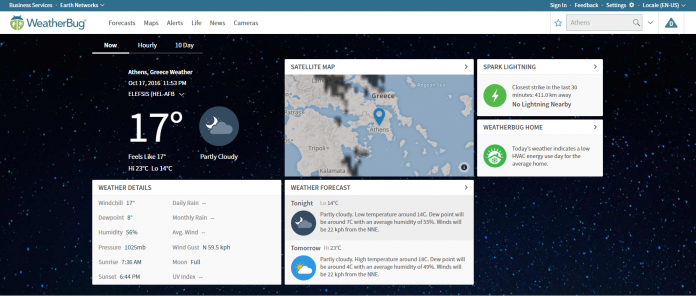
On the main page, the app is set up with a set of widgets that you can arrange to your liking. The top shows your current location, with time, temperature, cloudiness level, real feel temperature, and the high and low for the day. Below that you have a list of widgets, including:
- Wind and rain meter
- Home energy usage meter
- Weather news (for the country and your state)
- Spark widget (checks lightning nearby)
- Photos
- Outlook for the week, including videos
- Live cams nearby
- Lifestyle widget
 The most useful widgets that are available are home energy use, weather news, outlook, and lifestyle. Spark is most useful if you live in an area with a lot of lightning, and the live cams are helpful if you want to check traffic before you head anywhere.
Highlighted Features
Lifestyle
Our favorite widget is the lifestyle because it will tell you how the weather will impact your daily routine. Want to mow the lawn? This app will show you the best time to do it. Want to know when allergies are at their peak? You can find out here. This widget enables you to take the data provided and apply it in a way that affects you.
Home Energy Usage
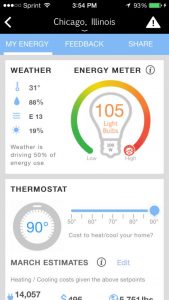
This is another powerful tool if you want to save money on your utility bills and conserve energy. Based on the weather in your area, you can sync up your home’s thermostat and find out what the ideal temperature range is for you.
Weekly Outlook
This is another valuable tool if you want to get an overview of the week. With this option, you get a comprehensive view of the days to come, rather than just a list of highs and lows. Here you will find what expert meteorologists have to say about the weather on any given week.
Other Notable Features
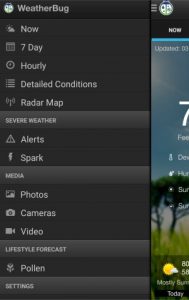 The WeatherBug app gives you the ability to save multiple locations, has customizable settings, includes a temperature readout in your status bar, and hosts interactive maps so you can see what the weather looks like around you visually, rather than numerically.
Conclusion
WeatherBug is a practical app to monitor the weather. We especially like that you can see how the weather impacts your utility bills, your lifestyle, and the traffic. And to top it off, it’s conveniently customizable for your needs.
Penn students targeted in racist, violent GroupMe campaign
It’s barely been 72 hours since Donald Trump was elected president and the racism that his campaign stoked over the last 15 months has already burst through its floodgates. Since the race was called, Twitter has been awash in stories of minority citizens being bullied, harassed, threatened and physically assaulted by newly emboldened white nationalists. On Friday, that racist tide flooded through Penn University when someone launched a virulently bigoted GroupMe board titled “N–er Lynching” and then added a number of black freshmen at the school.
Calvary Rogers, a freshman at the university, first brought the group to the administration’s attention. Soon after, however, numerous students began posting their own reactions to the group on social media.
Black students throughout @Penn’s campus, like myself, have been added to this hateful GroupMe. I am petrified and all I want to do is cry. pic.twitter.com/DrqLvpXAW5
— Chidera (@chiderasiegbu) November 11, 2016
By 3:40, the University had determined that the OP “appears to based in Oklahoma” and that the school was working with authorities to dewtermine the origin of the posts. “Our police and information security staff are trying to locate the exact source,” Penn spokesperson Ron Ozio said over email to BillyPenn, “and see what steps can be taken to cut the account off.”
A statement from Penn on the current events on campus. pic.twitter.com/CALK7OERup
— Penn (@Penn) November 11, 2016
The Penn student body doesn’t appear to be backing down either. A number of students have already gathered at the The Vice Provost for University Life offices on campus to organize and protest against the messages. Even the Penn College Republicans have spoken out against the matter.
“These messages are absolutely despicable,” a statement fromt he student group reads. “Hate such as this has no place on Penn’s campus or in our nation. Our thoughts and prayers are with those affected, and we hope that Penn administration and Penn police find the perpetrators as soon as possible.”
Source: The Daily Pennsylvanian
iBooks StoryTime app narrates children’s stories on your Apple TV
To encourage parents and kids to read together, Apple has debuted a new app for tvOS. The iBooks StoryTime app features “Read-Aloud” tool that narrates books and flips pages automatically. For the times when you’d rather read to your child yourself, you can turn the feature off and turn to the next page by swiping with the Apple TV remote.
Selections include books with Sesame Street characters and stories from other children’s favorites like Teenage Mutant Ninja Turtles. You can purchase iBooks from any Apple device and the Read-Aloud stories will sync automatically in the library on your Apple TV. iBooks StoryTime for tvOS is free and it comes with Dora’s Big Buddy Race Read-Along Storybook at no extra charge so you can test drive the app without having to hand over any funds.

Via: The Verge
Source: App Store
 AIVAnet