


AT&T Plans to Gift Free Apple TV to DirecTV Now Subscribers Who Commit to 3+ Months of Service
AT&T plans to gift a free Apple TV to DirecTV Now subscribers who commit to at least three months of paid service, according to documents seen by Variety. Likewise, customers who pay for at least one month of service will allegedly receive a free Fire TV stick. The promotion ensures early subscribers will have at least one device with access to DirecTV Now when it launches.
DirecTV Now is AT&T’s internet-based live TV streaming service slated to launch in late 2016. The cord-cutter service will start at $35 per month and provide access to more than 100 channels, such as ABC, A&E, CBS, ESPN, Fox, HBO, MTV, NBC, Nickelodeon, and Discovery, on smartphones, tablets, streaming boxes, and other devices. Availability of channels may vary based on regional restrictions.
DirecTV Now will reportedly include a 72-hour catch-up window, allowing subscribers to watch TV shows they missed up to three days later, alongside a video-on-demand library of up to 14,000 titles. A free 7-day trial will be available upon launch.
Related Roundups: Apple TV, tvOS 10
Tags: AT&T, DirecTV Now
Buyer’s Guide: Apple TV (Caution)
Discuss this article in our forums
Uber, Lyft, and Zipcar Launch Election Day Promos to Help Voters Get to the Polls
Ahead of Election Day in the United States tomorrow, November 8, a collection of popular iOS and Android ride-hailing apps have launched promos for customers to more easily make it to their polling location before the 8PM deadline (via BuzzFeed). As the biggest ride-hailing app in the U.S., Uber [Direct Link] recently announced that starting tomorrow an action sheet will pop up when users launch the app, reminding them to vote.
Through a partnership with Google, the prompt will also include a way for users to find their polling place, add it as a destination, and use Uber to make it to the polls. Uber said that the small update was implemented because the company wants “to make getting to and from your polling place easier than ever.” As a blanket rule, polls open 6AM and close at 8PM.
Let Uber and Google help you get out to vote. As part of our ongoing campaign to encourage users to vote, Uber is teaming up with Google to launch a special in-app feature on November 8th that will help you locate your polling location and then seamlessly request a ride with just a push of a button.
Given the important decision people around the country will make on November 8th, we wanted to make getting to and from your polling place easier than ever. Teaming up with Google, Uber is excited to help make that trip as convenient and stress free as possible.
Another popular taxiing app, Lyft [Direct Link], is angling its Election Day promotion as more of a money-saver for its customers (via The Verge). In twenty select markets, Lyft riders will be able to get a 45 percent discount on one ride between 7AM and 8PM tomorrow, although the return trip does not receive a similar discount.
Lyft’s promotion is limited to the following cities: Atlanta, Baltimore, Boston, Charlotte, Chicago, Dallas, Denver, Detroit, Miami, Minneapolis-St. Paul, Nashville, New Orleans, New York City and New Jersey, Orange County, Philadelphia, Phoenix, Portland, Raleigh, San Diego, and Washington. Eligible customers in these cities can check their inbox for a promotional email from Lyft and take advantage of the 45 percent discount in the Deals of the Week section of the app.
Car-sharing company Zipcar [Direct Link] is offering 7,000 of its vehicles completely free of charge on Election Day to customers riding to the polls. Of course, limitations apply, including the fact that a free Zipcar can only be taken between the limiting, last-minute window of 6PM and 10PM on the night of November 8. Users can reserve a Zipcar now, although supplies of the 7,000 rides available are likely to be limited.
Note: Due to the political nature of the discussion regarding this topic, the discussion thread is located in our Politics, Religion, Social Issues forum. All forum members and site visitors are welcome to read and follow the thread, but posting is limited to forum members with at least 100 posts.
Tags: Uber, Lyft, Zipcar
Discuss this article in our forums
Reflecting on the Leica SL: Three photographers talk about the mirrorless marvel
Towards the end of 2015 Leica released a brand new system camera to its lineup: the Leica SL. As the world’s first mirrorless full-frame camera it represented a shift in the company’s thinking – with advanced autofocus, touchscreen control, advanced electronic viewfinder and its new zoom lenses showing a modern focus from the German company.
And photographers are loving it. A year after its initial announcement, we caught up with three Leica SL users – Olaf Willoughby, Fred Mortagne and Kristen Meister – to garner the ins and outs about what makes this particular camera special in their photography practice.
Leica SL: The move to mirrorless
Olaf Willoughby, a conceptual photographer, is a long-time Leica user. “I’ve got three: the M Monochrom, the SL and the M (Typ 240). What initially drew me to the brand was the quest for perfect images. I think Leica lenses are the best available.”
Olaf Willoughby
For Fred Mortagne, aka French Fred, a well-known skateboard photographer, it was a different story: “After using the same film-based gear for over 12 years I was reluctant to be convinced by digital. But now with the SL I manage to achieve similar results.
“I’m also widely working in videography – so it’s good to have a great quality camera that can cover all fields,” he says referring to the SL’s 4K video capture capabilities.
Fred Mortagne
Kristen Meister, known for her American landscapes, didn’t start out as a Leica user. “I was a Nikon shooter – Leica was always a reach brand – but the SL replaced all the needs I had as an SLR shooter, while serving as an upgrade too.”
That’s the power of mirrorless. The SL has no mirror box like a traditional DSLR, so its autofocus is just as quick whether using the screen or electronic viewfinder to compose images.
Leica SL: A viewfinder like no other
When it comes to points of difference compared to the wider camera market, all three photographers are clear that the Leica SL’s 4.4-million pixel EyeRes viewfinder is one of its standout points.
Kristen Meister
“Leica has raised the bar here. The electronic viewfinder separates the SL from the Nikon D800 and D610,” says Meister.
Willoughby agrees: “The EVF is really a major leap forward in terms of resolution and brightness. I mean you pick up a Sony and, well, the picture itself isn’t very clear and the quality isn’t there. But you look through the SL’s finder and it’s pretty much like looking through a normal viewfinder. It’s very good.”
As mirrorless cameras use electronic viewfinders, rather than traditional optical ones, it has taken brands a long time to elevate the standard for size and resolution. Leica ensured it went in at the top-end with the SL.
Fred Mortagne
Mortagne has similar thoughts: “The big size of the viewfinder really allows me to see deep into the scene and see all the details, rather than discovering some annoying ones when opening files on the workstation after.”
Leica SL: Lens flexibility
In particular the breadth of these photographers’ work shows how the SL can serve so many differing shooting styles – from street photography to fast-moving skateboarding, meticulously composed landscapes and beyond.
Fred Mortagne
Mortagne doesn’t find the fast motion of his skateboarding subjects to be of any concern. “My work is more about composition than speed. And with the SL’s 24-90mm lens I’m certain to have all the necessary composition options. Sure the lens is big, but it’s got more benefits than drawbacks for me.”
Willoughby compares the SL to his Leica M Monochrom, highlighting their almost complementary differences. “The Monochrom is so small and so easy to use, with the manual rangefinder focus – but you need time to work with it. The SL is distinct from that. It’s immediate: bang. Even if it’s got the big zoom lens on it, it just snaps subjects into focus and it’s done. It’s almost silent too – so quiet that people wouldn’t realise a picture is being taken.”
Olaf Willoughby
Meister, reflecting Willoughby’s earlier sentiment, think the lenses are a key component of sticking with Leica, whether the distinct SL-mount – the 24-90mm f/2.8-4 was the only lens available at launch, with 90-280mm f/2.8-4 and 50mm f/1.4 options launched since – or manual use M-mount lenses via an adapter.
“The SL allows me to use specialty lenses like the M-series 50mm f/0.95 Noctilux to create a unique look. While I own other M-series lenses, I don’t tend to use them on the SL because of the weighting; the Noctilux is a big lens on the M bodies, but feels nice on the SL body.
“I am looking forward to more wide-angle lens choices for the SL-mount: the announcement of a 16-35mm lens due for late 2017 was cause for celebration, though I wish it was coming sooner.”
Pocket-lint
Meister doesn’t fret about the camera’s overall size. “I’m not trying to be stealthy with the SL. I am primarily a landscape and outdoor photographer, and the trees and mountains don’t tend to be frightened by a bigger camera! When I am traveling trying to capture a great moment I don’t care about the size of the equipment as much as I care about the performance.”
Willoughby comments that the SL-mount 24-90mm lens is “only big and heavy compared to other Leica cameras. It’s not big and heavy compared to other equivalent cameras.”
Olaf Willoughby
Mortagne, with his video focus to the fore, sees even wider potential beyond the M, S and R lenses: “I’d like to try it with Cine lenses, as I hear the quality is really killer. Although for street photography I definitely go out with my M-series lenses mounted on the SL.”
Leica SL: Resolution sweet spot
With such a wide variety of topics, and experience with other higher-resolution cameras, the question of resolution crops up. Does the 24-megapixel full-frame sensor in the Leica SL hit the “sweet spot”?
Kristen Meister
Meister feels it’s the right choice. “I ‘downgraded’ from 36-megapixels with the Nikon D800 when I moved to the Leica SL, and I haven’t been the least bit fazed by the decrease in resolution. The increase in image quality and dynamic range more than compensates for that difference – there is so much dynamic range and colour detail in the files. Plus the D800 resolution acted as a crutch – it allowed me to be a lazy photographer and crop. I’ve become a more deliberate and thoughtful photographer because of the SL.”
Mortange agrees: “It’s all I need. In fact it’s often too good – I tend to add grain to my images in post-production! With the skateboard series I shot in Los Angeles, I wanted to show that you can achieve a great black & white arty look with that filmic grain.”
Leica SL: Telling a story
What, then, is it about the Leica SL that stands it apart from the competition?
Kristen Meister
Willoughby enjoys the detachment. “The SL has got the zoom and autofocus that makes it so simple to shoot with. That means I can focus on how I’m going to shoot that’s different to anyone else. I think the craft comes from the heart.”
Meister is all about telling a story. “The Leica SL opened up a whole new world of storytelling for me. If the viewer looks at my work and feels something, then I’ve accomplished my goal. Making a pretty picture is a combination of luck and timing – making fine art photographs requires a great deal of thought about the story and feelings you want the viewer to experience.”
Fred Mortagne
For French Fred it’s the control over video that no other Leica offers. “The auto-focus is really helpful, and because I can change the focus point with a touch on the screen, while filming, it’s really helpful. I shoot a lot with manual focus, too, but I am never fully certain if my focusing is right. With the SL’s digital zoom in focus assist, there are no bad surprises. And I’ve never shot such beautiful footage before, genuinely.”
Leica SL: Want to know more?
Fred Mortage can be found on Instagram (@frenchfred), or via his website frenchfred.com. His book, Attraper Au Vol, will be available worldwide from November, published by Umyeaharts.
Olaf Willoughby can be found via his website, olafwilloughby.com, on Twitter and Instagram. His book Antarctica, A Sense of Place is available now.
Kristen Meister is an internationally published American photographer currently residing in Europe, and the winner of the 2014 Vincent Versace Award for Photographic Excellence. Her work can be viewed at http://www.scenictraverse.com, on Facebook, or on Instagram.
The Leica SL is available now from selected retailers, or direct from Leica stores, priced £5,870 body only.
- Leica SL preview: The mirrorless marvel?
Sony’s PlayStation 4 Pro is a perfect way to show off your 4K TV
The PlayStation 4 Pro is a new breed of console. It’s not going to replace the original system. Instead, it’s meant to tide over gamers who’ve upgraded to new 4K TVs with fancy high-dynamic range (HDR) lighting features. It’s a more significant step up than the Xbox One S, which is mostly centered around upscaling 4K content, but it’ll directly compete with Microsoft’s bigger console upgrade, Project Scorpio, next year. Welcome to the new era of gaming systems, which is beginning to resemble the world of PC games with a multitude of minor upgrades, rather than completely new system generations. (Nintendo, ever the iconoclast, is trying to do something both new and traditional with the Switch.)
There’s no doubt that the $399 PlayStation 4 Pro is the closest we’ve gotten to high-end PC-quality graphics on a home console. But the thing is, it’s not going to be a major upgrade for existing PS4 owners. And to really see the benefits of its faster hardware, you’ll have to wait for games to get upgraded. At the very least, though, it’s a welcome reward for anyone who’s held off on buying a PlayStation 4 until now.
Hardware
Take Sony’s original PlayStation 4 design, add another sharply angled layer on top, and you have the the PlayStation 4 Pro. You could call it a triple-decker PS4. It’s a tad taller than the original, but otherwise they look near-identical, with the same general shape and black plastic case. The PlayStation 4 Pro extends a bit farther back than before, likely to make room for both a larger power supply and more powerful components.
The PlayStation 4 Pro’s front buttons are physical, rather than touch-sensitive, and they’re separated now, with the power button on the far left and eject on the far right. (The original PS4’s buttons are incredibly tiny and located right above and below each other, which has led to plenty of frustration among gamers.) There are two USB 3.0 ports on the front, just like before, and an additional one in the rear. The latter is useful for connecting the PlayStation VR neatly without taking up on of the precious front USB ports.. Alongside the HDMI port is a standard power connection, an “Aux” output for the PlayStation camera, an optical audio port (which is notably absent from the PS4 Slim), and an Ethernet jack.
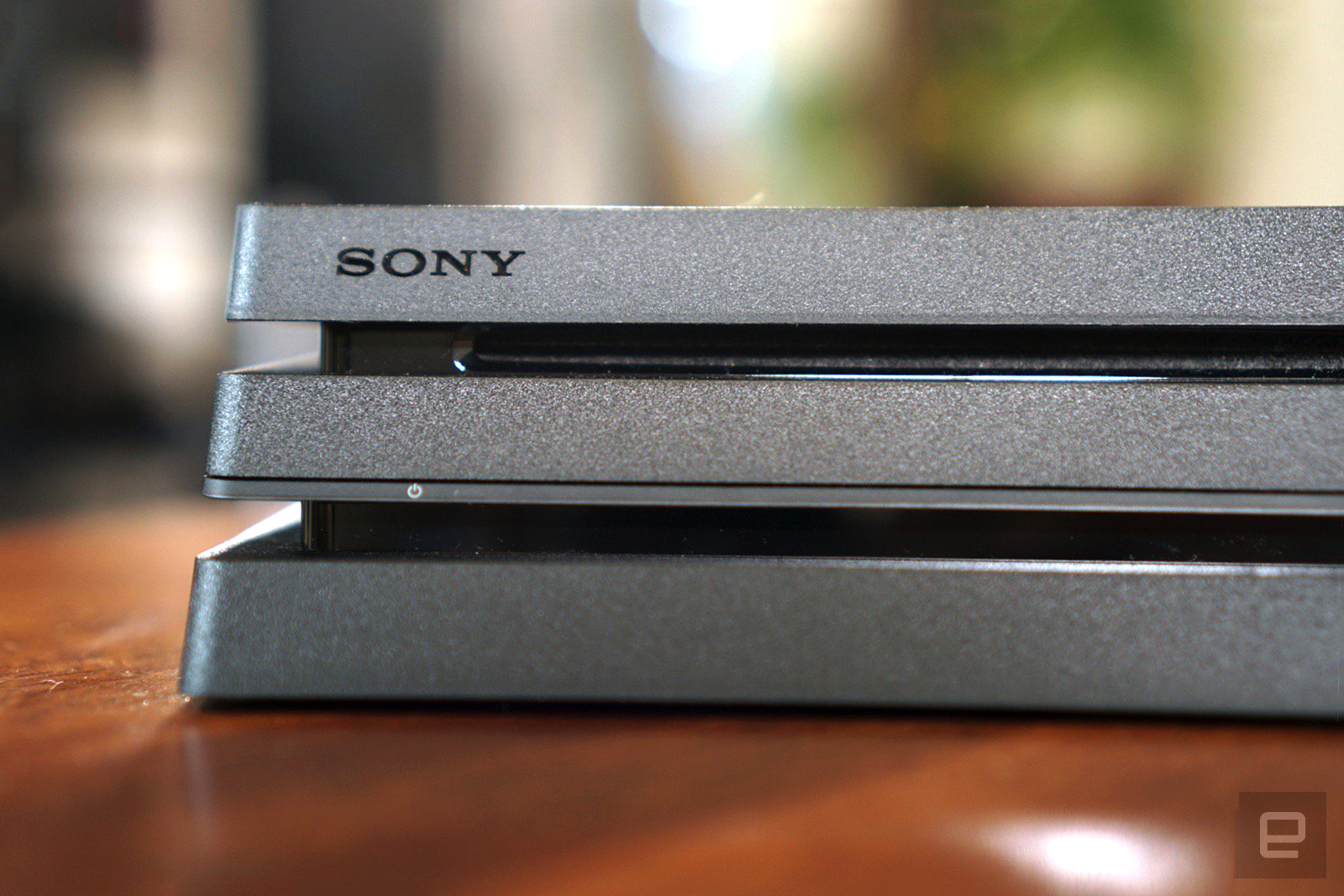
But forget aesthetics: What’s most important is what’s under the hood. And much of that is drool-worthy. The PS4 Pro packs in a speedier eight-core CPU; a new 4.2 teraflop AMD Polaris GPU that’s twice as fast as the original PS4; a 1TB hard drive; and 8GB of RAM. Just like the PS4 Slim, it also adds an 802.11ac 5GHz WiFi radio, which should make downloading games and large updates significantly faster. On paper, the PlayStation 4 Pro sounds more like a decent gaming PC than a console.
Sony’s revamped DualShock 4 also comes with the PS4 Pro, after first making its debut with the PS4 Slim. It’s functionally identical to the original controller, except the LED lighting from the front now carries over to a thin strip above the touch panel. That’s useful for figuring out things like which character you’re controlling in a multiplayer game. There are a handful of other minor aesthetic tweaks too, like using gray for the triggers and some buttons, but they’re honestly too minor to mention. If you’ve held a DualShock 4 before, you won’t feel much of a difference here.
While the PS4 Pro is packed to the gills with fresh hardware, there is one surprising omission: a 4K Blu-ray drive. That’s something the Xbox One S includes, and for $100 less than the PS4 Pro, too. Forgoing 4K Blu-ray particularly is surprising because Sony is one of the main backers of the Blu-ray format. It would be like if Microsoft chose to dump support for Word files in its next OS; it’s hard to fathom why they’d do it. Sony says it’s focusing on 4K/HDR streaming with the PS4 Pro (more on that below), but that doesn’t completely explain why it’s seemingly cutting off its own format at the knees. Did Sony forget that the PlayStation 2 was one of the big reasons DVDs took off so quickly?
In use

I’ve long argued that 4K isn’t something consumers should get too worked up about, at least not yet. But, in preparation for testing the PlayStation 4 Pro, I bit the bullet and purchased LG’s 55-inch B6 OLED TV. So, for once, I was actually excited about 4K. We’re also at the point where that format is finally beginning to make sense for mainstream consumers. 4KTVs are getting cheaper (I was astounded to find an OLED set under $2,000), there’s more high-resolution content out there, and HDR also makes a compelling case for upgrading (even more so than 4K itself).
Basically, it seems like we’ve finally reached a point where 4K isn’t just something being forced on us by TV makers. So it makes sense for Sony to jump aboard the bandwagon and introduce a console centered entirely around it.

I should also point out that I’m coming at this console after shifting much of my AAA gaming over to my PC. If I can get even better quality for the same price, and still pipe it conveniently to my living room from my PC, why would I choose a lesser console experience? Indeed, the PS4 Pro’s very existence seems designed to tempt PC gamers.
After excitedly connecting all of the necessary cables, I booted up the PlayStation 4 Pro and was honestly a bit disappointed just to see the same old PS4 home screen. It makes sense for Sony to avoid fragmenting its software too much, but still, I’d like something to indicate it’s different. Then I started playing some games upgraded to support the new console, and my mood changed considerably.

The games
I started off with The Last of Us: Remastered, a game that I know well after playing through it on the PS3 and a bit on the original PlayStation 4. It’s one of the first titles to get patched for the new console, an upgrade that adds an HDR mode and general improvements to make it hit 60 frames per second more consistently. While that might not sound very exciting, it means there’s a much bigger visual change here than a mere resolution bump. On supported TVs, HDR leads to higher contrast, greater color definition and much deeper blacks than we’re used to.
The Last of Us: Remastered is already an incredible-looking game, but the addition of HDR breathes new life into its environments. You can pick out more depth in the clouds and post-apocalyptic fauna, and pointing the camera at the sun makes it seem almost eye-searingly bright. It’s a good change for the most part, though it sometimes made environments seem artificially oversaturated with color. I didn’t really notice much of an overall performance upgrade either, but there might be some evidence of that later in the game. On my 1080p plasma TV, I didn’t notice any difference playing the game on the PS4 Pro versus the original console.
Sony is leaving it up to developers to figure out ways to tap into the PS4 Pro’s power. For the most part, devs will include some combination of rendering games at a higher resolution than 1080p, packing in more visual effects and delivering a smoother overall experience. As I’ve reported before, most PS4 Pro titles won’t render natively at 4K, though that’s not something you should get too hung up on. Running at something like 2160p (2K) with more graphical bells and whistles should still lead to much better looking games than on the original PS4. Wisely too, Sony isn’t allowing developers to charge for PS4 Pro support either.
Infamous Second Son lets you choose between playing in a higher resolution than 1080p, or better overall performance. And I quickly noticed that I’d much rather have the game running at higher frame-rates. Smoother gameplay suited Infamous’s fast, action-heavy setup more than a resolution bump. Unfortunately, though, the game also seemed to slow down quite a bit whenever I tried to play in the higher resolution mode.
You’ll have a similar set of choices in Rise of the Tomb Raider. You can either have it run at higher frame-rates in 1080p; get more visual effects at 1080p and 30 fps; or run the game in 4K at 30 frames per second. Again, I leaned towards the non-4K options. What most impressed me is that the game looked like I was running it off of a PC, no matter which mode I chose. Tomb Raider’s HDR support in some ways made it seem even more impressive than on PCs. The environments simply “popped” a bit more; things like the sun bouncing off snow and flames through the game seemed realistically bright, and character models were lit more dramatically.

When it comes to PlayStation VR, the PS4 Pro has even more potential to be useful. VR is the sort of thing where any hardware upgrade could improve your experience considerably. I was only able to test out the console in Sony’s PlayStation VR Worlds, but I noticed that the environments and characters were all sharper, and frame rates seemed generally smoother. It didn’t seem to improve head and hand tracking much, but the upgrades make PSVR seem like a more viable competitor to PC-powered VR moving forward.
One peculiar issue: You can’t run PlayStation 4 Pro games in HDR while the PSVR is connected. Sony’s VR system relies on a passthrough box that apparently can’t handle an HDR signal. That could be a huge inconvenience to many gamers, since it means you’ll probably have to constantly connect and disconnect the PS VR box whenever you’re using it.
While Sony is also positioning the PlayStation 4 Pro as something players with 1080p sets can enjoy, it doesn’t seem worth an upgrade for those consumers yet. You’ll notice the better graphics in games like Rise of the Tomb Raider, but you won’t see any of the HDR benefits. And I just have a hard time recommending a $400 upgrade for minor performance improvements. If you’re a 1080p TV owner who plans to upgrade to 4K eventually, it’s still worth waiting on the PS4 Pro, since it’ll probably be cheaper by the time you get a new tv.
4K media
So how do you get 4K video content when there’s no 4K Blu-ray player on the PlayStation 4 Pro? For now, mainly through Netflix and YouTube. Sony said it’s pinning its hopes on 4K streaming taking off in the future, though strangely enough, it hasn’t yet announced plans to bring the technology to the PlayStation Store. The company recently launched a 4K streaming store for its latest Bravia TVs, but I wouldn’t be surprised to see that reach the PS4 Pro eventually. Both Amazon and Vudu also have a healthy library of 4K content, but they haven’t yet upgraded their apps for the PS4 Pro.
The competition

There’s no doubt about it: The PS4 Pro’s greatest competitor right now is … the PlayStation 4. You might be able to find a decent discount on the original model, and I wouldn’t be surprised to see the Slim discounted for Black Friday. At normal pricing, though, the PS4 Pro is only $100 more than the PS4 Slim. It makes sense to pay a bit more now to future-proof your investment, rather than just settle for an underpowered console you might end up replacing sooner. Complicating things even further, Sony has also enabled HDR on all PlayStation 4 models, which makes it less of a must-have feature for the Pro.
Honestly, the PS4 Pro doesn’t really have direct competition until Microsoft’s next-gen “Project Scorpio” console debuts next year. That system will have an even more powerful 6 teraflop GPU, which could potentially allow developers to reach 4K more easily. Still, it’s hard to get too excited for Scorpio until we know more about it.
You might also consider a decent gaming PC instead of the PS4 Pro, but you’ll probably have to spend closer to $700 to get something that can handle today’s games. And of course, you’ll be out of luck if you’re interested in Sony’s exclusives. But if you can afford it and you care about graphics quality, a PC will deliver the best gaming experience.
Wrap-up

So who is the PlayStation 4 Pro actually meant for? After testing it out for the past week, I’d say it’s for people who haven’t yet bought a PS4 and want to show off their fancy new 4K/HDR sets. And of course, there are the hardcore gamers who will snap up any piece of hardware that promises to be faster. Most consumers are better off waiting until more games get patched for the new system, and until Sony figures out its 4K media strategy.
The Timex IQ+ Move is a glorified (but very pretty) fitness tracker
Fitness trackers and smartwatches have an image problem. Most of them are bulky or bland-looking, while some are borderline ostentatious. Plus, not everyone wants to ditch their Rolex or Omega for a device with a lit-up face that buzzes every five minutes. So companies have been trying to camouflage their smartwatches by embedding them in traditional, analog timepieces. Timex is proving it can appeal to old-timers with its second analog-tracker hybrid, which has a simpler design and is cheaper than its predecessor. The IQ+ Move comes in men’s and women’s sizes and designs for $150, and I’ve been wearing one for about a day. And despite my misgivings about its scarcity of features, I’ve been won over by its classic design and excellent build.
Watch purists like me will appreciate the Move’s conventional good looks. This thing actually looks like a traditional timepiece, and if no one told you, you wouldn’t know it had some smarts. The taupe-colored model I tried is classically pretty, with a dainty 36mm glass-and-metal-alloy case that has a polished sheen. Plus, I loved the slightly intoxicating scent of the genuine leather 18mm band.
That leather band isn’t waterproof, unlike the case, which can withstand submersion in up to 50 meters of water. You can swap it out for a silicone one, which is included with the women’s versions.
I was most impressed by how thin its case is. I’ve always disliked the tall, chunky cases on other smartwatches, but understood that size was a tradeoff to house all the components that make these watches smart. So it was a treat to find that the Move’s module is barely noticeable, and its case is actually slightly thinner compared to the company’s other fully analog offerings.

Other Swiss brands such as Frederique Constant and Mondain have adopted the third-party MotionX Horological platform for turning analog watches into hybrid smartwatches. But because I haven’t seen those two company’s products in real life, I can’t vouch for how sleek they are in person. The Guess Connected, which is made in partnership with Martian Watches, certainly has a heftier case. Timex, however, developed its own module that it calls the IQ+, which gives it more control over how its devices look and perform. The Move is the first of a series of products with this kind of functionality.
The IQ+ system offers some very basic features, and that might explain why it’s thinner than most connected watches. It has an accelerometer that helps it track your steps and distance traveled, and a Bluetooth radio that transmits this information to your iOS or Android device. With the companion app, Timex tracks your calories burned and sleep quality, bringing the total number of monitored metrics to four. In the time that I’ve had my Move, I’ve walked an estimated 2.5 to 3 miles (based on Google Map’s distance calculations). The app says I’ve traveled 3.38 miles. That’s quite a big difference, but I didn’t consider the steps I took at home or in the office, so this isn’t the best way to test the Move’s accuracy.

I also wore the Move to bed, since it’s supposed to automatically track my sleep. Unfortunately, this didn’t happen for me, and I awoke to find that no sleep metrics were recorded. It’s still not clear if the issue is a fluke or if there’s a setting buried in the app that I need to activate (Timex is investigating my problem), but the feature at least appeared to work in a recent demo with company reps present.
That’s one of my biggest issues with the Move: Too many things touted as “automatic” aren’t actually so. My data is supposed to automatically sync with my phone four times a day, but I realized it wasn’t doing that, and I had to manually sync it by holding down the dial for three seconds until I heard a triple beep. Later, as I was exploring the app’s settings, I realized that I had to enable auto sync and pick the four precise times of day I wanted data transfer to happen. That’s something that should already be preset in the app without requiring an opt-in. But it’s an easy problem to fix. Timex has already addressed a bunch of customer concerns about previous iterations by revamping its software, making it easier to navigate and use, so an issue like this could potentially be solved very quickly.

Without your phone, you can still monitor your day’s progress by glancing at the sub-dial on the Move’s face. You can choose to show your steps or distance progress on the second ring, and then set the second hand to always show the other metric. You can also have the second hand point at the current date instead.
The Move doesn’t do much else, really. You can set alarms and countdown timers through your phone, but other features I’ve come to expect, such as call and text alerts, are missing. It has a nice blue backlight that comes on whenever you push on the dial. This takes me back to my childhood, when I would fiddle with my Casio Baby G under my blanket at night. In fact, all it takes is glancing down at the Move on my wrist to transport me back to the days when I wore watches that did nothing but tell time. And that makes me appreciate the device’s conventional aesthetic even more.
Overall, the IQ+ Move is one of the best options in the connected analog watch space. It is a good alternative to the Withings Activite Steel, and looks more like a timepiece than most devices on the market. I appreciate the availability of sizes for men (41mm face, 20mm bands) and women (36mm face, 18mm band) and the variety of truly gorgeous designs for both genders as well. But folks who are more serious about tracking their fitness might need something that’s more full-featured and accurate. The Move is well-suited for someone who prizes good quality and design, and is happy to keep it basic.
Google Search will show election results as they come in
The US election has been good business for Google, thanks in part to its localized ballot data and state voting guides. The search giant wrote that it will soon show election results directly in search after polls close, including “Presidential, Senatorial, Congressional, Gubernatorial races as well as state-level referenda and ballot propositions.” It also revealed counties with the highest voter interest in key battleground states, based on the search query “where to vote.”
A lot of folks caught the election debates on the YouTube channels of Fox, NBC and other media outlets, instead of watching them on cable. Google has promised more of the same, saying you’ll be able to tune in to NBC, PBS, MTV, Bloomberg, Telemundo and The Young Turks on YouTube to watch live, post-election coverage. The company has also been encouraging folks to participate via its #voteIRL campaign (Facebook will also remind 100 million eligible voters that it’s election day). The latest #voteIRL YouTube video (below), features the POTUS himself encouraging you to go to the polls — even though he’s uncertain of what IRL even means.
Source: Google
Apple Seeking Stronger Foothold in India Through Financial Incentives for iPhone Manufacturing Plant
Apple is seeking financial incentives within India to make it easier to build a new manufacturing plant within the country (via The Economic Times).
The company has asked for incentives specifically from the Department of Revenue and the Department of Electronics and Information Technology in India as a way to offset the high cost of building an entirely new iPhone manufacturing unit in the country.
Throughout the year, Apple struggled with India’s local sourcing laws, which requires 30 percent of goods sold by a foreign company to be manufactured or produced within India, a law which also hampered Apple’s retail expansion because it creates most of its products in China. Over the summer, Indian Prime Minister Narendra Modi made it easier for Apple to expand its retail stores in the country by approving a three-year extension on the local sourcing laws because of its single-brand company status selling “cutting-edge technology.”
These various extensions will only last for a few years, however, so Apple’s seeking of financial incentives for its new manufacturing plant proves its long-term goal to have a consistent presence within India.
“They are doing their due diligence from quite some time. The Department of Industrial Policy and Promotion (DIPP) will write to both the departments regarding this communication for their views,” the official added.
At present, to boost electronic manufacturing in the country, the government provides benefits under Modified Special Incentive Package Scheme (MSIPS). The scheme provides financial incentives to offset disability and attract investments in the electronics hardware segment. It also gives subsidy for investments in Special Economic Zones, among other benefits.
In the spring, Apple CEO Tim Cook visited India to discuss manufacturing and retail opportunities with PM Modi. In terms of retail sales, Apple’s Authorized Mobility Resellers program has allowed Apple to skirt the country’s restrictive retail presence rules, but still lacks the ability to bring in big sales numbers from India.
In the midst of Apple’s struggle to expand in India, a report from Strategy Analytics in August described a drastic percentage dip in iPhone users from 2015 to 2016, with 35 percent fewer iPhone devices sold this year. One reason for its deflating sales in the country, according to Tim Cook, could be the fact that iPhones are too expensive in the country, priced around 31 percent higher than they are in the U.S.
Tag: India
Discuss this article in our forums
Apple May Add ‘Jet White’ Color Option for iPhone 7 and iPhone 7 Plus
Apple plans to add a “Jet White” color option for iPhone 7 and iPhone 7 Plus models, according to Japanese website Mac Otakara. The report did not outline when Apple might add the sixth color to the lineup, and it also warned the information obtained from supply chain sources “may be unreliable.”
Mac Otakara has accurately leaked information about Apple’s upcoming plans in the past, including the new Jet Black color and no 3.5mm headphone jack on iPhone 7. It was also correct about several other iPhone 7 details, including its naming, flush Home button, longer earpiece cutout, and lack of Smart Connector.
Nevertheless, the blog has been wrong on occasion, such as when it said the iPhone SE may come in a brighter pink shade that’s different than Rose Gold. Given the lack of confidence in its own source, however, this rumor may not materialize and should be treated with a proverbial grain of salt.
Related Roundup: iPhone 7
Tag: macotakara.jp
Discuss this article in our forums
Apple’s Oft-Delayed Irish Data Center Now on Fast Track to Begin Construction Within Six Months
Last week, a new legal challenge arose for Apple’s massive data center in Galway County, Ireland at the hands of three individuals in the nearby town of Athenry, who filed official complaints against the data center with the Galway County Council, local planning body An Bord Pleanála, and even the High Court. Today, the Irish High Court has ruled in Apple’s favor and pledged to fast-track building approval of the data center following months of roadblocks and red tape (via Business Insider).
Specifically, the court has decided to put the dispute between Apple and the three individuals on the “commercial list,” a dedicated section of the court which deals with cases that have more than €1 million at stake. Because of this, the case “must be concluded within six months,” and Apple will be able to eventually begin construction of the data center, which is intended to power services like the App Store, Apple Music, Apple Pay and iCloud.
Locals march in support of Apple’s data center
Local politician Ciaran Cannon wrote on the Athenry for Apple Facebook group: “Very good news from the High Court just now. The Fitzpatrick/Daly proceedings have been admitted to the Commercial Court list. This means that the hearing must be concluded within 6 months, rather than the 18 months for a normal Judicial Review case. Their case will now be be heard on the 21st of March. The application to admit the third objector, McDonagh, to the same list will be heard next Monday.”
Today’s decision followed a local march in Athenry yesterday organized by citizens in the town and its surrounding villages — with more than 2,000 in attendance — to show Apple that only a vocal minority was against the data center, and that most people are fervently in support of the Cupertino company’s presence nearby. The citizens in support of Apple believe its data center will introduce new jobs to the area and boost the local economy.
Tags: data center, Ireland
Discuss this article in our forums
Android 7.0 Nougat beta test for the Galaxy S7 and S7 edge kicks off from Nov 9

TouchWiz is getting some Nougat love.
Samsung offered a Marshmallow beta program for the Galaxy S6 and S6 edge last year, and the company is doing the same this year for the Galaxy S7 and S7 edge. The Android 7.0 Nougat beta test for both devices will kick off from November 9, and testing will continue until mid-December, which is when we can likely expect a final Nougat build.
The program gives beta testers the ability to send feedback and suggestions directly to Samsung. If you’re interested in testing out Nougat on your S7 or S7 edge, you need to download the Galaxy Beta Programme app from Samsung’s Galaxy Apps store. After downloading the app, you’ll have to fill out an application form, and if you’re selected, you’ll be able to download beta Nougat builds from the Software Update section in your phone’s settings.
As always, there are a few caveats: beta testing is limited to unlocked models of the S7 and S7 edge in the UK, and carrier variants (Sprint, T-Mobile, and Verizon) in the U.S.. The Galaxy S7 edge Olympic edition and Batman Injustice Edition are ineligible.
 AIVAnet