


Sony Cyber-shot RX100 V preview: Adding quality, speed and accuracy
One glance at the RX100 V and you won’t know whether you’re looking at a new camera, or, pretty much, any of the previous four models. That’s perhaps as much a testament to the design of the RX100 as it is the frequency with which Sony chooses to update this stellar compact camera.
From its first iteration, the RX100 has been causing a buzz and in this latest iteration, the mark V version, this trend will continue. Sony pulls out the stops and claims the new RX100 V has the best image quality in the line’s history, as well as offering more processing power and more accurate autofocus.
With a price of £1000, and all the previous models of RX100 still available from Sony, choosing your RX100 could be a challenge.
Sony RX100 V preview: Design
Sitting in a compact metal body, the RX100 hasn’t changed much over its life. There have been changes over the past years: a new sensor, new lens, the addition of a pop-up OLED viewfinder, and all have been achieved without moving on from the solid body that the RX100 V offers.
Pocket-lint
The dimensions remain much as they were before, so this is still a pocketable camera, the big sell being that you get a lot of photo power in that compact package. Sony claims that a hefty proportion of buyers are picking the RX100 as a second camera to a changeable lens camera, a back-up or goto device for the enthusiast or professional.
Weighing 299g with battery and card, it’s solid enough to feel up to the job, light enough to not weigh you down.
The layout puts all the controls at your fingertips, the barrel ring on the front and the dial on the back making it easy to manipulate settings quickly and easily. It’s a design the feels natural and although there’s a lot crammed into this camera, it’s not overwhelming.
That lens on the front offers a 24-70mm (35mm equiv) focal length, with maximum f/1.8 aperture.
- Sony Cyber-shot RX100 IV review: Still the compact to beat
Sony RX100 V preview: Stepping up the performance
Sony has made a number of changes to the RX100 V over the RX100 IV, but in many aspects the specs of these two models are similar. Both have the same 1-in type stacked Exmor RS CMOS sensor.
Pocket-lint
Sony changed the design of the sensor in the RX100 IV to improve the communication and handling of the data it captures by adding a separate signal processing layer and adding DRAM memory on the sensor. The same 21-megpixel sensor is in the mark V camera, again designed to give you speed.
Sony says this is five times faster than a conventional sensor and it helps power some of the RX100 V’s more advanced features. Making a step-up over the RX100 IV, however is the new front-end LSI (large scale integration) which sits with the Bionz X image processing engine.
Technical terms aside, Sony has lifted the processing power from its flagship a99 II to supercharge the good work already being done by that stacked sensor. The idea is to process data faster and it results in some pretty impressive features.
Pocket-lint
Perhaps the most notable is 24fps shooting for up to 150 shots at a time. It does this without slowing down. Where some camera offer this speed, they noticeably slow the capture rate as the buffer fills. The RX100 V also offers this with continuous focusing, so you can accurately track a subject and there’s minimal blackout between shots. So you basically get to watch the action as you snap it incredibly fast.
This should appeal to anyone capturing fast moving objects and looking for that perfect shot, without the sort of distortion than some cameras suffer from. The result, hopefully, will be a nice sharp image plucked out of a the action.
We had the chance to test this fairly heavily with dancers and some fancy dancing paint (on a boombox) when we went hands-on with the RX100 V. The high-speed continuous shooting is just a couple of clicks away, then it will rattle off shots like a minigun.
Pocket-lint
That’s all fun, but there’s one noticeable downside. Once you’ve captured all those photos they then need to be saved to the SD card and this takes some time – even with a fast card. At least you’ll get an indicator showing how that writing is progressing, but be warned, just because you can shoot 24fps, doesn’t mean you’ll always want to!
Sony is also claiming more accurate autofocusing, with the power meaning that tracking objects is now faster. It uses a hybrid autofocus system, with 315 phase detection points covering 65 per cent of the sensor. There’s a downside here on the 3-inch variable angle display that carries over from the previous RX100 models: there’s no touch.
Pocket-lint
That means that selecting a focus point manually means using controllers, rather than a simple tap of the finger. That said, focusing is fast and crisp from our first impressions.
There’s also high frame rate video for silky-smooth slow-motion video – up to 1000fps – as well as more regular 4K video capture at frame rates up to 50p. This is oversampled, so there’s no pixel binning, which should result in some lovely detailed 4K video.
Of course this is a great camera for more regular shooting too. The maximum aperture runs from f/1.8-2.8 at full zoom, so there’s flexibility for lower light shooting. Sony also tells us that the RX100 V gives cleaner high ISO results than its predecessors too. When it’s all said and done, it appears to be a pretty solid point and shoot camera too.
First Impressions
First impressions of the Sony RX100 V are good, but you’d expect no less from a compact camera that’s commanding a £1000 asking price. This is only £1 more than the RX100 IV (based on Sony’s current website pricing) making this a no brainer: the newer model is the one to pick.
The experience from the limited shooting we’ve done with the RX100 V has been good. ISO noise appears to be well controlled, with clean images in the ISO 1000 range, manual controls are a breeze with the combination of the dials on those camera, as it was previously, and we still marvel at the way the OLED viewfinder has been crammed into the corner.
We will be bringing you a full review of the Sony RX100 V as soon as we can, and we’re expecting stellar performance.
Smart sensor helps you brew the perfect cup of tea
Given the quantity of gadgets specifically designed to brew the perfect coffee, it’s easy to think the tech world hates tea. Thankfully, 42Tea’s new brewing sensor is designed to let people get as snobby about chai as most people do when arguing the merits of Arabica vs. Robusta. The device is a small white cube that, along with a companion app, will hold your hand through the brewing method necessary for specific blends of tea. You’ll still have to make the cucumber sandwiches yourself, unfortunately.
The first stage of the process involves you selecting what blend of tea you’re planning to brew via the smartphone app. Once selected, your phone will tell you how much water to stick into your kettle, but before you hit the on switch, you’ll toss the sensor in, too. The device, which is about the size of a 2×2 Duplo brick, will monitor the water’s temperature and tell you when to deactivate the kettle. Because, fact fans, boiling water is often far too hot for delicate tea leaves.
When the sensor detects that you’ve poured all of the water out of the kettle and into the pot, it’ll set a countdown timer. That’ll tell you how long you’ve got to wait until the brew has properly steeped and you can enjoy your tea like a true connoisseur. According to the company’s Romuald Clermont, the brick should last for three years, with 5-10 brews per week, while replacement batteries can be bought from the company.
42Tea is expected to go on sale towards the end of the year and in Europe it’ll set you back €48. In addition, users can pick up a tea caddy that can hold 50g of tea that comes with a programmable NFC lid. Should you wish, you can simply drop the sensor onto the lid of the caddy and it’ll automatically identify which tea you’re about to brew. In addition, the company is producing a wooden frame that’ll make the brick look nice while sat on your kitchen countertop. No word on how much either of those will cost, at least not yet, but prices should be available in the very near future.
Source: 42Tea
Apple adds SIM-free iPhone 7 and 7 Plus option in the US
Apple has started selling SIM-free iPhone 7 and 7 Plus — on its US website, at least — just like it did for the previous models. It’s the way to go if you’d rather not be tied down with a two-year AT&T, T-mobile, Sprint or Verizon contract. The unit you’re getting is also unlocked and supports both CDMA and GSM networks, so you can take it to any carrier you want to get the best plan for your lifestyle.
The moment you click “SIM-free” on the iPhone 7 section, you’ll get taken through a series of pages where you can choose its finish and storage size. Take note that you’ll have to wait twice as long (six to eight weeks) to get the Jet Black version, which isn’t really surprising, since it sold out way back in mid-September. Also, you’ll have pay for the phone’s full price, though Apple does offer up to 18 months of special financing. If this is the first time you’re getting a SIM-free iPhone, don’t forget to read the FAQ on the website to make sure you know exactly what you’re getting.
Via: 9to5mac
Source: Apple
This paper rolls up into an adjustable flashlight
The latest capsule collection from Design of Things (courtesy of design firm Nendo and Softbank) is just as fascinating as its 3D-printed, prune-able Bonsai trees announced last year. The Paper Torch is equal parts designs, patterns and heritage of Takeo paper (est. 1899), and electronics know-how from a startup that specializes in flat components and printed circuits (est. 2014). The results might be… illuminating. If only I could see it working in person…
Paper that rolls into a working torch. Also: When a company shows off its coolest thing with a video on a 12-inch screen. 😔
A video posted by Mat (@thtmtsmth) on Oct 13, 2016 at 8:32pm PDT
I’m infatuated with the simple design. From what I can tell, as you roll up the paper, it changes the printed circuit: shortcuts are made and more power is delivered to the bulb. A smaller circle pools that light into a smaller spot, while a bigger cylinder ensures gentler dispersion. At least on paper — and in the delightful concept animations. We’ve reached out to all the companies involved to see if we can roll one up for ourselves. If LG can make a TV display that works, I’m sure a flashlight is doable. There’s no price just yet, however. The Paper Torch will launch in search of crowdfunding affection in Japan mid-November.

Source: Softbank
Smart sleeve warns you of impending forearm injuries
Wouldn’t it be great if you could know that you’re about to injure yourself moments before you actually do? A pair of students out of Rice University believe that they’ve developed a wearable that can do just that. Ziel’s M2 Sleeve is a prototype device that’s designed for baseball pitchers to monitor the stress on their forearm. Using a combination of accelerometers, gyroscopes and muscle sensors, the unit can track motion and raise the alarm just before someone does some real damage.
There are plenty of other established performance-monitoring devices that already do a similar job, but Ziel CEO Senthil Natarajan thinks that his firm has an edge. He believes that “coaches don’t have time for a lot of needless data that they can’t understand.” Rather than bombarding people with reams of statistics about throwing speed, the company’s deep learning tech will offer simple, useful advice in real time. That should enable coaches for, say, high school baseball, to hook players at risk of injury or leave pitchers on for longer if they’re doing fine.
Major League Baseball has shown extraordinary willingness in embracing technology, and issued a memo saying such earlier this year. As it stands, players can wear a Motus Sleeve for monitoring elbow stress as well as a Zephyr Bioharness for heart-rate monitoring. While the insights can’t be used in real time, it seems like it won’t be long before coaches will run games using a data-driven approach.
The company is hoping to get the gear ready for consumers in time for the holidays in 2018 and will target high school baseball coaches first. The sleeve itself is expected to cost around $250, while a coaching subscription for each individual user will be priced at $10 a month. That subscription charge is down to the fact that the deep learning insights will develop over time, offering more granular insights the more it’s used.
It’s not just baseball pitchers who could stand to benefit from this technology, however, as any repetitive motion can be analyzed by the technology. That could mean widening the circle to quarterbacks in football, soccer players and factory workers at risk from repetitive strain issues. The firm will, however, have to make sure that it can offer a compelling alternative in what’s becoming an increasingly-competitive market.
Source: Ziel
Sony Details Smartphone Gaming Plans, Launching More Than Five Titles by March 2018
Sony today confirmed that it is working on creating more than five smartphone games for iOS and Android, all expected to launch before March 2018 (via CNBC). The games will be created through Sony’s ForwardWorks subsidiary, which it formed earlier in March of this year as a way to craft “full-fledged game titles” for smartphones.
At the time of that announcement, the company hadn’t detailed the launch plan, or specified how many games it wanted to create, so today marks the first time it talks about its smartphone gaming plans since then. Known in March and reiterated today, the Sony iOS and Android games will first hit Japan and other Asian countries, with the expectation being that each game will then slowly rollout wider after the initial release.
Despite consistently strong sales figures for its PlayStation 4 system, the company’s aim at Japan is an attempt to battle low console sales in a country where users are more likely to spend their time picking up mobile and smartphone games rather than sit in front of a home console system.
“Japan is a market where Sony and other console makers are struggling to sell units. Sony had to react. People are consuming smartphone games like there is no tomorrow,” Serkan Toto, CEO of Japanese gaming consultant and advisory group Kantan Games, told CNBC by phone.
Sony has still yet to confirm which games and franchises might receive the smartphone treatment, but any of its first party franchises published under Sony Interactive Entertainment — Uncharted, Sly Cooper, Ratchet & Clank, God of War — could be fair game. Although the company said that the experiences would be “full-fledged” games, it’s likely Sony will take Nintendo’s approach and optimize each for smartphones, like the latter company is doing in partnership with Apple for the endless runner Super Mario Run.
Analyst Serkan Toto mentioned that since Sony’s intellectual properties aren’t as recognizable as Nintendo’s, the company’s chance for failure might be higher.
“Sony doesn’t have the same power as the Nintendo IP. There is nothing that comes even close to Mario,” Toto said.
“If the first couple of games from that company just don’t work, I think the smartphone game business will see the same fate as the portable game business. Nobody talks about the Vita anymore,” the analyst added, referring to Sony’s PS Vita handheld console.
In the same vein of Sony’s announcement, back in May of 2015 Nintendo revealed that the company was working on 5 smartphone games, in partnership with DeNA, with an end-goal to launch all of them by March 2017. The first was the quickly abandoned Miitomo, followed this December by Super Mario Run.
Animal Crossing and Fire Emblem were originally planned to launch this fall, but Nintendo pushed their debut back to 2017 so as not to overcrowd the end of the year and keep the spotlight on Mario. That still leaves one unannounced Nintendo mobile title to launch before the end of Nintendo’s fiscal year — March 31, 2017 — if the company is to keep to its original promise of five smartphone games by March 2017.
Tags: Sony, PlayStation
Discuss this article in our forums
How to transfer your iCloud calendar to Android
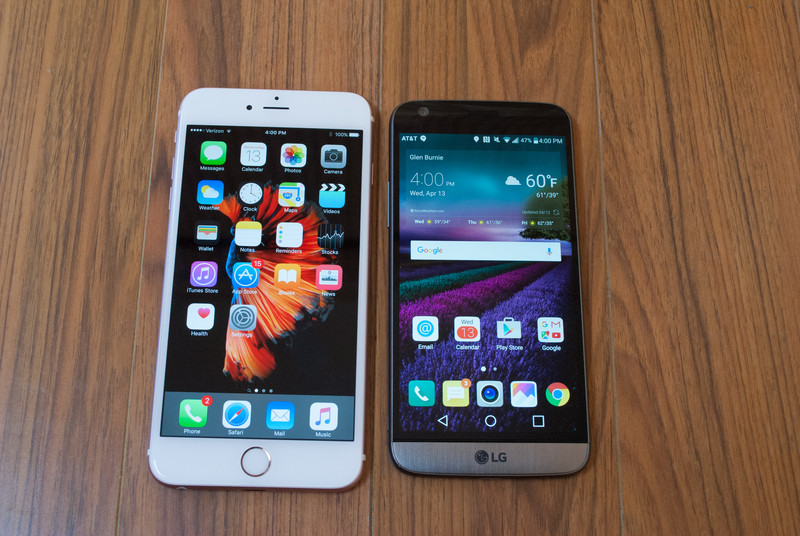
How do I get my iPhone’s calendar onto my new Android phone?
If you’re making the switch from iPhone to Android, you’ll want to take all the things that matter in your life with you, i.e. your calendar, contacts, and other personal data.
Though there’s no real way to “sync” your iPhone’s iCloud calendar to your new Android phone, you can still transfer it over pretty simply.
Here’s how!
How to transfer your iCloud calendar to your Android phone
First thing you’ll need is a Google account set up on your Android phone. If you skipped that in the setup process, you’ll need to create one.
On your iPhone
Launch Settings from the Home screen.
Tap Calendar.
Tap Default Calendar.
Tap the Gmail account you use with your Google calendar.
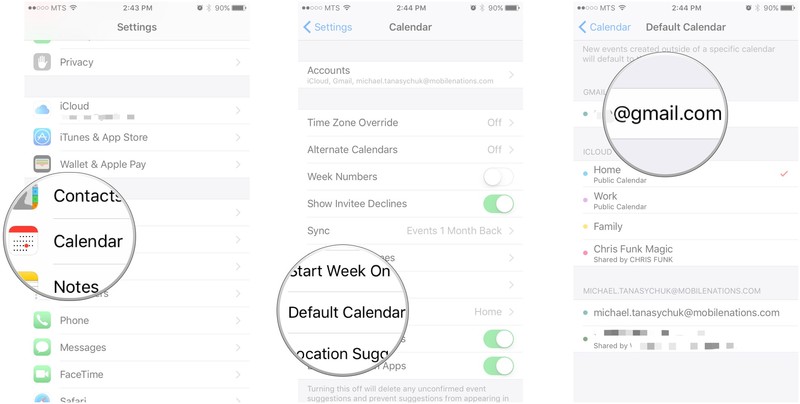
Now any dates you add to your iPhone calendar will be apart of your Google account calendar (in case you keep using your iPhone for a bit). This ensures that everything
On your Mac or PC
Log into your iCloud account.
Click Calendar.
Click the broadcast button next to the calendar you want to share.

Click the checkbox next to Public Calendar.
Copy the URL that appears and paste it in the address bar of your web browser. Do not hit enter yet.
Replace webcal at the beginning of the URL with http and hit enter. You’ll either be prompted to download an ICS file or one will automatically download to your default downloads folder.

Go back to your iCloud Calendar and uncheck Public Calendar.
Log into your Gmail account.
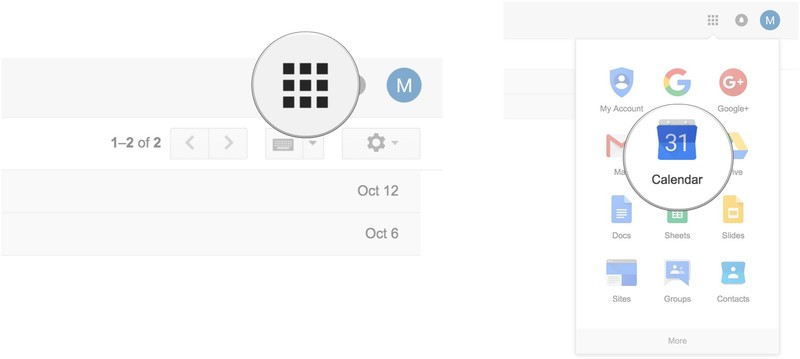
Click the apps button on the upper right of your screen. It’s a square made of nine smaller squares.
Click Calendar.
Click the settings button on the upper right of your screen. It’s the gear icon.
Click Settings.

Click the Calendars tab.
Click Import calendar.

Click Choose File or Browse, depending on your operating system.
Click the ICS file you just downloaded from iCloud.
Click Import.

Boom, you iPhone calendar events are now apart of your Google account. If you have multiple iPhone calendars, you’ll want to repeat the same steps for each one.
Use SmoothSync
SmoothSync for Cloud Calendar is a handy app that lets you sync your iCloud calendars and reminders with your Android phone.
It’s not the prettiest app in the world, but it gets the job done. All you have to do is enter your Apple ID and password, select the calendars you want to sync and that’s it. It’ll create new calendars on your Android phone for each iCloud calendar you had.
It’s a great app for folks who like to keep both an iPhone and Android phone around, since you can set it to auto-sync, and you can use your Google calendar on your Android phone as normal; SmoothSync works in the background!
Download: SmoothSync ($2.86)
Questions?
Let us know in the comments below!
Best Phone 2016: EE Pocket-lint Gadget Awards nominees
The EE Pocket-lint Gadget Awards will be taking place at the end of November for the 13th year celebrating the best devices over the last 12 months, across 14 categories. The categories span phones, tablets and games to cameras, smarthome and cars and as usual, we will be giving you a run down of all the nominees in each category through a series of features.
Best game and camera were up first so you can read all about the nominees of these categories by visiting the Awards hub, but this feature concentrates on the Best Phone of 2016. There have been quite a few changes in the smartphone market this year, not just in terms of design, but also in terms of the technology within them.
Of course they have all become faster with upgraded processors, but fingerprint sensors are now a given, dual rear cameras are now a thing and some displays continue to take things one step further with either dual-edges or force touch.
Design has greatly improved too with Samsung really pulling it out of the bag yet again with the Galaxy S7 edge, HTC making some big improvements with this year’s flagship and OnePlus and its third flagship killer also making design a key focus. Which smartphone will be crowned winner of the Best Phone of 2016 though?
Click here to see the Awards nominees for 2016’s Best Phone in a little more detail to help you make your mind up about which one should get your vote.
Voting in the 13th annual EE Pocket-lint Awards is now open so you can let us know which one of these great devices you think should win the Best Phone award for this year and give us your verdict on all the other tech across the 13 categories.
Winners will be announced at the exclusive event in London on 23 November in association with EE. For now, keep an eye on the EE Pocket-lint Gadget Awards 2016 hub for all the latest on how the voting works, who the elite judges are and the EE Pocket-lint Gadget Awards shortlist.
Leaked new HTC Vive controllers take design cues from Oculus Touch
Although the HTC Vive motion controllers are decent enough already, it seems that replacements are in the pipeline.
A Valve development slide and hands-on pictures of the prototype controllers have leaked online and they seem to own a lot to the forthcoming Oculus Touch devices.
They have been designed by Valve rather than HTC it is claimed. Valve is the owner of Steam and the Steam VR system the Vive uses.
- HTC Vive review: An experience that’s out of this world
The slide showing early prototypes was first posted on Twitter by @robmerki, director of Cognitive VR.
New Vive controllers coming soon. Prototype available at #SteamDevDays pic.twitter.com/C5HMvOrwt4
— Robert Merki (@robmerki) October 12, 2016
This was followed by postings from @mxweas and Shawn Whiting, who both tweeted images of the controllers in their own hands.
New Valve controller prototype was really cool. Much closer to having hands in VR vs holding a tool. pic.twitter.com/8LzEkGDEn1
— Max W @ SteamDevDays (@mxweas) October 12, 2016
More photos of the new Vive controllers! #SteamDevDays #Vive #VR pic.twitter.com/o99QHPZvvD
— Shawn Whiting (@shawncwhiting) October 12, 2016
If these are to be the final products, they could take a while to put on considering how much strapping can be seen in the images. However, the less you feel like you’re holding a baton, the more immersive the experience, so we heartily approve.
There’s no clue yet to when we see the new HTC Vive controllers or how much they’ll cost. We doubt they’ll be cheap though, considering the Oculus Touch controllers are priced at around £190 for the pair.
Tesla rival’s EV outed by public records request
Atieva is a Chinese company building an EV for the US market, and we’re now getting a first look at its “Atvus” sedan, thanks to a public records search by Recode. The vehicle bears a passing resemblance to the Tesla Model S, with a Citroën-esque rear-wheel cover thrown in. The company has also developed an impressive drive train in a Mercedes test mule van, with a 0 to 60 acceleration time of under three seconds (see the video below). What’s perhaps most interesting about Atieva, though, is its tangled ownership web, as the Guardian reported earlier this year.
Atieva is developing its “premium electric sedan” under the “Project Cosmos” codename, Reuters reported. It expects to unveil the EV by 2018, and wants to eventually build up to 130,000 a year following a ramp-up period. The project has serious engineers behind it, including former Tesla VP Peter Rawlinson, who led development of the Tesla Model S, and Brian Barron, who oversaw vehicle manufacturing for BMW.
Atieva was founded in 2007 by Bernard Tse and Sam Weng, and originally worked on batteries and drivetrains for buses and vans. In 2014, it received a $100 million cash infusion from Chinese state automaker BAIC and LeEco, owned by Jia Yueting, who also founded Faraday Future. At that point, it decided to build a connected autonomous car, with a mission to best Tesla’s Model S.
After a dispute with BAIC, founder Tse left, and BAIC also dropped out, reportedly selling its shares to LeEco, according to sources inside the company. If accurate, that means that LeEco’s Jia Yueting is behind three EV automakers: LeEco, Faraday Future and Atieva. Each is working on its own mainstream EV for the US market, with LeEco having recently revealed the LeSee, and Faraday Future expected to unveil its own vehicle soon.
Atieva has an R&D center in Silicon Valley near Tesla, and said it’ll build a US factory once it chooses a site. However, the public records document currently lists its manufacturing facility as an electric bike company in China. LeEco head Jia Yueting is already building a $1 billion factory in Nevada for Faraday Future, and a $1.8 billion plant in China that could pump out up to 400,000 cars per year. He’d be building another 130,000 with Atieva and an unknown number with Faraday.
However, Nevada officials recently questioned Jia’s ability to come up with the cash for his current factory proposals, let alone another one. “His Internet company is successful, but that doesn’t generate the billions of dollars he’d need. Where’s he going to get the money?” Nevada treasurer Dan Schwartz told Bloomberg. Former executive also Martin Eberhard also questioned Yueting’s strategy of investing in both Faraday and Atieva. “I left Atieva because that’s not my kind of company. It’s being run like an old-school Hong Kong company which is not my take,” he told the Guardian.
Source: Recode
 AIVAnet