


BMW teases an all-electric future with Mini and X3
BMW’s outline to reinvent itself as an automaker of the future has a new wrinkle to it. The company plans to sell electric versions of the X3 SUV as well as an EV Mini, according to Reuters. There isn’t a timeline for the former, but the latter is expected in roughly three years. In addition to licensing out its EV tech, it looks like the company will keep charging ahead (sorry) on its homegrown alternative fuel projects. This all dovetails nicely with the recently completed coastal charging network, Formula E news and the EV rumors from earlier this month. Will it be enough to get a leg up on Tesla, though?
Source: Reuters
Best Android Phone Under $700

Want to ensure you’re wielding the best around for your budget? The Galaxy S7 is the best phone under $700, when you factor in performance, size, camera quality, and battery life.
Best Overall
Samsung Galaxy S7

See at AT&T
See at Sprint
See at T-Mobile
See at Verizon
See at Amazon
The Galaxy S7 is the best version of Samsung’s flagship yet. It’s equipped with a powerful Qualcomm Snapdragon 820 processor, 4GB of RAM, and a 3,000mAh battery pack. Its 12-megapixel rear-facing Dual Pixel camera is particularly impressive, and you’ll appreciate its performance in low light.
Of course, as is the case with most versions of Android that aren’t directly developed by Google, Samsung’s version of Android is polarizing. The newly dubbed Grace UI offers some helpful features, but the extra software that comes bundled is redundant. At the very least, you can disable and hide any apps you don’t care for.
Bottom line: If you’re buying a flagship, get the one that’s the best around. That’s the Samsung Galaxy S7.
One more thing: If the GS7’s 5.1-inch display is too small for your liking, consider the Galaxy S7 Edge for its bigger screen and curved edges. The S7 Active is also a viable choice if you’re a rugged outdoor person and an AT&T subscriber. And of course, Samsung offers an unlocked model that also works overseas.
Why the Galaxy S7 is the best
Style, performance, and polish in one little smartphone.
Haven’t we done enough to convince you that Samsung’s Galaxy S7 is worth your dollar bills? Everything you could need from a smartphone is right here.
This flagship device boasts powerful internal components, a water resistant metal and glass chassis, an expansion slot, a front-facing fingerprint scanner, and a variety of mobile payment and wireless charging options. It’s also equipped with one of the best rear-facing smartphone cameras — it’s capable enough that you’ll never fret about leaving your camera at home.
Best “Not Samsung” phone
HTC 10

See at Sprint
See at Verizon
See at Amazon
Give HTC a chance, won’t you? The fashionable HTC 10 features an aluminum unibody chassis and a 5.2-inch Quad HD display. It’s equipped with a high performing Snapdragon 820 processor, 4GB of RAM, a 12-megapixel rear-facing UltraPixel 2 camera, as well as a 5-megapixel front-facing camera with OIS. The HTC 10 also offers BoomSound Hi-Fi, which the company worked on in conjunction with Dolby, and there’s an amp built in to the headphone jack. You might even like HTC’s modern take on stock Android.
Bottom line: The HTC 10 is a great flagship alternative for anyone looking for stylish performance from a longtime Android player.
One more thing: The HTC 10 does not have water resistance like Samsung’s devices, but HTC does offer Uh Oh Protection, which covers broken screens, water damage, and even switching carriers.
Best for customizing
Moto Z

See at Motorola
See at Verizon
It’s always fun with a manufacturer tries something different. Motorola’s trying out the modular smartphone thing with its Moto Z flagship. This svelte smartphone is an absolute sight to see: It’s one of the prettiest phones on the market and is incredibly thin. Inside, it boasts a Snapdragon 820 processor, 4GB of RAM, and a 2600mAh battery. It also has a 13-megapixel rear-facing camera.
If you’re aching for features like more battery life or true-to-form optical zoom, you can invest in any of the Moto Z’s modular accessories. For instance, there’s a variety of power packs you can purchase for extra battery life, or you can buy the Hasselblad True Zoom for better smartphone photography.
Bottom line: The Moto Z is a worthy considering for anyone who wants a razor thin smartphone—or who believes modularity is the future of mobile devices.
One more thing: You can choose between the Moto Z Force if you’re a Verizon subscriber and you’re looking for a better camera sensor and a bigger battery, or the mid-range Moto Z Play if you’re looking for something a little cheaper and a bit more basic. Both phones are compatible with Motorola’s Moto Mods accessories.
Best for photos and video
LG V20

See at LG
At the time of publishing this, the LG V20 is still not available for sale in the U.S. Regardless, we’re eagerly awaiting its arrival because its specifications are quite impressive. Inside, it’s on par with the other flagships out right now, but LG also equipped its content creation device with a dual 16-megapixel rear-facing camera and 8-megapixel camera for wide-angle shots. Additionally, the V20 offers Hi-Fi audio compatibility, manual video and camera controls, and a cool looking metal body with removable back cover and battery pack—that’s a rarity in this day in age.
Bottom line: If you’re obsessed with making videos and Snapchatting every bit of your life, the LG V20 is the perfect high-end device for doing so.
One more thing: We’re still not sure when it’s hitting the U.S., but you can read all about it.
Conclusion
The Galaxy S7 impressed us so much this year that now, six months later, it’s still the best phone in its price range. While it can be argued that the Galaxy S7 edge and Note 7 are superior in substantive ways, you’re not going to get better value than the S7 proper at $649.
Best Overall
Samsung Galaxy S7
See at AT&T
See at Sprint
See at T-Mobile
See at Verizon
See at Amazon
The Galaxy S7 is the best version of Samsung’s flagship yet. It’s equipped with a powerful Qualcomm Snapdragon 820 processor, 4GB of RAM, and a 3000mAh battery pack. Its 12-megapixel rear-facing Dual Pixel camera is particularly impressive, and you’ll appreciate its performance in low light.
Of course, as is the case with most versions of Android that aren’t directly developed by Google, Samsung’s version of Android is polarizing. The newly dubbed Grace UI offers some helpful features, but the extra software that comes bundled is redundant. At the very least, you can disable and hide any apps you don’t care for.
Bottom line: If you’re buying a flagship, get the one that’s the best around. That’s the Samsung Galaxy S7.
One more thing: If the GS7’s 5.1-inch display is too small for your liking, consider the Galaxy S7 Edge for its bigger screen and curved edges. The S7 Active is also a viable choice if you’re a rugged outdoor person and an AT&T subscriber. And of course, Samsung offers an unlocked model that also works overseas.
Action Launcher 3 update adds Android 7.1’s launcher shortcut feature
New “Quickcuts” capability rounds out the list of Pixel Launcher features in the popular app.
Ready to try out some of the features from the Google Pixel’s home screen launcher (without sideloading a leaked APK that doesn’t quite work right)? Action Launcher has just been updated with a new “Quickcuts” feature, which recreates the launcher shortcuts feature from the unannounced Android 7.1 Nougat release. Spotted in certain Google apps by enterprising hackers, these shortcuts let you perform a gesture on an icon to access shortcuts to different areas of that app — similar to 3D Touch on the iPhone.
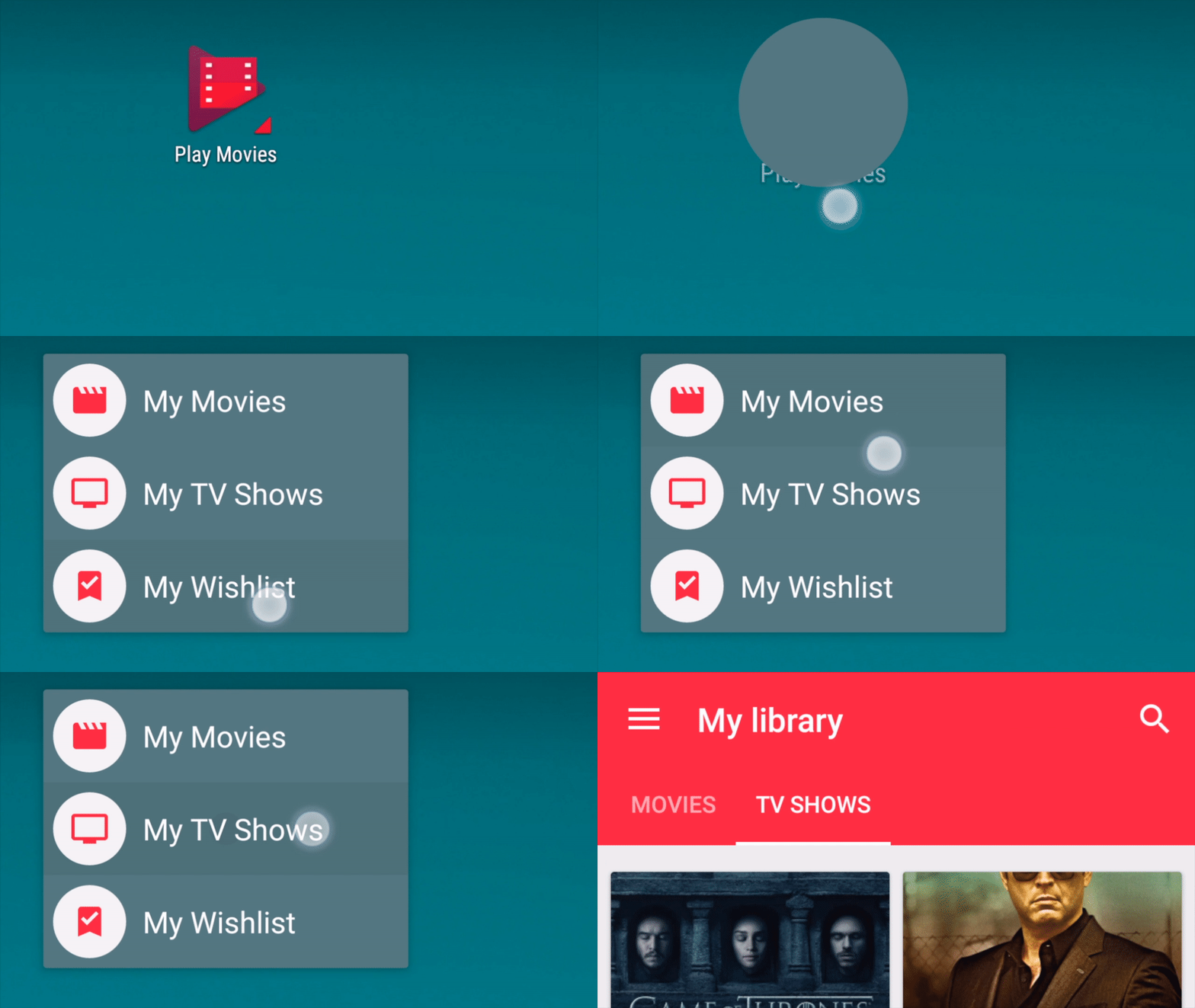
Simply swipe on an icon and release over the shortcut you want to jump straight to that section of the app.
And now it’s possible to get this feature without waiting for the Pixel phones to land — or for your handset to get an Android 7.1 OTA. Developer Chris Lacy tells us that functionality is limited to a few Google apps right now, but that Quickcuts for other popular apps are hard-coded in.
Currently this is limited to [a] selection of Google’s apps including Play Music, Play Movies and Photos, but more will come as 7.1 is announced. I’ve also hardcoded Quickcut definitions for a few key apps like Twitter (New Tweet/DMs) and YouTube (Watch Later/Subscriptions).
This latest feature addition gives Action Launcher 3 all the features of the leaked Pixel Launcher, days ahead of the debut of Google’s new phones. And you can bet that if anything new crops up next Tuesday, the developer will be quick to react.
The update should now be rolling out through the Play Store, so hit your updates tab to see if it’s ready.
GoPro Hero5 Black review: A new breed of super Hero
A new GoPro flagship action camera has finally arrived, two years after its predecessor. The Hero5 Black – which was announced alongside the Hero5 Session and the long-awaited Karma drone – and brings a host of new features with it.
The new Hero launches into a market that has some serious competition though, much more than the company had 14 years ago when it first introduced the world to capturing their best action moments.
Does the Hero5 Black confirm GoPro’s position as king of the action cams? And does it offer enough to warrant an upgrade from an older GoPro camera? Yes, it most certainly does. Here’s why:
GoPro Hero5 Black review: Design
The GoPro Hero5 brings with it an entirely new design and it’s fabulous. The company ditched the shiny silver front found on the Hero4 and Hero3+ and traded it in for a matte black, rubbery finish that is not only easier to hold when out of its accompanying plastic housing, but waterproof up to 10-metres on its own too.
The new Hero also has rounder, smoother edges than its predecessors and, although it is larger, it is much more refined. All the ports have been covered, accessed by pushing in the button and sliding the flaps down. The HDMI port and USB Type-C port are situated on the right-hand side of the Hero5 Black, while the removable battery and microSD card slot are underneath.
Pocket-lint
The large protruding camera lens remains in the top right corner on the front of the rectangular device, as it has done on preceding devices, distinguishing the Hero5 Black as a GoPro. It protrudes slightly more so than the Hero4 Black as the waterproofing and protection are built-in, delivering the same finish around the lens without the additional casing as the Hero4 does with its bulky casing.
The Hero5 Black’s extra housing is minimal as it ignores the front and rear, meaning it looks significantly better than the Hero4’s alternative. The camera lens is more vulnerable, of course, but if you scratch the protective element around the Hero5 Black’s lens then you can buy a new one and switch it over. T
he housing is how you mount the Hero5 Black and, as you would expect, it’s the same system as other GoPro cameras, with plenty of options for any activity you can think of – from surfing to recording your child’s first time riding their bike without stabilisers.
Pocket-lint
A small, square monochrome display sits alongside the lens of the Hero5, though it is slightly smaller and more discreet than the one on the Hero4. There is also no black trimming, which is a blessing, while the red flashing recording light has been moved to the top left-hand corner of the Hero5, making it much less obvious. Branding is also more subtle, with a faint GoPro logo sitting under the lens, rather than Hero5 in big, black capitals, as per the Hero4.
The On/Off/Mode button has also moved positions. On the Hero4, it sits at the front beneath the monochrome display, but on the Hero5 Black, it moves to the left-hand side, refining the front. The recording button is still easily accessible and unmissable the top of the device, but there is no longer a setting button on the Hero5, because all the settings can now be accessed from the two-inch touchscreen on the rear.
GoPro Hero5 review: Display
Yes, that’s right. The GoPro Hero5 Black comes with a built-in touchscreen, meaning it is no longer necessary to use the Capture app to change settings, or buy a separate screen and attach it to the back, as was the case with the Hero4 and Hero3+.
It also means settings are much more accessible, with streamlined menus for easy switching between field-of-view and resolution – rather than pressing numerous buttons and hoping you don’t press the wrong one and end up back at the start menu.
Pocket-lint
The built-in touchscreen is a godsend. It makes using the Hero5 Black and connecting it to your smartphone a lot simpler and more sophisticated. It also means it’s possible to see what is being recorded and check you have the right angle or shot before you start capture, or without having to open the Capture app capture.
This app is of course still useful if you want to mount the GoPro and control it remotely, for example, but it’s no longer as necessary as it was with previous devices.
With the plastic housing on the Hero5 Black, swiping down from the top of the touchscreen is a little fiddly and it takes a few goes to get used to – but once you’re in navigating is a piece of cake, as is selecting the various options available. There is a little bit of lag in some places, but on the whole, the touchscreen is responsive, images are crisp and it is by far our favourite element about the Hero5 Black simply because it makes control so much easier.
GoPro Hero5 review: Features and settings
Another one of our favourite features about the GoPro Hero5 Black is voice control. There are currently 12 commands that are recognised in seven languages, including US English, UK English and AUS English. Make sure you select the right one or GoPro might not understand your accent.
Voice commands include instructions such as “GoPro Start Recording”, “GoPro Take a Photo”, “GoPro Stop Recording” and “GoPro Turn Off”. These are the ones we used the most frequently during our time with the Hero5 Black, and most of the time they worked flawlessly. Following a command, the Hero5 Black beeps to confirm it is doing what you’ve asked. If you don’t hear the beep, it has ignored you – or just not understood.
Pocket-lint
For voice commands to work properly you have to make sure you say the exact phrasing, otherwise no amount of raising your voice or getting shirty with it will get the Hero5 Black to do what you want it to. For example, saying “GoPro Take a Picture” instead of “GoPro Take a Photo” will not get you your photo. It could do with slightly more evolved language in that regard.
The Hero5 Black will capture 12-megapixel images, offer access to RAW files and it will also capture HDR-like photos, which GoPro calls WDR. Video image stabilisation is also finally on board, which works very well in our experience – especially when riding a horse on very bumpy terrain – while GPS location tagging is a nice added extra.
The Hero5 Black also offers built-in stereo sound and wind noise reduction, the latter of which worked brilliantly when we were at the top of a very windy mountain and when we tested the Hero5 Black in the Karma drone. Despite tables being blown over, the wind can barely be heard in that footage.
- GoPro Karma preview: Badass but beautifully simple drone
GoPro increased the audio range of the Hero5 Black by 10dB compared to the Hero3+, and the new device is also said to offer twice the dynamic range. On the whole, audio results are clear with no muffling, as has been the case with previous devices due to their housing restrictions. That’s no longer the case.
Pocket-lint
In terms of other extra features over its predecessors, the Hero5 Black adds a new field-of-view called Linear Mode. This mode is in addition to the SuperView, Wide, Medium and Narrow field-of-views, offering a more natural perspective by making things such as the horizon look flat rather curved. It’s a great option when using the Karma drone, but it’s also a nice option for those who want a more standard shot.
Field-of-view options are determined by resolution. SuperView offers 4K capture at a maximum of 30fps, Wide offers 4K capture at up to 24fps, Medium and Linear offer 2.7K capture up to 60fps, while Narrow offers Full HD capture up to 80fps.
GoPro Hero5 review: Battery and performance
The GoPro Hero5 has a slightly more capacious battery than the Hero4: it’s 1,220mAh compared to 1,160mAh. Which, Hero3 and Hero4 users, probably has you wondering “can I use the same battery in the Hero5?”. The answer is no, so those older spares you have you’ll have to buy into again.
This new battery is removable (unlike in the Session) and, as we mentioned previously, it is now charged via USB Type-C, which is much more useful than the mini USB of older GoPro devices as it means a charge in around 45-minutes.
Based on our experience, we were able to capture around two hours of footage before the Hero5 Black died on us. This was dependent on how much we were fiddling with the settings on the touchscreen however. Touchscreens use lots of power so pick the setting that best suits what you’re trying to capture and try and stick with it.
Video quality is great, as we have come to expect from GoPro. We used several settings in several scenarios and the results were all brilliant. The beauty lies in the fact that you can simply press record and have decent, shareable footage on your smartphone or computer within a few minutes. Yes, you might need to do a bit of editing with the Quik app (which is separate to the Capture app), but ultimately, the groundwork is all there and it’s very good.
Connecting the Hero5 Black to a smartphone is still a little fiddly, as it is with preceding GoPro models, but it was made slightly easier thanks to the connect option on the touchscreen, found by swiping down from the top.
After you’ve linked your smartphone to the Hero5 Black’s Wi-Fi, the Capture app will allow you to control the camera, as well as see the videos and images you’ve already captured, as has been the case in the past.
Verdict
The GoPro Hero5 Black is the GoPro we have all been waiting for. The company’s previous offerings deliver great results, but the new device adds more than enough to warrant an upgrade – and not just because of the great image and video quality.
The touchscreen being part of the GoPro design is a very welcome addition, which makes using the action cam far simpler than ever before. Then there’s the main unit’s waterproofing – without the need for the bulky housing – which brings plenty of added benefits to design, style and sound capture. Couple those positives with voice control, video image stabilisation, the ability to capture a more natural perspective, and there really is very little to complain about.
It’s only really the two-hour battery life that, as ever, could be better – but you can swap out the batteries if you buy additional extras (although the Hero5’s battery is a different capacity, size and shape compared to older models, so you can’t rely on those old spares if you have any – which could prove costly).
The Hero5 is a new breed of super Hero, perfect for upgraders of newcomers alike. It modernises the series and, ultimately, reinforces GoPro’s position as king of the action cams.
Facebook tests feature similar to Snapchat Stories for Messenger
Facebook has been keen on borrowing features from Snapchat as of late and it’s testing yet another one in Poland. The so-called “Messenger Day” tool allows Facebook Messenger users to share a collection of photos and videos with friends that will disappear in 24 hours. And yes, they can be decorated with text, scribbles, stickers and more just like you can do with Snapchat Stories. If you’ll recall, Facebook reportedly tried to buy Snapchat for $3 billion before getting turned down in 2013.

Image credit: TechCrunch
The social network is no stranger to the Snapchat-like feature. Instagram announced its own “Stories” tool back in August, and similar to “Messenger Day,” those slideshows of snapshots and videos are no longer available for followers to view after 24 hours. Facebook recently added “Instant Video” to Messenger as well, a feature that allows users to share videos in an on-going conversation quickly and easily. That video tool is another option that’s similar to something Snapchat offers its users. Facebook says that “Messenger Day” is currently only in testing among a small group of users in Poland.
“We know that people come to Messenger to share everyday moments with friends and family,” A Messenger Spokesperson told Engadget. “In Poland we are running a small test of new ways for people to share those updates visually. We have nothing more to announce at this time.”
It’s common practice for companies to test new features with a small group before making the final call on when or if the tools will be part of a wider roll out. As is the case with any beta process, there’s no guarantee “Messenger Day” will be available for all users in the future. However, adding something similar to “Stories” to the messaging app makes a lot of sense. A lot of people around the world are using it to communicate, so making the slideshow feature part of the app rather than a piece of standalone software would leverage that existing user base.
The United Nations is turning VR into a tool for social change
Virtual reality is lauded as an empathy generator. The ability to transport viewers to a setting that would otherwise be inaccessible, or even unfathomable, lends a sense of poignancy to the medium. Over the last two years, journalistic stories and charitable causes have been translated into VR films to raise awareness. In particular, the United Nations Virtual Reality (UNVR) initiative has been using the medium as an advocacy tool for vulnerable communities across the world. And now with the recent launch of a mobile app that introduces a “take action” button for the viewers to engage with the social issues, UNVR is looking to convert compassion into action.
The app, led by Gabo Arora, the UN creative director who spearheads the organization’s VR productions, will host experiences like Clouds Over Sidra that places viewers alongside a 12-year-old girl in a Syrian refugee camp; Waves of Grace, which brings them into the world of an Ebola survivor in Liberia, and My Mother’s Wing that takes them to a home in Gaza, where a mother lost her two young sons in the bombing of the UNRWA school.
Virtual experiences about tragedies that are far removed from the everyday lives of most people outside the affected countries tend to evoke a powerful emotional response from the viewer. But as the hardware required to view these films continues to stay out of reach for the masses, the actual impact of the VR experiences has come into question.

A still from Waves of Grace. Photo credit: UNVR
While the effect isn’t quantifiable yet, VR creators are starting to look for ways to facilitate change through grassroots efforts. At the UN, Arora has been leveraging the organization’s network to bring VR experiences to as many people as possible. For Clouds Over Sidra, for instance, he partnered with UNICEF’s streets programs called Translating Empathy to Action, where fundraisers took to the streets with Google Cardboard and Samsung Gear VR across 40 countries. And most recently, Arora has collaborated with Artscape, a Canadian organization, for The Sidra Project. With over 500 screenings of the VR film at private homes, public spaces and classrooms across Toronto, Vancouver and Ottawa, the project is designed to aid the resettlement of refugees in Canada.
I caught up with Arora at the UN headquarters in New York to talk about the ways in which he plans to facilitate change in the real world with virtual reality.
Why does the United Nations need a VR app?
There’s so much that’s so abstract at the UN and in policy making. I do think that’s important and I don’t want to denigrate my colleagues because they sometimes go, “Oh we’re still writing reports.” But this, [the VR initiative] highlights all the great work they do and I’ve done that too. I know that without that work we don’t really have anything to move forward and so much of the UN’s work is not really understood. But I think doing things like this gets people engaged with the UN in some ways.
Because I think what it does is, it shows the power of storytelling for impact. The power of storytelling in diplomacy and foreign affairs. Which I don’t think has been able to happen until now. A lot of it is my work but I am trying to now build capacity. We want to open up the app to third-party filmmakers to try to build these storytelling bits so that, yes, I have helped kickstart something but we create something that’s sustainable and is more than just about me.
One of the more unique features of the UNVR app is the action button. How did that come about?
With the app we make it so that when you finish watching the film, there’s an action button on the app that leads to a menu of actions. Right now it takes you the The Sidra Project [take action page]. Through this you will be able to donate money, get involved with organizations in Canada, donate your time or extra things lying around. If you want to teach English, want to mentor a family or you want to invite them for dinner. We’re figuring out what this needs to be with leading experts but the idea is to really tie [VR] to those actions and be able to measure it. The project was launched at the Toronto Film Festival [earlier in September]. There are 25 partners, including the US Consulate in Canada, and it is something that we are using as the first pilot to see how something like this could actually make a difference in the resettlement issue.
If it works well, we want to take it to Germany. When we started thinking about it in January [this year], the political climate was a certain way but now I think things have gotten to a point where anything we can do to make it better would be incredible. Right now we’re using “Clouds Over Sidra” and it’s for the refugee resettlement issue, but it goes into a humanitarian fund. So it helps all of our crises.
You have four films on the UNVR app right now and there’s plenty more in the works. How do you go about finding these stories, what’s the process for you?
We have offices in 135 countries and we have communications offices in each one. We have incredible relationships with people who are already doing video, doing their own version of storytelling. It’s almost like having a built-in production house. For example what’s going on in Nigeria with Boko Haram: the families, the kids. I have to call the local offices to see if there is a particular story or if they have someone in mind? They’re the ones that are going to help in giving me the access. Facilitating security and those relationships is an amazing advantage.
Beyond the films, you’re taking your VR efforts straight to people’s homes. Could you tell me about The Sidra Project and how that came about?
I was an arts and culture leader this year at Davos, where they showcased some of the VR work to the delegates. I met Tim Jones, who was Entrepreneur of the Year in 2015 for the Schwab Foundation, and is now [CEO] of an organization called Artscape in Toronto. He watched Clouds Over Sidra and said: “With all these refugees coming into Canada, what if we built some sort of program where refugees can kind of lead screenings and use VR as a kind of way to build understanding and empathy between host communities and refugees.” Because there’s increasing xenophobia and there were some hate crimes that were happening, so in a lot of ways, his idea was: If more and more people saw this film, they’d really understand where these people are coming from.
I thought that was really cool, and he also has an incredible network, he’s a pioneer for using art for social change, so we put our heads together. We thought we would develop a project, almost like a social enterprise so that it can actually fund itself, and it would target 10,000 Canadians with 500 screenings over a course of time.

Gabo Arora. Photo Credit: Ethan Scott
What about other visual mediums like augmented reality for instance, have you tried building something around that?
I had an idea to do something with genocide survivors through augmented reality. What if you went to Auschwitz and you could get a survivor to kind of be the guide or to have other overlays on site? A lot of these things can really be powerful in that way. So I talked to Metavision [an SF-based company with an augmented reality headset] and then I did some demos but I didn’t feel the technology was there. So that idea now has morphed into doing something in a concentration camp using photogrammetry.
You seem to be integrating all kinds of new technologies to build stories. But I wonder if you have any challenges introducing something like VR, given the bureaucratic framework of the UN?
Every day.
What were your biggest challenges?
Is this a Western rich person’s technological toy? How does this relate to helping the most vulnerable? How do we scale this? How do we show impact? The app is the answer to all of that. Yes, look, we can get our stories out there, we can build the platform for filmmakers within the UN, we can have an action button that people can actually use to take action. To me it’s better, but it’s always a rocky road, because it’s something that is creative.
For instance, I want to have third-party content on the app that might be critical of a member-state. In theory you’re not allowed to do that. There are two schools of thought at the UN, and I take a very clear one. One is beholden to our member-states and what they stand for, but 60 of our member-states are not democratic and would kill homosexuals. That doesn’t make sense to me. I believe it’s the UN Charter that we should feel compelled to follow. It’s the “We the People” part of it. I think the spirit of that document is what I’m trying to make the spirit of what the app is, which is open, inclusive, democratic, transparent. That doesn’t mean that we’re not going to curate and have some sort of closed ability to it, and then we’ll have a content committee and we’ll create something that will make it as fair as we can.
“I believe it’s the UN Charter that we should feel compelled to follow…I think the spirit of that document is what I’m trying to make the spirit of what the app is, which is open, inclusive, democratic, transparent.”
Obviously it’s such an unwieldy organization that it’s impossible to get consensus and please everybody. We almost always just have to do something and then ask for forgiveness later, and then try to make it work and respond as best as we can without it falling into the same trap everything else does. I feel a great responsibility.
Part of me feels like, why don’t I just move to LA and focus on that, just be 100 percent storyteller. But another part of me still feels I wouldn’t have as much of an impact. And to me, fighting these little fights and going through all of that, mainstreaming it, not letting it die, changing the culture of storytelling in the UN is something great.
What’s next on the VR front?
Our next one is on the Nepal earthquake, but a year and a half later. Where are we now? We still have three million people living in temporary shelters. We don’t have their houses built. I think showing that and figuring out how we can accelerate on something that isn’t this hot crisis now? These people are still forgotten in these rural areas. It’s about a young girl who has to give up her dreams and start working to build back her house, can’t be a doctor, lost her rooms, doesn’t have a place to change. It really has a gender story to it too.
It’s the first time we can try to build empathy in something that people have kind of forgotten about and try to bring it up and get people to care is something I’m very excited about. It’s also a music video documentary. It really is about indigenous music and sounds of the area being used.
In the beginning everyone was like “It’s like ‘Clouds Over Sidra’.” We’re like, no, because it’s going to have a different angle of the reconstruction, but the music video part is what is going to make it different. It’s a little more avant-garde. There’s less voice over. But I think the more subtle you are in VR the better it works. That’s the power of the medium.
(The interview has been edited and condensed for clarity.)
Wanted: One 400-lb hacker (or maybe five tiny ones)
This week the topic of cybersecurity made its first-ever appearance at a presidential debate.
This was thanks to moderator Lester Holt, who asked candidates Hillary Clinton and Donald Trump how to fight cyberattacks. Both were heavy on emphasizing importance of “the cyber,” scant on policy details and, worryingly, omitted critical cybersecurity issues (like ransomware and breaches).
Except cybersecurity doesn’t begin and end with cyberwarfare and Russian hackers. It is a catastrophic mistake to see urgent issues like ransomware and breaches as separate from cybersecurity, because they are all part of the same thing. And, thus, the introduction of cyber to presidential debate territory (about ten years too late, if you ask me) took a left turn into bizzaro-land and faceplanted center stage.
“We want to start with a twenty-first century war happening every day in this country. Our institutions are under cyberattack, and our secrets are being stolen. So my question is, who’s behind it? And how do we fight it?” Holt asked.
For her part, Clinton went straight to cyberwar. She opened her response saying that “cyber warfare will be one of the biggest challenges facing the next president.”
“We need to make it very clear — whether it’s Russia, China, Iran or anybody else — the United States has much greater capacity.” Suggesting that hacking back or escalation is on the table, she framed the issue as fighting “state actors” who “go after our information, our private-sector information or our public-sector information.” She explained, “And we’re going to have to make it clear that we don’t want to use the kinds of tools that we have. We don’t want to engage in a different kind of warfare. But we will defend the citizens of this country.”
Concentrate only on this, and I promise things will get worse. Because what we desperately need protecting from right now is Yahoo, and companies like them, whose negligent enterprise security facilitate large-scale attacks. And just this week, Europol issued a report saying that ransomware is now the largest online cybercrime threat, period. There’s more, like getting the cybersecurity of government orgs and voting into this century, but let’s not worry about putting on pants before we run out the door to fight with our aggro neighbors.

Trump inflicted his usual amount of abuse on the English language, and took us on another outside-voice narrated trip to the land of free-association. “So we have to get very, very tough on cyber and cyber warfare. It is — it is a huge problem.” He added, “I have a son. He’s 10 years old. He has computers. He is so good with these computers, it’s unbelievable.” Mostly he said we don’t cyber so good, and fixing it probably isn’t possible. This came out as, “The security aspect of cyber is very, very tough. And maybe it’s hardly doable.”
He’s speaking from first hand experience — having just experienced a website leak that included personal information. Trump’s website, DonaldJTrump.com, failed to secure sensitive files up until last week. Security researcher Chris Vickery found that Trump’s site had misconfigured settings on its Amazon cloud account. This allowed anyone to gain access to and download files on the site (including resumes), simply by guessing file names and typing the URL. In frustration at being ignored at every turn by Trump’s people, Vickery asked DataBreaches.net to help him contact the campaign. Ultimately, Trump’s campaign remained mute about the security fail; the issue was eventually fixed, silently, without notification or acknowledgement of any kind.
So, that’s all we got from this long-overdue mention of “the cyber” (as in security) in this little slice of debate history.

Of course, the debate was already making history with Hillary Clinton as the first woman in a presidential debate, and the first candidate to call out their opponent for being racist. After slamming Trump for his “whole racist birther lie,” Clinton outright stated “He has a long record of engaging in racist behavior.”
But I digress… All anyone will really remember is what Trump said when Hillary asserted that Russia is behind a spate of recent hacks against the US. Specifically, the recent DNC hack-spectacular, which became a public-exposure embarrassment of the highest order.
Taking Hillary’s bait, Trump went on the defensive for Russia and suggested it could be anyone. “I don’t think that anybody knows it was Russia that broke into the DNC” he said. “It could also be China or it could also be lots of other people, or somebody sitting on their bed who weighs 400 pounds.”
Well, if there’s one thing consistent about Trump, it’s that he loves to hate on fat people. (Methinks the lady doth protest too much.) Yet this wasn’t the first time Mr. Big pointed the finger away from Russia and took a poke at big beautiful hackers who happen to like working from bed.
Trump engaged in a little hacker fat-shaming in July when he spoke to an audience in Scranton, Pennsylvania, and mentioned the DNC hacks. “Probably it was China or somebody else. Might be a 400-pound person sitting in bed, okay?” He added, “Might be … some of the greatest hackers of all time.”
Might be, indeed. That was the same day Trump had called for Russia to hack the private email server Clinton used while Secretary of State. In the morning, at a campaign event before boarding a plane in Florida, he said “Russia, if you are listening, I hope you are able to find the 33,000 emails that are missing — I think you will probably be rewarded mightily by our press.”
As long as none of you are fatties, of course.
Images: AP Photo/John Locher (Trump); AP Photo/Julio Cortez (Clinton)
Hackers targeted voter registration systems in 20 states
With the US presidential election just over a month away, a Homeland Security official says voter registration systems in 20 states were the targets of hackers. The Associated Press reports that an official from the department confirmed the activity over the the last few months and explained that it hasn’t been determined if the threats were domestic or foreign. ABC News reported this week that Russian hackers targeted the systems of 20 states and successfully infiltrated four.
This news follows an FBI warning in August that hackers outside of the US took aim at systems in Illinois and Arizona. While it’s important to note that these attacks are on the voter registration systems and not the actual voting systems themselves, it’s still a major concern heading into the election. There are already concerns that foreign hackers may try to influence the results of the process and the FBI has said it’s looking into Russian hackers that may try to do so.
As the AP notes, government officials say that accessing the polling systems to sway an election would be “nearly impossible” because they are decentralized and not connected to the internet in most cases. However, Engadget security columnist Violet Blue argues there’s reason to be concerned about the issue for a number of reasons, including aging voting machines. Homeland Security Secretary Jeh Johnson told state election officials last month to take technical precautions and make sure that machines aren’t connected to the internet for added security.
Source: Associated Press
 AIVAnet