


Hubble study helps explain the heyday of galaxy formation
The Hubble Space Telescope still isn’t done giving up secrets of the early universe. Researchers using the Atacama Large Millimeter/submillimeter Array (ALMA) have discovered that a patch of 10 billion-year-old galaxies in Hubble’s Ultra Deep Field view holds gas that helps explain the “Golden Age” of galaxy and star formation. This first completely “blind” (that is, not expecting anything) 3D millimeter wavelength search of the old universe turned up galaxies with an abundance of carbon monoxide, a hint that they were rich in the molecular gas key to creating stars.
Combined with Hubble’s visible and infrared light data, the ALMA search forms a much more complete picture of galaxy formation. Astronomers could even create a 3D map of the universe’s star-forming potential, transitioning from a young period (where those gas-laden galaxies were common) to today. There’s a promise of more, too. The Ultra Deep Field study covered a slice of sky for 50 hours, but a future initiative, the ALMA Spectroscopic Survey in the Hubble UDF, should cover a larger area over 150 hours. You may hear much more about the history of the cosmos in the near future.
Source: ALMA, NRAO Outreach (Vimeo)
A ‘Fruit Ninja’ movie might really happen
Now that the Angry Birds movie has proven to be a financial success, other studios want in on the mobile-games-as-movies trend. New Line Cinema has secured the rights to a Fruit Ninja movie already in development by game creator Halfbrick Studios and producer Tripp Vinson (of San Andreas and Journey to the Center of the Earth). Not surprisingly, this will involve a lot more than watching an off-screen assassin cut produce into pieces — the project is currently envisioned as a live-action comedy that sees a ragtag group becoming Fruit Ninjas to, naturally, save the world.
We wouldn’t count on the as-yet undated movie being a critical smash. On top of Vinson’s notable-but-not-exceptional pedigree, the writing team is best known for penning an Emmy Awards show and the TV series Anchorwoman. However, it’s doubtful that New Line is expecting something Oscar-worthy in the first place. This is really about capitalizing on one of the most popular mobile games in history before a rival studio gets a chance. At this rate, we’re half-expecting a Crossy Road flick to materialize any day now.
Via: The Verge
Source: Hollywood Reporter
Security writer recovers from massive revenge cyberattack
Journalists are no stranger to making enemies bent on retaliation. However, it’s becoming increasingly difficult to survive that retaliation in internet era… just ask security writer Brian Krebs. An unknown party knocked his website offline last week with a massive distributed denial of service attack (620Gbps of non-stop data) as revenge for exposing two major cyberattack sellers who’ve since been arrested. He’s only back online after taking advantage of Google’s Project Shield, which protects journalists against censorship-oriented denial of service campaigns. His previous anti-DDoS provider, Akamai, had little choice but to drop him — the company tells the Boston Globe that a sustained attack on that level would have cost the company “millions.”
The campaign might not have required an elaborate effort, either. Krebs believes that the attackers took advantage of a botnet made up of hacked Internet of Things devices like DVRs, home internet routers and security cameras, many of which have poor or even unchangeable passwords. A larger attack recently played havoc with a French web host using similar tactics. There’s also the chance that the culprits used spoofing, which magnifies attacks by tricking machines into sending reply messages to the victim.
To Krebs, the incident highlights the dangers to free speech in the modern era. It’s not just that it’s relatively trivial to mount a censorship campaign, it’s that the cost of defending yourself against that campaign can be prohibitive. One anti-DDoS service estimated that an Akamai-level defense would cost Krebs over $150,000 per year. How could any small-scale news outfit afford that kind of protection? A concerted effort to clamp down on device exploits and block spoofed traffic could be vital not just to improving basic internet security, but protecting freedom of expression. Countries with a penchant for censorship can easily use these data floods to silence critics, and they might just try so long as it’s easy.
Source: Krebs on Security, Boston Globe
‘Minecraft’ October updates are big deals for tweakers and VR
Minecraft is close to some updates that could seriously alter how you play if you like to mess with game mechanics… or simply immerse yourself in a virtual world. An upgrade arriving October 18th for Minecraft’s Windows 10, Pocket and Gear VR editions will introduce Add-Ons, which let you change how characters and objects behave by tweaking text files. Want giant chickens, or Creepers that trigger huge explosions? It’s now relatively trivial. Think of it as an entry point into the world of game mods without having to learn programming.
VR users, meanwhile, get more advanced controller support. You can use the Bluetooth-equipped Xbox One gamepad (like the one that ships with the Xbox One S) in the Windows 10 or Gear VR editions of the game, and PC players with an Oculus Rift can use Oculus Touch hand controllers. If Minecraft in VR still feels like a conventional PC or mobile game at the moment, it should be a more distinctive experience following the update.
The new software also introduces boss battles to the Windows 10, Pocket and Gear VR versions.
Console users won’t have to wait until the 18th to have something new, though. Microsoft and Mojang are releasing a Chinese Mythology Mash-Up that, as the name suggests, introduces a world and characters inspired by China’s culture. You’ll also find banners and more logical biomes, such as polar bears and igloos in arctic climates. Xbox and Wii U gamers get this update on October 4th, while the PlayStation crowd gets it on the 5th.
Source: Xbox Wire, Mojang, PlayStation Blog
Sony Xperia X Compact now on sale for $499

Sony’s latest small phone is now up for sale directly from Amazon unlocked.
The list price on the Xperia X Compact is a somewhat-steep $499, but if it’s the phone for you and you want it right at launch you can now pull the trigger on one. At $499 the X Compact is a bit more palatable than the $699 Xperia XZ, though it still lands in an awkward pricing bracket — slightly above solid mid-range phones that hit the $399 price point, but below flagships near $600.
More: Our complete Sony Xperia X Compact review
If you aren’t up to speed with what the X Compact offers, let us offer a quick primer. The 4.6-inch little sibling to the Xperia XZ offers a really solid (and undeniably Sony designed) build, and runs on a Snapdragon 650 processor with 3GB of RAM and 32GB of storage, plus an SD card slot. Though it’s smaller than the XZ, it isn’t short on performance or battery life, and even has Sony’s latest 23MP camera setup.
The X Compact sits in an awkward price category, but is a great little phone.
The phone doesn’t quite match other flagships as it’s lacking a fingerprint sensor and waterproofing, but in nearly every respect is the “small flagship” many have been clamoring for. And of course it’s less expensive than Sony’s last couple of high-end phones. If it seems like a phone worth your consideration, be sure to read our full review and then hit up the link below to order.
Amazon was running a $50 off discount for pre-orders of the X Compact, but at the time of writing that offer seems to have disappeared. Keep an eye out if it happens to come back.
See at Amazon
Fender’s FXA2 in-ear monitors sound great onstage and off
When you think “Fender,” your brain conjures up images of guitars, of long-haired tattooed musicians exploding into ear-piercing solos. It’s an appropriate assessment — the Stratocaster (or one of its many clones) is usually the first instrument of aspiring rock gods. What you don’t think about are earbuds. But after a recent acquisition, the guitar maker is hoping to change that with its line of in-ear monitors.
I just happen to be in a band. (Actually, several. Okay, five. I’m in five bands.) And no matter where we play, we need to be able to hear ourselves. To accomplish that, everyone from Beyoncé to a local band at a small club uses “monitors.” Unlike the wall of sound directed at the audience, the in-ear and speaker-based monitor system is mixed for either a particular person or area on stage. And from my own experience if you’re a musician and can’t hear yourself — or worse, your bandmates — you’re going to have a bad time.
After years of filling clubs and arenas with piercing guitar wails, Fender is now jumping into helping people hear what’s actually going on onstage. It’s actually not that surprising: The company, earlier this year, purchased Aurisonics, an outfit catering to audiophiles and musicians. So when I put in the $200 FXA2 Pro in-ear monitors, it was easy to see why Fender made that purchase. The thing is, though, you really don’t need to be in a band to get the most out of these earbuds.
They sound outstanding and more importantly fit snugly in my ears without being uncomfortable — an issue I’ve had with other earbuds. Fender says that the FXA2 monitors are especially well suited for bass players and drummers. That translates to deep, rich kick drum (and Roland 808) hits and bass lines that sound crisp. Both of which are great, considering these sounds are typically lost in audio gear with such a tiny form factor.

Meanwhile guitars, vocals and the rest of the band also sound better than you’d expect on a set of $200 earbuds. Cymbal hits might not resonate as well as they would on more expensive headphones and earbuds, but the FXA2s do a respectable job. But it’s the low end that really impresses.
As for actually using these on stage, I sing in those aforementioned bands and was able to test these out using the PA system in our practice space. We use a Mackie 1604VLZ4 16 channel mixer and Shure SM58 mics. Typically we use speaker monitors, so using an in-ear system took a bit to get used to. That said, the FXA2 did seem lose some crispness in the higher registers while singing. Higher-pitched yells and screams also felt a little flat. But while using a Roland TR8 and listening to a bass guitar or singing in a lower range, the earbuds sounded great.
I’ll admit I never used them at a show. It would have required a wireless setup so I wouldn’t be tethered to the PA system. But if I started playing drums again or became a bass player and wanted a more focused audio monitoring solution, the FXA2s would be in my ears.
They’re comfortable and snug enough to use for hours without worrying that your sweaty rock-and-rock-level head movements won’t knock them free. The FXA2s have the added bonus of cutting out most outside audio, which has made them my go-to listening devices before a show. They’re more compact than the noise-cancelling headphones I usually wear, and I can use them as earplugs in the very loud clubs I frequent when I’m not listening to the music I’m trying to memorize before we go on stage. (I get pre-show jitters, fretting that I’ll forget everything.)

I also tried out the $400 FXA6 in-ear monitors from Fender and for double the price, they sound incredible. But, I know that being in a band is like having a direct line from your bank account to Guitar Center, and I feel that for musicians a $200 solution that works on stage and off is more ideal.
So if you’re a drummer, bass player or sing in a low register, the FXA2’s will serve you well as you bring down the house. For everyone else, they’re a great set of earbuds for enjoying your favorite music, regardless of whether you wrote it or not.
Google internet balloon uses AI to stay in place for weeks
When Google first introduced Project Loon, its internet balloons used static algorithms to change altitude and stay in position. While clever, they were limited — Google couldn’t do much to adapt to unexpected weather patterns, which are quite common tens of thousands of feet in the air. Flash forward to today, however, and it’s a different story. The Project Loon team has revealed that it’s using artificial intelligence technology (specifically, machine learning) to alter balloons’ behavior and keep them in position for much longer. One test balloon stayed in the Peruvian stratosphere for 98 days, adapting to tricky wind conditions that might have sent it drifting away.
As Wired notes, the algorithms now comb over large amounts of data and learn from it. In one case, the balloon temporarily floated over the Pacific Ocean to catch winds when it determined that there wouldn’t be enough gusts to stay over land. There’s even “reinforcement learning,” which has the balloon refining its behavior even after making predictions as to what will happen. All told, the Peru vehicle made just under 20,000 tweaks to its altitude over the course of those 14 weeks, or dozens per day.
The AI-based upgrade should not only keep balloons in place for longer, but help Google trim costs and expand its reach. It won’t have to use quite as many balloons to blanket an area with aerial internet access — it can either scale back the size of the fleet or spread out over a wider area. Either way, the progress is good news for people who may soon depend on Project Loon to get internet access that would otherwise be out of reach.
Via: Wired
Source: Project Loon (Google+)
Mobile Nations Weekly: Sequels and successors

iPhone 7 takes the world by storm, Forza races onto consoles everywhere, and yet another chat platform says Allo.
If there’s only one iPhone 7 review you read, make it Rene’s at iMore. Diving deep into what makes the new iPhone, both good and bad, it’s everything you need to know about the phone you’re going to start seeing everywhere. Oh, and there’s also a whole new version of tvOS and even an updated and renamed Mac operating system.
The HP Elite x3 is the best Windows phone that Dan’s ever used, but it’s not yet ready. It’s an awkward position. Forza Horizon 3 is one of the best racing games ever, if not the best — and the best Xbox One game. And Gears of War 4, coming in October is shaping up to be one heck of a game, and as an Xbox Play Anywhere title it’ll work on both Xbox One and PC with one purchase.
After a few months of gestation, Google’s anticipated chat app slash smart assistant Allo has launched. It’s Google’s latest attempt at a communications platform, and it’s mostly stripped down the messaging side and seriously ramped up on the artificial intelligence. But if you’re more into the hardware side of things, Google’s next Nexus Pixel phones are coming on October 4. Probably.
If VR’s your thing, Sony’s PlayStation VR appears to be threading the needle between the accessible and affordable options that lack power (Samsung Gear VR) and the super powerful versions that demand an expensive PC to even function (HTC Vive, Oculus Rift). You might have heard of Sony — they’ve been doing the whole console gaming thing for a few years now — so it’s no surprise that PlayStation VR has an impressive list of games lined up for launch.
Which smartphone camera do YOU think is the best?
Android Central — Say Allo to new Pixels

It was a big week in Google land, where we got confirmation that there’s an event happening on October 4 with a big teaser that phones will be launched. Leaks show off some sleek hardware for the supposed Pixel and Pixel XL, and we’re also expecting even more hardware announcements.
Google also launched its much-anticipated chat app Allo, with new group messaging features and integrated Google Assistant intelligence. There’s a lot going on in Allo — mostly good, but some puzzling — and it’s going to take a while before we’re all up to speed on it.
In hardware news, Sony and Moto both unleashed very expensive U.S. unlocked models of their phones. The Xperia XZ and Moto Z are both out, and they’ll each set you back $699.
- Google Pixel and Pixel XL: What we expect
- Which smartphone camera do YOU think is the best?
- AC roundtable: How the Note 7 recall has hurt Samsung’s brand
- Sony Xperia X Compact review
- Google Allo: Everything you need to know
- HTC Desire 10 preview: Flashy outside, ordinary within
- Huawei Nova + Nova Plus review: Lean and mean
- How to tell if your Galaxy Note 7 is safe to use
- Five reasons the LG V20 may be your next phone
CrackBerry — Android and Argon

A bit of an odd week for BlackBerry ahead of their earnings results on Sept. 28. Their, presumably, upcoming Android device better known as Argon made a brief appearance. They announced Caravan Transport Group Inc. has deployed BlackBerry Radar, and one of their rare test devices appeared for sale. On top of that, they forged a new partnership with Zimperium to provide mobile threat protection for Enterprise and Government.
- BlackBerry ‘Argon’ likely to be released as the DTEK60
- Caravan Transport Group Inc. now using BlackBerry’s end-to-end asset tracking solution, BlackBerry Radar
- Rare BlackBerry Passport Silver Edition running Android goes up for sale on Kijiji
- BlackBerry and Zimperium partner to provide mobile threat protection for Enterprise and Government
iMore — What kind of week has it been
It’s been a busy seven days at iMore HQ, with new iPhones, new versions of macOS, camera tests, and more. We took a first look at the AirPods, reviewed tvOS and macOS Sierra, and, of course, reviewed the new iPhone 7 and 7 Plus — and recommended some must-have iPhone accessories.
We chatted with readers and each other about iOS 10 features, asking what you would change, as well as providing an alternate solution for unlocking your iPhone if you really hate the way it works in iOS 10. And for camera-inclined iOS 10 users, we wrote a guide to shooting RAW on your iPhone.
That’s not the only thing iPhoneography lovers had to look forward to this week, however: We’ve been doing a battery of comparison tests, including zoom tests between the iPhone 7 and 7 Plus, 4.7-inch iPhone comparisons, and pitted the iPhone 7 Plus’s upcoming Portrait mode against a pro DSLR camera.
We’ve got lots more about iPhone, iOS, macOS, and camera features coming soon — as well as our Apple Watch review next week — so stay tuned for more excitement!
- Our favorite macOS Sierra features you may have missed
- The iPhone I want versus the iPhone I need
- How to use the iPhone 7 Plus’s Portrait mode in the iOS 10.1 beta
VR Heads — All things PlayStation VR

Sony is continuing their incredible PlayStation VR promotion efforts at trade shows and demo stations around the world, and that means lots of new games to play. With mere weeks before the official launch, we took a look back at what we’ve learned from these experiences so far.
- Here’s every PlayStation VR game we’ve played so far, ranked!
- Magnetique on Gear VR lets you immerse yourself in a comic book
- Supercharging Google Cardboard with VRidge
Windows Central — A new Horizon
This week we took a deep dive into the new HP Elite x3, which is slowly hitting markets around the world. Although the phone has some rough edges that are to be patched in an update the phone’s hardware and quality is the best we’ve ever seen.
Gears of War 4 is the long awaited sequel to the gaming franchise due in October. We spent a few days up at The Coalition getting a sneak peek at the campaign and even interviewed studio head, Rod Fergusson.
Speaking of games, Forza Horizon 3 is one of the best racing games we have ever tried and we gave it a perfect rating in our review. You can learn more in our ultimate buyer’s guide.
Finally, the AT&T Microsoft Lumia 950 picked up the long awaited firmware update enabling double-tap to wake and many other features.
- Comprehensive list of Cortana voice commands on Windows 10
- Dan and Jez discuss Gears of War 4 impressions, gameplay footage and more
- Windows 10 Anniversary Update doubles usage in a month while Mobile stalls
- Windows Ink: How to use Sketch pad
Google Play is still in beta, but it’s good to be back on Chrome Stable
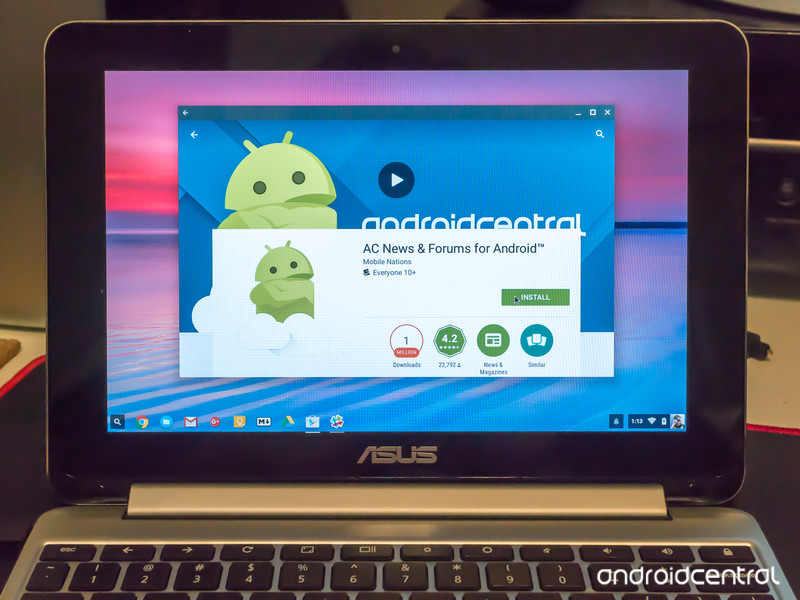
Google Play is finally on the Chrome Stable channel for the Asus Flip and the Acer R11.
Google has made a lot of progress getting Google Play and Android apps working on Chrome. It wasn’t the worst thing to come out of Mountain View when it initially launched, but there were bugs and it lacked a lot of polish, especially when running next to Chrome itself which is dead-simple and very user-friendly. The worst part of the experience for me and many others was using the Chrome Dev channel.
I really like being able to run a handful of apps from Google Play on my Asus Flip. I actually enjoy using a Chromebook for work and play, and the addition of apps like Slack and Hangouts — that are far better than their corresponding Chrome extensions — make me more productive. Each is one less thing I have to use my phone to do. But some of that shine was taken away when the browser would crash, or tabs would reload while I was a few hundred words into a writing groove, or everything would just stop working for a few seconds at a time. That makes things pretty rough, and eventually, I was back to the Stable channel on another Chromebook and left my Flip be a “testing device” which is really what the Dev Channel or Canary are for. Playing with developer software is fun, but I don’t recommend you try to depend on it.
Using developer software can be fun, but I can’t depend on it.
Thankfully, the Chrome Stable update to 53.0.2785.129 for the Asus Flip and the Acer R11 carried the Google Play store along with it. It’s still in beta, and it can still be a little finicky. The Play Store tells me I have no connection more often than it should. Every once in a while when I go to pull up an app from my shelf it has to restart. Annoying, but not show-stopping because everything else is working fine again. And it’s nice to have those few apps available again even if not perfect. My long national nightmare is over. Or something like that.
There are plenty of other Chromebooks that will get access to Google Play “soon.” The Chromebook Pixel (the 2015 version) hasn’t been updated to a Stable channel build with Google Play just yet, but we know it’s coming. Along with plenty of models from HP and Dell and everyone else who makes them. We have no exact timeline, for I’m looking for it to be a few weeks yet so Google and everyone involved can make sure the initial push to more users goes as smoothly as they had hoped before they push things out to any more models — we all know how Google likes to take its time with software rollouts and extended testing. When it happens we’ll let you know.
Here’s where I ask you to write a bunch of words! If you have an R11 or a Flip and didn’t jump to Dev to try Google Play (a longshot, I know) tell us what you think about it now. It’s a definite improvement on the Stable channel, and that might make us think it’s better than it is because we saw how much worse things could be. And if you’ve been using Google Play all along on your Chromebook, let me know that I’m not crazy and it really is a better experience on Stable.
What are VoLTE and HD Voice, and why should you use them?

What is VoLTE and why should I care about it?
Here in the U.S., most carriers have rolled out the red carpet for Voice over LTE. If it is available in your area and through your carriers, taking advantage of the upgrade currently depends on your having the right hardware. Once you have everything you need, setting VoLTE up on your phone is very easy and well worth it.
Let’s take a deeper look.
What is VoLTE?

Image courtesy of Ericsson
As the name suggests, Voice over LTE is what happens when your carriers allows you to place a phone call over your LTE connection instead of the more common voice networks. Verizon Wireless, for example, traditionally used 1XRTT for all of your voice calls, relying on LTE for data. This used to be why Verizon phones couldn’t simultaneously use voice and data. AT&T and T-Mobile, which relied on a combination of LTE for data and HSPA+ for calls, would drop down to a 3G signal when talking to someone on the other line. With VoLTE, neither of these scenarios are necessary anymore.
What both network types now have in common thanks to VoLTE is the ability to use more bandwidth to make phone calls with higher quality audio traveling both ways. When you are on a call with someone else who is using VoLTE, you immediately notice the difference in call quality on both ends. You’ll also notice the calls connect faster if you are calling someone near you, and while that’s not a feature worth bragging about it’s a cool thing to test for yourself.
How can I use it VoLTE?

Most major U.S. and Canadian carriers have rolled out VoLTE to some extent, as of September 2016.
-
Verizon rolled out VoLTE in September 2014, and has since been building it into most new high-end devices from Samsung, LG, and Motorola. Consolidated under its HD Voice brand, VoLTE is rolled into video calling and Wi-Fi Calling, but all customers need to know is that a VoLTE-enabled device will be able to stay on LTE on a phone call, and connect to other cellphones and landlines at much higher qualities. Verizon also recently rolled out VoLTE support to prepaid devices.
-
AT&T rolled out VoLTE in May 2014, and most new devices support the protocol. Also bundled under its HD Voice brand (coincidence?), AT&T says that the higher-quality codec and reduced background noise that come with such calls are currently limited to other AT&T customers, but that it has worked with Verizon to test interoperability between networks.
-
T-Mobile rolled out VoLTE in May 2014, and says that over 50% of the calls made on its network use the new standard. Earlier this year, it appended EVS, Enhanced Voice Services, on top of the VoLTE standard, claiming to improve call quality, reliability, and connectivity speed. Most new T-Mobile phones support VoLTE out of the box, and the company has been great about updating its older devices to support it, should the hardware allow.
-
Sprint and US Cellular are in the testing stages for VoLTE, and have not yet rolled it out to customers. Sprint is in a unique position where it doesn’t need VoLTE, since it has fewer customers than the other big carriers, but a comparable amount of spectrum, making it less essential to refarm the spectrum they currently use for voice calls to the more-efficient VoLTE standard. US Cellular wants to wait until VoLTE is mature enough to be revenue-positive for the company. Neither company has committed to a timeframe for public availability.
-
In Canada, Rogers, Bell, and Telus have rolled out VoLTE to some customers, though the two former have considerably wider support than Telus, which is limited to Alberta and British Columbia. The good news is that, unlike in the U.S., carrier interoperability was built into the carriers’ plans, meaning that calls made between VoLTE users on Rogers and Bell will sound just as good as those made intra-network.
What else do I need to know?

One of the curious problems associated with VoLTE is accurately measuring usage to ensure that those on tight data budgets aren’t getting ourselves in trouble by taking advantage of higher quality audio.
Today, all carriers count HD Voice/VoLTE calls towards the minutes in one’s monthly bucket, and not data, even though VoLTE uses the same data network as video streaming or browsing the web. But for carriers like Verizon that support video calls under the VoLTE standard, the voice portion of a chat will use minutes, while the video portion will use data. Verizon says that “an average 1-minute video call uses about 6 – 8 MB of data,” beware of that before making that video call — or just use Wi-Fi.
It’s also worth noting that all carriers in this list also offer Wi-Fi calling, which routes regular voice calls through a Wi-Fi network in a seamless way that, in areas of poor cellular coverage, improves call quality and reliability.
While the VoLTE revolution has been slow and steady, it’s good to see most U.S. and Canadian carriers beginning to take the benefits of the new technology more seriously, and ensure the experience is as seamless as possible for users like you.
 AIVAnet