


Apple Car: Here’s why Apple wants to buy British automaker McLaren
Apple is reportedly considering another acquisition, but this one stands out from all the others because it involves McLaren
According to The Financial Times and The New York Times, Apple is attempting to buy British automaker McLaren – or at the very least, it is discussing a strategic investment. McLaren, which is best known for its Formula One racing team and P1 hybrid car, not only makes a range of supercars but also has a consulting division and a technologies group that supplies parts.
- Apple Car: What’s the story so far on Project Titan?
Keep in mind Apple is reportedly developing a car, Project Titan, which is rumoured to be electric and might have autonomous capabilities. The Cupertino, CA-based company recently recruited a former longtime Apple executive, Bob Mansfield, to lead the project, though newer reports claimed Apple has cut many jobs in the division in an attempt to narrow the project’s scope.
McLaren is valued between $1.3 and $2 billion. While Apple declined to comment, McLaren has already denied the reports, saying it is not in discussion with Apple “in respect of any potential investment”, according to The Verge.
Still, here’s why Apple has probably considered buying McLaren.
McLaren
Technological expertise
A McLaren acquisition would give Apple the expertise and experience it needs to quickly develop a car itself, as there’s no denying that McLaren has lots of technological and engineering prowess when it comes to manufacturing drivetrains and vehicle control systems.
The company, which sold 1,654 cars in 2015, makes sports cars and has roughly 5,000 employees working across six different divisions that include automative, racing, marketing, and automative supplying (that last bit means it has plenty of experience with supplier-OEM deals, too). Let’s also not forget that it has a consulting division that works across several industries to provide R&D.
McLaren
Next-gen innovation
McLaren has used advanced, premium materials such as carbon composites, aluminum, and carbon fiber in the past. And it’s very familiar with electric vehicles (with the most famous example being its P1 hybrid that traveled up to six miles on electric power) and high-performance Formula One race cars, all of which suggests it has the gumption to develop a next-generation car.
McLaren
Size and convenience
McLaren is small. It’s a privately-owned, independent carmaker, so an acquisition is logistically possible for Apple. Plus, it’s conceivable that McLaren would continue operating its automotive and racing divisions after an acquisition. Beats, which Apple acquired a couple years ago, still develops and sells headphones, even as Apple works to integrate Beats’ tech into its own stuff.
McLaren
Apple-like mind
McLaren’s Technology Centre was designed in 2004 by Foster + Partners, the same firm making Apple’s spaceship campus and many Apple stores. This building highlights its surrounding landscape, using water from a lake for energy-efficient cooling purposes. There’s even a wind tunnel for aerodynamic testing. The McLaren Production Centre was also designed by the firm.
Based on its state-of-the-art headquarters, approach to making vehicles, and overall ethos, it’s clear that McLaren is very similar to Apple in terms of aesthetics and using breakthrough technology. We’re very interested in what the two could do together. One can only hope.
The drought-busting balls that don’t bust drought
California’s water problem is severe. Despite 2016 seeing a distinct improvement in precipitation over previous years, to almost average levels in many areas, much of the state is in extreme drought. As well as ordering mandatory water reductions, the state has also been looking to other solutions.
“Shade balls,” the 4-inch wide black plastic balls pictured above blanketing Los Angeles Reservoir, have been touted as one of those solutions. But they’re not. The primary purpose of the release, which went viral last year, was to obey Federal rules on covering drinking water. The Los Angeles Department of Water and Power (LADWP) had previously used the balls in smaller reservoirs, and in the case of the Los Angeles Reservoir, says the balls helped the department save more than $250 million over installing a more permanent cover.
Although they were released to headlines like Shade Balls in Los Angeles Reservoir to Save 300 Million Gallons of Water Annually, the main benefit of the balls is to prevent sunlight from reacting with the chlorine-treated water and naturally occurring bromide to create the possible carcinogen bromate. The shade balls aren’t a complete solution, and there are accusations that they may deteriorate and release dangerous chemicals into the water. The water in the Los Angeles Reservoir, however, goes through a UV treatment process before it makes its way to citizens.
So why the headlines? Well, the shade balls also discourage algae growth and, as a side-benefit, prevent evaporation to an extent. But the “300 million gallons saved” claim represents less than a day’s water use for the LADWP. According to LA Weekly, 300 million gallons of water was worth around $2 million at the time the balls were deployed, or roughly $32 million less than the cost of the balls themselves.
Evaporation reduction is a fringe benefit, then, and tying the shade balls to drought (which the LADWP absolutely did with its press release) wasn’t the brightest idea. According to the LADWP, though, shade balls have been a successful alternative to the extensive construction work required to install a cover. They’ll remain in place at Los Angeles Reservoir, but they’ve been, or are being, removed from all the other reservoirs under LADWP’s jurisdiction. One such site was scheduled for closure, while the others will get permanent floating covers. Whether this decision was taken for financial reasons, or because those sites lack the Los Angeles Reservoir’s backup UV treatment process, is unclear.
Despite their lack of drought-busting guile, shade balls nonetheless make for a fantastic photo opportunity, and have inspired some fascinating stories. Silica Magazine’s cover story on the subject is recommended reading, while National Geographic photographer Gerd Ludwig has a photo series that’s simply stunning. As for California’s water issues, there’s always cloud seeding, although that comes with its own conspiracy theories.
The Big Picture is a recurring feature highlighting beautiful images that tell big stories. We explore topics as large as our planet, or as small as a single life, as affected by or seen through the lens of technology.
Chan Zuckerberg Initiative to invest $3 billion to cure disease
Facebook CEO Mark Zuckerberg launched the Chan Zuckerberg Initiative last year with his wife, Priscilla Chan, in an effort to try to “advance human potential and promote equality for all children in the next generation.” The two pledged to donate 99 percent of their Facebook shares — which is worth upwards of $50 billion — to the cause. Today, the couple held a press event in San Francisco to announce their next big project: curing diseases. Indeed, it has pledged over 3 billion dollars over the next decade to cure, prevent and manage all diseases by the end of the century.
That’s obviously a pretty lofty goal, but Chan and Zuckerberg believe it’s possible. They plan to do this with a three-pronged approach: 1) Bring scientists and engineers together, 2) Build tools and technology to empower the scientific community 3) Grow the movement to fund science. The first step is already underway, as the initiative has already started to partner with scientists, doctors, engineers and universities to achieve this goal. Leading this project is Dr. Cori Bargmann, who will become the initiative’s President of Science. A renowned neuroscientist and geneticist, she led the president’s BRAIN initiative.

“We spend about 50 times more treating people who are sick than we invest in research so you won’t get sick in the first place,” said Zuckerberg, adding that public support for this initiative matters.
The first investment is in something called the Biohub, a facility that brings together a group of researchers and engineers from UCSF, Stanford and UC Berkeley to develop new tools to treat disease. It’ll serve as a central point for collaborations between experts across disciplines — engineers, computer scientists, biologists, chemists and others. It will be led by Joseph DeRisi, a PhD in Biochemistry and Biophysics and Stephen Quake, a DPhil in Bioengineering and Applied Physics and Physics.
One of Biohub’s first projects is the Cell Atlas, which is to dive deep into the different cell types in the human body and understand the complex interactions between cells. Another one is called the Infectious Disease Project, which is to figure out how to finesse the process of detecting, responding, treating and preventing diseases such as Ebola, HIV and Zika. All of Biohub’s findings — along with everything that is studied in the Chan Zuckerberg Science initiative — will be open source and available to all.
“We have to be patient. This is hard stuff,” said Zuckerberg at the event. “This is about the future that we all want for our children. If there’s even a chance that we can cure all diseases, we have to do it. We have the opportunity to leave the world a much better place than when we found it.”

At the end of the event, Bill Gates made an appearance to lend his support to the initiative. He praised Zuckerberg and Chan for their ‘very bold and very ambitious” plan. Gates, who also has his own charitable organization — the Bill and Melinda Gates Foundation — agreed with Chan and Zuckerberg that we need to fund science to help develop preventative tools like vaccines. “Their vision and generosity is inspiring a whole new generation of philantropists who will do amazing things,” he said. “We’re proud to say that we were here when Mark and Priscilla started this journey.”
“My heart is full of hope, and we are eager to get started,” said Chan to close out the event. “Let’s do this together.”
Vizio’s SmartCast soundbars don’t work well with Spotify for now
Vizio’s line of SmartCast soundbars and speakers tout Google Cast for wireless audio streaming from a variety of apps. One of those apps is Spotify, a massively popular music streaming service. Unfortunately, the Cast functionality with that particular library of tunes isn’t working like it should. There are a number of posts in both Spotify and Google’s forums from users who say Vizio’s latest soundbars don’t show up as an option for Casting in the streaming app. Spotify’s software isn’t recognizing the speakers as available gadgets for playing music. Reports of the issue go back as far as late July, over a month after the SmartCast soundbars went on sale.
While the situation is certainly a headache for folks who already bought Vizio’s audio gear, the company says a fix is on the way. “Vizio, Google and Spotify are aware of an issue on the soundbars and are working closely on improvements via a firmware update,” the company told Engadget. “Once available, the product will update automatically. In the meantime, we recommend using Bluetooth when streaming from Spotify.”
Bluetooth isn’t the best option in terms of audio quality, but at least the secondary connectivity offers a way for owners to still use Vizio’s soundbars with Spotify in the interim. Vizio doesn’t have a timeline for when the fix will be available, so Bluetooth may be the only option for using that particular music service for the foreseeable future. Users report that Cast functionality works well in other audio apps, so the issue appears to be limited to using Spotify with Vizio’s group of soundbars. The company didn’t mention any issues with the recently released Crave 360 speaker that went on sale earlier this month.
[Thanks, Dan]
Source: Spotify Community, Google Product Forums
Democrats slam Republicans fighting the internet handover
If you thought Facebook and Google raised a big fuss over Republican opposition to the US’ plan to hand the internet’s ‘keys’ (the authority managing domain name assignments) to an international governing body, you haven’t seen anything yet. A quintet of House and Senate Democrats have used TechCrunch to post an open letter to the Republicans, chastising them over their resistance to the transition to ICANN. While Senator Ted Cruz and supporters have previously claimed that international control would make it easier for authoritarian governments to censor the internet, the Democrats reject this outright. The task of managing the domain name system is “clerical,” they argue — countries like China or Russia can’t manipulate content just because DNS isn’t under exclusive US oversight.
If anything, the Dems argue, a delay past the planned October handover would play into Russia’s hands. It could push for moving these functions to an organization like the UN, where it’d have a better chance of skewing the internet in its favor — say, getting more authority to silence political opponents. And a delayed transition might tempt countries to create their own domain name system equivalents, fracturing the internet and giving them censorship powers that they can’t have today.
Not surprisingly, this is as much about us-versus-them politics as technical issues. The Democrats portray Cruz and crew as using the transition as an excuse to block a budget bill (before, many Republicans were fine with the handover), score points in election season and “mollify their extreme colleagues.” Whether or not you agree, it’s clear that at least some Democrats are determined to make this once-safe issue a major point of contention.
Source: TechCrunch
Tesla edges out Toyota for longest range zero-emission vehicle
We knew Tesla was revving up and adding range to its electric vehicle lineup, but now we have the EPA’s official word. The company’s top-of-the-line Model S P100D is not only quickest production car in the world, but it’s also the longest-running zero-emission vehicle with 315 miles of range – narrowly beating out Toyota’s hydrogen fuel-cell Mirai by just three miles.
While the Tesla might get you up to freeway speeds in a heartbeat, the Mirai will actually spend less time at the fueling station. According to fuel network True Zero, a Mirai will only spend four minutes at the hydrogen pump and, in an impressive feat of their own, the company set out to land a new Guinness World Record for most electric miles driven in a 24 hour period. By connecting the dots between True Zero’s fifteen fueling stations in California (and one in Tesla’s territory near Reno), the two companies put 1,438 miles on a Mirai in a single day. While that figure should do wonders for range anxiety, it still has to be confirmed by the good folks at Guinness.
Source: Autoblog, Next-Gen Transportation
30 minutes with Fujifilm’s medium-format mirrorless GFX 50S
Fujifilm made the biggest splash at Photokina with the GFX 50S, a mirrorless camera with a giant sensor stuffed into a fairly compact body. When it arrives early in 2017, the company will be in the weird position of having APS-C and medium-format cameras, but no full-frame model. So, it’s a big risk — Fujifilm is introducing a new format, complete with brand new lenses, and hoping that the market is open to the idea.
Most importantly, how is it as a camera? Fujifilm hasn’t released any images yet and the prototype had no memory card, but we were able to play with it a bit at Photokina. My first takeaway was just how small it is given the huge sensor.
You’d be forgiven for mistaking it for a DSLR or an oversized X-T2. I held it in one hand (I think I saw the rep flinch) with my camera in the other and believe, unofficially, that the GFX 50S is lighter with Fujifilm’s new 63mm f/2.8 prime than a Canon 7D with a similar-sized 15-85mm zoom. It’s less chunky as well, and thanks to the just-right grip, is marvelous to hold.
The weather-sealed camera is heftier than Hasselblad’s new X1D medium-format mirrorless camera. But Fujifilm told Engadget that it wasn’t aiming for the lightest weight, but just something lightweight with the best optical performance.To that end, it used a focal-plane, rather than the typical leaf, shutter. That helps keep the flange-back lens distance as short as possible — just 26.7mm. That, it says, makes for the best optics and most compact lenses.

The viewfinder is removable, and you can install a tiltable one or a large monitor in its place on the dedicated hotshoe. You can even go without an EVF completely, if that suits you. Given the large sensor and small body, battery life might be a concern, but Fujifilm will offer a grip accessory that adds longevity and additional camera controls.
As for the menu system, Fujifilm isn’t reinventing the wheel. It’s wisely sticking to the setup it uses for its high-end X-series APS-C mirrorless models, with simple menus and dedicated physical dials for ISO, shutter speed and aperture.
It’s only when the lens is popped to show the 43.8mm x 32.9mm, 51.4-megapixel sensor that you realize you’re in new territory. The size is quite a leap (1.7 times more area, to be exact) from the 36mm x 24mm chips on full-frame cameras by Sony, Canon and Nikon. Fujifilm engineered and built the new bayer (not X-trans) chip, which has no AA filter.

The EVF is remarkably bright and sharp, and the rear, tiltable display appears to be very high res. Looking at either, you can see the fruit of a larger chip. With the 63mm lens set at f/2.8, the depth of field is razor thin, so this thing is going to require a very good autofocus. Taking a few (simulated) shots, the AF was not fast, but again, it’s a prototype and there’s plenty of engineering work left to do. In any event, it’s not a camera for sports photographers or photojournalists — the large sensor is better suited for portrait, landscape and architectural photography.
It will take seriously good lenses to resolve a medium format, 50-plus megapixel sensor. Fujifilm said its three new models, a 63mm f/2.8, 120mm f/4.0 macro and 32-64mm f/4.0 zoom have much more sharpness than needed. (During its press event, in fact, Fujifilm said it wants the lenses to be ready for 100-megapixel sensors in this format). It’ll release an additional three lenses, a 35mm f/2.8, 23mm f/4 and 110mm f/2 in mid-2017 (remember that on a medium-format camera, the crop factor is less than one).
The success on this model will likely depend on the price, but Fujifilm said it will be well south of $10,000 (the Hasselblad X1D is $9,000 for the body only). At the same time, Fujifilm suggested that it’s not in competition with, and will therefore not be as cheap as, a $3,500 Canon 5D Mark IV, for example. In any case, the medium-format market is now getting oddly crowded with models from Hasselblad, PhaseOne, Pentax and now Fujifilm. And that should make the once-neglected segment, and photography in general, much more interesting.
Oculus’ Touch controllers priced at £190 in the UK
If you still haven’t figured out why the Oculus Rift sells for a solid $200 less than HTC’s Vive, let this be the final word: it’s the motion controllers. According to a display in a GAME store in the UK (found by our very own Nick Summers), Oculus’ virtual reality motion controllers will retail for £190, or just over $200 after deducting local UK taxes. That’s expensive, but not at all unexpected — if that price holds across the pond, it puts the cost of a room-scale Oculus Rift kit on equal ground with HTC’s $800 Vive.
Oculus Touch controllers to cost £190 in the UK. Crikey. pic.twitter.com/zg9JTNiCg8
— Nick Summers (@nisummers) September 20, 2016
As daunting as that total price is, it’s sort of the going rate for immersive, room-scale VR. We’re still in first generation of high-end consumer virtual reality, and first-gen hardware is always expensive. Even so, we’ve reached out to Oculus for confirmation on the listed UK price and if the $200 projection will carry over to the US market — but don’t expect a forthcoming revelation. The company is probably holding that announcement for Oculus Connect, next month.
Source: Twitter
Tinder brings swipe judgement to your iMessage conversations
Productivity apps have been trying to improve the hassle of group discussion for years, often by setting up basic “polls” that look more at home in enterprise software. But now you can spice up your queries with the interface everybody knows and loves: Tinder. The dating (and friend-finding) service is lending its swiping interface to iMessage users to better ask their friends photo-laden questions. Prepare to get your “hot or not” fix when picking dinner in your next group text.
But really, rolling images and choices together in a smooth interface is much easier than manually sending photo barrages spliced with context texts. It’s the iMessage API dream made reality: Expanded functionality tucked into a little conversation bubble. Sure, other apps have taken a stab at this, but they lack Tinder’s instant UI recognition. It’s only a matter of time before the newly fertile field of iMessage augments flood the App Store, so it was smart of the dating/friending app to leverage its recognizability, especially to diversify somewhat into the productivity space. Just don’t be surprised if asking your boss to get a new Tinder service to “improve team communication” ends up raising a few eyebrows.
Source: Tinder blog
Review: Kanex’s GoPower Watch Battery Provides Six Full Apple Watch Charges in a Small Package
Although Apple remains conservative regarding the battery life of the Apple Watch, many users have noted that the wearable device makes it through one day with plenty of charge left over in its 18-hour estimated life. Still, third-party power banks and portable chargers have been popular mainstays in the Apple Watch accessory line, and recently Kanex launched its own charging device for the Apple Watch, called the GoPower Watch.
Kanex’s charger is packed with a 4,000 mAh battery and a claim that, on a full charge, it can recharge the Apple Watch up to six times with an integrated inductive charger. As a bonus, the GoPower Watch also includes a USB port, letting you charge your iPhone (or any USB-powered device) simultaneously with the Apple Watch. There’s also priority charging, so your devices charge first and the battery pack second.
Design
Kanex’s GoPower Watch meets the form and function that any successful portable battery pack needs to be used on a daily basis. Its small 3-inch square will fit comfortably in a backpack, and the quartered LED lights — surrounding the only button on the housing — provide quick and easy reminders of how much juice is left in the pack.
The slightly raised inductive charger is surrounded by a smooth Space Gray material (admittedly, a few shades darker than Apple’s definition of Space Gray), that feels sturdy despite the small frame of the GoPower Watch. Interestingly, the actual inductive charger on Kanex’s device is a bit larger than Apple’s own inductive charger, but its added 1/4 of an inch appears negligible and doesn’t affect the charging of the device.
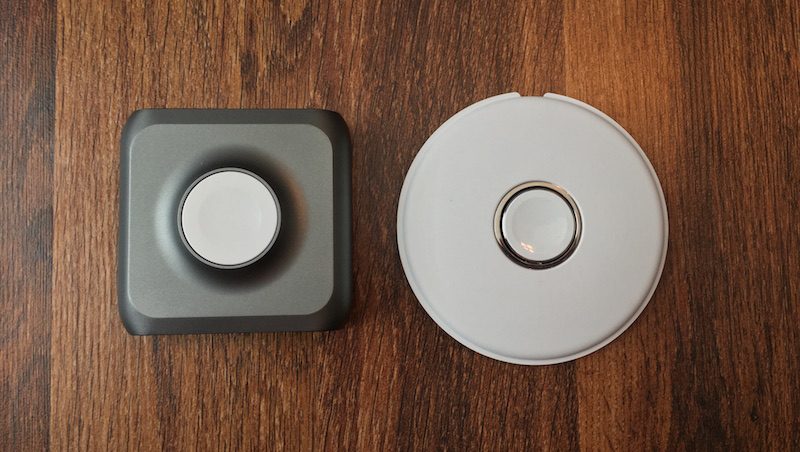 GoPower Watch compared with Apple’s Magnetic Charger
Otherwise, the design is no-frills. The front and rear of the pack are made up of a black, plastic-type material that’s a bit more fingerprint-attractive than the Space Gray of the rest of the device. On the back users will find the micro-USB port to charge up the battery pack, and the USB Type-A port for smartphone charging. Anyone opposed to large branding on their products probably won’t like the prevalent Kanex logo on the front of the unit, however.
Charging the Apple Watch
After using Kanex’s GoPower Watch battery for a week, I found that the company’s claims of six full recharges on an Apple Watch to be right on the money. The battery pack uses a simple circle of lights, cut into four quarters, to display the remaining charge in its 4,000 mAh battery. The GoPower Watch lost its first quarter of battery in the middle of the third charge of my Apple Watch, and then finally lost the second quarter in the sixth Apple Watch charge.
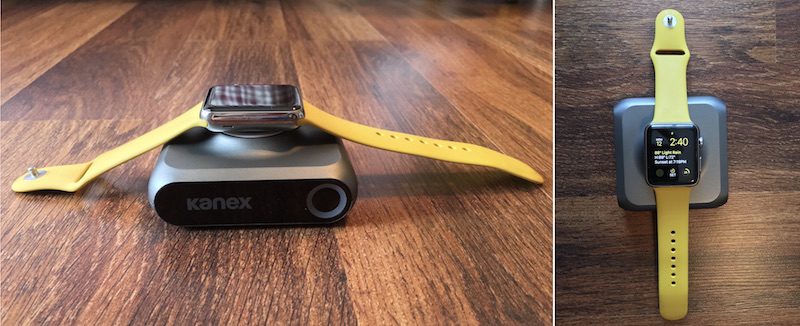
From there the battery status declined quickly, and after the pack filled my Apple Watch up to 100% life for the sixth time, the final portion of the ring began flashing and the battery quickly died. During these tests I didn’t charge my iPhone, focusing first on the company’s own Apple Watch-heavy marketing for the accessory. And in that sense, the GoPower Watch delivered on its promises. The average charging time of all the tests was about 90 minutes.
If used solely as a power bank for an Apple Watch, Kanex’s device will easily provide its intended six full recharges on Apple’s wearable, although the larger battery on the Apple Watch Series 2 means those models might get slightly fewer charge cycles. Although that might be a bit of overkill for most casual Apple Watch wearers, the combination of the integrated inductive charger and deep well of battery life could justify the $99 price tag for those who find themselves away from a traditional power source on a consistent basis.
Charging the iPhone
After depleting the GoPower Watch during my Apple Watch tests, I topped off the battery pack again — a lengthy process that takes the large part of an afternoon, which is the case for most battery packs — and focused on the iPhone. With the GoPower Watch fully charged, I managed to recharge my iPhone 6s Plus from 10 percent to 99 percent charge over the course of about two hours, after which Kanex’s battery was down to 50 percent.
In a subsequent test, to see how much percentage I could add onto my iPhone with the rest of the GoPower Watch’s battery, the battery pack swiftly whittled down to 25 percent and then died, adding on about 15 percent charge to my iPhone. Considering the 2,750 mAh within the iPhone 6s Plus, one full charge with a little left over makes sense coming off of the GoPower Watch’s 4,000 mAh battery.
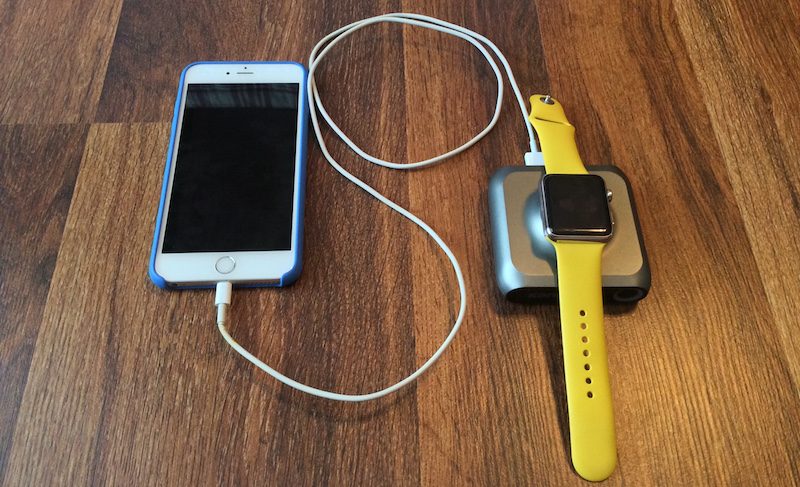
Although smaller smartphones could get more out of it, like the iPhone SE (1,624 mAh), iPhone 6s (1,715 mAh) and iPhone 7 (1,960 mAh), the GoPower Watch is simply not an iPhone accessory; it’s an Apple Watch accessory that could potentially recharge your iPhone in a pinch, with very little left over for your watch. Simultaneous charging of each device also negates the portability such battery packs allow for smartphones, since the Apple Watch needs to remain on a flat surface to stay attached to the inductive charger.
For iPhone battery packs, similarly priced accessories, like Mophie’s powerstation XXL, give users upwards of 20,000 mAh for around $100. Other brands, including Anker, offer similar battery capacities at even cheaper prices. As such, it’s hard to harp on GoPower Watch’s clear intent to focus on Apple Watch over iPhone, but it’s an aspect of the accessory that should still be noted.
Bottom Line
Overall, GoPower Watch’s solid design and integrated induction charger make it one of the most enticing charging solutions on the market for Apple’s wearable device, if you’re an Apple Watch power user and in need of one, that is. Lack of Nightstand Mode and closed-loop band support could, however, be deal-breakers for some.
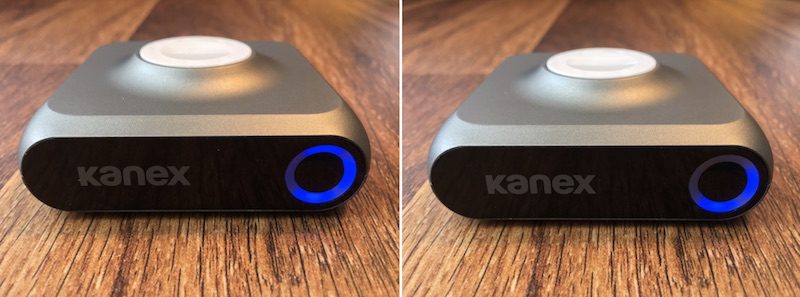 The display shows the GoPower Watch’s dwindling battery
Compared to other Apple Watch battery packs, Kanex’s solution is a slightly steeper monetary investment, but its higher-capacity battery justifies the price. Nomad’s Pod, for comparison, costs $29.95 but provides an 1,800 mAh battery, or the ability to keep your Apple Watch “powered all weekend,” according to the company.
If you repeatedly find yourself scrambling for a power source for your Apple Watch when not at home, and want to invest in something you won’t have to constantly remind yourself to charge all too often, the GoPower Watch makes a reliable case for itself. Just remember that it won’t provide much in the way of repeat charges to a smartphone, especially any larger-screened models with higher-capacity batteries.
Pros
– Clean design with soft, attractive Space Gray material
– Integrated inductive charger
– Charging Apple Watch as quickly and reliably as first-party accessories
– Meets Kanex’s claim of six full Apple Watch charges
Cons
– Dies quickly when charging bigger devices through USB-A port
– Doesn’t support Nightstand Mode or closed-loop bands
How to Buy
Anyone interested can purchase the Kanex GoPower Watch from the company’s website for $99.95. Kanex also sells a line of other accessories, including a USB-C battery pack for the 12-inch MacBook, a Thunderbolt 3 adapter, and a Bluetooth Mac keyboard that can sync with up to four devices and includes Apple’s long-gone numeric keypad.
Related Roundups: Apple Watch Series 2, watchOS 3
Tags: Kanex, GoPower Watch
Buyer’s Guide: Apple Watch (Buy Now)
Discuss this article in our forums
 AIVAnet