


News Organizations Team Up in Lawsuit Against FBI Over San Bernardino iPhone Hacking Case
A group of three news outlets, including Gannett, the Associated Press and Vice Media, filed a lawsuit today against the FBI on grounds relating to the bureau’s decision to keep its method of hacking into San Bernardino shooter Syed Farook’s iPhone a secret. The news organizations are looking for more information about how exactly the FBI entered the iPhone, what “outside party” helped with the process, and how much the government paid for it (via USA Today).
Gannett, the AP, and Vice Media have each sought details on the hack under the Freedom of Information Act, but the FBI denied the requests, arguing that “revealing the records would imperil its enforcement efforts.” Now the organizations are teaming up and asking the court to force the FBI to release the requested information.
While the security drama swirls, University of Cambridge researcher Sergei Skorobogatov has released proof countering the FBI’s claim that it couldn’t get into Farook’s iPhone without Apple’s help. In his report (via Engadget), Skorobagatov detailed his process in bypassing the passcode retry counter of an iPhone 5c running iOS 9, which he said “does not require any expensive and sophisticated equipment.”
This was achieved by desoldering the NAND Flash chip of a sample phone in order to physically access its connection to the SoC and partially reverse engineering its proprietary bus protocol. The process does not require any expensive and sophisticated equipment. All needed parts are low cost and were obtained from local electronics distributors. By using the described and successful hardware mirroring process it was possible to bypass the limit on passcode retry attempts. This is the first public demonstration of the working prototype and the real hardware mirroring process for iPhone 5c.
After removing the NAND from the iPhone — which requires “a temperature above 300 ºC…due to heavy heat sinking of the main PCB” — he created a backup of it and placed it onto a custom-built, special test board. To continue the NAND mirroring process, following a successful creation and verification of the backup copy, the original chip is placed back into the iPhone 5c, where the researcher entered six passcode attempts, and then power cycled the device. In total, the process takes 90 seconds each time, meaning the true password could feasibly be discovered in “less than two days.”
Once the phone is powered up and the screen is slid the passcode can be entered six times until the delay of one minute is introduced again. Then the process of mirroring from backup can be repeated again and again until the correct passcode is found. On average each cycle of mirroring for six passcode attempts takes 90 seconds. Hence, a full scan of all possible 4-digit passcodes will take about 40 hours or less than two days.
The fight between Apple and the FBI began earlier in the year when Apple refused to help the government unlock Farook’s iPhone 5c under the belief that it could set a fearful precedent for security and privacy moving forward. The FBI didn’t know what could potentially be on the device, but believed that any information gathered from it would potentially help move the case of the San Bernardino shooting forward in meaningful ways.
Although that particular case is over, FBI director James Comey said that he expects litigation over the encryption of mobile devices to continue, as encryption is “essential tradecraft” of terrorist organizations like ISIS. Technology and security have intersected more and more as smartphones grow more popular, with Comey also stating that WhatsApp’s new end-to-end encryption was already “affecting the criminal work [of the FBI] in huge ways.”
Note: Due to the political nature of the discussion regarding this topic, the discussion thread is located in our Politics, Religion, Social Issues forum. All forum members and site visitors are welcome to read and follow the thread, but posting is limited to forum members with at least 100 posts.
Tag: Apple-FBI
Discuss this article in our forums
2017 Porsche 911 Carrera 4S review – Roadshow
Sep 2016
The Good The 2017 Carrera 4S is a joy to drive, thanks to a responsive engine and an impressively quick transmission.
The Bad The 911 can pick up some serious wind noise at speed, and if you include every option, the car’s price heads north of $150,000 in a hurry.
The Bottom Line The latest iteration of the 911 might add two turbochargers, but its core character remains the same — it’s a wondrous sports car that won’t become a chore on longer jaunts.
These days, everybody wants their cars to be superheroes. We want them to be sporty, but not so sporty that we can’t be comfortable. We want power, but we’re not willing to give up fuel economy. We want our cake and, dad gum it, we want to eat it too. Cost keeps most cars from achieving this goal, but most cars aren’t the Porsche 911.
While it may have started its life as a lithe rally machine, the 911 has grown considerably, spawning many different variants along the route, nearly all of which sport turbochargers as of 2017.
It’s an efficiency move, no doubt, but the 911 has soldiered on through worse, and I’m happy to report that the car you see here, the 2017 911 Carrera 4S, hands out the cake on a fork and begs drivers to take a bite. Whether it’s cruising down the expressway in proper grand-touring form or whipping about the back roads of Insert State Here, it’s a delight.
Easy to pick out of a lineup
If you’ve seen a Porsche 911 since 1966 or so, it’s not hard to pick one out on the road. Its rear-engine layout gives it a familiar, demi-ovate silhouette that hasn’t changed much, save for generational expansions along all three axes. Mild revisions for the 2017 model year include a revised front end, new taillights and a new engine cover. This specific color, Graphite Blue, is worth the $710 cost of admission.

If you’re unsure what you’re looking at, the litany of badges across the rear end will definitely remind you.
Nick Miotke/Roadshow
Inside, 911 traditions remain, like the five-gauge binnacle and the left-side ignition, but they’re given a 21st-century update — the key now stays in your pocket, and the center-right gauge houses a 4.6-inch color display.
Even though the infotainment screen dominates the center stack, there are still loads of dials and buttons. I found the menagerie of controls below the shifter, which adjust all manner of chassis and powertrain bits, confusing at first. By the end of my week with the car, though, opening the exhaust or lifting the front end (a $2,590 option) was muscle memory.
My tester came with a blue-and-white leather interior, and it was hard to find a surface that didn’t feel nice and expensive. The seats, despite carrying a Sport moniker, are comfortable and supportive on long trips. Except for the rear seats. No matter how big the 911 gets, the rear seats are, have been, and always will be, a cruel joke.
Thankfully, I could fold down the rear seats and use the parcel shelf as additional grocery storage. If you need to grocery shop for more than two people, the 911’s frunk will need some help, as it’s just big enough for several backpacks or a smaller weekender bag.
The
2017
Porsche
911
is
part
grand
tourer,…
See full gallery


1 – 6 of 43
Next
Prev
No longer analog
Whether tucked away inside the suspension or right up front on the gauge cluster, technology makes the 2017 Carrera 4S decidedly digital. Drop $3,970 for the Premium Package Plus, and the 911 picks up LED headlights that provide ample illumination, auto-dimming mirrors and heated and cooled seats.

Porsche’s latest iteration of its PCM infotainment system is snappy and very easy to figure out — except for the settings menus.
Nick Miotke/Roadshow
As for infotainment, I was blown away by the latest iteration of Porsche’s infotainment system, which is new for this year. It now supports Apple CarPlay, but not Android Auto. The screen features a proximity sensor, hiding extraneous bits until a hand draws near.
I found this new infotainment system easy to use, but slightly difficult to fully figure out. For example, it gave me three different ways to change settings — use of the Opt button on a specific screen, through the touchscreen’s Settings menu or forcing attention up to the gauge cluster’s information display, which has its own control stalk.
If you need to remain connected on the road, the 911 car can be equipped with a 4G LTE antenna supporting a Wi-Fi hotspot. Optional onboard apps deliver fuel prices, weather, online destination search, news and even Google Earth maps to the screen. Porsche also has the Porsche Car Connect app, which lets the driver control vehicle functions using either a phone or wearable device.
While it may not come loaded with every new safety system on the planet, Porsche will add adaptive cruise control and autonomous emergency braking for $2,490. Another $850 tacks on blind spot monitoring. Parking sensors and a backup camera come standard, which helps keep the shiny parts shiny.
Which color Honor 8 should you get?

Which color Honor 8 should I buy? There are so many to choose from!
Pearl white, midnight black, sapphire blue, and sunrise gold. Which one, which one?! It’s always hard to make the decision, especially when you’re going to have to look at the Honor 8 every five minutes for the next year or two.
We know that the color you choose often comes down to personal preference, but we’ve got some tips that might help those of you still struggling to make a choice.
- Pearl white
- Midnight black
- Sapphire blue
- Sunrise gold
- Sakura pink
Who should get the pearl white Honor 8?


The full glass body of the Honor 8 is a head-turner, no matter which color you choose, but if you want instant attention on your device, white is certainly the way to go. It’s clean and has an almost sterile quality to it, reminiscent of futuristic sci-fi films.
The best part of having an all-white phone is its propensity to hide fingerprints and dirt, since it’s reflective with no dark undertones. If you like a clean-looking phone at all times, you’ll want to go with white.
It grabs attention, sometimes distractingly so. Having such stark, white bezel around a dark screen may end up stealing some of your focus. But if you can get past that, or you have your screen as bright as it’ll go (you animal), then no worries.
See at Honor
Who should get the midnight black Honor 8?


Black is sleek, sexy, and just plain cool. The midnight black Honor 8 really is as black as midnight, without any of the blue hues you see in competitors’ black phones, like the Galaxy S7.
The nice part about going with a black phone is that it’s going to look great with or without a case. Without a case, you have a devilishly handsome phone that’s understated and mysterious, but at the end of the day, it’s just a black phone, so slap a case on it and you probably won’t regret it.
The biggest drawback of having such a dark black phone with a reflective surface is that fingerprints will show up. You’ll either want to carry around a microfiber cloth or you’ll be constantly wiping your phone with your shirt, which is why black often lends itself better to a case.
Black is usually a default choice for most folks, but with current availability (only pearl white is available through the Honor site), we’ll likely see fewer black editions than usual.
See at Amazon
Who should get the sapphire blue Honor 8?


The sapphire blue Honor 8 is gorgeous. It’s not quite as soft, nor polarizing (especially now), as the blue coral Note 7, but it’s truly unique. When most companies are pumping out black, silver, gold, white, and pink/rose gold, if you’re looking for something a little unusual, blue sapphire is the way to go.
It’s a deep, rich shade of blue, reflecting subtly in the light. It’s got a certain beauty and allure. If you’re torn between the flash and guile of pearl white and the shrouded mystery of midnight black, blue might be a good in-between choice.
Who should get the sunrise gold Honor 8?


If you want to stand out with an ostentatious style, then sunrise gold is absolutely for you. If just want something more fashionable that’ll match your golden vibe, it’s definitely your best choice.
Gold is a fickle phone color in that, depending on the lighting, it can change from an almost silver tone to a rose gold to a sickly yellow, and fingerprints will show up at random and then vanish. Them’s the breaks when it comes to phone colors that straddle the fine line between light and dark.
The gold version is also incredibly hard to come by in North America, since it’s being focused in Russia and Middle Eastern markets to start. Don’t expect to get your hands on one any time soon.
Who should get the sakura pink Honor 8?
So far, no one’s seen the sakura pink Honor 8 outside of China, so the only answer, really, is anyone in China.
That being said, if it does make its way stateside, the same folks who usually opt for a white phone will also like the pink. It hides fingerprints fairly well and adds a sort of fashionable, head-turning flair to your phone.
The color will change, depending on the lighting, from a pearlescent rose to an almost crimson, but that’s what happens with such reflective phones.
Read more: Honor 8 review
Still undecided?
If you still can’t make up your mind, hop into our forums and get in on the discussion!
Honor 8

- Honor 8 review
- Honor 8 specs
- Pre-order the Honor 8
- 5 things to know about the Honor 8 in Europe
- All the Honor 8 news
- Join the discussion in the forums
Amazon
HonorBest BuyNeweggB&H
Digital Offers: Secure your internet connection for $79
How secure is your internet connection? When you’re travelling or using a public network, can you guarantee that your private information will be safe from hackers and other sketchy types? Most of us jump onto public networks and never stop to think about the access we might be granting to total strangers. That includes not only your passwords, but your messages and photos, too. Add to that the fact that, depending on where you’re travelling, public networks may not even allow you full access to the internet you’re used to; blocking certain sites isn’t uncommon. How are you supposed to keep up and stay safe when you’re travelling, or even just out and about in your own city, when you’re spending all of your time worrying and getting frustrated?
What you need is a VPN, or Virtual Private Network. It allows you to become the authorized user of a network that is encrypted, meaning your data remains safer than if you just use a regular public Wi-Fi network. PureVPN is a trusted provider, with well over one million users worldwide, giving you a secure network connection even when your only choice is a public network.
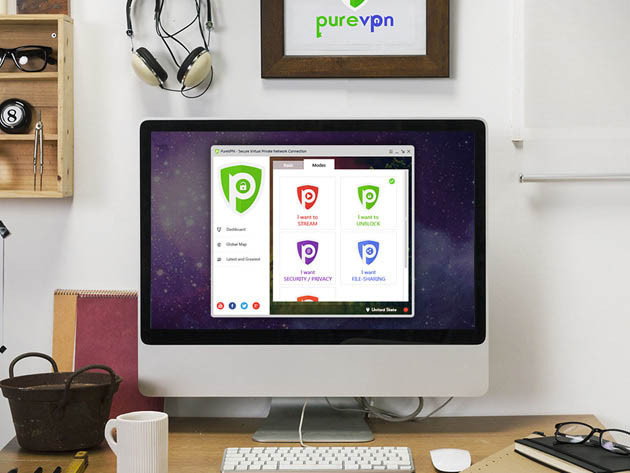
You can get a lifetime subscription to PureVPN through Android Central Digital Offers for just $79, which is 86% off the original price of $597! PureVPN is supported by over 500 servers in 141 countries, so whether you’re overseas on business or just down the street from your place, you’ll have a secure internet connection and access to everything you need. Your subscription:
- Keeps your web history completely out of view of potential hackers, protecting your passwords and usernames from becoming public information
- Is ideal for travel in places where you may find sites have been blocked for some reason; you can now work around those blocks and get access to the sites you need
- Is compatible with nearly any Smart device you may use at home or when you’re away. The subscription also includes five multi logins so that you can access a server from multiple devices at once
- Includes unlimited data transfer so you can download, browse, stream, and share as much as you like
- Prevents unauthorized access to your messages, photos, videos, and more
Lifetime subscriptions to anything are expensive, but right now you can get one for PureVPN for 86% off and never have to worry about secure networks or internet roadblocks again. Get yours now!
See at Android Central Digital Offers
Samsung Galaxy Note 7 going back on sale from 28 September
One of the worst periods in Samsung’s history is almost at an end with reports suggesting that the company has isolated the problem which made some Note 7 smartphones explode. It is almost ready to put the phone back on the market, with suspected faulty models removed from the supply chain.
A spokeswoman told CNN in the US that sales of the Samsung Galaxy Note 7 will resume in the company’s homeland of South Korea on 28 September. Other countries will also start to stock the phone again from that date.
This comes after a mass recall was demanded by US regulators yesterday, Thursday 15 September. Samsung will start to replace handsets with error-free models from Monday 19 September in Korea and other regions.
Pocket-lint understands that will also be the case in the UK.
- Official US recall of Note 7 fully reveals how many have exploded
- Samsung Galaxy Note 7 recall: How to exchange or return your phone
The issue arose at the end of August, with reports that new Note 7 handsets were overheating while charging. In some cases they caught on fire or exploded, allegedly causing burns and property damage.
Samsung was quick to inform its customers to stop using their phones and issued a recall program. Around 2.5 million Note 7 smartphones had been sold to that point, so isolating the problem became a priority.
Not all phones are affected but Samsung offered to replace or refund any it had already sold.
Surely I just played my final ‘Final Fantasy XV’ demo
While Final Fantasy XV’s decade-long development doesn’t beat Duke Nukem’s excessive run, it’s still a hell of a long time for another part of one of gaming’s biggest, longest-running franchises. And it’s still not here. However, at the Tokyo Game Show, I got what is possibly the last taster before the main course; a lengthy 30-minute play-through that — barring some brutal initial loading times — felt like a finished game.
The demo started in a pretty fascinating way: you’re thrown into a throne room on fire, and some evil (and huge) human figure is goading you to fight. You’re also no longer the boy-band prince that’s been part of FFXV’s promotional materials since 2006, but an older, grizzled version. Even your fellow bros are looking a bit rougher around the edges. You then assemble to duck another magical flame attack, and the demo frustratingly moves on to a glossy intro movie showing the King (the protagonist’s dad) biding you farewell as you cross the country to marry… someone. That early fiery scene seems like a tantalizing teaser of what’s to come. I’m all about time skips.
After setting up on your bro roadtrip, your car breaks down, and while it gets fixed, you’re free to do some chores, hunt some monsters and get used to the battle system quirks. Like the surprisingly dense Episode Duscae demo that came out two years ago (!), you’re given free reign to do what you want. Explore, fight, camp out, eat at the cafeteria and all the other important things.

My party gained levels, picked up new skills and I even forced them into casual clothes during my play: nothing seemed particularly locked down, and I could access monster hunt side-quests even if they were beyond my current level. Like I said at the start, it felt like the start of a whole, entire game, and it wouldn’t be a huge shock if it was.
Director Tabata himself said the game would have been ready for its previous September launch date, but the team wanted to avoid the curse of the Day 1 Patch, iron out bugs and add further polish.
I’m still not sure what to make of Final Fantasy XV: it’s willfully different, and I get why. Now I need to work out whether Square Enix can deliver on a modern, open-world Final Fantasy game — and get me to care about Noctis and his buddies. The only way I’ll figure that out is when the whole thing lands. Which is currently November 29th. For now.
The Engadget Podcast Ep 6: I Beg Your Pardon
Managing editor Dana Wollman and reviews editor Cherlynn Low join host Terrence O’Brien to discuss all the latest Apple goodies. Plus they’ll talk about Samsung’s software bandaid for your exploding Note 7 and debate whether or not Edward Snowden deserves a presidential pardon.
The Flame Wars Leaderboard
Wins
Loses
Winning %
Chris Velazco
3
1
.750
Christopher Trout
2
1
.666
Dana Wollman
2
1
.666
Devindra Hardawar
6
4
.600
Nathan Ingraham
3
4
.429
Cherlynn Low
4
6
.400
Michael Gorman
1
2
.333
Relevant links:
- ACLU and Amnesty International ask Obama to pardon Snowden
- Edward Snowden explains why Obama should pardon him
- NYC nixes kiosk browsers after homeless commandeer their use
- Samsung’s Note 7 exploding battery ‘fix’ is a 60 percent limit
- Apple releases iOS 10 and watchOS 3
- Apple’s AirPods aren’t a must-buy — yet
- iPhone 7 and 7 Plus review: Apple (mostly) plays it safe
You can check out every episode on The Engadget Podcast page in audio, video and text form for the hearing impaired.
Watch on YouTube
Subscribe on Google Play Music
Subscribe on iTunes
Subscribe on Stitcher
Subscribe on Pocket Casts
iPhone 7 Teardown Reveals ‘Incredibly Thin’ A10 Chip With 2GB RAM, Intel Modem
While iFixit was busy tearing down the iPhone 7 Plus, the experts at Chipworks opened up an iPhone 7 to take a close look at the chips included on the device’s logic board.
The new A10 Fusion chip at the heart of the iPhone 7 is the most significant feature to be examined, with Chipworks noting the chip is indeed manufactured by TSMC with a die size of roughly 125 square millimeters. The iPhone 7 is also confirmed to include 2 GB of memory, compared to the 3 GB found on the iPhone 7 Plus.
The A10 is also extremely thin, due in large part to the InFO packaging technique used by TSMC which was seen as a major factor in TSMC winning exclusivity for A10 production.
[W]hatever node is being used, the A10 processor is incredibly thin, giving credibility to the reports that TSMC’s InFO packaging technique is being used.
The A10 sits below the Samsung K3RG1G10CM 2-GB LPDDR4 memory. This is similar to the low power mobile DRAM as the one we found in the iPhone 6s. Looking at the X-rays we see the four dies are not stacked, but are spread out across the package. This arrangement keeps the overall package height to a minimum. Assembled in a package-on-package assembly with the A10 InFO packaging technique reduces the total height of PoP significantly.
On the cellular modem side, Chipworks found an Intel part that is likely the XMM7360, paired with two SMARTi 5 RF transceiver chips and a power management chip also from Intel.
As we previously noted, Apple is producing two different models of both the iPhone 7 and 7 Plus, with models for AT&T and T-Mobile users not including support for CDMA networks. This is apparently a result of a modem supplier split between Intel and Qualcomm, with Intel’s current chips unable to support CDMA networks due to licensing issues. iPhone 7 and 7 Plus models with Qualcomm modems can support both GSM and CDMA networks.
Finally, Chipworks notes that flash storage for the iPhone 7 is also being at least dual-sourced, with Hynix and Toshiba chips being found in its two teardown phones.
For the rest of the details on the chips found in the iPhone 7, check out Chipworks’ full rundown.
Related Roundup: iPhone 7
Tag: A10 Fusion
Discuss this article in our forums
Target Says Apple Watch Series 2 Orders Will be Delayed, Offers $50 Gift Card to Affected Customers
Following in the footsteps of Best Buy, Target has emailed customers that pre-ordered the Apple Watch Series 2 today to inform them that orders may not be delivered by the original date promised upon checkout.
Target said it is experiencing delays in receiving Apple Watch Series 2 models from Apple, adding that it will expedite all orders as inventory becomes available to get customers their new Apple Watches as soon as possible.
No updated date was provided for when orders will begin. Target will be emailing a complimentary $50 gift card to affected customers in the next 24 hours to help assuage any inconvenience or frustration the delay may have caused.
Apple Watch Series 2 launched today in the U.S. and select other countries, including pre-order deliveries and limited in-store availability at Apple and authorized resellers. The second-generation models feature improved water resistance up to 50 meters, a built-in GPS, a two-times brighter display, and a faster dual-core S2 chip.
Related Roundups: Apple Watch, watchOS 3
Tag: Target
Buyer’s Guide: Apple Watch (Buy Now)
Discuss this article in our forums
Outlook on the web can import GDrive files and Facebook photos
Microsoft is showing its Outlook.com users some love by adding both Facebook and Google Drive integration. If you use Outlook on iOS or Android, you probably already know that you can link it with your GDrive account. Now that the feature’s finally available for the service’s web version, you can open file attachments and even edit the document right within its interface. All you need to do is click on the attachment icon and type in your Google log-in. The process is pretty much the same if you want to email your Facebook photos.
Say, you want to email snapshots from a party to a friend who doesn’t really use the social network. Just click on the attachment icon and log in. Once you’re done setting things up, you can browse both photos you uploaded and pictures of you other people uploaded within Outlook.com. From there, you can choose the ones you want to share with someone else. Finally, Microsoft made it easy to look for attachments within lengthy email threads. If you need to find something buried deep within piles of emails from your workmates, simply click on the new drop-down menu next to the subject line to see all the attachments in that conversation.

Source: Microsoft
 AIVAnet