


T-Mobile Tells Customers Not to Install iOS 10 on iPhone 6, 6 Plus, and SE
T-Mobile CEO John Legere says T-Mobile customers who own an iPhone 6, iPhone 6 Plus, or iPhone SE should not install Apple’s iOS 10 update, released on Tuesday. According to Legere, iOS 10 is causing those three iPhone models to lose connection to the T-Mobile network.
Legere’s comments come following customer complaints that started circulating following T-Mobile’s latest carrier update, 25.1. It was initially believed the problem was the carrier update on T-Mobile’s end, but Legere says that’s not the case.
Apple is working to resolve the issue with iOS10 for @TMobile customers. Don’t download iOS10 if you currently use an iPhone 5SE, 6 or 6+
— John Legere (@JohnLegere) September 15, 2016
Apple is working to resolve the problem, but in the meantime, customers should avoid the update. T-Mobile has offered a fix for those who have already updated to iOS 10 and are experiencing connectivity issues – restart. According to the company, the only way to resume connectivity is to restart the iPhone each time that it loses connection.
Apple is expected to have a fix ready in the next 24 to 48 hours.
Tag: T-Mobile
Discuss this article in our forums
Messages in iOS 10: How to Send Handwritten Notes
The Messages app in iOS 10 has been entirely overhauled, adding a slew of new capabilities that make it more fun to keep in touch with friends and family. One of the more personal touches added to Messages is a new handwriting feature, which allows users to send handwritten messages to their loved ones.
Using the handwriting feature is simple, but it’s also a bit hidden on the iPhone, because the button to activate it won’t show up unless you’re in landscape mode. Here’s how to do it:
On an iPhone, turn it to landscape mode. On the iPad, you can use handwriting in landscape or portrait mode.
Tap the handwriting squiggle to the right of the return key on the iPhone or to the right of the number key on the iPad. On the iPhone 6 and 6s, the handwriting screen will pop up automatically.
Use a finger to write whatever you would like to say on the screen. Once you reach the end of the screen, press the arrow if you would like to keep writing. Go back to the beginning by using a two finger swipe.

Alternatively, tap one of the pre-written options below, which include phrases like “thank you,” “happy birthday,” and “I’m sorry.”
When finished, tap “Done” to return to the standard keyboard. Your handwritten message will be available as an image to send in the message compose box.
 After you send your handwritten message to someone, it will display as a neat little animation that lets the person on the other end watch as you write each letter. Handwritten messages need to be viewed within the Messages app and notifications for them will simply read “Handwritten Message.”

Message length is limited to two screens on the iPhone or iPad, so the handwriting feature is primarily designed for short phrases meant to complement longer text messages, but it’s a simple addition that adds a sweet personal touch to your conversations. As a bonus, it can also be used to send little drawings, much like Digital Touch.
Related Roundup: iOS 10
Discuss this article in our forums
First iPhone 7 and 7 Plus Pre-Order Customers in New Zealand Begin Receiving Shipments
With time zone differences, Apple customers in Australia and New Zealand are always the first to get their new devices when orders begin shipping out.
It’s just about 9:00 a.m. in New Zealand, so customers who pre-ordered an iPhone 7, iPhone 7 Plus, or Apple Watch Series 2 are beginning to receive their shipments and have begun sharing photos of their devices on social networks like Instagram and Twitter. Deliveries will begin soon in Australia.
Image via Instagram user Hamad960
As September 16 hits around the world, the iPhone 7 and 7 Plus will be available in Australia, Austria, Belgium, Canada, China, Denmark, Finland, France, Germany, Hong Kong, Ireland, Italy, Japan, Luxembourg, Mexico, Netherlands, New Zealand, Norway, Portugal, Puerto Rico, Singapore, Spain, Sweden, Switzerland, Taiwan, UAE, the UK, US Virgin Islands and the US.
 Image via Instagram user 0anna0banana0
Retail stores in those countries will be opening at 8:00 a.m. local time letting customers pick up reserved devices and purchase new phones via walk-in. Customers who did not pre-order will have a limited selection of iPhones for walk-in purchases, as Apple has said there are no iPhone 7 Plus models and no Jet Black iPhone 7 models available at all.
Customers who planned to wait in line to obtain an iPhone 7 Plus or a Jet Black iPhone 7 should instead order online. Delivery estimates for those devices range into November based on color and configuration.
In the United States, the first iPhone 7 deliveries will begin starting at approximately 8:00 a.m. local time, with the first deliveries occurring on the east coast.
Related Roundup: iPhone 7
Discuss this article in our forums
Top 5 Android apps for privacy and security
Are you a fan of Android, but maybe not Google? Are you tired of using services that track your every move, what you say and use that information against you? Here is a roundup of our favorite apps for privacy and security.
Email: Protonmail
Protonmail is an encrypted email service based in Switzerland. Since your data is stored on Swiss servers, they are protected by strict Swiss privacy laws. You get strong security with end-to-end encryption, so third parties like Google or the NSA (is there a difference?) can’t read them.
Protonmail doesn’t keep any personal information, not even IP logs. It’s compatible with OpenPGP and fully open source. You can protect emails with passwords, send emails that self-destruct and use custom labels and filters.
Protonmail comes in three tiers: Free, Plus and Visionary.

Google Play Link | Source Code
Messaging: Signal
By using Signal, you can send fully private messages to your friends and family. It offers end-to-end encryption on all of your messages. Unlike Facebook Messenger or Google Allo, every message is in incognito mode.

Just like most other messaging apps, you can chat with people one on one or create groups. Signal is free and open source software (FLOSS) so anyone can verify its security. The app uses your existing phone number and address book.
Not only can you send private messages, but you can also use Signal to call people anywhere in the world with no long distance charges.
Google Play Link | Source Code
VPN: LiquidVPN
LiquidVPN is a great tool to protect your web browsing. Many people recommend using a VPN on public Wi-Fi, but we at AndroidGuys recommend using a VPN all the time, on public and private Wi-Fi.
With LiquidVPN you can hide your IP address, encrypt your data, bypass censorship and unblock websites. The Wyoming-based company has servers located in nine different countries.

The service has unique features not found with other VPN providers, like modulating IPs, a custom DNS service, shared IP VPN tunnels and a technology called Liquid Lock. Liquid Lock controls your system’s firewall so only encrypted traffic can stream out.
LiquidVPN has three plans:
- Sidekick: $7/month (two devices)
- Road Warrior: $10/month (four devices)
- Ultimate: $18/month (eight devices)
Google Play Link
Cloud Storage: Mega
Mega offers 50GB of free end-to-end encrypted cloud storage. Dubbed “The Privacy Company” Mega is a New Zealand-based company. With Mega, you can automatically upload your photos and contacts.

You can upload, download and share encrypted files with other people. They have a free plan as well as several paid plans, giving you more storage and better bandwidth. However, you can only buy the pro plans through third-party resellers.
Google Play Link
Web Browsing: Orbot
Orbot is a free tool that lets you browse Tor. Although Tor isn’t without issues, having been notoriously hacked by the FBI, it’s still generally secure enough for the majority of users.
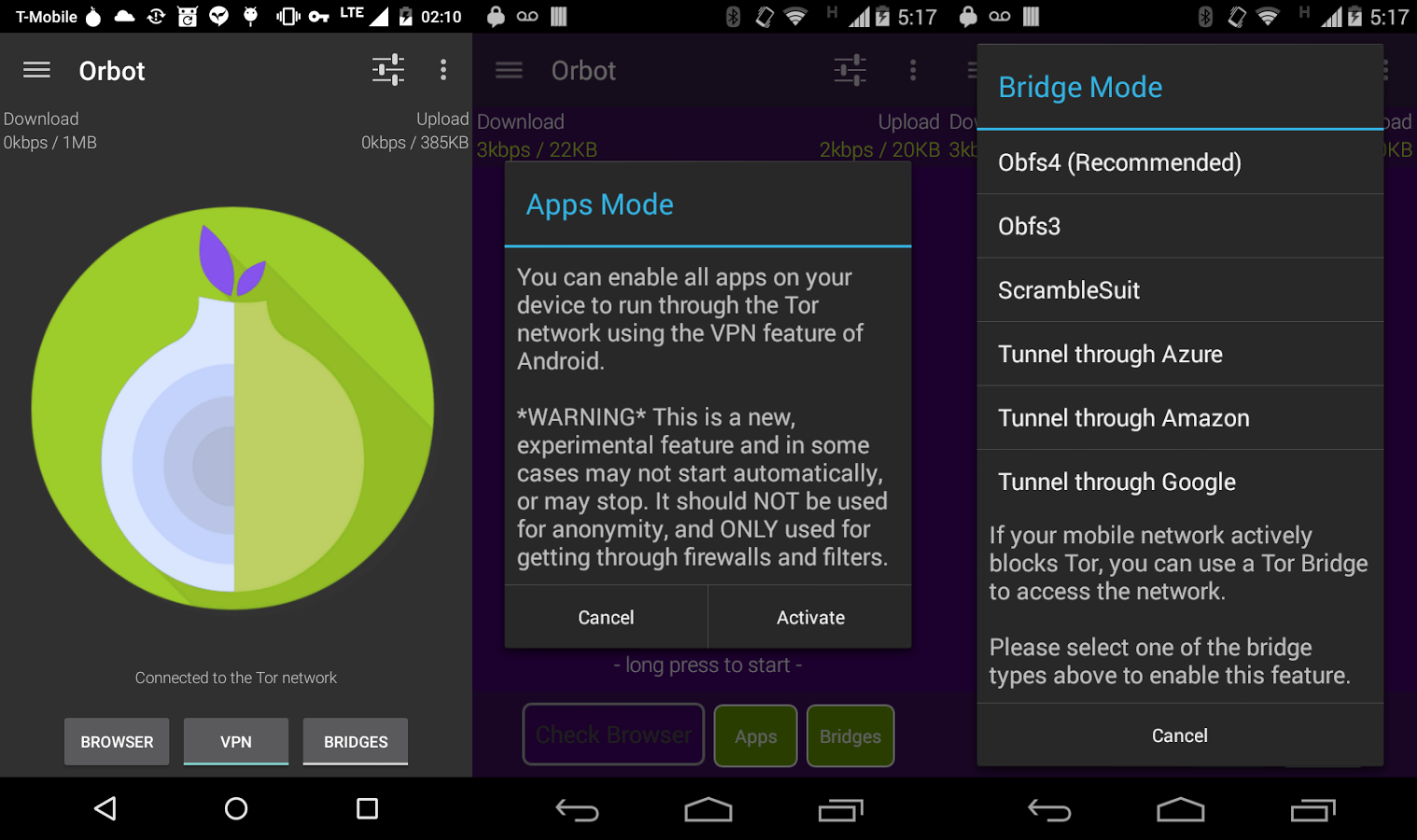
Orbot encrypts your web traffic and routes it through a system of nodes/relays around the world. It’s open source and if your phone is rooted, you can route all app traffic through Tor, not just the internet.
Google Play Link | Source Code
Conclusion
As you can see, being safe and secure while using the internet is easy. As technology becomes more advanced and the Internet of Things becomes further entrenched in our lives, privacy will become more important in the future.
Further Reading: www.privacytools.io – encryption against global mass surveillance 🔒
Visually stunning puzzler Pavilion makes debut exclusively on SHIELD TV

Discover the mysterious world of Pavilion on your Nvidia SHIELD Android TV!
Fans of the Nvidia SHIELD will get a rare exclusive look at a brand new indie title, as Pavilion makes its debut exclusively for the Android TV console today, available on the Google Play Store for $10.
Pavilion is a beautiful “fourth-person puzzler”, which drops you and the main character into a mysterious world without any text instructions, backstory or really any context at all. With no tutorials or guides, players explore and interact with objects in the beautifully crafted levels as an omnipresent orb, as you try to help the A.I.-controlled main character work through intricate puzzles.


The real standout here is the beautiful, hand-drawn 2D levels, which has earned the game developers at Visiontrick Media heaps of praise over the past year. The environments are rich with fine details and take on a dreamlike aesthetic that runs throughout the game. Accompanying the beautiful images is a wonderfully ambient soundtrack that blends environmental sounds with a calming musical score. Taken as a whole, Pavilion’s sounds and visuals create a fully-immersive experience.
After a week of SHIELD exclusivity, Pavilion will launch on Steam and the Humble Store on September 22. The game will hit consoles such as the PlayStation 4 and mobile Android devices later in the year. This release is called Chapter One, so we can also expect more Pavilion puzzles in 2017.
Check out the launch trailer to prepare yourself for an otherworldly gaming experience!
Android Gaming

- Best Android games
- Best free Android games
- Best games with no in-app purchases
- Best action games for Android
- Best RPGs for Android
- All the Android gaming news!
How much faster are Samsung’s Fast Wireless Chargers?

How much faster are Fast Wireless chargers?
Wireless charging is one of those things most folks tend to ignore for two reasons. No Android phone that supports wireless charging has ever included a wireless charger in the box, and wireless charging is never as fast as the charger you do get in the box. It’s only marginally more convenient to set a phone on a little tray than it is to plug it in, so the list of positives has never really been high enough to justify mass adoption.
Samsung’s recent phones have included a new kind of wireless charging — dubbed Fast Wireless Charging — which aimed to do something about the charging rate. With more Samsung phones arriving with this Fast Wireless support, we decided to take a look at the difference between these new chargers and the older Qi chargers from the Nexus 5 days.
Your average wireless charger

Qi and Powermat chargers have been around for a while, and while most of them look like small platters you connect Micro-USB cables to there are a few that have drifted from this design. Zens has a cool Qi car charger you just slip your phone into, Fonesalesman makes a battery pack with a Qi coil on top, and the list goes on. The problem with these chargers is rarely design, and usually output. These chargers had a maximum output of 5V/1A, which charges a Galaxy S7 from 9% to 100% in about five hours.
This is fine if you’re charging your phone overnight, or if you’re leaving your phone at your desk all day during work, but when your power cable can replenish 30% of your battery in 10 minutes that wireless charger becomes a lot more difficult to justify. The only real benefit here is less stress on your Micro-USB or USB-C port, which is frequently not worth the cost of a wireless charging accessory. Even a really cool one.
Fast Wireless Charging

Setting the same Galaxy S7 on a new Samsung Fast Wireless charger offers a mostly similar experience. You get a notification that your phone is charging wirelessly with a fun animation, and the phone starts charging. There’s a small indicator for faster charging, like you get with Samsung’s included rapid charger, but the results are a little different.
On a Fast Wireless charger, our Galaxy S7 charged from 9% to 100% in just over two hours, cutting the total charge time in half. A quick look at power input through Ampere confirmed that Fast Wireless Charging was delivering almost exactly twice the amount of energy to the phone. This isn’t quite as fast as a rapid charger, which will take this same Galaxy S7 from 9% to 100% in 90 minutes, but it’s still pretty great when compared to the alternative.
Should you upgrade?

Samsung’s Fast Wireless Charger certainly delivers a much faster charge than the previous generation of Qi and Powermat chargers, but it’s still an additional accessory you need to buy for your phone. That means shelling out around $50 for one of these accessories from Samsung, or keeping your eye out for a deal on third-part Fast Wireless Chargers. Now that Fast Wireless chargers exist for the house and car, it may be worth considering a full replacement to wireless charging. On the other hand, your included power cable still delivers the fastest overall charge.
Best AT&T phones

What are the best phones you can buy at AT&T right now?
Whether you’re a loyal AT&T subscriber, or you’re looking to jump ship to its giant cellular network, take a peek at our list of the best smartphones the carrier has to offer.
We’ll be updating this guide throughout the year to keep you informed of the latest devices worth wielding as your daily driver. Be sure to read through our reviews for the full rundown on each smartphone.
- Samsung Galaxy S7/S7 edge
- Samsung Galaxy S7 Active
- LG G5
- Samsung Galaxy Note 7
- LG G3
Samsung Galaxy S7/S7 edge

The Galaxy S7 and S7 edge are Samsung’s flagship devices for the year and the two best Android devices on the market. Both smartphones feature cameras with advanced features we all want, a fingerprint sensor embedded in the home button, and a Power Saving mode that actually works.
The Galaxy S7 and S7 edge run on the same hardware, including the Qualcomm Snapdragon 820 and 4GB of RAM. The 5.1-inch Galaxy S7 comes equipped with a 3000 mAh battery and is available in black and gold, while the 5.7-inch Galaxy S7 edge comes with a 3600 mAh battery and is available in black, gold, and silver.
Want to get more in-depth?
Read: Samsung Galaxy S7 review
Read: Samsung Galaxy S7 edge review
Ready to make your purchase?
See the Galaxy S7 at AT&T
See the Galaxy S7 edge at AT&T
Samsung Galaxy S7 Active

If you’re the Bear Grylls type, you might also want to check out the Galaxy S7 Active, which is an AT&T exclusive. It’s the ruggedized, nearly life-proof version of the Galaxy S7, and it has all the same features in addition to a significantly larger 4000 mAh battery, better water resistance, and shock resistance.
Read: Samsung Galaxy S7 review
See at AT&T
LG G5

The LG G5’s modular smartphone offerings might not be your thing, but that doesn’t discount the fact that the G5 is still a solid smartphone. LG’s flagship features a Snapdragon 820, 4GB of RAM, removable storage, and a removable battery. Its rear-facing 16-megapixel and secondary wide-angle camera are a delight, too. As written in the original G5 review, “The cameras are where LG really shines with its phones.”
The G5 also comes with a whole host of “friends” — that is, swappable modules that you can pop on and off the G5’s chassis, though there are still only two to choose from, including a helpful camera module that adds on physical camera controls.
The LG G5 is available in four colors, including pink, gold, titan, and silver.
Read: LG G5 review
Ready to buy?
See at AT&T
Samsung Galaxy Note 7

AT&T’s got Samsung’s latest phablet, too. The Galaxy Note 7 is the sixth-generation successor to last year’s Galaxy Note 5 and it’s a major improvement. The 5.7-inch smartphone features the same Snapdragon 820 processor, 4GB of RAM, and stellar 12-megapixel rear-facing camera as its flagship predecessors listed above. It’s also equipped with a pressure-sensitive stylus and it’s water resistant, so you can take it with you into the pool to take some notes — though don’t dunk it for too long! The device can only withstand five feet of water for up to half an hour.
Read: Samsung Galaxy Note 7 review
Note: Samsung has issued a broad recall for the Galaxy Note 7 due to battery issues. We still recommend the Note 7, but we advise checking with AT&T to ensure that it has received new stock of the phone that was made after the recall. Follow the link below for more information.
Samsung Galaxy Note 7 recall FAQ
AT&T has also suspended sales of the phablet until the recall has been “called off.”
See the notice at AT&T
LG G3

Sometimes, the best budget phone is merely an older flagship. If you’re looking to save some cash but still want a smartphone that’s worth wielding, AT&T is offering the certified pre-owned LG G3 for a mere $160 upfront. That’s quite affordable for an older smartphone that’s still pretty capable.
Most budget smartphones will skimp out on the processor and camera performance, but you don’t have to compromise with an older high-end smartphone. The G3, which launched in 2014, features a 5.5-inch Quad HD display, a Snapdragon 801 processor, 2GB of RAM, and a 3000 mAh battery. It also comes with a 13-megapixel rear-facing camera that was actually quite capable for its time, though its low-light performance isn’t as good as what you’d get with today’s flagships. No matter: for the price, it takes better photos than anything the pricier Samsung Galaxy J3 offers — that shoots at a measly 5 megapixels!
You don’t have to worry about the G3 being pre-owned, either. AT&T offers a two-week trial period after you purchase the device, so you can take it for a test run before you fully commit. The only bummer is that you’ll miss out on an official update to Android 7.0 Nougat, though you will be able to update to Marshmallow.
Read: LG G3 review
Think you wanna bring one home?
See at AT&T
Best Smartwatch For Kids

Your kids want a smartwatch? Android Wear isn’t where you start.
 Russell has been covering Android since the G1, and has had his head in VR headsets since the first Oculus Rift dev kit. Managing editor at VRHeads, video and podcast host, you can follow him on Twitter @russellholly. For suggestions and updates, you can reach him at russell@androidcentral.com
Best overall
VTech Kidizoom Smartwatch DX

Find on Amazon
Instead of a tool for connecting to a smartphone, VTech created an experience that is mostly toy but partially useful. Amid all the games and onboard camera tricks you’ll find a functional calendar for appointments, a voice memo app, and several other tools that work well with the smartwatch aesthetic. This is a great way to get kids thinking about using technology for more than entertainment, without completely pulling them away from the shiny world of fun things.
Bottom line: If you have a youngster who wants a smartwatch just like you, this is a fantastic place to start.
One more thing: This watch comes in Blue and Purple, depending on what color you think your child will prefer.
Why VTech Kidizoom is the best
Smartwatches are already luxury accessories, and for kids they become little more than toys. VTech’s smartwatch for kids has a few games, but also lets them take photos from their wrist and have some fun with the photos. It’s a fun way for a kid to emulate their smartwatch-wearing parent without needing to be tethered to a smartphone, and it actually includes some tools that could be useful. Calendar access, for example, gives you an teaching opportunity. Calculator apps let children explore math on their own. There’s plenty of fun to be had here, but the need to charge the watch regularly in order to use it and the availability of actually useful apps could become tools for teaching children how to care for their hardware and use it properly.
Best value
Supvin U80 Smartwatch

Find on Amazon
U80 is a barebones traditional smartwatch. It pairs to a phone via Bluetooth 4.0 and acts as notification sync. It’s a limited experience, but one that covers the basics of smartwatch use and fitness or sleep tracking. It’s simple, and the biggest feature here is the price. If you’re looking for a very basic smartwatch, this is where you start.
Bottom line: This is the beginner smartwatch you buy for a kid on their first smartphone, who really wants something inexpensive.
Only on AT&T
FiLIP 2

Find on AT&T
FiLIP 2 is less about giving your child a cool watch full of features and more about giving your child a one-way phone they can strap to their wrist so you can reach them and track them as you desire. The FiLIP app allows you to send one-way text messages and track the GPS in the watch, and because the watch has a phone number you can call to check in whenever necessary. For the child, it’s a fairly simple watch with an emergency button that calls each of the contacts built in to the watch while recording the background audio just in case.
Bottom line: This is more or less a tracking bracelet for a child you don’t trust with a phone.
Only on Verizon
GizmoPal 2

Find on Verizon Wireless
LG’s GizmoPal 2 is a wrist-mounted phone with some simple features for both parents and children. For kids, pre-programmed messages and emoji can be sent to a list of approved contacts. Two-way calling ensures your child can reach and be reached when necessary, and there’s a fitness function onboard for jump rope or step counting. The big feature for parents is real-time tracking through the Android app, which gives you GPS coordinates and offers notifications if your child strays from GPS boundaries you have set up.
Bottom line: This is a simple, friendly watch for kids who aren’t ready for their first phone yet.
Conclusion
While there are certainly some great Android Wear watches out there, these are the best options for most kids. VTech offers a great fun accessory that doesn’t require a phone. U80 is an inexpensive way to offer base smartwatch features. If you’d prefer the smartwatch be more for your peace of mind than your child’s entertainment, AT&T and Verizon have you covered with the FiLIP 2 and GizmoPal 2 exclusives.
Best overall
VTech Kidizoom Smartwatch DX
Find on Amazon
Instead of a tool for connecting to a smartphone, VTech created an experience that is mostly toy but partially useful. Amid all the games and onboard camera tricks you’ll find a functional calendar for appointments, a voice memo app, and several other tools that work well with the smartwatch aesthetic. This is a great way to get kids thinking about using technology for more than entertainment, without completely pulling them away from the shiny world of fun things.
Bottom line: If you have a youngster who wants a smartwatch just like you, this is a fantastic place to start.
One more thing: This watch comes in Blue and Purple, depending on what color you think your child will prefer.
Ex-HTC CEO hints at the future of VR headsets
For a man who spent 18 years at HTC turning smartphones from mere business tools into ubiquitous consumer gadgets, Peter Chou knows a thing or two about nurturing new product categories. In fact, he had already started his second chapter at the company by bringing us the Vive virtual reality headset before his quiet departure last August. Today, Chou’s mission is extended by way of two chairman roles: One at visual effects studio Digital Domain where he can “fully and deeply understand” VR content creation, and another at VR game studio Futuretown where he is also an investor. This may seem like a weird match given Chou’s prior focus on hardware, but to him it felt like a logical next step. After all, it’s now content, not hardware, pushing VR forward.
Chou crossed paths with Futuretown while he was still developing the Vive. At the time, Chou wanted to extend HTC’s resources to support small VR companies with great potential, so he tasked his team with a scouting mission. That led them to Futuretown, which happened to be located nearby. One day its CEO Johan Yang simply walked over to meet Chou for some guidance.
“They were worried at the time because they didn’t really know where the market was, but I told them, every industry is like that,” Chou told Engadget ahead of Futuretown’s Tokyo Game Show press event. “At the beginning you can’t really see the market and how great the market is, but if you have a vision, if you believe that is the future, then you should work on that and build capabilities in that area, and try to be the best.”
Chou would later invest in Futuretown personally and then serve as a mentor under the “Honorary Chairman” title. This proved to be a smart move. The startup has already three VR games that quickly rose to popularity. In particular, Cloudlands: VR Minigolf now owns 30 percent of the Vive market share, which translates to about 30,000 units out of the estimated total of 100,000. The game was also recently updated with a level editor along with over 200 user-created levels from the earlier beta program. Furthermore, Futuretown will add Oculus Rift support to at least two of those games, and they are ready to launch as soon as the Oculus Touch controller arrives — likely by end of year, as speculated by Yang.
Back in July, Chou returned to his hardware roots and announced Digital Domain’s professional 4K 360-degree camera, the Zeus. Then, this week he unveiled Futuretown’s first hardware product, the 5D Totalmotion modular simulator ride, in the hopes of making VR more immersive and user friendly. It will have four games at launch: Whiteout: Ski VR, Infinity Rider: Motorcycle VR, Wave Breaker: Surf VR and Stallion Adventures: Horse Riding VR.
Neither Yang nor Chou would say how much the machine might cost, but it’s clear that it won’t come cheap and is geared towards the business market (think: malls, arcades and internet cafes). Yang explained that these are the sorts of places where VR is already gaining momentum in parts of Asia, HTC and Futuretown’s home region.

Peter Chou showing off Digital Domain’s professional 360-degree 4K camera, the Zeus, at a press conference in July. (Image credit: Digital Domain)
While Futuretown isn’t the first company to release such hardware for enhanced VR experience, Chou is confident that his motion feedback machine is already better and easier to use than what the competition is offering. What he doesn’t have total control over right now, however, is the headset. It’s certainly come a long way from the days when you could easily get motion sickness after just one or two minutes, whereas now you might be able to last 30 to 40 minutes straight. Even so, Chou reckons the industry is still a ways off from realizing his vision. He described VR’s current state as feeling like somewhere between 480p and 720p (even though it’s a 2K display inside most high-end headsets), which is still usable but leaves room for improvement. Obviously, it would also be more convenient to go wireless as well.
Obviously, it would also be more convenient to go wireless as well.
“I would say the 1080p kind of experience plus wireless are two to three years away,” Chou said “There’s some solution coming out of maybe second half of next year, but I think it will probably go to the next step in 2018.” Similarly, Chou and Yang expect some strong smartphone VR solutions to arrive in the same time frame, especially given how tech giants like Google, Qualcomm, Intel and NVIDIA are more actively looking at VR and inside-out tracking technologies. Just look at Google’s Tango for a sense of where these companies are headed.

Oculus founder Palmer Luckey trying Futuretown’s 5D Totalmotion platform at the Tokyo Game Show. (Image credit: Futuretown)
For those who think two to three years seems like a long time, Chou would like to remind you that it took even longer for smartphones to catch on — five or six years, he says. “In 2005, if you said everyone would have a smartphone, nobody would believe that. But today, the smartphone is an essential part of our lives.” Perhaps, he says, VR will follow a similar path to eventual success — a future where our smartphones alone can somehow deliver compelling VR experience without breaking our wallets or draining our handset batteries. Or maybe he is wrong. Maybe by that point the smartphone will have a different form factor altogether. Time will tell.
Apple’s Sunnyvale Car Team Includes a Dozen Magna Engineers
In a piece on car company Magna International, Bloomberg has shared a tidbit about Apple’s car development plans, suggesting there are approximately a dozen engineers from Magna working with Apple’s car team in Sunnyvale.
Magna employees are said to be helping develop Apple’s electric vehicle, reigniting rumors that Apple is working with a third-party to manufacture its vehicle rather than taking on vehicle development costs itself.
A completely new vehicle can cost several billion dollars, so leaning on the expertise of an industry veteran is a way of minimizing those costs. Apple has been quick to understand that: about a dozen Magna engineers have been working with the iPhone-maker’s team in Sunnyvale to develop a vehicle, according to a person familiar with the arrangement.
This isn’t the first time we’ve heard rumors of some kind of partnership between Apple and Magna. In April, a German news site suggested Apple had a secret car lab in Germany and was planning to have subsidiary Magna Steyr manufacture its cars, and Apple executives also visited Magna Steyr in Austria in February of 2015. Apple also reportedly held talks with Daimler and BMW, but no deal was able to be established due to questions over who would lead the project and who would have ownership over data.
Magna executives and Apple both declined to comment on rumors of a partnership, but in a separate interview on plans to build a new car plant, Magna CEO Donald Walker spoke on partnerships like the one the company has established with BMW. Magna will be producing BMW’s 5-Series and is said to be “positioning itself for the prospect that technology companies will eventually join its roster of customers.”
“You could easily have enough business outsourced from the existing carmakers to fill up other contract assembly plants, or you could have new entrants that come in and say ‘I really want to have something but do I really want to manufacture vehicles?,”‘ Magna Chief Executive Officer Donald Walker said in an interview at the company’s headquarters in Aurora, Ontario.
While Apple has hundreds of employees working on its car project, the company’s plans seem to be in flux. Following Bob Mansfield’s takeover of the car initiative earlier this year, Apple is said to have laid off dozens of employees as part of a “reboot” that will see focus shifting towards the development of an autonomous vehicle system. Based on these recent rumors, it is no longer clear if a physical Apple-branded car will actually materialize or if the project will result in something more software oriented.
Related Roundup: Apple Car
Discuss this article in our forums
 AIVAnet