


Facebook test highlights what your friends are talking about
Facebook’s new experimental feature shows you status updates you might have missed otherwise. Mashable has spotted a box marked “What friends are talking about,” which lists a few of your friends’ posts in a single box on top of your feed, in the company’s Android app. We weren’t able to replicate the experience on either Android or iOS (or even on a computer), but that’s not exactly surprising. Only very few people get access to the social network’s features in their experimental stage, so you’ll have to check your own apps to see if you’ve been chosen.
The company has been making changes to the News Feed for months in order to bring status updates you’d actually want to read closer to the top. This test feature, which could change the way you interact with your friends’ posts, is most likely part of that effort. As always, Facebook could eventually give this feature a wider release, but the company could also pull it down, depending on whether it does well during the test period.

[Image credit: Mashable]
Source: Mashable
Bragi The Headphone Release Date, Price and Specs – CNET

Bragi’s The Headphone is available for $120 until November 1, then goes up to $150.
Bragi
In case you haven’t of Bragi, it’s a German startup that had a highly successful Kickstarter for a totally wireless “smart” earphone called The Dash. After finally shipping in January of this year, the high-tech $300 Dash (€300, converting roughly to £225 in the UK and AU$395 in Australia) got off to a rocky start, garnering some critical reviews, but has apparently improved with subsequent software upgrades.
The company is back with a second headphone that it simply calls The Headphone. It, too, is completely wireless and consists of two wireless earbuds and a charging case. It’s much more affordable than The Dash, carrying a list price of $149 (converting roughly to £110 in the UK and AU$195 in Australia), but will be available for $119 until November 1 in a preorder sale. That preorder price is roughly £90 and AU$155.
I’ve yet to try the Dash but will hopefully receive review samples of both The Dash and The Headphone in the coming weeks. Several new totally wireless earbuds are making their way onto the market, including Jabra’s just-announced Sport Elite, so Bragi’s headphones aren’t such a novelty and now have plenty of competition.
Here’s a look at The Headphone’s key features, according to Bragi.
- Can be connected to any Bluetooth device.
- Users can switch between listening to music tracks, take phone calls, activate Audio Transparency (allows ambient noise in) and deliver voice commands, all without having to look at a second device.
- Three different FitTip size tips are included to help get a secure, tight seal.
- Just over six hours of wireless battery life per charge
- Available through the newly launched Bragi Shop (http://shop.bragi.com) for a special presale price of $119 until November 1.
- Those who participated in the Bragi Dash Kickstarter will receive $20 off coupon via email.
- Following the presale, The Headphone will retail for $149.
- Shipping is expected to begin in November (though it’s worth noting that The Dash was delayed for months).
- No word on international pricing yet.

The included charging case.
Bragi
Bragi has also announced that its Bragi OS 2.1 is now available through its new Desktop Updater. It’s the second major software update for The Dash since its January 2016 launch and according to Bragi, with the update The Dash “becomes smarter, faster and better in several areas, including Bluetooth connectivity.”
With the software update, the headphone can speak four new languages – Chinese, French, German and Spanish — and now synchronizes with Google Fit, Apple Watch and the Apple Health Kit.
Other Bragi OS 2.1 features include Touch Lock, which prevents inadvertent gestures from impacting the Dash, Shuffle for the internal music player and on-demand heart-rate tracking.
Best camera drones

What are the best camera drones I can buy right now?
Whether you’re an independent filmmaker looking to step up your game with drone videography, or simply a hobbyist looking to record stunning video to share with friends and family, you’ll want to invest in a top-of-the-line camera drone.
This probably isn’t a list for someone buying their first drone, however we will note which options are most beginner friendly. Considering how expensive high-end drones are, you’ll want to be sure of your competency as a pilot before you get behind the controller. Our list of best drones under $300 might be a better starting point if you’ve never flown a drone before in your life.
- DJI Inspire 1
- Parrot Bebop
- DJI Phantom 4
- 3DR Solo Smart Drone
- Blade Chroma 4
The Best
DJI Phantom Inspire 1

If you’re looking for the best camera drone, then look no further than the DJI Phantom Inspire 1.
Featuring 4K video capabilities up to 30FPS, 1080p video up to 60FPS, and 12 megapixel photos from the gimbal-mounted camera, the Inspire 1 is fully capable of shooting the professional aerial footage you’ve dreamt about.
The drone itself is also a marvel of technology, featuring aerodynamic transforming design that allows the carbon-fiber arms to move out of the way of the camera at the flip of a switch while in flight. It’s one of the smartest drones you can buy, as DJI has included revolutionary technology, including intelligent battery power management that always lets you know how much battery power remains, and will ensure your drone never dies on you before returning home. Max flight time is around 18 minutes, and if the battery starts running low or your handset loses connection with the drone, sophisticated onboard GPS-positioning algorithms will flip into auto-pilot mode and have the drone fly back to its launch point.
That’s not all, as the Inspire 1 also features a Vision Positioning system, that uses both the camera and sonar sensors to detect where it is when hovering, and will automatically raise or lower the legs if it’s taking off or landing.
The DJI Inspire 1 is an real investment at over $4000, but you’ll be getting everything you’ll need, including a second battery, two controllers, replacement props, a 64GB microSD card and a Pelican case for easy transport.
See at Amazon
Also Great
Parrot Bebop

Parrot is a reliable name in the drone game, and the Parrot Bebop is a great entry-level camera drone for anyone just getting into the hobby.
The body of the drone is built around the 14-megapixel fisheye camera — capturing 180-degree range of 1080p video at 30FPS, but without the horizon-distortion you’ll find with other wide-angle action cameras. There’s also smart built-in safety features to protect your drone, including emergency mode that will land the drone safely and props that will stop spinning instantly when a collision is detected to avoid damage.
You control the Parrot Bebop with the Freeflight 3 app, available for Android and iOS devices, which includes one-touch return home function: this flies the drone back to its take-off point, where it hovers six feet off the ground until recovered. If you’re a serious fan of Parrot drones, you might be interested in buying the Parrot Skycontroller, which increases the range of your Bebop drone and allows you to pull off advanced tricks and, most importantly, offers significantly improved controls over the touchscreen controls.
Set up an account on the Parrot Cloud to have your photos and videos backed up and shared with Parrot’s growing community of over 100,000 pilots. Ready to fly out of the box with beginner-friendly features, the Parrot Bebop should better fit your budget (at $399) while still providing stable, quality video, with a battery that allows for 22 minutes of flight time.
See at Best Buy
DJI Phantom 4

It should come as no surprise to see another DJI drone on this list. The DJI Phantom line has been a favorite amongst drone enthusiasts, and the Phantom 4 is as sleek and well-designed as consumer drones get.
Featuring much of the same technology found in the Inspire 1, the Phantom 4 comes with a gimbal-mounted 4K camera which shoots at 30FPS.
Enjoy stable, precision hovering thanks to the Vision Positioning System, so even when you let go of the joystick controls, the Phantom 4 will brake and hover in place — even if the wind picks up. Use the ActiveTrack mode to easily set your drone to follow and record a moving subject, while it avoids running into trees or other objects with it’s built-in Obstacle Sensing System.
And then there’s the overall look and design of this thing. It’s by far one of the sleekest all-in-one drones on the market and is sure to turn heads whenever you take it out flying. Available for $1400 with a package that includes a backpack carrying case, blade guards and a 64GB half the cost of the Inspire 1, it’s a little easier on the wallet.
See at Amazon
3DR Solo Smart Drone

If you’ve already invested in a GoPro camera that you’d prefer to use with your drone, the 3DR Solo Smart drone would make a fantastic vessel for shooting your aerial GoPro footage.
This all-in-one drone comes with a capable controller that features a mount for your smartphone, convenient camera controls on the shoulders, and both on-screen flight time display, as well as a vibrate function to let you know when the battery is low. On-board stabilization lets you focus on setting up your epic shots without having to worry about keeping the drone in the air.
If you buy the optional gimbal for your GoPro, you’ll be able to execute Smart Shots — pre-programmed movements such as Orbit, Follow and Cable cam which allow you to capture professional, cinematic shots.
The 3DR Solo also has important safety features, including a maximum altitude of 400 feet to keep it FAA compliant, as well as a “pause” button that instantly sets the drone to hover in one place if you feel like you’re losing control.
See at Amazon
Blade Chroma 4K/GoPro

The Blade Chroma 4K is another solid choice that comes in four options, but all of which are essentially ready to fly out of the box.
There’s two pricier versions that include a 4K camera, as well as a controller with a built-in screen for recording video and keeping track of important flight information such as altitude, speed, and remaining flight time. Upgrade to get an extra battery as well as a handy carrying case for your drone.
Then there’s the cheaper versions, which allow you to mount your own GoPro (Hero 4 is recommended), with an option for a 3-axis gimbal. These versions feature the same drone as the 4K camera version, except with a standard wireless transmitter, which means you’ll have to stream video from your GoPro to your smartphone.
No matter which drone you decide to go with, they all come with both Smart Mode for beginners still learning the basics and AP Mode for more advanced pilots who want maximum control over their drone. There are also amazing features like Follow Me Mode and Tracking Mode which allow you to set altitude and distance settings in advance and then focus on getting those epic shots.
It’s an amazing package for a reasonable price — just over $1400 — considering all the professional features that’s included.
Shop at Amazon
Yuneec Q500 4K Typhoon
The Yuneec Q500 4K Typhoon is a sharp-looking quadcopter that will take stunning video at a reasonable price (under $800 on Amazon).
It comes fully assembled out of the box — just attach the props and you’re good to go. The controller features an integrated touchscreen that lets you control video settings such as video resolution, white balance and light exposure on the fly (pun intended). The camera is mounted on a 3-axis precision gimbal and can record 4K video at 30fps, or 1080p slow-mo video at up to 120fps.
Design-wise, the Q500 Typhoon stands out with it’s industrial-style supports along the arms that stand out from the streamlined look of DJI drones. Yuneec also includes an aluminum carrying case for safe transport so you can take your Typhoon wherever you go. This kit also includes a really cool accessory, the Handheld SteadyGrip. Essentially a compact Steadicam rig you can hold and operate with one hand, simply attach the Q500 camera and you’re set to record smooth footage from the ground straight to your smartphone.
Shop at Amazon
Which drone do you love?
Do you have any experience with the drones we’ve mentioned here? Got a recommendation for one that we’ve missed? Let us know in the comments below!
Dual lens smartphone cameras: A history and what to expect from iPhone 7 Plus
With Apple lining up to launch the iPhone 7 Plus, rumoured to be carrying a dual camera system, it’s important to understand where this is coming from and what it’s all about.
Dual lens cameras on smartphones aren’t new, with a number of models offering a range of unique features using this camera setup.
Apple might be bringing it to the masses in 2016, but follow us as we walk you through smartphones dual lens camera systems of the past and present.
LG Optimus 3D and HTC Evo 3D: Another dimension
In 2011, 3D was a thing. The world’s TV manufacturers were lining up 3D TV sets, there were 3D films being produced and we were being told that 3D was the next big thing, again.
Pocket-lint
For smartphones, it was the opportunity for innovation. The LG Optimus 3D was announced in February 2011 and the HTC Evo 3D launched on Sprint in March 2011.
Both these smartphones (and there were some others) used dual lenses to allow them to take 3D video and 3D photos. They use the same technique used by regular 3D cameras, using those dual lenses to create a sense of depth in images. This was boosted with a 3D display to view those images, without the glasses.
But 3D was just a passing phase, and although we could capture 3D, ultimately, that was only the start of the story for dual lens cameras.
- LG Optimus 3D vs HTC Evo 3D: Which has the better 3D camera?
- LG Optimus 3D review: Seeing double
- HTC Evo 3D review: Three’s a crowd
HTC One M8: Making sense
It was the HTC One M8 that really introduced dual lens cameras to the world and saw HTC trying to do something different. The HTC One M8 was launched in April 2014.
Pocket-lint
With a 4-megapixel UltraPixel main image sensor and a secondary 2-megapixel sensor capturing extra data, the dual lens camera was used, like 3D, to create a sense of depth in photos. The idea was that the second lens could capture this depth information and feed it into the final image.
That meant you could create bokeh/background blur effects, you could refocus the image with a tap and you could easily manipulate photos, keeping the subject sharp and changing the backgrounds.
The One M8 was clever, but the camera wasn’t that impressive. The effects were rather gimmicky and the benefits of having a dual camera didn’t really make an impact – even if the full metal body did.
- HTC Duo Camera explained: What is it and what will it do?
- HTC One M8 review: Full metal masterclass
LG G5: Going wide
Suddenly we arrive in 2016 and LG announces the LG G5 in February. There are two things that are interesting about it. Firstly, it attempts to integrate modular accessories. Secondly, LG has equipped it with dual cameras.
Pocket-lint
In the case of this LG smartphone, there’s a main 16-megapixel sensor and a second 8-megapixel sensor.
Rather than combining information to create effects, LG’s dual camera approach is straight shooting. The 16-megapixel camera offers regular photos, but the second lens is wide-angle.
With 135-degree lens on the rear for that 8MP camera, the LG G5 can shoot wide-angle photos to great effect. You simply switch from one camera to the other by tapping the button in the app and you can get more in. Perfect for tight spots or landscapes, with that slight fish-eye effect that’s on trend.
It’s a lovely addition that actually adds something to the feature set. While panorama is common, there’s no shortage of after-market wide-angle lenses you can clip on, but the G5’s pairing is more useful as it’s so simple to use.
- LG G5 review: Modular misfire?
Huawei P9: Leica’s monochrome mark
With LG making its mark, Huawei launched the P9, in partnership with Leica, in April 2016. With two cameras sitting on the back, Huawei’s big selling point wasn’t about depth sensing or wide-angle, it was about monochrome.
Pocket-lint
Leveraging Leica’s classic monochrome cameras, the Huawei P9 presented two cameras on the rear, claiming one lens captured RGB colour and the second lens captured monochrome detail. Both cameras are 12-megapixels.
This results in some great black and white photos, but working together, the P9 attempts to combine information from both sensors to make all your photos better. The results are very good, it’s a very capable partnership.
There’s also a P9 Plus with the same offering, but slightly larger.
- Huawei P9 Leica camera explored: Double the camera, double the fun?
- Huawei P9 review: The flagship and the folly
Honor 8: Slightly less Leica, but very much the same
With the Huawei P9 launched, it was only a matter of time before sub-brand Honor produced an equivalent model. Called the Honor 8, again, there was a dual camera on the back.
Pocket-lint
With the Leica tie-in being for the Huawei phone, the Honor 8 doesn’t make much of the monochrome side of things, but again offers twin 12-megapixel cameras, one with an RGB sensor, the other with a monochrome sensor.
The message is the same: data is combined to result in sharper images, with better grip on colour and monochrome detail. Again, the result is a camera that’s very capable, especially on a phone that’s purportedly mid-range.
- Honor 8 review: A different take on the premium mid-range market
Apple iPhone 7: The future?
Finally, Apple is expected to announce the iPhone 7 on 7 September, with the iPhone 7 Plus offering a dual lens camera on the rear.
Feld & Volk
The rumours suggest that twin 12-megapixel cameras will capture colour images, but slightly differently. That captured information is then combined, leading to better results. Rather like the Huawei approach, this suggests that the aim will be to use both sensors to better the final result – but without the gimmicks of the HTC One M8.
Having two cameras presents a lot of advantages, especially when you have difficult conditions. Where we’ve used HDR in the past to produce balanced images, a dual lens camera could easily capture at different settings and combine the image. Traditionally, this is called bracketing, where you might under expose the highlights and over expose the shadows, for a combined higher dynamic range.
Ultimately, simplicity is the key to a dual lens camera. HTC’s approach in the M8 was too complex and subsequent implementations have given good results. The important thing is producing a result that’s worth the additional hardware. If it means brilliant photos every time you press the button, then that can be considered a win.
- Apple iPhone 7 and iPhone 7 Plus: Release date, rumours and everything you need to know
Rosetta probe belatedly finds the Philae comet lander
You have to sympathize with the European Space Agency. It’s less than a month away from crashing its Rosetta probe into its host comet, and it just found the Philae comet lander — you know, the machine the mission team stopped trying to contact back in July. Photos show that the lander get stuck in a dark crack on the comet in a position that prevents it from getting sunlight, revealing exactly why it went to sleep after a mere three days of activity. The ESA has had a general idea of where Philae was, but the low-resolution photos available before now made it hard to pinpoint the machine’s location.
It’s a bittersweet discovery when the agency can’t change history. Philae won’t come back to life, and even photos won’t be available for much longer. The ESA is still happy, though. This gives it the “proper context” it was missing for Philae’s fate, and lets the team shift its attention to photographing Rosetta’s eventual crash site. Think of this as a form of closure. Researchers may never get Philae back, but they won’t be left wondering what happened to their pride and joy.
Source: ESA
The best of the rest at IFA 2016
Now that we’ve said goodbye to IFA 2016, it’s time to bring you highlights of the most interesting devices at the event. In this particular edition, you’ll find some that aren’t smartphones or wearables. We’re talking virtual reality massage chairs, fridges with built-in tablets, as well as adorable robots and drones. Acer’s ridiculous 21-inch gaming laptop is there too, along with its new convertible Chromebook. But that’s just part of it, so check out the slideshow and think about which items you want the most.
We’re live all week from Berlin, Germany, for IFA 2016. Click here to catch up on all the news from the show.
Netflix orders a series from ‘Mythbusters’ veterans
Still missing Mythbusters? It’s not about to come back any time soon, but you might get the next best thing. Netflix (which has a habit of resurrecting fan favorite shows) has greenlit White Rabbit Project, a series from Mythbusters Build Team veterans Kari Byron, Grant Imahara and Tory Belleci. The premise is right up their alley. They’ll investigate strange topics (such as exotic World War II weapons or seemingly impossible jailbreaks) and use science to determine the truth. You won’t have to wait long to see how well the concept works, either — Netflix premieres White Rabbit Project on December 9th, so you won’t have to put up with the year-long waits that come with other streaming releases.
Source: Deadline
John McAfee sues Intel for the right to use his own name
In the six years since John McAfee sold the eponymous antivirus company he founded to Intel for billions of dollars, the software creator has made the headlines for a variety of reasons. He’s already claimed that he could snoop on encrypted WhatsApp messages and would have “no problem” becoming president, but more recently he’s been trying to claim back something a lot more important: his name. Bloomberg reports that McAfee has sued Intel for the right to use his name after the chip maker blocked his request over trademark issues.
The lawsuit comes after McAfee joined online gaming company MGT Capital Investments as CEO and chairman in May and planned to rename the company John McAfee Global Technologies Inc. Intel, which owns McAfee’s “trademarks, tradenames, and associated goodwill,” warned that the rebrand would infringe on those properties.
In a complaint to the New York District Court, MGT and McAfee argue that “at no point in the Agreement did McAfee assign the rights to his personal name […] or agree to restrict his right to do business using his own name” and that the agreement with Intel “did not contain any non-compete provisions of any kind.”
In January 2014, Intel dropped the McAfee brand and began marketing the antivirus suite under “Intel Security.” According to Bloomberg, the chip maker is now trying to sell the company but will use the McAfee mark to help make it more valuable to buyers. Intel counsel Kerry Smith also warned that “any use of the McAfee name would be likely to dilute the McAfee mark […] by reducing its unique association with McAfee and Intel Corporation.”
McAfee and co. have requested a trial by jury in order to win the rights to his name. We wonder if his ‘How To Uninstall McAfee Antivirus” YouTube video will get an airing should they be given a court date.
Via: Bloomberg
Source: McAfee vs Intel
Bragi Unveils Wireless ‘Headphone’ Earbuds Ahead of Apple Event
Wireless audio company Bragi has today announced a new pair of Bluetooth earbuds simply called the “Headphone”. Based on the firm’s original crowdfunded Dash earpieces, the Headphone buds boast the same overall design, but lose some features in favor of a more affordable price tag.
According to Bragi, the main physical difference is the Headphone’s three physical buttons, which replace the touch controls found on the Dash for controlling playback, audio transparency, volume, and taking calls.
The activity tracking features native to the $300 Dash buds are also missing in the new earpieces, but their removal shores up battery life on the Headphone, with Bragi promising up to six hours of operation on a single charge, rather than the three hours Dash users will be accustomed to. Bragi also claims the Headphone buds feature a stronger Bluetooth connection than the Dash.
The Bragi Headphone buds are poised to launch in November and will cost $150, with pre-orders starting today at the lower price of $119.
In addition to the new earpieces, Bragi today announced a firmware update to the original Dash buds which the company says improves the accuracy of the devices’ heart-rate tracking, while also bolstering the strength of the Bluetooth connection.
With Apple’s event just days away, Bragi is unlikely to be the last accessory firm to announce wireless products this week, as the industry shifts gears in anticipation of a new iPhone widely believed to lack a headphone jack.
Apple will provide a live stream of the September 7 keynote on the Apple TV and on iOS and Mac devices through its website. MacRumors will be providing live coverage of the event for those unable to watch, both on MacRumors.com and through the @MacRumorsLive account on Twitter.
Read: What to Expect From Apple’s September 7 Event
Tag: Bragi
Discuss this article in our forums
Romoss Portable Charger Station: The king of power banks has arrived (review)
We review quite a few portable power banks at AndroidGuys. Generally most portable charging solutions are rather boring, but they’re essential for many of us as our smartphones, tablets and other tech gear need power beyond the typical charge.
Have you ever been at the gym, a restaurant or at a coffee shop doing work/homework when you ran out of power? It’s happened to all of us and the anxiety of losing power is real in the age of the smartphone. LG has named it ‘Low Battery Anxiety’; instead of offering us smartphones with two day battery life, we are still stuck with subpar battery performance on our devices.
The need for power on the go is only growing as we increasingly use our devices, especially in cases like Pokemon Go which is a leach on battery life. Backup power is also becoming more of a necessity due to the power outages caused by weather, natural disasters, and other odd scenarios that are occurring much more frequently.
I’ve been using something for the past month, that I had never even heard of, until Romoss informed me of its charging station that holds and charges eight battery packs. For a single guy like me, this charging station is well beyond my needs.
Those with large families, or small business owners who try to differentiate themselves by providing free power to their customers, like gyms, coffee shops, restaurants, and other public venues, the Romoss Charging Station is an investment that will keep your clients ‘Low Battery Anxiety’ free.
Let’s check it out.
Design
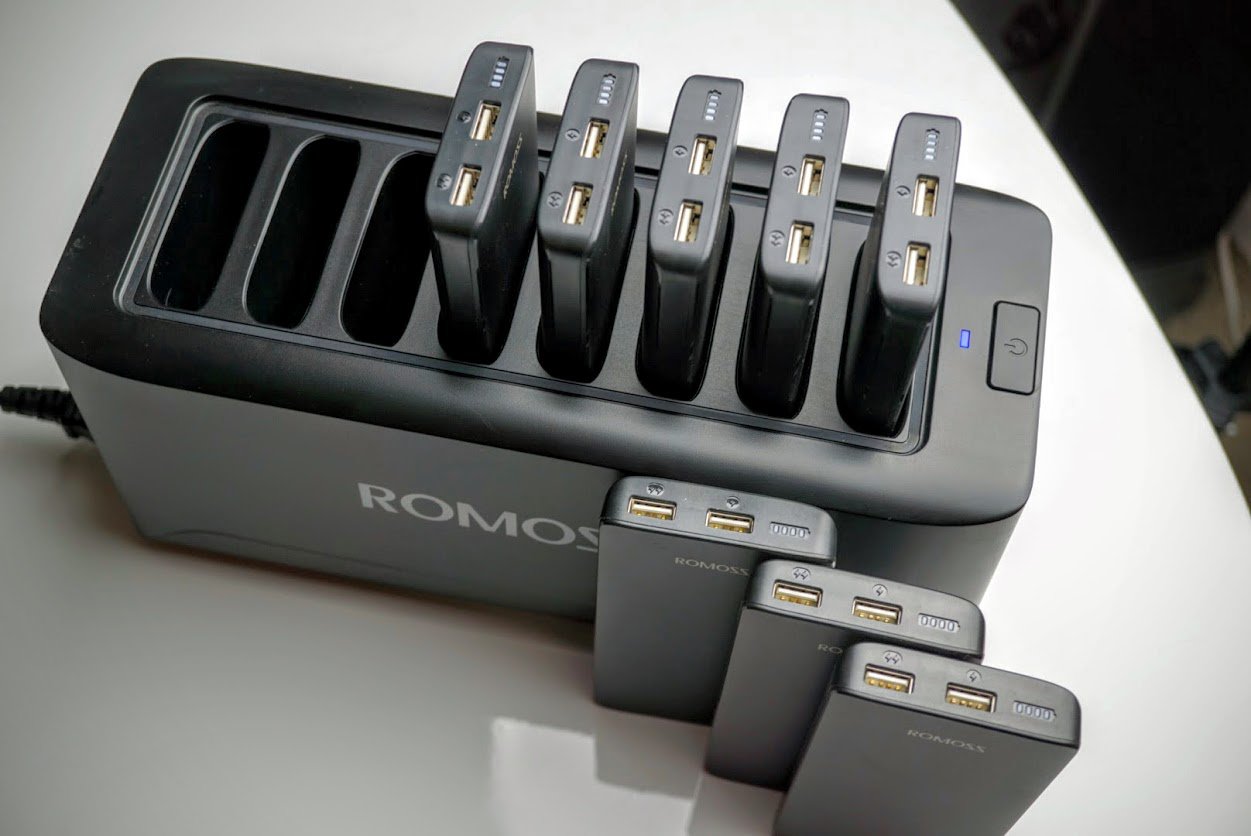
At first glance the Romoss Charging Station reminds me of a toaster oven on steroids. Instead of two slots, it has eight, and instead of dropping bread into those slots, they’re made to accept and charge eight individual portable power banks.
The Charging Station is made of matte black plastic that can be customized to suit individual business needs. If you opt for black, it comes with a matte finish which keeps away scratches and fingerprints. The build quality is top notch; all of the seams line up perfectly with no overlap of plastic on the edges. The station itself has one power input that accepts standard 100-240V, and can be daisy chained to keep wires clean if you need more than one.

Each individual power bank holds a 10000mAh lithium battery with inductive charging as the input. The inductive charging is built into each battery for ease of use (versus plugging in each battery to recharge) as well as to prevent thieves from taking the batteries home with them. There’s no way to recharge this battery other than with the charging station.
There’s a fan to keep the charging station cool while it’s under max load and recharging all eight batteries at the same time.

The fan kicks on for no more than 30s at a time in my experience, and is barely audible unless you are sitting right next to it.
Each individual battery pack has a 10000mAh rating, which is enough to charge most smartphones 3-4 times. There are also dual USB output ports so users can charge two devices at the same time at 2.4A which is the fastest iOS devices can be charged, but not quite fast enough to keep up with Android Quick Charge 2.0 and 3.0 standards.
Romoss kindly includes eight coiled charging cables with combo microUSB/lightning charging tips to suit almost all needs. It did not come with USB Type-C cables but it still can charge those devices safely with intelligent circuitry built into each power pack.

The only downside to the cables is the fact they are not permanently built into each battery pack. While you would hope users wouldn’t take them, it’s simply too easy not to in this case.
Usage
It’s nearly impossible for me to test out every single battery pack on my own. While I do not work in a coffee shop or gym, I do work a M-F 9-5pm job with 200 other employees at a biotech in San Diego. My colleagues provided the perfect testing ground for this review.
I dropped off the Romoss Charging Station in the Research group’s meeting room where we have most of our meetings, and get-togethers as well. At first the group thought the concept of the charging station was a cool novelty, but within a few days I would check on it and it was being used regularly. I frequently saw the station empty as some colleagues would bring the battery packs into the labs, offices and even home.
Since 10000mAh is enough to charge most phones 3-4 times, I had colleagues who gave me feedback that they loved taking them on the weekends on their family excursions. More importantly, it provided power to those who forgot to charge their phones before coming into work. Instead of bumming a charge off of someone else, they would grab an individual power bank and return it when finished. Romoss even provides a large vinyl sticker indicating what the charging station is so people don’t stare at it in confusion.

My coworkers use a variety of smartphones; iPhones, Nexuses, Galaxies, and a variety of budget smartphones I recommend to them as an alternative to higher priced flagships. Not one of them had a single complaint about the battery, and I work with some whiny people. The Romoss Charging Station scores high marks there for ease of use and reliability. We’ve used the station for over six weeks without a single complaint.
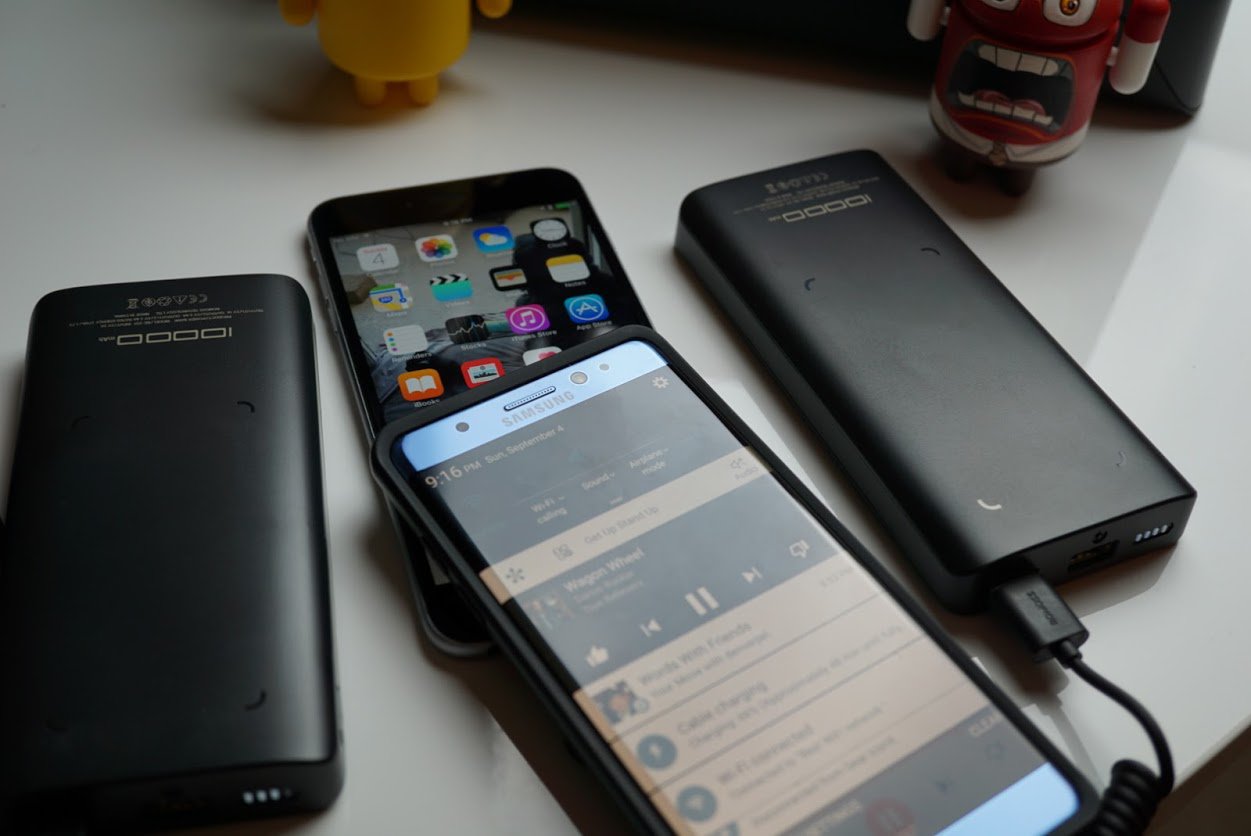
I used the power banks with a variety of smartphones and tablets myself to ensure wide range compatibility. Here is a list of devices I used:
- Nexus 6P
- Xiaomi Mi5
- iPad Pro 12.9″
- Pixel C
- Samsung Galaxy Note 7 (no it didn’t catch fire)
- Samsung Galaxy S6 and S7 edge
- iPhone 6S plus, 6S, 6 and 5SE
- Moto Z Droid
- LG G5
Not one device ran into issues. While the iOS devices charged at the fastest speed, the other Androids didn’t reach Quick Charge 2.0 or 3.0 speeds. That’s not really an issue since the power is free to use. It’s also something you probably wouldn’t want to include in a charging station like this since Quick Charge can be hard on batteries.
Recharging all eight batteries at the same time is no concern with the charging station. If you’re worried about vampire power draining out of this at night, you can turn it off with the power button on top of the station.

Summary
I am sure glad I reviewed the Romoss Charging Station with eight power banks. It’s an ingenious concept that is perfect for large families or small business owners. Portable power is becoming almost essential for every one of us who rely on our smartphones and this power station is sure to keep family members and customers happy. It sure kept my coworkers happy during the review process, and when I had to take it home for review, every single one of the users asked me when I was bringing it back. Luckily for them I will be bringing it back into work on Tuesday after the holiday weekend.
If you’d like to learn more about the Romoss Charging Station, head on over to http://www.romoss.com.

 AIVAnet