


Boomerang uses AI to help you write emails people will read
Why don’t you get a response to every email you write? It’s possible your recipient is busy. Maybe it didn’t reach them. Or maybe, just maybe, you didn’t write a quality email in the first place.
Boomerang’s Respondable widget that you can download right into your browser to be used within Gmail. Its aim? To help you craft better emails that improve your response rates. Using machine learning algorithms that improve based on how you pen your various emails to different recipients, it uses that intelligence to assist you when it comes to how you write your messages.
When you activate Boomerang, you get a new bar inserted into the window you use to compose messages that will change in real-time depending on what you write. Clicking on it brings up a new menu that offers suggestions based on the text in the window. Subject length, word count, question count, and reading level are available for free users, with positivity, politeness, and subjectivity measurements available for anyone who springs for the Advanced Features options.
I put Boomerang Respondable to the test and it did a decent job of measuring the message I sent to a willing Engadget guinea pig. I kept it short to a few paragraphs, asked one question, and kept my subject line to a reasonable length. With a few tweaks I was able to swing the “response” meter to “likely,” which was in the green zone. I didn’t reach “Very likely,” which is a cool teal that I feel a little disappointed I didn’t try enough to reach.
Respondable is an interesting tool that could absolutely help you compose better emails, but I also wonder how well these algorithms actually work. I’m going to be utilizing it to see if I start to get responses in a more dependable manner.
If you’re interested in trying out the free version, you can get it for both Gmail and Outlook.
Source: Boomerang
The surprisingly effective way I solved my computer eyestrain problem – CNET
Like a lot of people — many people? most people? — I spend a good chunk of my day in front of a computer. Because I work from home, I often move from room to room, just to change up the scenery, and even alternate between standing and sitting.
But no matter where I go, I suffer from eyestrain. And recently it’s gotten a lot worse: On some days my eyes are so tired and achy, it’s hard to continue working. (Thankfully, I have the world’s most forgiving editors.)

EyeLeo
I tried lubricating eye drops; no help. Then I remembered the 20-20-20 rule I’d read about many times, the idea being that every 20 minutes, you should take a 20-second break and focus on something 20 feet away.
I’d always scoffed at this. Interrupt my workflow every 20 minutes? No, thank you. And, really, like a 20-second break was really going to help.
But I was desperate, and realized I was going to need some kind of automated timer. That’s when I discovered EyeLeo, a freeware utility designed to help computer users reduce eyestrain.
Let me just say I was extremely skeptical at first, because the program is even more intrusive than 20-20-20: It hits you up with eye exercises every 10 minutes and imposes a 5-minute break every 50 minutes. As a writer, I find it difficult to cope with interruptions, and I fully expected to hate EyeLeo.
Guess what? I love EyeLeo.
Every 10 minutes, a cute little leopard face appears onscreen and gives me an 8-second exercise to do: look left/right, blink my eyes, roll my eyes in circles, and so on. Turns out those interruptions are brief and innocuous enough, I don’t mind them at all.
When I hit the 50-minute mark, EyeLeo gives me the option of taking a full break or, if I’m right in the middle of something, waiting another three minutes. (All these timers are user-adjustable.)
The very first day I used EyeLeo, I experienced almost zero eyestrain. Still skeptical, I used it for a full week before writing this post; it’s still doing the trick. Color me gobsmacked.
Although I don’t like being “forced” to stop my workflow, EyeLeo made me realize that I previously stared at my screen for very long stretches. When those 50-minute breaks come up, I think, “Wow, already? Feels like I just had one.” That’s how I know I was my eyes’ worst enemy. And I use those breaks to accomplish things I normally put off, like walking the dog, emptying the dishwasher, etc. Nice little productivity boost!
Your mileage may vary, of course, but if you’re experiencing eyestrain issues, I definitely recommend giving EyeLeo a try. I haven’t loved a leopard this much since “Bringing Up Baby.”
Best Samsung Galaxy S6 cases

With all the options available to protect your Samsung Galaxy S6 from damage, how is one to decide which case is best?
We all have different needs to be met, but there are particular covers out there that stand out among the rest, providing both quality protection and exceptional design.
After careful consideration and input from members of the Galaxy S6 forums, we’ve selected cases that have made the biggest impression. These choices aren’t limited by their size, manufacturer or price — only tried and true options that keep your Galaxy S6 safe from the inevitable drop.
- OtterBox Defender Series Case
- OtterBox Commuter Series Case
- Ringke Slim Case
- Urban Armor Gear Composite Hybrid Case
- Spigen Slim Armor Case
- Speck CandyShell Grip Case
- Spigen Neo Hybrid Case
- Obliq Thin Bumper Case
- Verus Card Case
- Supcase Unicorn Beetle PRO
- Caseology Wavelength Series Case
OtterBox Defender Series Case

First up, we have the OtterBox Defender Case for the Galaxy S6. Easily the most rugged of the bunch, this hybrid case comes loaded with 3 layers of protection along with a tough belt-clip holster to keep on your belt or pocket. Its size isn’t meant for everyone, but those who do use it are keeping their Galaxy S6 safe from the worst impacts.
Speaking of its size, the Galaxy S6 OtterBox Defender is actually the slimmest version we’ve seen to date, and that’s really saying something. You’ve still got all the familiar features of the Defender series, including an interior foam that seats your device safely, port covers to keep out dirt and other debris, an exterior slipcover that helps absorb impacts while enhancing your grip around the case, topped with a high-impact polycarbonate shell that keeps it all together.
Let’s not forget the built-in screen protector, either — great for shielding against those pesky scratches. The Defender’s holster holds the Galaxy S6 with the case on, allowing quick and easy access when you need answer a call, text or email while you’re out and about. Many users opt out of utilizing the holster, but it’s definitely handy for certain occasions.
See at Amazon
OtterBox Commuter Series Case

The slimmer option of the OtterBox series is the Commuter Case, providing just about everything you’d need to protect your Galaxy S6 from scratches, drops and dirt intrusion.
Surprisingly lightweight for its design, the Commuter Case features a smooth polycarbonate shell on top of a shock absorbing silicone interior that slides together for a compact fit. It comes with port covers pre-installed to keep out dust and other debris, but are able to be permanently removed if they’re more annoying than useful.
With this hybrid case around your Galaxy S6, you can enjoy an enhanced grip thanks to the skinned edges and easy-press side buttons. It comes in black, blue or glacier color combinations and even includes a self-adhesive screen protector.
See at Amazon
Ringke Slim Case

There’s always a total transparent option that makes it to the top of the list, and the Ringke Slim Case is ranked most popular this time around. And, if clear’s not your thing — there are 6 other colors to choose from.
Perfect for slim, casual protection, this clear cover keeps bulk out of the equation and the good looks of the Galaxy S6 in. There’s complete access to the side buttons, ports, camera and display while the case is worn, too. Included with the Ringke Slim Case is a complimentary HD film for shielding the back and front of your Galaxy S6 from unwanted scratches — so that’s a plus.
Keep in mind, however, that you’re not getting a huge amount of protection with this case. It’s slim, yeah, but when it comes to more serious impacts — don’t expect a whole lot. For everyday use and minor drops it’ll do the job, though.
See at Amazon
Urban Armor Gear Composite Hybrid Case
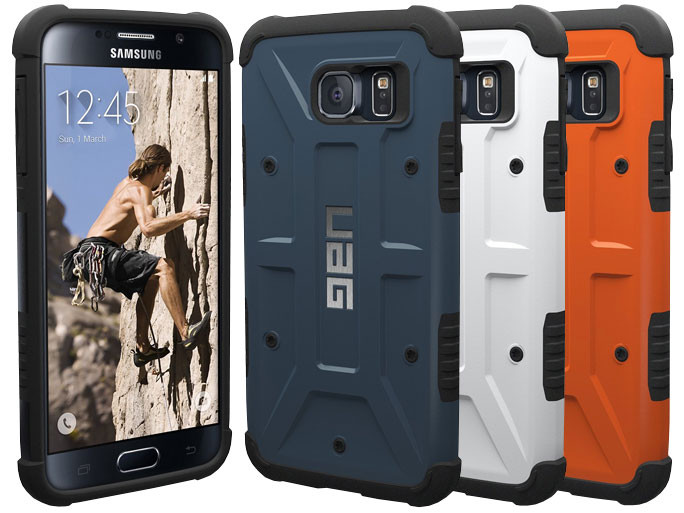
If you’re into rugged looks, the Composite Hybrid Case from UAG Read our hands-on review is definitely worth considering. Don’t be put off by its damage-resistant design, though, because it’s actually slim for the level of protection it provides. Both the TPU and polycarbonate shell are fused together with extra impact protection around all 4 corners.
There’s obviously a lot to grip with the Composite Hybrid Case, between the TPU side grips and busy pattern on the back shell — dropping your Galaxy S6 becomes a rare occasion. There aren’t any port covers to get in the way, but the case meets military drop-test standards — including a screen protector to ward off any scratches.
This case comes in some pretty cool color options, too. Solid colors include: black, white, rust and slate — for more transparency, there’s ice and ash.
See at Amazon
Spigen Slim Armor Case

An all-around favorite is Spigen’s Slim Armor Case, sporting dual layers in an incredibly low profile. It’s no secret that Spigen has been at the forefront of the popularity list for quite some time now, and for good reason. They’re consistent with their quality and design, offering options for both heavy duty and average users.
What’s great about the Slim Armor Case is its ability to shield against impacts without bulking up the Galaxy S6 to the point that it’s no longer attractive. It leaves precision cutouts for everything you’d need, including the camera, flash and ports. The side buttons are raised for a more uniformed look, and are easy to press.
On the back shell is a fold-out kickstand for convenient viewing when you need it, and it doesn’t protrude from the rest of the case like we’ve seen with the Trident Kraken AMS. It’s designed to allow you to face your Galaxy S6 down on any flat surface while elevating the display, keeping away any possible scuffs or scratches. The Slim Armor Case comes in gunmetal (as shown), metal slate, shimmery white, and blue topaz.
See at Amazon
Speck CandyShell Grip Case

Speck’s CandyShell Grip is back by popular demand with the Samsung Galaxy S6. It’s got serious grip, and we can’t blame users for enjoying that level of security.
Featuring an easy, snap-on installation the CandyShell Grip Case provides a soft, rubbery interior that keeps your Galaxy S6 safe from wear. Each corner has been reinforced to help handle impacts if and when they occur, while the raised bezel keeps the display from touching flat surfaces.
The polycarbonate shell is glossy, so fingerprints and smudges can be an issue over time, but are easily manageable. The most notable feature of the CandyShell Grip is its rubber stripes that wrap from side to side, enhancing grip in the most important areas. The symmetrical pattern has a unique look, too. If the black and grey (pictured) isn’t your style, choose from 5 other color combinations.
See at Amazon
Spigen Neo Hybrid Case

Sporting excellent grip with its textured TPU skin is Spigen’s Neo Hybrid Case for the Galaxy S6. This slim cover combines a thin polycarbonate bumper with a shock absorbent skin that’s design to keep things slim yet protective. Metal coated buttons along the sides add to the case’s good looks, too. Bumper colors include slate, gold, blue, and silver.
See at Amazon
Obliq Thin Bumper Case

This slim bumper case for the Galaxy S6 is designed to offer easy installation and removal while keeping you safe against minor impacts. The back cover rocks a brushed aluminum finish that looks amazing around the Galaxy S6 in any color. Ports and buttons are left open for easy access as well. Take your pick from 7 different color combinations.
See at Amazon
Verus Card Case

Who says a wallet case has to be a flip cover? The Verus Card Case for Galaxy S6 features a dual-layer design that provides optimal protection against impacts while adding storage under the shell for your personal items. Keep your ID, credit card, even some cash in your new case by sliding it open when you need. Available colors include silver, red, yellow, gold, and dark silver.
See at Amazon
Supcase Unicorn Beetle PRO

The next best thing to an OtterBox is the Unicorn Beetle for Galaxy S6. This rugged case turns your device into a beast that’s ready for anything. Between the textured exterior shell, built-in screen protector, and shock absorbent skin inside, impacts don’t stand a chance in damaging your Galaxy S6. Also included is a rugged belt holster for keeping your protected device at your side. The Unicorn Beetle comes in black, blue, green, pink, and white.
See at Amazon
Caseology Wavelength Series Case

If you’re after grip, then Caseology’s Wavelength Case for Galaxy S6 is right up your alley. This incredibly slim cover utilizes both polycarbonate and TPU materials to handle impacts. The grippy “wave” patterned skin on the back is what makes this case stand out. Choose from a handful of different color combinations to find the Wavelength that suits you and your Galaxy S6 best.
See at Amazon
Which is your favorite case?
How do you keep your Galaxy S6 protected? Let us know in the comments!
Beyond Nougat: What’s next in Developer Previews, post-Android 7.0

Android is getting even more Developer Previews, as it moves towards a new ‘maintenance release’ schedule beyond version 7.0.
Following the official release of Android 7.0 Nougat, there’s a lot going on around the Android Beta Program, which started back in March with the first “Android N” Developer Preview build. The short version is this: We’ll be seeing more Developer Previews in future versions of Android — and in the short term you might want to stay enrolled in the Beta program, even on the stable 7.0 firmware.
The Android Beta program isn’t going away. If you’re already enrolled in the Beta program, you’ll be among the first to get the final, stable Nougat update. As for future updates, if you stay in the Beta program you’ll eventually be updated to the Developer Preview build of the first Nougat maintenance release. (More on that later.) So if you still want to be on the cutting edge of Android, you don’t need to do anything after getting updating from Developer Preview
Right now the Beta program is a a reliable way to skip the queue for over-the-air updates and get your Android 7.0 update. And if you un-enroll after taking the final, stable 7.0 OTA, you won’t need to factory reset. (In contrast to the situation during the Nougat Beta, where unenrolling on a Developer Preview build would wipe your phone via an over-the-air update from Google.
Read: How to get Android 7.0 on your Nexus right now
Android has always had maintenance releases, but they haven’t always been this visible.
As we move beyond Android 7.0, the Beta program will evolve into a way to test new Maintenance Releases (MRs) of Nougat.
Maintenance releases aren’t new in Android, they just haven’t always been this publicly visible. (For example, Marshmallow MR1 landed in December 2015, MR2 in April 2016 — both were Android 6.0.1.) Sometimes these have involved new API levels (and new features for developers to use), and a new Android version number — for example in Android 5.0 to 5.1. Other times MRs have focused on bug fixes under-the-hood tuning, as in Marshmallow.
From Android Engineering VP Dave Burke on the Android Developers blog:
We’re moving Nougat into a new regular maintenance schedule over the coming quarters. In fact, we’ve already started work on the first Nougat maintenance release, that will bring continued refinements and polish, and we’re planning to bring that to you this fall as a Developer Preview. Stay tuned!
So maintenance releases in the Nougat era are partly about codifying Android’s smaller updates, and partly about giving developers more of a chance to prepare for these changes before they land. With the arrival of new Developer Preview builds in the future, it’s more likely that Nougat’s maintenance releases could introduce a new API level, and maybe a bump to Android 7.1.
If you stay in the Android Beta program after getting the final 7.0 update, you’ll automatically get updates to the MR1 Developer Preview when it’s available. Presumably it’ll work just like the earlier March-to-August Nougat preview program. According to the Android Beta program site, you’ll then receive Android’s regular over-the-air updates once the program ends.
Even as Android matures as a platform, the pace of development hasn’t slowed — if anything, the new push behind transparent, regular maintenance releases could accelerate things even further.
Android 7.0 Nougat
- Android 7.0 Nougat: Everything you need to know
- Will my phone get Android Nougat?
- All Android Nougat news
- How to manually update your Nexus
- Join the Discussion
Google might launch its Daydream platform soon with new VR hardware
A few months after introducing Daydream at its I/O conference, Google is reportedly now ready to launch the mobile virtual-reality platform.
Bloomberg has claimed that Google is “investing hundreds of thousands of dollars apiece in virtual-reality films and programs”. It also plans to promote VR projects from Hulu, fund the production of 360-degree videos from YouTube stars like Justine Ezarik (iJustine), and it’s partnered with video game producers and sports leagues, all with the purpose of launching Daydream with a lineup of exclusive VR content.
Google has apparently spent a lot of money in recent months, because Daydream already faces stiff competition in the crowded VR headset space from likes of Facebook’s Oculus Rift, Sony’s PlayStation VR, Samsung’s Gear VR, and HTC’s Vive, among others. The company wants apps, shorts, and games to fill up a hybrid store in order to attract users, encourage growth, and create a highly engaging environment.
Google is reportedly spending “high six figures on video games” and offering “low five figures to low six figures” for projects with filmmakers and online talent. Also, YouTube is slated to be one of dozens of apps available at launch, alongside HBO’s streaming service, Hulu, and apps from the NBA and MLB. Keep in mind the latest version of Android, called 7.0 Nougat, began rolling out this week with support for Daydream.
In fact, Android Nougat has VR-enhancing features including faster graphics processing and quicker head tracking. It’s therefore only matter of time before Google gives its new mobile VR platform a proper launch. Bloomberg said Daydream will even be introduced simultaneously with new Android phones, VR headsets, and controllers. Google has only developed reference designs for headsets and controllers, though.
The plan is that other companies will build their own VR devices, such as smartphones, which can run Daydream. We still don’t know much about the mobile VR platform, including what Google is demanding of hardware partners, as we’ve only seen a concept of a prototype headset design and have heard that Daydream phones will require key components like specific sensors and screens.
That said, we know Google has partnered with Samsung, LG, Xiaomi, and HTC on building Daydream-compatible phones that would work with Daydream headsets to serve up a mobile VR experience.
- What is Daydream and when is it coming?
Google’s Daydream VR could debut in the next few weeks
With the release of Android Nougat this week, Google’s mobile VR platform Daydream couldn’t be far behind. And that indeed seems to be the case, as Bloomberg reports that Daydream will launch in the “coming weeks.” You can also expect some brand new VR media from the likes of Hulu and YouTube stars like Justine Ezarik and the Dolan twins to accompany the platform.
At this point, the search giant is dabbling in different types of VR content to see what sticks, according to Bloomberg. It’s shelling out in the “high six figures” for video game-related VR experiences, and in the “low five figures to low six figures” for projects involving filmmakers. Facebook, in comparison, has poured millions into producing VR media for its Oculus platform. That’s also one of the biggest strengths of Samsung’s Gear VR, which was built in partnership with Oculus.
While Daydream seems like a far more ambitious VR initiative than Google Cardboard, there’s still plenty we don’t know about it. For one, we’ve only seen a sketch of a prototype headset design, which looks very similar to Samsung’s Gear VR. It’s also unclear what, exactly, Google will demand of its hardware partners. All we know is that Daydream compatible phones will require “key components” like “specific sensors and screens.” (Based on conversations with people in the VR industry, I’d bet that OLED displays will play a major role.) The company has at least managed to get Samsung, LG, Xiaomi and HTC onboard with building Daydream-compatible phones.
Source: Bloomberg
FBI improved a Dark Web child pornography site, lawyer argues
The FBI operated Playpen, a child pornography site on the Dark Web, for nearly two weeks in February 2015, distributing malware to users so the bureau could track suspected pedophiles across the globe. It was a major bust, with the FBI hacking 4,000 computers and leading to charges against 186 people so far, Motherboard reports. This week, a lawyer for one man accused of running Playpen argued that the site operated even better while under the FBI’s control, leading to an increase in users and distribution numbers.
Under the FBI’s stewardship, Playpen membership rose by 30 percent and the number of visitors to the site increased from roughly 11,000 to 50,000 per week, assistant federal defender Peter Adolf argued in a motion to dismiss his client’s indictment. Playpen distributed 200 videos, 9,000 images and 13,000 links to child pornography while the FBI ran the site from February 20th to March 4th, Adolf said. He supported his claims with archived messages from Playpen users commenting on how well the site was running during this same timeframe.
Adolf argued that his client’s charges should be thrown out because the FBI’s actions in the investigation were shocking and equated “outrageous conduct.”
“Government agents worked hard to upgrade the website’s capability to distribute large amounts of child pornography quickly and efficiently, resulting in more users receiving more child pornography faster than they ever did when the website was running ‘illegally,’” Adolf wrote.
Other lawyers have argued that the FBI effectively distributed child pornography during the Playpen sting, though a judge ruled in January that the bureau did not engage in “outrageous conduct.” Additional motions filed on Monday from related cases claim the FBI distributed as many as 1 million pictures and videos of child pornography to more than 100,000 users while running Playpen.
The FBI has moved to classify the hacking tool it used to infiltrate Playpen users’ computers via the Dark Web, arguing that it is a matter of national security.
Source: Motherboard
Prisma’s arty photo filters now work offline
There’s a lot going on behind the curtain with Prisma, the app that turns your banal photos into Lichtenstein- or Van Gogh-esque artworks. The app actually sends your cat photo to its servers where a neural network does the complex transformation. Starting soon, that will no longer be necessary, though. “We have managed to implement neural networks to smartphones, which means users will no longer need an internet connection to turn their photos into art pieces,” the company says. Only half of Prisma’s styles will be available offline at first (16 total), but others will be added in the “near future.”
Running the algorithms locally will speed things up (depending on your smartphone), help folks with poor internet service and free up valuable CPU cycles on its servers. The latter benefit will allow its tech to work with video, in a later release, Prisma adds. “Now that we’ve implemented neural networks right to the smartphones, we have enough servers capacity to run full videos on them in the near future.”
Now that we’ve implemented neural networks right to the smartphones, we have enough servers capacity to run full videos on them in the near future.
Prisma claims it’s the first to implement neural network tech on a smartphone, and that “no team or company has ever done anything close.” That, it says, opens up AI to developers without access to server farms, meaning “we will see [a lot more] new products based on neural networks.” Companies like Google and Apple may beg to differ, as they have already implemented smartphone AI for translation, voice recognition and more.
52 million folks have installed Prisma and 4 million use it daily, according to the company. Much as Snapchat has done, it plans to monetize the app via brand filters, while keeping it free for users. The offline processing speed depends on which smartphone you have — Prisma says it takes six seconds for the iPhone 6s to repaint a photo and a bit more for the iPhone 6s. The new features will arrive to iOS shortly and hit Android after that.
Update: Prisma originally said that it takes 2.5 seconds for an iPhone 6s to process a photo and three seconds for an iPhone 6. However, it now says the transformation takes six seconds on the iPhone 6s and a bit longer with the iPhone 6. The post has been updated with this information.
Samsung launches first 4G, Tizen-powered smartphone in India
Samsung’s experiment with the Tizen operating system hasn’t shown up in more than a couple of handsets and some Gear smartwatches so far, but the smartphone behemoth still believes the open-source platform has value for low-cost phones in emerging markets. Case in point: the first 4G Tizen offering, the Samsung Z2 arrives in India next week, with a price tag of around $68 USD (or 4,590 INR) and a range of region-specific features.
First, the basics: the Z2 sports a 4-inch 480×800 AMOLED display driven by a quad-core 1.5GHz processor with 1GB RAM and 8GB of internal memory, expandable via a microSD slot. The Z2 also offers dual-SIM support, a 1,500 mAh battery, a 5-megapixel camera and a front-facing VGA selfie cam. While it’s not exactly a flagship phone with those specs, Samsung has included a range of “Make for India” features like Ultra Data Saving Mode, Ultra Power Saving Mode, S Bike mode and the My Money Transfer app to make it doubly appealing to the Indian market.
When the phone officially goes on sale August 29th, it will be available in Black, Gold or “Wine Red” at retail stores or online at Paytm, and comes pre-loaded with a trial version of Samsung’s Jio mobile streaming apps. The phone is expected to hit other countries after its initial release in India, although the price could vary slightly depending on the region.
Source: Samsung
PlayStation Now will soon let you play anywhere you have a PC
Analysts have been predicted the death of game consoles for years — and while they’re usually wrong, PlayStation Now is the strongest living argument for a gaming industry without iterative hardware. Sony’s internet-streaming games service puts PlayStation games on micro-consoles, full-sized PlayStation 4 machines and even standalone televisions. Today, Sony announced that the service is coming to an even wider platform: Windows.
Sony says PlayStation Now for Windows will launch in Europe soon, and will be followed by a timely North American rollout — but the exact details are still in the air. Sony has announced that it will sell a $25 DualShock 4 controller adapter for use with the service, for instance, but neglected to say if PlayStation Now for Windows will play nice with other PC gamepads. It might not: PS4 Remote Play on PC and Mac requires Sony’s own controller. It wouldn’t be too shocking if PlayStation Now kept tradition.
Even so, controller compatibility isn’t the only barrier to entry. PlayStation Now is pretty neat, but it requires a hearty internet connection to function properly — at least 5Mbps and a reasonable proximity to PlayStation Now server. The service also requires a PC running Windows 7 or higher, a 3.5Ghz Intel Core i3 or better CPU and 2GB of RAM. If you meet all those requirements, though, you can do something mildly historic: Play PlayStation 3 games on your PC for the first time ever. Neat.
Source: PlayStation
 AIVAnet