


Google Drive for Android now creates file and folder shortcuts
Google’s latest Drive update makes it easy to access your favorite files on Android. It adds the ability to add file and folder shortcuts to your homescreen, so you don’t need to launch the app every time there’s something in there you want to open. You can do that by going to your device’s Shortcuts menu and choosing Drive shortcuts, which could be next to the Drive scan and toolbar options. That might sound minor, but it could help you become more productive if you use the app as your primary cloud storage.
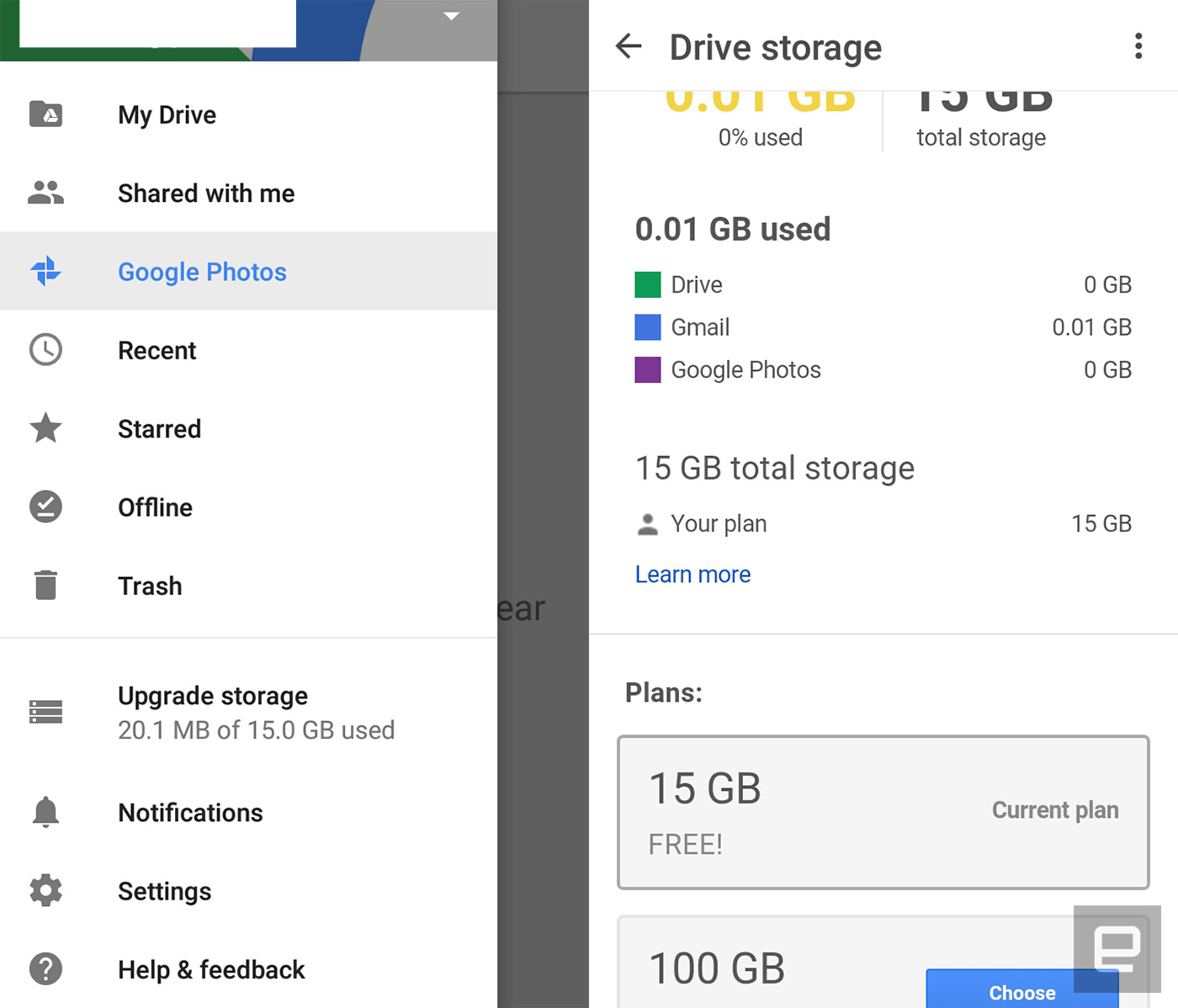
Besides the ability to add shortcuts, the latest version also adds an “Upgrade storage” option in its menu drawer. It shows your current plan and makes it a cinch to upgrade if you need more space. While the update comes a couple of small but useful features, it also serves as the bearer of bad news if you’re stuck on Android Ice Cream Sandwich. This is the last ICS-supported update, which means you won’t be getting any more new features after these.

Via: 9to5google
Source: Google Drive
Amazon now offers unlimited cloud storage for £55 per year
One of the benefits of being an Amazon Prime member is unlimited cloud storage for photos, as well as 5GB of space for other file types. If you own any of the retailer’s Fire devices, too, you get unlimited storage for photos taken with that product, as well as 5 gigs for whatever else. Amazon’s latest offer is altogether more simple: For £55 per year, you can get unlimited cloud storage, full stop.
Amazon Drive’s unlimited plan first launched in the US last year, not long before iOS and Android apps arrived to make the service a serious competitor to the likes of Dropbox, Google Drive, Box and others. It’s also accessible through browsers and dedicated Mac/PC programs. There’s no Prime favouritism here — anyone with an Amazon account can sign up for the £55 yearly unlimited plan, and most will be able take advantage of a three-month free trial to get themselves settled in.
Source: Amazon
Thunderbolt Device Promises Desktop-Class GPU Performance For MacBooks
A Kickstarter project for a high-performance desktop GPU that can plug into a MacBook via Thunderbolt and is compatible with the Oculus Rift VR headset has raised its backing target of $50,000 in less than 24 hours.
The Wolfe is a portable box that contains an Nvidia desktop-class graphics card and connects to a MacBook or other laptop via Thunderbolt 2 (or potentially Thunderbolt 3), and promises vastly improved performance for gaming, virtual reality, graphic design, and video editing.
The team behind the Wolfe claims owners of newer laptops can expect performance increases up to 500 percent when using a Wolfe box, or up to 1000 percent with the Wolfe Pro, while older computers are said to see even more dramatic performance gains.
- The Wolfe contains an NVIDIA GTX 950 GPU – 768 cores operating at 1024MHz, for a peak compute power of 1.57 TeraFLOPS.
- The Wolfe Pro runs on an NVIDIA GTX 970 GPU – 1664 cores operating at 1050MHz, for a peak compute power of 3.49 TeraFLOPS.
What about NVIDIA’s 10-series GPUs? As of right now, The Wolfe Pro includes an NVIDIA GTX 970. However, it’s more than likely that Wolfe Pro level backers will be able to opt for the new GTX 1060 in our post-campaign survey for even better performance.
The box runs off a 220W PSU and has three DisplayPort 1.2 connections, one HDMI 2.0 and one DVI-I port. The Thunderbolt connection also offers the potential for more than one Wolfe box to be used with one laptop, for building a render farm or for a multi-monitor setup, say the makers.
Kickstarter early-bird pledges of $399 or more get backers a Wolfe box powered by a GTX 950 with the option of Thunderbolt 2 or 3 connectivity, while a standard pledge costs $449. An early-bird pledge for the Wolfe Pro is $549 ($599 for a standard pledge). A Wolfe DIY pack for modders who want to use their own GPU costs $269.
The makers note that while the Wolfe will increase laptop display performance, the best results are expected to come with using an external monitor or VR headset, due to the inherent bandwidth restrictions in Thunderbolt 2.
The project was conceived by a group of Harvard computer science graduates and Mac-owning gaming enthusiasts, after they hacked together a prototype GPU box in a DeWolfe dorm room at Harvard.
The team has continued to improve the hardware and software at the Harvard Innovation Lab, with the aim of making Macs “performance powerhouses” and “to stop big companies from charging outrageous prices for minuscule upgrades” by letting users take control of their computer’s performance. The Kickstarter project page quotes a shipping aim of February 2017.
The project comes five months after Oculus Rift founder Palmer Luckey suggested VR headset support for the Mac was “up to Apple,” and that the company needed to “prioritize higher-end GPUs.” If Apple builds a machine that can handle the hardware, Oculus VR would “love to support Mac,” said Luckey.
Tags: Kickstarter, Wolfe
Discuss this article in our forums
Photo Editing App ‘Prisma’ Now Supports Offline Picture Processing
Popular photo manipulation app Prisma has been updated to allow offline processing of images for the first time.
The photo app recreates images in the style of famous artists and gives shots a painterly aesthetic using neural networks, but up until now users needed an internet connection and had to wait for the app’s Moscow-based servers to process their pictures.
The latest update doesn’t bring offline mode to the whole collection of Prisma’s filters, but the developers say more is to come on that front, and the change means server-side video manipulation is just around the corner.
“Now that we’ve implemented neural networks right to the smartphones, we have enough server capacity to run full videos on them in the near future,” said the Prisma team.
Prisma Labs says “repainting” times have been reduced to five seconds on Apple’s latest iPhones and that there should be no increase in handset battery usage.
Prisma is a free download on the App Store for iPhone and iPad. [Direct Link]
Discuss this article in our forums
Tim Cook Reaches Five Years as Apple CEO, Unlocks Over $100 Million in Bonuses
Today marks the fifth anniversary since Tim Cook was named Apple CEO on August 24, 2011, the same day that late co-founder Steve Jobs stepped down as chief executive for the final time and recommended the board of directors appoint Cook as his permanent successor.
Upon reaching the five-year mark, Cook has today unlocked previously awarded stock bonuses currently worth over $100 million. The bonuses are tied to both his tenure and Apple’s performance under his leadership, including its total shareholder return relative to the S&P 500 index.
Cook’s bonus includes 700,000 tenure-based restricted stock units that vested today as part of a larger compensation package of over 4.7 million shares awarded on August 24, 2011, in addition to his first of six annual installments of 280,000 tenure-based restricted stock units that vested today. The combined 980,000 shares are valued at nearly $106.7 million based on AAPL’s closing price of $108.85 on Tuesday.
Cook’s bonus could be even higher if Apple’s total shareholder return is in the middle third or top third relative to other companies in the S&P 500 from August 25, 2013 through August 24, 2016. He will receive another 140,000 RSUs for middle third performance, or 280,000 RSUs for top third performance. AAPL has risen around 52% since August 25, 2013, while the S&P 500 has risen around 32% in the same time period, making at least a middle third finish a strong possibility.
A restricted stock unit, or RSU, is a form of compensation valued in terms of company stock, but the stock is not issued at the time of the grant. Instead, the recipient gets shares of stock at a later date, generally only if they are still employed by the company. Cook personally requested that his award be modified to adhere to a more performance-based compensation system in 2013. Another 700,000 of his RSUs are scheduled to vest on August 24, 2021, plus 280,000 RSUs each August 24 through 2021.
Cook’s net worth, assuming he remains with the company through August 24, 2021 and meets performance targets, is estimated to be over $500 million based on his current stock options and RSUs awarded. He has previously pledged to donate the vast majority of his wealth, including these stock bonuses, to charities in his lifetime. In May 2015, for example, Cook donated approximately 50,000 shares of Apple stock, then worth approximately $6.5 million, to undisclosed charities.
Cook has overseen the launch of the Apple Watch, MacBook Pro with Retina display, ultra-thin 12-inch MacBook, iPad Pro, several iPhone and iPad models, Apple Maps, Apple Music, Apple Pay, Siri, and many other products and services since taking over the reigns in 2011. Apple became the world’s most valuable company in 2012 under his leadership, and it continues to hold that title today. Apple stock has risen over 132% since Cook was appointed as CEO five years ago.
Tags: Tim Cook, AAPL
Discuss this article in our forums
PowerVision PowerEgg Release Date, Price and Specs – CNET
It’s very difficult to say “PowerEgg” and not smile or giggle, and that’s sort of the point.
Robotics company PowerVision was looking for a drone design that is friendly and approachable and not intimidating to anyone — and the result is the PowerEgg. When closed up, it looks like a giant shiny white egg, roughly the size of a rugby ball. Press a button to drop its legs, pull up each of its four propeller arms and it’s transformed into, well, a flying egg. A 4.6-pound (2 kg) one at that.
Under a cap on the bottom is the PowerEgg’s 4K-resolution camera on a 3-axis motorized gimbal that, once flying, is completely unobstructed and can rotate 360 degrees. The quad’s visual positioning system is then also uncovered, to assist with indoor flying up to 13 feet (4 m) above the ground.
PowerVision PowerEgg is not your ordinary…
See full gallery


1 – 4 of 25
Next
Prev
When flying outside, the drone relies on GPS to keep it stable and to assist with a handful of automated shooting modes. Included are a Follow Me mode that tracks the moves of the controller, another that orbits a subject, one for waypoint navigation and one for selfies.
Those things aren’t unique to the PowerEgg, but the drone’s controller is. PowerVision made it modular by breaking out the flight processor and base station into a separate unit. Bundled with the quadcopter is a fairly typical gaming-style two-stick controller as well as the one-handed, gesture-based PowerEgg Maestro. The Maestro basically lets you point to where you want the drone to fly and it follows.

The Maestro controller lets you use gestures to guide the PowerEgg where you want it to fly.
Joshua Goldman/CNET
The drone is capable of delivering real-time video transmission up to 3.1 miles (5 km) to a smartphone or tablet (Android or iOS). The battery, which loads vertically in the top, has a maximum flight time of approximately 23 minutes, which is disappointing but understandable given the drone’s weight and size.
The PowerEgg can be ordered now for $1,288 (approximately AU$1,700 or £975) through the PowerVision site, but won’t ship till October. That price gets you the drone, the Maestro and two-stick controllers, a battery, a charger and a light-up base station that does nothing more than display your PowerEgg. If you order before the end of September you get a backpack for everything, too.
We did see the PowerEgg in action, and it did manage to take off and land on its own and fly around a loft space if nothing else. We didn’t get to see any video off the camera, so I can’t say what the quality is like. Or how it will behave outside. The price seems too high to me, given how much competition is out there. However, it does offer a couple interesting features, such as its rotating camera and modular controller, and a distinctive design that is made for travel and starting conversations.
Dexmo exoskeleton glove lets you touch and feel in VR
As much as we enjoy virtual reality these days, there’s still the occasional urge to fiddle with virtual objects using just our hands. If all goes well, the upcoming Manus VR glove will be the first to unwrap our hands from controllers, but it’ll only provide tactile feedback, meaning you still won’t be able to feel the shape nor physical properties of virtual objects. This is where Dexmo comes in: This mechanical exoskeleton glove tracks 11 degrees of freedom of motion and offers variable force feedback for each finger. To put it simply, you’ll be able to realistically squeeze a rubber duck in the VR world. Better yet, this seemingly clunky glove claim to be lightweight and also runs wirelessly “for a relatively long time.”
Dexta Robotics, the Chinese startup behind Dexmo, has spent the last two years coming up with over 20 prototypes before getting to the current version. Unfortunately for us mere mortals, it’ll be a while before we can get our hands on this device. CEO Aler Gu told Engadget that he’s only made a batch of Dexmo and is currently seeking keen software developers plus VR/MR (mixed reality) market leaders who can take full advantage of his gear, before he eventually takes it to market — be it for gaming, education, medical or training.
“Selling Dexmo is different than selling consumer electronics because you can’t use Dexmo right out of the box,” Gu added. “It will take some really amazing content for people to realize how gaming-changing this innovation actually is.”

Little else is known about the Dexmo at the moment — no date nor price just yet. However, with Valve now opening up the HTC Vive’s trackers to third-party peripherals, we can already imagine how much more awesome VR will be courtesy of these futuristic gloves. Some day we’ll look back and think, VR was so lame when we only had controllers.
Source: Dexta Robotics
Australian Retailers Back Banks’ Right to Negotiate With Apple
Australian retail giant Coles, the Australian Payments Clearing Association (APCA), and the Australian Retailers Association have all expressed their support to allow some of the country’s banks to collectively negotiate with Apple over access to its NFC-based digital payment technology (via ZDNEt).
Last month, Commonwealth Bank, National Australia Bank (NAB), and Westpac lodged a joint application with the Australian Competition & Consumer Commission (ACCC) to negotiate with Apple because they want to be able to use digital wallets they have already financed and developed, rather than be tied into using just Apple Pay.
Apple lambasted the banks over the application, and last week the request was denied by the ACCC to give the antitrust regulator more time to consult and consider the views of all the parties involved.
However, in a letter of support sent to the ACCC, retailer Coles argued that giving the banks the ability to negotiate with Apple will enhance the experience for customers, as well as improve the transparency of costs related to credit card processing fees.
We believe the ability to tailor solutions for customers and provide them with greater value should be the driver for customer choice and not a technical lockout that many consumers may not have realized would be imposed when they purchased their mobile device.
The APCA also backed the banks, claiming enabling them to negotiate will encourage greater innovation and enhance competition in the payments markets, and ultimately deliver benefits to consumers and merchants.
“We consider that the exclusivity and restrictions on access to platforms and functionality, by contrast, may tend to stifle innovation and competition,” it said.
Meanwhile, retail body ARA argued that if Apple allowed the banks to put their mobile banking apps onto the iPhone, it would give consumers the option to choose.
“We would like to see all customers have a choice of mobile wallets and payment services using the mobile phone they already have and the bank debit and credit cards and loyalty cards they already use,” the ARA wrote.
PayPal also wrote to the ACCC, but rather than endorsing the banks’ request for negotiations, it said the original application’s definition of “mobile wallet” was too broad. The digital payments giant also wrote that the APCA’s voluntary Third Party Digital Wallet Security Industry Guidelines should not be mandated without open discussions on standards.
Apple’s opinion on the matter remained the same: the company believes the original application shows the banks want to maintain complete control over their customers and blunt Apple’s entry into the Australian market.
Related Roundup: Apple Pay
Tag: Australia
Discuss this article in our forums
Volkswagen Golf R Estate review: The ultimate fast, all-weather estate
It is sometimes said that a Volkswagen Golf is the car for everyone. But who is everyone? There’s now an electric Golf and a hybrid Golf in among the regular diesel and petrol Golfs, plus a powerful diesel one and a powerful petrol one.
But which powerful petrol Golf? The answer to that question used to be easy – it was called a Golf GTi, and in the latest seventh generation hatchback bodyshell it’s a very fine drive indeed. But in a world of hot hatches that sport as much power as a two-generation-old Ferrari, VW needed something more than a GTi. Step forward the Golf R.
We’ve driven the hatchback Golf R briefly, and liked it a lot. But what if your spatial needs extend a bit beyond a regular 5-door family hatch? Then a Golf estate could be the perfect answer. Thing was, up until recently, if you wanted a Golf estate with much engine power you were rather stuck. But now Volkswagen has put a rocket under the estate version of the car for everyone, by creating the Golf R Estate.
Never mind a car for everyone, the Golf R Estate has the makings of all the car you will ever need.
Volkswagen Golf R Estate review: Body shaping mix
The R Estate’s mixture is simple enough. Take one regular 5-door Golf – with all that’s great about that. Extend the roofline and the rear overhang until you’ve created a massive boot with a 605-litre volume, seats up. Drop the 296bhp, 2.0 TSI engine from the Golf R hatch under the bonnet, and channel power to the road through a 4motion, four-wheel drive system. Mediate the power through a standard 6-speed DSG automatic gearbox. The result? A very quick way to make your labrador vomit all over the inside of the rear screen.
Pocket-lint
It’s just a pity that the elegantly evolved, sharp-looking Golf hatch doesn’t quite translate into estate car format. It lacks the sleekness of the sports wagons from the class above – the Audi A4 Avant, BMW 3-Series Touring and Mercedes C-Class, which start at a similar price. But here’s the rub: the Golf has more boot space than any of them, and while you might look at the badge, price and scoff “more than £30K for a Golf!?”, to spec a version of the aforementioned cars with an engine that would remotely keep up with a Golf R, you’re looking at spending another £10K on top – possibly more. That’s key to this car’s appeal.
Volkswagen Golf R Estate review: Kitted out
The power and powertrain specs are just one part of the picture. Whereas once Volkswagen wanted to take money off you for just about every option, if someone handed you a Golf R with no options, you’d likely not be too upset.
It’s easier to talk about what’s missing – heated seats, leather, a panoramic roof – than what’s standard. Because the list is long, including sat nav, flash LED lights, big wheels, a 6.5-inch touch screen, DAB radio and more.
Pocket-lint
And, of course, that DSG auto box. This is a potentially contentious point, because the auto gearbox is the only one available with this car. Whereas in the hatch you can have a 6-speed manual.
We’ve been on record before as saying we think this 6-speed DSG is less impressive than the 7-speed used elsewhere in VW’s range. It seems to struggle more at slow speeds, such as when manoeuvring and coming up to roundabouts in slow-moving traffic. It occasionally makes you look like you’ve lost the ability to drive, by throwing in a downshift and causing a massive head-jerk, or occasionally having a slight delay in delivering the power when you’re needing some quickly to get out into a gap.
There are some good parts to the transmission though. Firstly, you get small paddle shifters as standard behind the wheel. Flick the gear lever across and you’ve complete control. Secondly, in the sportier driving modes, it shifts up very quickly indeed and upshifts are accompanied by a noticeable and amusing “parp” from the quad exhausts.
Pocket-lint
The R Estate is a formidable thing. Its combination of 300 horsepower and four-wheel drive mean you’re not coping with wheelspin or torque steer and it’s a great all-weather drive. We think the DSG box takes a little bit of the tactile playfulness away, compared with the hatch, but can see why VW opted for the auto option.
Volkswagen Golf R Estate review: Playing fast and loose
In other ways, however, the Golf R R Estate retains the engaging qualities of the hatch and then some.
Core to this quality is the mode selector with its Comfort/Normal/Race/Individual settings which configure the gearbox, ride, engine and exhaust sound. We drove most of the time in individual (ride in comfort setting, engine in sport, exhaust normal), but in Race mode, the R is a bit of an animal.
Pocket-lint
When you take it by the scruff of the neck it moves around in a very engaging way – the extra weight over the rear and added length of the estate meaning the rear end of the car is happier to move around. And not in a way where it feels like it’s going to spit you off the road, but in a manner which if you’re into driving quickly will have you laughing out loud.
For such a spacious car, you would expect this Golf to feel like an unwieldy bus, but it feels almost Mini-like in its size, alertness and adjustability. Who said the Germans don’t know how to have fun? Just a pity that the dynamic chassis control (DCC) is an £830 option.
And it bears repeating that with 300 horsepower and four-wheel drive, you need some serious firepower to keep up with a Golf R Estate, which smashes through the 60mph benchmark in a smidge over five seconds. In the wet and grim conditions that we seem to experience even in summer months in the UK this factor is magnified such that as an all-weather, any road car the Golf R Estate has few peers. Think of it not so much as a very expensive Golf but more as a cut-price Audi S4 Avant.
Pocket-lint
You’re wrong if you think nobody is going to notice you in this car. Our car’s Lapis Blue paint (£630), 19-inch Pretoria alloys (£990) and the double day time running light LED graphic (standard) certainly drew attention. Sometimes the wrong kind of attention. If you want to do the discrete Golf R thing, stick with the standard 18-inch alloys and an exterior colour like black. For our money, those four exhaust pipes (the hatch has two) are overkill, too.
Volkswagen Golf R Estate review: Architecturally speaking
Part of the appeal of any Golf is its normal, blend-in quality – and this is true of the inside too. It’s tasteful, largely black/grey and not going to challenge anyone in design terms. But if you’re looking for a massive change in quality of trimmings on an R compared to regular Golf, prepare to be disappointed.
Pocket-lint
Changes are limited to the deco finishes: a carbon-fibre pattern effect (repeated in the seat bolster pattern on our car’s optional leather trim), and some blue details on the dials and switch gears (it’s the R sub-brand’s signature colour). Note our test car came with the £2,615 carbon/nappa leather upholstery, including heating of the front seats. The chairs on their own are good, so we would advise if you can live without leather then do – spend a couple of hundred quid on heated seats separately if you feel the need.
Elsewhere the Estate is the standard Golf. Which means very high levels of perceived quality, clear dials, nice ergonomics, and nothing to wrong-foot the newcomer besides the electronic handbrake. The wheel is chunky-rimmed, deep dished, small and lovely to hold too.
Tech-wise the standard 6.5-inch touchscreen with proximity sensor works well. Volkswagen has just upgraded the standard spec (along with the basic price) to mean this comes as standard with sat nav – which given nav is standard on this car’s cheaper Skoda and Seat cousins, it needs to be. Note: our pictures show the larger, 8-inch touchscreen – which is a significant £1,325 price jump. For that you get better screen resolution, a 64GB SSD hard drive and connected services. But we wouldn’t bother.
Pocket-lint
If there’s criticism it’s that, now four years old, architecturally speaking, the Golf interior is starting to feel old. It’s quite blocky, with a very high centre console that’s going out of fashion – the lower set design of its cheaper Skoda cousin gives an airier feeling inside – and more cars are going towards floating or flip-out infotainment screens, minimised switchgear and more premium detailing. It’s in these areas where you’ll most see and feel the difference between this Golf and the mechanically identical Audi S3 (but note that you cannot have the S3 in an estate car bodyshell).
Verdict
Picking fault with cars such as the Golf R Estate feels like an exercise in nit-picking. It is, in many regards, the perfect package. It’ll do most things most families will need (even being economical – 40mpg on a run is easy to achieve), while entertaining the enthusiastic driver when required.
If you’re after a high-performance, all-weather estate car and can’t run to the cost of Audi’s S and RS Avants, this Golf really is one of your best (and only) choices.
Quibbles are limited, but there are a few: that standard fit auto gearbox, which takes out some of the involvement of the hatch and occasionally has dim moments; the cost (people still seem to have issues with the idea of an expensive Golf); and the car’s relative merits compared to various not-precisely-comparable cousins offered by Seat, Skoda and Audi
Nonetheless the Golf R Estate remains a devastatingly fast and appealing class act. And with the £200-a-month personal lease deals we’ve recently seen this car advertised at, it is perhaps the performance estate car bargain of the moment.
Google hires satellite exec to head up Project Loon
The Project Loon team has been conducting successful tests in different parts of the globe for quite some time, but they’ve yet to release a commercial product. Google’s new hire could change that. The tech titan has signed up Viasat exec Tom Moore to become the team’s new general manager by mid-September. Moore originally joined the satellite communications provider when it acquired the company he co-founded. Now, his role is to steer the Loon ship into its next phase and make the internet balloons’ commercial deployment a reality.
Astro Teller, head honcho at Google’s secretive research facility X, said in a statement:
“Under Mike’s scrappy, entrepreneurial leadership, Loon moved from science project to viable venture, and Tom’s valuable industry experience will help launch us into the commercial stage of this moonshot.”
Mike Cassidy is Loon’s old chief, and while he’s out of the project, he’ll remain with X to work on other ventures.
This isn’t the first time the big G hired someone with experience running big companies in an effort to turn experimental projects into commercial endeavors. Google also signed up former Ford and Hyundai exec John Krafcik in 2015 to run its self-driving car division. It’s worth noting, though, that the company lost a few of that particular team’s key members, as well. They’re now working for Uber and are developing the ride-sharing giant’s autonomous car project.
Source: Bloomberg, Recode
 AIVAnet