


Google wants to standardize Android password managers
Security is more important than ever, but people still don’t love typing passwords into phones. As such, Google is teaming with Dashlane and other password managers on the “Open YOLO” (You Only Login Once) project. The idea is to create an API that lets Android developers access password managers so that you can log into apps automatically with no typing or insecure autofill. Dashlane is spearheading the venture in cooperation with other password managers, though it hasn’t said which are involved.
Details are light on how it works, but we assume you’d log in once to your password manager then get access to all apps that support Open YOLO (gawd that name). Such a system would be more convenient and secure for the average user, as many managers require strong passwords and protect you from reuse attacks. (That’s assuming, of course, that nobody hacks YOLO or the password manager itself.)
Dashlane said that while the project is starting with Android, it could eventually hit other platforms and operating systems. Neither Google nor other password managers like LastPass have chimed in, but we expect we’ll find out more once they do.
Source: Dashlane
SoftBank: Japan’s most interesting tech company
Japan and technology are often mentioned in the same breath. Bullet trains, robots, only-in-Japan phones that’ll never leave the island, digital pop-idols and so on. Tech legends like Sony, Nintendo, Panasonic, Sharp, Nikon, Canon, Toyota and more were born here, but most have had mixed fortunes in recent decades. Some missed out on (or were too late to) the smartphone boom, or suffered from declining point-and-shoot-camera sales. Others simply faced stronger competition from Korean and Chinese companies. Smartphones, wearables and VR have generally come from elsewhere. Japan’s reputation for getting the newest technology first doesn’t ring very true these days — in fact, those aforementioned tech giants have a reputation for being a risk-averse and slow to change. (Many, if not most companies still request that I fax over my RSVP for their press conferences and meetings. I kid you not.) Then there’s Softbank.
Softbank is now best known as one of Japan’s top three phone carriers, but at a time when Japan’s big tech firms are shrinking (or pairing off), it’s launched a humanoid robot, teamed up with Honda to make smarter cars and just bought out the company that designs the chips for most smartphones — including the iPhone.
But first, there’s Pepper. Years after Sony’s Aibo robot faded into obscurity and Honda’s Asimo walked, waved — and not much else — the idea of a personable home robot was replaced with faceless automated vacuum cleaners. Then SoftBank, with no history of robots, announced a large humanoid robot that would come to its phone shops — and even homes.
Early adopters and companies alike seemed to love it. Despite Pepper costing more than a high-end laptop, the first waves of the four-foot robot sold out in minutes. Japanese banks and companies like Nescafe and Pizza Hut all claimed one to help project their images of a futuristic company hiring android help. Pepper is far from perfect, but SoftBank managed to reinvigorate the robot dream in a country whose love for robots has never faltered — as well as inspiring a new generation of rivals. It’s an effort to restart the robot revolution. It’s still not the bot of our dreams, but it’s exciting, OK?
Last month SoftBank announced it’s buying ARM, the UK company responsible for the reference processor designs found in nearly all smartphones. Processors designed by the firm also power a lot of lightweight VR headsets, wearables and and myriad Internet of Things devices. It’s a powerful move for the company: Softbank is buying a major part of the tech supply chain, one that even Apple depends on for chip blueprints that it further develops.

While Internet of Things is taking its time becoming a true revolution, SoftBank is well-placed to profit from it when it does. “ARM will be an excellent strategic fit within the SoftBank group as we invest to capture the very significant opportunities provided by the ‘Internet of Things,”‘ CEO Masayoshi Son said in a statement about the purchase. “This is one of the most important acquisitions we have ever made.”
In the same week as said “most important acquisition ever,” Son took to the stage with Honda’s CEO to announce a partnership aimed at developing cars that drivers can speak and interact with, channeling the same cloud-based processes found inside Pepper the robot. Details aren’t all that specific, but the companies say they’re looking into combining the technology so that cars could speak and interact with the driver, assess the driver’s emotions through vehicle sensors and cameras and offer support during long trips or while trying to park.
Perhaps even weirder: Honda and Softbank hope that by letting mobility products “grow up” while sharing various experiences with the owner, the user will form a stronger emotional attachment with the car. SoftBank talked a similar game before it launched Pepper, although we’re still waiting for a true reaction to our illogical human emotions.
Softbank isn’t new to Japan’s tech scene. Founded back in 1981, it’s changed and adapted what it sells and deals in. CEO Son started the company specializing as a software distributor and soon launched PC magazines at the start of the personal computing boom — a lucrative time to do so.
The company is also used to taking risks. After struggling for years to enter Japan’s carrier market, SoftBank acquired Vodafone Japan in 2006, and in 2008 it was the first (and only) phone operator in the country to offer the iPhone 3G — an exclusive it kept until 2011. Being the exclusive carrier for the iPhone sounds like common sense, but at the time it was surprisingly risky. Japan is the country of the “Galapagos” phones: flip-phones that had high-resolution cameras, TV tuners, GPS and music downloads for years before the iPhone arrived on the scene.

Apple’s (innovative but still new) PC-style Safari browser didn’t work with Japan’s already well-established mobile sites, and there weren’t even any emoji (gasp!). Phones with embedded NFC chips for contactless payments had already existed in Japan since 2004. To many Japanese phone users, it didn’t look quite as revolutionary as the rest of the world saw it.
History explained the rest: The iPhone was a huge success and helped SoftBank as a carrier gain a foothold in the Japan’s competitive phone market. Softbank’s long-running series of hugely popular TV ads ensure that everyone in Japan knows the company. The ads are weird, confident, funny — and now all the other native phone carriers are trying to copy the same magic for their own advertisements. Softbank-owned Sprint even tried to repurpose them in the US — even if it didn’t work out so well.
Softbank has so far struggled to turn around the American carrier, but it forms just one part of CEO Son’s bid to make Softbank a truly global organization. The company, primarily focused on Japan, also owns a substantial 28 percent share of China’s e-commerce giant Alibaba — it’s like Amazon, but way bigger. And of course, it now owns the UK-based ARM.
The gambles are paying off: SoftBank announced it increased profits 19 percent last quarter. And while the most recent moves may seem hugely disconnected, combining its moves into artificial intelligence (Pepper, autonomous cars) with ownership of ARM (and the chips it designs) Softbank could eventually be the company that truly makes internet of things a … thing.
Bahrain imposes ‘internet curfew’ near protests, activists say
The Bahrain government has shut down 3G and 4G services in the village of Duraz every night for the past month, according to advocacy group Bahrain Watch. Activists found that each night between 7PM and 1AM, some 3G and 4G cell towers in Duraz stop working entirely, while 2G towers broadcast notifications to phones saying mobile internet services are not supported in the area. Since the shutdowns are regular and appear to be coordinated across multiple ISPs, namely Balteco and Zain, Bahrain Watch says, “it is possible that the disruptions are a result of a Service Restriction Order from the Bahrain Government, in relation to the protests.”
Bahrain Watch published a technical breakdown of the reported shutdowns.
Duraz is home to leading Shia Cleric Isa Qassim and it’s been the site of protests since officials revoked his citizenship on June 20th. On top of the nightly internet interference, police have set up blockades and checkpoints across Duraz, activists say.
The United Nations Human Rights Council unequivocally condemns any government’s practice of restricting internet access for its citizens. In July, the council passed a resolution reaffirming and expanding its stance upholding internet rights across the globe. The governments of countries such as Vietnam, China, Russia and Turkey have restricted internet access during times of political unrest or in an attempt to block content it deems “scandalous.”
Source: Bahrain Watch
Where the would-be vice presidents stand on cybersecurity
Aside from sound bites on Russia and hacking, where Clinton and Trump stand on cybersecurity issues is generally unclear. In fact, they’ve devoted little time to this crucial and urgent subject. Which is weird in light of the epic amount of hacking shenanigans this presidential race has compelled us to endure.
When it comes to cybersecurity, neither Clinton nor Trump has a position, a statement, a plan or a section in their “Issues” sections of their campaign websites. Only Clinton’s website mentions it — in passing: once on China’s accountability to the U.S., and then again in a little line stating she will work to promote “cybersecurity at home and abroad.”
You’d think either one of them would have something substantial on a topic that’s simultaneously consuming the nation and making them both look foolish. But apparently, that’s where their VPs are supposed to come in and take up the very troubling amount of cybersecurity neglect we’re witnessing.
Which, as you’ll see, is pretty lopsided.
Mike Pence’s cyberrecord
As Indiana’s governor, Pence established a reputation for seeing cybersecurity through a business-focused lens and for emphasizing law enforcement’s need for greater resources to fight hacking. During his run as governor, he also pushed for tax breaks to draw in more infosec jobs into the state.
In April, Pence announced the formation of a public-private partnership initiative called the Indiana State Executive Council on Cybersecurity. It was framed as “a comprehensive public-private partnership charged with enhancing Indiana’s ability to prevent, respond to and recover from all types of cybersecurity issues, including attacks.”
Those partners include organizations you’d expect, like the Indiana DHS and private partners such as government cyber-darling consultant FireEye/Mandiant, which has well-documented troubles producing results and maintaining its stock price. Other private partners include Indiana University, Purdue University and RSA.
The Cybersecurity Council’s site for Indiana citizens is riddled with bizarre advice, like “see if your information will be protected” before using public WiFi and contact the Indiana State Police if you get hit with ransomware. It also has embarrassing problems like unfinished sentences and words placed senselessly in the middle of sentences, showing that no one really cared to read or finish the help guide.
Perhaps that’s because the Council’s command center is only open “from about 8-5” … and maybe when it’s time to clock out, proofreading and readability becomes someone else’s job. As things go, Pence’s whole initiative reads like an unfinished joke.
Tim Kaine’s cyberrecord
When Kaine was announced as Clinton’s pick for VP, Trump said that Kaine was a terrible governor … for New Jersey. Kaine, the former governor of Virginia, took it in stride admitting that, yes, he was definitely a no-show governor for the Garden State. But he was all business on Trump’s remarks encouraging Russia to hack Clinton, telling press “cybersecurity is no laughing matter.”
Kaine has done more work on and given more thought to cybersecurity and digital issues in general than Pence, Trump and Clinton combined. As a senator, Kaine voted in favor of the controversial Cybersecurity Information Sharing Act of 2015 (CISA). As you may remember, CISA was panned for worsening America’s digital-surveillance problems, as well as for leaving out critical privacy protections. Its critics were surprised and furious when it was snuck through inside a budget bill.
Being a victim of the OPM hack motivated him to go deep into cybersecurity policy. Kaine partnered with Sen. Mark Warner (D-Va.) to introduce legislation giving OPM hack victims identity-theft protections.
The OPM hack is something he mentions frequently, like in his May keynote at the Center for Strategic and International Studies’ event, “Cybersecurity After Information Sharing.” In it, he outlined the primary issues he’s tackling in the Senate Budget Committee: “cyber doctrine; the debate over the security-privacy balance; and then third, cyber security investment.”
Kaine wants to see more money spent on cybersecurity, specifically in hiring and policy, calling the 2017 budget “make or break” for cyber. He shares Pence’s affection for FireEye and speaks highly of his discussions with the beleaguered company about cyber-modernization of various departments.
On Snowden, Kaine believes what he did was illegal but won’t throw labels like “traitor” around until the government can prove it. When the encryption debate went mainstream during the Apple vs FBI controversy, he carved out a middle ground. He voiced opposition to legislation that would mandate backdoors, yet seeks a solution for law enforcement and, like Clinton, he backed the creation of an encryption commission. Hopefully he’ll take into account the lack of fact-checking found in the first report.
The Internet Security Alliance praised Clinton’s pick of Kaine. Larry Clinton, president of the ISA, said, “Perhaps more importantly, in speeches and hearings, Sen. Kaine is on record as saying that the next administration needs to act with greater urgency and frankly invest more on cybersecurity.”
Elaborating further, he said Kaine “has articulated, as we have at ISA, that the digital age fundamentally changed our world and we need to address this challenge much more aggressively and creatively.”
Considering Clinton’s barely-there grasp of all things cyber and hacking, like Trump, she would be leaning heavily on her VP for guidance on these pressing issues. Unlike many of his colleagues, Kaine understands just how urgent and important cybersecurity is right now.
And for a presidential race that feels more acrimonious and negative by the day, this is a bit of good news … for once.
Six Flags adds a gaming twist to its VR roller coasters
Six Flags first announced that it was teaming up with Samsung to outfit roller coaster riders with Gear VR headsets back in the spring. The theme park company is taking its virtual reality project to another level though, adding a gaming component to the immersive visuals. Before now, the addition of VR to rides just added a different visual experience to the ride itself. With the new “Rage of the Gargoyles,” riders take flight in an Apache-style helicopter to battle “blood-thirsty” beasts.
How do you control the game? Well, the Gear VR headset does all of the work so you can keep your hands tightly wrapped around whatever handle the ride offers. As Six Flags explains it, riders aim at the gargoyles by looking in their direction to aim the helicopter’s Gatling guns. Once a target is locked on, the weapon fires automatically. Based on the details the company offered, it sounds like there’s a HMD (Head Mounting Display) UI to guide you through the whole thing. There’s no word on if you’ll be able to keep score and compete against fellow riders.
If you’re planning to take a road trip before summer officially comes to a close, “Rage of the Gargoyles” will be available on nine VR-equipped coasters at Six Flags parks in the US and Canada. Those locations and rides include Demon at Six Flags Great America, Skull Mountain at Six Flags Great Adventure, Shock Wave at Six Flags Over Texas, Kong at Six Flags Discovery Kingdom, Dare Devil Dive at Six Flags Over Georgia, Goliath at La Ronde, Ninja at Six Flags St. Louis and Steamin’ Demon at The Great Escape. What’s more, there are sure to be new VR adventures at the parks in the future as Six Flags touts the setup’s versatility.
“One of the most exciting things about this technology is that we have the ability to change the storylines to offer our guests new thrills and new reasons to visit our parks,” said Six Flags president and CEO John Duffey.
Rage of the Gargoyles virtual reality comes to the Demonhttps://t.co/xrpg9JzIYH
— SF Great America (@SFGreat_America) August 5, 2016
Source: Six Flags (Business Wire)
One month after going free, ‘Evolve’ averages 15,000 players
Pick a random moment in June and you’d likely find about 100 people playing Turtle Rock Studios’ Evolve on Steam. That’s not a lot of players in general, but this number is especially sad for a game billed as an online multiplayer extravaganza. One and a half years after launch, it looked like Evolve was dying. And then, in July, Evolve’s active player base shot up to an average of 15,400 at any given time on Steam, according to current lead designer Brandon Yanez.
This didn’t happen by accident: Developers at Turtle Rock knew they had to take drastic action to save Evolve and so, on July 7th, they did. They made the game free on PC.
Evolve originally cost $60, the standard price of a AAA video game, and it launched alongside a bevy of pricey downloadable extras. This flood of day-one DLC was one reason the game simply didn’t resonate, even though it received a ton of pre-release buzz from critics and players alike.
“There was a ton of conversation in the community with regard to business models rather than discussion on the game itself,” Yanez said.

When Turtle Rock released Evolve into the wild, it landed smack in the middle of a “DLC shitstorm,” according to studio founders Chris Ashton and Phil Robb. It was early 2015, and gaming forums and blogs were rife with conversations about developers overloading their titles with pricey downloadable content. Many players were sick of it and extremely vocal about their displeasure. Any mention of DLC, especially tied to a $60 AAA game, instantly ignited comment sections and Twitter.
And Evolve certainly had a lot of DLC from day one. Players lambasted it for this fact, which surely influenced some people’s decision to not buy the game. However, DLC wasn’t Evolve’s only problem.
The game had a steep learning curve, Yanez said, meaning many players couldn’t jump in and have fun right off the bat. On top of that, the game simply wasn’t fun until late in each round. Evolve used an asymmetrical multiplayer strategy where four players acted as hunters, each with an individual skill, and one person embodied a Lovecraftian kind of monster that attempted to evade capture and take down the other players. It looked like a fast-paced, hectic kind of game, but Yanez said it was criticized for being a “running simulator” before the monster gained all of its abilities.
Basically, until that point, Evolve was boring.

“After seeing our original player base decline and after reviewing a ton of feedback, we realized we needed to change the game so that it was faster-paced, less role dependent and more accessible,” Yanez said.
Going free was always on the table for Turtle Rock. Plenty of team members were fans of other free multiplayer games and they talked about the option early on in Evolve’s development. Some of the most successful online multiplayer games in recent memory have been free, including League of Legends, Dota 2 and Hearthstone. Shooters, however, tend to have an entry price — think Overwatch, Counter-Strike, Call of Duty or Destiny. Evolve was well within its genre’s boundaries when it launched at $60. However, its sluggish gameplay simply didn’t support a large, captive audience.
Evolve Stage 2, as developers dubbed the free version, didn’t just include a price drop; it reworked how the entire game operated. The hunters were overhauled, lending them all a more robust set of skills, rather than rigidly defined roles. For example, originally, only the hunter known as a “trapper” could deploy a dome that caught the monster, but Stage 2 gave that power to all hunters. Plus, monsters started with enough skill points to unlock all of their abilities right away.
The message was clear: No more running simulators.

“That has probably been the most exciting thing about this first month [as a free game] so far, is how much has changed simply because our community asked for it,” Yanez said. “We feel that has been the biggest difference. You still find wonderful people who become exceptional members of the community, but now there are way more opportunities for community growth and engagement with a much wider audience we could’ve never reached if we remained a ‘paid’ community.”
Evolve Stage 2 hit Steam for free on July 7th, bringing with it all of the content that Turtle Rock had previously released for the game. Since then, more than 1 million people have tried it out, and it hit a peak of 25,000 concurrent players just two days after going free. One month in, an average of 15,000 active players means Evolve certainly isn’t dead just yet.
The game still has a base price on consoles, for now. Turtle Rock said that if the PC experiment goes well — meaning, if Evolve can sustain a large and steady player base — it’ll go free on Xbox One and PlayStation 4 as well.
To that end, the studio is focused on regularly updating and tweaking Evolve on PC in a bid to keep players interested. Turtle Rock recently kicked off “Shear Madness,” a month-long event that will introduce three new characters, three fresh map variants, a new game mode and a bunch of community-requested features.

This is a far cry from where the game would be if it had remained a paid product.
“We’d be reaching the tail end of our life cycle,” Yanez said. “It’s exciting for us to see people giving the game another chance, but we know this is only the beginning.”
MacRumors Giveaway: Win a Smart Home Starter Kit From Yonomi
For this week’s giveaway, we’ve teamed up with smart home app Yonomi to give away a Smart Home Starter Kit consisting of a Sonos Play:1, an Amazon Echo, and two LIFX Wi-Fi connected lightbulbs, all of which can be controlled together using the Yonomi app for iOS devices.
Yonomi is designed to connect to more than 60 smart home products from companies like Withings, Philips, Quirky, Sonos, Nest, Belkin, and more, allowing users to group and control devices that normally would not work together.
Smart home products come from a wide range of manufacturers and usually require their own dedicated apps that don’t interface – Yonomi bridges them all together and makes it possible to create Routines for a true automated smart home experience. Yonomi also includes easily accessible favorites options and customized smart home recommendations.
With Yonomi and the products in the giveaway, for example, a “Wake Up” routine can be created that’ll turn both the LIFX light bulb and the Sonos speaker on at the same time through a voice command to the Amazon Echo. Yonomi is highly customizable and routines can be created for all kinds of situations.
A “Bed Time” routine might dim the LIFX bulbs to night light level and turn on soft lullabies on the Sonos for the kids, while a “Party” routine might set the bulbs to different colors and play the appropriate music. All of the routines can be initiated through the Echo, which is super convenient, and the Echo can also control other connected products and respond to individual commands.

As for the products themselves, the Sonos Play:1, LIFX bulbs, and Amazon Echo are all popular smart home choices that tap into a home’s Wi-Fi network. The Play:1 is one of Sonos’ most popular speakers, the LIFX bulbs can turn any color, and the Amazon Echo is a central hub that can play music and respond to a huge range of voice commands.

Yonomi’s app is available directly from the App Store for those who would like to try it out with their existing products, and one MacRumors reader will also win the full Smart Home prize pack. To enter to win, use the Rafflecopter widget below and enter an email address. Email addresses will be used solely for contact purposes to reach the winner and send the prize.
You can earn additional entries by subscribing to our weekly newsletter, subscribing to our YouTube channel, following us on Twitter, or visiting the MacRumors Facebook page. Due to the complexities of international laws regarding giveaways, only U.S. residents who are 18 years of age or older are eligible to enter.
a Rafflecopter giveawayThe contest will run from today (August 5) at 11:00 a.m. Pacific Time through 11:00 a.m. Pacific Time on August 12. The winner will be chosen randomly on August 12 and will be contacted by email. The winner has 48 hours to respond and provide a shipping address before a new winner is chosen.
Tags: giveaway, Yonomi
Discuss this article in our forums
Incipio Acquires Griffin Technology
Accessory maker Incipio today announced that it has acquired Griffin Technology, a company known for its wide range of accessories for Apple’s line of devices. Incipio and Griffin did not disclose the terms of the deal.
“Griffin has a 25-year history of designing, manufacturing and distributing iconic mobile accessories,” stated Andy Fathollahi, Founder and CEO of Incipio Group. “As part of Incipio Group, Griffin strengthens our product development and manufacturing capabilities, complements our existing product lines in rugged cases, power and connectivity, and allows our brands to reach a broader domestic and international audience through enhanced distribution in the business-to-business, enterprise and education verticals.”
Under Incipio, the Griffin Technology brand name will be maintained and it will continue to retain its global headquarters in Nashville, Tennessee. Products, such as Griffin’s Survivor series, will still be sold.
Incipio has made a number of acquisitions in recent months, purchasing brands that include Skullcandy, Clamcase, and Incase.
Tags: Griffin, Incipio
Discuss this article in our forums
Beoplay H5 Review: B&O’s Bluetooth Earbuds Sound Great, but They’re Pricey
With the controversial removal of the headphone jack from Apple’s upcoming iPhone range a seeming inevitability, audio companies are already ramping up Bluetooth headset options ahead of the devices’ launch in the fall.
In June, premium audio heavyweight brand Bose debuted a wireless version of its flagship over-the-ear headphones with the QuietComfort 35’s. Not to be outdone, last month Danish audio big hitter B&O entered the fray with its Beoplay H5 Bluetooth buds, a pair of high-end magnetized earphones designed “for music lovers who live to move.”
Design and Features
As with most products bearing the Bang & Olufsen moniker, the Beoplay H5 buds aren’t exactly cheap at $249, but apart from the luxury brand cachet that comes with them, they promise premium performance in a compact package whatever your lifestyle, designed to segue seamlessly between a fitness routine and a daily commute, for example.
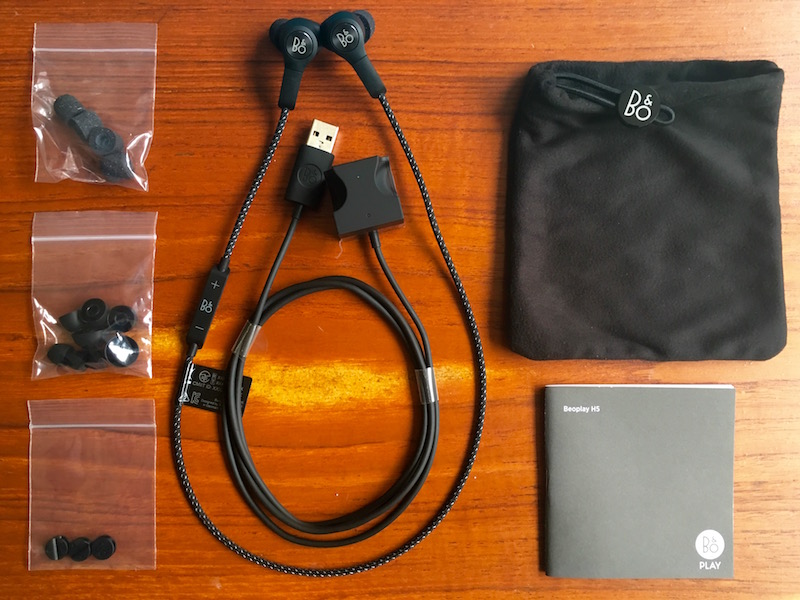
The dust and sweat-proof earpieces are made of a featherweight polymer-rubber compound with a branded aluminum disc on the rear, and each bud has a neck about an inch in length, with the power/pairing LED on one ear.
The buds are connected by a 52 cm (~20 in) cord sheathed in a soft braided textile that sits over the nape of your neck during wear, with an inline remote on the left-hand side and a hidden omnidirectional mic built in for taking calls.
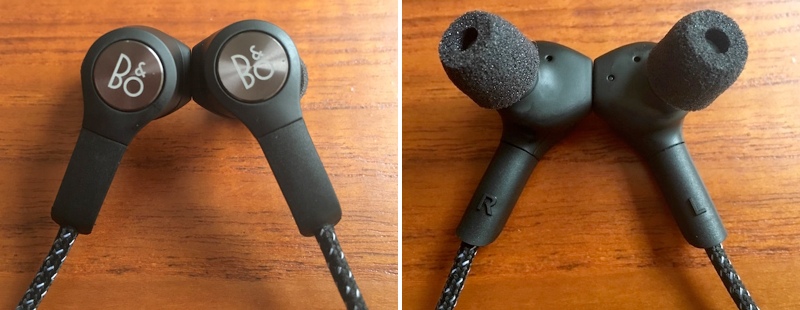
Each earpiece contains a magnet, so you can clasp them together securely for them to rest around your neck when they’re not in use. In another neat design feature, clicking the magnets together also auto-powers down the earphones to save battery.
Seven pairs of eartips come supplied – three sizes of Comply Sport memory foam tips offering a malleable seal, and four sizes of standard silicone molded tips.
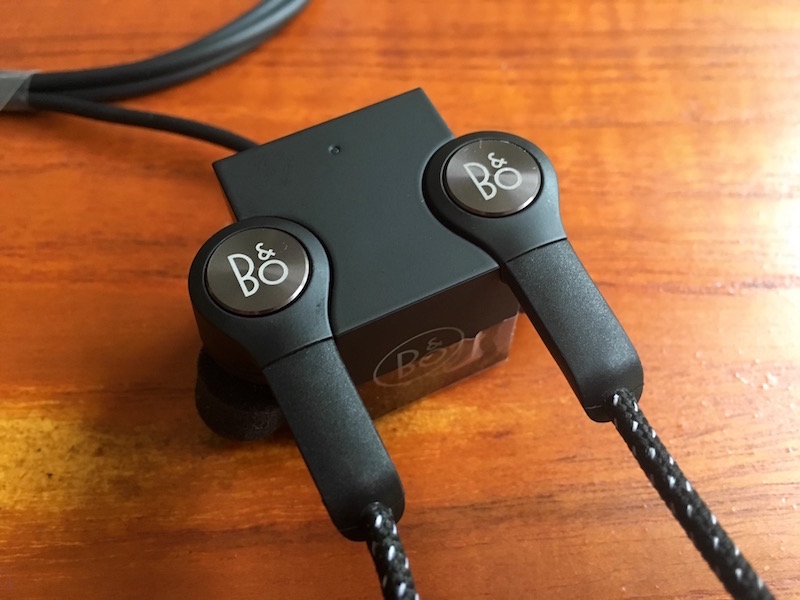
Also included in the box are cable clips, a carry pouch, a quickstart guide, and a unique magnetized “cubic charger” with two molded recesses that the earpieces snap into, with a cable running out the rear with a USB connector attached.
The earbuds connect to a source device using the latest version of Bluetooth (4.2) and support high-quality AAC and aptX codecs – only newer MacBooks, not iPhones, support the latter as of writing.

Audio output can be adjusted via the easy-to-use Beoplay iOS (or Apple Watch) app, which offers four presets for different activities (workout, commute, clear, podcast) and a ‘Tonetouch’ graphical equalizer to customize the sound further.
Once you’ve adjusted the output to your liking, you can save the audio profile directly to the earbuds, allowing you to set and forget. If you’re an Apple Watch wearer, you can choose between presets from your wrist, too.
Performance
Pairing the buds was a one-click affair of the power button on the inline remote, and the volume buttons proved to have the typical dual-functionality for moving between tracks, with the power/pair button also taking and ending calls.
Out of the box, the H5’s sound decent enough, offering a flat, natural reproduction and a close, friendly soundstage. Treble was a tad too crisp at times, but with a bit of adjustment via the accompanying app it was easily dealt with, and once I had a custom profile set, they really came into their own.
The controlled bass and clearly defined mid- and high-range detail of the H5’s serve rock, hip-hop, and instrumental genres extremely well, with jazz tracks reminding me of Vibe’s eminently balanced Brass Ba11 buds and their intimate, inclusive sound. As for the mic, it had no trouble picking my voice out over the din of a typical commute on public transport.
The earphones remained comfortable to wear, whether I was working out or casually listening to music, although the left earpiece had a habit of slowly loosening when I was on the move which broke the insulating seal and let sounds leak in from outside.

That got annoying after a while, so I switched to the Comply eartips and chose a larger left tip (I have odd-sized lugholes, apparently) which solved the problem.
I loaned the H5’s to a friend who complained that the left bud kept flying out of her ear during a high-intensity exercise routine due to the added weight of the inline remote, even after she swapped the tips for a bigger size. I couldn’t replicate the issue myself using the memory foam tips and the buds stayed securely in place whatever I was doing, but this should serve as a warning to potential buyers.
I was underwhelmed by the stated five-hour battery life of the H5’s (confirmed in my own tests) given that buds in Jaybird’s wireless range offer up to eight hours’ listening time, but in practice I only wore the H5’s two hours a day on average and it wasn’t a huge inconvenience to charge them for a couple of hours every other night – your mileage may vary.
Bottom Line
$250 earbuds will be a hard sell for many people. Personally I couldn’t justify it, but if you have the spare cash and are fond of luxury kit, then I suppose it’s not a deal breaker. Overall, the Beoplay H5 earphones are a lovingly designed, solid bit of kit. To be fair, it’s the least I’d expect at this hefty price, and happily they deliver.
The magnetized buds and auto-off feature are signature B&O design wins, as is the supplied charging cube – it’s just a shame the charge doesn’t last a few hours longer. I’d also advise to be careful not to lose the charger; it’s not like you’d be able to replace it with a standard micro-USB cable, as with some other wireless buds.
My only real design gripe was with the inline remote – its surface smoothness made it hard to find which was which volume control when out of my line of sight. After a while though, I became familiar with the layout and it became a non-issue.
Sonically the H5’s are rich, well-balanced, and pack a satisfying punch, and with some subtle audio profile manipulation you can easily adjust the output to your musical taste. Still, this is a significant investment, and for that reason I’d recommend you try the buds before you buy, even if that’s just to see if the tips play nice with your earholes. If they sound great and sit securely – and you can live with the middling battery life – then this luxury wireless headset could be an ideal match for your iPhone, headphone jack or no.
Pros
- Slick, comfy, considered design
- Plenty of supplied eartips to choose from
- Decent built-in mic and excellent audio output
- App presets that make a difference
Cons
- Battery life isn’t spectacular
- Inline remote mold unhelpfully smooth
- Achieving a secure eartip fit may be an issue for some
- Very expensive for earbuds

How to Buy
The Beoplay H5 earbuds cost $249, are available in black or dusty rose, and can be ordered on the B&O PLAY website.
Note: B&O PLAY provided the H5 earphones to MacRumors free of charge for the purposes of this review. No other compensation was received.
Tag: Bang & Olufsen
Discuss this article in our forums
Apple Acquires Machine Learning and AI Startup Turi
Apple recently purchased Seattle-based machine learning and artificial intelligence startup Turi, reports GeekWire. Apple is said to have paid around $200 million to acquire the company, which was known as “Dato” until earlier this month.
Turi is designed to help developers build apps with artificial intelligence capabilities that automatically scale. It has developed the Turi Machine Learning Platform, GraphLab Create, and Turi Predictive Services, used for functions like recommendations, fraud detection, sentiment analysis, and more.
Turi toolkits simplify development of machine learning models. Each incorporates automatic feature engineering, model selection, and machine learning visualizations specific to the application. There is no faster way to build performant models.
Citing people familiar with the acquisition, GeekWire says Turi employees will remain in the Seattle area, where Apple has been establishing a presence over the past few years.
Apple confirmed the acquisition with the standard purchase statement it gives to media outlets: “Apple buys smaller technology companies from time to time, and we generally do not discuss our purpose or plans.”
It is not known what Apple will do with Turi’s technology, but Apple has made several AI-related purchases in recent months including VocalIQ, Perceptio, and Emotient.
Tags: Apple acquisition, Turi
Discuss this article in our forums

