


The Rapidfire K70 is a gaming keyboard that typists will love
Mechanical keyboards are favored by gamers and programmers for how precise and springy the buttons feel under their fingers. The latter is important not just for improving a player’s reaction time in a heated match, but a shorter key depression is also way kinder to a typist’s hands. So it seems that Corsair’s new Rapidfire K70 RGB would be the ultimate step up thanks to its new “Cherry MX Speed” keys, which only need to be pushed down 1.2mm: the shortest actuation point on the market. I’ve been using it as my work keyboard for the past two months and it’s been a sweet experience, though not without a few bumps.
Unlike other gaming keyboards that might pack in extra features like macro keys or a display screen, there aren’t too many bells and whistles on the Rapidfire K70. In fact, there’s not a whole lot to distinguish it from the standard K70, which was the top pick in our gaming keyboard roundup last year. It has a pretty basic key selection of 107 keys, though there are a few media buttons on the upper right along with a roll bar for adjusting the volume. The K95, also from Corsair, has a selection of 18 macro keys on the left side, but it’s not a Rapidfire model, so you’ll miss out on the benefits of MX Speed buttons.
I appreciated the simplicity of the layout, which made it ideal for mixed-use scenarios, in which you might want to use the same keyboard for gaming and work. Its compact size means its reach is far friendlier to my smaller hands, and the rubberized palm rest feels nice to the touch. I’ve had issues with rests before, as some plastics have a tendency to irritate my skin. I haven’t had that problem with the K70, even after hammering away on a few 1,200-word stories. I’m even typing this review on it, and loving it.

There are other nice touches here. The space bar is textured, and the K70 also came with some extra key caps if you prefer your WASD setup to feel a bit rough as well. It’s extremely easy to remove the caps, too: Corsair thoughtfully packed in a tool to pull them out, though you can also just give the buttons a good yank with your bare hands and the tops will come right off. This makes the whole rig extremely easy to clean, as the keys are housed in an aluminum deck with no nooks and crannies to trap crumbs and dust. This is ideal as I’m a bit of slob; it’s not uncommon for me to eat breakfast or lunch while I work. Indeed, I just noticed something stuck on the side of one of the number keys. It looks like jam? Probably best not to think about it. The important thing is that I was able to pull the key cap off, wipe it down and pop it back onto its switch with no evidence that anything was ever wrong.

The aluminum board also means the Rapidfire feels solid and is heavier than your average keyboard. In fact, It feels like something you’d keep around the office as a melee weapon in case you get caught at work during the zombie apocalypse. It’s that sturdy.
The USB cords alone make it a bit unwieldy; their braided design means they don’t tangle, but they also don’t tuck away easily, so they’re always this looming presence on your desk. It’s especially annoying as one is a USB passthrough, which I don’t need, so it just sits around like a paralyzed snake, making it harder to keep my cables in order.
In use, the Rapidfire K70 is mostly a pleasure. The buttons are smooth and responsive; a little smaller than I’m used to, but it hasn’t been a problem. I love the sound of the keys, too. Mechanical keyboards have a well-earned reputation for being noisier than the membrane and scissor-switch peripherals that populate most offices, and the K70 is definitely louder than my standard decks. But the lighter touch needed to activate the Cherry MX keys means that it’s possible to be whisper-quiet with enough practice.

What’s become more apparent in my time with the Rapidfire K70 is how sloppy a typist I can be. The larger buttons on my usual Comfort Curve Keyboard mean that I don’t need to have a good aim to hit the right one, and I often have to slam my finger to get the membrane keys to register. I don’t need to be delicate or precise: It’s a blunt instrument for typing.
One persistent problem I had with the K70 was that my palm sometimes brushed against the Alt key as I typed. It isn’t an issue on a membrane keyboard or even other mechanical layouts because it’s not enough to register as a deliberate key press. But thanks to the extremely short actuation point on the Rapidfire K70, I was activating hotkeys left and right. No, I don’t need the edit menu right now, thank you very much. Stop that.

In contrast, a mechanical keyboard is more of a scalpel, and the Cherry MX Speed switches on the Rapidfire K70 make it even more so. They’re a bit thin, so I have to be careful about hitting the center of the key cap. I barely have to touch them to register a press; it feels like I could breathe funny on the keyboard and end up typing gibberish. That won’t actually happen, though. I hit the K70 with a can of compressed air and the keys jiggled but didn’t depress enough to register as strokes.

My ham-handed typing aside, it feels and looks great — I’d be remiss in not mentioning the backlit RGB keys, which are bright and bold and pretty distracting. Of course, Corsair provides its own utility engine, so you can tweak the lighting as well as programming macros. It’s pretty robust but also a bit opaque, so if you want anything more complicated than simple keystroke shortcuts you need to put in a serious sit-down with the software to figure out how it works. But it’s easy enough to mess with the default lighting schemes and find one that looks good without being too annoying. And if the lighting does ever become a problem, there’s a button on the keyboard to just turn it off.
But I don’t really want to. The candy-colored lighting makes me happy in a way my conscious brain can’t explain. That visual treat combined with the crisp, light typing makes the Rapidfire K70 RGB a sensory delight that actually gets me excited about typing on it. It makes me want to work. When was the last time you could say that about a keyboard?
Facebook launches guided tours for 360-degree videos
When you explore 360-degree videos on Facebook like you’re supposed to, you could miss crucial moments happening outside your POV. The social network’s new “Guide” tool for Pages, however, can make sure you see the best, funniest and most compelling parts. Now, when publishers upload a 360-degree video, they can enable the feature and highlight points of interest simply by pausing and clicking “+ Add Point.” It will then be on by default, and the video will automatically swivel to show you those highlighted scenes. It’s like having a tour guide pointing out the most interesting sights to see to a bunch of overwhelmed tourists.
You’ll know that it’s active if you see the word “Auto” on the right side of the video — if you want to switch it off and be able to pan around on your own, you only have to tap that indicator. Facebook has begun rolling out the feature today, and you can expect to encounter more and more guided videos as it becomes available to all Pages these coming weeks.
Source: Facebook
NFL Network and NFL Redzone are now live on Sling TV
After striking a content deal with the NFL last week, Sling TV is now making the NFL Network and NFL Redzone channels available on its streaming service. The company announced that, starting today, Sling Blue subscribers will have NFL Network on their guide — that bundle is $25 per month, in case you’re not familiar with Sling TV’s offering. Meanwhile, NFL Redzone requires the Sports Extra add-on for Sling Blue, which costs an extra $5 monthly. Thankfully for cord-cutters who love watching football, the timing couldn’t be better, as the NFL preseason kicks off tomorrow with a game between the New England Patriots and New Orleans Saints.
Source: Sling TV
First Photo of Apple’s A10 Chip for iPhone 7 Appears With Mid-July Production Date
Less than one month before Apple is expected to announce the iPhone 7 and iPhone 7 Plus, Chinese repair shop GeekBar has shared the first photo of what appears to be the next-generation A10 chip destined for the smartphones on Weibo. The number of pins appears to be consistent with the A9 chip’s 64-bit LPDDR4 interface.
While the photo could easily be faked, the chipset is labeled with a 1628 date code, corresponding with mid-July production. Additionally, GeekBar has accurately leaked components for unreleased Apple products in the past, including the iPhone 6s display assembly and iPhone 6 schematics showing a 128GB storage option.
What is pictured here is not the complete A10 chip and may be the RAM layer that is stacked on top of the A10 wafer as one system-on-a-chip, rather than the processor itself. Apple A-series chips are typically labeled on all four edges, suggesting this chipset is in a mid-production state.
TSMC is expected to be the sole supplier of Apple’s faster A10 chip based on its 16nm FinFET WLP process. The new processor should bring performance improvements to the iPhone 7 and iPhone 7 Plus. The smartphones are expected to be announced on September 7 and released on September 16.
Last year, TSMC-built A9 chips were found to outperform Samsung-built A9 chips in early iPhone 6s battery benchmarks, but subsequent tests showed less significant impacts that Apple later said amounted to only a 2-3% difference in “real world” battery life. Samsung is not expected to be an A10 chip supplier.
Related Roundup: iPhone 7
Tags: weibo.com, GeekBar, A10 chip
Discuss this article in our forums
Moto G4 Review: No longer a game-changer (Video)
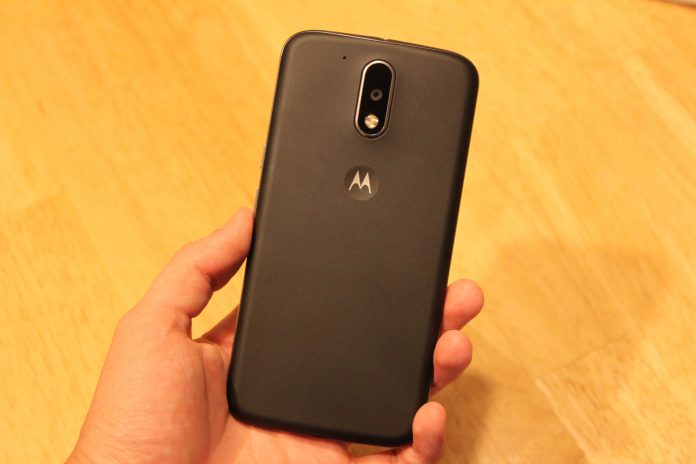
Before Lenovo bought Motorola from Google in 2014, the company created a few very interesting lines of phones under the Moto brand that sought to change the way we buy phones. One of these is the Moto G line, that was introduced a few years ago and offered an very reliable and speedy phone for less than $200 unlocked. The Moto G eventually became Motorola’s highest selling phone of all time.
Fast-forward to today, Lenovo hopes to carry on the legacy of the Moto G, and offer a quality, affordable successor in a world where most other smartphone companies are offering their new phones for lower prices. The Moto G4 is here, and literally bigger than ever.
Build
The Moto G4’s build quality hasn’t improved from the previous years iterations, but it feels solid for a $200 plastic phone. At 155 grams, it has the perfect amount of heft for me. I really like the plastic back of the phone which has a slightly textured feel to it and feels almost like rubber, although the oil from your hands will visibly show up on it after just a little usage. Wash your hands at all times.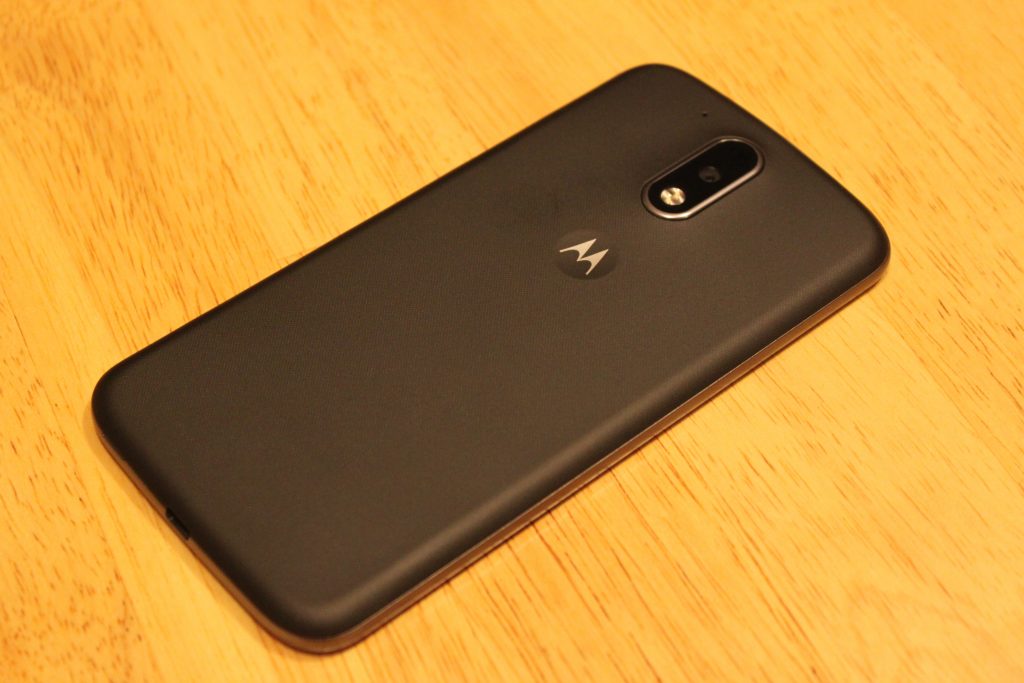
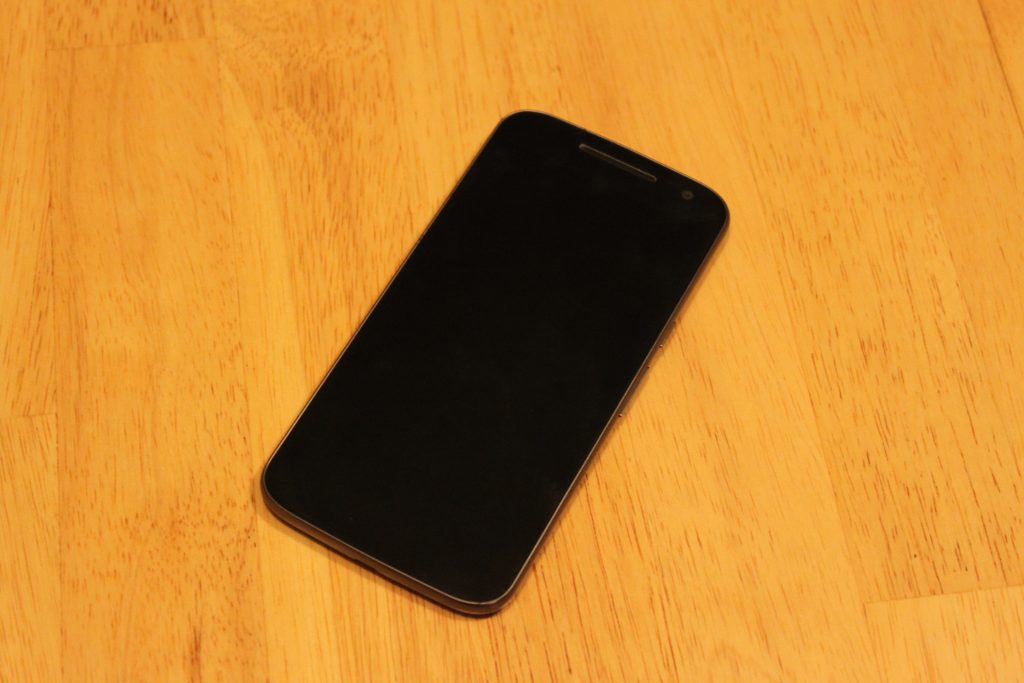
The front of the device brings the classic minimalistic style I’ve loved since the Nexus S came out a long time ago. In fact, the design of this phone reminds me so much of a bigger Galaxy Nexus – front and back. There’s nothing on the front except the secondary camera and a single front-facing speaker right above the screen. No Lenovo logo, no Moto logo. That’s a +1 right there. While I’m bummed they didn’t include dual speakers like last year’s Moto G, I can’t complain for the price. Plus, the single speaker does get very loud, and almost competes with speaker quality on flagship phones using single speakers on the bottom.
As for the power and volume buttons, someone at Lenovo should’ve spoke up about these. They feel cheap, and barely provide any feedback when pressing them. It takes more effort to press the volume buttons than any other phone I’ve used. The power button at least has a horizontal line texture on it to distinguish it from the volume.
Screen
Easily the highlight of this phone. I’ve seen quite a few cheap LCD displays on phones before, even on more expensive phones, but the 1080p LCD display on the Moto G4 rocks.
I was disappointed with Lenovo’s decision to put a 5.5 display on the Moto G, but after using it for a week, it doesn’t feel like a big phone at all. 71% of the front of this device is covered with screen, so it doesn’t feel bulky to me.
Aside from the size, the quality of this screen seriously impresses me for what it’s worth. If any of you still own the OnePlus One or OnePlus 2, the display quality is right with those. I will say, the viewing angles are not great, as the brightness decreases and colors go yellow as soon as the device is slightly shifted away from your eyes. However this isn’t a problem for me, as my phone is directly facing me 98% of the time I use it.
Comparing the screen to other LCD displays like the Nexus 5X and Nexus 5, I immediately prefer the display on the Moto G4. The colors look very washed out on the LCD Nexus devices compared to the Moto G4, which is able to produce colors almost as vivid as an AMOLED display.
The 1080p resolution is perfect for this device. I started using this phone right after using the OnePlus 3, and believe it or not, I prefer this screen. These phones both have 5.5 inch 1080p displays, but the pentile AMOLED screen on the OnePlus 3 holds it back in comparison in terms of image sharpness. Images are sharper, more accurate, and the whites on the G4 look much better. I still much prefer the deep blacks on the OnePlus 3’s AMOLED screen though.
Performance
In 2016, it’s hard to find a phone running Android 6.0 that doesn’t perform well. The Moto G4 runs on a Snapdragon 617 processor which was unveiled by Qualcomm in September of 2015. I was expecting a sluggish experience, and to this day I’m waiting for the inevitable crashes or hair-pulling slowdowns to happen. But so far, this phone runs well! If I were to compare the everyday speed of the Moto G4 to something else, I would say it’s neck and neck with the Nexus 5 from 2013 – which still runs like a champ on Marshmallow with its Snapdragon 800 chip.
After using the phone for a couple hours on AT&T LTE while browsing on Chrome, the phone didn’t get as warm as other phones have, and quick-charging it with the Motorola Turbo-Charger doesn’t make the phone as hot as previous Motorola phones, specifically the hot-plate that is the Droid Turbo.
If you’re into mobile gaming, you might want to look the other way. The Adreno 405 GPU here does not handle most games very well, and loading times are pretty terrible. I primarily play Fallout Shelter, and while I had zero hiccups and quick loading times playing it on a phone with a Snapdragon 820 chip, the loading time to get into my game on average took a staggering 72 seconds on the Moto G4. This was if the game didn’t freeze or crash mid-load, which happened 20% of the time. I experienced similar results with other 3D games.
Camera
Don’t expect miracles here, people. But also don’t expect a bad camera. The Moto G4’s 13-megapixel with f/2.0 aperture provides pictures more than deserved for a $200 phone. Pictures in daylight look a little more dim than they should be.


Low-light pictures lose a lot of detail, but having HDR mode on really helps balance out the bright parts of the photos and the darks. Notice the overexposure of the Subway sign and interior in normal capture mode.

HDR off

HDR on

Daylight HDR on

Daylight HDR off
The camera app takes a couple seconds to open, which is annoying when trying to grab a quick shot. The app comes with some useful features such as professional mode that allows for manual tweaks, slow motion mode (although the 540p resolution for this is kind of a joke) and auto-HDR.
Software
I was a little nervous Lenovo would take Motorola’s near-stock Android skin and mess it up, but things have barely changed since previous Moto phones.
This is basically stock Android with the addition of a few useful features. First, we have Moto Gestures, which includes four ways of interacting with the phone. When it’s off, you can make a chopping motion with the phone to turn on the flashlight. Keeping the phone face down immediately mutes the phone and keeps it silent. When someone calls, picking the phone off the table cuts the noise of the ringer. Finally, whether the phone is on or off, twisting it will launch the camera.
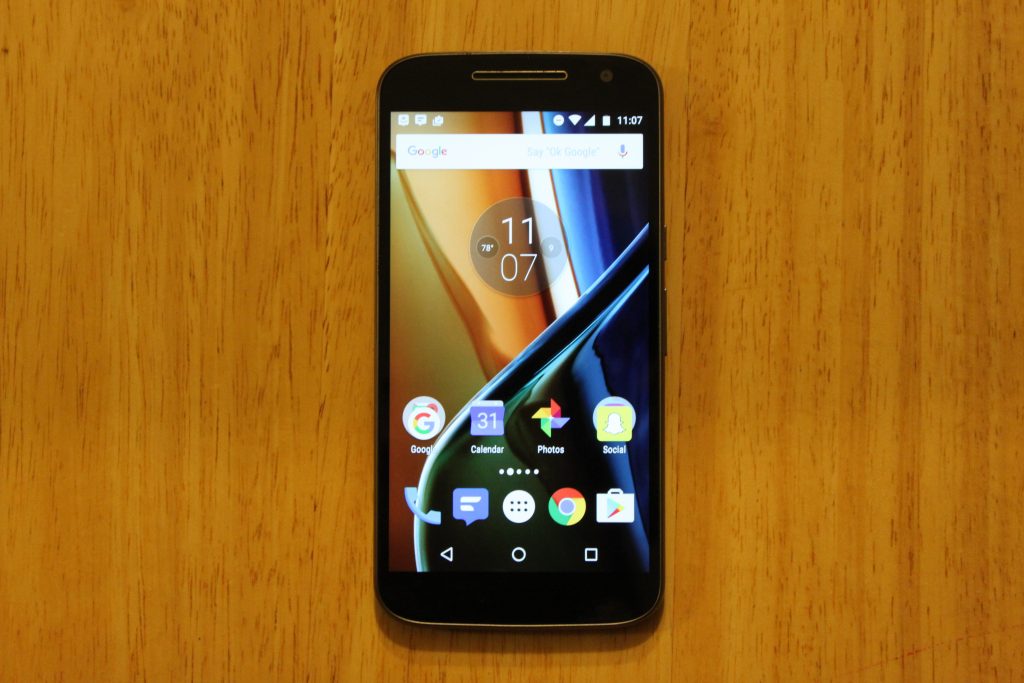
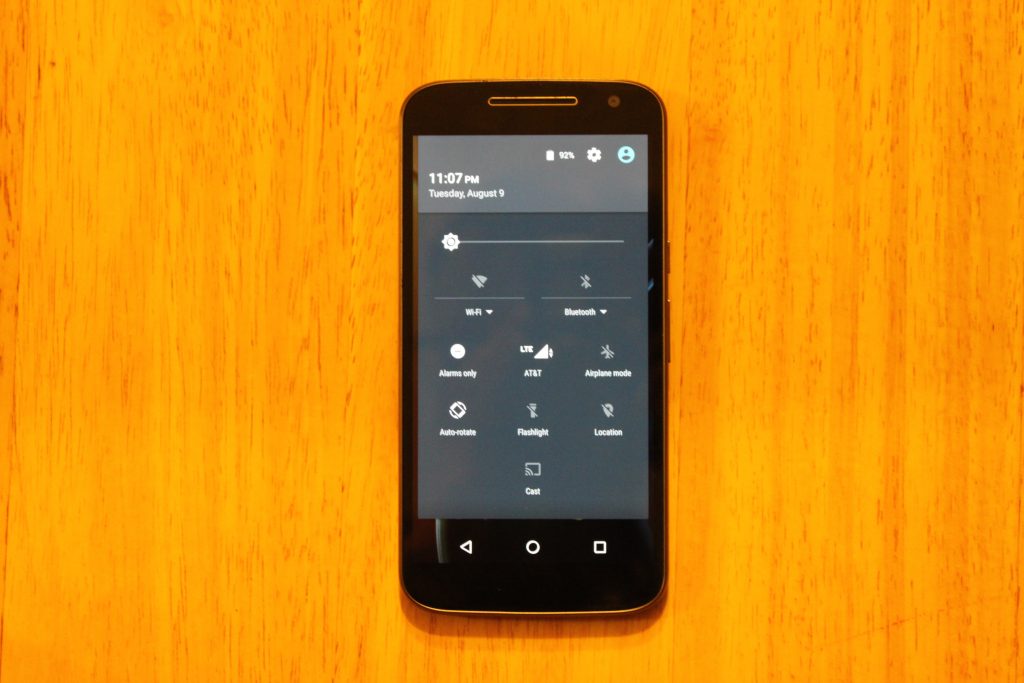
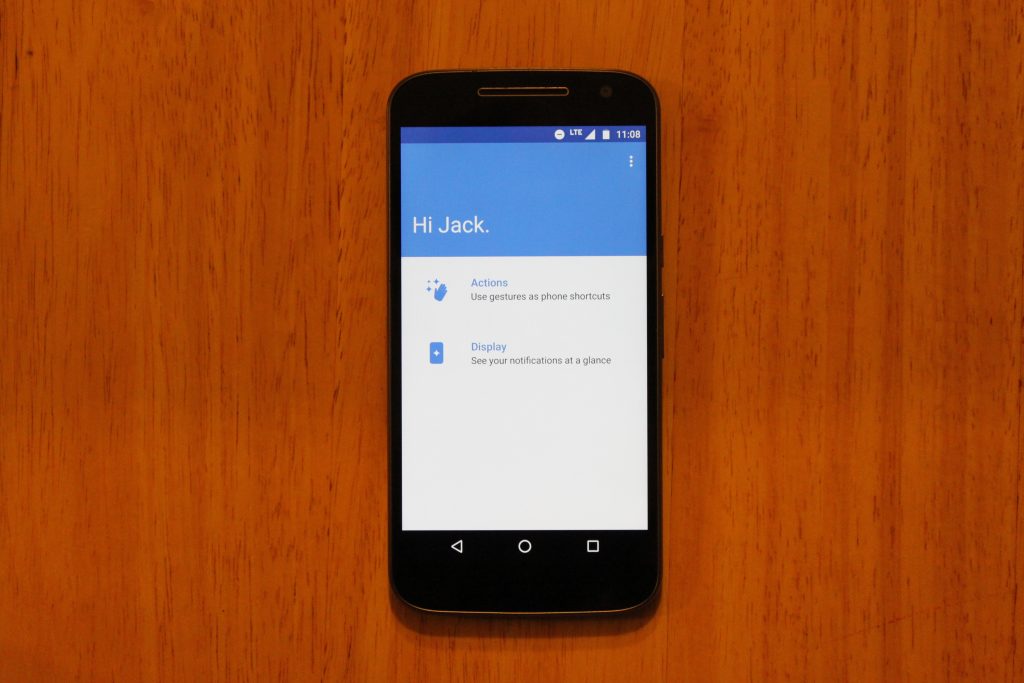
On top of this, Moto Display is back, showing your notifications when the phone is sleeping, however it;s nowhere near as useful as it is on the Moto Z, or previous Moto X phones that have sensor on the front for hand waving gestures, or the AMOLED screens that actually save battery when using the Moto Display. On this phones LCD display, you can totally tell the entire screen is on, and it just doesn’t look great.
Battery
A 3000mAh battery is becoming common for a high-end phone, so the decision to put one in the $200 Moto G4 was a great move from Lenovo. This phone lasts until the very end of the day for me with 10-15% left. To be exact, I unplug the device at 6:45 AM, stream Play Music for 30 minutes to work, browse reddit and Chrome for about an hour a day, text my imaginary friends using Textra, send between 20-30 snaps with Snapchat, and use a lot of GroupMe until I’m tuckered out at 10:30 PM. That’s 16 hours of “moderate” usage.
I haven’t felt concerned with running out of battery in a day yet, but if I do, this phone comes with a Turbo-Charger that supports Qualcomm Quickcharge. I remember when I had to pay extra for a Turbo-Charger when I bought a Moto X 2014… so I’m very pleased with this.
Conclusion
I’m satisfied with the Moto G4. I’m not blown away by it, and I’m not disappointed with it. Lenovo didn’t take risks with this device, and they didn’t push any boundaries. The build quality lives on from previous Moto G generations, and the display quality is something I never expected to see on a $200 smartphone. But is a bigger, better display worth the removal of dual front-facing speakers and a waterproof exterior? If I were to give an answer, I would say the screen is more important to me than speakers I rarely use, or having the ability to pour champagne on my smartphone.
At $199 for the 16GB model, the Moto G4 is less impressive than it was in its earlier generations, and faces serious competition from smartphones in similar price ranges, such as the all-metal, fingerprint scanner included Honor 5X. For $199, I would recommend the Honor 5X over this phone, but you won’t be disappointed with a purchase of the Moto G4, especially with the experience of customizing it through the innovative Moto Maker website.
You can purchase the Moto G4 here
Kyocera DuraForce Pro Release Date, Price and Specs – CNET

The handset also has a fingerprint reader, Android Marshmallow and a 5-inch display.
Kyocera
The newly announced DuraForce Pro is unique to Kyocera in one big way: It has three cameras. In addition to the front-facing shooter, the back has a 13- and 5-megapixel camera. And while the former features a standard lens, the 5-megapixel rear camera is an “action camera,” which has a wider 135-degree lens and can record 1,920×1,080-pixel video.
Given that the device also features a durable construction that is dust, shock and waterproof, the camera is especially handy for recording water-friendly activities like swimming, surfing, and boating. Just make sure it’s submerged for less than 30 minutes in up to 6.5 feet (2m) of water. (For other splash-proof phones, check out our roundup of water resistant handsets).
Beyond its cameras and durability, the DuraForce Pro has a power button that doubles as a fingerprint reader for extra user security and Android Pay. Its 5-inch display has a 1,920×1,080-pixel resolution and its left edge houses a programmable push-to-talk button.
The Android Marshmallow handset is powered by a 1.5GHz eight-core Snapdragon processor and a non-removable 3,240mAh battery that features QuickCharge 2.0 technology from Qualcomm. Other features include dual front-facing speakers, 32GB of internal storage (with the option to expand up to 200GB with a microSD card) and 2GB of RAM.
The DuraForce Pro is slated for sometime this fall. Though carrier information and pricing have not been released, Kyocera says it’ll cost considerably less than Samsung’s leading durable handset, the Galaxy S7 Active, which costs $795 on US carrier AT&T (that converts to about £610 and AU$1040).
Rough and tumble: 8 phones for the adventurous
See full gallery


1 – 4 of 9
Next
Prev
Seagate Backup Plus Ultra Slim Portable External Hard Drive review – CNET
The Good The Seagate Backup Plus Ultra Slim is compact, fast and includes helpful backup software.
The Bad There’s no USB-C port, so no future-proofing for you.
The Bottom Line The Backup Plus Ultra Slim is a handy portable drive for those needing to carry additional data or perform backups on the go.
Seagate’s Backup Plus Ultra Slim is a slimmer, faster version of the Backup Plus Slim portable hard drive we first reviewed in 2014 and is ultimately a better buy than its older brother. The Ultra Slim is the Chris Hemsworth to the Slim’s Luke Hemsworth. Who is Luke Hemsworth, you ask? Exactly.
The included Seagate Dashboard software not only lets you back up drive data, but your mobile devices and social media (Facebook, Flickr and YouTube) info as well. I had no issues with the software, but truth be told, I only used the Windows version. There’s a separate version for Mac that I didn’t test. You also get 200GB of online storage (free for two years) with Microsoft Onedrive. If you use Windows 10, though, I’d recommend using the built-in File History utility for local backups, among other things you won’t need to install any extra software on the computer.
CNET USB 3.0 portable drive performance
Seagate Backup Plus Ultra Slim
149.6
169.21
Seagate Backup Plus Slim
118.8
125.35
Buffalo MiniStation Extreme
110.3
118.82
WD My Passport Ultra
110.2
117.34
WD My Password Slim
107.7
107.89
SiliconPower Armor A60
104.3
114.48
WD Elements
95.7
102.15
Legend:
Write
Read
Note:
Longer bars mean better performance
While the micro-USB 3.0 port is fast for transfers, I was disappointed that there’s no USB-C port. So despite being available in gold (and silver) it won’t work with a Macbook — the Macbook has only a single USB-C port and currently comes in gold, silver and a few other colors.
The drive’s handy portability makes it perfect for all laptops not named Macbook (I’m talking solely about the single-port USB-C version here). The drive works out of the box with most computers, thanks to the included USB 3.0 cable. However, if you plan to use it with a non-Macbook Mac laptop or desktop, you’ll need to reformat it first.
GoPro Omni Release Date, Price and Specs – CNET
GoPro’s 360-degree Omni camera rig looks like it could be just another 360 cage for use with GoPro cameras and maybe doesn’t seem as elegant a solution as an all-in-one camera such as Nokia’s Ozo. But, you know, looks can be deceiving.
At the Omni’s core is proprietary hardware so all six of its cameras talk to each other and behave as one. Each camera connects to the Omni via the Hero port on the camera’s back, with one of the six acting as a master control camera. Power up the master camera and all of the others start up and setting changes happen simultaneously across all the cameras, too.
More importantly, though, all of the cameras record at the same moment with the Omni, keeping each video stream synchronized. For those who’ve edited 360 video before, this means you don’t need to rely on a clap once you’ve started all the cameras recording to match up video for stitching. Also, if for some reason one of the six isn’t ready, the Omni lights up to let you know, and the recording won’t start until the issue is fixed.
GoPro’s Omni VR rig has a surprise inside…
See full gallery


1 – 4 of 12
Next
Prev
All video (or photos) are stored to the microSD card in each camera; there is no mass external storage solution available for the rig. You can power the Omni off of an external battery for up to three hours, though, or you can just run it off the camera batteries.
The Omni sync rig alone sells for $1,500 (£1,300, AU$2,300), so if you have six GoPro Hero4 cameras you can update their firmware and take advantage of the synching. However, for the Omni to really pay off, you’ll want to use it with Kolor’s Autopano Video Pro and Autopano Giga software (about $775, £600 or AU$1,015). This includes the Omni Importer software, which uses the Omni rig’s sync data to give you a near real-time preview and calibrated stitching that’s good enough for immediate use.
If you don’t have the cameras and are willing and able to hand over $5,000 (£4,200, AU$7,500) for a complete out-of-the-box solution, GoPro has an Omni all-inclusive package that gets you:
- Kolor stitching software license
- GoPro Omni sync rig
- Six GoPro Hero4 Black cameras
- Six GoPro Hero4 batteries
- Six GoPro Mini USB cables
- Six GoPro lens covers
- Six 32GB microSD cards
- Six microSD USB card readers
- GoPro Smart Remote
- 7-Port USB hub
- Switronix Hypercore-98S battery
- Switronix GP-S V-mount battery
- Plate/clamp
- Switronix GP-LS battery charger
- PowerTap-to-DC 2.5 x 5.5mm cable
- Waterproof shipping case
- Plastic tweezers
- Microfiber bag
- 2.5mm hex key

GoPro Omni all-inclusive package.
Lori Grunin/CNET
That’s no small amount, but not outrageous for professional use, and considerably less than other solutions. In our demo with GoPro, both the rig and software looked easy enough to learn and use that I could see this being the go-to solution for things like travel or real estate. Situations where you need better results than consumer options, but don’t want the headaches of putting a 360-degree setup together on your own.
And that’s just producing the video or photos, too. GoPro also has a free VR player with Oculus support including Adobe Premiere to Oculus direct previewing. There are Premiere plug-ins available for adjusting the horizon, adding 2D elements to spherical content and creating 2D movies out of 360-degree video, so you can basically use your 360 clips as a virtual camera to pan and tilt through a scene.
GoPro made the whole process of capturing, editing, viewing and sharing 360-degree content look pretty seamless with the Omni rig and Kolor software in our demo with the company, as any good demo should. We won’t know for sure of any true operating issues until we test one ourselves.
Omni starts shipping on August 17.
Will there be a 6GB Samsung Galaxy Note 7 with 128GB of storage?

Looks like China’s getting a tricked-out Note 7 with more RAM and internal storage. So what does that mean for the rest of us?
Over the past year there’s been growing chatter among Android fans as to whether Samsung’s Galaxy Note line has become just another smartphone. It started back with last year’s Note 5, which on the inside was essentially a Galaxy S6 with an extra gig of RAM and a slightly bigger battery — a baby step forward compared to the huge leap we’d seen from Galaxy S5 to Galaxy Note 4.
And there are even more striking similarities between the Galaxy S7 series and the new Note 7: Same processor, same RAM, a small bump in internal storage, USB-C and a new iris scanner feature of questionable value. Notably absent was Qualcomm’s new Snapdragon 821. And as smaller rivals like ASUS and OnePlus pushed forward to 6GB of RAM, Samsung stayed at four.
Now, the Note 7 is still a far cry from being a disappointing phone. The company is building on a great platform — the Galaxy S7 — and providing a hearty upgrade for Note 4 and Note 5 owners. And yet, considering Note’s origins as a power-user device, it was a little surprising to see Samsung not go completely all-out with its specs.
Chinese consumers get the option of a premium 6GB/128GB Note 7, or a cheaper 4GB/64GB model.
Only now it looks like it might do just that in one market. There’s mounting evidence that Chinese buyers will get a Galaxy Note 7 variant (SM-N9300) with 6GB of RAM and 128GB of storage. The device passed through China’s TENAA regulatory body last month, and now whispers on Chinese social network Weibo suggest two models will go on sale — 4/64GB for 5688 yuan ($854) or 6/128GB for 6088 yuan ($914) — on Sept. 2. At present there’s no indication that this tricked-out Note will make it to any other regions, and understandably this has led to some enthusiasts in the West feeling short-changed. Even right-wing British tabloid the Daily Express is getting in on the outrage.
So why China alone? It’s likely the move reflects the more spec-conscious nature of buyers in that country, where local phone makers like Oppo, ZTE, LeEco and Lenovo are already pushing to 6GB. A device with 4GB of RAM might well be seen as passé next to the ZTE Nubia Z11 or Lenovo ZUK 2 Pro. In Europe and North America, by comparison, most normal people buying phones don’t care what’s inside as long as it’s fast enough. And as the Galaxy S7 proves, 4GB is more than enough for a smooth Android experience, even with all the extra software Samsung brings to the table.

There’s an outside chance a 6GB Note 7 could land on Korean shores at some point.
It’s highly unlikely we’ll see a wider release of the 6GB/128GB model in territories where the Note 7 has already been announced — with one exception, perhaps. In the West, a souped-up Note 7 would only cater to power users — exactly the sort of people from whom there’d be a backlash if Samsung were to drop an upgraded model only weeks or months after launch. But Samsung has a track record of releasing iterative upgrades in its home market of Korea. One example would be the hilariously named Samsung Galaxy S5 Broadband LTE-A — dubbed the “S5 Prime” by some — which packed a higher-res screen and faster CPU as well as quicker 4G networking. And in late 2014 the firm launched a souped-up Note 4 with support for 3X carrier aggregation. Neither saw a wider international release.
So it could happen, just don’t expect it anywhere in the West. And if you absolutely must have a 6GB Note, expect some serious trade-offs in an imported Chinese model — no bundled Google services, and incomplete LTE band coverage, meaning it might not work on all carriers in your home country.
Ultimately, the Note 7 still stands a chance of being the best Android phone of 2016, however much RAM it has — a result of the diminishing importance of specs for most consumers. Where it sells the Note with 4GB, there are surely financial advantages for Samsung — less RAM costs less money — and the company should benefit from economies of scale using largely the same internals as the GS7.
And if you absolutely must have 6GB of RAM right now? Well, it’s not like there aren’t other options.
Samsung Galaxy Note 7
- Samsung Galaxy Note 7 hands-on preview
- The latest Galaxy Note 7 news!
- Here are all four Note 7 colors
- Complete Galaxy Note 7 specs
- The Galaxy Note 7 uses USB-C
- Join the Note 7 discussion in the forums!
Verizon
AT&T
T-Mobile
Sprint
Circular ASUS ZenWatch 3 coming soon, IFA unveiling likely
Latest Android Wear device outed by FCC filing ahead of launch.
It’s not often that a good old fashioned FCC filing gives the game away anymore, but that’s exactly what’s given us the first reliable info on the unannounced ASUS ZenWatch 3. Diagrams first found by Ausdroid reveal a circular design and a handful of minor technical details.

The ZenWatch 3 will also feature Bluetooth 4.2, Wi-Fi b/g/n on 2.4GHz, charging at 5V/2A and a stainless steel back. The “input” reference in the graphic suggests it’ll charge directly over physical contacts, like previous ZenWatches, as opposed to Qi wireless charging like some rivals. The graphic also references “customized keys,” suggesting that like LG’s second-gen Urbane LTE there’ll be multiple keys on the side of the watch.
It’s no coincidence that Android Wear 2.0 includes a complete UI redesign to better accommodate circular displays.
The move to a circular display comes after two generations of decided square watches from ASUS — both the ZenWatch and ZenWatch 2 featured rounded rectangular designs. But with the notable exception of the Apple Watch, that’s the direction most smartwatches are heading. And it’s surely no coincidence that the upcoming Android Wear 2.0 release features a complete UI redesign built around better accommodating circular screens. A round ZenWatch 3 would be right at home on the new platform.
ASUS has an press conference scheduled for Aug. 31 in Berlin, ahead of the IFA trade show. For what it’s worth, we’ve also got pressers from Huawei and Lenovo on our pre-IFA calendar, so could this new ZenWatch have a refreshed Moto 360 and Huawei Watch to face off against? We’ll have to wait and see.
 AIVAnet