


Apple Researching Forensic Data Capture in Cases of iOS Device Theft
Apple is investigating ways that future iOS devices could store the biometric details of suspected criminals in cases of theft (via AppleInsider).
An Apple patent published today by the U.S. Patent and Trademark Office describes “Biometric capture for unauthorized user identification”, by using an iPhone or iPad’s Touch ID feature, camera, and other sensors.
The proposed system augments typical Touch ID verification by capturing and storing information about a potential thief after six fingerprint unlocking attempts have failed and the wrong passcode is inputted 10 times (after which a “cool down” period or a complete data wipe is activated, depending on user setting).
In another variation, a single failed authentication triggers the capture of fingerprint data and the device takes a picture of the user via the front-facing camera.
In yet other embodiments, the system can be configured by the user to enable or disable various triggers and scenarios in which the biometric capture protocols are activated. The patent also specifies how other data could be logged in the background to supplement the biometric capture, including time stamps, device location, speed, air pressure, audio data, and more.
 Flowcharts illustrate different implementations of the security system.
After capture, the data is stored either locally on the device or sent to a remote server for evaluation, while purges of data are activated when the system determines that it is no longer required.
In suggested uses that are likely to be controversial, Apple describes how the server-side aspect of the system could potentially cross-reference the captured biometric and photo information with an online database containing information of known users. Currently, the fact that Touch ID fingerprint data is stored locally and not in a centralized database is considered to be a significant security benefit to users.
There’s no reason to believe Apple will implement the forensic technology in an upcoming consumer product, but the patent does highlight Apple’s continuing research into how to harden security on mobile devices beyond passcode screens and Touch ID.
Tags: patent, Touch ID
Discuss this article in our forums
First Driverless Taxi Service Begins Limited Trials in Singapore
The first driverless taxi hit the roads of Singapore on Thursday, in a limited public trial taking place in a hi-tech business district in a western part of the country (via Reuters).
Developer nuTonomy invited a select group of people to download their ride hailing app and ride for free in its “robo-taxi”, saying it hoped to get feedback ahead of a planned launch of the service in 2018.
“This is really a moment in history that’s going to change how cities are built, how we really look at our surroundings,” nuTonomy executive Doug Parker told Reuters.
The ongoing trial rides are taking place in Mitsubishi i-MiEv electric vehicles, with an engineer sitting behind the wheel to monitor how the system deals with the road and take control if necessary.
The company has partnered with the Singapore government on the project, and hopes to have 100 taxis working commercially in the Southeast Asian city state by 2018.
NuTonomy is one of several companies racing to launch self-driving vehicles, with new projects or alliances between automakers and technology firms being announced on an almost weekly basis.
Last week, Uber announced it would begin allowing customers in Pittsburgh to summon self-driving cars from within its ride-hailing app, while Ford announced plans to build a fleet of fully automated driverless cars for commercial ride-sharing by 2021. In June it was reported that Uber had held talks with Fiat Chrysler about a potential partnership involving self-driving car technology.
Apple has been the source of many self-driving automobile rumors since last year, but it’s now thought the company’s first entrance into the vehicle industry likely won’t be autonomous, although later generations of its “Apple Car” would probably include the technology.
However, over the summer reports suggested that Apple is taking a “two-prong approach” to its car development, internally known as “Project Titan”, and will focus more on creating its own autonomous driving system rather than manufacturing the vehicle.
Related Roundup: Apple Car
Tag: nuTonomy
Discuss this article in our forums
Canon EOS 5D Mark IV Release Date, Price and Specs – CNET
It’s been a whopping four years since Canon first shipped its full-frame EOS 5D Mark III dSLR, a popular model for professional photographers who don’t need the speed of a model the size of, say, a 1D X Mark II. And even then the 5DM3 wasn’t a huge change from the Mark II. But for its update, the 5D Mark IV, Canon has made a lot of essential upgrades necessary to make it current for its core users — such as wedding, fashion and landscape photographers as well as videographers — especially if the company wants it to last another 4 years. These include a new sensor (with updated autofocus) and updated metering system, 4K and HDR video and built-in GPS.
For the body, the 5DM4 will run $3,500; Canon plans to offer two kits as well, one with the 24-70mm f4L lens for $4,400 and one with the new 24-105mm f4L II lens for $4,600. (Canon doesn’t set prices in Australia or the UK, but those convert directly to £2,650/£3,320/£3,473 and AU$4,600/AU$5,785/AU$6,050.) It’s about $900 more than the 5DM2.
Canon 5D Mark IV body displays some modest…
See full gallery


1 – 4 of 11
Next
Prev
Canon expects to ship the body and the 24-70mm kit during September, with the 24-105mm kit following in October.
What’s new
- Sensor and autofocus. With this model, Canon continues its trend of replacing the standard CMOS sensors in its dSLRs with versions that use its Dual Pixel CMOS technology — sensors with phase-detection autofocus points sharing each imaging pixel. The Dual Pixel CMOS architecture provides much better autofocus performance over older Canon systems, especially when shooting video or using Live View. The new sensor jumps to 30.4-megapixel resolution (from 22.3MP), and brings with it an update to the same second generation of its 61-pt High Density Reticular AF autofocus system that debuted in the 1DXM2, with a claimed AF sensitivity down to -4 EV in Live View, as well as its iTR face- and color-detection technology. The camera also gains the metering system found in the EOS 5DS models. Its image processor is the Digic 6+ which first appeared in the 1DXM2.
- 4K and HDR video. 4K recording has become essential in the current generation of high-end cameras; it delivers far more detail than HD and allows the ability to extract 8-megapixel images. Like the 1DM2, Canon skips the popular UHD 4K format (3,840 x 2,160), instead supporting just cinema-focused DCI (4,096 x 2,160). Most cameras that offer DCI also offer UHD, in part because the two formats have different aspect ratios: UHD’s TFV-friendly 1.78 vs. DCI’s 1.9. The 5DM4 also inherits the HDR movie capability Canon first incorporated into the 80D, which shoots each 1080/60p video frame at two exposures, then combines them for a single 1080/30p frame.
- Performance. Given the updates, the autofocus is likely faster, especially for Live View. However, its continuous shooting speed is only a bit faster — 7 frames per second vs. 6fps. That’s not bad in general for this class of camera, but here that rating is without autofocus, autoexposure and image stabilization. The buffer, too, is only a couple shots deeper for raw, which is disappointing.
- Features. In addition to Wi-Fi with NFC, Canon adds GPS; it can be used to sync the time across multiple bodies as well as geotag. And you can use FTP for file transfer via the Wi-Fi connection. Canon adds an intervalometer and a timer for bulb mode so your forefinger gets a break. There’s also a new file format, Dual Pixel raw, which will allow you to make sub-pixel adjustments in software for increased sharpness; since Canon is the last manufacturer to retain a softening antialiasing filter on its sensors — better for video but worse for stills — this is probably Canon’s workaround. The files are twice the size of a standard raw, however. In the same vein, you’ll now be able to shoot with its corrective Digital Lens Optimizer live rather than having to apply it in postprocessing.
- Design. Overall, the body design remains the same, save for a few tweaks. Perhaps most important, it has improved dust-and-weather sealing, on par with the 7D Mark II according to Canon. The remote terminal moves to the front to make room for a USB 3 connector, and it adds the much-easier-to-manipulate joystick control for selecting AF areas that we’ve seen in recent Canon models. The back LCD is similar to the one on the 1DXM2, but it supports touch for all actions (rather than just a limited number of operations). The shutter mechanism has a softer, less vibratory operation and the now-Canon standard Intelligent Viewfinder II overlay. You’ll have to buy a new battery grip, though, the BG-E20.
My take
Canon addressed many of the shortcomings from the previous model and seems to have brought it up to date appropriately. The biggest disappointment to me is the unchanged ISO sensitivity range; a high maximum usually means important improvements in noise reduction in the middle of the range. But it’s not surprising, since Canon usually targets maintaining image quality status quo when switching from standard to the Dual Pixel CMOS. Given that we’re approaching the Photokina (our coverage will appear at that link starting in September) announcement season it’s hard to judge how it will stack up against what competitors might be planning.
Given the new features, I suspect quite a few Mark III owners will be itching to upgrade; that means this fall should be a good time to pick up a used one.
Comparative specs
| Canon EOS 5D Mark III | Canon EOS 5D Mark IV | Nikon D810 | Pentax K-1 |
| 22.3MP CMOS8-channel readout14-bit | 30.4MP Dual-Pixel CMOSn/a14-bit | 36.3MP CMOS12-channel readout14-bit | 36.4MP CMOSn/a14-bit |
| 36 mm x 24mm | 36 mm x 24mm | 35.9 mm x 24mm | 35.9 mm x 24mm |
| 1.0x | 1.0x | 1.0x | 1.0x |
| Yes | Yes | No | No |
| n/a | n/a | n/a | n/a |
| n/a | n/a | n/a | n/a |
| ISO 50 (exp)/100 – ISO 25600/102400 (exp) | ISO 50 (exp)/100 – ISO 25600/102400 (exp) | ISO 32 (exp)/64 – ISO 12800/51200 (exp) | ISO 100 – ISO 204,800 |
| 6fps18 raw/unlimited JPEG(with AF/AE fixed on first exposure and IS off) | 7fps21 raw/unlimited JPEG(with AF/AE fixed on first exposure and IS off) | 5fpsn/a(6fps in DX mode, 7fps with battery grip) | 4.4fps70 JPEG/23 raw(6.5fps in APS-C crop mode) |
| Optical100% coverage0.71x/0.71x | Optical100% coverage0.71x/0.71x | Optical100% coverage0.70x/0.70x | Optical100% coverage0.70x/0.70x |
| Yes | Yes | Yes | Yes |
| 61-pt High Density Reticular AF21 center diagonal to f5.65 center to f2.820 outer to f4 | 61-pt phase detection21 cross-type at f5.620 cross-type at f4 and f5.620 horizontal at f5.65 dual cross-type at f2.8 and f5.661 to f8; 21 cross-type | 51-pt15 cross type11 cross type to f8(Multi-CAM 3500-FX) | 33-point phase detection25 cross type(SAFOX 12) |
| -2 – 20 EV | -3 – 18 EV | -2 – 19 EV | -3 – 18 EV |
| 1/8000 to 30 secs; bulb; 1/200 sec x-sync | 1/8000 to 30 secs; bulb; 1/200 sec x-sync | 1/8000 to 30 secs; bulb; 1/250 sec x-sync | 1/8000 to 30 secs; bulb; 1/200 sec x-sync |
| 150,000 cycles | 150,000 cycles | 200,000 cycles | 300,000 cycles |
| 63-area iFCL | 150,000-pixel RGB+IR with 252 zones | 91,000-pixel RGB 3D Color Matrix Metering III | 86,000-pixel RGB |
| 1 – 20 EV | 0 – 20 EV(-4 – 20 EV in Live View) | 0 – 20 EV | -3 – 20 EV |
| H.264 QuickTime MOV1080/30p, 25p, 24p; 720/60p, 50p | QuickTime MOV Motion JPEG DCI 4K (4,096 x 2,160) 2160/30p @ 500Mbps, 720/120p; 1080/30p HDR | H.264 QuickTime MOV1080/60p, 50p @ 42Mbps, 1080/30p, 25p, 24p@ 24Mbps | H.264 QuickTime MOV 1080/30p, 720/60p |
| mono; mic input; headphone jack | mono; mic input; headphone jack | stereo; mic input; headphone jack | stereo, mic input, headphone jack |
| Yes | Yes | Yes | Yes |
| 29m59s | n/a | 20 minutes internal40 minutes (with external pack) | 4GB/25 minutes |
| Yes | n/a | Yes | Yes |
| Optical | Optical | Optical | Sensor shift5-axis |
| 3.2 in/8.1 cmFixed1.04m dots | 3.2 in/8.1 cmFixed touchscreen1.62m dots | 3.2 in/8 cmFixed921,000 dots plus extra set of white dots | 3.2 in/8 cmVariable angle1.04m dots |
| 1 x CF (UDMA mode 7), 1 x SDXC | 1 x CF (UDMA mode 7), 1 x SDXC | 1 x CF (UDMA mode 7), 1 x SDXC | 2 x SDXC |
| Optional(Wireless File Transmitter WFT-E7A) | Wi-Fi, NFC | Optional (WT-4A Wireless transmitter or UT-1 Communication Unit with WT-5A) | Wi-Fi, NFC |
| No | No | Yes | No |
| Yes | Yes | Yes | Yes |
| 950 shots(1,800mAh) | 900 shots (VF), 300 shots (LV)(1,865 mAh) | 1,200 shots(1,800 mAh) | 760 shots(1,860 mAh) |
| 6.0 x 4.6 x 3.0 in152 x 116 x 76 mm | 5.9 x 4.6 x 3.0 in151 x 116 x 76 mm | 5.8 x 4.9 x 3.3 in146 x 123 x 81.5 mm mm | 5.4 x 4.3 x 3.4 in137 x 110 x 86mm |
| 33.5 oz950 g | 31.4 oz (est.)890 g (est.) | 34.6 oz980 g | 35.8 oz1,014 g |
| $2,600 £2,400AU$3,350 | $3,500 | $2,800£2,140 (est.)AU$4,500 | $1,800£1,600AU$2,900 |
| March 2012 | September 2016 | July 2014 | April 2016 |
HyperX Alloy FPS Mechanical Gaming Keyboard Release Date, Price and Specs – CNET
I’ve been using the new HyperX Alloy keyboard for a couple of weeks now. It sits in front of my monitor, turned at a slight angle to free up as much space as possible for the hand wielding my mouse. Nothing compares to range of motion for your mouse in first-person shooters.
None of this has made me any better at video games, but I’m told it’s how the pros do it. I thought that was good advice, listening to the pros. After all, that’s what Kingston did for the HyperX Alloy FPS keyboard.
The new Alloy keyboard, available now and retailing for AU$169 (not yet available in the US or UK, but that translates to around $130 or £100), was designed after talking to pros about how they play: Often on the go, bringing their own keyboards and mice, crammed onto whatever tiny desk they get allocated during the early brackets of an e-sports tournament.
There’s a mentality that gaming peripherals need to be big, mean and angular, only worth their weight in LED strips and chrome detailing. The HyperX Alloy couldn’t be further removed from that thinking, taking things back to base elements. It puts keys on a board, and it does it really, really well.

Dave Cheng/CNET
Specs
- 443mm by 130mm by 36mm (17.4 inches by 5.1 inches by 1.4 inches)
- 1049g (2.3 pounds)
- Steel frame
- 100 percent anti-ghosting
- Full NKey rollover functionalities
- USB charge port
- Coloured WASD keys
- Detachable braided cord and a mesh travel pouch
- Cherry MX Blue switches
- Red backlighting
- Game mode key
Checking items off the wishlist for things like portability, maximising desktop space, USB ports and even the types of switches used in the mechanical keys, Kingston, a company better known for its flash memory, has come out with a slim, slick mechanical keyboard for pros that even the violently amateurish like myself can appreciate.
Because luckily, those same requests make it an excellent keyboard for your average player too.

The slim keyboard alongside the travel pouch.
Dave Cheng/CNET
I can’t overstate how open my desk feels now, having replaced the Turtle Beach behemoth I’d been using with the slimmed down Alloy. I’m not admitting to bathing my mousepad in cold tea during a particularly tense shootout, but these things have been known to occur and the reclaimed desk space is a godsend. The Alloy is smaller even than the lightweight Dell number on my desk at work (yep, I measured).
It’s also a full keyboard with numpad, suspending the keys over a solid steel frame with no bezel to speak of. The design struck me as a little strange at first, with quite a bit of space between the keys and base, but the sleek, simple design won me over. The heavy base means that the keyboard won’t shift under even manic typing — the rubber feet usually do the heavy lifting on this front, but it’s nice to rest your hands on something that feels solid.
The mechanical switches (Cherry MX Blue, if you care about such things) are satisfyingly clicky and the tactile feedback on activation provided just the right amount of resistance for my fingers. I indulged, and swapped out my WASD and numbers 1 to 4 for the textured red keys included in the box. Just for that professional edge.

The HyperX Alloy uses MX Cherry Blue mechanical switches.
Dave Cheng/CNET
Little flourishes like the extra USB port for device charging on the rear and the game mode to disable your Windows key are excellent quality of life inclusions. The keyboard runs off a single braided plug-and-play cable, with an additional USB connector to power the charging port on the rear.
At the AU$169 price, it’s coming in well under what you’d pay for most mechanical keyboards from other gaming peripheral manufacturers. That’s because it avoids the bloat of features that you probably won’t ever use. Media controls are wrapped in function keys, rather than dedicated buttons. There’s only one USB port and no 3.5mm jack for your headphones. The Alloy is an exercise in minimalism. Kingston has built it to have the basics, and it built the Alloy very well.
Xiaomi Redmi Note 4 Release Date, Price and Specs – CNET
 Xiaomi
Xiaomi found success with the Redmi Note 3, and it’s not deviating too much from there with its newly announced Note 4. Instead, the new 5.5-inch smartphone refines its predecessor’s metal body design with chamfered edges for a more premium look while incrementally improving its insides.
The Redmi Note 3 used a Qualcomm Snapdragon 650 processor, but Xiaomi here has decided to go with Qualcomm’s rival MediaTek. The Note 4 packs a deca-core Helios X20 processor, which should be zippy, especially for a budget phone. The battery of the device gets a slight bump from 4,000mAh to 4,100mAh, though the camera drops a few megapixels from 16 to 13. It also runs Xiaomi’s latest Android-based MIUI 8 skin.
The Note 4 will retail in China for a mere 899 yuan ($135, £100 and AU$175) for the version packing 2GB RAM and 16GB of onboard storage. A slightly more powerful variant, with 3GB RAM and 32GB of storage, will sell for 1,199 yuan (approximately $180, £135 and AU$235).
While it is currently China only, expect the phone to launch in other markets soon, particularly India, where Xiaomi hopes the Redmi Note 4 will do as well as its predecessor.
Key specs
- MediaTek 10-core Helio X20 processor
- 5.5-inch full HD 1,920×1,080-pixel display
- 4,100mAh battery
- Rear fingerprint sensor
- 4G dual-SIM
Xiaomi Announces ‘Redmi Note 4’ in China Amid Market Share Concerns
Chinese mobile manufacturer Xiaomi announced a new smartphone today amid market research speculation that the Beijing-based company is struggling.
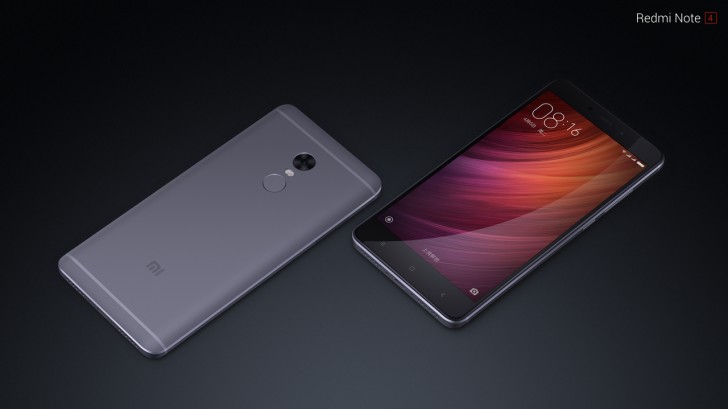
The successor to the popular Redmi Note 3, the new Note 4 has a unibody all-metal design with chamfered edges and a 5.5-inch 1080p curved-glass display.
The handset is powered by MediaTek’s Deca-Core Helio X20 SoC (clocked up to 2.1GHz) and comes in 2GB/3GB RAM and 16GB/64GB storage capacities, with a 13-megapixel rear camera and a 5-megapixel front-facing one. The handset has a dual SIM slot with space for an SD card up to 128GB. A fingerprint scanner is also featured on the rear.
The Redmi Note 4 comes in silver, gold, and dark grey, while pricing is RMB 899 ($135) for the 16GB model and RMB 1199 ($180) for the 64GB device.
The smartphone goes on sale tomorrow in China, at a time when suggestions are emerging that the so-called “Apple of the East” is feeling the squeeze in an increasingly punishing mobile sector.
Between 2011 and 2015, Xiaomi managed to become the world’s third largest smartphone distributor, competing with the likes of Lenovo, LG, Samsung, and Apple, but historically it has been difficult to know how many handsets Xiaomi sells because it doesn’t release any data. However, global consumer technology researcher IDC recently estimated that its mobile shipments had fallen 38.4 percent in the April to June quarter of this year compared to 2015.
Information published by Counterpoint Research in April also showed the company’s global market share shrinking, down more than 12 percent for Q1 this year compared to the same period last year. Xiaomi has disputed those numbers, and says that estimates from other research houses are more upbeat. In a statement given to the BBC, a Xiaomi spokesperson said:
We understand that different analyst firms have different calculation methods. There are many other third-party reports out there, including those by Strategy Analytics, Gartner and IHS that put our Q2 2016 numbers significantly above what IDC estimated, and those are much closer to our true sell-out number.
We are seeing very healthy demand, but also experiencing some challenges in the supply chain this year. We are ramping up and in June, we sold 6.94 million phones in just one month.
Two months ago, the company unveiled its first ever PC laptop, named the “Mi Notebook Air”. Xiaomi has been forced to defend itself from copycat accusations in the past. Its devices have been publicly criticized for heavily borrowing design elements from Apple’s iPhones and iPads and adopting marketing materials tactics similar to Apple’s, leading Apple chief designer Jony Ive to call the company’s antics “theft” and “lazy”.
Tag: Xiaomi
Discuss this article in our forums
PlayStation 4 Slim: Release date, rumours and everything you need to know
This isn’t about the PlayStation Neo, a console upgrade that Sony has already confirmed, but rather a second console that has leaked online and is going by the name PS4 Slim.
While PS4 Neo is expected to offer 4K output and beefed-up internals, the PS4 Slim is thought to be simply a slim console upgrade like we’ve seen with previous PlayStations, including the PS2 Slim and PS3 Slim. Sony will likely unveil this trimmed-down console alongside the PS4 Neo at a New York City event scheduled for 7 September. Here’s everything you need to know about it.
- What to expect from Sony’s PlayStation New York event
- Xbox One S: 4K, Ultra HD Blu-ray and HDR examined in more detail
- Sony PlayStation 4 Slim confirmed to exist
- Sony PlayStation 4K: What is PS4.5/Neo?
- Xbox One S vs PlayStation Neo: What’s the rumoured difference?
PS4 Slim: Release date
Sony is holding an event to announce something about PlayStation on 7 September, but in a flurry of leaks, some of that news might have escaped early. Sony confirmed its event on 10 August, inviting media to a New York launch. It said the event would relate to “the PlayStation business”. For some time, the launch of an upgraded 4K capable PlayStation has been rumoured.
The Wall Street Journal reported that we can expect two consoles to launch at the New York event: the rumoured PlayStation Neo, as well as a new “standard” slim model. While all attention has been on a future high-powered console, no one expected a “Slim” model to be announced too. Sony has a history of revamping its consoles, usually with a launch of a Slim model at a lower price.
@shortmaneighty2
The Wall Street Journal reported that we can expect two consoles to launch at the New York event: the rumoured PlayStation Neo, as well as a new “standard” slim model. While all attention has been on a future high-powered console, no one expected a “Slim” model to be announced too. Sony has a history of revamping its consoles, usually with a launch of a Slim model at a lower price.
PS4 Slim: Design
Auction site Gumtree had a listing for a PlayStation 4. The unreleased console had been listed for sale and bought. The buyer shared photos of the new console via Twitter, though it was never powered on. Eurogamer went to see the buyer, took photos and a video, and confirmed it was the real deal. It has since removed the video, citing “legal” reasons, which sort of removes any doubt.
@shortmaneighty2
Also, thanks to a series of leaks spotted by NeoGaf, including an unboxing video that has is now removed from YouTube, we can see that PS4 Slim has a slanted front and back, is significantly slimmer than its predecessor, and has most of the same connectors as the standard PS4. It has a power port, accessory port, HDMI out, and Ethernet port. It appears to be lacking an optical port, however.
PS4 Slim: Specs
A recent analysis by Digital Foundry supposedly revealed that the PS4 Slim has improved internals that should boost game framerates. That said, there are still significant questions about what Sony has packed into its PS4 Slim. It’ll be interesting to see how Sony compete with Microsoft’s new Xbox One S, which is a slimmer version of the standard Xbox One.
@shortmaneighty2
With the Xbox One S, Microsoft changed what gamers expect from a console hardware refresh. Not only did it have a slimmer profile, but it also brought an Ultra HD Blu-ray player, HDR, and 4K upscaling. It’s unclear if PS4 Slim will have these features.
PS4 Slim: Controller
The PS4 Slim might get a new controller, according to a recent leak. It looks as though the new controller isn’t going to vary too much from the DualShock controller of the PS4, but there’s a change to the light bar, now showing through on the top of the controller. Originally there was a video of this new controller shared by ZRZ on YouTube. A picture of the controller is floating around still, however, thanks to Engadget.
ZRZ (YouTube) via Engadget
To verify the new design, a gamer who was able to buy that original PS4 Slim from Gumtree, has confirmed that this visible bar on the top just looks like a transparent section, allowing the light that shows at the front to be seen on the top too. Speculation suggested that this might be for linking-up with PS VR when it launches. With the number of leaks appearing, this is all looking likely.
PS4 Slim: Price
We don’t yet know how much the PS4 Slim will cost – even though Sony’s previous Slim models were sold at a reduced price compared to the original console. The 500GB of the PS4 currently retails for around $350 (£250), so the PS4 Slim might cost that much, or more likely, less.
PlayStation Network adds two-factor authentication: Here’s how it works
If you own a PlayStation console or PSP, you can now enable two-factor authentication on your PlayStation Network account.
Sony has introduced the much-requested layer of protection, saying via Twitter that users can activate it on their accounts. It also provided a link to a security page that explains what to do. If you enable the safety measure, from now on you will receive a special code via SMS that you’ll need to enter along with your password and username when signing into PlayStation Network.
Keep in mind Sony was hacked about five years ago, and over 77 million PSN users had their details compromised. Also, Microsoft has long offered two-factor for both its online accounts and Xbox Live. Sony’s been under scrutiny for not giving its users more protection. That all changes now. Although you’re not immune to hacking, your chances will be greatly diminished.
Here’s everything you need to know about two-factor authentication, including how to set it up on PSN.
- What to expect from Sony’s PlayStation New York event
- Xbox One S: 4K, Ultra HD Blu-ray and HDR examined in more detail
- Sony PlayStation 4 Slim confirmed to exist
- Sony PlayStation 4K: What is PS4.5/Neo?
- Xbox One S vs PlayStation Neo: What’s the rumoured difference?
Sony
PSN: What is PlayStation Network?
PlayStation Network (also called PSN) is an online gaming service for the PlayStation gaming console. It allows for online gaming on not only the PlayStation, but also PlayStation Portable, and PlayStation Vita. It’s different than PlayStation Plus, a paid PlayStation Network subscription service that provides users with access to premium features like beta trials and discounts.
PSN: What is two-factor authentication?
If you use the same password for multiple accounts, click on a malicious link, or open phishing emails, your password will most likely one day be compromised. But there are ways you can prevent that from happening – like by using two-factor authentication. With that extra layer of protection, you will receive a verification code on your mobile phone via text whenever you try to sign into PlayStation Network.
You must input that code along with your password and username when signing into PSN. This is basically like requiring two forms of identification for sign-in, because in order to log in, a hacker will not only need your login credentials but also access to your mobile device. In other words, your account and personal information will be better protected if you enable two-factor authentication.
PSN: How do you set up two-factor?
Simple: hit the orange activate now button on this new Sony PlayStation page. You will then be brought into a sign-in screen. Once you log in, follow the on-screen instructions for setting up two-factor authentication for your PSN account.
HTC confirms timeline for Android Nougat updates
With the release of Android 7.0 Nougat by Google, it’s now the turn of all the manufacturers to get to work on versions of the software for their own phones.
HTC has taken to Twitter to confirm that the final software has been released to them by Google, meaning that this conversion and compatibility work can start.
For those who don’t remember, HTC has a 90-day guarantee. This is the timeframe in which the company aims to get the new version of the software onto its flagship device, in this case the HTC 10.
HTC has something of a mixed record with this, with some unlocked versions getting the update close to that timeframe, others slipping because of factors beyond HTC’s control – especially when carrier/network testing gets involved for locked devices.
We’re excited to receive final shipping Android 7.0 Nougat software from Google! pic.twitter.com/BNbQBpgddK
— HTC (@htc) August 24, 2016
HTC hasn’t committed to a specific date, just that it is aiming for Q4 for the Android Nougat update on HTC 10, HTC One M9 and HTC One A9. Currently, no other devices have been mentioned, but we suspect that’s because they will follow later.
For those who don’t remember, the HTC One A9 launched almost with vanilla Android Marshmallow in 2015. The HTC 10 followed suit, with HTC saying it was moving closer to Android, the aim being less bloat, plus offering the advantage of being able to update quickly.
Now that Android Nougat has dropped, it’s time to see if that holds true and if HTC’s purer software will see it updated before its rivals.
LG V20 photo leaks showing off a simple design
On Wednesday we bought you pictures of the V20 from a case manufacturer, talking about the predictability of device leaks. Thursday brings us a photo of the new handset from @evleaks, proving that the LG V20 is following a typical path of exposing itself to the public.
The LG V20 is the successor to the LG V10, the video-focused handset that was widely lauded in the US, but didn’t make it to launch globally. The fact that the V20 is coming is no secret, as LG has already confirmed the device and started drop-feeding us some of the details.
From a design point of view, @evleaks’s track record with device leaks is very good, so we can say with some confidence that this is what the V20 will look like from the front at least. We suspect there will be more leaks to come in the following days.
LG V20 pic.twitter.com/EmmZN21ENM
— Evan Blass (@evleaks) August 24, 2016
The design, as one commenter points out, looks a little like the BlackBerry Z30 thanks to those straight lines top and bottom framing the display.
The display has some sections blacked-out to hide some details, like location in the weather widget. There appears to be a front ticker display like the V10, although the alignment of this in the photo with the rest of the display suggests there’s been some manipulation of the photo here, so we can’t be certain: on the G5, LG opted for an “always on” display instead and might opt for that on the V20 instead.
Other details include the front camera to the left. The other pictures we saw on Wednesday suggested twin front cameras: again, that could have just been lifted from the V10, as it doesn’t appear here in this hardware.
The question of modularity still remains. We’ve seen a couple of previous suggestions that the V20 will have a button on the lower right-hand side to release the bottom section of the phone, and that’s not visible in this image.
LG will be launching the V20 in 6 September at a launch event in New York and so far it has been confirmed that it will be arriving with Android Nougat out of the box.
- Want to follow the full story of the LG V20? We’ve been tracking the rumours, leaks and all the official announcements right here.
- LG V20 is the first confirmed Android 7.0 Nougat phone, coming in September
- LG V20 design possibly revealed by case manufacturer
 AIVAnet