


Seagate Backup Plus Hub review – CNET
The Good The Seagate Backup Plus Hub is fast, has tons of storage and since it comes with two additional USB 3.0 ports it won’t hog your desktop’s expansion options. The drive has software that lets it work with Mac and Windows interchangeably.
The Bad The USB hub doesn’t always work when the drive is connected to a USB 2.0 port.
The Bottom Line Though it has some issues with USB 2.0, the Seagate Backup Plus Hub is an excellent external storage drive for any USB 3.0 desktop computer.
In most cases when you connect an external USB drive to your computer, you lose a USB port to it. Not so with the Seagate Backup Plus Hub. It has two extra USB 3.0 ports on the front, essentially giving you an extra port when you connect it.
Things work smoothly as long as you’re connecting the drive to a USB 3.0 port on your computer. When connected to USB 2.0, however, sometimes my computer wouldn’t recognize what was connected to one of the Backup Plus Hub’s two USB ports, through the drive itself worked fine.
It’s not a huge deal, since most newer computers have at least a few USB 3.0 ports, but if you have mostly USB 2.0 ports on your system this will get annoying, fast. If you do have an older machine and you’re reasonably technically adept, I’d recommend installing a USB 3.0 add-in card, which will add a few more ports to your system.
CNET USB 3.0/3.1 external drive performance
Seagate Backup Plus Hub
181.3
195.78
Segate Backup Plus Desktop
150.9
180.45
Samsung Portable T3
125.9
221.4
Seagate Expansion
125.2
127.93
G-Tech Gdrive EV ATC
119.0
138.73
Seagate Backup Plus Slim
118.8
125.35
Toshiba Canvio Slim II
118.8
118.49
Buffalo MiniStation Extreme
110.3
118.82
WD My Passport Ultra
110.2
117.34
WD My Password Slim
107.7
107.89
LaCie Christofle Sphere
105.5
111.43
SiliconPower Armor A60
104.3
114.48
WD Elements
95.7
102.15
Legend:
Write
Read
Note:
Longer bars mean better performance
The Backup Plus Hub is compact for a desktop external drive. It measures just 4.6 by 1.6 by 7.8 inches (118 by 41 by 198 mm) with a weight of 2.3 pounds (1.1 kg). And like all desktop drives, it requires its own power adapter (included) to function. Out of the box, the drive is formatted in NTFS and should work right away when connected to a Windows computer. It includes Paragon Driver for Mac that lets it work with a Mac computer without a reformat. Alternatively, you could reformat it into the HFS+ file system if you only want use it with a Mac.
LG V20: Imagining a next-gen, ‘phablet-class’ LG phone

After the flop of the G5, LG could do just about anything with the anticipated follow-up to the V10. Let’s look into our crystal ball and imagine how a larger, beefier LG smartphone might materialize.
The LG V10 was one of the more underrated phones of 2015 — in many ways, the logical conclusion of the plastic Android smartphone. The hardware was a weird mishmash of metal and plastic. Performance was fast. The screen was pretty good. The camera impressed. The software was kind of a mess. There was a removable battery!
LG augmented all this with some standout camera software features, a pair of front-facing cameras (one regular, one wide-angle) and a quirky second screen up top, which could show notifications in tickertape form, or let you quickly hop between apps.
The V10 was targeted at content creators and power users — a good chunk of the audience Samsung attracts with its Galaxy Note series. So a year on, and with Samsung in an even more dominant position, how might LG react? Let’s take a look at a few possibilities for the V10’s successor, reportedly coming to market as the LG V20 this September.

Surprise! Turns out LG’s modular experiment with the G5 has largely failed. That device has, by its manufacturer’s own admission sold in disappointing numbers. And if nobody’s buying the phone, we can be sure few are snapping up the lackluster selection of plug-in modules. As a result, the ecosystem of modular LG “friends” is as good as dead.
LG isn’t afraid to try all sorts of crazy concepts, as evidenced by the aforementioned modular mess, and the fact that things like the LG Rolling Bot exist. It’s also a phone maker with a notoriously short attention span, unafraid to drop ideas that don’t work without much of a second thought.
Case in point: the Nexus 4’s sparkly glass back, the LG G4’s leather hide, and the laughably bad G Flex 2 “self-healing” back, which scratched up faster and more permanently than any phone I’ve ever used. Before long the G5’s modules will surely end up on the same conceptual scrapheap.
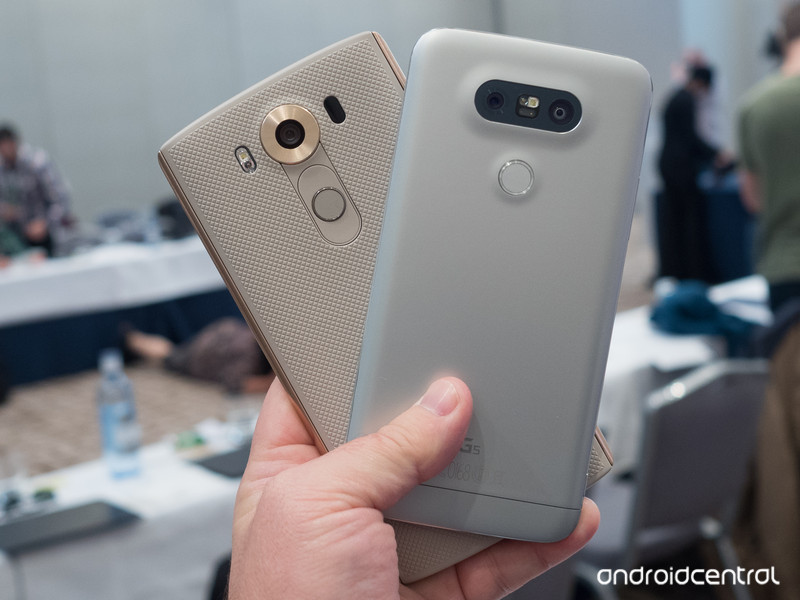
A lot of crap has been thrown at the wall, but very little has stuck.
Consequently, LG isn’t chained to any particular design language or feature set in developing the V20, mainly because its recent efforts have been so haphazard. It could do just about anything with its next phone. And after a disappointing start to the year, we’ll be looking to the V20 for signs that LG can stay relevant at the high end.
We shouldn’t overdo the doom and gloom, though — there are strengths to be built upon. LG’s cameras have been superb lately. Although mostly identical to the G4’s, the LG G5’s rear camera can challenge Samsung in most conditions. And the secondary wide-angle camera is a great example of how twin cameras can add real value.
And LG Display makes great screens — not just for LG phones, but also for the likes of Apple.

With all that said, what’s the best option for LG? Surely we’ll see another large display, likely around the 5.7-inch mark, as before. The standard collection of high-end internals will be along for the ride — probably a Snapdragon 820 or 821, 4 or 6 gigabytes of RAM. Expect USB Type-C and some form of quick charging. So far, so Android smartphone in late 2016.
As for the chassis containing all these guts, anything could happen. But we think it’s time for LG to finally move past removable batteries and the design compromises involved in making a phone you can take apart and remove components from. There’s a good reason LG’s the only manufacturer left making high-end phones with removable batteries — everyone else has figured out you can make more solid, better-looking gadgets if they’re not designed to be disassembled by the average user.
That being the case, the question is which direction LG will go in. Free from the constraints of a removable battery, LG could step up from the G5’s mix of resin-coated (plasticky) aluminum to a more traditional unibody. A glass back is another possibility, and one LG explored way back when with the Optimus G and Nexus 4. Plastic isn’t inherently bad — see last year’s Moto X for an example of how to combine metal and polycarbonate in a way that works. But it’s getting harder and harder to justify anything but premium materials in a $600+ smartphone.

The V20 might have a big reason to move away from ‘buttons on the back.’
Next, let’s talk about back buttons, and how the G5’s move away from rear-mounted keys didn’t really make much sense. Sure, the power switch stayed back there, but LG had a great little differentiator in its trademark rear-mounted volume keys, which made its quick-launch camera shortcut really easy to use.
As much as we’d rejoice to see back buttons return, LG has a big reason to move even more stuff off the back of its next phone. Back in May LG Innotek unveiled the first fingerprint scanner embedded into the front glass of a smartphone. It’s unclear when it’ll be ready for the mass market, but if this technology was used in the V20, LG might want to stick all its buttons back on the side, and rely on its fancy new screen-mounted fingerprint reader.
Speaking of the screen, we’re hoping to see the return of the V10’s quirky secondary display. It’s one of those features that’s way too easy to mock until you’ve actually used it. Sure, the default function — showing your name or some cutesy message — is dumb. But as a way to hop between recent apps in fewer taps, or flash up notification content without obscuring other apps, it works shockingly well. And depending on its size and placement, it could double as a reasonable “always-on” screen.
LG’s cameras are already really good, but it needs to not stand still in this crucial area.
LG’s cameras are already really good, but it needs to not stand still in this crucial area. It’s used the same 16-megapixel Sony sensor and f/1.8 lens in the G4, V10 and G5, so it’s time for some progress — be it in the sensor, the lens, the stabilization or all three. LG’s doing some good stuff with dual lenses, but the V10 needs to be more than just a G5 with a bigger screen to turn heads. (Samsung can afford to just build a bigger version of its small phone thanks to the S Pen, and the fact that the small phone in question is exceptionally good. LG doesn’t have that luxury.)
As for software, there’s always room for improvement when it comes to design, and LG’s taken a lighter tough to software “skinning” this year. Arguably it’s still well behind Samsung in this area though. If nothing else, the G5 is lightning fast, and the most onerous of LG’s software additions are easy to disable. What’s most important for the V20 though, considering its likely footprint of 5.7 inches or above, is that it ships with Android 7.0 Nougat. The phone would then benefit from Nougat’s native multiwindow support, as opposed to the half-baked implementation used in earlier LG phones (which as it happens was bizarrely absent from the G5.)
Standing out and successfully differentiating a new high-end smartphone is hard, even for a company with the resources of LG. That’s surely why we’ve seen so many off-the-wall ideas over the years from Samsung’s local rival. But by now the firm has no excuse for knowing what works and what doesn’t, because it’s tried just about everything.
The V20 should be better, and not just different.
In recent years LG has, it seems, looked at Samsung and just tried to be different. Now, with the benefit of countless product cycles, it’s time to prioritize being better. Mobile Nations Managing Editor Derek Kessler remarked to me after the G5 launch event that this phone was LG at its most LG — its most different for different’s sake. That’s the mindset LG needs to move beyond if it’s to succeed with the V20 and, eventually, the G6.
So will the V20 be the device that finally brings some fire to LG’s mobile division? According to reports from the Korean press, the LG V20 is set to break cover in early September. We’ll be watching with interest, bringing you full coverage along the way.
What would you like to see from the LG V20? Share your hopes and fears down in the comments!
MrMobile reviews the smartwatch on steroids — Casio’s WSD-F10
There’s something about summer. The fresh air. The hot sun. And the ability to dive up to 50 meters with your MIL-STD-810G smartwatch.
In his latest video, MrMobile reviews the Casio Smart Outdoor Watch — also known as the WSD-F10 — an Android Wear smartwatch that can go pretty much anywhere, and withstand pretty much anything. While it lacks some key fitness features, like heart rate and GPS, it has everything a hiker — or diver — could want, including directional, atmospheric, accelerometer, and gyrometer sensors.
But at $500, is it worth the expense?
See at Amazon
When you’re done, be sure to subscribe to MrMobile on YouTube if you enjoyed this video!
Moto G4 review: Balanced on a budget

The Moto G4 proves a budget phone can be quite capable.
The Quick Take
The Moto G4 is a 5.5-inch Android phone that lacks any kind of definition to help it stand out. With a single top speaker grill, and its rounded corners, it blends in. It delivers a great display that is easy to see both inside and outdoors, along with a battery that will keep you going all day — and then some. It’s got a decently-performing camera, and new access to manual features for photos.
The Good
- Solid feel in your hand
- Good camera with manual features
- Great battery life
The Bad
- Processor gets overworked from extensive use
- Camera lags when opening
- Only 16GB of onboard storage
About this Review
I (Jen Karner) after a week of using a Moto G4 for about ten days, running Android 6.0.1 with the May 1, 2016 security patch. The build number is MPJ24.139-48. It was connected to the AT&T network in Halethorpe, Maryland.

The best of plastic
Hardware
| Display | 5.5-inch Full HD display, 401 PPI, Gorilla glass 3 |
| Processor | Qualcomm Snapdragon 617 SoC (Octa-core Cortex-A53) |
| Storage | 16GB, expandable by 128GB Adoptable storage |
| RAM | 2GB |
| Rear Camera | 13MP, PDAF and laser autofocus |
| Front Camera | 5MP |
| Battery | 3000 mAh |
| Size | 153 x 76.6 x 7.9 mm154 g |
In your hand, the Moto G4 feels sturdy, but definitely made of plastic. The back plate is smooth, with a textured cross hatch that can feel a bit strange at first, especially if you’re moving to the G4 from a metal framed phone. Despite its large screen, the phone fits and can be used with a single hand.
When you’re looking at it, the phone could pass for any other rectangular, round-cornered phone. There’s only one piece of branding at all, on the backplate: the Moto logo just underneath the camera. This is a phone that is striving for simplicity, something you can tell by glancing at it. There are only two buttons, both located to the right of the screen. The power button is seated on top, with a textured pattern to help tell it apart from the volume rocker. The rocker, is seated just under the power button and is smooth. Both of the buttons are metal, and are easy to tell apart from the phone’s plastic body.
The screen does its job well, delivering a great experience even in direct sunlight.
There are only two ports on the phone, the micro-USB charger at the bottom, and a 3.5mm headphone jack. There is a single speaker located above the screen, and while not amazing, it gets the job done. To the right of the speaker grill is the lens for the front facing camera. On the back of the phone you’ll find your rear facing camera. The back plate of the phone also pops up revealing your SIM card slot, an microSD card slot, and the unremovable battery.
The screen on the Moto G4 is a 5.5-inch Full HD display with a Gorilla Glass 3 overlay that reaches nearly across the entire phone, with space above and below it. The screen does it’s job and well, delivering a great experience even in direct sunlight. You’ll get vibrant and poppy colors that aren’t washed out, or oversaturated. Even when you dim your screen, it’s never so dark that it’s unusable so long as you are indoors.
The Snapdragon 617 processor is adequate to let you get everything done, but doesn’t go above and beyond. Likewise, the phone occasionally heats up when playing a battery-intensive game like Pokemon Go or Avengers Academy for a prolonged period of time. For the most part, though, the phone is capable of handling anything from social media and the web to playing Match-3 games for an hour and a half.

Android all the way
Software
Happily, the Moto G4 is running Android 6.0.1 out of the box. Having the most up to date software possible is a must for many people, and seeing a budget level phone up to date is always a good thing to see (though it won’t be up-to-date for long). Instead of seeing overbearing Moto software, there is an emphasis on Google and stock Android, with a few Moto flourishes thrown in.
Those flourishes include gestures, but sadly lacks the Moto Voice feature that allows you to quickly access specific notifications usually found on more expensive Motorola devices. You will be using those Moto gestures as you become more acquainted with the phone. You can launch your camera by quickly double twisting the phone, or flipping it to lay face down to silence an incoming phone calls.
When the phone did start to heat up was when there were some issues with the performance of the phone.
There were some issues when the phone was used for an extended amount of time, though. The entire thing would heat up, and while never becoming too hot or issuing a warning, it did become uncomfortable in my pocket or hand. When the phone did start to heat up was when there were some issues with the performance; apps would stutter, and it was easier to just put the phone down and let it cool back down before trying to do much of anything.
To storage, if only 16GB of space seems like too little, you’re still in luck. The Moto G4 takes advantage of Google’s Adoptable Storage feature, letting you mount up to 128GB microSD card to augment the storage you have access to.

An expected flaw
Performance
The Moto G4 is running on a Snapdragon 617, with 2GB of RAM which, while technically an upgrade from its predecessor, is aging quickly and as you’re running around doesn’t always stand up to the abuse. That’s not exactly rare with a lower-end phone, but it is still just a bit disheartening.
For most people, the processor will be exactly what you need out of the phone. However when used heavily, the phone does occasionally try to rebel. On several occasions during my time with the Moto G4, it got hot and jittery enough that I had to clear all of the open tasks, or even restart the phone. This was generally after heavy extended use that most people wouldn’t get to.

Fine tuned controls
Camera
For plenty of people, the camera on their phone is a pretty big deal. You want something that can capture the moments in your life that matter. For the most part, the Moto G4 has delivered a great camera. With a 13MP sensor on the back and a 5MP front facing shooter you’ll be covered. The one big flaw, though: no matter how you open the camera it takes several seconds to load. It’s not a deal breaker, but it can be frustrating when you’re trying to grab a shot in the spur of the moment.
Once it opens up, you’re good to go. The camera allows you to adjust between regular shooting, and with the G4 they’ve added manual controls. While many people don’t want to fuss with these, there are others who like being able to fine tune the photos they snap and now they can. LG is already known for their manual settings, but it’s nice to see Moto joining in as well.


Switching between photo and video capture is simple, and just involves a few taps. If you want to adjust your default settings for photo and video, the settings are available by swiping to the side. If you decide to dive into the professional mode, you’ll have access to all of the manual settings. These settings pop up on a sliding scale for adjustment after you tap on the appropriate settings on the right side of the screen.
Another small downside to the camera: how long the HDR takes to process. Occasionally you’ll get a message asking you to hold your phone steady while taking a photo. For most people holding still for an extra second or two isn’t a big deal, but it can produce problematic blurry photographs if your hand is shaking. This didn’t happen often, but it’s worth noting.
Overall the camera performs really well, especially for a phone under $300. The laser autofocus also means that you can easily grab great candid shots. You’ll just need to make sure the camera is open in advance. It would have been nice to see some optical stabilization, but given the small size of the phone it’s usually pretty easy to hold steady.

It just keeps going
Battery
There’s something to be said for a phone that has a battery capable of getting you through the day without needing a charge. The Moto G4 is packed with a 3000mAh battery that will get you through your commute, and work day, along with getting you home. A single full charge got me through nearly a full day when I needed to charge it.
The adapter included with it is equipped with TurboPower charger, Moto’s take on Qualcomm’s Quick Charge 2.0 standard. It’s easy enough to just plug in for 10 or 15 minutes and see a 20% improvement in the battery. If the Moto G4 dies on you, which only happened to me once, it’ll only take about an hour and a half to get you back up to a full charge again.
For everyday users this battery will get you through at least a full day. For heavier use, it’s good for about 16 hours.

It’s worth it
Bottom Line
So is the Moto G4 worth the $199.99 price tag? In a word, yes. This phone packs a serious punch for its asking cost. You get fantastic battery life, a decent display, and a camera that delivers great results. While there are some small issues it doesn’t take away from the whole package, and the Moto G4 is a contender in the budget range of phones.
While Motorola used to dominate the budget range, those days might be running out. There are progressively more budget phones, and each one has it’s own particular perks. While the G4 may not be the best overall phone, you can deny the appeal of a battery that can take whatever you feel like throwing at it.
See the Moto G4 at Amazon
ICYMI: Robot spiders can patch an airship during flight

Today on In Case You Missed It: Lockheed Martin is unveiling a new hybrid airship in a couple years (a la Hindenburg) but is first addressing any potential tears in the hull by creating magnetic robots they call spiders, which can crawl over the ship and work autonomously to patch holes as they appear. Meanwhile China’s State Media says the country finished a year-long build of a huge seaplane that will be able to perform water rescues of up to 50 people at a time.
While the plane is down there, it could always pick up more of the mysterious orb just discovered by the Ocean Exploration Trust’s vessel that may be an as-yet undiscovered species of mollusk. That video is here. As always, please share any interesting tech or science videos you find by using the #ICYMI hashtag on Twitter for @mskerryd.
Lithium-ion pioneer Sony is selling its battery arm
Sony is planning to sell its battery division to Murata, a Japanese firm that makes a diverse variety of products like wireless components and robots. Sony started the battery business in 1975 and was the first company to commercialize lithium-ion batteries back in 1991. The electronics giant has been selling off core businesses and assets in an effort to return to profitability — it recently unloaded its VAIO PC division, New York and Tokyo Headquarters, and Sony Online Entertainment game division. It also split off its sensor and TV businesses into separate companies.
Murata will likely acquire the Sony Energy Devices Corporation subsidiary and manufacturing plants in China and Singapore, excluding alkaline batteries and USB chargers. It then intends to “position the global battery business as a core operation within its energy business.” The battery arm is part of Sony’s profitable sensor division, but was a drag on earnings in 2015 to the tune of $270 million.
Sony started the battery business in 1975 and was the first company to commercialize lithium-ion batteries back in 1991.
Sony says that while it focused on improving the profitability of lithium-ion smartphone batteries, it adds that the “competitive environment is significantly changing.” In fact, Samsung claims it is the current leader in small lithium-ion batteries, and has been since 2010. Other players like LG Chem and Panasonic also outsell Sony.
The agreement is non-binding pending “due diligence and negotiation of detailed terms and conditions of the transfer,” Sony says. Executives from both companies are aiming for an agreement by mid-October 2016, with the transfer complete by March 2017.
Source: Sony
NASA details preparations for SLS’ and Orion’s first flight
NASA began preparing for Orion’s 2018 maiden flight atop the Space Launch System quite some time ago. Since both Orion and SLS are new technologies, the space agency has been subjecting both to a series of rigorous tests, which it has listed and explained in detail in a Tumblr post. NASA says it’s been examining every component of the capsule and had blasted it with deafening sounds, earthquake-like vibrations and strong, hurricane-like winds in the past to test its durability. The spacecraft also underwent water impact testing with human dummies inside, wherein it was dropped into a pool from 16 feet above the surface. It’s slated to go through more water impact tests simulating different wind and wave conditions in the future.
NASA hasn’t been neglecting the SLS either and has regularly been firing up its engines. That said, both rocket and capsule are far from done. The agency is still in the midst of putting the SLS’ core stage (where the cryogenic liquid hydrogen and liquid oxygen are stored) together. Once it’s finished, it will become the most powerful rocket ever built.
As for the capsule, well, the agency is still waiting on a key component that could push back the first Orion/SLS flight. The European Space Agency won’t be able to deliver the capsule’s primary propulsion component in January as planned and had to delay its shipment until April 2017 or later. NASA says it won’t affect the project’s timeline, though, and that the duo’s flight is still a go for fall 2018.
Source: NASA (Tumblr)
Anyone can now print out all TSA master keys
Shortly after The Washington Post inadvertently published a photo of seven TSA master keys, a group of security experts were able to copy their designs and release their 3D models online. Now, these same experts have deciphered the secrets of the eighth and last master key the agency uses even without a photo to guide them. The first seven keys are manufactured by a company called Travel Sentry, while this one is by a separate manufacturer named Safe Skies. Since the hackers didn’t have a photo of the last key, they bought as many Safe Skies locks as possible, took them apart and examined their innards. Anyone with access to a 3D printer can now reproduce all eight keys.
The hackers, who go by the pseudonyms Johnny Xmas, DarkSim905 and Nite 0wl presented their work at the 11th Hackers On Planet Earth (HOPE) Conference in New York. According to 3D Printing Industry, the trio explained that it’s not their intention to scare people — they merely want to highlight the dangers of giving a third party access to master keys, whether digital or physical.
“This was done by legally procuring actual locks, comparing the inner workings and finding the common denominator,” Xmas said at the conference. “It’s a great metaphor for how weak encryption mechanisms are broken — gather enough data, find the pattern, then just ‘math’ out a universal key (or set of keys). What we’re doing here is literally cracking physical encryption, and I fear that metaphor isn’t going to be properly delivered to the public.”
Via: TechCrunch
Source: GitHub, 3D Printing Industry
 AIVAnet