


AT&T is experimenting with drones to make its network better
AT&T has announced that it is currently experimenting with drones in order to make its network better. The carrier is currently using them for cell tower inspections and to gather real-time information, and in the future it may use them as flying towers for additional coverage. By being connected to its network, AT&T can use the drones to gather information and make immediate changes based on the needs that are being shown.

From the announcement:
Connecting drones to our nationwide LTE network lets us capture data and feed it directly to our systems. In turn, this can allow us to make changes to our network in real time.
By using drones to inspect a cell site, we’re able to conduct inspections more quickly and safely – and even access parts of a tower that a human simply could not. We anticipate this will allow us to improve our customers’ experience by enhancing our cell sites faster than ever before.
It is worth noting that drones don’t offer great battery life currently, so fly time is rather limited. Also, odds are that people are not going to take well to a drone flying over their head at a concert, even if it means they can send that Snapchat or Instagram a little faster with the additional coverage. Either way, it will be interesting to see if AT&T can do anything of use with these drones in the future.
OnePlus 3 vs. Moto G4 Plus: What’s $100 between rivals?

The ultimate low-cost Android phone showdown is here!
How much difference does $200 make in the smartphone market? What about $100? At some point, these figures become both fundamental and meaningless to a person’s buying decision, especially when tacked on to phones categorized “mid-range” or “entry-level”.
It is with this lens that I approached a comparison I was initially reticent to do: the OnePlus 3 and the Moto G4 Plus. Why would it be necessary, given the $150 difference between mainstream models? And what is gained by trying to push some sort of narrative from two devices aimed at increasingly diverging markets?
A lot, in fact. Because, like the OnePlus 3, the Moto G4 Plus is a great phone at $199, $299, and $399. But coming in at the lower end of that spectrum means that it will inevitably come into the purview of those who are “just buying a phone,” which not only expands its potential audience but challenges its place in the enthusiast market — where OnePlus sits comfortably.
How do these two devices compare? And would there ever be a world where we’d suggest the Moto G4 Plus over the OnePlus 3 (tl;dr: no, but almost)? Let’s take a look.
Hardware
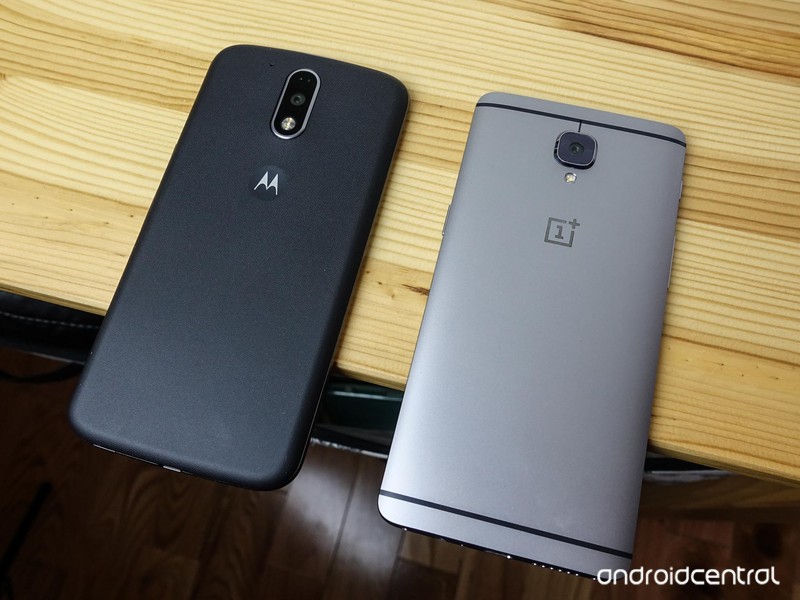
Before we get started, a quick note on options. Unlike the OnePlus 3, which graciously is offered in only one 6GB RAM/64GB storage/$399 option, the Moto G4 Plus has two:
- a 2GB RAM/16GB storage/$249 option
- a 4GB RAM/64GB storage/$299 option
But things get complicated when you consider the model I’m using, which is neither of those, but a Canadian-specific 2GB RAM/32GB storage/$400 CAD option. Here’s how we can hedge: all Moto G4 Plus models use the same Qualcomm Snapdragon 617 processor, and while I am confident an extra 2GB of RAM would offer some performance legroom, I am also sure, based on my extensive experience with Android in general and Motorola devices in particular, that the processor is largely the bottleneck here.
Complete OnePlus 3 specs
Complete Moto G4 Plus specs
Anyway, let’s talk hardware, because other than the processor this is where the bulk of the differences are. The OnePlus 3 is beautiful, crafted with a single piece of aluminum in a way that belies it’s true price. There are chamfers on the back edges and nicely-calibrated buttons on the sides. It feels robust, significant, but not heavy.
The Moto G4 Plus is, while better than its predecessors in most ways, very plasticky. Its buttons rattle in their sockets, and it’s very clear from the moment it is picked up that the sides are plastic. A removable back cover, also plastic, smudges easily, though after many a removable and reapplication it re-adheres with a nice snap.
The two devices are roughly the same height, though the OnePlus 3 appears considerably wider due to its less rounded corners. But the more expensive device is also thinner, lacking the roundness of the Moto G4 Plus’s back. That they both have 3,000mAh batteries is interesting, because, as you’ll see later they perform quite differently.
Another similarity is the size and resolution of the two devices’ screens: 5.5-inches at 1080p, making for a pixel density of 401ppi. Now that OnePlus has resolved the controversy around the OnePlus 3’s Optical AMOLED screen, releasing an over-the-air update to address the inaccurate and unnaturally wide color gamut, we can use the new SRGB mode to compare to other devices. But be careful what you wish for: the new setting mutes the display’s vibrancy and, to my eyes, isn’t nearly as pleasant as the default.
The Moto G4 Plus is, while better than its predecessors in most ways, very plasticky.
Comparing the two devices’ screens side by side, as impressed as I was by the OnePlus 3, I was even more struck by the bright, vivid and responsive panel on the Moto G4 Plus. For a device that starts at $249 ($199, in fact, for the regular Moto G4, which has the same screen), it’s one of the better displays I’ve interacted with.
Both phones also have fingerprint sensors below their displays, but the OnePlus 3’s is far better: wider, faster and considerably more accurate. Don’t let that impugn the G4’s too much, though: while small, and slower, it still gets the job done, despite its awkward square shape.
Around back, the both phones have centered 16MP rear camera sensors, jutting slightly from their respective casings. And while we’ll see later on that both cameras are more than capable (though one is clearly better), I far prefer the OnePlus 3’s design, its over-sized square module fitting better with the phone’s overall aesthetic than the G4’s oblong protrusion.
One area of differentiation is the OnePlus 3’s mute toggle, which my colleague Andrew Martonik loves, and I, frankly, do not. As I said in my previous comparison, I just don’t see the point when, for years, a combination of volume buttons and intuitive software have done a fine job.
Software and performance

In software, the phones are remarkably similar, with each taking Google’s stock version of Android 6.0.1 Marshmallow and augmenting it ever so slightly.
On the Motorola side, we get what is still the G series’ pièce de résistance, Moto Display. While most phones have some sort of ambient display feature built in these days, the G4’s is actually useful, pulsing notifications that can be activated or dismissed without unlocking the phone. Motorola has refined Moto Display to near-perfection, and to this day it’s one of my favorite smartphone features, period.
The phones’ differences aren’t as stark as they would appear on paper.
Unfortunately, Motorola didn’t see fit to retain its Moto Voice feature for the G line this year, remanding it relative obscurity in the more expensive (and likely far less popular) Moto Z. Ultimately, though, it’s not a huge loss considering the Google Now launcher supports “OK Google” hot-word support from any screen, but Moto Voice was/is a bit more robust and customizable. Thankfully, Moto Actions — double-chopping to turn on the camera, double wrist-flicking to open the camera — is in good shape, and works like a charm.
More importantly, the Moto G4 Plus performs beautifully for a phone under $300, and rarely feels bottlenecked — even on my 2GB RAM model — by the Snapdragon 617 processor. There were times I yearned for the camera app to open more quickly, or the shutter to engage a beat earlier, but those moments did not dampen my enjoyment.
The software on the OnePlus 3 has a bit more flair to it, with a number of gestures, shortcuts and display settings built in, but none of them are essential to enjoying the phone. What the company has been able to do with OxygenOS, especially after its false start on the OnePlus One and early bugginess on the OnePlus 2, is remarkable. Being able to use either the capacitive navigation buttons (which can themselves swap places with a toggle) or virtual makes for an ideal compromise, and OnePlus’s gesture-friendly launcher is outstanding.
Obviously, when it comes to performance, the OnePlus 3 trounces the Moto G4 Plus. With the fastest processor on the market today and between 2GB and 4GB of extra RAM over the G4, there’s just no competition. Games are buttery smooth; apps load considerably faster; keyboard lag is non-existent; and the camera never wavers.
But those differences aren’t as stark as they would appear on paper. As fast as the OnePlus 3 is, the Moto G4 Plus never feels sluggish, even when tested with the most onerous multitasking tests. It’s for this reason I believe it to be one of the better smartphone deals around.
Unfortunately, the Moto G4 Plus fails to compete with the OnePlus 3 in one more key area: battery life. Despite both phones having 3,000mAh batteries, the Moto fell behind the OnePlus 3 by at least two hours every day. Whereas I never worried about the latter going dead before bedtime, I often had to recharge the Moto G4 Plus during the day to keep it chugging. Like the OnePlus 3, it does boast fast charging — a variant of Qualcomm’s Quick Charge 2.0 — which is certainly useful.
Camera
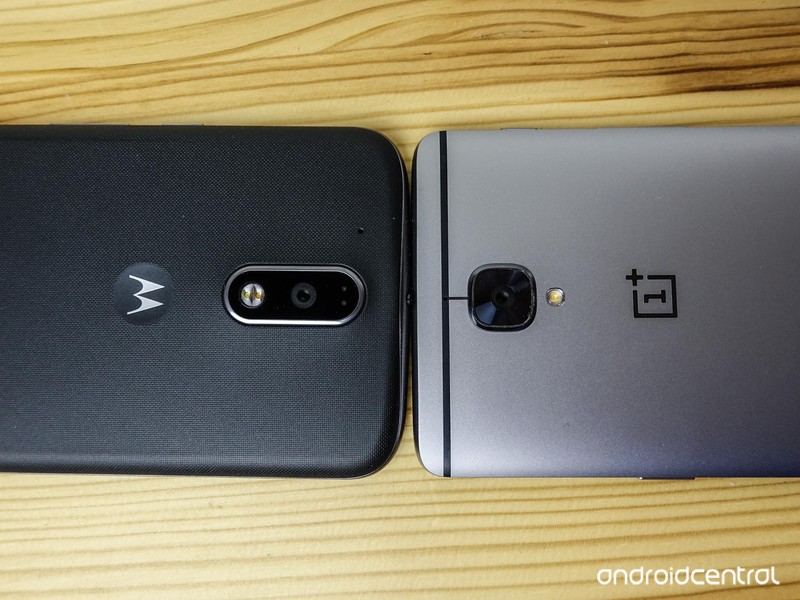
The cameras on these two devices are a lot closer than they have any business being.
While the OnePlus 3 has an optically stabilized 16MP sensor that excels in low-light situations, they are fairly evenly matched in daylight scenarios. In fact, the OnePlus 3 adds far more sharpening to its well-lit photos that, while resolving smaller details better, distract from the overall fidelity of the photos.


OnePlus 3 (left) / Moto G4 Plus (right) — click image to view larger








The Moto G4 Plus captures slightly cooler colors with its 16MP sensor, but does not inject its shots with much post-processing, resulting in softer, more neutral photos. It’s an effect I prefer.
In low light, the OnePlus 3 does pull ahead, but not by much — the Moto G4 Plus holds its own, again impressing for such an inexpensive product. But whereas the Moto G4 Plus is limited to video capture at 1080p / 30fps, the OnePlus 3’s Snapdragon 820 chip enables 4K capture at the same frame rate.

Their camera apps, simple as they are, expose some major differences in strategy. The OnePlus 3 has a powerful manual mode that allows for granular tweaking of ISO, shutter speed, exposure, and even focus; the Moto G4 Plus goes as far as adding a timer and HDR toggle, but not much else.
Speaking of HDR, the OnePlus 3’s implementation is far more subtle than Motorola’s, as seen in the shot below. While the company has come a long way to improving the performance of its camera app, in particular its HDR setting, don’t expect shots that look overly-processed or vibrant. Whether that’s a good thing will be a matter of taste, since the Moto G4 Plus swings almost completely in the other direction.


OnePlus 3 HDR sample (left) / Moto G4 Plus HDR sample (right) — click image to view larger
Like most aspects of these two devices, I prefer the OnePlus 3’s overall experience, but the Moto G4 Plus, especially in daylight, manages to capture some unbelievably good photos that are impressive, period — not just at its price point.
Bottom line

Both of these phones represent the best of their respective price points, with the OnePlus 3 justifying its higher cost with a better design, stunning build quality, excellent performance, and great camera.
The Moto G4 Plus, though, manages to keep pace for most of the race, and does so between $100 and $150 less than its OnePlus counterpart. That both phones are available primarily online and unlocked in the U.S. also means they lack bloatware and other carrier-induced issues, and they are updated directly from their manufacturers.
Ultimately, what these phones prove is that the high-end Android market is no longer secure in its high-margin, $699 ivory tower, and companies like Samsung, HTC, LG and others are going to have to do a lot more to continue justifying those prices going forward.
OnePlus 3
- OnePlus 3 review: Finally, all grown up
- OnePlus 3 specs
- OnePlus 3 vs. the flagship competition
- Latest OnePlus 3 news
- Discuss OnePlus 3 in the forums
OnePlus
I made a pizza and charged my phone with a camp stove because the future is amazing

This is hands-down my new favorite camping accessory.
My family is full of people who enjoy camping. Sometimes that means hiking the Appalachian Trail for a few days with no tech at all, and sometimes that means renting a few campsites together with a cooler full of tasty drinks and a fire that regularly encourages Park Rangers to come check on us. When I go hiking, the BioLite Camp Stove is usually in my pack. It’s great for making a small fire and I like knowing I can charge a phone in an emergency. At a campground you already have grill tops and fire pits, so for me there’s never been a need to bring something else for cooking before.
I stand before you a changed camper. This weekend I cooked the perfect pizza while charging my phone on the larger BioLite BaseCamp stove, and I’m unlikely to go family camping without this stove ever again.


For the uninitiated, BioLite’s BaseCamp stove is really just a bigger, more capable version of their portable Camp Stove. It holds more wood and offer a larger, sturdier cook surface, but the basic concept is the same. You start a fire in the front opening, and when the orange box on the side of the stove has converted enough heat into electricity a small fan will kick on. That fan keeps the stove hot, which keeps delivering more power to the 2200mAh battery contained within. After 20 minutes or so, you can connect just about anything to the USB port on the side and receive 5 watts of power at five volts. That’s enough to power anything you’d need in an emergency situation, but is also means you can charge a phone or tablet if you’re inclined to use one of those while camping.
Not only had I made dinner for the family, but my phone had been charged 20% while I was cooking.
All of this has been around for a while already. The new thing here today is the Pizza Stove. This accessory adds a Pizza Stone, heat spreader, and a lid to the Base Camp. This means you can create a small oven to bake a pizza in, which isn’t as easy as it sounds when you’re camping. I’ve made more than my fair share of “campfire pizzas” with dutch ovens and disposable foil packs. The end result usually tastes something like a pizza, but is frequently either a greasy mess or at least a little charred. Using a pizza stone offers the promise of pizza you would make at home, only you’re outside and using sticks.
Much to my surprise, the end result was amazing. As long as I kept a steady supply of firewood moving into the stove, maintaining a mostly constant temperature was easy. After 11 minutes in the Pizza Dome, I had a flawless wood-fired pizza that was ready to be eaten. The burning wood from the stove added a nice flavor to the crust, and everything cooked evenly. Not only had I made dinner for the family, but my phone had been charged 20% while I was cooking and the battery on the stove had another 50% left to offer. Five minutes of cleanup and wiping down later, and the stove was ready to be used again.

It’s rare for camping gear to offer an experience like this, and while this is hardly an accessory for hiking up a mountain it seems perfect for anyone looking to enhance the stereotypical family campout at a local campground or offer a little extra cooking prowess to an actual camping base camp. You don’t necessarily need pizza while camping, but everyone around you will be pretty glad the option is there if you have one of these Pizza Domes.
Check out the BioLite BaseCamp and its Pizza Dome accessory!
One frightening live sex show and the state of 360 video
NSFW Warning: This story may contain links to and descriptions or images of explicit sexual acts.
A woman with an enormous, warped vagina stands over you, attempting to situate a pair of naked coeds just so on an overstuffed sectional. Their faces distort and sporadically disappear as they pleasure each other and themselves. Their movements are sometimes smooth, sometimes staccato, like a couple of gyrating marionettes on Ecstasy. They moan with pleasure and talk dirty to no one in particular, but their mouths don’t move.

The room is largely empty save for one of those shitty IKEA floor lamps, a frat-house couch and a handful of empty exercise equipment. A woman stands behind you, hula-hooping in a dated leotard, like some voyeuristic bargain-basement Jane Fonda. A screen above the couch displays an error message and a chat room where men bark out explicit commands for the marionettes and their well-endowed puppet master.
This is not a nightmare. This is reality or, more accurately, a live 360-degree recording inside Camsoda’s model house, an always-on content farm for live amateur sex. If you ask the company’s president, Daron Lundeen, it’s the future of adult entertainment. However, as we’ve learned from mainstream examples like the first live 360-degree performance from Dawn Richards and YouTube, the medium still has a long way to go.
Like YouTube, Camsoda is banking on the promise of 360-degree video, live streaming and, yes, virtual reality, to usher in a new era of user-generated content. Problem is, no one cares about 360-degree video. At least not yet.
Instead of some sexual fantasy land, I was transported back to the dingy college apartments of my youth.
Like so many first times, my first time watching a live cam show in VR was clumsy, overhyped and over before it started. The hourlong performance was scheduled for a Wednesday afternoon. Having checked the company’s site for compatible devices, I was there, Samsung Gear VR in hand, ready to go. I’d been able to play the video on my desktop, but, due to Oculus’ closed-garden approach to content and Camsoda’s use of YouTube’s open source 360-degree player, it would have taken me nearly the entire hour to get it up and running.
Two weeks and a handful of emails back and forth with the Camsoda crew later, I was ready for a second try. Instead of hacking my way into this immersive, interactive sex scene, I went the path of least resistance and grabbed a generic Google Cardboard from the office. This time, the setup was simple. I loaded the link on the site’s VR page, pressed the Cardboard icon and slotted my phone into the headset. Just like that, I was there, dead center in the poorly furnished romper room I described earlier.
Instead of some sexual fantasy land, I was transported back to the dingy college apartments of my youth. Decor has never been porn’s strong suit, but virtual reality can and should take us places we’ve never been before. I’d been in places like this, and I never want to go back. But who cares about paint swatches and track lighting when you have a room full of hot, naked women, ready to do anything you say, right?
Unfortunately, it’s not that simple. Yes, Camsoda brought together some of its best performers for the shoot. They even seemed to keep a handful of onlookers engaged for a majority of the performance. But when it comes to 360-degree live video, success is measured in more than a few good nuts.
The show was plagued by slow connections, poorly synced audio and pixelated private parts. The models spent an excessive amount of time trying to figure out where the camera was and how to play to it once they found it. In a previously recorded video, I even saw a large, male crew member step on set to adjust a piece of equipment. Talk about breaking the fourth wall.
In a perfect world, users would not only be able to see what their favorite performers are doing in real-time, but to feel it too.
Live 360-degree video requires a fair amount of bandwidth and battery power on the part of the viewer. If you’re watching in VR, it also requires specialized hardware and a heavy dose of patience. And what of the live cam show’s killer feature? With a VR headset strapped to your face, how does one ask a performer to finger her co-star, pucker her butthole or reach for the rubber fist? Even for the most adept touch-typist, single-handed key pecking is a time-consuming undertaking.
I won’t fault Camsoda or its handful of competitors for trying. Porn’s ability to shape new technology has become legend and created a new class of technologically minded entrepreneurs. Add to that an immersive new medium that promises to put the viewer right where the action is, and you seemingly have the recipe for the next big thing in adult entertainment.
When the tech and consumer interest finally catch up, early adopters like Camsoda will be there, ready to cash in, and I have no doubt that they will. The trouble is, we’re still a long way from figuring out how to use these amazing new tools, and the sight of one giant warped vagina combined with the squeals of two faceless banshees aren’t exactly the stuff wet dreams are made of.
Late last week, Camsoda announced a partnership with Kiiroo, the teledildonics platform that gave me the power to fuck myself. In a perfect world, users would not only be able to see what their favorite performers are doing in real-time, but to feel it too. VR, teledildonics and live 360-degree streaming all present amazing ways of thinking about and having sex, but putting them all together before anyone one of them is ready for prime time is just one big technological boner-killer.
If you can figure out how to hold a Google Cardboard in place, type commands to your dream girl and pleasure yourself with an internet-connected stroke sleeve all at the same time, I’ve got about 500 Camsoda tokens with your name written all over them.
ABC launches new streaming original and throwback content
ABC is looking to revamp its push into the exclusive subscription content game, relaunching its free streaming service with a wealth of new content and classic shows for viewers to binge on.
The network has opted for free on-demand content over heading down the same subscription route its competitors have chosen such as NBC’s Seeso comedy offering and CBS All Access. The network is launching digital shorts under the ABCd moniker, and include new shows like Boondoggle, starring Ty Burrell from Modern Family, and comedian Iliza Shlesinger’s Forever 31.
There are currently 40 additional series coming down the pipeline that will eventually be added to the mix, with full seasons of shows like 8 Simple Rules, My So-Called Life, The Neighbors and Ugly Betty being added in the meantime. If you’re looking for a new source for classic shows and new ones going forward, this might be a good bet.
Via: Variety
Source: iTunes
Behind Facebook’s efforts to make its site accessible to all
Earlier this year, Facebook launched a new feature for iOS screen readers called automatic alt text. Powered by artificial intelligence and machine learning, it recognizes the objects in a photo and then describes them, which is incredibly handy for users who are blind. It arrived on Android soon after, and two weeks ago, the social network officially made the tool available in 20 other languages. These are just a few recent examples of how Facebook is attempting to make its products — as well as the internet as a whole — more accessible to those with disabilities.
It all started five years ago when Jeff Wieland, who worked in the company’s user research team at the time, discovered that there were people with disabilities who were having a rather terrible experience with Facebook. For example, he found out that screen readers — software used by blind users to know what’s happening on a page — would interpret a button on a site as simply, well, “button.” It would have no information on what the button does. “This is a really simple example,” he said. “For an engineer, adding a label to a button is one line of code. But it changes everything.”
The problem, he said, was that developers were not designing the web experience with screen readers in mind. It seems like a “No, duh” explanation, but as Wieland tells me, accessibility is not a subject that’s often taught in computer science classes. “It’s not part of the core curriculum. You have people graduating from great programs, but who have no exposure to accessibility. It’s a real tragedy.” Indeed, he says that almost all incoming engineers have no prior exposure to the subject.

And the fact is, the community that needs this tech is a large one. According to the World Health Organization, about 285 million people worldwide are visually impaired, and of those, around 39 million are fully blind. And that’s just those who suffer from vision loss. “Accessibility is about more than that; it’s about serving those who have varying ability,” said Wieland. “I discovered there was this vast community we were underserving.”
In response to this, Wieland set about creating an accessibility team at Facebook with the company’s blessing. “Philosophically, people got it,” he said, adding that the goal aligns with Facebook’s mission for connecting the world. “But the big question was, how do we do this?”
Over the years, the team has worked to raise awareness of accessibility issues and assistive technologies within the company. It started out with two people, but now it’s grown to more than 20. It’s a cross-functional group made up of people in design, user research, data science, operations and more. Remember those unlabeled buttons? Now, Wieland said, that’s a mostly solved issue (though, given the scale of Facebook, there are probably still a few unlabeled ones here and there). The key factor? Working with existing teams on Facebook to integrate accessibility across the board.

That automatic alt text photo captioning, for example, required the assistance of Facebook’s artificial intelligence team. “There’s this concept of alt text for photos, which used to be provided by the site owner or web developer,” said Wieland. “But now the internet is all photos … The only way we could really provide the text for photos at our scale, would be to use computers to do this.” Fortunately, Facebook’s AI team has been working on computer vision for at least a year and a half already and had the technology and expertise to work on the project.
According to Crista Earl, the director of Web Services for the American Foundation for the Blind, most sites have incorrect or poorly designed forms. “For example, when trying to book a flight on a travel site … the manner of selecting choices poses an obstacle to users of assistive technology.” Inadequately labeled videos and images are also a problem. Other common issues are low-contrast images and tiny fonts for those with low vision.
“During my experience online with accessibility issues, I have struggled with a lot of different things,” said Kevin Cao, a visually impaired tech support employee for the New York Institute for Special Education. Examples include the lack of voice descriptions for images and text. A few of his favorite sites are YouTube and Applevis.com, a community website for low-vision Apple users, which he said have “clear label buttons, links and heading recognition.”

As for how he thinks Facebook is doing, he believes it’s good for now, but it could use improvement. “I would like to add more picture descriptions with faces, people,” he said. That’s the same feedback Wieland heard as well. “They want to know what a person’s hair is like, et cetera. A human can describe a full context, but we’re just returning a list of objects … Hopefully in the future we can tell a richer narrative.”
Facebook’s work on accessibility encompasses more than just vision loss. Back in 2014, the company added the ability for users to provide closed captions to videos. It’s currently working on a more automated captioning system with the help of Facebook’s language-and-speech-technology group.
“The real lion’s share work that we do is to prepare our teams to write and design applications that are accessible, to make it foundational,” said Wieland. “We want to embed accessibility into all of the steps along the way, from ideation to actually shipping the product.” To help this along, Facebook has now integrated accessibility to the QA process that Wieland says has been useful. “It helps push accessibility earlier in the process, without waiting to hear user feedback.”
As part of the education process, the accessibility team has done a lot internally to raise awareness of the issue. There’s an Empathy Lab located in the middle of the Facebook campus that’s partially designed to simulate disabilities to engineers and developers. On display are assistive technologies such as a Braille display for phones, a computer that uses eye tracking for control as well as screen-reading software. “It allows them to play with some of the technologies that people use day in and day out,” said Wieland. “It makes it feel real and close to home.”

As an extra step to increase accessibility training, Facebook joined a bunch of peers including Google, Yahoo, Microsoft and IBM, along with leading academic institutions like Stanford and MIT, to tackle the challenge of bringing it into the classroom. The initiative is called Teach Access, and the idea is to make sure students of technology will be able to graduate with more exposure and understanding of the needs of disabled users.
Just last Thursday, Facebook released a Teach Access tutorial on GitHub that aims to teach developers best practices to writing accessible code and designing accessible experiences. It’s free, and anyone can use it and edit it.
Other companies have increased their accessibility efforts too. Twitter recently enabled users to add alt text to images. Google and Apple have made their products more accessible across the board. For example, Google introduced voice commands to Docs a few months ago, allowing users to type, edit and format text just by talking. Swift Playgrounds, an iPad app that teaches coding skills to kids, had the input of a blind engineer at Apple so that even kids who can’t see could learn to program.
“Our long-term goal is that we want systemic changes to happen in schools,” Wieland said. “Every computer science program should include accessibility to some degree. We don’t expect people to be experts. But we want them to have at least some level of understanding of what accessibility is about.”
Adobe Lightroom now lets you edit RAW files on your phone
Adobe Lightroom mobile users have been asking for the ability to edit RAW files in the mobile app, and now the company doing something about the request. In the latest update for the iOS version of the software, there’s a RAW Technology preview. This means that you’ll be able to import those hefty files to your iPhone or iPad, giving you a means of checking the images before you get back to your computer. Lightroom mobile for iOS will also let you edit the files just like you would in the desktop or web versions of the app, making changes to white balance, highlights and more for an uncompressed file. Those changes also sync across devices.
iOS users will also be able to adjust linear and radial selections inside the app. With those tools, you can add a selection, modify an existing one or use the features to emphasize certain parts of an image. If you fancy doing your edits with an iPad and a connected keyboard, you’ll now be able to use those handy shortcuts with the mobile app. The update is available from the App Store now for both iPhone and iPad, free of charge.
The Android version of the app is getting some new features, too. Earlier this year, Adobe added an in-app camera and “shoot-through” presets to the app. With this update, the company is adding manual controls to that workflow as well. When you’re taking photos with Lightroom mobile on Android, you’ll be able to leverage a new Pro mode that allows adjustments to ISO, shutter speed, white balance and manual focus. Adobe brought its DNG RAW format to the Android app a while back, and now the software has the manual controls to go along with it. What’s more, there’s also a new Lightroom Camera widget for easy access to those features, so you won’t have to launch the full app just to grab a few snapshots.
Android faithful also gain improved support for full-resolution files. If you have an image stored somewhere within the Lightroom ecosystem, you’ll be able to pull it into the full-res version, make your changes and export it. The latest version of the Android app offers those features and more for free, and it’s available now over at Google Play.
Source: Adobe
Tesla no longer guarantees your electric car’s resale value
Tesla introduced its Resale Value Guarantee in 2013, when buying an upscale electric car was a riskier prospect. What if your Model S was worth less than a tried-and-true German sedan? However, the market has clearly grown up since then… and Tesla is changing accordingly. The automaker tells The Verge that it has discontinued the program for any new car bought after July 1st. The move will reduce interest rates “as low as possible” and sweeten leases and loans, a spokesperson says. You’re still protected if you bought a car under the guarantee, but any relative latecomers will just have to trust that the used EV market will work in their favor.
Maintaining the program was potentially very expensive. Tesla promised that you’d get at least 50 percent of the base price as well as 43 percent of the options pricing. That wasn’t a huge hit to the bottom line when the company was selling a relatively small number of luxury cars (Elon Musk even backed it with his own money), but it could cut much deeper when Tesla starts selling hundreds of thousands of Model 3s.
Look at it this way, though: while the move is unfortunate if you liked the idea of your car maintaining a high minimum worth, it’s also a sign that the EV market is growing up. Tesla has enough demand that it can ditch the guarantee without worrying that sales will drop off a cliff. And with these kinds of volumes, resale value might not be an issue in the first place. There’s clearly an audience for these vehicles, so you shouldn’t have to lower your asking price just to attract a buyer.
Source: The Verge
Amazon Prime Day was 60 percent bigger than last year’s sale
Amazon’s Prime Day ended up being more successful than even the company could have predicted, with customer orders surpassing Prime Day 2015 by over 60 percent worldwide and 50 percent in the United States alone.
The special sale day, which included various deals on Amazon-branded products like Kindles and Alexa-enabled home devices, saw Prime members flocking to the retail giant in droves. It quickly became the biggest day ever as far as Amazon devices went, breaking records left and right.
In all, Prime Day found over two millions toys and one million pairs of shoes purchased by consumers, 90,000 TVs purchased and hundreds of thousands of Kindle e-readers sold along with other impressive numbers. What’s really impressive is the fact that these sales were able to go through considering the torrent of issues customers experienced during the sale, with checkout difficulties and other various headaches to worry about.
Still, the annual Prime Day was another success. It’s likely we’ll see another one next year looking at these numbers. Will you be participating?
Source: Amazon
Tesla unveils its less pricey crossover Model X 60D
While much pricier than its upcoming $35,000 Model 3 sedans, Tesla’s Model X crossovers fit the bill for electric car enthusiasts that need a little more space. That dream is a little easier to achieve with the new $74,000 Model X 60D, which doesn’t go quite as far as the old baseline X 75D but costs $9,000 less.
The new model’s 60kwh battery gives it an EPA-estimated 200-mile range, which is 37 miles less than its bigger cousin. Otherwise it performs just like the 75D with a top speed of 130 mph and acceleration of 0-60 in 6.0 seconds. Given that Tesla has recently announced slightly cheaper car models that limits battery capacity behind a costly software update, the company could be doing the same and introducing the 60D as a code-crippled version of its longer-range predecessor, wonders Autoblog. Regardless, you can order the newest Model X on Tesla’s site and get it by September.
Source: Autoblog
 AIVAnet