


Play Store carrier billing coming to India as Idea teams up with Google
India’s third-largest carrier Idea Cellular is all set to roll out Play Store carrier billing in the country. According to Gadgets 360, the carrier’s partnership with Google will be announced later this week.
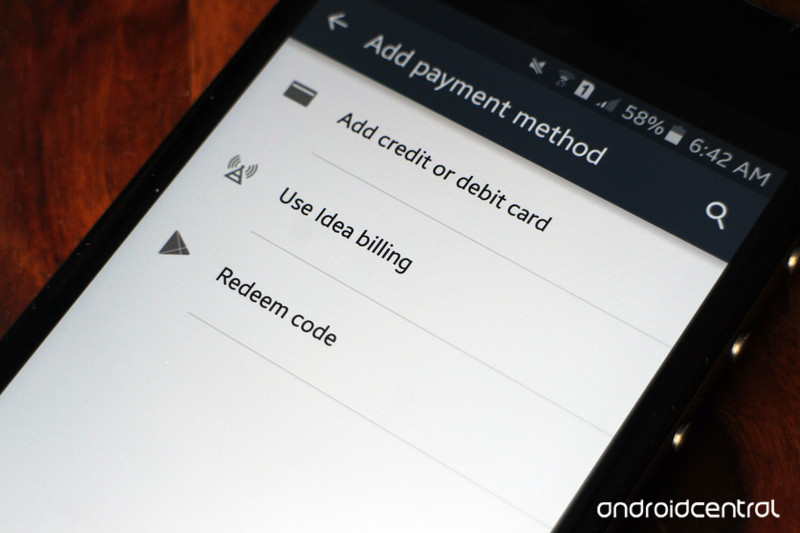
In a statement shared to Gadgets 360, Google said:
We are in the process of adding direct carrier billing to Google Play in India on Idea Cellular so that people can more easily pay for their favourite content. We will have more news to share soon.
Google mentioned that carrier billing will be available on other carriers, but initially it will be limited to Idea subscribers. In a country with very limited credit and debit card penetration, carrier billing is seen as the way forward to boost purchases of digital content.
The feature allows you to charge purchases on the Play Store to your prepaid or postpaid account. If you are a prepaid customer, the amount for the app or game you’re buying is automatically deducted from your balance. If you’re on a postpaid connection, you’ll see the items added to your monthly bill.
From a thread on Reddit, it looks like carrier billing is already rolling out to a few Idea customers. We’ll share more details once the partnership is official.
BMW has the first smart emergency system for motorcycles
While cars and trucks have long had smart emergency systems to send help in the event of a crash (think services like OnStar), motorcycles have had to go without — a scary thought if you’ve ever worried about wiping out miles away from help. That’s where BMW might just save the day, though. It’s introducing the first smart emergency tech for motorbikes, Intelligent Emergency Call, to give the two-wheel crowd a proper safety net. You can trigger it yourself, such as when you need to help a fellow motorist, but the real magic comes with its automatic responses.
IEC’s acceleration and lean angle sensors can not only tell if your bike falls or crashes, but time the call for help based on severity. A bad accident will call for help immediately, for instance, while a gentler incident provides a delay so that you can cancel the call. If things are dire enough for that call to go out, it’ll send your ride’s position at the same time.
Don’t expect to see this system in North America, at least not any time soon. IEC will first launch in Germany sometime in early 2017, and it’ll spread to other European countries soon afterward. There’s no mention of availability in other countries, unfortunately. However, you may well see equipment like this become widespread among bike makers eager to one-up the competition.
Source: BMW
Mee Audio’s X7 Plus stereo Bluetooth sports earbuds are a cut above the rest
I’ve been a huge fan of audio and music since I was a kid growing up in the 80’s. In my time I saw the evolution of record players and tape decks move to compact disks. From CDs to mp3 players, like the Rio Player and iPod, the one thing that stayed consistent over that time frame were wired headphones.
While Bluetooth speakers have been quite popular for a few years now, we’ve all been waiting for wireless headphones to catch up. Until now, most wireless headphones have been expensive, uncomfortable, have poor battery life, and sadly lack in sound quality in comparison to their wired counterparts.
I’ve been testing the Mee Audio X7 Plus stereo Bluetooth sports in-ear headphones for about two months and have something to tell you – these are the first Bluetooth headphones that have convinced me I no longer need wires for high-quality sound.

Specs
- High-quality wireless in-ear headset designed for active lifestyles
- Over-the-ear fit with moldable “memory wire” is secure for any activity
- Advanced Bluetooth 4.1 technology with Multipoint functionality
- High fidelity sound with aptX and AAC HD audio codec support
- Sweat-proof design with Liquipel Watersafe Technology
- Built-in microphone and controls for phone calls, volume, and media
- Rechargeable battery provides up to 8 hours of talk/music playback time
- Includes protective carrying case and 3 sets of eartips

Background and Usage
Sound quality is the most important feature with any audio product. The Mee Audio X7 Plus sport earbuds are fantastic in that area.
Most people think that wireless audio can only meet high quality standards over WiFi. For the most part, that is true with high-quality WiFi being streamed to speakers from the likes of SONOS or AirPlay.
Bluetooth was originally designed to connect smartphones to wireless headsets. It compressed the audio output from our smartphones in order to maintain long battery life. We could have conversations while leaving our phones in our pockets with little headsets that attached to our ear.
Music was not originally apart of Bluetooth’s plan but with the advent of better battery technology, manufacturers saw a market for Bluetooth headphones and speakers. Since Bluetooth was designed with such a narrow market, the sound quality for music lacked for many years. The sound typically came in weak, tinny and downright bad.

Mee Audio understands that most of us prefer quality over convenience when it comes to music. If music sounds bad we just won’t listen to it, because it won’t entertain us. Knowing that, Mee Audio added support for CD quality playback with the X7 plus earbuds with the AAC HD audio and aptX codec.

Enabling high fidelity sound makes the X7 sports Bluetooth earbuds some of the best I wireless headphones I have ever used.
The earbuds are made from high-quality plastic, and are coated with Liquipel Watersafe Technology to ensure they can withstand sweat and moisture from being active. The X7s aren’t designed for petite ears, but they should fit most if you put them on properly. There is just one durable wire that connects both earbuds with an in-line remote and microphone.
What also makes the X7s great is the long battery life. Mee Audio rates the X7s at eight hours of playback/talk time. I frequently achieved eight hours or more if I listened to them at about 50-60% of max loudness. There is almost no need to listen to these earbuds anywhere near max volume if you seat them properly into your ears. They can get loud and you can feel the bass in your ears.
Sound reproduction is definitely top notch. The X7s aren’t just great because they provide lots of bass like some headphones. Highs, mids and lows all shine bright, and cover a wide spectrum of frequencies that make music sound fantastic. These are the first wireless earbuds that have convinced me I no longer need a wired connection for high quality sound reproduction. They’re great for working out, but they’re also perfect for enjoying music when I am at home and am doing chores. The Bluetooth range is fantastic, and call quality is flawless even with the wire placed behind my neck.

Overall
The Mee Audio X7 Plus Bluetooth earbuds retail for $99.99, and are a bargain at that price if you prefer sound quality above all else. The eight hour battery life, water resistance, and great build quality also set them apart from the competition. I’m usually very picky when it comes to earbud sound quality, and the X7s have convinced me I no longer need wires for HiFi audio.
The Mee Audio X7 Plus earbuds are an even better deal at $79.99 right now at Amazon.com.
You can also pick the X7s at meeaudio.com.
Hacker who stole from banks ordered to pay $7 million
A hacker whose creation stole bank account details from over a million computers across the globe has been ordered to pay $6.9 million. Nikita Kuzmin from Russia is one of the three architects of the Gozi virus, which infects computers through PDF files. People unwittingly install it on their machines by downloading a PDF file they receive that’s relevant to their interests. Authorities first identified Gozi back in 2007, but by the time they did, Kuzmin and his cohorts had already siphoned millions of dollars from people’s accounts.
The feds’ computer experts identified a server that contains 10,000 bank account details pilfered from 5,200 computers, 160 of which belongs to NASA. Besides stealing money himself, Kuzmin also rented out the Gozi virus to other hackers for $500 a week. He earned $250,000 from that particular venture. However, Kuzmin helped authorities out with other investigations while he was in jail for 37 months back in 2011. While the DOJ didn’t release the details of how he contributed, it’s clear whatever he did worked: he didn’t get additional jail time.
Source: Department of Justice, Bloomberg, Reuters
Equine CT scanner can peek inside standing, conscious horses
Horses are majestic creatures, but one thing they are not is tiny. Well, not for long, anyway. That creates a problem for equine medicine. When an animal weighs just under an imperial ton and is six-foot tall at the shoulders, there’s only so much a veterinarian can do while the animal is still conscious. To that end, the University of Pennsylvania School of Veterinary Medicine (phew) is partnering with imaging outfit 4DDI to make free-standing CT scans a reality. Dubbed “Equimagine,” the setup uses a pair of robotic arms that can gather internal images of a horse while it’s awake and standing on all fours.
The school says that this will give doctors a glimpse at parts of the animal’s body that were previously unseen. Specifically, it could help preemptively diagnose stress fractures in racehorses before they result in a “catastrophic breakdown” during a race.
There’s a human application to this as well. Comparatively, children are an awful lot smaller than a pony, but getting one to not move outside of a traditional CT scan tube is pretty difficult. Putting a kid in one and expecting them to hold still is likely much harder. This tech could be used to scan little tykes too, without the need for anesthesia, in around 30 seconds.
Equimagine is already capable of gathering traditional, still 2D scans in addition to 3D imaging, moving images and X-rays at up to 16,000 FPS. But UPenn says the ultimate goal is to someday take these scans while a horse is trotting on a treadmill. To catch a glimpse of it in action, hit the source link below.
Source: University of Pennsylvania
Amazon launches a Prime Now website
Amazon’s Prime Now expedited delivery service finally has a standalone website. It was previously accessible only through a mobile app, but now Prime subscribers — those who live in areas where the one- to two-hour delivery option is available, at least — can access the service on their computers. The company didn’t integrate the option into their own e-commerce portal, but all customers have to do is go to PrimeNow.com, enter their zip codes and shop.
The service’s vice president, Stephanie Landry, said in a statement: “We have expanded the service rapidly over the last year to new cities and customers told us that they would want the option to shop on a browser as well as mobile — so we’re excited to expand the shopping experience to http://www.primenow.com.”
Since the service comes with people’s Prime subscription, they can avail of two-hour deliveries for free. In case they’re in immediate need of beauty products, or any of the health and household items available through Prime now, however, they can pay for one-hour delivery for $8.
Via: Recode, GeekWire
Source: Amazon Prime Now
New BMW i8 expected late next year
Introduced in 2014, the BMW i8 is due for its first update. The new version is expected to hit the dealers in late 2017, and the hybrid powertrain will receive a host of improvements.
Autocar reports the electric motor will get a 10 percent boost in power in the facelifted car; the 1.5-liter three-cylinder gasoline engine will also be worked on. The combined power output would reach 420 horsepower instead of the current car’s 362 hp.
With the six-speed automatic transmission also getting updated, the laundry list of upgrades would result in an even faster car. Currently, the i8 hits 62 mph in 4.4 seconds. As for the battery packs, the capacity of the new ones isn’t disclosed, but as the Formula E safety car swaps its 7.1 kWh battery for a 10 kWh one, the same might be expected of the facelift i8. And as the safety car has experimented with the Halo inductive wireless charging system engineered by BMW partner Qualcomm, expect that to appear in the production car as well.
Along with improvements ranging from revised suspension to 25 percent lighter carbon fibre wheels, the 2018 i8 should be an even better technological showcase of BMW’s hybrid capabilities.
Related Video:

Source: Autocar
Europe and Russia move their ExoMars mission launch to 2020
While the first part of Europe’s and Russia’s ExoMars mission took off on time in March, the second phase has been delayed. They’ve decided to launch their Martian rover, which will be capable of drilling up to two meters (6.5 feet) below the surface, in 2020 instead of 2018 like they previously planned. According to the BBC, Roscosmos’ engineers have been having a hard time designing rover’s landing mechanism. At the same time, European Space Agency’s engineers are also having trouble putting together all the components and instruments ExoMars’ second phase needs.
In the statement the ESA released, the agency says they’ve assessed the situation and “concluded that, taking into account the delays in European and Russian industrial activities and deliveries of the scientific payload, a launch in 2020 would be the best solution.” The ExoMars project has been difficulties from the start due to the lack of a proper budget. As the BBC noted, the ESA even teamed up with NASA at one time. But like many relationships, that one ended when they found themselves with different priorities.
Via: BBC
Source: ESA
Three Earth-sized planets exist in the Aquarius constellation
It’s the dawning of the age of Aquarius. Well, the discovery of three planets orbiting a cooler-than-the-Sun dwarf star located in the Aquarius constellation, according to NASA. A number of telescopes, including the TRAPPIST at the La Silla Observatory in Chile were used in this trio, and the star itself bears the name TRAPPIST-1 for pretty obvious reasons. The planets are Earth-like in size and two of them orbit the star roughly every 1.5 and 2.4 days. The third one has proven a bit harder to track, with NASA saying its orbit is anywhere between 4.5 to 73 days.
From the sounds of it, though, none of them are in the habitable zone for their orbits because of how close they are to TRAPPIST-1. The inner two? They might have habitable regions, and the outermost (with the unknown orbital period) might be habitable considering that it “probably” gleans less radiation than Earth does from our sun.
Come May 4th, astronomers will be able to get a better look at TRAPPIST-1 and measure two of the planets as they transit the star via the Hubble telescope, analyzing their atmosphere and seeing if there are any bits of water vapor present. An extended campaign will give NASA a chance to study these with the relatively new James Webb Space Telescope’s infrared capabilities to further study their atmospheres.
Source: NASA
Uber adds Android Pay support, dropping Google Wallet on May 9

After being one of the most recognizable apps using Google Wallet for payment processing, Uber is making the switch to using Android Pay as the old Wallet system is closing in on its sunset. Though Android Pay is most notably taking over as the NFC tap-and-pay system for Google, it is also ready to handle in-app and online payments that were once handled by Google Wallet as well.

As you may remember, Google has dramatically scaled back the capabilities of Google Wallet since Android Pay was announced; the older of the two services now simply works as a person-to-person money transferring system.
Uber is sending out emails to customers reminding them that Google Wallet support will be officially discontinued from the app on May 9, and in order to continue paying for rides in the app you’ll have to move along to Android Pay or input a credit card manually. If you’ve already set up Android Pay with a card, you’ll be able to simply tap on the Android Pay button in the payment settings of the Uber app and choose a previously-entered card from the list.
 AIVAnet