


The next ‘Battlefield’ drops you in WWI, launches on October 21st
EA and developer Dice today revealed the next major entry in the venerable warfare series Battlefield. Just as the rumor mill believed, the game will be set in World War I — and the new game, appropriately, is titled Battlefield 1. “We chose the name because we’re going back to the true dawn of all out warfare,” lead game designer Daniel Berlin said at a private event near San Francisco for press and fans, “and this is the genesis of what modern warfare is today.” The game will be out on Xbox One, PlayStation 4 and PC starting on October 21st, and an open beta will take place later this year.
This marks the first time the Battlefield series will dive into WWI, and judging from the trailer shown off, the game takes full advantage of next-gen console power to make both combat and environments bigger, more varied and (naturally) more violent. Some rumors made it sound as if the game would present an alternate-reality version of WWI, but it looks as if Battlefield 1 is reasonably faithful to its source material. It was a time when historical warfare tactics and weapons collided with a totally new technology, and as such the game naturally presents a variety of different combat colliding all at once.

“This was probably the most technically divergent war ever,” Berlin said. “You have cavalry fighting side by side with tanks, biplanes flying above you, hellfights in muddy trenches where hand to hand becomes just as viable as using firearms.” Indeed, the trailer showed off all of that and more — there’s plenty of firearm combat, but also some incredibly violent up-close action, plenty of tanks around the European countryside, some pretty amazing-looking plane dogfights and horseback battles in the deserts of Arabia. And there’s a new melee system in the game to bring the era’s interplay between hand-to-hand and weapons combat to life properly.
The variety of combat styles, vehicles and landscapes all were quite impressively rendered — it’s hard to say what actually playing this game will be like just yet, but there’s no doubt that the footage shown today both gorgeous and terrifying in its realism. The trailer notes that we were watching “pre-alpha” gameplay, so obviously things can change a lot between now and launch, but if Dice manages to get the whole game looking as good as the trailer did, it’ll likely be worth a look just for the graphics alone.
As is always the case with the Battlefield series, multiplayer is the main attraction here. This time out, though, the Dice team says that vast scale and scope of the game means that trying to go “lone wolf” style is going to be a lot harder. “We wanted teamplay to be the recipe for victory,” Berlin said. “It’s important to feel like you’re a critical asset to your team but also that your team is an asset to you.”

Battlefield 1 will also include a single-player campaign that’ll likely be looked at as an afterthought by the franchise’s fanbase — it wasn’t even mentioned until 45 minutes through the hour-long presentation. There weren’t many details revealed just yet, but Berlin did say that the campaign would “push more variety, add more vehicle gameplay, and… introduce larger environments and more player chocie in those large environments.”
We should learn more on both the campaign and multiplayer fronts by this June — the game will be playable at the EA Play event taking place at E3. If you’re already sold, you can pre-order the standard, “early enlister” deluxe edition and the incredibly expensive collector’s edition now on Amazon.
How Armenian gangsters blew up the fingerprint-password debate
Paytsar Bkhchadzhyan is a woman with a colorful past and a bummer of a present.
She arrived this week in news stories with a string of criminal convictions, and gained notoriety for pleading “no contest” to felony identity theft early this year. Her iPhone was seized from her boyfriend’s house, one Sevak Mesrobian, who is a member of Los Angeles based gang Armenian Power.
Her fingerprint then began its long journey to giving civil liberties fetishists a new storyboard for their “bad touch” role-play scenes.
“Bad Touch” ID
Much ado has been made over a Los Angeles judge’s February decision to grant a search warrant allowing authorities to take Bkhchadzhyan’s fingerprint and use it to unlock her iPhone. Surfacing in the news this past week with drama and fanfare, it’s an unprecedented revelation that has divided legal experts, and given our collective Big Brother paranoia and infosec hysteria a shot in the arm that we really didn’t need.
The decision came in record time, probably thanks to Touch ID’s own timeout function giving the authorities a helpful spike of urgency to their request. Within 45 minutes of Bkhchadzhyan’s arrest for identity theft last February, the warrant to search her phone was granted, and her fingerprint was taken and used to bypass the biometric password for her iPhone’s Touch ID.
Things would have been different had she been using a regular password or passcode, which is protected by the 5th Amendment’s safeguards for self-incrimination.
The federal judge weighing in on the search warrant, U.S. Magistrate Judge Alicia Rosenberg, didn’t consider a fingerprint the same as a password. Rosenberg’s decision was preceded by a Virginia Circuit Court judge in October 2014, where it was a ruled that giving biometric data is not the same as divulging knowledge.
Some argue that what happened in LA violates the woman’s 5th amendment rights. But the issue is far from being decided. In the meantime, some authorities are quick to exploit the law’s failure to keep pace with technological advances like Touch ID and the public’s perception of what a password really is.
The jury is out
As we learned in the San Bernadino iPhone case, phones are just about the most valuable real estate law enforcement can get its hands on. We also learned that the whole situation of laws and phones and threats and passwords is messy and baffling.

But think about it this way: Our laws around tech, privacy, and the needs/wants of authorities are a bit like an old building. One that has had every inch of usable space utilized, with no overall plan for expansion. But in the era of cyber, it must remodel. The only thing really guiding it is the structural bits that can’t be moved (like the 5th Amendment). To expedite growth into the next room, cops are just punching through walls. And judges, like the tech companies whose inventions are facilitating this explosive growth, are really not interested in signing off on anyone’s expansion plans.
Though, I think it’s safe to assume that Apple didn’t consider that its innovation was going to give law enforcement a pass to jump the search and seizure queue.
In this case, it all ended up boiling down to the relative value of the password protections afforded ordinary citizens versus the worth of a gangster’s girlfriend. And that’s where things start to get really interesting.
It turns out that Paytsar Bkhchadzhyan is a link worth clicking on.
If only she’d used a PIN code
If you think there’s irony in a woman getting sent up the river for identity theft ending up center stage in the biggest fight over passwords and privacy ever, just wait — there’s more. Authorities were actually after the treasure trove of information in Bkhchadzhyan’s phone, which most likely included her boyfriend’s activities in a gang called Armenian Power.
As described in an elegant piece by Halyley Fox for LA Weekly, Armenian Power members run with names like Thick Neck, Guilty, Stomper, Gunner, Lucky, Menace and Casper (and at least one lady gangster named Sugar). They earn these names from shootouts involving AK-47s on the streets of LA, as well as their occupations. Their business practices include kidnappings and protection rackets, but primarily involve exploiting security holes to perform identity theft, bank fraud, and card skimming through hardware hacking.

To that effect, the racket that helped land an Armenian Power leader in prison in 2014 was what the FBI called, “a sophisticated debit card skimming operation” involving “the installation and use of skimmers to steal thousands of customers’ debit card numbers and PIN codes.” Gangsters went into stores and swapped out point of sale keypads while checkout clerks were distracted, then returned to swap them again a week later, loaded with customers’ credit and debit card data.
Bkhchadzhyan’s boyfriend is currently in prison. But since news reports link the iPhone fingerprint warrant with an ongoing investigation, he may not be the droid they’re looking for. What comes to mind here is the Armenian Power’s well-documented willingness to fight for Syria’s President Bashar Al-Assad — self-described “gangbanging for Syria” and for their homies back in SoCal. Bringing that war home would be very bad, indeed.
At any rate these are the kind of guys, who, unlike the genteel security team members at Apple, would be more inclined to part your hair for you about eight inches too low than debate theories about password security use cases.
Now that American judges are treating Armenian gangsters like country mice in the big city, some of the more extreme hypotheticals about cops exploiting Touch ID have come home to roost.
And in light of the all implications here, paranoid jokes about fingerprint passwords posing a serious risk to outlying body parts under extenuating circumstances don’t seem so far fetched after all.
Images: Petrovich9/Getty (Lead); Bryan Thomas/Getty Images (No entry); Magdalena Mayo/PA Wire (ATM)
MacRumors Giveaway: Win a Limited Edition ‘Lost Time’ UE Boom 2 Speaker From Ultimate Ears
For today’s giveaway, we’ve teamed up with Ultimate Ears to give MacRumors readers a chance to win a limited edition UE Boom 2 Bluetooth speaker. Called “Lost Time,” the speaker has a colorful, abstract design that was created by Australian artist Reka.
Available for $199.99, the same price as all of the UE Boom 2 speakers, the Lost Time version is available in limited quantities. Ultimate Ears is also selling “Rabbit Eye Movement” and “Fresh Cut” limited edition speakers with unique designs.
Aside from its look, the Lost Time UE Boom 2 is the same as other UE Boom 2 speakers, offering high-quality sound in a portable package. The UE Boom 2 line is waterproof with an IPX7 rating, meaning it can be taken to the beach, the pool, or used in the shower, and it’s also shockproof so it’ll survive drops up to five feet. The built-in battery will last for up to 15 hours.
We reviewed the UE Boom 2 back in November and found that it puts out a lot of sound for its compact, size, which is equivalent to a water bottle. The UE Boom 2 also benefits from the UE Boom app, allowing multiple speakers to be linked together.

We’re giving away one Lost Time UE Boom 2 to a lucky MacRumors reader. To enter to win, use the Rafflecopter widget below and enter an email address. Email addresses will be used solely for contact purposes to reach the winner and send the prize.
You can earn additional entries by subscribing to our weekly newsletter, subscribing to our YouTube channel, following us on Twitter, or visiting the MacRumors Facebook page. Due to the complexities of international laws regarding giveaways, only U.S. residents who are 18 years of age or older are eligible to enter.
a Rafflecopter giveawayThe contest will run from today (May 6) at 11:00 a.m. Pacific Time through 11:00 a.m. Pacific Time on May 13. The winner will be chosen randomly on May 13 and will be contacted by email. The winner has 48 hours to respond and provide a shipping address before a new winner is chosen.
Tags: giveaway, Ultimate Ears
Discuss this article in our forums
New Rumor Suggests iPhone 7 Won’t Include Smart Connector After All
A Smart Connector has been one of the features rumored for the iPhone 7 and 7 Plus, but a new report from Japanese site Mac Otakara suggests Apple has decided not to include a Smart Connector on the upcoming devices.
The Smart Connector, first introduced with the iPad Pro, is a new type of port designed to transfer both data and power between the iPad Pro and accessories like the Smart Keyboard. It’s never been clear what purpose a Smart Connector would serve on an iPhone, but speculation ranged from battery cases to wireless charging.
Hints that a Smart Connector would be included on the iPhone 7 and iPhone 7 Plus first surfaced in an image said to be of the iPhone 7 Plus shared by a Chinese website in March. It is still not clear whether that image depicts an actual iPhone 7 device, a mockup based on design schematics, or a counterfeit device. A Smart Connector was also depicted in design drawings created by Mac Fan, but those drawings are often largely based on circulating rumors.
Mac Otakara suggests Apple decided to shelve the Smart Connector after considering it as an included feature, but given the questionable nature of the original rumor, it’s possible a Smart Connector was never planned for the device. Rumors about the iPhone 7 are still uncertain with a lot of conflicting information surfacing, so the final design and features of the device continue to be up in the air.
Rumors have disagreed on features like waterproofing, the removal of the headphone jack, the thickness of the iPhone 7, stereo speakers, whether the camera will protrude, and more, but it’s likely a clearer picture of the iPhone 7 will emerge in the months leading up to its prospective fall release.
Related Roundup: iPhone 7
Tags: macotakara.jp, Smart Connector
Discuss this article in our forums
Tweetbot for iOS Updated With New ‘Topics’ Feature for Linking Multiple Related Tweets
Popular third-party Twitter client Tweetbot was updated to version 4.3 today, adding a new “Topics” feature that’s designed to link multiple related Tweets together in a cohesive way. Tweetbot’s Topics function is built around the Twitter feature that links Twitter conversations, something that clever Twitter users have utilized for “Tweetstorms.”
Twitter has no built-in tool for handling grouped Tweets, leading Tweetbot to fill the void with its new “Topics” function. Tweets composed as a topic in Tweetbot will be linked all together via Twitter’s built-in conversation threading and they’ll also use the same hashtag so each Tweetstorm is viewable in a cohesive way to Twitter users regardless of the Twitter client being used to view the Tweets.
Sans Tweetbot, one would link several tweets together in a “Tweetstorm” by writing an initial tweet and then replying to that tweet, deleting the username at the start of the tweet. Though the username is removed, the tweets are still linked together in a conversation. Tweetbot’s Topic feature simplifies this process.
Linking multiple tweets together is often desirable in situations where a single tweet won’t suffice, such as a lengthy rant or live event coverage.
This release introduces Topics. A Topic is a way to let you quickly Tweet a group of related Tweets without having to manually reply to yourself and/or manually add the same hashtags over and over again. They are really great for rapid fire live Tweeting events.
Topics can be created by tapping on the Settings gear when composing a Tweet. Making a topic will prompt users to give the topic a title and an optional Hashtag, with another option to save the Tweets as a collection, visible in the Tweetbot app or embeddable in websites.
Today’s update also includes several other tweaks to Tweetbot, including an option to hide the extra side column on the iPad, improved support for hardware keyboards, options for pasting images when composing a tweet, and more.
Other cool stuff
– You can now hide the extra side column on the iPad
– Much better support for hardware keyboards, including using arrow keys to navigate the timeline
– iPad images are no longer super huge
– You can paste images when composing a Tweet, really useful when using GIF (with a hard G) keyboards
– Support for Arabic language, including Right to Left UI
– Muting a user you don’t follow will now also prevent Tweets from that user from showing up in your Mentions, Lists and Searches
– Support for Twitter Collections
– Quoting a Tweet looks much nicer when composing a Tweet
– Support for Firefox browser
– Improved support for uploading video to Twitter
– Fixed an issue where timeline would get stuck
Tweetbot can be downloaded from the App Store for $9.99. [Direct Link]
Tag: Tweetbot
Discuss this article in our forums
Poppet – a 2D game for players of all ages (review)

Overview
Poppet, a 2D scrolling game, welcomes you with a colorful purple character wearing goggles into what looks like a scene out of a food-induced slumber in the woods. The colors are bright and the animation is seamless, but simple. The music is generic in an unobtrusive way, which fits the game.
 Different levels offer different ways to navigate the game.
Game options
- Price: Free
- System: Android 4.0+
- Size: 34.2mb
- Market link: Poppet: magic miracle of fairy
Review
Poppet has two modes: simple and normal. Upon selecting the mode, you are instructed to tap on the right-side of your screen to jump up and to tap on the left-side to duck. This is only for the first level.
Upon successful completion, a new level opens. Poppet takes the scrolling game concept from level one and changes it a bit, with some levels scrolling horizontally and others vertically, with the user tapping left and right to avoid obstacles, bounce off clouds, and collect acorns.
The objective is to collect acorns and other valuables while avoiding obstacles. The game begins with six hearts on the upper left-hand screen. Each heart is akin to a life, as one is deducted every time an obstacle is not avoided. Obstacles change from level to level: thorn bushes, snowballs, and other less-than-lethal obstacles appear throughout.
Gameplay
 Swim underwater & jump on clouds.
Gameplay is smooth… but a bit too slow. Playing in simple mode felt like time was moving backwards. Each jump initiated leaves your character lingering in the air waiting on gravity to do its job. You can also press down to hasten your drop, but it’s still sluggish. Normal play is a little faster but still leaves the user anticipating the end of each level instead of enjoying the game.
To ensure that this was not my experience, I let my elementary school aged kids play and they reported the same thing: the game is way too slow and easy, even in normal mode. The difficulty does rise with each level, but your patience will be tested by the first few levels and their anemic play. As such, I think this game will do just fine with toddlers but not with older kids or adults.
 Navigate by jumping, ducking or from side to side, based on the screen’s orientation.
Conclusion
Poppet is a cute and fun game. The gameplay speed is a bit too slow for the average user, but this is perfect for kids or new Android gamers. The different levels and the different ways you interact with Poppet and your environment make it a worthwhile game for all, but especially for younger or inexperienced Android users.
Monoprice’s new USB type-C cables are fun, colorful and safe (review)
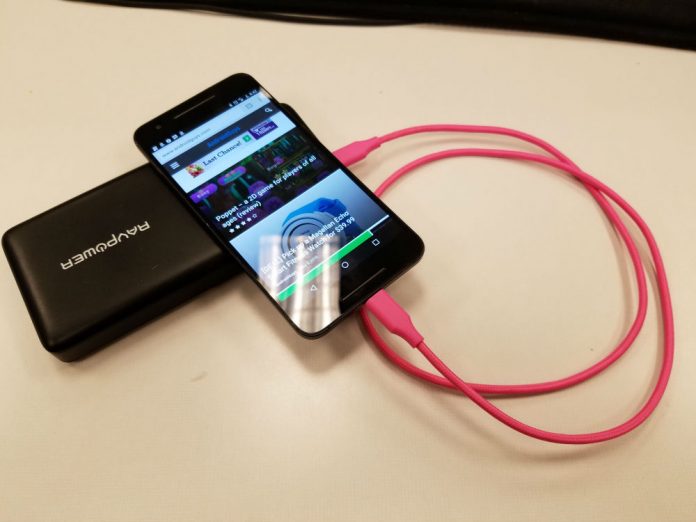
Monoprice recently announced its new Palette series of USB type-C cables. With an increasing number of devices featuring type-C ports, we thought it important to take a look at them to find out if they’re safe for your device and how they stack up against the competition.
The new line of cables comes in many sizes and flavors. You can pick from black, blue, green, gray, pink, purple, red, and white. They’re bright and colorful which I like to buy because brightly colored cables are easier to identify. The Palette series definitely stands out.

In addition to a number of colors, you also have several options in lengths and connectors. Monoprice sent over a six-inch, three-foot, and two six-foot long cables, but you can also get them in 18-inch and three-foot lengths. The cables come in type-C to type-C, type-C to type-B , type-C to mini type-B and type-C to type-A (male and female) combinations.
The construction of the cables is fantastic. All of the cables in the Palette series are covered in a braided nylon jacket that keeps them safe from nicks and cuts, as well as keeping them tangle free. The connectors are held by a hard plastic head that should last even when being beat-up in your bag. If they don’t, Monoprice offers a limited lifetime warranty.

Charging times are good. The cables can support up to 2.4A of power which puts this in rapid charging territory. Data transmission caps out at 480Mbps. These cables are all USB 2.0 cables so they can’t take advantage of USB 3.0 or 3.1 features, but Monoprice has informed us that they’re working on a design to incorporate USB 3.0 into its next lineup of cables.
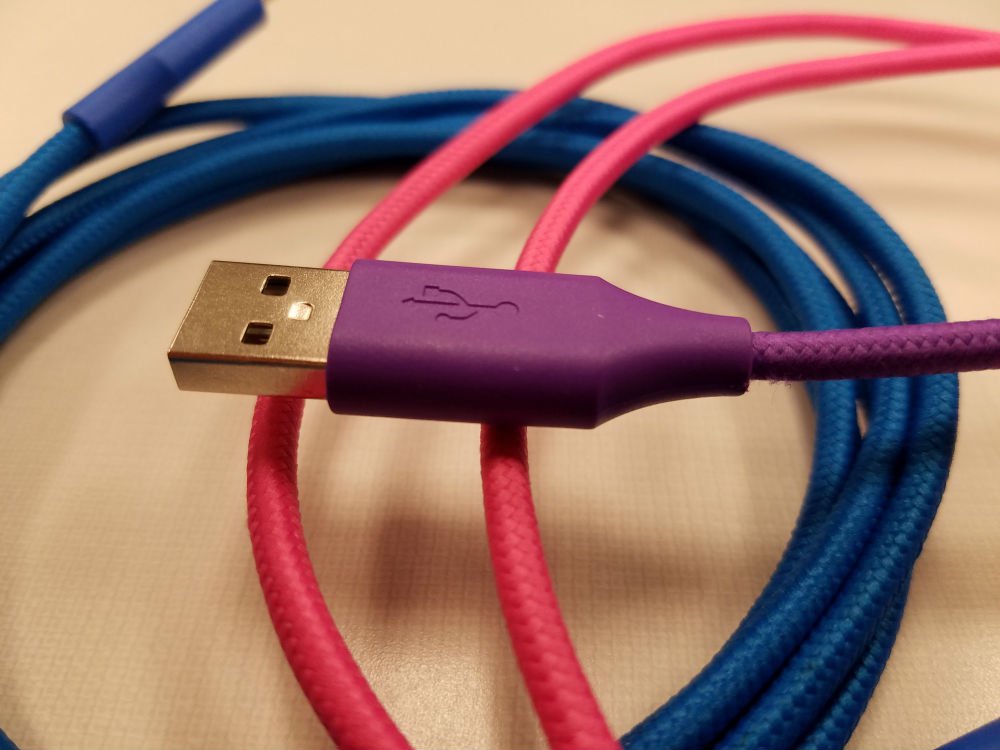
Monoprice has ensured that the new Palette series falls under compliance with USB-IF standards. While these cables aren’t currently listed as compliant, they soon should be. Famed Googler Benson Leung, who has taken to reviewing USB type-C cables on Amazon and pointing out non-compliant cables, gave Monoprice’s previous USB type-C series, the Select Series, his stamp of approval. The new Palette series is currently for sale on Amazon, which very publicly stated that they would no longer sell out of spec cables.
When it comes to price, Monoprice is right in the ball game, with everyone else, and most of the time beats its competitors. A search of Amazon finds these results:
Six-inch USB type-C to USB type-A
Amazon: $6.49 vs. Monoprice: $3.99
Three-foot USB type-C to USB type-A
Amazon: $9.99 vs Monoprice: $4.99
Six-foot USB type-C to USB type-C
Amazon: $7.99 vs Monoprice: $6.99
If you’re interested in picking up any of Monoprice’s Palette series of cables, be sure to check out its website or its listings on Amazon.
What is adb and do I need it?

You hear the phrase “adb” thrown around a lot in Android forums and blogs. We’re guilty of it, too. But what exactly is adb, and why do you need (or not need) to use it?
According to Google — “Android Debug Bridge (adb) is a versatile tool lets you manage the state of an emulator instance or Android-powered device.” That certainly sounds like something Google would say, doesn’t it? To put it simply, adb is two different applications — one running on your computer (Windows, Linux or Mac) and one running on your phone. When your phone is connected, and USB debugging is enabled, you can issue commands and communicate with the phone using your computer screen and keyboard. It’s part of the Android SDK for Windows, Mac or Linux. Sorry OS2/Warp.
Your Android phone uses the Linux kernel and tools as a base. This means that quite a few Linux commands can be sent via the adb server (the one running on your computer) to the adb client (the one running on your phone) and they will be executed. You can see a partial list of them in the picture above.
This can be awfully handy for debugging things that aren’t going right, as well sending those weird commands you need when you’re hacking away in the middle of the night. Chances are, if you aren’t actively debugging something or trying to break hack at your phone, you won’t have much use for adb. And that’s OK — there’s no right way to have fun with an Android device.
If you do have a use for adb, be sure to check out the Android Developer site for the full usage guide. Go forth and debug.
Best heavy duty cases for the LG G5

Get a case designed to handle wear and tear, so your LG G5 doesn’t have to.
No matter how careful you are with your phone, sooner or later you’re gonna drop it or it’s gonna fall. When the inevitable happens, you want to make sure it’s protected from getting scuffed, scratched, cracked, and smashed.
Not all cases are built equal. If you’re an outdoorsy type, you’ll want some added protection and only the most rugged cases can stand up to everything Mother Nature throws your way. Let’s dive right in.
- Otterbox Commuter series
- Supcase Rugged Unicorn Beetle Pro Combo
- Spigen Rugged Armor Case
- Poetic Affinity Series Case
- Lifeproof FRE
- i-Blason Prime
Otterbox Commuter series

Otterbox is well-known for making tough cases that can take a beating. Their Commuter series cases are no exception.
We tried this case out on our G5 and found that it fit perfectly. When on the device, the case forms a lip around it that protects the vulnerable corners from shattering. It also protects the LCD screen from getting scratched when the device is lying facedown.
For an Otterbox case, the Commuter feels quite light. It’s comprised of two pieces: a hard polycarbonate outer shell and an inner silicone liner. The hard plastic shell protects the phone from scratches and dents while the softer inner lining absorbs impacts. The inner lining also has flaps that cover the charging port and audio jack so that dust and debris cannot get in.
You won’t have to fiddle with removing the case to access important features of your device — the case has a triangular cutout in the back for the camera and the fingerprint scanner, cutouts along the bottom edge for the speaker and microphone, and along the top for the microSD card slot.
While not the heaviest-duty case around, the Commuter series is rugged enough to protect your LG G5 from damage from most everyday situations. If you’re taking your phone with you while skydiving, well, maybe this isn’t the case for you.
See at Amazon
Supcase Rugged Unicorn Beetle Pro Combo

If you want a strong combination of solid protection and sporty design, this is the case for you. The Supcase Rugged Unicorn Beetle Pro Combo includes a built-in screen protector and a swiveling belt clip holster so your phone is secure and protected, yet easily accessible if you’re out hiking in the wilderness. With a dual-layer back cover offering shock absorption and port covers to keep dust and debris out, your phone is protected 360 degrees.
It’s available in three distinct colors and, according to one reviewer, is even better when paired with a tempered glass screen protector, in lieu of the one the case provides. It’s worth considering if you trust the protection that tempered glass provides.
See at Amazon
Spigen Rugged Armor Case

This offering from Spigen is sleek and elegant, with a carbon fiber texture that offers a better grip in your hand. Made from thermoplastic polyurethane (TPU for short), it’s flexible enough to be easy to install your LG G5, while still providing fantastic protection, thanks to military-grade certified air cushion technology to protect when your phone falls and lands on its corner.
When you put your G5 down, your screen and camera is always protected with a 1.2 millimeter lip around the display and 1.5 millimeter of space between your camera lens and the table or ground if you drop it. And, for all the protection Spigen provides, you’ll also retain easy access to all the buttons, ports, and speakers.
See at Amazon
Poetic Affinity Series Case

If you want full-protection but also want to show off the LG G5 design, this is the case for you. Made of clear polycarbonate with TPU accents around the corners, this case is slim and stylish with extra protection provided for those detrimental impact areas. If you’ve found other cases to be slippery and hard to hold, you’re going to love the side grip pattern they’ve included. The extra texture will make your phone easier to hold without adding unnecessary bulk.
The X-form strips of black TPU running down the back aren’t just there for looks — they also provide shock dissipation without sacrificing the thin form factor. With raised bezel protecting your display and the same level of protection for the camera lenses on the back, it’s perfect for protecting your new phone while still allowing you to show off its design.
See at Amazon
Lifeproof FRE for LG G5

If you’ve had a Lifeproof case before, you know what you’re getting here. This case is waterproof, dirt-proof, drop-proof and even snow-proof, making it arguably the best full-protection case you can buy. This is the case for you if you’re constantly out exploring in the wilderness and want to make sure your phone is protected from the elements.
It has received the highest ratings on the Ingress Protection scale, meaning it’s guaranteed for full immersion in up to 6 feet of water for an hour. It also meets the U.S. Military Standard for drop and shock protection. Also included is a headphone adapter, so you can enjoy your music while surfing or snowboarding without worrying about compromising the waterproofness of the phone. All in all, if you never want to worry about your phone being damaged by the elements or drops, this is the case for you.
See at Lifeproof
i-Blason Prime

Combining rugged protection with stylish design, the i-Blason Prime features a dual-layer back cover that includes a convenient kickstand built right in. Featuring a polycarbonate hard shell with carbon fiber patterns on the inlay coupled with a shock absorbing silicone sleeve, your G5 will get a snug fit with maximum protection. And, all the ports are precision-cut with ample space for all your cables and headphones.
It also comes with a side-mount holster that clips onto your belt, and the raised bevel around the display won’t affect your ability to install a screen protector.
See at Amazon
How ’bout you?
Not finding what you’re looking for here? Check out our guide to the best cases for the LG G5. Or, do you have a favorite rugged case for your LG G5 that isn’t on the list? Drop us a line below in the comments!
LG G5
- LG G5 review
- LG 360 CAM review
- LG G5 complete specs
- LG’s G5 Friends modules are a neat idea, but they won’t matter
- LG G5 Hi-Fi Plus w/ B&O
- Join the LG G5 discussion
AT&T
Unlocked
Sprint
T-Mobile
Five must-have games for your Oculus Rift

Consider this your Oculus Rift starter kit.
There’s a lot going on in the Oculus Store, which is the primary place you get games for your Rift headset. Titles range wildly when it comes to price and description, due in no small part to Oculus pulling content that was originally made for the Samsung Gear VR into the store so you can experience it in a higher resolution. It’s a lot to take in, and that’s only going to get more interesting when you start playing games for your Oculus Rift that come from Steam instead of the Oculus Store.
To help you get started with your Oculus Rift, we’ve put together a quick lift of titles everyone should have in their library in order to fully appreciate this incredible VR experience.
Ready, go!
Project CARS, for all racing fans
When it comes to racing in VR, you either want the most realistic experience possible or you want something utterly fantastic with weapons and whatnot. Project CARS is the former, and in regular PC form it’s a fantastic racing sim that offers more realism than just about anything else available today. Put that experience in a VR headset, and you include real world head tracking from the driver’s seat to take that immersion one step further.
The cost of admission into this incredible experience is $50 through the Oculus Store. If you’re a fan of driving games, the Project CARS will be well worth it.
Adr1ft, for a disembodied adventure in space
Virtual Reality has created an incredible space for First Person Experiences, or FPX for short. These games create an environment where you experience a story happening all around you. These games are often powerfully emotional without being overly action-packed or requiring an itchy trigger finger.
Adr1ft puts you in a space suit as you float silently through a space station that has just failed catastrophically, and through your Oculus Rift that experience can be downright terrifying if you let it.
This stunning FPX will set you back $20, but is a perfect way to show off VR to someone who doesn’t handle shooters or campy platformers well.
Chronos, to get your RPG on in VR
Most great games are great regardless of where you’re playing. Virtual Reality adds depth and immersion, but the story and the game mechanics still need to be above and beyond to really capture the player. Chronos is an RPG with an interesting twist: every time you “die” in the dungeons your character ages by a year, forcing you to be very careful about the decisions made at every turn.
Through Oculus this game becomes an experience you witness almost from above. Using your head as the ‘camera’ makes finding treasure and lurking enemies a lot more interesting, ultimately leading to an enjoyable and unique experience all around.
Chronos is $50 through the Oculus Store.
The Climb, to experience beautiful immersion
Rarely do you hear the words “achieved with CRYENGINE” and walk away disappointed. With games like FarCry, MechWarrior Online, Crysis, and Ryse: Son of Rome all having been built with the CRYENGINE platform, seeing that brand usually means you’re in for a visual treat. In The Climb, you may not walk away at all. The game is built to make you feel as though you’re climbing massive rock formations. As you look around with your Rift, the environments you’re climbing in are intoxicating and — if you’re afraid of heights — terrifying. You can race your climb against friends if you need co-op in your lift, but clearly the goal here is to solve some cool puzzles and enjoy the remarkable scenery.
Bonus points: this game will almost assuredly be even more incredible when played through Oculus Touch controllers when they are made available later this year. For $50 in the Oculus Store, it’s nice to know you’re getting a game that will be even more fun later on.
Eve: Valkyrie, for intense space combat
If you’re one of the first to order an Oculus Rift, you already own Eve:Valkyrie. If you weren’t so lucky, add this game to your library right now. It’s a futuristic space flying game that puts you in control of an incredible aerial experience. As a fighter pilot, you need to be constantly looking out of your cockpit windows for the enemy, which makes using your Rift headset a ton of fun. Play in squads with friends or in massive groups to take down even bigger ships in some of the classic battles throughout the Eve universe.
There’s no other way to say this, the game is nonstop excitement and well worth the $50 from the Oculus Store.
 AIVAnet