


Dish gets into… the iPhone repair business?
Now this is interesting. Today, satellite TV provider Dish introduced a new service for iPhone repairs in the US. It’s an intriguing business decision, considering the company hasn’t done anything similar in the past — unless you take into account fixing its own antennas and set-top boxes. Still, Dish’s Executive VP of Operations, John Swieringa, says his team of technicians is “uniquely positioned with the technical know-how” to fix people’s broken screens and batteries.
Smart Phone Repair, which isn’t limited to Dish customers, will require a one-time $35 fee to get a technician to your home or office. After that, you’ll have to pay anywhere between $40 and $190 depending on what kind of iPhone you have and what’s wrong with it. That’s a lot less compared to what Apple charges for accidental damages, particularly if you aren’t covered by Apple Care or Apple Care+.
At launch, the service is only going to be for Apple’s iPhone, 5, 5c, 6, 6 Plus, 6s and 6s Plus, but Dish said in a press release that it plans to support other devices “in the coming months.”

Detailed pricing for Dish’s Smart Phone Repair service.
Source: Dish
Erato is the next company trying ‘truly wireless’ earbuds
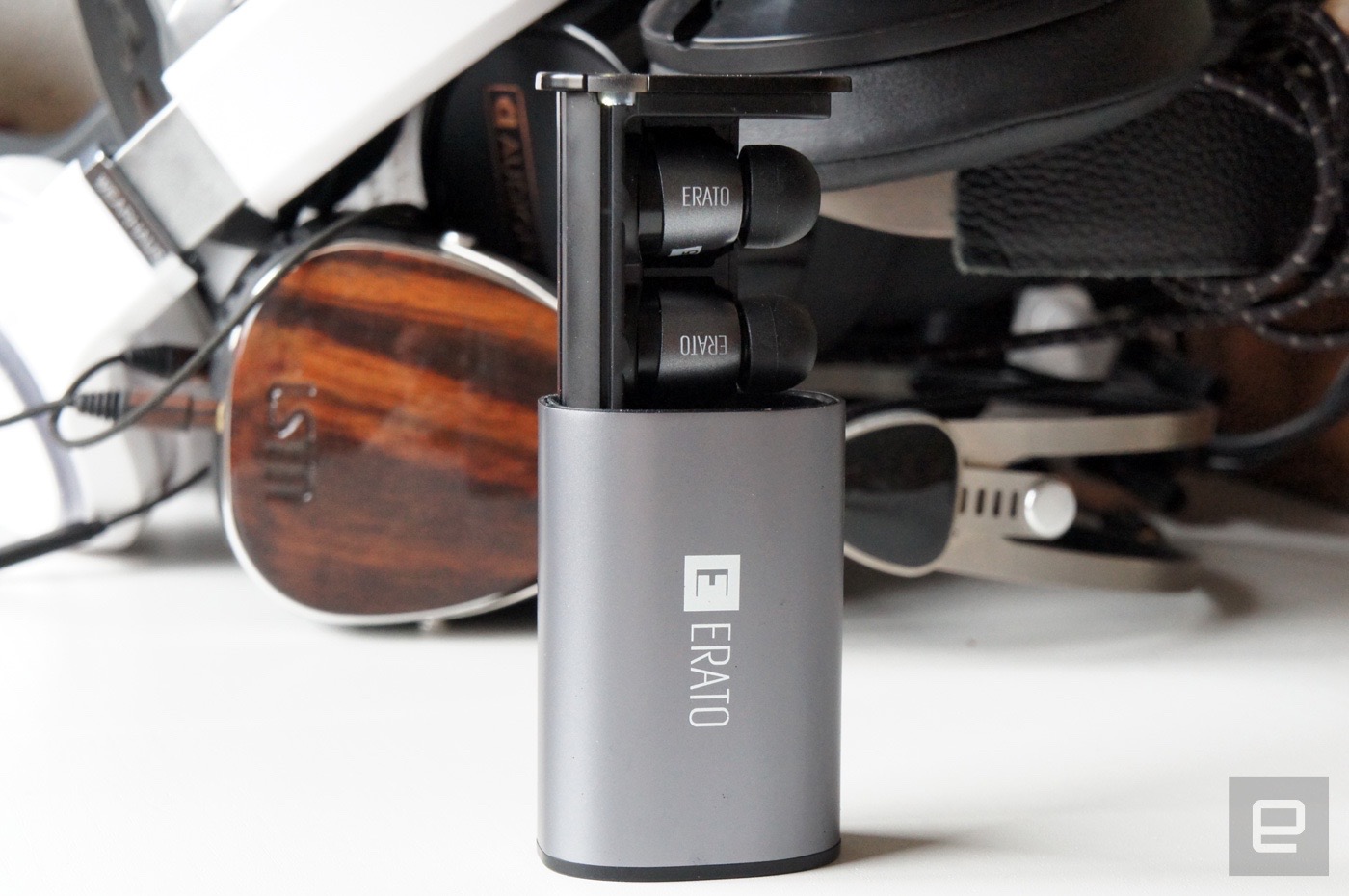
Cast your mind back to 2014. Now imagine a pair of wireless headphones from that time. Most likely, you thought of an “over the head” pair of cans, like the SMS Sync, or a pair of tethered earbuds like Powerbeats. These days, the definition of “wireless” is being taken to its logical conclusion: buds not joined to each other in any way. The concept first came to many people’s attention via Bragi Dash or Earin. The idea is catching on, though, with more headsets — including known brands — getting in on the action. Is this the future of wireless earbuds? Newcomer Erato, with its Apollo 7 set, seems to think so, and — like Bragi and Earin — it’s hoping you’ll be excited enough to fund it on Kickstarter. I got to try an early set for myself, and see if truly wireless really is the way to go.
The first question you might be asking is: What does the Apollo 7 offer that existing products don’t? We’ve already mentioned the main rivals (Bragi Dash and Earin), but to recap, the Dash costs $300 a pair and comes with a mic, fitness-tracking features, a slick app, touch controls, an onboard media player and a host of sensors. The Earin is just headphones (no mic, so it can’t be used for calls). Earin is also a lot smaller than the Dash and, at $250, more affordable. The Apollo 7 buds look similar to Earin, and will also cost $250 a pair — but only for early birds on Kickstarter. The retail price will be $299, putting them on par with the more feature-rich Bragi.
Price aside, Apollo 7’s really going after Earin’s lunch, if design is anything to go by. In particular, the winning feature here is a microphone for handling calls. Basically, then, Erato took the one key function Earin doesn’t have and made an otherwise very similar product. In my opinion, the Apollo 7 has a decent second advantage as well. Each bud has a small button so you can control tracks, change volume and answer calls. With Earin, you control music playback via the media player (and there are no calls to answer, obviously). But for the price, there aren’t many reasons to choose these over the Bragi, unless you really prefer the smaller bud.

But what are they like to use? Those little buttons actually work surprisingly well, given the lack of available real estate. A long press will switch each bud on or off and activate Bluetooth pairing. A single press answers calls or pauses music. A double press, meanwhile, will increase or lower volume depending on the side (press the left ear for volume down, right for up) or activate Siri/Google Voice. The buttons aren’t as fancy as the Dash’s swipe/touch controls but are less prone to flaking out (as is sometimes the case with Bragi’s headset).
One other benefit with Erato’s design is that you pair each bud individually (they then connect with each other). This is different to how Bragi’s Dash works, which uses a technology that requires both buds be close to each other to function. With the Apollo 7, two people could listen to the same track with one bud each. You could also just use one as a hands-free headset, and swap it for the other when the battery goes. Which it will: a common feature of all these headphones is short battery life. Apollo 7 is no worse than the others, but you’re still looking at about three hours on one charge. (The battery in the case can charge them two full times before you need to find an outlet.)
The first thing I noticed when wearing the Apollo 7 is that they stick out a bit. My wife told me I looked like Frankenstein’s monster. It’s not that bad, but they are a little on the pokey-outey side. Otherwise, they’re comfortable to wear, and never felt like they were going to fall out, even during runs. While most of the Apollo 7 sits in your ear where no one sees it, there are four colors to choose from, which eerily/un-coincidentally match the colorways of the iPhone (dark gray, light gray, metallic pink and gold). The buds are so small that there’s not really a lot to judge them on, looks-wise, but they’re not ugly.
Far more important than looks, of course, is sound. I’ll admit that at first I found the Apollo 7 a little harsh. Mid-frequencies had a bite to them that I didn’t take to at first, while lower tones were better (and not overpowering). After extended wearing, I did find them to be less harsh, but it’s not clear whether I adapted to them, or there was some of that fabled “burn-in” going on. In summary, the Apollo 7 sounds adequate, but you might be used to a superior sound if you’re accustomed to paying the same price for wired headphones.
There’s a bigger problem than metallic midtones, though. Much like Earin, the Apollo 7s frequently lose connection with each other. This usually results in one, but sometimes both, ear buds going silent for a second or two while they reestablish connection. It’s a pain, and makes for a generally frustrating experience. It’s not a deal-breaker, as they do seem to settle after a few minutes and then the connection holds for good, but your threshold for minor annoyances may vary.
The far bigger problem, and this is true for all three headsets mentioned, is that they can struggle to maintain a connection to your audio source/phone when you’re outside. If you walk along holding your device in your hand, or your chest pocket or backpack, there’s no problem. But should you slide your phone in your front trouser pocket, it’s pretty much game over. The distance between the headphones and the handset is just enough for the signal to keep dropping in and out. If this is going to your primary use scenario, then stick with conventional Bluetooth headphones, or a wired set.
This really is the theme across all these “truly wireless” headphones I’ve tried so far. The absence of any cables seems to mean contending with flaky connections and tolerating short battery life. I’d suggest, for many, that an untethered experience might not be worth it.

This is a real shame, because the Apollo 7 does sometimes offer a good experience. I used them all week while at my desk, and even wandering around the office (some distance), and the connection held up. It’s just the great outdoors that seems to flummox small Bluetooth devices, and wireless earbuds are definitely that. Again, this appears to be a limitation of the form factor and Bluetooth, not this specific product, but that’s likely little consolation if you’re hoping to enjoy these in the sunshine.
So is it time to join the truly wireless club? I’d say hold off for now. All three products I’ve tried have their merits. They also have some pretty big drawbacks. When they work well, they’re great. When they bug out, it’s no fun at all. What’s more, if companies like Intel and Apple have their way, the 3.5mm jack will be a thing of the past, and you’ll want to consider wireless headphones even if right now you’re not interested. Should that happen, let’s hope companies like Erato will have ironed out these kinks. If you’re not fazed by the above, and are ready to cut that last cable, you can put your money where your ears are over on Kickstarter.
Source: Kickstarter
TalkTalk to simplify broadband prices by including line rental
Line rental is one of the things you have to consider when taking out a broadband contract, since they almost always come hand in hand. But with these two separate monthly fees, one-off setup charges and introductory discounts, you need ten minutes and a calculator to figure out exactly what you’re being asked to pay. TalkTalk has pledged today, however, that this autumn it’s going to make everything that bit simpler, by bundling line rental and broadband costs into one, transparent monthly price for all of its packages.
TalkTalk has dabbled with “all-in pricing” before — last year’s Black Friday offers used this model, for instance — but expects to be the first major provider to implement it fully. If others don’t beat TalkTalk to the punch, though, you can be sure they won’t be far behind.
After all, the Advertising Standards Authority (ASA) told ISPs earlier this year that they must do away with confusing and convoluted pricing. Its recommendations included bundling all monthly costs into one figure, though without any strict guidelines published just yet, the new rules probably won’t come into force at the end of May as previously expected.
Source: TalkTalk
ICYMI: AI in a USB stick, electric bike wheel and more

Today on In Case You Missed It: Chip maker Movidius created an advanced neural networks USB stick to put AI into any device; the GeoOrbital wheel turns any dumb bike into a 20 miles per hour powerhouse; and Samsung has a pilot program to put a mother’s heartbeat into her premature baby’s incubator.
An open source robot used for research is also really good at yoga. As always, please share any great tech or science videos you find by using the #ICYMI hashtag on Twitter for @mskerryd.
Xiaomi Mi Max, Mi Band 2 leak ahead of official unveil
Xiaomi’s all set to unveil the Mi Max phablet and the Mi Band 2 in Beijing on May 10. Ahead of the official launch, live images of the phone and smartwatch have surfaced, giving us a look at what’s on offer from Xiaomi’s upcoming products.

From the image above (via CNMO), we can see that the Mi Max will feature a metal frame, with capacitive buttons at the front. Early leaks hinted at a fingerrint sensor, which may be included at the back. As for what’s on offer with the Mi Max, the latest rumors suggest a 6.4-inch FUll HD display, Snapdragon 650 SoC, 3GB of RAM and 32GB storage, 16MP camera, and a 5MP front camera.

As for the Mi Band 2 leak (via FoneArena), it looks like the fitness tracker will be similar to its predecessor, featuring a detachable sensor unit. The device will also offer a display that shows battery status and time, along with daily steps, BPM, and more, with a physical button allowing you to toggle between various modes.
Both products are set to be officially announced on May 10. Xiaomi is also slated to roll out MIUI 8, and may announce its custom Rifle CPU cores at the event.
Oppo R7s gets a near-stock Android experience with Project Spectrum beta

Oppo announced the company has made available a new Marshmallow-based ROM for the R7s. Called Project Spectrum, this beta test is ready for download and will be available for the R7 Plus on May 13. Project Spectrum is an alternative option for those with supported OPPO hardware who do not wish to use ColorOS. What makes this particular option worth considering is the near-stock Android experience.
The team at OPPO have fused together some of the best features of Android 6.0 Marshmallow and ColorOS. Not only will you see Doze Mode and more from Google, but also OPPO customizations like screen gestures like double-tap to wake, VOOC Flash Charge support and more. You can head to the OPPO website for more details and download links.
Press Release
Shenzhen, May 3, 2016 – Continuing efforts to bring greater choice to a wide range of users, OPPO has released a Marshmallow-based Project Spectrum beta for the R7s, with an R7 Plus release planned for May 13.
Project Spectrum is an official alternative to OPPO’s ColorOS, offering a near-stock Android experience while preserving some of the best-loved features of ColorOS.
Project Spectrum for the R7s combines all the advantages of Android 6.0.1 Marshmallow, including the battery-saving Doze Mode and Google Now on Tap, with some of ColorOS’ signature enhancements: customizable screen-off gestures (double tap to toggle wake/sleep modes, draw a circle to start the camera app, etc.), support for VOOC Flash Charge, OPPO’s phenomenal camera app, and more.
Previous devices to receive the Project Spectrum treatment include the Find 7, R5 and the R7g (available in Taiwan, Australia and Singapore). Meanwhile, a Marshmallow-based beta for the R7 Plus is set to be released on Friday, May 13.
To install the new Project Spectrum release, R7s users need only visit the OPPO Community website to find the download and instructions.
Warranties for devices sold over oppostyle.com or Amazon in Europe, which mostly serve Western customers, will not be affected if users choose to switch to Project Spectrum. Customers who bought their phones anywhere else, such as offline stores in Asia, Africa or Latin America, should consult their local resellers for detailed information about warranty policies.
The OPPO R7s is the latest device to receive Project Spectrum.
For users who prefer a superb, hassle-free experience straight out of the box, ColorOS will continue to be supported as the default system for all OPPO phones.
BMW i3 upgrade now delivers a whopping 195 miles on a charge, watch out Tesla
It looks like Tesla has given the established car companies enough of a shock to get them taking electric cars seriously. Now BMW has upgraded its i3 battery to extend the range to a respectable 195 miles on a charge.
Tesla announced its Model 3, the first affordable electric car from the company, which led to it getting millions of pounds worth of pre-orders. The BMW i3 is already placed at an affordable price point but didn’t deliver the range, unless the Range Extender was added. This battery upgrade should make it more appealing.
The new BMW i3 94Ah, as the name suggests, uses a 94Ah battery over the current 60Ah offering. That means fast charging for a full charge in under three hours, 170hp, a 0-62mph time of 7.2 seconds and a 195-mile range when it arrives in July.
All that and it’ll fit inside the same physical space as before thanks to a more densely packed battery for a 33kWh setup. The motor is efficient too and in fact, BMW says, makes this the most economical electric car of its size and class.
The BMW i3 94Ah model, available from July, will be £27,830 while the Range Extender, which tops out at 276 miles and is a little slow off the mark, will be £30,980. Both prices are after deducting the £4,500 OLEV government grant amount.
READ: BMW i8: Driving the supercar of the future
Best tech BBQ kit for a flaming good summer
Summer is finally upon us and with it comes the primal desire to make fire and cook meat. But the barbeque itself doesn’t have to be such an old traditional grill, there’s plenty of new tech to make cooking outdoors even better.
The art of the barbeque has jumped leaps and bounds beyond the simple task of making a fire and heating some charcoal under a grill. Nowadays you can fire up a grill outside without needing to actually make a fire. You can even create a BBQ ready cooking station that goes from cold to hot in mere minutes.
But kit goes beyond the barbeque itself. Now there are ways of making even the most novice fire-starter and chef create a meal on the grill worthy of praise.
We’ve found the best barbeques and the best BBQ gadgets to help make outdoor cooking easier, faster, more fun to end up with the best food possible.
Lotus Grill and Lotus MiniGrill BBQ
Lotus
If you want to make your barbeque as quick, simple and safe as possible you can’t go far wrong with the Lotus Grill and Lotus MiniGrill.
The Lotus Grill is a battery-powered, fan-assisted unit that is ready to cook within 5-minutes of powering on. It’s also totally smokeless so you should be able to use it anywhere. Before you worry about losing that smoky taste, know that the grill uses natural hardwood charcoal that’s infused in the food via invisible gases. So you get the flavour without the carcinogens of flame-grilled food.
The newer Lotus MiniGrill goes from off to ready-to-cook in just 3-minutes. It’s half the size of the Louts Grill at just 2kg and has a grill that prevents sticking so there’s no oil needed, making it even more healthy.
The Lotus Grill starts at £140 while the Lotus MiniGrill is £100 on Cuckooland.
Grillbot
This has been described as the Roomba for your barbeque. It’s a robot that will take care of cleaning your barbeque so you can cook, eat and that’s it.
The Grillbot is armed with brushes on three corners. These spin and drive the bot around your grill, brushing it clean. A simple button touch sets it to go for 10, 20 or 30 minutes. It’s rechargeable and the brushes can be replaced so you never need to clean your grill again.
Grillbot is $130 (about £88) and comes in red, blue, orange and black from Grillbots.
BBQ Dragon
BBQ Dragon
If you’ve already got a barbeque but want to speed up the lighting process the BBQ Dragon can help.
Essentially the kickstarted BBQ Dragon is a glorified hair dryer. But it works far better than even the best stylist’s kit with a BBQ heated to readiness in just 10-minutes. It’s also powered by micro-USB meaning you can use anything that charges your phone, mobile or otherwise, to keep it powered. The BBQ Dragon clips to any barbeque and goes to work automatically so all you need to do is get the food ready to cook.
The BBQ Dragon is $60 (about £40) from BBQDragon.
Caliber Pro Kamado Charcoal Grill
Caliber
If a simple grill isn’t enough and a true smoker is what you want you’d normally need to shell out for more charcoal. The Caliber Pro Kamado aims to change that.
This grill does it all, with slow cook settings to smoke meats or pizza stone addition to fire up a pie fast. There’s even a rotisserie accessory for perfectly cooked birds.
It’s good that you’ll save money on charcoal as you’ll need to shell out $1,800 (£1,220) to get one from BBQguys.
BBQ Grill Light and Fan
Amazon
When night descends it can make cooking on the barbque harder than it needs to be. Then there’s that breeze that will inevitably blow smoke in your face. The BBQ Grill Light and Fan aims to tackle both those issues.
It simply clips onto your BBQ and uses 4 LED lights and dual fans powered by 8 AA batteries to make cooking a well-lit and smoke-free experience.
The BBQ Grill Light and Fan is $80 (around £55) on Amazon.
Uuni 2S wood fired oven
Uuni
This one moves away from the traditional BBQ while keeping the cooking in the garden, to make pizza.
The Uuni 2S is the next generation of this wood fired pizza oven that can make a pizza go from raw to cooked in as little as 90-seconds.
This bad-boy heats up to 500 degrees Celsius and uses a stone base to make sure pizza is cooked to crispy perfection. Simply load with wood chips, get the flames going and once up to speed start loading in your homemade pizzas. The result is a smokey taste and fun alternative to the traditional BBQ outdoor experience.
The Uuni 2 is £199 and can be bought directly from Uuni here.
READ: Best garden gadgets for your summer 2014 yard upgrade
Start saving now, Nintendo NX likely to be expensive
Nintendo has learnt many lessons from the troubled lifespan of the Wii U and that is likely to be both good and bad news for the Nintendo NX.
It will undoubtedly benefit from the extra time the company wants to put into its development before a March 2017 release. However, it could also turn out to be much more expensive than previous Nintendo consoles.
Speaking during the company’s Q&A session with investors, on the back of its posted financial results, CEO Tatsumi Kimishima revealed that the NX will not be made at a loss. It is thought that the Wii U hardware cost Nintendo more to make than it could recoup in sales alone. Software sales would make up the shortfall.
“We are not thinking of launching the hardware at a loss,” he said.
“When Wii U was launched, the yen was very strong. I am assuming that situation will not repeat itself. Selling at a loss at launch would not support the business, so we are keeping that mind in developing NX.”
READ: Nintendo NX: Release date, specs and everything you need to know
Considering that it is widely speculated that the NX will be a much more powerful machine, on a par with Xbox One and PS4, yet is also described as a “totally new concept”, that is likely to mean it won’t come cheap.
On the up side, Nintendo doesn’t want to repeat the issues that it faced when launching the Wii U. It announced the current console at E3 more than a year before release and clearly felt under pressure to deliver.
Both the Xbox One and PlayStation 4 were released a year later, so it was immediately superseded in hardware terms – resulting in a shortened shelf life.
“We want consumers to continue to play this game system for many years, so we believe that in the beginning it is most important to make sure that everything is in order at launch,” said Kimishima.
“In that sense, our approach is that we should wait until we can provide a fully realised experience rather than rushing to launch in the holiday season, and this approach has not changed.”
Samsung Galaxy A5 and A3 make the mid range feel premium
Samsung has announced its latest Galaxy A series phones in the A5 and A3, both of which deliver impressive specs and build for the mid range.
Samsung has taken everything it’s developed at the flagship level for the Galaxy S7 and S7 edge and filtered it down to make it more accessible for everyone. That means better cameras, fast charging and good build quality all for a more affordable price than the flagship phone.
The Galaxy A3 and A5 both use premium glass and metal builds that are just 7.3mm thick. Both feature Android 5.1, 13-megapixel and 5-megapixel f/1.9 cameras and Super AMOLED displays.
The larger Galaxy A5 is also more powerful with a 5.2-inch 1080p display, 1.6Ghz octa-core with 2GB of RAM, 16GB storage and microSD. This uses a 2900mAh battery that’s fast charging compatible and reaches cat 6 LTE speeds.
The Galaxy A3 is smaller with a 4.7-inch display at 1280 x 720 resolution, 1.5GHz octa-core processor with 1.5GB of RAM and 16GB storage plus microSD expansion. This tops out at cat 4 LTE and uses a 2300mAh battery.
The Samsung Galaxy A3 and A5 handsets are on sale from 5 May and will be available in black, white or gold variants. The A5 is £229 and the A3 is £179.
READ: Samsung Galaxy S7 tips and tricks: Master your new Galaxy
 AIVAnet