


Twitter Experimenting With Dedicated GIF Button for Mobile Apps
A few Twitter users on the social network’s Android app have begun to notice a dedicated GIF button within the Tweet composition box of the mobile client. Speaking with TechCrunch, Twitter user Phil Pearlman said that the new button lets users browse through current popular GIFs in a trending tab, or select a mood they’re feeling to see resulting GIFs based on that emotion. So far the GIF button appears to only be showing up on Android, but if Twitter is planning a wide rollout, it should presumably come to iOS as well.

If people aren't seeing it yet twttr is testing way cool gif feature. cc @bluechoochoo pic.twitter.com/LuTsVeUiSs
— Phil Pearlman (@ppearlman) February 4, 2016
http://platform.twitter.com/widgets.js Pearlman wasn’t the only Twitter user to see the GIF button appear within the Android app, with quite a few people mentioning it over the past day. It’s also been disappearing for just as many who got to briefly test the feature out, with a couple users — including Pearlman — noticing the button suddenly disappearing from the app.
Besides a playful GIF of its own, Twitter didn’t respond to comment on the possible large-scale rollout of a GIF button feature for the service’s mobile app. Given that many users already go through the laborious process of searching for GIFs online and inserting them into tweets through the Media option, it makes sense for the company to begin streamlining that process.
Discuss this article in our forums
App Store and iTunes Experiencing Issues for Many Users Worldwide
Apple has updated its System Status page to reflect that many users may be unable to access, purchase, or update apps on the App Store on iPhone, iPad, and Mac. Multiple other iCloud services are or were also experiencing downtime, including the iTunes Store, iBooks Store, iCloud Drive, and iWork for iCloud.
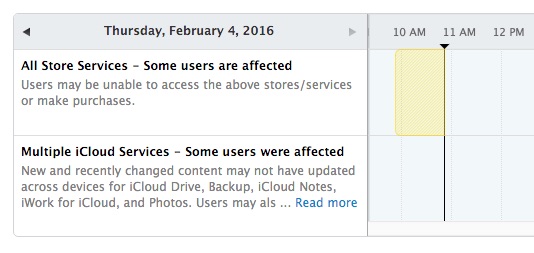
The issues began shortly before 7:00 a.m. Pacific and appear to be widespread, affecting customers in the United States, Canada, Europe, and elsewhere, according to social media posts. Apple TV services and Apple’s Volume Purchase Program are also affected by the service issues.
This article will be updated as the status of Apple’s services changes.
Discuss this article in our forums
Huawei’s Honor 5X is now available in Europe from €229/£169

Today is February 4th, which means it’s the day that the European launch of Huawei’s Honor 5X at an event held in Munich, Germany. In the States, the handset launched with a budget-friendly $199 price tag, while in Europe it has been announced that the 5.5-inch Honor 5X is priced at €229 in Europe, or £169 in the UK. Join us after the break for a brief rundown on the handset’s hardware.
The Honor 5X features a 5.5-inch Full HD display using IPS technology, Snapdragon 616 processor, 2GB of RAM, rear fingerprint scanner, 16GB of internal storage that is expandable by up to 128GB thanks to the included MicroSD card slot. There’s dual-SIM functionality as well. Some of you may have noticed the bump in spec, in that the Honor 5X was originally slated to use the Snapdragon 615, but is now using the updated version, the 616. The difference in processor means that the lower quad-core runs a smidge higher, thus providing a little extra grunt. Providing the power is a 3,000mAh non-removable battery. Moving on, and the Honor 5X carries a 13MP rear camera with LED flash, with an 8MP front camera for those selfie pictures.
The handset runs Android 5.1 Lollipop with Huawei’s EMUI 3.1 skin on top, an update to Android 6.0 Marshmallow has already been confirmed, although the ETA has not been set presently.
The Honor 5X supports all European network bands, so theres no worries that it won’t support your network’s 4G bands. The Honor 5X also supports WiFi 802.11 b/g/n (2.4GHz only).
Besides being priced at €229/£169, the Honor 5X will launch in Gold, Silver and Grey variants from Honor’s own web store, vMall.eu, as well as Amazon.
What do you think of the Honor 5X? Is it the smart choice for the budget-conscious consumer? Let us know your thoughts in the comments below.
Come comment on this article: Huawei’s Honor 5X is now available in Europe from €229/£169
Samsung Galaxy S7 and Galaxy S7 Edge pass through the FCC

Earlier today, a couple of unannounced Samsung-branded smartphones bearing the model numbers SM-G930A and SM-G935A passed through the United States of America’s official cellular certification authority, the FCC. This isn’t the first time we’ve seen these two model numbers, though. Back in November, we reported that the International variants of the Galaxy S7 and Galaxy S7 Edge will have these identification digits attached when they’re finally introduced to us on Sunday, February 21.
Unfortunately, the paperwork that accompanied the handsets doesn’t disclose anything about the internals of the duo, but we do know that they are set to pack a variety of different connectivity options, including support for 4G carrier bands 2 4, 5, 7 and 13, Bluetooth Class 1 (Version 4.0, LE+EDR), 802.11b/802.11g/802.11n dual-band Wi-Fi, NFC and GPS.
If recent leaks and rumors are anything to go by, it certainly looks like the Galaxy S7 is destined to be the most impressive smartphone of 2016, with its 5.1-inch qHD display, a Qualcomm MSM8996 Snapdragon 820/Exynos 8 Octa 8890 CPU, an Adreno 530/Mali-T880 MP12 GPU, 4GB of RAM, 32/64/128GB of internal flash memory and a 2,550mAh non-removable Li-Ion battery. It’s also expected to feature an iris scanner, together with a biometric reader and heart rate monitor.
If you wish to view the full FCC filing, hit the source link below.
Come comment on this article: Samsung Galaxy S7 and Galaxy S7 Edge pass through the FCC
Benchmark shows Xiaomi’s Mi 5 having a 5.7-inch display

Less than three weeks away from Xiaomi’s February 24 launch event for the Mi 5 and today we’re getting a better idea of what the handset will offer. On GFXBench, alleged specifications for the Mi 5 were revealed and perhaps most surprising the size of the display. The handset was originally believed to have a 5.2-inch display, but this benchmark shows its display being 5.7 inches. Xiaomi’s Mi Note series already features displays of that size, so it’d be a little confusing to see the Mi 5 have such a large display.
Hit the break and we’ll take a look at the alleged specifications.

The benchmark shows the display, measuring 5.7 inches, has Full HD (1920×1080) resolution. Even aside from the size being abnormally large for the series, it’s difficult to believe Xiaomi would pair Full HD resolution because quality (or pixel density, specifically) would suffer after being stretched. Having a 5.2-inch display would keep everything nice and tight for Full HD. If anything, Xiaomi would need to raise the resolution to Quad HD (2560×1440) to accommodate for 5.7 inches.
Xiaomi is also apparently going to be using Qualcomm’s Snapdragon 820 processor, Adreno 530 GPU, 3GB of RAM, and 64GB of internal storage. Both rear and front cameras were not identifiable, and GFXBench tells Phone Arena it’s possible Xiaomi blocked them on purpose.
Also, Android 6.0 Marshmallow was found running at the core. But, undoubtedly, Xiaomi will use its MIUI over stock Android.

The Mi 5 won’t be available in the United States, but consumers in the country seeking to get a Xiaomi device can purchase one through US Mobile. The carrier announced on Monday that it is selling Xiaomi and Meizu devices in the U.S.; however, Xiaomi quickly disapproved of any transactions because authorization was never provided. US Mobile has since stripped its webshop and said its just operating in the same way Amazon does.
Source: GFXBench
Via: Phone Arena
Come comment on this article: Benchmark shows Xiaomi’s Mi 5 having a 5.7-inch display
Spotify is finally here for the Amazon Echo

Listening to music on the Amazon Echo just got a little bit easier today. Amazon and Spotify announced today that Spotify Premium subscribers in the US will now be able to effortlessly play their favorite music on the Amazon Echo.
All Amazon Echo owners have to do is tell Alexa to play a specific playlist, artist, or genre. For example, one might say, “Alexa, play Adele on Spotify” or “Alexa, play my Study playlist on Spotify.”
Amazon Echo also supports Spotify Connect, which allows users to effortlessly transfer their music experience and control from the Spotify app to Echo.

Keep in mind that this functionality does require a Spotify Premium subscription. Alternatively, if you’re not a Spotify subscriber, Echo has some of the same capabilities with other services, including Amazon Music, Prime Music, iHeartRadio, Pandora, and TuneIn.
The Amazon Echo is a hands-free digital assistant. With seven microphones, Alexa will be able to gather information for your every need, such as the weather, news, audible books, sports updates and scores, and much more.
Amazon in partnership with American actor Alec Baldwin is hoping to show millions of people what the Echo is all about during the Super Bowl 50 on February 7.
If you’re interested, the Amazon Echo is available on Amazon for $179.99. We’ve got the press release below.
Spotify Premium subscribers can listen to any song in the Spotify catalog on Echo
SEATTLE–(BUSINESS WIRE)–Feb. 4, 2016– (NASDAQ: AMZN)— Amazon today announced that Spotify Premium subscribers in the U.S. can now listen to their music on Amazon Echo—just ask Alexa to play any playlist, artist, genre and more from Spotify’s catalog. And because Echo also supports Spotify Connect, customers can effortlessly transfer and control their listening experience from the Spotify app to Echo—just select Echo from the list of available devices within the Spotify app. If you don’t have Spotify Premium, new users can try Spotify Premium free for 30 days by visiting: www.spotify.com/premium.
“We’re extremely pleased that Spotify Premium subscribers can now listen to their favorite music on Amazon Echo,” said Ian Geller, Global Head of Hardware at Spotify. “Creating innovative experiences is core to our mission. We know our users will love controlling music with their voice at home.”
“Now playing your favorite music from Spotify is as easy as asking Alexa,” said Toni Reid, Director, Amazon Alexa. “Music is one of the most popular features on Amazon Echo, and Spotify has been one of the most requested services, so we’re excited to bring it to our customers today.”
Additionally, Echo customers can play music from Amazon Music, Prime Music, iHeartRadio, Pandora, and TuneIn. Simply ask Alexa for an artist, song, genre, playlist, or station, and once music is playing you can pause and skip tracks using voice commands. Echo is also Bluetooth-enabled so you can stream other music services from your phone or tablet.
Amazon Echo is hands-free and always ready, and with seven microphones and beam-forming technology, it can hear you from across the room—even while music is playing. Alexa—the brain behind Echo—is built in the cloud, so it’s always getting smarter. Echo also offers hands-free voice control for information from Wikipedia and the web, weather, timers and alarms, news, shopping/to-do lists, sports updates and scores, smart home features, Audible books, calendar entries, IFTTT, and much more—with new skills being added every week.
Amazon Echo is currently available for $179.99 at Amazon.com and other retail locations across the U.S. For more information, visit www.amazon.com/echo.
About Amazon
Amazon.com opened on the World Wide Web in July 1995. The company is guided by four principles: customer obsession rather than competitor focus, passion for invention, commitment to operational excellence, and long-term thinking. Customer reviews, 1-Click shopping, personalized recommendations, Prime, Fulfillment by Amazon, AWS, Kindle Direct Publishing, Kindle, Fire tablets, Fire TV, Amazon Echo, and Alexa are some of the products and services pioneered by Amazon. For more information, visit www.amazon.com/about.
About Spotify
Spotify is an award-winning digital music service that gives you on-demand access to over 30 million tracks. Our dream is to make all the world’s music available instantly to everyone, wherever and whenever you want it. Spotifymakes it easier than ever to discover, manage and share music with your friends, while making sure that artists get a fair deal.
Spotify is now available in 58 markets globally with more than 75 million active users, and over 20 million paying subscribers.
Since its launch in Sweden in 2008, Spotify has driven more than US$3bn to rights holders. Spotify is now the second biggest source of digital music revenue for labels in Europe, and the biggest and most successful music streaming service of its kind globally. www.spotify.com
For more information, images, or to contact the team, please visit http://press.spotify.com.
Come comment on this article: Spotify is finally here for the Amazon Echo
Honor will preload Deezer on all future Honor-branded devices

Honor and Deezer announced a new partnership today, revealing that the music streaming service will be preloaded on all future Honor-branded devices.
This partnership will give Deezer some much-needed visibility, allowing consumers to get a taste of the app, and hopefully as a result, a permanent spot on users’ smartphones and tablets.
Deezer is available in 180 countries, dishing out a lot of curated and rich media, including personalized stations, podcasts, and audiobooks. Deezer also has a rich library of over 40 million songs. In contrast, Spotify has a catalog of over 30 million songs.
Gerrit Schumann, Chief International Officer at Deezer said:
“Honor customers will get the best of both worlds – Smart technology alongside the best in music and radio. With just one touch, listeners can access the largest music catalogue in the world, as well as over 40,000 podcasts, radio and audiobooks.”
Deezer will be found on Honor devices in Europe, the Middle East, Russia, South East Asia, Latin America, and North America.
You can get the full scoop in the press release below!
DEEZER AND HUAWEI ANNOUNCE FIRST GLOBAL STREAMING MUSIC PARTNERSHIP
Deezer to be preloaded on new honor brand with instant access to Music, Radio Programs, Podcasts and Audiobooks
London, 4th February 2016: Deezer, the leading global on-demand music streaming service, has entered a new music partnership with Huawei and its honor smartphone devices. In a first of its kind global streaming partnership, Deezer will be preloaded on all honor devices, giving its customers immediate access to Deezer’s rich library catalogue of 40 million songs, 40,000 radio programs, podcasts and audiobooks.
Huawei’s massive global network is used by a third of the world’s population and combined with Deezer’s global footprint in 180 countries, the partnership would give users more flexibility, freedom and options to discover new music with personally curated recommendations from 50 Deezer editors from around the world.
Deezer will be available on honor devices in Europe, Latin America, Middle East, North Africa, Russia and South East Asia.
“Honor customers will get the best of both worlds – Smart technology alongside the best in music and radio,” said Gerrit Schumann, Chief International Officer, Deezer. “With just one touch, listeners can access the largest music catalogue in the world, as well as over 40,000 podcasts, radio and audiobooks.”
“Honor customers are always looking to find new ways to be entertained on their mobile devices. And Deezer is at the forefront of innovation and entertainment,” said Liu Dan, the Chief Strategy Officer and VP of honor, Huawei Consumer Group. “We are delighted to partner with Deezer as its extensive selection and variety of music and audio service will no doubt, surprise and delight our customers.”
Come comment on this article: Honor will preload Deezer on all future Honor-branded devices
Three vows to fix prices to ensure O2 merger is approved

The proposed merger of UK carriers Three and O2 is far from a done deal. The European Commission, which is conducting the official review, telecoms regulator Ofcom and the UK’s Competition and Markets Authority (CMA) have all voiced similar concerns: the union will have a significant and likely negative impact on competition in the mobile space. With the merger under threat, Chairman of Three UK Canning Fok has now made a number of promises to grease the wheels, including a five-year freeze on the price of minutes, texts and megabytes across both networks if the deal is approved.
In a letter published by the Financial Times, Fok made assurances that a combined network would improve services and drive down prices for customers. “To back that guarantee,” he’s vowed that the price of minutes, texts and data will not rise for five years after Three and O2 become one. Also, he says, any cost savings arising from combining the companies will be passed down to consumers.
It’s important to note that he’s talking about the per unit prices of minutes, texts and data here, not contract prices, which are only loosely related since these typically include “free” allowances. Should it have a beneficial impact on contract pricing, though, it’ll be no consolation to a subset of disgruntled Three customers, who are seeing their cheap legacy plans retired towards the end of the month.

Image credit: Shutterstock
Fok has also pledged that Three and O2 will invest £5 billion in network infrastructure and improving services over the next five years, which is said to be 20 percent more than both carriers would devote in total as separate companies. The final promise, and likely the most important from a regulatory perspective, is that Three and O2 will offer other operators “fractional shared ownership” of the pair’s combined network. This means other players can effectively buy a portion of infrastructure, as opposed to simply paying to use it.
These commitments are also compromises, intended to alleviate concerns that shrinking the number of mobile operators in the UK from four to three will adversely affect competition. They’ve been announced at an important point in the process, too. The European Commission is due to issue its Statement of Objections any day now, which is likely to elaborate on the potential problems it foresaw when it began probing the merger in October last year.
The Commission fears that the union “would remove an important competitive force.” By joining to become the UK’s biggest carrier with a market share in excess of 40 percent, it argues there may be less incentive to invest in services and compete with EE and Vodafone on price, to the detriment of consumers’ bank accounts. Also, by removing a potential partner for mobile virtual network operators (MVNOs) like giffgaff, these providers won’t be able to negotiate favourable terms as easily, which could impact pricing and stymie new and possibly innovative players joining the fray.

Image credit: Getty
The European Commission isn’t alone in its views. The UK CMA asked to take over the merger review from the Commission on the basis it would significantly threaten competition on its home turf, though that request was denied. And just this week, Ofcom chief exec Sharon White wrote in the Financial Times that “competition, not consolidation, has driven investment” in the country’s mobile services. She worries that Three will cease to be the low-cost, “disruptive” player it traditionally has been once the acquisition of O2 turns it into the number one provider.
Furthermore, a merger of the two could upset the status quo currently maintained by network sharing agreements between the four UK carriers, and that Three and O2’s combined retail footprint may give it a competitive advantage. Wherever you look, the message is clear: Green-lighting the fusion of Three and O2 is no formality, and there will undoubtedly be significant caveats to the approval, if it’s cleared at all.
Three and O2 have found an ally in Sky, however. The company’s chief strategy officer Mai Fyfield has voiced her support for the merger, claiming it’ll foster continued investment, particularly on O2’s network. Sky has its own agenda, of course. The company is set to launch a mobile service running on O2’s network in the near future, and its broadband and pay-TV nemesis BT has just completed its acquisition of EE without a hiccup, despite opposition from the wider industry. In light of this, Three’s Canning Fok also believes the merger with O2 will allow the combined company “to stand up to the new Leviathan BT, not to mention to the old top-of-the-heap predator Vodafone.”
Source: Financial Times (1), (2)
Select Twitter users are seeing a dedicated GIF button

Twitter has begun testing a new feature for fans of reaction GIFs. Some users have spotted a dedicated GIF button in their Android apps, smack dab in the middle of the camera and poll icons. Bank of the Ozarks Director of Marketing Phil Pearlman was able to test it out for TechCrunch and discovered that the new button is a portal to a selection of trending GIFs. It also categorizes entries based on moods, so you can easily find Captain Picard if you want to facepalm. A lot of people, including Pearlman, only had access to the button for a short while, though — it disappeared from their apps as quickly as it came.
Twitter will probably work with GIF sources (such as Giphy) like Facebook does if the feature gets a wider release, but only the company can say for sure. TechCrunch tried to ask for more info, but a spokesperson merely responded with an apt Justin Bieber GIF. Despite the lack of a longer response, we know Twitter’s fond of testing experimental features. This might make it to everyone’s apps in the future; for now, you’ll have to continue scouring the internet for reaction GIFs of your own.
If people aren’t seeing it yet twttr is testing way cool gif feature. cc @bluechoochoo pic.twitter.com/LuTsVeUiSs
— Phil Pearlman (@ppearlman) February 4, 2016
New gif button on Twitter… pic.twitter.com/GySgnQdogX
— TWD ~ RT or FAV (@WalkerBait_TWD_) February 4, 2016
Twitter has a gif button pic.twitter.com/fDxWhKAPrT
— |CG| ArmoredDeath (@ArmoredDeath) February 4, 2016
Source: TechCrunch
Ubuntu’s first tablet doubles as a desktop, goes on sale in Q2

Remember that time Spanish device maker BQ started promoting a new, Ubuntu-powered tablet before Canonical was ready to start talking about it? Well, the Ubuntu developer finally decided to get chatty. As expected, the device is a Ubuntu-fied version of BQ’s existing Aquaris M10 tablet, with just about everything from the 10.1-inch display to the quad-core MediaTek MT8163A chipset left unchanged. The biggest difference centers on what Canonical calls “Convergence” — the updated M10 is the first bit of consumer Ubuntu hardware that acts like a full-blown PC when you connect a keyboard, mouse and display to it.
Ubuntu’s tablet ambitions stretch back for years — Canonical released an Ubuntu installer for the original Nexus 7, and a preview version of Ubuntu Touch was made available for the Nexus 10. It’s a little surprising that it took this long for a full-blown Ubuntu tablet to hit the market, but better late than never, we guess. Anyway, once those peripherals are connected, Ubuntu’s touch-friendly interface shifts into a more familiar desktop view, allowing you to multitask, run desktop apps and manage mobile apps you already have installed. New software can be had after a quick trip to the platform’s single app store, too, and Canonical has to draw lots of attention there if it wants people to seriously consider Ubuntu gadgetry as a functional alternative to other mobile platforms.
If that all sounds familiar, it’s because Microsoft’s direction with its new Windows Phones is nearly identical. Both approaches focus on the ability to let a device’s computing power — and the software that harnesses that power — to thrive no matter what display is attached to it. Unfortunately for Ubuntu, Microsoft’s seemingly endless cash and talent hasn’t kept Windows 10’s Continuum feature from feeling like a fancy, hamstrung add-on. The situation has slowly gotten better as developers continue to explore what’s capable with universal apps — hopefully, Ubuntu doesn’t run into similar growing pains.
 AIVAnet
