



‘iPhone 6’ Case Giveaway and Other Prizes from MacRumors
The iPhone 6 is expected to be announced on September 9th, 2014 with an Apple Media event. The actual launch will likely take place a couple of weeks later.
Some of the first rumors of any new Apple iPhone seems to come from the case manufacturers. There’s a huge financial incentive for case manufacturers to be early to market with case designs for a new iPhone. The first leaked schematics for the iPhone 6 were published in March, 2014 and the first cases based on the designs started appearing shortly thereafter.
These case-design leaks aren’t always correct, but this time there have been part leaks as well. Our iPhone 6 roundup goes into great detail about what we know so far.

During our early iPhone 6 research, we obtained a batch of 200 rumored 4.7″ iPhone 6 cases with our logo on it. We thought they might be useful on day one of iPhone 6 launch, or could simply serve as a MacRumors souvenir if the specs turn out to be not-quite-right. So, we’re giving away 200 4.7″ iPhone 6 cases to 200 of our mailing list members selected at random. To be clear, these cases might not even fit the real iPhone 6– but that’s part of the appeal. The case colors will be distributed at random, but possibilities include red, blue, grey, and frosted clear.
We’ll be giving out other prizes over time to our mailing list subscribers. Official rules are available here. For this initial prize, we have to limit it to U.S. mailing addresses only, due to the cost of shipping 200 items internationally. iPhone 6 case giveaway contest deadline is midnight (Eastern) on the evening of Thursday, August 21st. Winners will then be picked and mailed their cases, hopefully in time for September 9th.
Our mailing list provides readers with regular updates to the biggest stories on MacRumors.
If you are already a member of our mailing list, you still have to fill out this entry form (and check the agree checkbox) to get entered. You won’t be added to our mailing list twice.
.CPlase_panel display:none;

Snowden: The NSA’s building Skynet to fight wars online

More than a year after Edward Snowden first spilled the beans on the NSA’s digital surveillance practices, you wouldn’t think that he had much left to reveal. In an interview with Wired, however, the former spy has revealed that the agency is building an autonomous online defense system that will, not only crush digital attacks on the US, but could also launch digital retaliations in the blink of an eye. The in-no-way-ominously-named MonsterMind is designed to scour metadata databases, analyzing the traffic patterns in a way that’d make malicious traffic stand out. Foreign attackers launching DDoS or malware attacks against financial institutions, infrastructure or government systems could then be identified, and blocked.
Snowden doesn’t know much beyond that — after all, it has been more than a year since he fled the US — but Wired raises the point that the only way to spot these spikes in anomalous traffic would be to scan the whole internet. That practice, however, would be in direct contravention of both the fourth amendment and the recent oversight report that Judge John Bates carried out about the NSA’s respect of privacy and civil liberties. We’d also like to wonder, that if MonsterMind is automatically launching online attacks against foreign powers, then surely it’d be violating the rule that only Congress can make a formal declaration of war. Still, the notion of a digital system that was clever enough to deliver a fast, efficient response to enemy attack… wait, have these guys not seen The Terminator?
Filed under: Internet
Source: Wired
.CPlase_panel display:none;

Edward Snowden left behind clues so the NSA would understand his motives

So much for trying to dodge unwanted attention. In a wide-ranging interview with Wired, the enigmatic Edward Snowden claimed that he wanted the US government to know what he was up to when he started collecting all that sensitive information to release unto the world. His plan? To leave behind a trail of clues behind for NSA investigators so they’d be able to suss out the rationale behind his actions.
At first blush, the whole plan sounds a little crazy — if your intent is to pull back the curtain one on of the most pervasive surveillance operations in history, it seems just a bit naive to assume that the government being affected would be inclined to cut you some slack. Still, that’s exactly what Snowden went for. He hoped that by thoughtfully making off with some files and only “touching” others, investigators would be able to tell that he wasn’t a foreign spy poking around for sensitive data. Instead, he wanted to portray himself the same way he did after he first unleashed that load of information: as a whistleblower who only wanted to shine light on improper government practices.
Turns out, his moves weren’t just meant to cover himself; he also intended those bread crumbs to give the NSA a shot at rebuilding its security and changing codenames to minimize damage from his leaks. That, obviously, didn’t pan out. Those who were on his trail didn’t managed to pick up on his plan and instead announced to the masses that Snowden accessed 1.7 million files in total, a figure that he (and his lawyer) think is way overblown.
.CPlase_panel display:none;
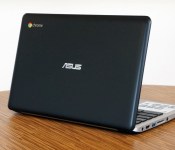
ASUS C200 review: The company’s first Chromebook is a battery life champ

Sorry, naysayers: You’re going to see a fair number of Chromebook reviews from us over the next few months. That’s mostly because sales of these inexpensive laptops have shot up — which means everyone and their mother is now making one, even companies that had previously shied away. The latest brand to join the fray is ASUS, which already has loads of experience building small, cheap notebooks. Indeed, ASUS’ 11-inch C200 Chromebook ($250) looks like a 2009-era EeePC brought back to life: The spacious keyboard feels eerily familiar, as does the long, 11-hour battery life. Even so, it’s not a perfect machine by any means — in fact, it has a pretty serious flaw — but if you’re in the market for a Chromebook, it couldn’t hurt to consider a company that seems to know what it’s doing.
Hardware

I know you’re tired of hearing Chromebooks compared to netbooks and, look, so am I. But hear me out: The reason some of you have even heard of ASUS in the first place is because it pioneered the mini-PC fad. By now, it probably knows a thing or two about making super-small, super-low-priced machines, right? Right. Mostly. The C200 is made of plastic, as you’d expect on a sub-$300 system, and indeed, it’s pretty unremarkable-looking. But, to ASUS’ credit, the build generally feels more solid than, say, Acer’s C720, which flexed when you grabbed it by the palm rest. There’s less bend here, though the screen wobbles when you set the laptop down on a table. It’s also fairly compact: At 0.8 inch thick, it has similar dimensions as the Acer C720, except it weighs just 2.5 pounds, versus 2.76 for the C720. Although both are perfectly easy to tote around, the C200 is noticeably lighter.
It’s on the keyboard that ASUS’ netbook expertise really shines through. The buttons here manage to be cushier than on most other Chromebooks, though the Dell Chromebook 11 and Toshiba Chromebook both rank pretty highly in that regard. Not only that, but also the keys are well-spaced, and none of the major buttons (Enter, Shift, etc.) have been shrunken down to fit the 12-inch-wide frame. The trackpad, meanwhile, is spacious compared to the one on the Acer C720, and does a precise job with single-finger tracking. No complaints there.

I wish I could say such nice things about the display, but this is one of the main areas where Chromebook makers cut corners. As on rival systems, the C200 rocks an 11.6-inch, 1,366 x 768 panel (non-touch), and as usual, the viewing angles are awful. Dip the lid forward even slightly and the screen washes out to the point of being unreadable. Unfortunately, even if you were to invest in a more expensive machine, the display quality would still be fairly crappy. Take the Samsung Chromebook 2, for instance: Even with a sharper, full HD screen, it still suffers from narrow viewing angles.
The C200 also offers the same exact port selection as other Chromebooks. This includes two USB connections (one of them 3.0), a full-sized HDMI socket, an SD card reader, a headphone jack and a lock slot.
Performance and battery life
| SunSpider v1.0.2 | Google Octane | Mozilla Kraken | |
|---|---|---|---|
| ASUS C200 (Celeron N2830, 2GB RAM) | 482.8ms |
7,197.7 |
4,291.4ms |
| Acer C720 (Core i3-4005U, 4GB RAM) | 289.4ms |
14,530.3 |
2,112.5ms |
| Acer C720 (Celeron 2955U, 2GB RAM) | 342.2ms |
11,502.0 |
2,614.3ms |
| Dell Chromebook 11 (Celeron 2955U, 4GB RAM) | 339.8ms |
11,533.3 |
2,621.9ms |
| Toshiba Chromebook (Celeron 2955U, 2GB RAM) | 323.6ms |
11,306.7 |
2,626.3ms |
|
*SunSpider and Kraken: Lower scores are better. **We regrettably didn’t run enough of these tests on the Samsung Chromebook 2 when we had a unit in our possession; otherwise, we would have included it in this table. |
|||
What a difference a processor makes. The C200 is one of the few Chromebooks that doesn’t use a dual-core Intel Celeron 2955U chip — instead, it packs the dual-core Celeron N2830. Given the common “Celeron” brand and the fact that the C200 is in the same price range as its competitors, I assumed the performance would be similar. In fact, though, the C200 is quite a bit slower than other models I’ve tested. The machine takes 12 seconds to cold-boot, for instance, compared with six or seven seconds for every other Celeron-based machine. And whereas most Chromebooks sign out in four seconds (this is a necessary step for switching to Guest Mode), the C200 takes six. That sluggishness is borne out in the benchmarks as well, with the C200 coming in dead last in every test, sometimes by a wide margin.
In everyday use, too, the C200 feels a bit poky, though that didn’t stop me from using it as my main machine, juggling email, HipChat, Facebook, Twitter and various blogs that I read. In the end, there wasn’t one big issue dragging down the performance — I never saw websites or games slow to a crawl, and I thankfully never suffered an outright crash. No, it was the little things. Deleting emails in Gmail sometimes took longer than it should have. Ditto for loading webpages, or comments at the bottom of news articles. I even noticed a slight delay whenever I hit the “View new Tweets” button on Twitter’s website. Sometimes, I would click a link to open something in a new tab, and then when I moved over to that tab, the machine would pause briefly. Most telling of all, I didn’t have any of these issues when I switched to a more powerful laptop connected to the same WiFi network.
|
Battery life |
|
|---|---|
| ASUS C200 | 11:19 |
| Dell Chromebook 11 | 8:37 |
| Samsung Chromebook 2 (13-inch) | 8:22 |
| Toshiba Chromebook | 8:15 |
| Acer C720 Chromebook (Intel Core i3) | 7:53 |
| Acer C720 Chromebook (Intel Celeron) | 7:49 |
| Samsung Chromebook (2012) | 6:33 |
| HP Chromebook 11 | 5:08 |
| Chromebook Pixel | 4:08 (WiFi)/3:34 (LTE) |
| HP Pavilion 14 Chromebook | 3:35 |
| Samsung Chromebook Series 5 550 | 3:23 |
| Acer C7 Chromebook | 3:16 |
Don’t worry, though, ASUS redeems itself somewhat with amazing battery life. In a field where almost every Celeron-powered Chromebook gets the same runtime (around eight hours), the C200 is a stand-out. All told, our review unit lasted through 11 hours and 19 minutes of continuous video playback, making it the longest-lasting Chrome OS machine we’ve seen yet. Now, does the best-in-class battery life make up for the worst-in-class performance? Not quite, if you ask me, but hey, it’s your shopping decision to make, not mine.
Software

Obviously, you’ll get the same Chrome OS experience regardless of which model you get, so that shouldn’t factor into your decision about whether to buy one Chromebook over another. But if you’re unsure if Chrome OS is a good idea in the first place, you might be wondering how much you can do with such a machine, and whether it’ll be enough to replace a “real” OS. As ever, it depends on what you need out of your computer. Since the first Chromebooks came out three years ago, Gmail and Google Drive are both usable offline, without an internet connection. The same is true of many third-party apps offered in the Chrome Web Store. Recently, too, Google started allowing folks to watch Google Play movies and TV shows offline, so you definitely don’t need an internet connection quite as desperately as you did when Chromebooks first came on the scene.
Like every other Chromebook, the C200 comes with 100GB of Google Drive space, free for two years, which should partially take the sting out of having just 16GB of built-in local storage. As for navigating the OS itself, having a desktop and windows you can close and resize continues to make Chrome OS feel like a more traditional operating system. The OS has also benefitted recently from other features that might seem like no-brainers — things like pinch-to-zoom, a more sophisticated file-management system and the ability to upload Google+ photos in the background.
Configuration options and the competition

What you see is what you get: The C200 goes for $250 (often less) and comes with the same specs as the unit I tested here, including a dual-core Intel Celeron N2830 processor, 2GB of RAM, a 1,366 x 768 display and 16GB of built-in storage. There’s also a 13-inch version, the C300, which features the same price and carries the same specs, with the exception of screen size and battery life (runtime is rated at up to 11 hours on the C200, and up to 10 hours on the C300).
As for competition, the C200 has plenty. If I had published this review last week, I would have compared this mainly to other Celeron-based models, like the Dell Chromebook 11, HP Chromebook 11, Acer C720 Chromebook, Toshiba Chromebook and the 11-inch Samsung Chromebook 2. I would have reminded you that the performance is just about the worst in its class, though the battery life is the best. The keyboard is nice, and the display, while poor, is at least on par with the competition. In other words, I would’ve told you it’s worth a look, though it’s hardly a slam dunk.
The problem is, even as I sat down to write this review, Acer announced the Chromebook 13, the first Chrome OS device to make use of NVIDIA’s Tegra K1 chip. I haven’t tested it yet, so I can’t vouch for the performance or say how it compares to the C200. If nothing else, though, the Chromebook 13 should excel at graphics-intensive tasks — things like browser gaming, movie streaming and interactive web apps. Meanwhile, the battery life is said to be as good as, if not better than, the C200: 13 hours if you get it with the 1,366 x 768 resolution screen, and 11 if you go with the full HD model. That’s another thing: The regular ol’ HD version starts at $279, just 30 bucks more than the C200, while the 1080p edition is priced at $299. If the Acer Chromebook 13 really performs as promised, with long battery life and impressive graphics muscle, then it’s priced uncomfortably close to the C200.
Unless you’re hankering for an 11-inch machine (or can’t spare the extra $30), the Chromebook 13 is shaping up to be a smarter buy. Even then, the Acer C720 can be had for a lower price (around $199) and the performance is guaranteed to be better. And besides, NVIDIA has made it clear there are other Tegra K1 Chromebooks in the works. Surely, an 11-inch one is on the way, right?
Wrap-up

How’s this for a ringing endorsement? The C200 isn’t totally without merit. Its battery life is easily best in class, and the spacious, cushy keyboard makes it one of the better Chromebooks for typing. Even so, its performance is actually worst in class, which is saying a lot considering its rivals aren’t exactly powerhouses themselves. Even today, there are Chromebooks on the market offering smoother performance for a similar price, while Acer’s forthcoming Chromebook 13 promises improved graphics muscle and equally long battery life for only $30 more. ASUS would do well to upgrade the C200′s processor, and maybe drop the price to better compete against other brands. Until that happens, this is an acceptable option, but hardly the best.
.CPlase_panel display:none;
Apple Receives Approval to Sell Two iPhone 6 Models in Thailand
Takorn Tantasith, Secretary General of the National Broadcasting and Telecommunications Commission (NBTC) in Thailand, announced earlier this week that the agency has approved Apple’s application to distribute two iPhone 6 models in the country, reports Manager Online [Google Translate]. The Secretary also tweeted word of the approval from his @TakornNBTC Twitter account.
 Google Translate version of Tantasith’s Tweet
Apple reportedly filed the import application on August 5 and received certification of equipment and a written approval notice on August 8 for two iPhones with model numbers A1586 and A1524. According to government regulations, these approvals must be announced publicly, but details on the iPhone 6 handsets referenced in the documents remain sealed.
Apple is expected to announce the iPhone 6 in early September with retail sales to follow in the weeks following the announcement. Apple reportedly is prepping two iPhone models, with a 4.7-inch version slated to launch first this fall and a 5.5-inch version that could launch either alongside or up to several months later than the smaller version.
An application for approval in Thailand over a month prior to the device’s expected introduction is unusual and suggests Apple may be planning for a very large number of countries in the initial wave of launches. For the iPhone 5s, Thailand was part of the second wave of launches that took place on October 25, 2013, and the company reportedly did not apply for approval in the country until September 16, 2013.
.CPlase_panel display:none;

The NSA collected more of your personal data than it was legally allowed to

Former NSA chief Gen. Keith Alexander defended the NSA’s bulk collection to John Oliver by saying that all his former employers did was collect metadata. He defined that as “two phone numbers, date, time and duration of [the] call.” The agency’s rules for collecting our electronic communications were similarly stringent, with the government only permitted to store the “to” and “from” fields, as well as the time any private message was sent. Unfortunately, newly-declassified documents have shown that the agency had difficulty just collecting those pieces of information, and instead stored the full texts of e-mails and other messages sent online. According to the report, the NSA had “exceeded the scope of authorized acquisition continuously during the more than [REDACTED] years of acquisition.”
The document in question is a report from Judge John Bates of the Foreign Intelligence Surveillance Court, which criticizes the NSA”s ability to police itself. The details are heavily redacted, but it appears that NSA officials failed to communicate their requirements to the bodies who were directly responsible for running the metadata collection program. The report goes on to say that it wasn’t so much an intentional desire to hoover-up the contents of the internet but “poor management, lack of involvement by compliance officials and lack of internal verification procedures” that caused the over-zealous collection. As if sharing your naked selfies around the office wasn’t enough of a clue that respecting privacy wasn’t top of the agency’s agenda.
Filed under: Cellphones, Internet
Via: TechCrunch, IC On The Record (Twitter)
Source: IC On The Record
.CPlase_panel display:none;

Guillermo Del Toro and ‘Metal Gear’ creator join forces for next ‘Silent Hill’ game

With the sad state that the Resident Evil and Dead Space franchises are in, word of a new high-profile horror game is incredibly tantalizing. Downright exciting, even. Earlier today at Sony’s Gamescom media briefing, the next Silent Hill was teased in a rather convoluted way on stage — of course, when Hideo Kojima is involved, convolution is to be expected. A title called P.T. was was briefly shown after a video for Metal Gear Solid V: The Phantom Pain‘s in-game box (seriously), and the audience was told that an interactive trailer for the former would be available on the PlayStation Store relatively soon. NeoGAF spotted that a gamer on Twitch started broadcasting her gameplay after downloading, and that’s when something peculiar happened. Toward the end of her terrifying stream, she unlocked a cutscene with a mysterious town and title cards bearing the names of the Metal Gear head honcho, filmmaker Guillermo Del Toro (Pacific Rim, Pan’s Labyrinth, Hellboy) and the name “Silent Hills.“
Another aspect of the reveal is that the game’s protagonist is apparently played by none other than Norman Reedus — everyone’s favorite Dixon on The Walking Dead, Daryl. If it were just him involved and not Kojima or Del Toro we might be a bit worried — Reedus’ last starring role in a game was the horrible Activision TWD tie-in.
What’s more, this could be Del Toro’s chance at finally getting involved with video games. Before THQ famously was dismantled piece-by-piece in 2012, he was working on a title by the name of Insane that still hasn’t seen the light of day. Maybe that could change soon.
The cutscene begins around 1:16
[Image credit: Jordan Strauss/Invision/AP]
Filed under: Gaming, Home Entertainment, HD
Via: NeoGAF
Source: Twitch
.CPlase_panel display:none;

British Airways adding cat videos to its roster of in-flight entertainment

In the newspaper trade, August is traditionally known as silly season, for its lack of serious news. The latest company to indulge in some silly-season silliness is British Airways, which has learned that looking at pictures of kittens causes people’s heart-rates to slow. That’s why the company is adding a Paws and Relax channel to its catalog of in-flight entertainment from September. Rather than a continuously looping video of a room full of newborn kittens and puppies, however, the channel will just show the cartoon Simon’s Cat, documentary The Secret Life of Cats and Animal Planet’s America’s Cutest Dog. We’re fine with this news so long as BA doesn’t use it as an excuse to withdraw the complimentary whiskey — because no matter how cute the clip of the kitten playing with the string is, it’s not enough to offset crippling in-flight sobriety.
Filed under: Transportation
Via: Yahoo
Source: Battersea Cats & Dogs Home
.CPlase_panel display:none;
Google+ app updated with Chromecast support [APK Download]

Amongst the various bug and stability fixes bundled into the latest Google+ update, Google have also added a pretty significant feature, allowing you to cast your Google+ stream to Chromecast. Whilst you’re casting the app, you can browse the posts on your feed like you would in the app. The Chromecast will show a pretty… Read more »
The post Google+ app updated with Chromecast support [APK Download] appeared first on AndroidGuys.
.CPlase_panel display:none;

Tesla opens new Supercharger sites in London and Birmingham

Tesla’s right-hand drive Model S has been available in the UK for a couple of months now, but its complementary Supercharger network has yet to make real impact on Britain’s roads. However, the company has always intended to expand its free car-charging stations to cover many of the UK’s major motoring hubs, and it’s now started to deliver on its word. From today, London will play host to two Supercharger locations, with a new site located at Hyatt Regency London in Central London joining Tesla’s first charger at the Royal Victoria Docks.
A second Supercharging site has also been established at the Hyatt Regency Birmingham, allowing Model S owners to juice up ahead of their Midlands trip or reach other major cities (London or Manchester, for example) on a single charge. According to Tesla’s official website, the company plans to have at least 11 Supercharger locations in operation across the UK within the next year, ensuring Model S (and maybe future Model 3 owners) can almost travel the length and breadth of Britain without having to steal someone else’s power.

Filed under: Transportation
.CPlase_panel display:none;
 AIVAnet