



Bing now lets you ask follow-up questions after your searches

Google sometimes lets you ask follow-up questions when a search doesn’t provide all the answers. Bing, however, has required that you phrase each query as if you’re starting fresh — a bit of a headache if you’re the curious sort. That won’t be a problem for much longer, as Microsoft is rolling out a Bing update that adds conversational, context-aware searching to the mix. If you ask who President Obama’s wife is, for example, you can then ask “how tall is she?” (spoiler: fairly tall) without having to mention Michelle by name — the engine knows who you’re referring to. The feature doesn’t appear to be available everywhere just yet, but it shouldn’t take long before you’re holding short chats in your web browser.
Filed under: Internet, Microsoft
Via: Microsoft-News
Source: Bing Blogs
.CPlase_panel display:none;
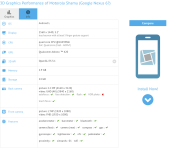
New specs for Motorola Shamu suggest quite powerful device after all

It’s a new day and we’ve got new specifications for the rumored Nexus 6 from Motorola. Known, for now, under its code name of “Shamu”, the smartphone figures to be a more powerful experience than previously expected. According to a newly discovered GFXBench database listing, the Motorola Shamu could boast a 5.2-inch Quad HD (1440px) display,… Read more »
The post New specs for Motorola Shamu suggest quite powerful device after all appeared first on AndroidGuys.
.CPlase_panel display:none;

Scientists turn sweat into electricity with a temporary tattoo

What if running a 5K could do more than just burn calories? A team at the University of California San Diego have developed a temporary tattoo-like sensor that keeps tabs on exercise and converts sweat into electricity. The removable device monitors lactate: a substance that’s present in perspiration and increases with more strenuous the activity. Athletes and some medical patients need to keep an eye on lactate levels for a range of reasons, but testing currently involves an invasive blood test during an exercise session. Here, an enzyme on the sensor collects electrons from lactate, and in turn, generates a modest electric current. What’s more, the researchers turned those findings into a biobattery that’s powered by the collected charge. The most energy produced by one person during the test was 70 microWatts per square centimeter of skin, but work is already underway to boost the system so that if can be used to power small gadgets like watches and heart-rate sensors.
Filed under: Wearables, Science
Via: Gizmodo
Source: PhysOrg
.CPlase_panel display:none;

Spotify wants to help musicians sell stuff directly to fans

It’s no secret that some musicians aren’t the biggest fans of Spotify — or, in general, any music streaming service. Still, there’s also no denying that Spotify is often trying to find ways to put more money in artists’ pockets. Today, in partnership with BandPage, a startup which allows musicians to create customized fan pages, Spotify revealed it’s going to give music makers “powerful new ways” to offer all kinds of stuff to the people who love them the most. For example, thanks to this new BandPage integration, musicians can now sell things like VIP access, secret shows and more to Spotify listeners — something similar to what Beats Music is trying to do. The announcement comes as, earlier in 2014, Spotify opened up a merchandise store within its service, so this should certainly help act as yet another form of revenue stream for every artist.
Source: BusinessWire
.CPlase_panel display:none;

Why Activision is spending $500 million on Destiny

Yes, it’s true: Activision is spending half a billion dollars on Bungie’s Destiny. Yes, that’s true despite Bungie’s statement that, “the budget for Destiny, including associated marketing costs and pizza Wednesdays, is nowhere near 500 million dollars.” And that’s because, when Activision head Bobby Kotick revealed that gargantuan number earlier this year, he was speaking to the entire franchise, not just this September’s game.
“That number has been widely misinterpreted as a production number for the first game,” Activision CEO Eric Hirshberg explained in an interview today at Gamescom. “That number is an all-inclusive number that’s several years worth of investment, including marketing and several games, and a lot of up front investment in things like engines and tools that will be able to be used for years to come.”
This should come as no surprise to anyone closely following the tale of Destiny and Bungie working with Activision. The two companies signed a 10-year contract to produce a series of games under the Destiny moniker; the partnership was announced in April 2010, putting us just over four years into that 10-year deal. Despite being nearly halfway finished, Hirshberg said the $500 million includes more than just marketing, production and “pizza Wednesdays.” It includes additional entries in the franchise, even.
“When you see it play out, it’ll be fairly familiar: we’ll have packaged games, follow on content,” Hirshberg told us. All that is to say that Activision (and presumably Bungie as well) don’t see Destiny as the MMO-like game (think World of Warcraft) that the beta led many to believe: there’s no monthly subscription, no servers to manage, etc.. “I think that people are ascribing more mystery to the business model of Destiny than they need to,” he said.
So, yes, Destiny costs $500 million. But not this fall’s game — that’s the beginning of a much larger plan to make Destiny into the next blockbuster franchise. The next Halo. The next Call of Duty. Or even something bigger.
“Even with all that context, no one should be surprised that Destiny is a huge undertaking,” Hirshberg said, “An ambitious vision takes an ambitious investment. We wouldn’t be making it if we didn’t believe in the potential of the game.”
.CPlase_panel display:none;

Scientists turn to hemp for cheap, fast-charging batteries

Forget lab-made materials like graphene — natural, old-fashioned hemp may be the ticket to our energy future. Researchers have demonstrated that you can make very efficient carbon electrodes simply by heating hemp bast fibers in a two-stage process. The resulting substance holds as much energy as graphene, but is much cheaper to make. You’re just using biological leftovers, after all. It’s much more tolerant of temperature extremes, too, and can survive anything from freezing conditions to a scorching 200F. And before you ask — this is hemp, not pot, so you’re not going to get a contact high just by using a battery.
It’s easy to see the potential impact. Graphene is already being tested for both regular batteries and supercapacitors, which charge up almost instantly and don’t degrade; it’s feasible that future electric cars and mobile devices could have affordable, hemp-based energy packs that top up within seconds. The technology might also be useful as a graphene substitute in other areas, such as solar cells and touchscreens. It’s not just a proof of concept, either — a small Canadian firm is working on scaling hemp electrode production, and US production is increasingly realistic as legal hemp production expands. If all goes well, you may eventually carry a phone powered by the same plant used to make your handbag.
[Image credit: AP Photo/P. Solomon Banda]
Filed under: Science
Source: American Chemical Society
.CPlase_panel display:none;

Samsung ushers in new design language with Galaxy Alpha

Expected to launch at the beginning of September, the new desgin focuses on both beauty and functionality After months of rumors and speculation, the Samsung Galaxy Alpha has finally become official. Announced on Wednesday, the Android-powered smartphone ushers in a new design language that offers users a compact body with a metal frame. If you ask… Read more »
The post Samsung ushers in new design language with Galaxy Alpha appeared first on AndroidGuys.
.CPlase_panel display:none;

Measure gas, light, humidity, and more with Sensordrone Bluetooth Sensor [DEAL OF DAY]

Today’s deal of the day is the Sensordrone, a portable Bluetooth device that can programmed to turn your smartphone into a gas leak detector, carbon monoxide detector, and more. Small enough to hook to your keys, there are nearly a dozen sensors inside. What’s more, it is also an open platform for other Bluetooth devices… Read more »
The post Measure gas, light, humidity, and more with Sensordrone Bluetooth Sensor [DEAL OF DAY] appeared first on AndroidGuys.
.CPlase_panel display:none;

Samsung Galaxy Alpha gallery

Samsung on Wednsesday announced its latest smartphone, the Galaxy Alpha. Featuring a new “design language”, the handset boasts a metal frame and 6.7mm chassis.
The post Samsung Galaxy Alpha gallery appeared first on AndroidGuys.
.CPlase_panel display:none;

Boost Mobile now offering $80 LG Realm

Boost Mobile on Wednesday announced its latest smartphone, the wallet-friendly Android-powered LG Realm. Priced $79.99, the handset features a 4.5-inch display, a 1.2GHz dual-core processor, 1GB RAM, and a 5-megapixel rear camera. Additionally, customers will find the no-contract phone to offer 4GB internal storage, a front-facing VGA camera, and a 2100mAh battery. Powered by Android 4.4… Read more »
The post Boost Mobile now offering $80 LG Realm appeared first on AndroidGuys.
.CPlase_panel display:none;
 AIVAnet