


Boston PD monitored concertgoers with facial recognition

With perhaps the exception of the bands on stage, no one really goes to a concert to be seen — they go to feel the music coursing through their veins and melt into a crowd. As it turns out, fun-seekers at the 2013 Boston Calling music festivals weren’t just caught on film by photographers and Instagram nuts. According to recent, intriguing reports from Dig Boston and Noisey, the city was quietly watching thanks to more than 10 active security cameras and some scarily clever IBM software that recognized concert-goers and passersby based on their skin color, clothes, and facial features. Smile!
All of that visual data was relayed back to a command center of sorts where members of the city government and the Boston Police chewed on it, along with social media snippets that helped flesh out their understanding of the crowd’s actions. It’s not hard to see why a city still recovering from a senseless terrorist attack would want to dial up the level of security at a pair of huge concerts. To hear Dig tell the tale, the city hoped to use that preponderance of data to (among other things) identify “suspicious objects,” find logistical logjams and keep an eye out for possibly sketchy characters.
The scope of the test project was at the same time impressive and unnerving: An IBM memo unearthed by the Dig Boston team purportedly outlined plans to use that face capturing tech on every one of the show’s attendees. Even more unnerving than the notion of being silently surveilled is the fact that some of that data remained accessible well after the concerts came to a close. Kenneth Lipp, one of the journalists who broke the story for Dig, told Vice’s Noisey that he was able to recover a full 70 hours of recorded footage from the concerts just before the team pulled the trigger on their story — keep in mind, it’s been nearly a year since the second monitored Boston Calling came to a close.
Via: Noisey (Vice)
Source: Dig Boston
.CPlase_panel display:none;

Apple’s now storing some personal user data in China

It’s no secret that the relationship between Apple and China hasn’t always been the best. From the banning of its products for government use, to the Chinese state media wanting the Cupertino company “severely punished” for NSA spying, these cases are well-documented. That said, China’s consumer market is extremely important to Apple — which isn’t really surprising, given the sheer magnitude of it. But now, with a number of new iDevices hitting shelves there of late, Apple’s had to look to servers located in mainland China to store Chinese users’ personal data. As Reuters notes, this is the first time the company has begun storing this type of data in that country — Apple says the decision was made as part of a plan to improve the overall performance of its cloud service, iCloud.
“We have added China Telecom to our list of data center providers to increase bandwidth and improve performance for our customers in mainland China. All data stored with our providers is encrypted. China Telecom does not have access to the content,” Apple told Reuters, addressing whatever questions may rise about the security of said data. What’s more, Reuters writes that a source familiar with the matter says the encryption keys for this data “would be stored offshore” and China Telecom wouldn’t be given access to them. In other words, China’s users can rest assured their personal iCloud belongings are being well taken care of.
Filed under: Misc, Storage, Software, Mobile, Apple
Source: Reuters
.CPlase_panel display:none;

A restaurant in China lets robots do a lot of the work

Let’s face it, the Robot Apocalypse is near. Just a few days ago, we met A.L.O Botlr, a robot from the high-tech Aloft Hotel in Cupertino, California that acts as a butler. Naturally, the food industry, as important as it is, couldn’t stay behind, so here’s where a new restaurant in China comes in. Simply called Robot Restaurant, the place, located in Kunshan, China, has over a dozen androids in its staff. Some of them are waiters, others cook and a couple greet customers as they come in — sorry, everyone, no booze-carting servers here. Robot Restaurant’s owner and founder, Song Yugang, that his peculiar staff members can understand about 40 “everyday sentences,” making them smart enough to interact with human customers. Most importantly, he adds, “They can’t get sick or ask for vacation. After charging up for two hours they can work for five hours.”
Filed under: Misc, Robots, Alt
Via: Yahoo News
Source: New Vision
.CPlase_panel display:none;

Fleksy Keyboard review

Fleksy is one of the best keyboards available for Android. There is one particular keyboard app that refuses to get pushed around by the big names in the industry. With the constant updates, support for over 35 languages, and the ability to boast the “fastest keyboard in the world”, Fleksy is worth taking a look… Read more »
The post Fleksy Keyboard review appeared first on AndroidGuys.
.CPlase_panel display:none;

Accessory of the Day: Limefuel Lite 15000mAh USB Battery Pack $34.99

Looking for some extra battery power to get you through the day or weekend? Of course you are! If there’s one thing we know about owning multiple smartphones and gadgets it’s that they’re zero good when their out of power. In the words of Boba Fett to Lord Vader, “He’s no good to me dead”…. Read more »
The post Accessory of the Day: Limefuel Lite 15000mAh USB Battery Pack $34.99 appeared first on AndroidGuys.
.CPlase_panel display:none;

Apple Adds Five Vice Presidents, Including Two Women, to ‘Apple Leadership’ Press Page
Apple today updated its Apple Leadership press page to add the bios of five vice presidents, including Paul Deneve, Lisa Jackson, Joel Podolny, Johny Srouji, and Denise Young Smith.
The inclusion of several vice presidents on the executive team is a new move for the company, as the page previously only listed the company’s lineup of senior vice presidents.

Since taking over as CEO, Tim Cook has aimed to share the spotlight with his employees, letting company leaders like Eddy Cue, Craig Federighi, and Jony Ive take part in press interviews and lead Apple events. The addition of five new VPs to the press roster suggests Cook and the team at Apple are more open than ever, recognizing the efforts of an even larger number of key employees.
Of the new executives joining the page, Paul Deneve and Lisa Jackson are relatively new hires, joining Apple in 2013. Deneve oversees special projects, while Jackson has a public-facing job overseeing Apple’s environmental efforts. Joel Podolny, dean of Apple University and Denise Young Smith, who oversees Apple’s human resources, were promoted to their roles early in 2014. The remaining VP, Johny Srouji, oversees hardware technologies, a role he has held for just over a year.
The new additions to the executive press page also spotlight two additional women who hold important leadership roles at Apple, bringing the total number of females on the page to three, with Angela Ahrendts. Apple has faced criticism for its lack of female leadership in the past, which Cook has been aiming to remedy. According to diversity numbers released earlier this week, 72 percent of Apple employees in leadership roles are male.
.CPlase_panel display:none;
Apple Working to Remedy Labor Violations Found at Quanta Factories
The Fair Labor Association (FLA) today published a new report examining two factories operated by Apple-supplier Quanta Computer, finding several code violations related to working hours, recruitment policies, compensation, health and safety, and more in August of 2013 [PDF] (via TechCrunch).
Factories examined included a Quanta facility in Shanghai and one in Changshu. Quanta is a long-time Apple partner that manufactures Apple’s MacBook Air and much of the rest of the company’s Mac lineup.
Violations were found in both locations, with some of the more egregious issues including verbal abuse by supervisors, a hiring fee charged to workers by a broker or labor dispatch agent and long working hours. According to the report, 62 percent of workers in Changshu received no rest day for much of Q4 2012, working as many as 16 days in a row.
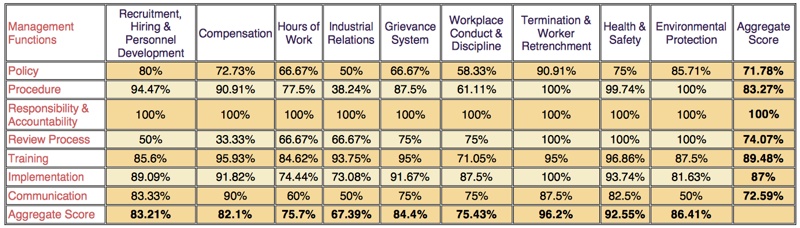 Overall score summary of management functions at Changshu
Many workers were also underpaid for sick leave and may have been uncompensated for up to an hour of work each day, based on clock in and clock out times. Some workers were forced into joining the All China Federation of Trade Unions, and there were several safety violations.
Both of the factories fell short of the local requirements for indoor air quality, and neither had easy access to a shower/eyewash station in case of emergency. There was no active worker participation in the Employee Health and Safety committees, and flammable and toxic substances were stored improperly at Shanghai while chemicals at Changshu were not properly monitored.
The Fair Labor Association provided a number of recommendations to improve conditions at the factory, and according to the report, Apple is using the recommendations to work with Quanta to fix each code violation. Apple released a statement on the FLA’s Quanta inspection, stating that it has worked closely with Quanta to bring improvements to working conditions.
Our suppliers must live up to the toughest standards in the industry if they want to keep doing business with Apple, which is the first and only technology company to be admitted to the Fair Labor Association. We are committed to providing safe and fair working conditions for everyone in our supply chain.
Last year we conducted 451 comprehensive, in-person audits deep into our supply chain so we could uncover problems and work with our suppliers to fix them. We track and report the weekly working hours for more than 1 million workers, and our 18-month Apple Supplier EHS Academy training program is raising the bar for environment, health and safety management in the industry.
The Quanta facilities inspected by the FLA last year were included in our 2014 Supplier Responsibility report, which we released in February. Our own experts have audited these sites 16 times, most recently last month.
In the year since the FLA’s visit, we have worked closely with Quanta to drive meaningful improvements in areas identified by both the FLA and Apple. Apple conducted four follow-up inspections on top of the annual audits of both facilities, to ensure the needed corrections are in place.
This year, through the end of July, Quanta has averaged 86 percent compliance with our 60-hour workweek. Excessive overtime is not in anyone’s best interest, and we will continue to work closely with Quanta and our other suppliers to prevent it.
Apple initially signed up for factory assessments by the Fair Labor Association back in 2012, following a rash of worker suicides at Foxconn, the factory responsible for assembling many of Apple’s mobile devices. The FLA has since helped to improve working conditions in several of Apple’s factories, with Apple aiming to bring all workplace compliance standards in line with the FLA’s guidelines.
Apple also maintains a Supplier Responsibility team that audits supply chain facilities to ensure compliance with Apple’s strict code of conduct preventing underage labor and providing safe, comfortable living conditions for workers. An additional Supplier Responsiblity academic board also evaluates Apple’s labor policies and practices and researches labor standards within the supply chain to create ethical working conditions wherever Apple products are produced.
.CPlase_panel display:none;

Back to School Guide 2014: Laptops

No gadget — besides a smartphone, maybe — is as crucial to a college student as the laptop. Regardless of your major, you’ll want a solid machine with a well-crafted keyboard to see you through term papers, class presentations and more. From a sub-$400 Chromebook to sleek models from Lenovo and Samsung, our roundup has something for everyone. Click through the gallery below to see all 11 picks, and don’t forget to check out the rest of our guide for other gadget recommendations.
Filed under: Laptops, Apple, Samsung, Dell, Acer, Lenovo
.CPlase_panel display:none;

Artists build a Roland TR-909 drum machine for giants

Roland made some of the most iconic drum machines used in electronic music, and its TR-909 is entering its 30s. So, what’s the best way to celebrate three decades of tones? Well, you could build a 9-foot long playable version of the unit to rage on with your mates, and that’s just what Scottish audio/visual outfit Ray did. The frame is constructed with a combination of aluminum, steel and wood with a TD-12 module (from a set of V-Drums) and AIRA TR-8 drum machine providing the sounds. That Roland gear wrangles rhythms from a dozen PD-8 drum pads mounted underneath the super-sized buttons, and MIDI signals beam visuals to a projection system for added effect. Don’t take our word for it though, there’s a short clip of the massive gadget in action just after the break.
Filed under: Misc
Via: Fact Magazine
Source: Vimeo
.CPlase_panel display:none;
The death of the original jumbo jet, Boeing’s 747-400

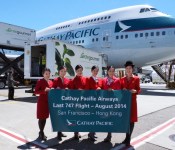
Later this month, Cathay Pacific’s 747 will fly from San Francisco to Hong Kong for the very last time. It’s a story we’re hearing from nearly every airline still flying the most recognizable passenger jet in aviation history — rising fuel costs are prompting carriers to ground their fleets, opting to shuttle passengers in more modern (and efficient) airliners instead. Hundreds of 747s still take to the skies every day, but their numbers are dwindling, with Boeing’s 777-300ER and 787 Dreamliner, as well as the enormous Airbus A380, picking up the slack. The flagships of yesteryear now litter the desert, with several sites in California serving as a permanent resting place for the plane that was once known as the Queen of the Skies, the Boeing 747-400.
The 400, the most prolific 747 type, first entered service with Northwest Airlines in 1989. It was the fourth iteration of Boeing’s popular jumbo, featuring a more advanced flight deck, a lighter build and, perhaps most importantly, a significantly boosted range. The most recent iteration can travel more than 8,000 miles, enabling airlines to fly from North America to Southeast Asia or Australia without stopping to refuel. An extended-range model, which added fuel tanks to the cargo hold, is used exclusively by Qantas. That plane has a nearly 9,000-mile range, which covers the 8,500-mile trek from Sydney to Dallas, Texas (with a fueling stop on the longer westbound return). The Airbus A380 will replace the 747-400ER on that route beginning in September.
During the last three decades, more than 500 747-400s have been built, with British Airways, Lufthansa and United placing some of the largest orders. That latter carrier still operates one of the longest 747 routes, transporting nearly 400 passengers the 7,000 miles from San Francisco to Hong Kong every day. The versatile 777-200 has replaced its aging sibling on many of UA’s other long-haul routes, though, offering significantly improved performance and a better passenger experience, with amenities such as more comfortable seats, WiFi and in-flight entertainment.

The 747-400′s retirement doesn’t mark the end for the entire aircraft line. Boeing’s built an extended version, the 747-8, in an attempt to reclaim some of the superjumbo market from Airbus, and Lufthansa has begun operating that higher-capacity plane on routes between Germany and the US. And while carriers like British Airways, Delta and Qantas are phasing out the 747 entirely, other airlines are reassigning their planes to regional service. Thai’s 747 travels throughout Asia, for example, and even carries passengers on the one-hour trip from Bangkok to Chiang Mai, while Cathay Pacific continues to operate the type between Hong Kong and regional destinations such as India and Bali.

And while passengers may want to avoid traveling 16 hours on a 747 that excludes power outlets and seat-back TVs, such as those operated by United, getting to fly the quad-engine jet on a short hop is nothing short of a thrilling treat. Even shorter routes will transition to more efficient aircraft over the next few years, but for the time being, you can still experience the original superjumbo on select flights. In the commercial aviation world, there’s nothing more exhilarating than traveling in seat 1A, where the curvature at the nose makes it possible to see at a near-forward angle during takeoff and landing. And, if you’re lucky enough to be traveling in business class, climbing the stairs up to the exclusive second deck is an experience in and of itself.
For aviation buffs, the 747′s retirement is a devastating milestone, but it also represents significant progress. Better fuel efficiency means reduced emissions, and the 777-300ER, 787 Dreamliner, Airbus A380 and the upcoming A350XWB offer unprecedented comfort, for passengers and crew members alike. Fortunately, there’s still time to hop aboard a 747-400, and while you might find a better experience elsewhere, I highly recommend taking this brilliant craft for a final spin.

Filed under: Transportation
.CPlase_panel display:none;
 AIVAnet